Seeing the Story Through Other Eyes: Why I Use The Mythic Chronicle

One thing I have been thinking about while working on The Veil of Kings and Gods is how much of a fictional world exists beyond the people carrying the main story. A book has to stay focused on the characters, problems and consequences that matter most to its plot, which means there will always be people standing nearby whose experiences remain largely unseen. They might be servants, guards, clerks, priests or ordinary people who witness part of an important event while knowing very little about what is really happening. I have found myself increasingly interested in those people.

The Unmarked Path, the first book in The Veil of Kings and Gods, already has a lot moving through it. Simion returns to Bremyra under orders from the Order of Magicians, Prince Patrick is trying to govern during his father’s absence, Princess Elana is preparing to leave for an arranged marriage, and pressure is beginning to build far beyond the kingdom itself. The Order and the Church distrust one another, trouble is developing in the north, and Simion gradually discovers that his reason for being in Bremyra reaches further than he expected.

Those are the people and events the book needs to follow closely. While writing around that story, though, I kept wondering what the same period looked like to people who stood several steps away from it. I wanted to know what the servants thought when they were suddenly ordered to reopen an old Order manor above the city, what a castle clerk made of a sealed letter arriving beneath gold wax, and what the people working inside the cathedral noticed when Archbishop Alaric prepared to receive a magician he clearly distrusted.

That became one of the reasons I started using The Mythic Chronicle alongside the books.


Looking Beyond the Main Story

The current Chronicle cycle is called The Sealed Road of Bremyra. It surrounds the events of The Unmarked Path, with some accounts taking place shortly before the book, others during it, and others dealing with what remains immediately afterwards.

I wanted the distinction between the two to stay clear. The Unmarked Path carries the direct story, while the Chronicle follows fragments around it. Those fragments can come from servants, clerks, chapel attendants, guards, household records, later copies of old accounts or people trying to understand something after the event has already passed.

That difference has given me far more room than I expected because I can stay inside Bremyra while changing where the reader stands.

The first Chronicle, The Manor That Waited, follows the servants sent to prepare the old Order manor before Simion arrives. In the book, Simion reaches the manor and finds an old house that has been out of regular use for years, still carrying traces of the Order’s former presence. The Chronicle allowed me to go back to the hours before he reached it and spend time with the people ordered to reopen those rooms.

They climb the hill carrying keys, linen, lamp oil and instructions from the castle. They open shutters, lay fires and prepare the western suite for a guest whose name they have never been given. As they work, small things begin to feel wrong. A lock seems to turn before the key has fully moved, marks appear in dust, doors behave strangely and a lamp is found burning where nobody remembers lighting it.

The servants have no idea what Simion is involved in, and they have no reason to understand the larger events beginning around Bremyra. They only know that an old house has suddenly been ordered back into use and that, somewhere during their preparations, it begins to feel as though the manor was already expecting someone.

I probably would never have followed those people inside the main book because Simion’s story has other places to go. The Chronicle gives that quieter part of Bremyra somewhere to exist.


What a Sealed Letter Means to Someone Else

The second Chronicle, The Letter Beneath Gold Wax, gave me another way of looking at the same period.

For Simion, the Council of Five belongs to the structure of his life. He was trained by the Order, he understands its authority, and the instructions sent to him affect his future directly. A clerk working inside Bremyra Castle has a very different relationship with the same event because, from his position, the Council arrives as an object carried through the door.

He sees a cedar case bound with dark cord and sealed beneath gold wax. He sees senior officials become unusually careful around it, watches the receipt entered formally into the castle record, and notices that people who usually deal with royal paperwork suddenly measure every word. He cannot read the wider story behind the letter, although he can tell from the behaviour around him that something important has entered Bremyra.

I have enjoyed working with that kind of limitation because the person recording an event does not always understand what the reader may later come to know. A clerk can preserve the hour, the condition of the seal, the names of the witnesses and the route taken through the castle, yet still have no idea why the letter matters so much.

That feels right for the Chronicle. History often survives through people who saw one small part of something larger and recorded what their position allowed them to see.


Standing at the Edge of a Scene From the Book

The Cathedral Warning pushed the idea in another direction because it sits close to a scene that already exists in The Unmarked Path.

Simion is summoned to Bremyra Cathedral by Archbishop Alaric, and their meeting makes the tension between the Church and the Order very clear. From Simion’s position, the encounter is about suspicion, authority and the limits Alaric intends to place around him.

The Chronicle moves away from Simion and spends its time with the people preparing the cathedral before he arrives.

Sister Maelis notices candles behaving strangely. Brother Osric is given responsibility for the undercroft key. Parts of the cathedral are restricted, doors are watched and Archbishop Alaric makes preparations that suggest he is worried about something deeper than an awkward meeting with a visiting magician.

When Simion finally enters, those people hear the same formal conversation, although they experience it from the edges. Their attention moves towards the locked doors, the keys, the candles and the sounds beneath the floor. They have no access to Simion’s thoughts, and Alaric certainly gives them no explanation for his concern.

I like being able to return to a moment from the book in that way because I am not rewriting the scene from another camera angle. I am looking at what the scene disturbed around it and asking what the people standing nearby might have carried away afterwards.


Remembering Simion Before He Became the Lord Magician

The fourth Chronicle, The Boy Remembered in the Kitchens, has probably been one of my favourite examples so far because it looks at Simion through a very different kind of memory.

By the time he returns to Bremyra, people see the black robes of the Order before they see the person wearing them. Servants lower their eyes, officials address him by title and even people who knew him years earlier have to reconcile the man standing before them with the person they once remembered.

The kitchens carry a different version of him. Their memories are connected to bread, work, illness, cold rooms and the ordinary routines of castle service. They remember a boy who once carried food through the halls and slept close to the hearth during a winter fever, long before anyone expected him to return as a magician.

That interested me because institutions remember people according to their own needs. A court remembers rank, the Church remembers authority and the Order remembers its own position, while servants may remember who was hungry, who worked beside them or who disappeared from their rooms one winter.

The Chronicle lets those memories sit beside the person Simion has become. It adds something to Bremyra without asking the main book to stop and explain every part of his childhood through exposition.


Leaving Some Things Uncertain
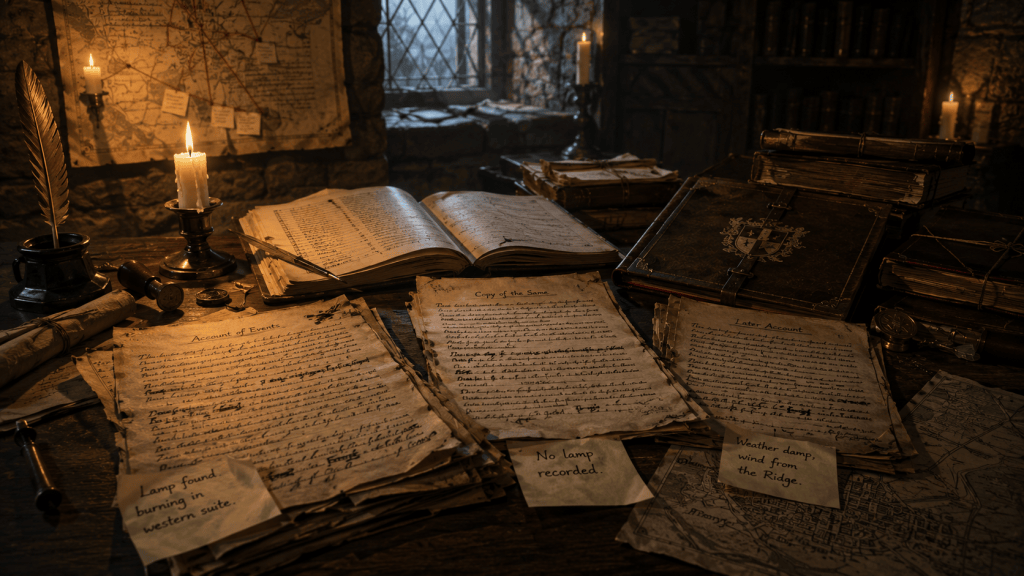
Another part of the Chronicle that I have come to value is that the records are allowed to be incomplete.

A servant can misunderstand what happened. A clerk may record only what his office required. A later copy of an account might remove a detail found in an earlier one, while someone writing years afterwards may decide that an unexplained event was caused by damp stone, winter weather, frightened servants or an old building settling in the cold.

I do not want every Chronicle to provide a final answer because that would weaken what makes the format interesting to me. The book remains closer to the direct events, while the Chronicle preserves what other people thought they saw and what later records chose to keep.

Sometimes the difference between those accounts matters as much as the event itself. A formal register may describe a perfectly ordinary household preparation while a lesser copy remembers that a lamp was already burning. A church record may describe proper restrictions during a formal reception while someone in the margins remembers candles bending towards a locked stair.

That leaves room for the reader to decide how much of each account they trust.


Another Way Into The Veil of Kings and Gods
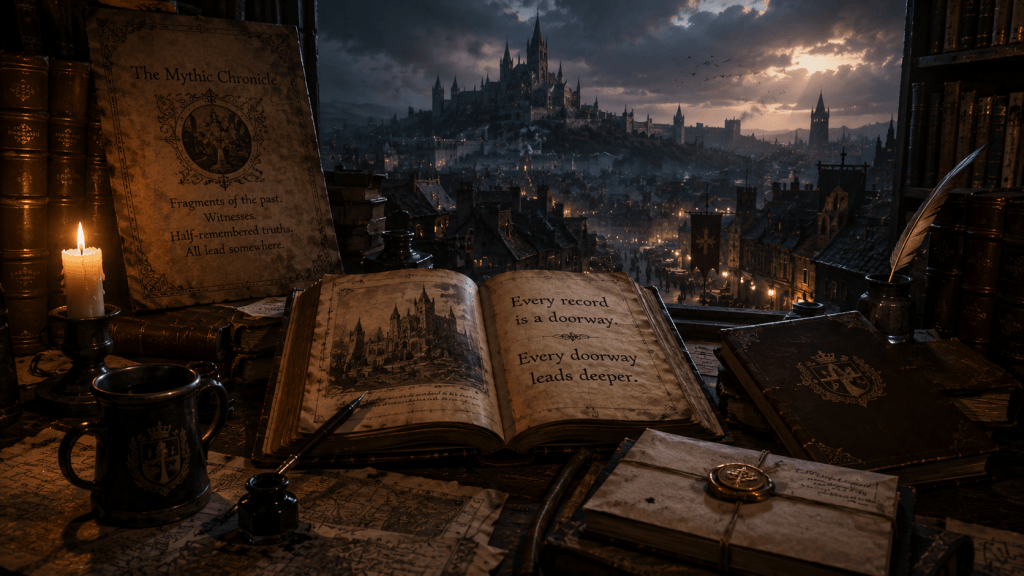
There is a practical reason I like this approach as well because I want the website to give readers several ways into the fiction.

Someone who has already read The Unmarked Path can enter The Mythic Chronicle and return to Bremyra from places the book only passed briefly. They can stand inside the old manor before Simion arrives, sit beside a clerk as the Council’s letter enters the castle, or wait inside the cathedral while Alaric prepares for a confrontation the reader already knows is coming.

Another reader may discover the Chronicle first. They might begin with an abandoned manor that appears to be waiting for an unknown guest, a sealed letter that makes an entire chancery uneasy, or a cathedral locking its lower doors before a magician arrives. They do not need to understand everything about Simion, the Order or Bremyra before those accounts can work.

If the records make them curious about what is happening beyond the edges, The Unmarked Path is there to carry them into the main story.

I prefer that to repeatedly telling readers that I have another book available. The Chronicle can offer something worth reading for itself while quietly opening a door towards the larger series behind it.


The People Standing Nearby
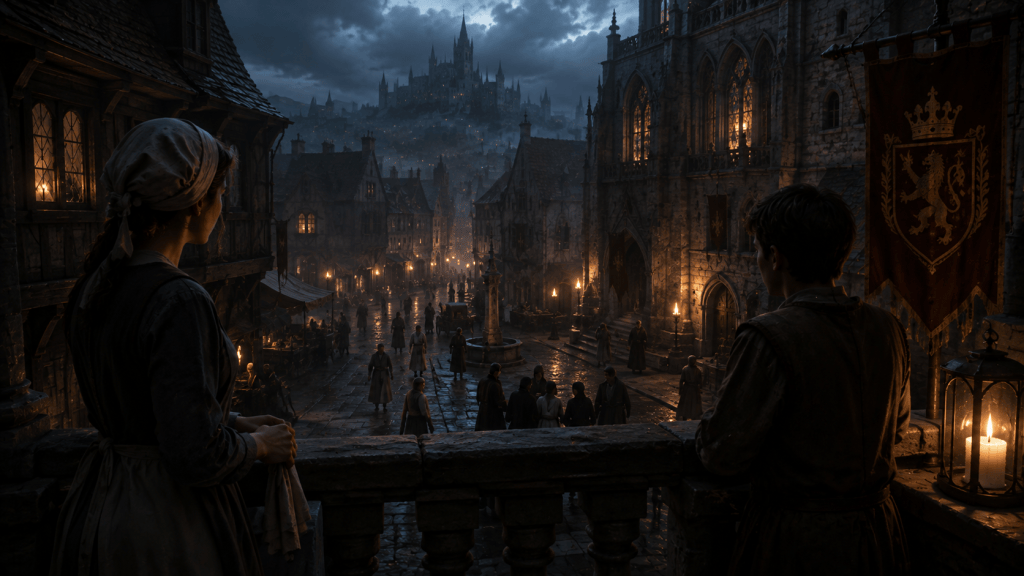
I think that is what I have loved most about The Sealed Road of Bremyra so far. It gives me the chance to stay inside the world for longer and follow parts of the story that the main book could never reasonably stop to include. I can spend time with a housekeeper opening rooms that have stood empty for years, a clerk examining a seal with unusual care, a chapel attendant watching candles lean towards a locked stair, or a cook looking at a feared magician and remembering the boy who once worked beside the hearth.

That kind of thing has always appealed to me. When I was a child, I could spend hours, sometimes days, thinking through parts of a story that might never actually be used. I would imagine places beyond the main setting, work out what happened in rooms the characters never entered, think about people who only existed at the edge of the story, or decide what might have happened years before the part I was actually telling. Most of it never needed to appear anywhere. I simply enjoyed knowing it was there.

I still write that way now. The more time I spend inside a world, the more real it begins to feel in my own head, and I enjoy following those smaller threads even when they sit outside the central plot. They help me understand the place, the people and the history around them, and they make writing the main story feel less like moving characters through a constructed setting and more like returning somewhere that already has its own memory.

The Mythic Chronicle has given me somewhere to put some of that imagination instead of leaving all of it hidden in notes or in my head. The book can stay focused on Simion, Patrick, Týrnan and the larger events moving around them, while the Chronicle can step sideways and spend time with the people who only caught a glimpse of what was happening.

None of those witnesses understand the whole story. They see enough to know that something is changing, then carry away their own version of it as memory, rumour or record. For me, that makes Bremyra feel larger than the central plot because the world continues beyond whichever character happens to be on the page.

That is probably the part I enjoy most. I get to write the story I need to tell, while still giving myself permission to wander into the corners that first made me love making up worlds in the first place.

If you would like to see Bremyra from some of those quieter corners, The Sealed Road of Bremyra begins with The Manor That Waited, before Simion has even climbed the hill.

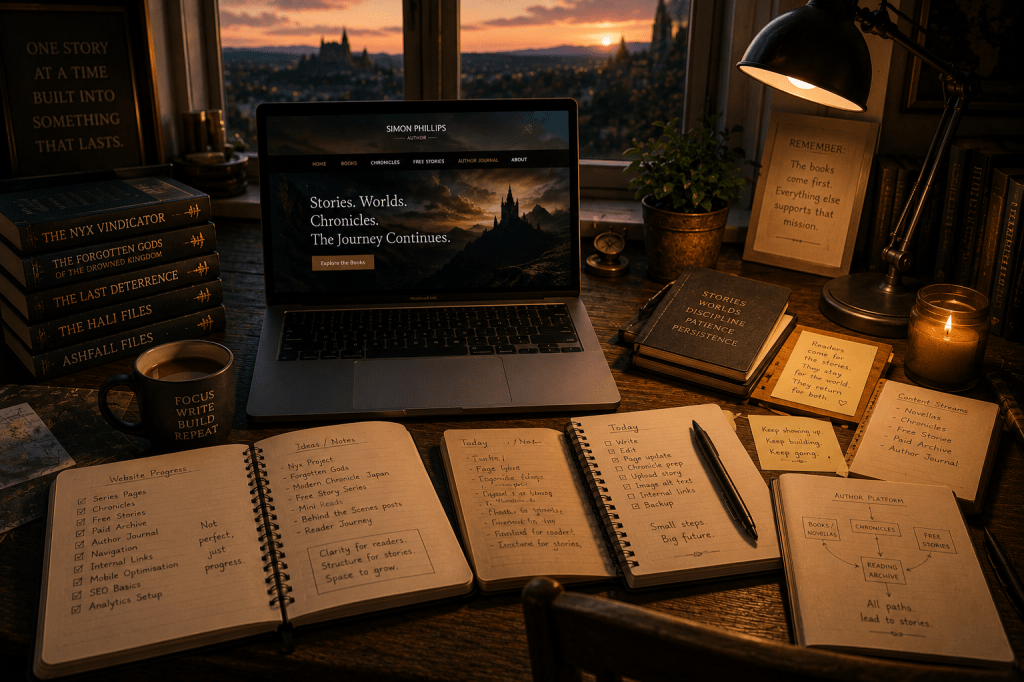
Why I Am Treating WordPress as Its Own Author Platform

I have been spending a great deal of time working out what my WordPress website is supposed to be. The obvious answer is that it is an author website, although that answer leaves most of the important questions untouched.

An author website can be little more than a collection of book covers, sales links, a short biography, and an occasional update. That structure is tidy and easy to understand, although it does not match the amount of work I am trying to bring together or the kind of relationship I want the website to have with readers.

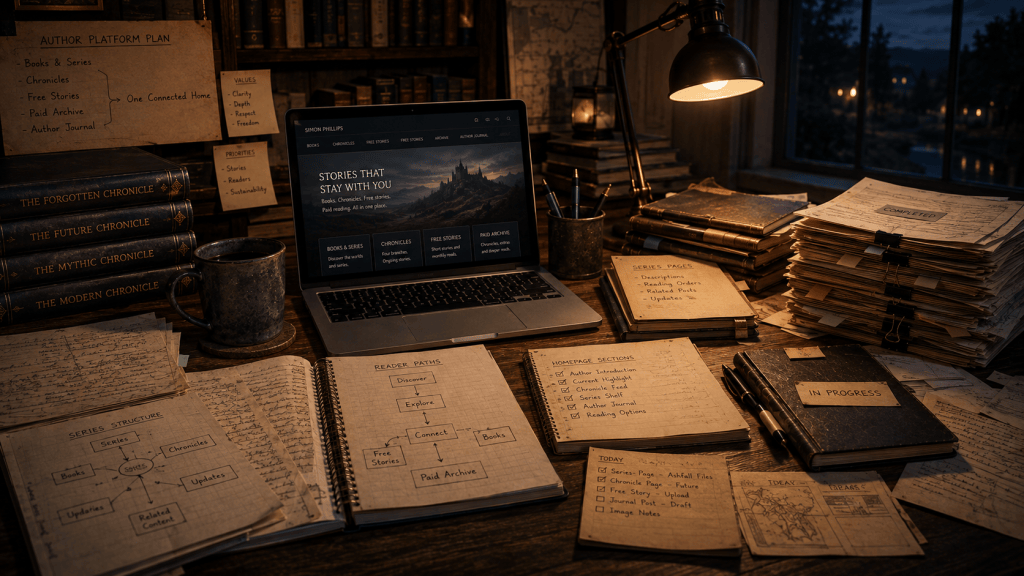
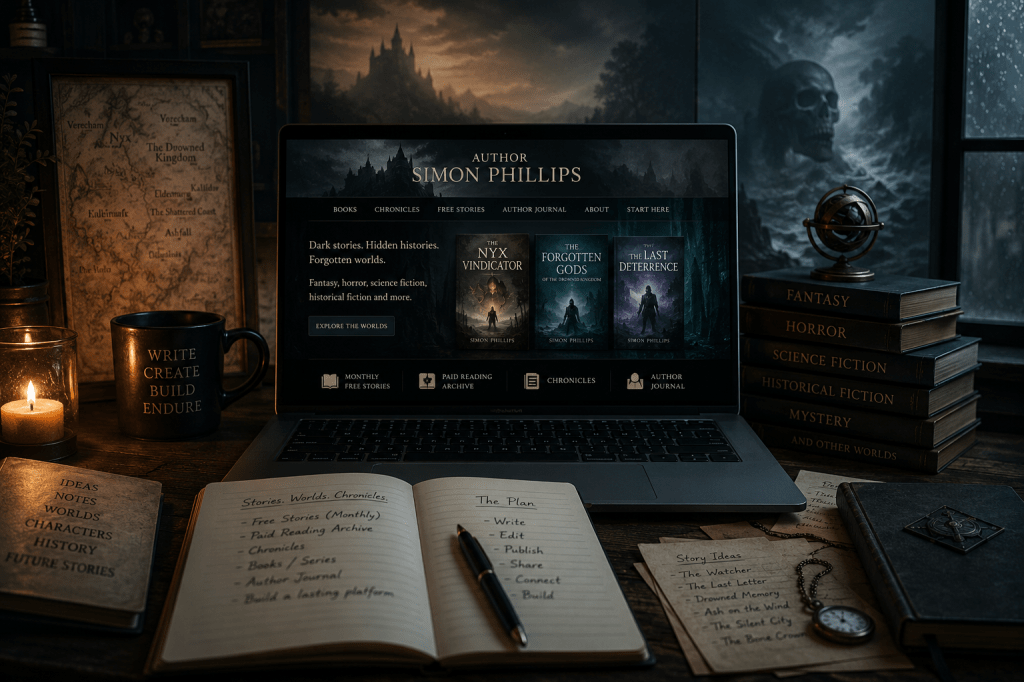
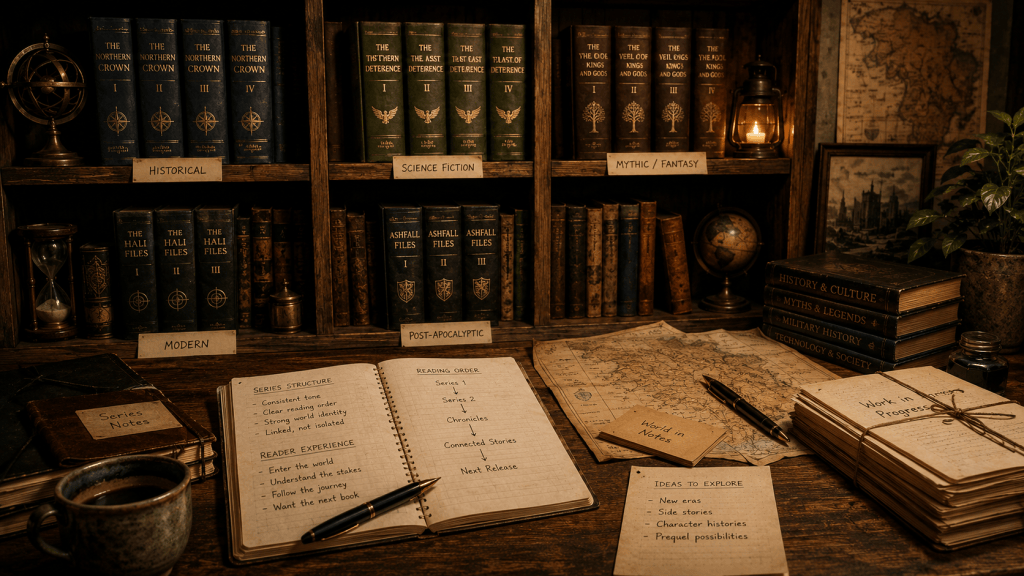
The more I have worked through the site, the clearer it has become that WordPress needs to function as a platform in its own right. It needs to give the books permanent homes, make the Chronicles easy to follow, provide free ways into the fiction, support paid reading, and give me somewhere to explain what I am building as it develops.


A Static Website Was No Longer Enough

There is nothing wrong with a simple author website. For someone with a small catalogue and only occasional news, a few book pages and a purchase link may be all that is needed.

My own work has grown beyond that shape. I have several series in development, four Chronicle branches, free stories, paid material, book updates, and a growing amount of author-side writing that needs to sit somewhere sensible.

Putting all of that on a single blog feed would create a different problem. A reader interested in science fiction could easily find a historical Chronicle beside a publishing reflection, followed by a fantasy update and then a website post. Everything would technically be available, although very little would feel properly organised.

I wanted the site to help readers find the parts that interest them. That meant thinking beyond individual posts and asking how the whole platform should work over time.


The Books Need Permanent Homes

The books remain the main reason for the website. Every other section has to support them rather than compete with them.

A basic books page can show a cover, a description, and an Amazon link. That works for a small catalogue, although it becomes difficult once several connected books belong to the same series and each series has its own setting, reading order, themes, updates, and related material.

I am therefore treating each series as something that needs a permanent home. A series page should explain what the books are, show the current releases, make the reading order clear where necessary, and give readers a direct path towards buying or reading them.

Those pages should also remain useful between releases. When I publish an update, a behind-the-scenes post, a related Chronicle issue, or a piece about developing that series, the relevant material can appear on the series page automatically.

This matters because a series page should not feel finished once the sales copy has been added. It should continue to gather the work connected to that story world while the main description remains stable.


Giving the Chronicles a Clear Place

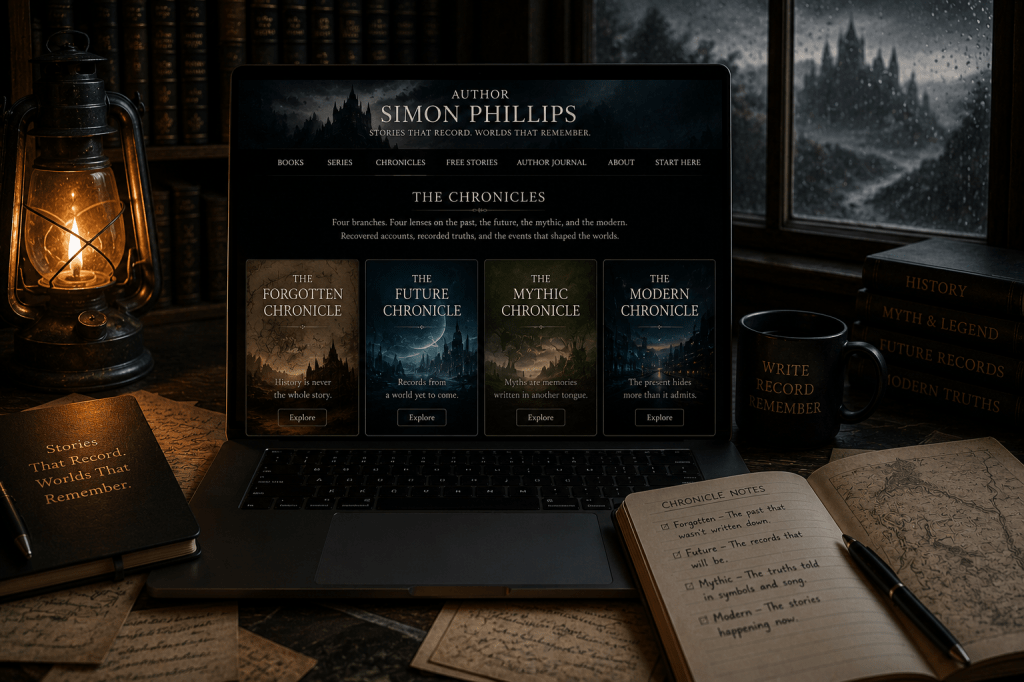
The four Chronicles create another layer of the site. The Forgotten Chronicle, The Future Chronicle, The Mythic Chronicle, and The Modern Chronicle each have their own identity, subjects, and style of presentation.

They need to be easy to recognise and follow, although they cannot be allowed to divide the website into four unrelated sections. The site still belongs to one author, and the books remain the centre of the work.

I see the Chronicles as reading and discovery branches. They give me room to publish substantial ongoing material, build regular points of contact with readers, and connect certain runs to the book series they naturally support.

That connection needs to be handled carefully. A Chronicle may introduce readers to a historical period, a speculative setting, a mythic theme, or a modern concern that leads towards one of my series. Even then, the Chronicle should retain its own identity while the related series remains clearly presented as the main body of fiction.

WordPress gives me the structure to do that through permanent Chronicle pages, clear categories, and filtered feeds. A reader can follow one Chronicle branch without having to search through every post on the site, while still seeing the wider author platform around it.


Free and Paid Reading Need to Sit Together

The previous Author Journey post looked at the balance between free and paid work. That decision affects the shape of the website as much as it affects individual stories.

I do not want every path through the site to lead immediately to a payment request. Readers need space to understand the books, sample the writing, read selected stories, and decide whether they want to continue.

At the same time, paid work needs a proper home. The Chronicles, archive material, and longer reading sections require time to write and maintain, and WordPress needs to support that work as part of the author business.

The solution is not to separate free and paid material into two disconnected websites. They need to sit beside one another in a way that feels clear and fair.

A free story can lead towards a related book series. A Chronicle opening can introduce the subject and atmosphere before a paid continuation. An author update can explain why a new archive section exists. A series page can show the books while also gathering related free posts beneath them.

When those parts are connected properly, the reader is given choices rather than being pushed in one direction. Someone can read freely, buy a book, follow a Chronicle, or support the paid archive according to their interest.


Building Around Reader Paths

One of the most useful changes in my thinking has been to stop looking at every page in isolation. A page may look complete on its own and still leave the reader with no clear idea where to go next.

I now think in terms of reader paths. Someone may arrive through a search result, a shared Chronicle post, a YouTube link, an Amazon author page, or the homepage itself.

The site needs to help that person understand where they have arrived and what is connected to the page in front of them. A Chronicle post should lead towards its Chronicle branch and, where relevant, a related book series. A series page should lead towards the current books and a small selection of connected posts. A free story should offer a natural route towards further reading.

This does not mean filling every page with links. Too many choices can be as unhelpful as having none.

The aim is to provide one or two sensible next steps. Readers should be able to continue with the subject they have already shown an interest in, rather than being sent back to the homepage to start again.


Keeping the Homepage Active

The homepage has also changed in my mind. I once thought of it mainly as a fixed introduction, with a short biography, a few featured books, and links to the main sections.

It still needs to introduce me and the work clearly, although it should also show what is active now. A returning reader ought to be able to see a recent Chronicle, a current book or series update, the latest Author Journal post, and a route towards free or paid reading.

The difficulty is keeping the homepage current without rebuilding it every week. That is where filtered post sections become useful.

Instead of manually replacing every item, the homepage can pull the latest posts from the correct categories. The main structure remains stable while the visible content changes as new work is published.

This allows the site to feel active without turning website maintenance into a second full-time job. The homepage can continue to introduce the overall platform while reflecting the work I am actually doing.


Keeping the Author at the Centre

With several series and four Chronicle branches, there is a risk that the website could feel like a group of separate publications sharing the same address. That would make the structure harder to understand and weaken the connection between the different parts of my work.

The author identity has to remain visible throughout the site. The Chronicles can have distinct visual styles, and each series can have its own atmosphere, although they still need to feel connected to the same body of work.

The Author Journal has a supporting role here. It gives me somewhere to explain the decisions behind the site, share progress, discuss publishing work, and record the practical steps involved in building a long-term catalogue.

That does not mean the Author Journal should take over the site. Readers are coming primarily for the books, stories, and Chronicles, and the author-side posts should help them understand that work rather than distract from it.

This is why the Author Journal will sit lower in the overall structure. It adds context and a human voice, while the fiction remains in the stronger position.


The Work Behind the Visible Pages

Much of this work is quiet and repetitive. Categories need to be decided, pages need to be connected, old posts need to be routed correctly, images need proper descriptions, and each series needs enough structure to remain useful as the catalogue grows.

None of those tasks produces a new book. It can therefore feel difficult to justify spending time on them when there is always more writing to do.

The problem is that an expanding catalogue becomes harder to use if the supporting structure is ignored. Books can disappear into a long list, older posts can become difficult to find, and readers may never discover that two pieces of work are connected.

I am trying to build the structure before that problem becomes larger. The site does not need every possible feature, and I am avoiding additions that would make it harder to maintain.

What it does need is a clear foundation. Pages need defined purposes, categories need to route posts correctly, and each section needs to lead readers towards the work that belongs there.


What This Means in Practice

In practical terms, WordPress is becoming the main organised home for my author work. The books will have permanent series pages, the Chronicles will have their own branches, and ongoing posts will appear in the correct places through categories and filtered sections.

Free stories will give readers direct access to the fiction. Paid material will have a clear place inside the same platform, with enough free reading around it for readers to make their own decision.

Substack will continue as a parallel publication and discovery channel. YouTube and shorter visual work will provide additional entry points. Amazon will remain the place where the books are sold.

The difference is that WordPress will connect those parts. It will explain the catalogue, preserve older work, show what is current, and provide a stable place that is not dependent on a single external platform.


Building It Slowly and Properly

The site is still developing, and some parts will take time to complete. There are many series pages to build, older material to organise, and several sections that need to work together before the structure feels settled.

I am trying to resist the temptation to rush through it simply so that everything looks finished. A page that exists without a clear purpose can create more confusion than a page that has not been built yet.

The slower work has helped me decide what each part of the site is meant to do. It has also made me remove ideas that sounded useful at first but did not support the books or the reader.

That is probably the most important change. I am no longer treating the website as a collection of things I should have as an author. I am treating it as a working part of the writing and publishing system.


What Readers Can Expect Next

As the structure develops, readers will begin to see clearer series pages, more organised Chronicle sections, regular free reading, and a paid archive that is easier to understand and follow. Each addition should make it simpler to move between the books, stories, Chronicles, and author updates.

The Author Journal will continue to record the practical decisions behind that work. Some updates will be substantial, while others will cover a small change that has taken longer to solve than expected.

The next stage is to keep building the permanent homes for the books and connect the ongoing posts to the correct places. I will continue adding updates as those sections take shape, and the latest free reading can always be found through the main story areas of the site.

Why Free Fiction and Paid Reading Both Belong on the Same Website

Finding a Fair Shape for the Website

One question has kept returning while I rebuild my author website: how should complete free fiction and paid reading sit beside each other?

I want the website to give readers a genuine way into my writing. I also want it to support the time, planning, writing, editing, publishing, and maintenance behind that work. Those aims can appear to pull in different directions, especially when an author website is trying to welcome new readers while becoming part of a long-term independent income.

For me, the answer is to give both forms of reading a clear place.

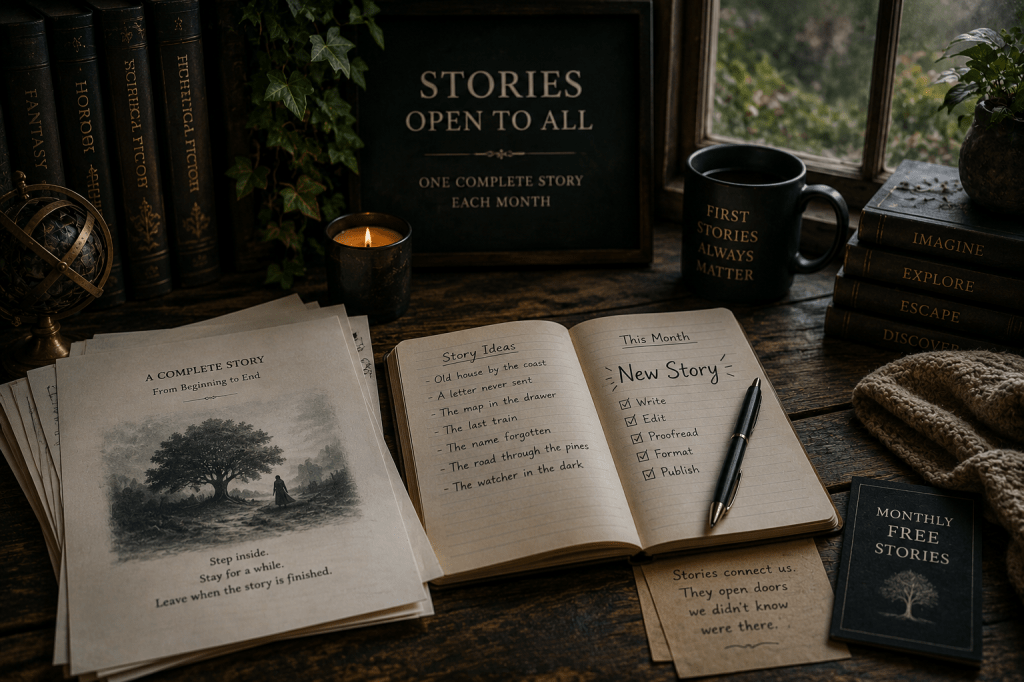
Monthly Free Stories offers one complete free story each month. The Paid Reading Archive gives selected continuing work, particularly the Chronicles, a place where it can help support the wider platform. Each area serves a different purpose, and the distinction needs to remain honest.


Why I Wanted Complete Free Stories

I never wanted every route into the website to end at a payment screen. A new reader may know very little about my books, the Chronicles, or the different series I am building. Asking that reader to subscribe or pay before they have had a proper opportunity to read my fiction would place the decision too early.

Monthly Free Stories provides a simpler starting point.

Each month, I will publish one complete story on the website. The genre may change according to the idea. One month may bring horror, while another may lean towards science fiction, fantasy, historical fiction, mystery, modern fiction, or something that sits between established genres.

The important part is that the story should feel finished. A reader should be able to arrive, choose a story, and read it from beginning to end. There should be no missing conclusion or sudden payment gate before the final section. The free story should give the reader a complete piece of fiction, even when the idea later proves capable of growing into something larger.

This also gives me room to write beyond the established series. Some ideas clearly belong inside a book project from the beginning. Others are smaller, stranger, or still uncertain. A complete standalone story gives those ideas room to exist before I decide whether they deserve a larger future.

Some may eventually suggest a series or book. Others may remain single stories that achieved exactly what they were meant to achieve.


Why Paid Reading Still Matters

Writing carries practical costs that readers rarely see directly. The time spent developing a story is only one part of the process. There is also revision, proofreading, formatting, cover preparation, website maintenance, image work, archive management, platform subscriptions, and the regular work required to keep everything organised.

A paid reading section gives part of that work a direct way to support itself.

The Paid Reading Archive is intended for material that benefits from an ongoing home, especially Chronicle issues and other selected work connected to the regular publishing structure. Readers may begin with an open section, understand the subject and tone, and then choose whether they wish to continue.

That choice needs to remain clear. Readers should understand which material is free, which material requires payment, and what access provides. Clear labelling matters because trust can disappear very quickly when the boundaries between free and paid material become uncertain.

Paid reading also allows WordPress to function as a full author platform instead of acting as a collection of links pointing towards other services. The website should hold fiction, organise it properly, give readers reasons to return, and contribute towards the continuing work behind the books.


Different Forms of Reading Serve Different Needs

Free fiction and paid content are sometimes discussed as though one must weaken the other. I see them as serving different readers and different kinds of work.

The free stories help readers discover my fiction. They show the range of genres I write, the kinds of atmosphere I return to, and the human pressure, uncertainty, history, strange systems, or hidden danger that often sits inside the work. They also give existing readers something complete to read between book releases and Chronicle posts.

The paid archive supports regular and continuing material. It gives readers who want to follow the work more closely a clear place to do so, while helping with the practical cost of keeping the website active.

The distinction matters. Free fiction should feel complete and worthwhile. Paid reading should offer enough depth, continuity, or regular material to justify the cost. Each side can remain clear about what it offers.


Avoiding the Feeling of a Sales Funnel

I am wary of turning every free piece into a carefully disguised route towards payment. Readers can usually sense when a story exists mainly to push them towards a purchase, and that approach would make the fiction feel secondary on an author website.

Monthly Free Stories needs its own integrity.

Each story should provide a full reading experience. A closing link may guide readers towards the books, another free story, a related series page, or the Paid Reading Archive, yet the story itself should already have delivered what it promised.

One reader may finish a story and leave the site. Another may return the following month. Someone else may move towards a book series, a Chronicle branch, or the paid archive. Each response is reasonable, and those choices should grow naturally from interest.

This means the website has to be organised carefully. Free stories need a clear home. Paid material needs equally clear labelling. Series pages need to remain focused on the books. Chronicle pages need to explain what readers can expect, while the Author Journal should remain a supporting area where I can discuss the work behind the fiction.

Clear structure helps readers understand where they are and what each part of the site offers.


Giving Readers Several Ways Into the Work

Readers will arrive with different interests and different levels of familiarity with my writing. Some may already know one of the books. Some may discover the website through a Chronicle post. Others may find an Author Journal article, a free story, a social post, or a short video.

Trying to force every reader through one route would make the website too narrow.

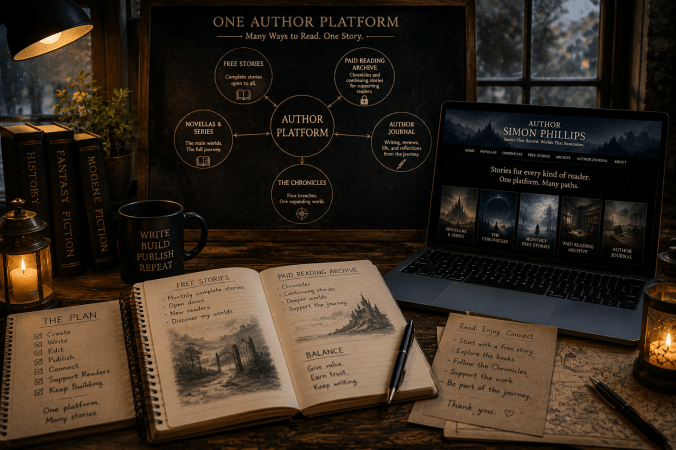
The books remain the main body of the work. The permanent series pages give each larger project a proper home. The Chronicles provide regular themed reading. Monthly Free Stories offers complete standalone fiction. The Paid Reading Archive holds selected continuing material. The Author Journal explains parts of the work and the decisions behind it.

These areas can connect to one another while still making sense individually.

That is particularly important for a website covering several genres and many long-term series. A reader interested in historical fiction may have little interest in science-fiction horror. Someone who enjoys a free ghost story may later discover one of the darker historical series. Another reader may prefer the Chronicle format and spend most of their time within that part of the site.

The website needs enough structure to support those different reading habits while keeping the overall author identity clear.


Keeping the Balance Honest

The balance between free and paid reading will probably need adjustment as the website develops. Some monthly stories may grow longer than expected. Certain Chronicle strands may suit the paid structure better than others. Some experiments may prove manageable, while others may demand too much time beside the books and existing publishing work.

I prefer to make those decisions through actual experience instead of pretending the whole system is already settled.

The main principles are clear enough to begin. Free stories will remain complete. Paid material will be labelled properly. The books will remain central. The Chronicles will keep their own identity. The website will offer several entry points, with each one connected to the wider author platform.

That gives me a structure I can develop while respecting the fact that readers use author websites in different ways.


What I Hope to Build Over Time

Over time, I want the website to hold a growing body of fiction that readers can move through at their own pace.

The Monthly Free Stories archive should become a shelf of complete standalone work across different genres. The Paid Reading Archive should become a deeper collection for readers who want regular access to Chronicle material and other selected pieces. The books and series pages should remain the main route into the larger story worlds.

A reader might begin with a free story, browse the books, follow a Chronicle, read an Author Journal post, or support the paid archive. There is no expectation that every reader will use every section.

The purpose is to respect different ways of reading while giving the work a practical chance to support itself. Free fiction gives new readers an open door. Paid reading gives interested readers a way to follow the work further and contribute towards its continuation.


Building the Sections Through Regular Work

The next stage is straightforward, even though it requires steady work. I need to keep adding the material that gives each area a reason to exist.

That means publishing the monthly stories, building the archive carefully, connecting posts to the correct pages, and making sure readers always understand where they are and what they are being offered.

The balance will develop through use. Some parts may change as I learn what is manageable and what readers choose to follow. The central idea will remain the same.

Complete free fiction and paid reading can belong on the same author website because they support the same wider purpose. They keep the fiction available, organised, and moving forward, while giving readers the freedom to decide how deeply they want to follow the work.

My First Ambulance Ride in Japan After Seventeen Years

This Is Not the Usual Japan Post

This is not the usual sort of post about living in Japan.

There are no sightseeing recommendations, hidden restaurants, convenience-store discoveries or reflections on cherry blossom season. Instead, this begins on an ordinary train journey that ended with me unconscious on a station escalator, followed by my first ambulance ride in the seventeen years I have lived here.

It is also the reason my writing, website work and other projects have moved more slowly than usual recently.

That slowdown has not been caused directly by the cuts and bruises from the fall, nor by spending every day unable to work because of the symptoms that followed. Much of it has come from the appointments themselves. There have been visits to a clinic, hospital tests, return journeys, waiting rooms, a twenty-four-hour heart monitor, paperwork, another hospital visit to remove the monitor, and future appointments that remain on the calendar.

Each appointment takes time. More importantly, they occupy part of the mind even after the hospital visit has ended. It is difficult to settle into fiction when part of your attention is still waiting for an explanation about why you collapsed in the first place.

This post is not medical advice, and it is not an attempt to diagnose what happened. The doctors are still investigating it. It is a personal account of becoming unwell, entering parts of the Japanese medical system that I had never needed before, and discovering that living in another country can feel entirely normal until something forces you into unfamiliar territory.


Before the Collapse

The strange part is that, before the major faint, I had begun to feel that my stamina was improving.

I have what most people would probably call a dad body. I had tried getting back into regular exercise, although, like many attempts at building a new routine, it did not last. About a year earlier, I had tried running again and found it much harder than I remembered.

As a teenager, I had been used to long-distance running. Returning to it years later was different. I would run for a while, slow to a walk, then try to start again. Part of that may have been physical, although some of it was probably the difficulty of finding a rhythm after so long away from running.

My work is physically demanding, and over time my body had adjusted to that routine. There were shifts when the pace remained high for hours, including some particularly busy periods during the previous year, yet I had generally managed them.

The change became noticeable when I had to run from work to catch a train.

I expected it to feel much like my earlier attempts at running for exercise. Instead, I found a steady pace and kept it. I did not need to stop and walk in the way I had before. I was not running a great distance, but the difference was obvious to me because I knew how much more broken and difficult the same effort had felt the previous year.

It was only one run for a train, not proof that I had suddenly become fit again. Still, it suggested that the physical demands of work had improved my stamina more than I had realised.

That matters because what happened afterwards did not feel like the end of a long decline. Shortly before the collapse, I had experienced a small but clear sign that my body was handling sustained effort better than it had before.

About a year earlier, I had passed out on a train along roughly the same route. The sensations were similar enough that I now wonder whether the two incidents were connected. At the time, however, I recovered and continued with ordinary life. I worked through the following year, including demanding periods, without the earlier event becoming the centre of my daily thinking.

The escalator collapse changed that.


When the Train Journey Stopped Feeling Normal

The journey began like any other trip to work, until a growing sense of light-headedness made it clear that something was wrong. A floating, dropping sensation followed, similar to the moment when a roller coaster passes over the top of a rise. My stomach and body seemed to lift and fall even though the train itself was moving normally, and as the feeling intensified, my vision and awareness began to close in.

Remaining upright became more difficult, and by the final part of the journey I had crouched down, less because I had made a clear decision and more because standing no longer felt safe. I was trying to stay conscious long enough to reach the station, although my memory of what happened immediately afterwards is incomplete.

There is a gap after I left the train. I have a vague recollection of someone trying to get a response from me, but I cannot say with certainty what they did or what condition I was in at the time. They may have shaken me, pushed me roughly or used their foot in an attempt to wake or move me. I do not remember enough to describe it as an assault, and I cannot confirm whether I had fully lost consciousness.

It is possible that I fainted on or near the platform and then partially recovered. It is also possible that I experienced a severe near-faint without completely blacking out, or that the whole period formed one longer episode of broken awareness. I may even have lost consciousness twice. The truth is that I do not know.

What I do remember is becoming aware enough to continue moving through the station. The ticket gates were above the platform, so I needed to take the escalator to reach them. I believed that once I got there, I would be able to find somewhere to sit down and recover.

I stepped onto the long escalator and began the climb towards the concourse.


The Escalator

I made it most of the way up before losing consciousness, somewhere around four-fifths of the distance. There was no time to brace myself or hold on properly. I fell backwards and tumbled down the escalator while it continued moving beneath me, striking my head and face and injuring several parts of my body on the way down.

My memory of the fall is broken rather than continuous. I remember only fragments, followed by the confused aftermath. One moment I was trying to reach the concourse so I could sit down and recover. The next clear part of the day involved strangers around me, the pain from the fall, and the knowledge that an ambulance had been called.

Ambulances were not unfamiliar to me. Both my wife and one of my children had needed one before, and on those occasions I had followed behind or made my own way to the hospital by car. I had been close to that experience without ever being the person inside the ambulance.

After seventeen years in Japan, this was the first time I had ridden in one myself.


My First Ambulance Ride in Japan

The ambulance journey is blurred in my memory. I felt confused, unsteady and detached from what was happening, almost as though I were drunk despite having consumed no alcohol. My thoughts moved slowly, and the surroundings seemed to reach me through a haze, which made even ordinary questions take longer to process than they normally would.

My Japanese is not fluent, especially when a conversation moves into specialist medical language, although it is enough for daily life and for working in a fully Japanese environment. I can manage ordinary conversations, instructions and practical situations without needing someone beside me to interpret everything, and that remained true in the ambulance. I understood the questions being asked and was able to answer them, although my replies sometimes came more slowly than usual.

I cannot say whether that delay came from striking my head, from the disorientation of the faint and fall, or simply from my body trying to recover from a frightening physical event. What I can say is that there was no major communication failure. The difficulty was not understanding nothing, but needing more time to take in what was being asked and form a reply.

That distinction matters because language ability abroad is often treated as though it falls into two simple categories: complete fluency or complete dependence. In reality, there is a wide space between them. A person can work, travel, shop and deal with ordinary problems in another language while still finding that a medical emergency, unfamiliar vocabulary and physical confusion make communication slower and more demanding.

The ambulance took me to the hospital where my wife works.


A Familiar Hospital That Was New to Me

My wife was already on shift when the ambulance arrived. She works as an operating nurse in the hospital’s cardiac section, so she knew the doctors involved, although not every nurse working in the emergency department. Because she was already in the building and knew the medical staff, she was allowed to be there when I was brought in.

She quickly found herself occupying several roles at once. She was my wife, the person who had translated for me throughout much of our married life in Japan, and a nurse in a hospital she knew well. I could understand the immediate questions and answer for myself, but when the explanations became more technical, or when my responses slowed because I was still disoriented, she filled in the gaps. She also helped the emergency nurses where she could, although her manner with me was noticeably less gentle than theirs. The nurses treated me carefully as an injured patient, while my wife handled me with the practical firmness of someone who knew me too well to be overly delicate.

The situation became stranger when staff from her own cardiac section began following what was happening through the monitors. This was the first time many of them had seen me, and alongside their concern about what might have caused the collapse, there was also a small amount of curiosity. They commented that I was larger and more robust than they had expected, rather than thin. I still do not know what my wife had previously told them about me that produced such a reaction.

More importantly, it was the nurses from her section who first raised the possibility that the faint might be connected to my heart. Their concern did not provide an answer, but it changed the direction of what followed. The emergency department dealt with the injuries from the fall, yet I left the hospital without a clear explanation for why I had lost consciousness.

My boss also came to the hospital after hearing what had happened. There was no formal reason to do so because the collapse had not occurred at work, and the visit came entirely from concern. I appreciated it, especially while I was still trying to process how quickly a routine journey had turned into a serious medical emergency and the beginning of a much longer period of appointments and tests.

The journey felt much like the ambulance ride. I was awake, but everything remained blurred and strangely distant.


When the Body No Longer Felt the Same

The collapse became a dividing line in how I experienced my physical condition, although I am careful about making that connection too strongly. I cannot say that the fall caused everything that followed, and it is possible that several things overlapped. Around the same period, I also developed fever-like feelings, a sore throat and other cold symptoms that may have pointed to a viral illness.

What I can say is that ordinary effort began to feel different afterwards. Exertion that would previously have been manageable sometimes left me breathing more heavily, while my heartbeat could feel unusually forceful, fast or irregular. Chest aches returned in a familiar place, and episodes of dizziness, blurred vision, shaking, sweating and sudden weakness began to appear without much warning.

At times, my energy seemed to drain away quickly. My knees could feel unstable, and there were moments when my lower body seemed strangely disconnected from the rest of me. My thinking could also become foggy or boxed in, with brief periods when it took longer to understand what was happening around me.

The difficulty was that none of this followed a clear pattern. The symptoms did not always appear together, and they could change throughout the day. A difficult hour might be followed by a period when I felt almost normal, while a manageable morning could give way to a much harder journey later.

That inconsistency made it difficult to judge what was happening or how seriously to treat each episode. The doctors had not given me a confirmed explanation, and I did not want to fill that uncertainty with a diagnosis of my own.


The Heart Clinic

Following the concerns raised by my wife’s colleagues, I was advised to attend a heart clinic and obtain a referral letter for further investigation. The clinic carried out an echocardiogram, and during the explanation the clinician used wording that I understood as genki nai when describing the heart’s movement or action.

Genki is one of the most familiar Japanese words, usually meaning healthy, energetic or well depending on the situation. Hearing that something about my heart was “not genki” made sense at a basic level, but it was much harder to understand what that meant medically. The clinician also mentioned an issue with one of the valves, although I did not leave believing that I had been given a firm diagnosis of heart failure or any other serious condition. My understanding was simply that the clinic had seen enough to recommend further checks at a larger hospital.

That finding led to the referral and the next series of appointments. When the heart imaging was repeated at the hospital, the doctor explained that the valve issue appeared mild and was not significant enough to account for the fainting. It was reassuring to hear that they had not found an obvious severe problem, although the result left the original uncertainty in place.

The question was no longer whether the clinic had noticed something, but whether that finding had anything to do with what had happened. If the valve issue was too minor to explain the loss of consciousness, then I was still left wondering why I had fainted, why I had fallen down the escalator and why ordinary exertion sometimes seemed to affect me differently afterwards. A test can bring relief by ruling out something serious while still leaving the patient without the answer they were hoping to find.


Entering the Medical System Properly for the First Time

What made the experience especially strange was how much of it was completely new. In seventeen years of living in Japan, I had never ridden in an ambulance, gone through this sequence of heart checks and referrals, worn a twenty-four-hour monitor or needed to record symptoms throughout an ordinary working day. Many of the later appointments also had to be attended alone, which meant dealing with unfamiliar procedures in Japanese without my wife there to fill in the occasional gap.

There were no major misunderstandings. I followed the instructions, completed the tests and spoke with the staff in Japanese, but managing everyday life in another language is not the same as feeling completely certain inside a medical system. A nurse might explain where to go, what to remove, when to press a button or when to return, and those immediate instructions could be perfectly clear. The uncertainty often came afterwards, when I found myself wondering whether there had been another stage I had missed, whether the payment process worked differently for that appointment or whether a specialist phrase meant exactly what I thought it did.

Living in another country becomes ordinary through repetition. Over time, the trains, shops, workplaces, forms and daily routines stop feeling foreign because they become part of normal life. A medical emergency places you inside a different system, however, and years of familiarity do not change the fact that many of its procedures are being experienced for the first time. I was able to manage them, but that did not make the process feel familiar.


The Near-Faint and the Heart Monitor

A few days before the twenty-four-hour monitor was fitted, I experienced another serious near-faint. The morning had begun normally, but the bicycle ride became far more difficult than usual, and I came extremely close to losing consciousness again. Because the episode happened before any monitoring had begun, there was no record of what my heart was doing at the time.

A few days later, I returned to the hospital to have the monitor attached. The device was fixed to my body and set to record my heart rate and rhythm continuously for the next twenty-four hours, including the journey home, the night and the following working day. I was also given an event button to press whenever symptoms appeared, together with a card for noting the time, what I was doing and how I felt.

The most noticeable symptoms occurred on the second day, while I was still wearing the monitor and travelling to work. At around 7.13 on the morning train, the strong rising-and-falling sensation returned, accompanied by mild nausea, tiredness and a brief moment of confusion or panic as I looked towards a bridge and stretch of railway that were normally completely familiar to me. After climbing the subway stairs at about 7.31, my heart began beating so heavily and forcefully that I pressed the button again, followed by another recorded episode of breathlessness and dizziness at around 8.44.

Work that morning was extremely busy, and the symptoms continued rather than settling. At approximately 9.50, I felt fever-like waves, fatigue and a sudden sense of becoming unwell, followed at around 10.30 by pain in the centre of my chest. For the remainder of the shift, my strength rose and fell in cycles. At certain points, my energy dropped so sharply that I felt close to being unable to continue, only for some strength to return and carry me through until the next decline.

I did not press the event button for every change because the symptoms felt less like separate incidents and more like one prolonged cluster shifting in intensity. By then, the monitor had already been recording since the previous day, and it remained attached until I returned to the hospital later that afternoon to complete the full twenty-four-hour period.

Wearing it made an otherwise ordinary day feel unusually formal. Sensations I might once have noticed and dismissed now required me to decide whether they were important enough to record, while the device quietly collected information I could not interpret for myself.


A Slow Walk That Did Not Stay Easy

After lunch, I had about an hour and a half before I needed to return to the hospital and have the monitor removed, so I decided to walk slowly to a nearby river and sit in the shade. The journey there was manageable, and once I had stopped beside the water, I felt comfortable enough for the day to settle for a while.

The difficulty returned when I began walking back towards the hospital. My breathing grew heavier, my heartbeat felt unusually strong, and the familiar chest pain appeared again, prompting me to press the event button. It had not been a strenuous walk, only an ordinary slow journey after a period of rest, although by then I had already travelled, worked and spent more time on my feet than my body may have been ready to handle.

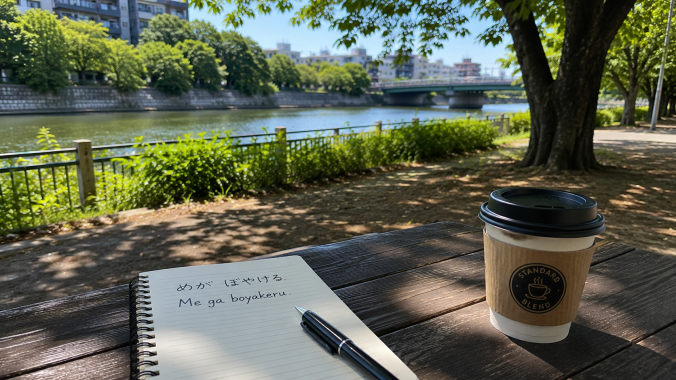
When I reached a coffee shop inside or near the hospital, I still had around thirty minutes before the appointment. I sat down to wait, but the heavy breathing continued and my vision began to blur without me deliberately allowing my eyes to lose focus. Trying to hold the image in front of me steady felt difficult and slightly painful, which meant I needed to add another symptom to the notes accompanying the monitor recording.

The phrase I used was simple: めが ぼやける, me ga boyakeru, meaning that my vision was blurred. It was a small piece of Japanese, but it captured much of what the experience had become. I was sitting in a hospital coffee shop, feeling unwell and trying to describe the symptom clearly enough for someone to connect it later with the heart recording. I did not need perfect Japanese in that moment. I only needed enough to make what was happening understandable.


Removing the Monitor and Going Home

By the time I returned for the removal appointment, I was still breathing heavily and also felt dizzy, with a noticeable tremor in my hands. Before the nurse began removing the equipment, I asked for a moment to catch my breath. She immediately treated the symptoms as something that needed to be included in the test rather than simply waiting for them to pass.

She firmly instructed me to press the event button and then asked me to describe exactly what I was feeling so it could be added to the record. Until that point, I had been thinking mainly about sitting still long enough for my breathing to settle, but she made sure the episode was documented before continuing with the appointment. She also advised me to drink fluids, rest and speak to the front desk if I felt that I needed further help.

Once my condition had settled enough, the monitor was removed and I handed over the completed symptom record. I was told that the test was finished for the time being, given the card for my next appointment and allowed to leave, so I believed that I had completed everything required.

The uncertainty only appeared later, when my wife asked whether I had paid. I had not been given any payment paperwork, called to the cashier or instructed to visit the accounts desk. I had simply followed the directions I was given and gone home when the staff said the appointment was finished, yet one question from my wife was enough to make me reconsider the entire final stage.

She has a natural ability to make me wonder whether I understood an instruction correctly, even when I felt certain at the time. There was no evidence that anything had actually gone wrong, and the process may have been completed exactly as intended. It was simply another example of the doubt that can appear after dealing with an unfamiliar system in a second language, when the possibility that you missed one sentence remains even after everything seemed clear.


Waiting for the Next Appointments

The heart-monitor test has now been completed, although I do not yet know what the recording showed. A head MRI is scheduled for August, and I am due to see the doctor before the scan on the same day. I may receive the monitor results during that appointment, particularly because the nurse told me to wait until the next visit, but I cannot be certain that this is what she meant. The next longer consultation is scheduled for September, when there may be more information available from the different tests.

The clinic had also mentioned the possibility of a treadmill or running-machine examination, although the larger hospital has not yet confirmed whether that will happen. The gaps between appointments feel slow from the patient’s side, but there may be ordinary reasons for the timing. The hospital may be busy, the doctor may want to consider several results together, or the schedule may partly reflect when my wife can attend and help with any detailed medical explanation.

Until the August appointment, I do not know whether the monitor identified anything significant or whether the doctor will discuss it before the MRI. I only know that the test has been completed and that the information is now with the hospital.

In the meantime, I have tried to stop examining every physical sensation as though it must contain the answer. Constantly monitoring the body can make it difficult to recognise whether things are improving, especially when symptoms vary from one hour or day to another. I am trying to move more steadily, avoid deliberately testing my limits and pay attention to the overall direction rather than turning each unusual feeling into a private investigation.

There are still several possible explanations. A virus may have contributed, the earlier faint may be connected, and the fall itself may have required time to recover from. The finding at the heart clinic may prove relevant, or the later tests may lead the doctors in another direction. Until those appointments take place, they remain possibilities rather than conclusions.


Why This Is the First Life in Japan Post

This was not how I expected to begin the Life in Japan part of my website. I had imagined something quieter and more ordinary, perhaps a small experience at work, a moment of language confidence or one of the details of daily life that only becomes noticeable after living somewhere for a long time.

Instead, the first post has come from being placed inside a part of life in Japan that I had never personally experienced before. After seventeen years, most of the country no longer feels foreign to me, yet the ambulance, referrals and unfamiliar hospital procedures reminded me that there are still systems I have never had to navigate.

The experience was not defined by a major language failure or by a simple judgement about the medical care I received. What stayed with me was the effort of managing something unfamiliar while injured, uncertain and often attending appointments alone. My Japanese was enough to get through each stage, even when I did not always feel completely confident about the wider process.

It has also affected the pace of my other work. The appointments have taken up time, while the waiting and uncertainty have taken up more mental space than I expected. Fiction, website work and other projects have continued, although more slowly, because part of my attention has remained fixed on the next appointment and the question that has not yet been answered.

Writing this has allowed me to acknowledge that interruption rather than work around it in silence. The medical process is still continuing, and I may understand more after the next appointments. Until then, I am returning gradually to my usual work and allowing this first Life in Japan post to remain what it is: an account of encountering an unfamiliar part of the country I have called home for seventeen years.

Elana’s Hidden Magic in The Unmarked Path

A Princess Standing at the Edge of Power

In The Unmarked Path, Elana enters the story as a princess shaped by duty, family expectation, and the cold machinery of royal alliance. She is not introduced as a warrior, a ruler, or a magician. She stands beside the burdens of others, close enough to see what they hide, yet bound by a role that expects silence, obedience, and grace.

That is what makes her so important.

Elana begins in Bremyra as Prince Patrick’s sister, a sharp and thoughtful presence within a court already strained by absence. King Cedric is gone. Patrick’s brothers are gone. The kingdom continues to function, but the foundations beneath it feel uncertain. Elana understands this more clearly than most. She sees Patrick’s exhaustion, his isolation, and the pressure gathering around him before the wider court fully recognises it.

She is preparing to leave for Vaeldring and an arranged marriage, yet she is not written as a passive royal figure being moved from one kingdom to another. Her duty is real, but so is her mind. Her compassion is real, but so is her judgement. Elana carries warmth, intelligence, and restraint, and those qualities make her one of the quietest forces in the opening movement of the story.


The Bond Between Elana and Patrick

Elana’s relationship with Patrick gives the reader a softer entry into the political weight of Bremyra. Patrick is acting in his father’s place, but he is not yet settled inside authority. He works through petitions, letters, border concerns, marriage arrangements, and the silence left by his missing family. Elana is one of the few people who can speak to him without ceremony.

Their conversations show the human cost of royal duty. Patrick must think like a ruler before he is ready to become one. Elana must leave her home because marriage is part of the kingdom’s strategy. Neither of them is free, yet they still try to comfort one another within the limits their world allows.

This matters because The Unmarked Path is not only about magic and ancient danger. It is about institutions pressing down on people before they understand the shape of the storm around them. Elana’s presence beside Patrick reveals the emotional life beneath the politics. She reminds the reader that kingdoms are not held together by banners and titles alone. They are held together by people trying not to break under the weight of what is expected from them.


The Return of Simion

Elana’s importance deepens when Simion returns to Bremyra.

To the court, Simion is a magician of the Order, a figure of authority and unease. To the Church, he is a threat. To Patrick, he is both a possible ally and a mystery. Yet to Elana, he is also a memory.

She remembers him from childhood, before black robes and formal titles stood between them. She remembers the boy from the kitchens, the fireflies, the warmth of a life that no longer exists. That recognition cuts through the distance Simion tries to maintain. For a moment, he is not only Lord Magician. He is someone who once belonged to the halls of Bremyra in a far more human way.

This is one of Elana’s strengths. She sees through the surface of people. She sees Patrick’s burden. She sees Simion’s guarded sorrow. She sees that something weighs on him even when he tries to hide it behind silence.

Her questions are gentle, but they are not weak. She does not force the truth from him, yet she lets him know she has noticed. In a world of court suspicion, Church authority, and Order secrecy, Elana’s insight feels dangerous precisely because it is so human.


More Than a Royal Daughter

Elana’s arranged marriage to Vaeldring could easily make her seem like a political piece. The story refuses to leave her there.

She is part of Bremyra’s diplomacy, but she is not defined by diplomacy. She is Patrick’s sister, but not only Patrick’s sister. She is linked to Simion’s past, but not only through memory. Her role grows through small moments of perception before it becomes something impossible to ignore.

When Elana leaves Bremyra, the road itself becomes a threshold. The journey that should carry her towards marriage instead carries her into violence. Her escort is attacked. The carriage is destroyed. Guards fall. The world that expected her to travel quietly between kingdoms is suddenly stripped of its formal order.

That is when the hidden truth within Elana begins to surface.


The Road, the Poison, and the Golden Light

Simion reaches Elana after the ambush and destroys the attackers, but victory does not save him. A poisoned arrow has already struck him. The danger becomes intimate and immediate. This is not a distant battle or a council debate. It is Elana kneeling beside him on scorched earth, watching death move through his body.

What follows is one of the most important moments in Book 1.

Elana does not call for someone else to save him. She does not collapse into helplessness. She acts. Golden healing light answers her fear, her will, and her refusal to let him die.

The scene matters because it changes what the reader understands about Elana. Until this point, her strength has been emotional, political, and perceptive. In this moment, that strength becomes magical. The story does not pause to explain everything. It does not flatten the mystery into a rulebook. It simply shows that something powerful has been living beneath the surface of a princess the world underestimated.

Elana’s magic is not presented as spectacle. It is urgent, costly, and deeply personal. It rises because someone she cares for is dying in front of her, and she refuses to accept that outcome.


What the World Failed to Notice

By the end of The Unmarked Path, Elana has become far more than she first appeared to be. She has supported Patrick in a court shaped by uncertainty. She has recognised the humanity still buried inside Simion. She has walked towards a political future she did not choose. She has survived violence on the road. Most importantly, she has revealed a hidden power that the world around her had not seen.

That is the heart of Elana’s role in Book 1.

She is not explained. She is revealed.

Her story draws readers into one of the central tensions of The Veil of Kings and Gods: power is often present before anyone understands it. Magic does not always arrive through titles, institutions, or formal permission. Sometimes it appears in a moment of fear, love, and refusal. Sometimes the person who changes everything is the one others thought they had already understood.


Watch the Elana Lore Short

I have also created a short lore video exploring Elana’s hidden magic and her role in The Unmarked Path. Rather than retelling the entire story, it introduces one of Book One’s most intriguing characters and the quiet mystery surrounding her. From her life as a princess bound by duty to the unexpected awakening of her healing magic, the video offers a glimpse into the emotional and mythic foundations of her journey without revealing the wider story.

Whether you have already begun reading The Veil of Kings and Gods or are discovering the world of Ældorra for the first time, it serves as a short introduction to the atmosphere, characters, and hidden threads that shape the opening of the series.


Read The Unmarked Path

The Unmarked Path opens the world of The Veil of Kings and Gods, a high fantasy story of forbidden magic, royal pressure, ancient divine history, political unrest, and the first stirrings of a power long buried beneath Ældorra.

Within its opening pages, a magician returns to a kingdom that fears his Order, a prince struggles beneath the weight of a throne he was never meant to inherit, a northern war leader crosses the sea under a shadowed cause, and a princess begins to reveal a power the world has not yet noticed.

If you enjoy character-driven epic fantasy, hidden magic, ancient gods, royal intrigue, dangerous journeys, and slow-burning mythic tension, this is where the path begins.

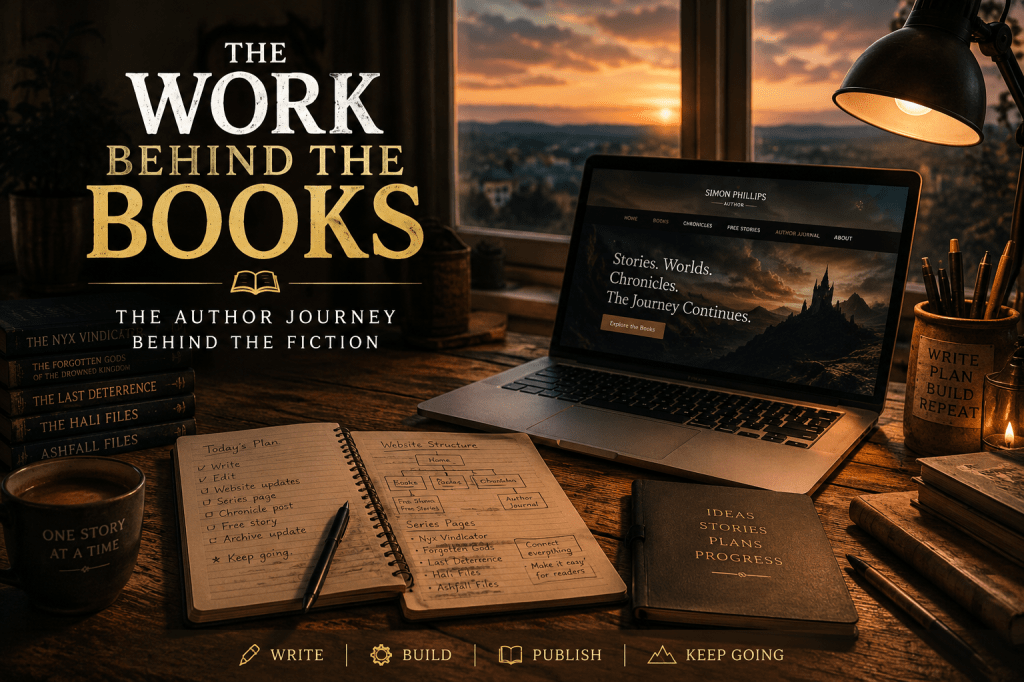
The Work Behind the Books

Why I Wanted to Start This Section

Most author websites naturally place the finished book first. That makes sense, because the book is usually the reason someone has arrived on the site. A reader wants to know what the story is, what kind of world they are entering, where to begin, and whether there is another book waiting after the first one.

I still want that to remain true here. The books, stories, series pages, Chronicles, free fiction, and paid archive are the main parts of this website. They are the reason the site exists. They are also the work I want readers to find, follow, and hopefully return to over time.

Even so, there is another side to the work that does not always fit neatly on a book page or a story page. It is the planning, the testing, the rebuilding, the slow decisions, and the small corrections that happen before a reader ever sees the finished result. That side is quieter, but it matters.

This Author Journey section is where I want to write about that part of the work.


What Readers Usually See First

By the time a book appears on a website, it can look fixed and simple. There is a cover, a title, a description, a purchase link, and perhaps a short note about the series. Everything seems clean because the messy part has already happened somewhere else.

The same is true of a Chronicle issue, a free story, or a new page on the site. The visible result is only the final layer. Behind it are choices about structure, timing, categories, images, links, tone, format, and how the piece fits into the wider author platform.

I have been thinking about that more as I rebuild the WordPress side of my author work. A website can easily become a list of books with a few links attached. There is nothing wrong with that in a basic sense, but it does not give much sense of the author behind the work, or the shape of the larger project being built.

I wanted a place where I could talk about that without turning every update into an announcement or a sales post.


The Work That Sits Behind a Finished Page

A lot of the work behind the books is not dramatic. It is often a matter of deciding where something belongs, what it connects to, and how a reader might find it later.

A story has to sit in the right place. A series needs a page that can grow over time. A Chronicle post needs to connect to the right branch without overwhelming the fiction it is meant to support. A free story should be easy to find, but it should not confuse the paid archive. A writing update should help readers understand what is happening without pulling attention away from the books themselves.

These decisions are small on their own, but they add up. They decide whether the website feels clear or scattered. They decide whether a reader has a simple path through the work, or whether everything becomes a pile of posts with no real direction.

That is one reason I have been treating WordPress as a serious part of the author platform rather than a spare noticeboard. I do not want the site to exist only as a bridge to somewhere else. I want it to hold the books, the story worlds, the Chronicles, the free fiction, the paid material, and the author updates in one organised place.


Building the Website Around the Fiction

The website is being built around the fiction first. That matters to me because it keeps the whole project honest.

The series pages are there for the books. The Chronicle branches are there to support discovery and give readers another route into the work. The free stories are there to let readers try the fiction without needing to pay first. The paid archive gives some of the longer material a proper home. The Author Journal sits beside those things, but it does not replace them.

That balance is important. I do not want the website to become a general blog where the books are pushed into the background. I also do not want every post to feel as though it is trying to sell something. Readers can usually sense that, and I do not think it helps build trust.

For me, the better path is to show the work clearly. Some posts will be about new stories or releases. Some will be about changes to the website. Some will be about what I am learning as I publish, organise, and keep going. The fiction remains the centre, but the process around it can still be worth sharing.


Why Every Update Should Not Be an Advertisement

A book advertisement has its place. A release post has its place. A paid archive update also has its place. Those posts are useful because readers need to know what is available and where to find it.

Still, if every update is only about buying, subscribing, or clicking through to something, the author begins to disappear behind the promotion. That is not what I want from this section.

I want some posts to feel quieter than that. I want room to write about decisions that are still forming, changes that have taken longer than expected, and practical lessons that might not sound impressive but are part of building something that lasts.

There is also value in admitting that not every part of the work is clean or fast. Some pages need rebuilding. Some ideas need sorting out before they make sense. Some stories take longer to place within the wider structure. Some plans look clear at the start and then need adjusting once the real work begins.

That does not mean the project is failing. It usually means the project is becoming more honest.


Writing Around Real Life

Another reason I wanted this section is that writing does not happen in a perfect empty space. It happens around work, family, tiredness, time pressure, and ordinary responsibilities. I do not want to turn that into the main subject of the website, but it is part of the truth behind the books.

There are days when the work moves quickly. There are other days when the most useful thing I can do is fix a category, update a page, make a note for a future story, or check whether the website still makes sense from a reader’s point of view. That kind of progress does not look impressive from outside, but it keeps the larger structure moving.

I have learned to take those smaller steps more seriously. A finished story matters, of course. A published book matters. A complete series page matters. Still, the quiet maintenance matters too, because without it the website becomes harder to use and the work becomes harder to follow.

The long-term goal is not to appear busy. The goal is to keep building in a way that readers can understand.


The Value of Small Progress

One thing I have had to accept is that slow progress is still progress when it is moving in the right direction. That sounds simple, but it is easy to forget when there are several books, several story worlds, different content streams, and a website that needs to hold all of them properly.

Small progress might mean writing a post like this. It might mean making the Author Journey section clearer. It might mean giving the Monthly Free Stories page a proper place. It might mean making sure a Chronicle issue links back to the right series page. It might mean writing a better excerpt, choosing a cleaner title, or deciding that a page should not try to do too many jobs at once.

Those things are not as visible as a new book cover, but they shape how the whole site works. They help the fiction feel less scattered. They also help me see the project more clearly as I build it.

That is one of the main reasons I want to write these posts. They give me a place to record the practical thinking behind the work while giving readers a clearer sense of what is being built.


What I Will Share Here

This section will mostly be about the writing life behind the books and the author platform around them. I expect to write about story progress, series planning, publishing decisions, KDP lessons, website building, WordPress changes, Substack reflections, YouTube experiments, mini-reads, free stories, paid archive updates, and the slow discipline of keeping a large fiction project organised.

Some posts may be simple progress notes. Others may look at a decision in more detail, such as why a page was added, why a series needs its own hub, or why free fiction belongs beside paid content. There may also be posts about setbacks, tiredness, false starts, and the problem of trying to build a writing career in real life rather than in theory.

What I do not want is a section full of empty advice. I am still learning many parts of this. I would rather write honestly about what I am trying, what has helped, what has been slower than expected, and what I am changing as the work develops.

That feels more useful than pretending everything was planned perfectly from the beginning.


Where This Fits on the Website

The Author Journey section is a support layer for the main website. It is here for readers who want to know more about the person building the books, the choices behind the site, and the practical work that sits around the fiction.

It should not take over from the books themselves. The series pages, Chronicle branches, free stories, paid archive, and main book pages remain the main paths through the site. This section simply gives those paths some human context.

I think that matters, especially with a site that is carrying several types of content. A reader might arrive through a free story, a Chronicle issue, a book page, or a post about the writing process. However they arrive, I want the site to feel connected rather than random.

That means building slowly, making careful decisions, and accepting that some of the less visible work is still part of the author life.


A Quiet Starting Point

This first post is not a major announcement. It is simply a starting point for a section I think the website needs.

There will still be book updates, story releases, Chronicle posts, free fiction, and paid material. Those are the main reasons the site exists. This section will sit beside them as a place for the quieter work: the planning, the lessons, the adjustments, the doubts, the useful mistakes, and the small steps that help the whole platform become clearer over time.

If you are here for the fiction, that remains the best place to begin. The books and stories are the centre of the site. If you also want to follow how the work is being built behind the scenes, this is where I will write about it.

I will keep adding updates as the site develops.

The Fires of Heaven by Robert Jordan: When The Wheel of Time Begins to Move Under Its Own Weight

There are fantasy novels that widen a series, and there are fantasy novels that make expansion feel dangerous. The Fires of Heaven belongs to the second kind.

By the time Robert Jordan reaches Book Five of The Wheel of Time, the world has already grown vast in geography, history, prophecy, factional strain, and remembered grievance. This novel gives that vastness motion. Armies begin crossing the land. Institutions begin splitting under pressure. Old certainties lose their shape. The Dragon Reborn stands closer to the centre of everything, and each step towards power seems to draw him further from ordinary life.

That shift gives the book its force. Earlier volumes often carried the feeling of a dangerous road opening ahead. The Fires of Heaven carries a different sensation: the road has already opened, and the world itself has started moving along it. The result feels heavier, more political, more emotionally charged. It reads like a point of no easy return.


A World Moving Under Its Own Weight

The clearest strength of The Fires of Heaven lies in the way Jordan makes consequence spread. Rand’s rise affects rulers, armies, religious authority, Aiel clans, Aes Sedai politics, and every person trying to decide what the Dragon Reborn means for their future. The novel feels less like a sequence of quests and more like the first great shaking of a continent.

In a weaker series, scale can become decoration. Jordan turns scale into pressure. Distance matters. Rumour matters. A command given in one place changes the atmosphere somewhere far away. A political fracture creates personal danger. A march across open land carries the weight of hunger, confusion, belief, and fear. The book gains its depth through this accumulation.

The Shaido Aiel become one of the clearest signs of that movement. Their advance gives the novel a harsh sense of momentum, an approaching force moving beyond the control of any single character. At the same time, the White Tower’s fracture opens another line of instability. The institutions meant to guide events now pull in divided directions. Power has multiplied; order has thinned.

Jordan gives the world a sense of gathering strain. Each major thread seems to press against another. Military movement meets political fracture. Prophecy meets personality. Ancient obligation meets present fear. The series had already grown large before this book. Here, largeness begins carrying weight.

What makes that weight so effective is Jordan’s refusal to treat world events as distant background. Every widening conflict settles somewhere close to the characters. It shapes the way people speak, the risks they accept, the loyalties they cling to, and the speed with which fear spreads through a camp, a city, or a court. The larger story never floats above the human one. It bears down on it.

Rand’s presence intensifies that effect. He has become too important for any place to remain untouched by him for long. Even people who have never seen him are forced to live in the shadow of what he represents. Some see salvation. Some see upheaval. Some see a threat to structures that once seemed permanent. Jordan allows those responses to coexist, which gives the world a convincing instability. The Dragon Reborn has arrived, yet agreement over what that means remains far away.

That is why The Fires of Heaven feels so powerful as a middle-book novel. It expands the series while tightening its pressure. The world opens further, yet the room around the characters feels smaller. Choices begin closing paths instead of revealing them. The age ahead remains vast, though this book makes clear that no one will enter it unchanged.


Scale Beyond Spectacle

Epic fantasy can chase scale through battles, councils, prophecies, and named threats. Jordan reaches scale through consequence. The Shaido advance matters less as a single danger than as proof that the world can now be thrown out of alignment by the conflicts gathered around Rand. The White Tower fracture matters because knowledge, legitimacy, and guidance have split. Rhuidean’s instability matters because the past is no longer safely contained in memory. Across the novel, each movement suggests that history has grown restless.

That creates a richer effect than simple escalation. The book rarely needs to announce that events are larger now. The reader feels it through how many lives seem exposed to each choice. A character can speak in private, and the consequences seem to echo across borders. A leadership decision can carry the threat of famine, war, or political fracture. Jordan’s scale remains human because the pressure always travels back into people.

This is one of the reasons The Fires of Heaven feels so substantial. It offers major fantasy spectacle, yet spectacle serves a larger design. The action matters because the world around it has been prepared with care. When violence arrives, it lands inside history, loyalty, command, and fear. The result feels earned.


Rand al’Thor and the Cost of Becoming Central

Rand remains the emotional centre of the review for me, because Jordan refuses to treat power as simple escalation. Rand grows stronger, and the more authority he gathers, the more his life narrows around duty. He has followers, advisers, allies, and enemies, and the burden settles inward. Every choice carries a larger human cost. Every refusal leaves consequences behind. Every act of leadership separates him a little further from the young man who once left the Two Rivers.

The Fires of Heaven captures that transition with real power. Rand’s path grows darker here, though darkness arrives less through spectacle than through strain. He has seen enough to understand the scale of what faces him. He has gained enough power to act. He lacks the peace required to carry that power cleanly. Jordan lets those elements grind against one another.

That tension gives Rand’s chapters a charged quality. Even moments of planning and conversation feel edged by expectation. Someone always wants something from him. Someone always fears him. Someone always believes they know what he should become. The prophecy surrounding him has ceased to feel distant. It has entered the room.

His relationship with Moiraine also gains sharper emotional weight. Their conversations carry accumulated frustration, trust, pride, and urgency. She understands the danger of delay. Rand understands the danger of surrendering his judgement. Their friction lends the novel some of its finest quiet tension, because Jordan allows care and conflict to occupy the same space.

What makes Rand compelling here is the sense that he remains aware of the damage surrounding him, even as the scale of events keeps forcing him forward. He has power, yet power offers no clean shelter. He stands at the centre of a widening storm, and the storm has begun speaking through every decision he makes.


Heat, Dust, Stone, and Gathering Force

Jordan’s fantasy landscapes matter. The Waste, the camps, the roads, the halls of authority, the spaces where characters measure one another through etiquette and restraint, all contribute to the novel’s feel. This book carries heat. It carries dust. It carries stone cities, tense rooms, and the stale breath of politics under strain.

Atmosphere in Jordan often works through material detail, customs, clothing, gesture, ritual, weather, and repetition of social behaviour. Those passages give the plot texture before crisis. The world seems inhabited long before danger reaches its peak. People live inside traditions that pre-date the scene before us. Their choices grow from those traditions, even when those choices push the world towards upheaval.

That quality matters in The Fires of Heaven. The novel’s conflicts gain force because Jordan spends time making societies feel lived-in. Aiel custom has weight because it reaches into personal honour, clan memory, leadership, shame, and belonging. Aes Sedai politics has weight because the Tower carries centuries of authority. Rand’s actions matter because the world he touches has depth before he touches it.

The book’s atmosphere comes from this sense of inheritance. Everyone seems to be carrying something handed down from the past. Sometimes it is duty. Sometimes it is fear. Sometimes it is a belief that has grown too rigid to survive the age arriving around it.


Mat Cauthon Becomes Far More Compelling

If Rand carries the novel’s burden, Mat carries one of its great pleasures. By this point, Mat has already become far more than comic friction or reluctant companion. The Fires of Heaven brings his instincts, memory, and unwilling competence into sharper focus. He keeps trying to move away from destiny, and destiny keeps finding useful ground beneath his feet.

What makes Mat so compelling here is the tension between what he says he wants and what he repeatedly proves capable of doing. He speaks like a man seeking escape. He acts like someone others will follow when the ground turns dangerous. Jordan lets this emerge through pressure, movement, and decision, which makes it far more satisfying than any blunt declaration of importance.

His presence gives the book a welcome shift in texture. Rand’s scenes often carry the ache of command. Mat’s scenes carry energy, surprise, and a sense of capability arriving almost against his own wishes. He creates motion simply by being placed near danger. By the time the novel settles into its later movements, he feels essential.

Mat also gives the series a different emotional flavour. He resists solemnity. He distrusts grand declarations. He keeps one foot pointed towards freedom even while events continue drawing him into history. That makes his growth feel alive. His importance develops through contradiction, instinct, and action, which suits him perfectly.


Rand and Mat as Two Different Answers to Pressure

One of the reasons the novel feels so satisfying is the contrast between Rand and Mat. Rand increasingly accepts that escape has vanished. Mat keeps insisting he seeks escape even as responsibility discovers him again and again. Their paths speak to two different responses to the same widening world.

Rand becomes more deliberate, more severe, more aware of what people expect from him. Mat remains restless, irreverent, and surprisingly lucid whenever danger clears the air. Rand feels history closing around him. Mat feels history snatching at his sleeve while he swears he has somewhere else to be. Both are compelling, and together they give the novel a strong emotional balance.

The contrast matters because Jordan avoids repeating the same heroic arc through different characters. Rand’s burden grows through command, prophecy, fear, and isolation. Mat’s burden grows through competence, chance, memory, and the inability to walk away once real lives depend on him. The reader watches identity form under pressure in two very different shapes.

That dual movement gives The Fires of Heaven much of its energy. The book can feel heavy in one chapter and suddenly quicken in another. It can hold great political strain, then shift into the sharper vitality Mat brings whenever he enters a dangerous situation. The range strengthens the entire novel.


The Wider Cast Keeps the Series Open

Even as Rand and Mat deliver much of the novel’s force, the wider cast helps keep the series expansive. Jordan refuses to collapse the world into a single heroic line. Other threads continue to carry political uncertainty, personal friction, magical danger, and the wider consequences of institutional collapse. That breadth can demand concentration, yet it preserves the scale that makes the series distinctive.

For me, Rand and Mat provide the clearest emotional through-line, yet the surrounding cast prevents the novel from becoming narrow. The world remains larger than any one figure, even the Dragon Reborn. Other characters carry their own hopes, mistakes, grudges, loyalties, and acts of courage. Jordan allows that complexity to remain visible.

That choice also matters structurally. A world threatened at this level should feel larger than any one protagonist. The Fires of Heaven sustains that feeling. It allows pressure to develop on several fronts, which means the reader senses history forming in overlapping directions.


The Series Shifts from Journey to Consequence

The phrase that keeps returning to me is simple: this is where The Wheel of Time stops feeling like a journey and starts feeling like a world moving under its own weight. That change explains why the book lingers. The earlier novels established landscape, myth, faction, threat, and wonder. The Fires of Heaven shows those elements colliding with greater force.

Jordan’s world has always felt broad. Here it feels active. The political order shifts. Military danger grows. The Forsaken press closer against the edges of events. Characters once defined by movement now become defined by consequence. Where they stand begins to matter as much as where they travel.

This is also why the book feels like such a strong middle-series experience. Middle volumes can sometimes serve as bridges between major turning points. The Fires of Heaven feels larger than a bridge. It takes everything already built and turns it towards collision. The scale keeps opening, yet the story never loses the sense that individual lives are being squeezed inside it.


Robert Jordan’s Great Strength: Accumulation

Jordan’s great gift in this novel lies in accumulation. He builds pressure through customs, councils, terrain, memory, warnings, jealousy, devotion, and unease. Scenes grow meaningful because of everything surrounding them. A military decision carries history inside it. A conversation carries institutional fear. A character’s silence can hold more weight than another author’s battle cry.

That style asks patience from the reader. It rewards attention in equal measure. The pleasure comes from feeling the world gain density while the narrative keeps drawing its threads tighter. Jordan trusts the reader to remain inside long stretches of preparation, friction, travel, and political positioning because he understands the release those stretches create once events turn.

By Book Five, that method has become one of the series’ defining strengths. The world has memory. People react to earlier choices. Institutions carry old habits into new crises. Very little feels created only for the immediate scene. The novel gains authority through that depth.


Why the Later Movement Lands

Keeping late-book revelations aside, the closing movement gains power because the novel has spent so long tightening its world. Events feel earned. Emotions feel prepared. The later chapters draw on tensions laid down across politics, loyalty, memory, and pride. Jordan allows release, yet he preserves cost.

That is a key reason the book feels so complete as a reading experience. It opens outward through war, prophecy, and unstable institutions, then gathers its emotional force around characters who have been carrying too much for too long. The closing impact grows from pressure, more than spectacle.

Even after finishing, the book leaves behind the sense that the series has crossed a threshold. The world feels more unstable. The central characters feel less sheltered. The stakes feel less theoretical. The future of the series lies far ahead, yet its harsher shape has begun to appear.


Final Reflection

When I think about the book after finishing it, the scenes remain vivid, though the deeper impression comes from movement. Everything feels closer. The final shape of the series lies far ahead, yet the pressure of that future has already entered the present. People move faster. Powers reveal sharper edges. The old road-story comfort recedes.

That is why I place The Fires of Heaven among the strongest middle-book experiences in epic fantasy. It expands with confidence, deepens key characters, gives Mat one of his great rises in significance, and pushes Rand into a more severe relationship with power. Above all, it makes the world feel alive in a new way.

The Wheel has gathered momentum. From here, it turns with greater force.

When Writing Becomes More Than a Hobby

You know what I’ve realised lately?

Writing, not just novels but short stories, flash fiction, even blog posts, has become more enjoyable to me than watching TV. More than movies. Sometimes, even more than reading.

Don’t get me wrong, I still love a good story in any form. But there’s something different about sitting down with a blank page. Something alive. It’s not passive, it’s creation. Every sentence, every scene, is something I get to build. To breathe life into.

It’s strange, isn’t it? We spend so much of our lives consuming stories, but when you start creating them, time shifts. You stop watching from the outside and begin shaping the inside, the heartbeat of the world you’re building.

And it’s not just about finishing something. It’s about the act itself, the quiet joy of shaping a world from nothing, of following a character you didn’t plan to meet, of reaching a line and thinking, Ah. That one was honest.

Writing has become my pause in the noise, a place where time disappears, yet I feel more present than anywhere else. It’s where I find myself again.

So I wonder, does anyone else feel this? Has writing ever felt more fulfilling than bingeing a series? More grounding than scrolling through a feed?

If so, I’d love to hear your thoughts. Because for me, writing isn’t just a pastime anymore. It’s where life slows down just enough for meaning to take shape.

Watch the video here: Why Writing Feels Better Than Watching TV | Life as an Author