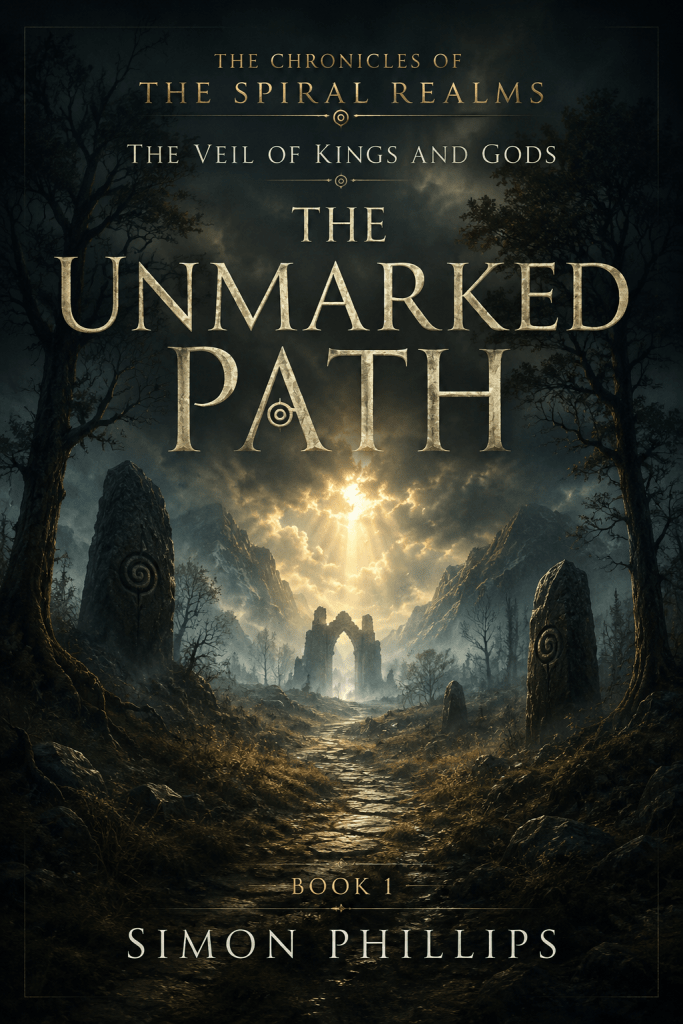
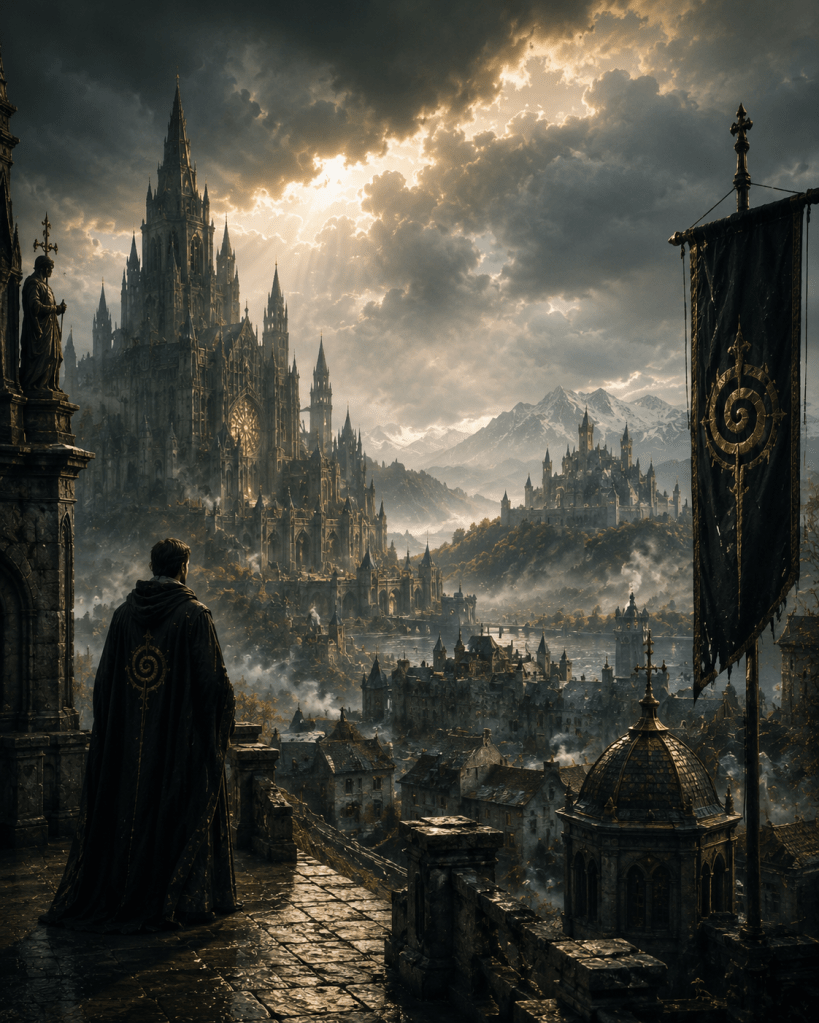
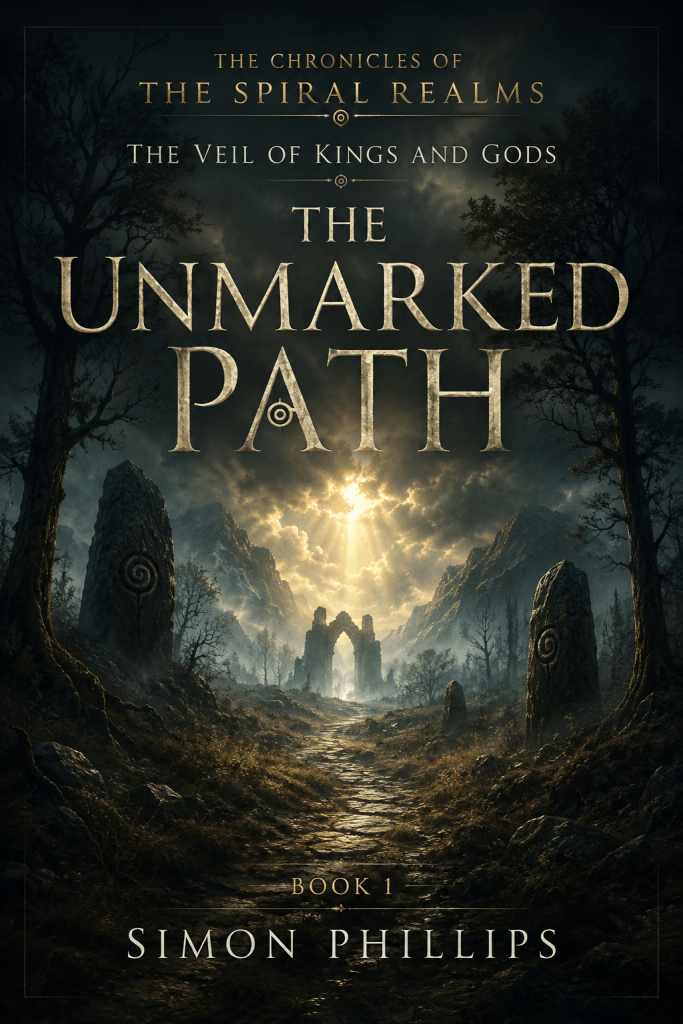
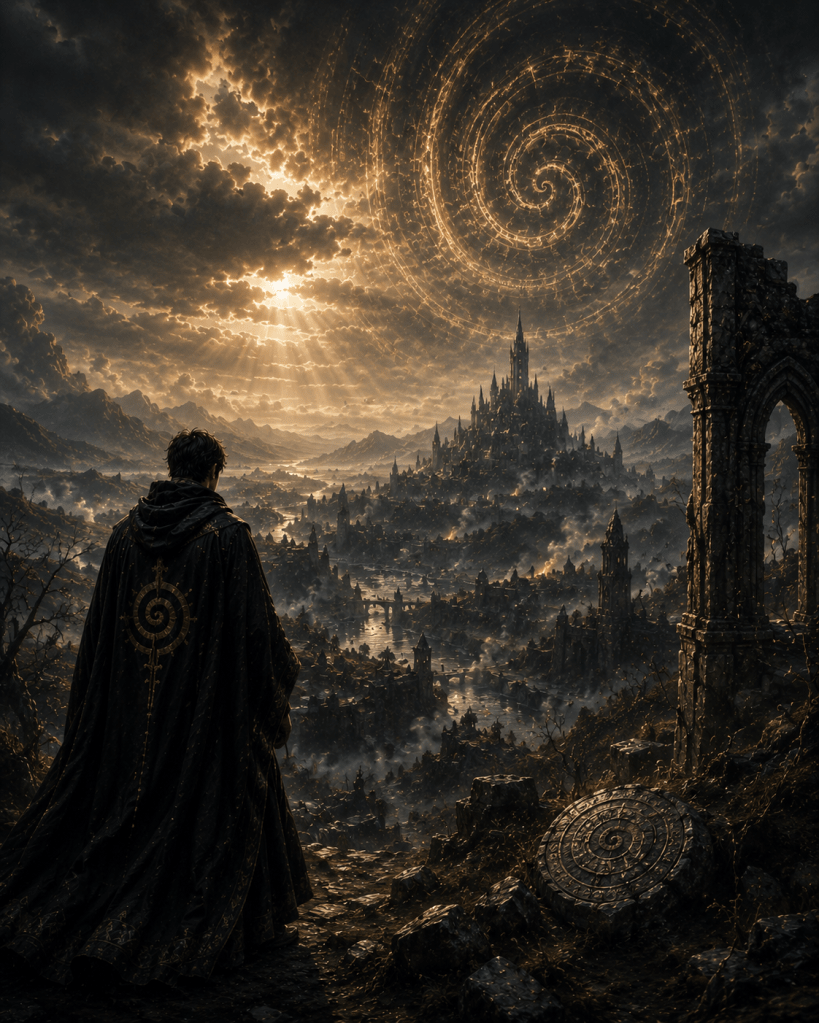
Some castles preserve the authority of the families who rule them, while others appear to retain every footstep, fear, and unfinished secret carried through their halls. Bremyra Castle belongs to the second kind. Its stone corridors have witnessed royal childhoods, political marriages, religious authority, private loss, and the uneasy return of magic to a kingdom that has learned to fear those who wield it.
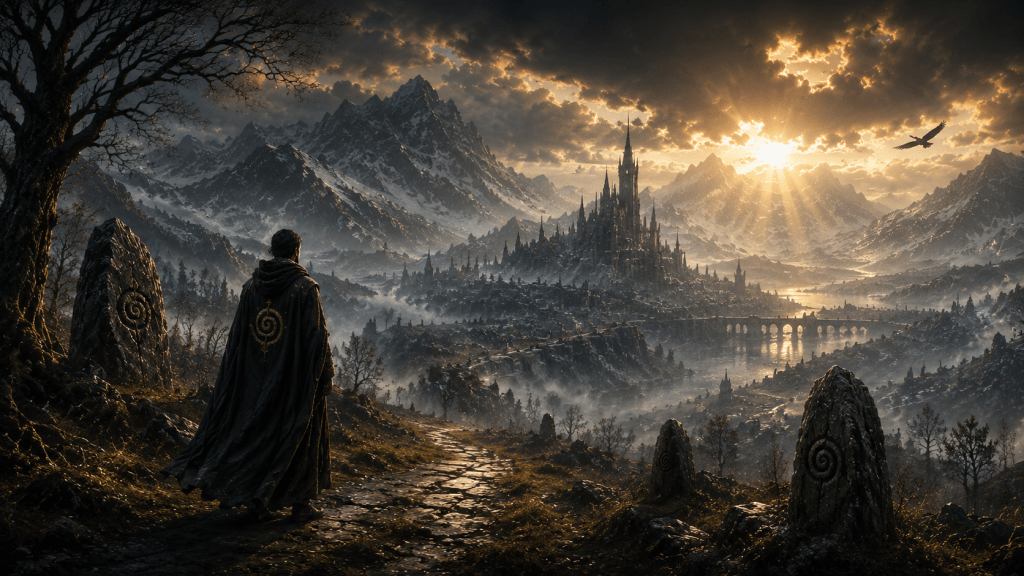
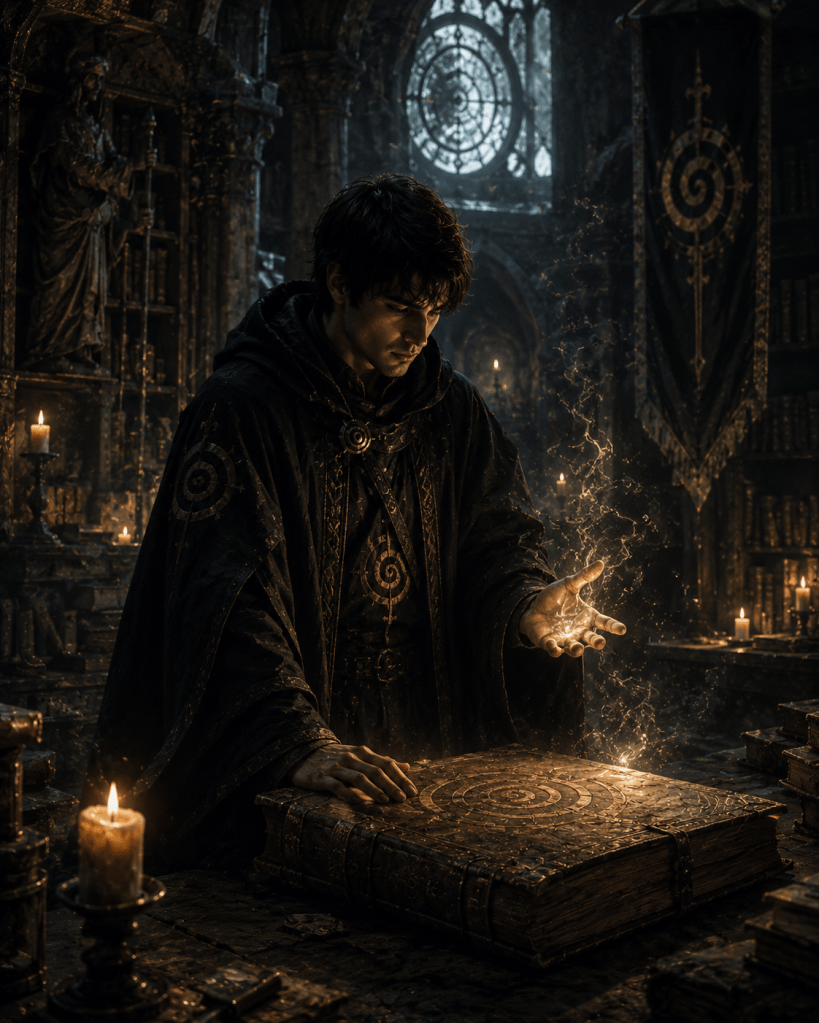
In The Unmarked Path, Book I of The Veil of Kings and Gods, Simion returns to those halls wearing the black robes of the Order of Magicians. He once crossed the same floors as a kitchen boy, almost invisible to the nobles, servants, and guards surrounding him. Years later, his robes command distance and fearful respect, though the castle itself appears to remember the boy beneath them.
The illustrated mini-read accompanying this article captures the moment when that memory begins to open.
Watch the Illustrated Mini-Read
The scene begins with a whisper so faint that Simion first mistakes it for memory. It brushes the edge of his thoughts as he walks through Bremyra’s familiar corridors, where every turn carries traces of a life he can no longer reclaim. The voice grows clearer as he moves, drawing him away from the inhabited chambers of the castle and towards its towering royal library.
Nothing rushes forward to announce the danger. No creature emerges from the shadows, and no great spell tears through the stone. The unease gathers through smaller movements: a voice without a visible speaker, carvings that seem to breathe beneath flickering light, and enormous oak doors whose silence feels strangely expectant.
By the time Simion enters the library, memory has become summons.
Returning to a Place That No Longer Knows Him
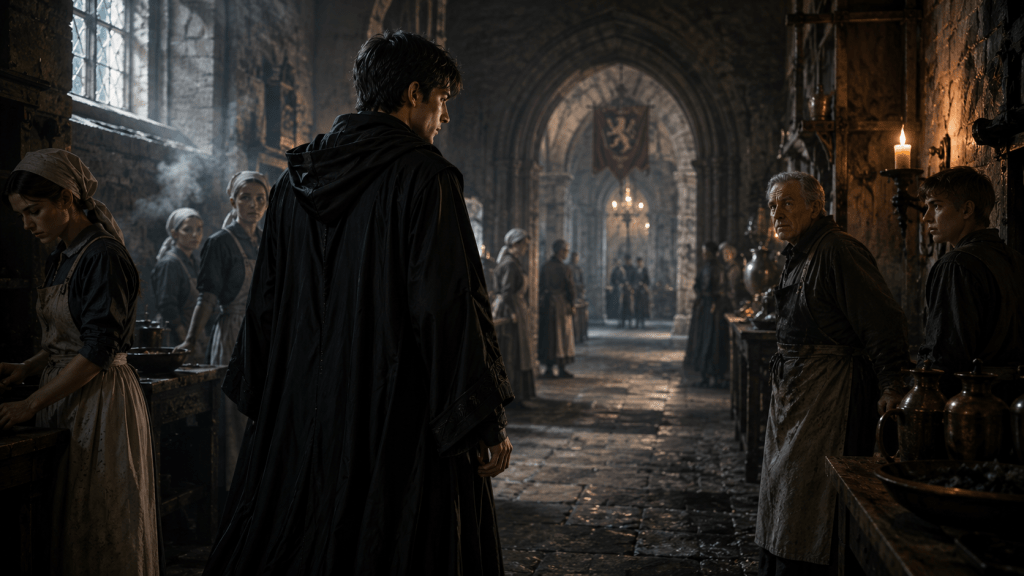
Simion’s return to Bremyra carries a tension deeper than simple nostalgia. The castle formed the boundaries of his childhood, although his place within it remained small. He worked among servants, scrubbed pots, carried trays, and stole brief moments of friendship with Prince Patrick and Princess Elana. Those memories remain warm in places, yet time and rank have altered every relationship surrounding them.
The servants who once worked beside him now lower their eyes. Courtiers measure their words in his presence. The Church watches him with suspicion, while the crown seeks answers from an Order whose motives remain carefully guarded. Simion has gained status, access, and power, though each of those gifts has placed another layer of distance between him and the life he remembers.
This separation gives the library scene its emotional force. The hidden passage appears inside a place tied to his former life, yet it opens for the magician he has become. Bremyra remembers both versions of him, even when its people recognise only one.
The voice calls him by drawing those identities together.
A Castle Built Above Forgotten History
Bremyra stands at the meeting point of royal, religious, and magical authority. The castle governs the kingdom, the cathedral shapes its faith, and the old magician’s manor remains as an uneasy reminder of the Order’s former influence. Beneath these visible structures lies another layer of history, one shaped during the age of the Imperium Arcana.
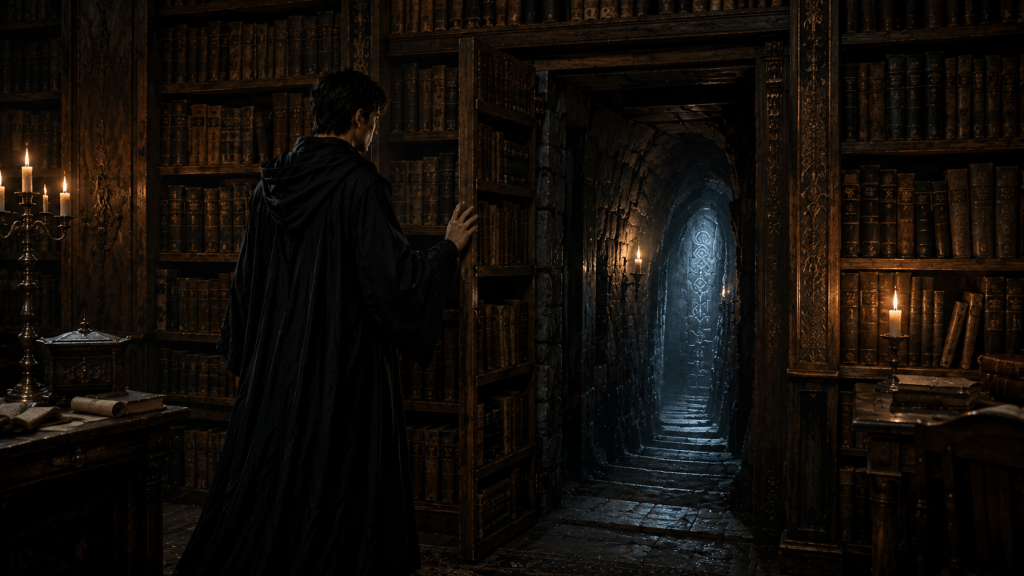
The library holds the written memory of kings. Its shelves preserve treaties, bloodlines, wars, journeys, laws, and decisions passed between generations. Behind one of those shelves lies a different kind of record, sealed within stone and kept beyond the reach of ordinary scholarship.
That contrast shapes the hidden passage. The royal archive protects what rulers chose to preserve, while the concealed chamber guards what the world attempted to bury.
Simion arrives at the precise point where those forms of memory begin pressing against one another. His hand touches the shelf, a mechanism answers, and the structure of the castle alters around him. What appeared complete reveals another depth. What seemed dormant reveals awareness.
The discovery suggests that Bremyra’s foundations were laid across histories its present rulers scarcely understand.
Simion Before the World Understands Him
Powerful fantasy figures are often introduced after their reputations have settled around them. Simion enters The Unmarked Path at a far earlier and more vulnerable stage. He carries the robes of a magician, yet uncertainty follows him into every chamber. His training has given him discipline and access to forces most people fear, while leaving him painfully conscious of the skills that resist him.
He approaches the library without the certainty of a man already crowned by destiny. He hesitates before the doors. He listens to the voice. His hand hovers above the iron handle because some part of him recognises that crossing the threshold will change the shape of his mission.
That hesitation matters.
Simion possesses enough knowledge to recognise danger, while lacking the knowledge required to name its source. He senses power in the castle, though its purpose remains veiled. He knows the Order has sent him to investigate missing magicians, yet the deeper force moving beneath Bremyra lies outside the task he believed he had accepted.
The world has begun to respond to him before he understands why.
This makes his journey human. His importance emerges through pressure, uncertainty, and the slow recognition that forces older than the Order have started drawing him towards them.
The Library as a Threshold
Libraries in fantasy frequently promise knowledge, safety, or sanctuary. Bremyra’s library offers something more severe. It forms a border between the history people can read and the history that continues to act upon them.
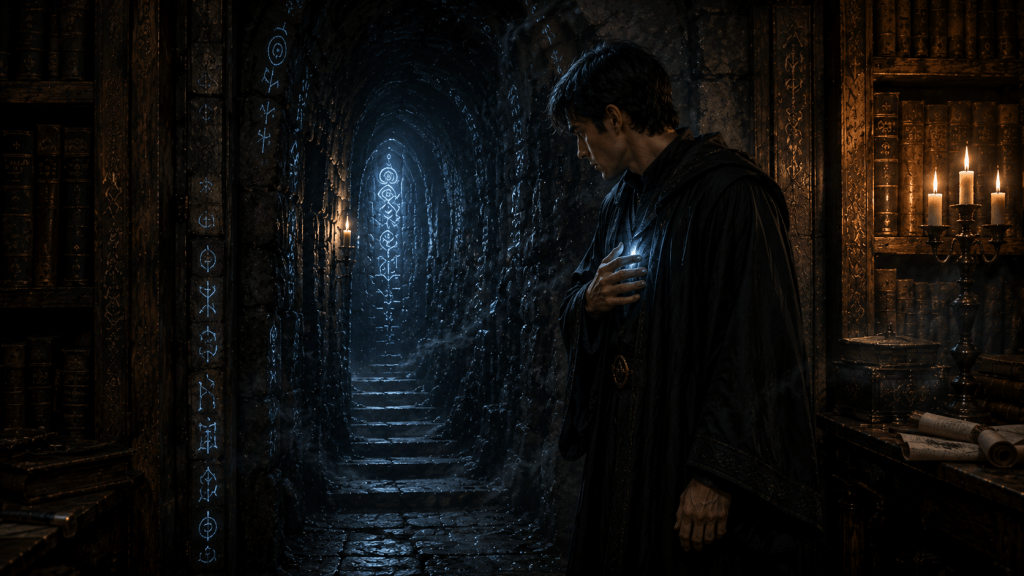
The towering doors create the first boundary. Their carved surfaces appear almost alive beneath the shifting torchlight, giving the architecture an unsettling patience. Once Simion enters, the scent of parchment and aged wood briefly restores a sense of order. Shelves rise in careful rows, old desks wait beneath the shadows, and generations of written thought remain where scholars left them.
Then his fingers touch the wood.
The faint click changes the meaning of everything around him. A hidden mechanism shifts with impossible precision, carrying an entire section of shelving aside. Cold air reaches into the library, disturbing dust and flame, while a low hum answers through Simion’s chest.
The secret becomes physical. It moves through the stone, the air, and his own body.
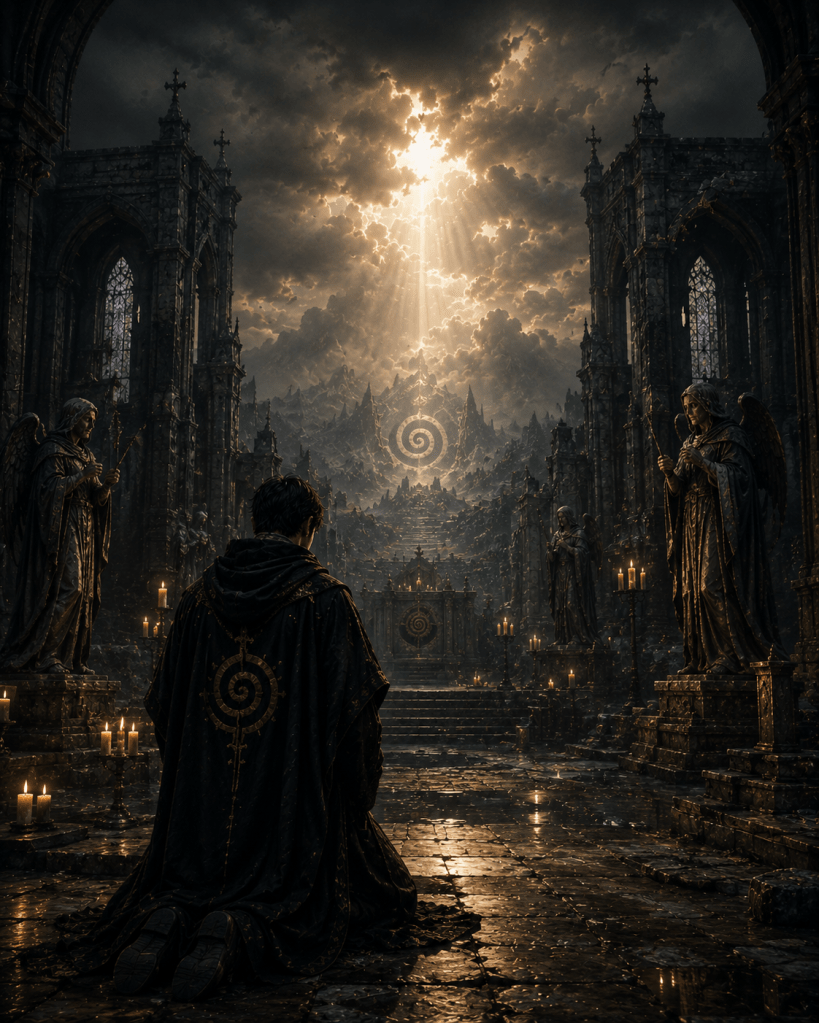
The scene ends at the threshold because the threshold carries greater power than an immediate answer. The passage stands open, the darkness waits beyond it, and Simion faces the point where curiosity becomes obligation.
The viewer receives the same choice.
Magic That Remembers
Magic within Ældorra carries age, structure, and consequence. It exists within institutions such as the Order, within the Church’s guarded authority, within ruined remnants of the Imperium Arcana, and within objects whose original purpose has slipped beyond present understanding.
It also remembers.
That quality separates the passage from an ordinary secret room. The mechanism resembles forgotten craftsmanship, yet the force guiding Simion towards it feels aware of presence and timing. He finds the correct shelf because the whisper draws him there. The hidden way opens because something beneath the castle has begun to move again.
The castle becomes part of that movement. Stone, timber, dust, and darkness serve as the visible surface of a much older design.
This early moment introduces one of the central pressures within The Veil of Kings and Gods. The present world believes itself governed by crowns, councils, religious offices, and the Order’s laws. Older forces remain embedded beneath every structure of authority, waiting for the balance to shift far enough for them to return.
Simion hears the first call before anyone around him understands that the silence has ended.
Political Pressure Above the Hidden Passage
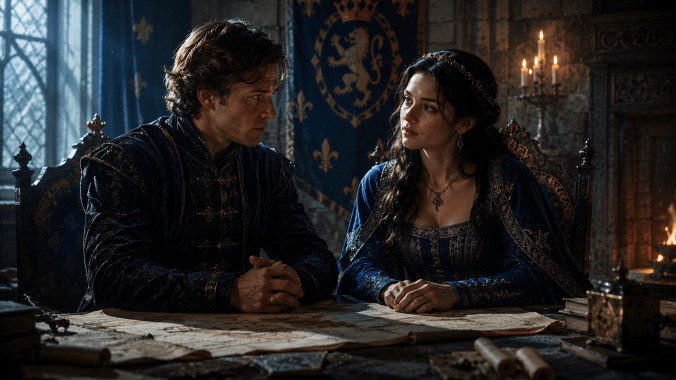
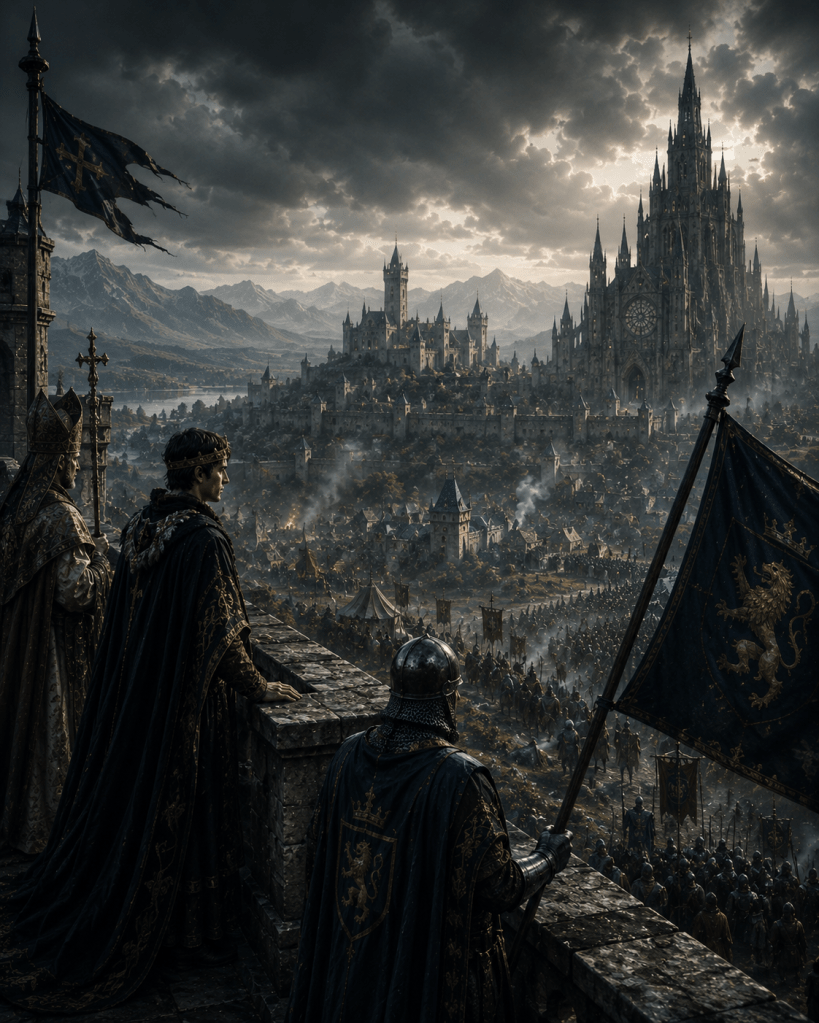
The secret beneath Bremyra gains further meaning through everything unfolding above it. Prince Patrick carries the burden of ruling while his father and elder brothers remain absent. The kingdom faces political uncertainty, growing tension with Arvendral, and rumours of foreign movement beyond its borders. Princess Elana prepares to leave for a marriage shaped by alliance and royal duty. Archbishop Alaric Thorne watches the Order with a suspicion rooted in generations of conflict.
Each character faces a path shaped partly by forces beyond personal desire. Simion’s path merely takes a physical form.
Patrick confronts sealed letters, council demands, and the growing shadow of a crown he was never raised to inherit. Simion confronts a concealed door within the kingdom’s own memory. Both stand before structures passed down from earlier generations, and both must decide how far inherited authority can guide them when the world begins revealing dangers their institutions failed to understand.
This parallel movement gives The Unmarked Path its wider shape. The story moves between Bremyra’s stone halls and the northern seas, between court pressure and approaching conflict, allowing distant events to gather towards one another before the people caught within them can see the complete design.
The hidden passage is one movement within a much larger turning.
The World Beyond Bremyra
While Simion follows whispers through the castle, Týrnan Valgrim crosses the northern seas with the Frostbane. His longboats enter storms, foreign waters, and a campaign shaped by clan duty, faith, conquest, and the ambitions of the High Chieftain.
The distance between Bremyra and the Frozen North creates the impression of separate stories unfolding across Ældorra. One follows a magician searching through hidden history. Another follows a war leader carrying his people towards violence and uncertain purpose. Between them stands Patrick, whose kingdom may soon feel the consequences of movements far beyond his court.
The reader sees the pressure gathering across different landscapes before the characters can recognise their connection. Magic awakens beneath stone. Armies move across water. The Church defends its influence. The Order searches for its missing members. Royal alliances tighten around men and women whose private wishes have little influence over the duties placed upon them.
History has begun drawing these lives into the same current.
Why This Scene Opens the Door to the Series
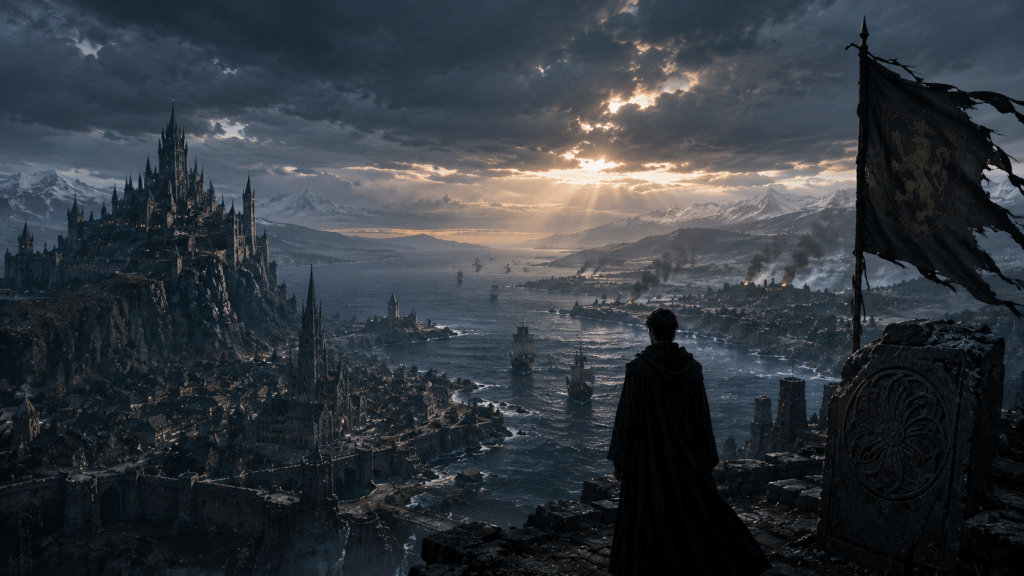
The illustrated mini-read offers a natural entrance into The Unmarked Path because it captures the atmosphere of the wider story without surrendering its answers. Viewers encounter Simion at a moment of movement, enter Bremyra at its most secretive, and feel the first pressure of ancient magic stirring beneath the visible world.
The scene also expresses the heart of the book. These characters begin changing before they understand the forces causing that change. Simion receives a summons from beneath the castle. Patrick feels the crown moving closer while his family remains absent. Týrnan sails towards a campaign whose true scale remains hidden. Elana walks towards a political marriage while reading the dangers gathering around her brother and kingdom.
Their paths appear separate, though each carries a burden shaped by authority, memory, and expectation. Beneath them, older powers have begun bringing the world into alignment.
The concealed passage provides one small opening into that movement. Once it appears, Simion can no longer pretend that his mission concerns only missing magicians or the guarded demands of the Council of Five.
Something beneath Bremyra has recognised him.
Read The Unmarked Path
The Unmarked Path is Book I of The Veil of Kings and Gods, set within The Chronicles of the Spiral Realms. It introduces Simion, Prince Patrick, Princess Elana, Týrnan Valgrim, the Order of Magicians, the Church, and the first signs of a struggle rooted in forgotten history, divine silence, political fracture, and the return of ancient power.
Readers drawn to immersive high fantasy, forbidden magic, political tension, hidden archives, old kingdoms, religious conflict, and characters caught between duty and forces beyond their understanding will find their first threshold here.
Bremyra’s library has opened upon a path concealed for generations, and Simion now stands before a darkness that appears to have been waiting for him alone.