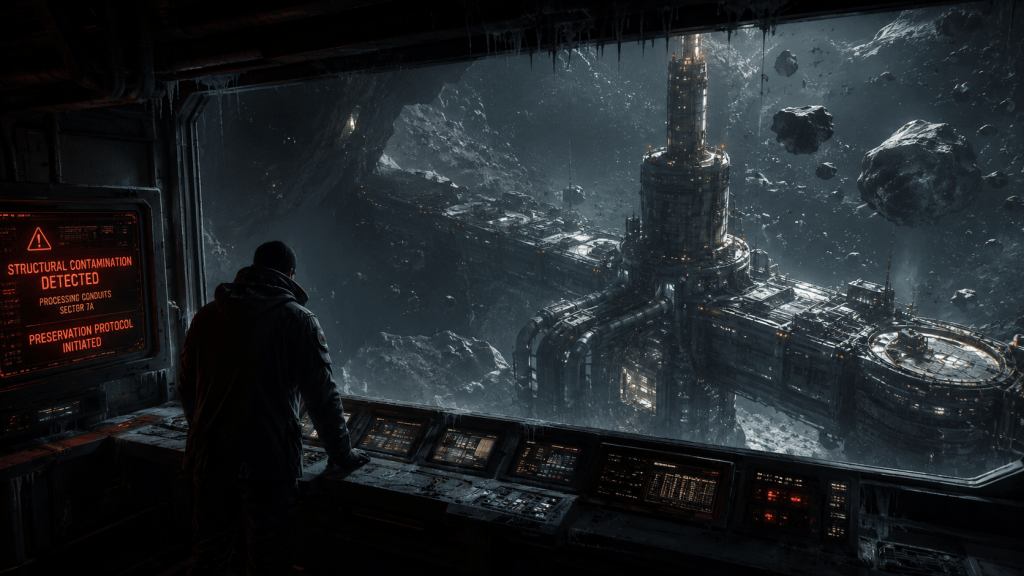
A low-power mining relay flagged structural contamination inside its processing conduits, then dropped into cold preservation mode as the crew began gathering near the vents.
Chronicle Opening: Preservation Load
Processing Relay Kheled-Three had been built inside the shadowed side of a nickel-iron body that never turned its face fully towards the system’s small blue-white sun. From the exterior cameras, the relay looked less like a station than a wound cut through old rock and lined with steel, its refinery spine driven deep through the asteroid, its docking collar fixed to a shallow crater rim, its ore conduits running in ribbed bands towards storage drums clustered along the lower hull. Inside, the working decks held a permanent cold that entered clothing before the shift began and stayed in the joints after sleep. Air came through the grilles in slow measured draws, thin with processed mineral dust and filter resin, while the floor carried the patient tremor of crushers, separators, pumps, and coolant exchangers pushing labour through metal long after the people inside had stopped trusting the sound.
Lena Orv had learned the relay through those sounds over eight years of maintenance watches. She knew when a bearing had warmed by the faint burr inside a bulkhead, when a coolant pump had lost pressure by the duller vibration beneath a stairwell, and when an ore gate had taken a bad bite by the way the deck answered through the soles of her boots. The relay’s boards gave numbers, warnings, and neat coloured lines for supervisors who preferred truth in square fields. Lena trusted the hull first, because the hull carried each failure before a display agreed to name it. During the third hour of the low watch, while the crew slept in Hab Ring South and the processing line ran on preservation draw, she felt the relay pause around her.
The tremor beneath the grating thinned, then returned too smoothly. Lena stood in Conduit Gallery Two with one hand inside an open service panel and her lamp hooked to the collar of her jacket, its narrow beam angled across a bundle of chilled sensor lines. The gallery ran along the old processing throat where ore slurry, heat exchange, and waste vapour crossed through stacked pipes behind protective mesh. Frost gathered around the lower clamps in hard white beads. Pale amber work lights sat at intervals along the ceiling, each one haloed by cold vapour. The relay remained awake in every official sense, power balanced, atmosphere clean, thermal load low, although the pause had moved through the space with a softness that felt too deliberate for a mechanical cough.
“Control, I have a hesitation in Gallery Two,” Lena said as she leaned closer to the panel and touched the back of her glove to the sensor casing. “Processing throat, lower exchange cluster. Give me line pressure across conduit seven.”
The answer came from Tarek Voss on the control desk, filtered through the maintenance channel and edged by the sleep he had been fighting since midnight. “Seven sits inside tolerance,” Tarek said, and Lena heard him dragging the board wider by the faint shift in his breathing. “Six is low, eight is low, seven is pretending to be the sensible child between them.”
“Seven never had that much personality,” Lena said, pressing two fingers against the casing until the cold bit through the glove seam. “Read it again from the local node instead of the central board.”
Tarek gave a small grunt over the line. “Local node takes longer in preservation draw.”
“That is why I asked for it.”
While the channel held, Lena looked past the open panel towards the service mesh on the far side of the gallery. A narrow seam of pale residue lay along the base of the grille, so faint that the lamp almost erased it when the beam crossed directly. At an angle, the residue appeared as fine ribbing threaded into the frost, less like mineral deposit than a pattern forming along places where air met metal. She lowered the lamp. The line stayed. The relay breathed through the grille in slow pulls, and the pale ribs held steady beneath the moving vapour.
Tarek returned after several seconds. “Local node reports seven stable, then corrects to minor structural contamination in the casing, then clears itself back to stable.” His voice sharpened as he read the sequence again. “That entry populated out of order.”
Lena withdrew her hand from the panel and stood fully upright. “Say the middle phrase again.”
“Minor structural contamination in the casing,” Tarek said, his earlier tiredness gone from the channel. “It self-cleared before the central board logged it.”
Lena looked at the grille. “Mark the frame. Keep the entry raw.”
“You want a contamination note raised off a self-cleared node?”
“I want the note preserved before the relay teaches itself a kinder story.”
Tarek stayed quiet for a moment, and beneath that quiet Lena heard the station drawing air through the service line above her. It moved evenly, almost soothingly, and the wrongness of that steadiness held her in place. The relay had been set to low power after a coolant imbalance across the lower processing band, a practical saving order while replacement parts crawled in from a Republic contract depot three weeks away. Most stations warmed themselves around people. Kheled-Three conserved itself around machinery, trimming heat from corridors, dimming unused rooms, slowing vent cycles across vacant decks, and keeping the processing conduits just alive enough to prevent freeze fracture. Cold had become a habit there. That night it felt more like a condition imposed by something larger than economy.
A second voice joined the maintenance channel as Mina Pell came awake in Hab Ring South, her words roughened by haste and sleep. “Lena, control called me. What has gone wrong?”
Lena turned the lamp towards the residue and angled the wrist pickup so the camera could see it. “Gallery Two. Lower exchange cluster. I have pale linework at the service grille and a node entry for structural contamination. It cleared itself.”
Mina breathed out through her nose, the sound close to irritation and concern together. “Mineral bloom loves that grille. We cleaned it last month.”
“Mineral bloom flakes when the vent pulls,” Lena said, keeping the light low. “This is sitting inside the frost.”
Tarek spoke from control, each word slower as he watched more boards wake beneath his hands. “I have a second correction from conduit nine. Structural contamination, then stable. Time stamp sits eight seconds behind the pressure update.”
Mina swore softly away from the pickup, then came back clearer. “Seal Gallery Two until I am dressed.”
Lena lifted her gaze along the gallery. The far hatch stood half open to the transverse service walk, beyond it a ladder well dropped towards the separator floor. Condensation threaded along the door frame, and for a moment the vapour moved inward from the open hatch against the main draw of the corridor. The shift lasted only long enough for her body to register it. When she checked the air ribbon tied to her sleeve, the strip had already settled in the proper direction.
“Control, did you reverse airflow here?” Lena asked, taking one slow step away from the panel.
Tarek answered quickly. “Airflow shows standard draw from Gallery Two towards return.”
“It pulled towards me from the service walk.”
“The board says otherwise.”
“I am standing in the otherwise.”
The line carried his silence, then the faint tapping of keys. “I can isolate local ventilation if you want.”
“Hold,” Mina said before Lena could answer. The supervisor’s voice had steadied into command shape, although bedding still rustled behind her. “If the flow is already lying to us, forcing a change may give it a path. Lena, step back from the grille. Tarek, take the gallery camera to local storage and open an incident shell under mechanical contamination, low priority until I see it.”
“Low priority?” Lena said as she obeyed, moving back across the grated floor with her eyes on the pale ribs.
Mina’s answer came with the weary discipline of somebody who knew how quickly one wrong phrase could travel beyond a relay. “Low priority keeps it inside maintenance while we still have guesses instead of evidence. High priority wakes route authority, Republic contract office, and every manager with a liability clause. Give me ten minutes before the station becomes paperwork with airlocks.”
The relay shifted again before Lena could reply. The lights along the gallery dipped in a sequence too clean for a failing line, one after another down the throat, amber to dim gold and back again. A pressure tone came from somewhere beyond the service mesh, soft at first, then lengthening into a narrow sound carried by the vent draw. It held the shape of a syllable for half a breath and sank under machinery before language could catch it. Lena kept still, her hand resting near the emergency seal lever.
Tarek’s voice entered the line at a lower volume. “Lena, your microphone just picked up an audio event.”
“I heard it.”
Mina’s breathing shifted. “Define it.”
Lena looked along the service grille, where the frost had thickened around the pale ribs. The safe words arranged themselves easily in her mind, airflow flutter, pressure whistle, duct contraction under cold load. Each one belonged to a record that could survive review. Each one felt smaller than the sound that had passed through the gallery.
“It came from the return duct,” Lena said. “Close to voice range.”
Tarek spoke over a burst of board noise from control. “Preservation system just requested a deeper load reduction. It says the lower processing band needs cold protection.”
Mina answered at once, her voice taut now. “The system requested it?”
“Yes,” Tarek said. “Automated recommendation. Reason field says structural contamination risk.”
Lena looked at the open panel, at the service grille, at the corridor vapour moving through air the board had already misdescribed. The relay’s hum lowered around her as though the station had taken a longer breath and chosen to hold it. Through the grille, very faintly, the sound came again, softer than speech and close enough to make the skin along her neck tighten.
Tarek spoke once more, quieter than before. “Lena, Hab South vents have changed draw. I have crew movement markers waking around the ring.”
Mina’s voice sharpened through the channel as she moved somewhere beyond the pickup, boots striking flooring now instead of bedding. “Who is awake?”
Tarek answered after a pause long enough to make Lena turn fully towards the hatch. “Too many.”
The service lights dipped again. Cold air moved through Conduit Gallery Two, carrying the mineral taste of old filters and something cleaner beneath it, like frost forming on metal. Lena pulled the emergency seal lever and watched the far hatch begin to close with painful slowness while the pale ribbing along the grille remained fixed inside the frost, patient beneath the lamp, as if the relay’s low-power silence had been preserving more than machinery.
A Visual Chronicle
When Processing Relay Kheled-Three entered deep preservation, its systems began correcting their own warnings while something inside the vents learned how to call the crew by name.
Station Record: Processing Relay Kheled-Three
Processing Relay Kheled-Three formed part of the outer Kheled Verge extraction network, a low-population mining and refinement installation built into the shadowed side of a nickel-iron asteroid where contract crews processed ore, maintained transfer conduits, and held cargo for slow movement towards Republic-linked freight lanes.
The relay had never been designed for comfort or display. Its structure followed the needs of work: a processing spine driven through old rock, a docking collar fixed to the crater rim, storage drums clustered along the lower hull, and narrow habitation rings kept close to the systems that sustained them. Heat was rationed carefully, power was measured by function, and every active section depended on the balance between cold preservation, coolant management, airflow control, and the steady draw of machinery buried deep inside the asteroid.
Stations of this kind existed because the outer extraction routes demanded endurance more than elegance. They handled ore slurries, mineral dust, refinery mesh, coolant filters, worn machine housings, and sealed industrial loads from places too remote for regular inspection. Their crews learned to live inside cold decks, dim work lights, and delayed replacement schedules, treating every fault as part of the station’s ordinary language until a failure became large enough to earn formal attention.
Kheled-Three entered restricted review after a maintenance node inside its lower processing throat flagged structural contamination across several conduits before clearing the entries back to stable status. The warnings appeared during low-power operation, while the relay was already running under preservation draw after a coolant imbalance in the lower processing band. At first, the event was treated as a local mechanical fault, possibly linked to mineral bloom, sensor lag, or cold stress inside the casing.
The relay’s preservation systems complicated the early record. Low heat, reduced airflow, and trimmed power draw may have slowed whatever had entered the processing infrastructure, allowing the station to remain functional long enough for scattered anomalies to appear as maintenance problems. Pale ribbed residue along service grilles, self-correcting contamination alerts, airflow reversals, and voice-range acoustic events were therefore logged separately before later comparison placed them inside the same pattern.
Processing Relay Kheled-Three became significant because it showed the danger entering a quieter state than earlier shipboard incidents. The relay was neither burning through rapid failure nor openly collapsing when the first reports appeared. It was cold, dim, and largely stable, with its own systems attempting to protect machinery from freeze damage while unknown traces settled into vents, conduits, and service spaces.
Later ESC comparison work linked the Kheled-Three record to wider early cases involving contaminated cargo, delayed system responses, false voice-like audio, intake residue, and crews drawn towards ventilation routes under uncertain conditions. At the time, however, the relay’s own language remained cautious. Structural contamination became casing irregularity. Voice-range audio became duct flutter. Crew movement towards Hab South vents became sleep-cycle disturbance under environmental stress.
Within the preserved station logs, those softer terms remained beside the raw readings. The relay’s boards showed a system trying to keep itself alive through cold, silence, and reduced power, while the first signs of a larger crisis gathered inside the machinery that workers had trusted to preserve them.
About the Creator

The Future Chronicle is written and curated by Simon Phillips, a writer of science fiction and speculative storytelling who explores the fragile edges of human expansion, where freight routes, inspection bays, patrol vessels, and isolated industrial stations continue their ordinary work while larger dangers gather quietly beneath routine procedure.
Many of the stories presented in these Chronicles exist within wider fictional worlds shaped by workers, survivors, officers, and investigators who encounter the first signs of events far greater than they are prepared to understand. These settings remain grounded in lived environments, where machinery, bureaucracy, and human judgement often shape the path of catastrophe long before anyone can give it a name.
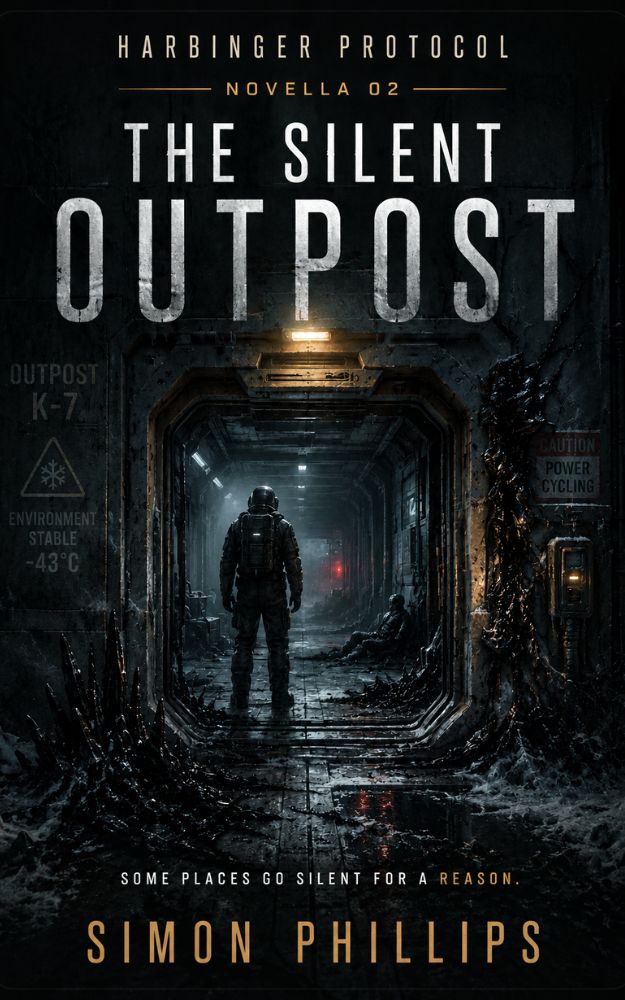
The Harbinger Protocol follow that unfolding pressure through the experiences of Soren Vale, beginning with the civilian freighter disaster recorded in The Ash in Transit and continuing into the colder, more procedural dread of The Silent Outpost, where isolated incidents begin to reveal the outline of something spreading across human routes and systems.
Readers who wish to explore the full opening phase of the Harbinger crisis can find the below.
Explore the books:
The Ash in Transit
The Silent Outpost
You can watch his YouTube channel here:
Author Simon Phillips
Continuing the Chronicle
The following Chronicle reconstructs the final low-power hours aboard Processing Relay Kheled-Three, as maintenance warnings, airflow irregularities, and cold-preservation protocols began drawing the crew towards the ventilation routes before communication with the relay failed.
Readers supporting The Future Chronicle can continue the record below.
The Chronicle: The Cold Hours
The hatch finished closing with a drawn metal tremor that travelled through Conduit Gallery Two and settled beneath Lena’s boots. The emergency seal light shifted from amber to white, then flickered as the local board argued with its own status. For three breaths the gallery existed as a narrow chamber of cold pipework, pale work lamps, frost beads, and the service grille whose ribbed residue held inside the ice like something preserved for inspection. Lena kept her hand on the lever until the hatch locks reported secure, listening to the relay through the metal around her. Kheled-Three had always spoken in strain, friction, pump labour, and ore-throat vibration. Now the station sounded careful.
“Seal shows closed on my board,” Tarek said from control, his voice thinned by the maintenance channel. “Local camera is still giving me the grille. The residue line has spread along the lower rib.”
Lena lifted her lamp and angled it across the mesh. “It has joined the frost,” she said as she moved closer by half a step, keeping her boots behind the yellow strip painted into the grating. “It looks like the frost grew around it after the last vent pull.”
Mina’s voice cut across them while movement rattled in her pickup. “Lena, stay clear of the mesh. Tarek, open crew welfare and tell me why Hab South markers are moving.”
The line filled with keys, a low alarm tone, then Tarek swore under his breath before discipline pulled him back. “Six markers awake. Rinna and Sevet are at Bunk Row Two. Arco is at the lower wash point. Jor and Cal are near the service grille by the south return. Drav is leaving medical berth.”
“Medical berth?” Mina asked, and Lena heard the change in her supervisor’s breathing. “Drav came off shift with a concussion.”
“He is walking,” Tarek said. “Slow path towards the same return line.”
Lena kept her gaze on the grille. The pressure along the mesh had altered again, a slow inward draw that carried cold vapour into thin strands. “Mina, I need a route out of here before you send anyone to the lower galleries.”
“The transverse walk is open from your side if the hatch clears,” Mina replied. “I am heading to Hab South. Tarek, give me station-wide address.”
A chime sounded through the relay, soft and tired across distant speakers. It came once, then again, delayed in the corridor beyond the sealed gallery. Mina’s voice entered the public system a moment later, calmer than the movement behind it deserved. “All awake crew, this is Supervisor Pell. Remain clear of service grilles and return ducts. Report to central galley for welfare count. Bring masks and thermal layers. Repeat, central galley, masks and thermal layers.”
The relay accepted her message, then repeated the first sentence by itself in a warped half-volume from somewhere below the gallery floor. Remain clear of service grilles. The last word thinned inside the pipework, stretched by metal and airflow until it almost became a sigh. Lena felt her shoulders rise, then forced them down.
“Tarek,” she said, “the public system just echoed under the gallery.”
“I heard it,” he answered. “Playback route shows main address only.”
“Then the pipes heard it better than the board.”
Mina’s boots struck faster through the channel. “Save the line. Tag it as address echo and duct response. We need language that keeps command awake later.”
Lena turned from the grille and crossed to the far access panel where the transverse walk controls sat beneath a crust of white frost. The touch pad recognised her glove on the second attempt. A status bar opened, paused, then corrected from local obstruction to seal ready. She watched the change happen, the same soft self-repair she had seen in the contamination entries. “The hatch wants to call itself clear,” she said.
Tarek answered before Mina could. “It is clear from my side.”
Lena pressed her palm against the manual release plate and felt resistance in the mechanism, a weight in the door line that belonged to pressure trapped across the seal. “It is lying from both sides.”
Mina’s voice softened in the way it did when anger would waste time. “Manual wheel. Slow opening. If the air moves against you, close it again.”
Lena folded the cover back from the manual wheel and turned it through the first quarter. The hatch gave a tight groan. Cold vapour slid through the edge gap and moved across her boots towards the service grille, crossing the chamber in a direction the relay had denied twice. She stopped turning. The vapour kept moving, drawn by the mesh.
“It is pulling through Gallery Two,” Lena said. “From transverse into the return duct.”
“That path should be isolated,” Tarek replied, his voice low.
“It wants a path anyway.”
The words left Lena before she could smooth them. Mina stayed silent for one breath, then answered with measured care. “The station wants to balance pressure. Keep the words on the station for now.”
Lena understood the correction. The danger gained too much shape if they gave it intention. Kheled-Three was pipes, conduits, boards, pressure maps, old valves, cheap replacements, frightened people, and something inside those systems finding easier routes whenever warmth, air, or power offered them. That was enough. That was already too much.
She turned the wheel back and sealed the hatch. “I am staying in Gallery Two until you give me a safer corridor.”
“Good,” Mina said. “Tarek, run emergency cold through lower exchange. Keep Gallery Two sealed. Pull the crew to galley through dorsal corridor only.”
Tarek hesitated, and that hesitation carried more warning than any alarm. “The preservation system has already taken partial authority from my panel.”
Mina stopped moving. “Say that cleanly.”
“Automated load protection engaged across lower processing. It cites structural contamination risk and coolant preservation. I can challenge, although the relay will ask for supervisor code and contract override.”
“Use my code.”
“I did,” Tarek said. “It accepted the code and narrowed my control.”
The channel held the three of them inside the same cold pause. Lena looked at the service grille. The pale ribs had reached the first vertical support, too gradual for visible motion and too changed to deny.
Mina spoke again, quiet and precise. “Then we stop asking the relay to save itself and start saving people. Tarek, record everything raw. Every correction, every denied command, every audio line. Send a compressed incident burst to route control and ESC relay access. Head it structural contamination in processing conduits, preservation authority compromised, crew movement affected by acoustic events.”
“Republic contract board sees that header if route control opens it,” Tarek said.
“Let them see it,” Mina answered as a door opened near her pickup and warmer room noise entered the line. “I am in Hab South.”
Lena heard voices behind Mina now, sleepy, confused, carrying fear in fragments. Someone asked why the lights had dropped. Someone else murmured that the vents had started calling. The public channel tried to regulate itself, issuing a welfare advisory in calm station language while Mina walked into the human centre of the event.
“Rinna,” Mina said, and her voice shifted from command to something closer and sterner. “Step away from the return.”
A woman answered her, distant through the pickup. “Mina, there is someone in there.”
“No one is in the return duct,” Mina said as fabric rustled and boots scraped. “Look at me, Rinna. Come towards my voice.”
“It said my brother’s name,” Rinna said. “It said Orrel was cold.”
Lena closed her eyes for one instant, then opened them because the grille in front of her had begun to hum at the same low pitch. The relay carried the sound through the conduits in pieces, and her mind tried to assemble what it heard. A name. A breath. A person behind metal. She pressed two fingers against the wall beside her, grounding herself in the cold panel and its rough paint.
Mina spoke again from Hab South, each word set down carefully. “Rinna, Orrel is on Pel Station. You showed me his last message yesterday. This sound is coming through machinery.”
Rinna gave a broken laugh. “Machinery knows his voice now?”
Mina crossed the room; the pickup caught her boots and the shallow struggle as she took someone by the arms. “Machinery knows pressure, old recordings, damaged speakers, and frightened minds. You know me. Come with me.”
Tarek broke into the private line, his voice tight. “External burst has failed twice. First packet left with a seven-second delay. Second packet returned with a route correction attached from our own relay. I am stripping it to emergency text.”
Lena stared at the lamp beam on the residue. “Send through the maintenance beacon. It has its own old channel.”
“The maintenance beacon rides the same mast.”
“It has an inspection pulse from before the contract upgrade. Old hardware, old path.”
Tarek breathed once, then keys moved fast beneath his hands. “Trying.”
From Hab South, a man shouted close to Mina’s pickup. “There is a hatch behind the grille. I can hear them.”
“Jor, leave the fasteners,” Mina said, her control fraying for the first time.
The sharp scrape of a tool answered her. Lena turned towards the sealed hatch as though distance could be crossed by will alone. “Mina, stop him.”
“I am trying,” Mina said, breathless now. “Cal, help me pull him back.”
The recording collapsed into overlapping movement: boots on flooring, a tool clattering, someone crying out as metal shifted. Then a vent tone opened across the relay, deeper than before, as if the whole return system had taken air at once. The service grille in front of Lena exhaled a sheet of vapour into Gallery Two. It rolled low across the grating and curled around her boots. Pale flecks moved inside it, bright where the lamp struck them, then settled along the floor seams.
Lena backed away until her shoulder hit the panel. “Gallery Two has particulate through the return,” she said.
Tarek answered at once. “Mask.”
She pulled the emergency filter from her belt, sealed it over her mouth and nose, and tightened the strap until the edge bit beneath her hairline. Her breath came back to her through resin and cold plastic. Across the gallery, the flecks lay still on the grating, each one small enough to pass for frost until the lamp revealed their faint ribbed edges.
Mina’s voice returned in gasps. “Jor opened the return cover. Only a handspan. We have pale residue along the inner lip. Cal has a cut across his glove from the mesh.”
“Skin breach?” Tarek asked.
“Checking.” Mina’s voice moved away from the pickup. “Cal, hold your hand still. Let me see it.”
A young man spoke near her, forcing humour through rising panic. “It is only a scrape.”
Mina answered him, gentler than the room allowed. “Then let me keep it a scrape.”
Lena heard the seal pack tear open. She imagined Mina in Hab South beneath dimmed lights, crew half-dressed in thermal layers, faces turned between her and the vent, fear catching them in the oldest human place, where a voice beyond a wall had to mean a living person. She imagined Cal’s glove under Mina’s hands, mesh cut, suit fabric frayed, a red line beneath, and pale dust waiting for warmth.
Tarek’s voice pulled her back. “Maintenance beacon accepted the stripped packet. Transmission window opens in thirty seconds.”
“Read it,” Mina said.
Tarek drew a breath. “Kheled-Three reporting structural contamination in lower processing conduits. Preservation system partially compromised. Acoustic events present in Hab South and Gallery Two. Crew movement affected. Keep relay cold. Avoid full system wake. Request remote quarantine guidance and retrieval under low-thermal protocol.”
Mina answered while someone whimpered behind her. “Send.”
The station lights dipped before the timer finished. In Gallery Two the amber lamps fell to a dull red, and the service grille vanished into shadow except for the pale residue holding the lamp’s narrow line. A preservation alarm sounded through the relay, older and lower than the public address, the kind meant to wake sleeping workers during coolant loss or decompression. It rang twice, then cut away mid-tone.
Tarek spoke from control, very softly. “The relay has entered deep preservation load.”
Lena looked at her wrist display. Temperature began to fall across the gallery. Power drained from nonessential lights. Vent draw reduced, then resumed in pulses as though the station were rationing breath. “Was that your command?”
“No,” Tarek said. “Automated load decision. It says crew welfare requires conservation.”
Mina answered through the sound of people gathering close around her. “Crew welfare means heat.”
“Processing preservation has priority over habitat comfort,” Tarek said. “Contract hierarchy. Machinery first if human life remains unconfirmed.”
“I am confirming it,” Mina said. Her voice sharpened across the channel. “Override the hierarchy.”
“I am trying.”
Lena crouched near the floor as the cold deepened. The particulate had crept into seams around the grating, gathering where warmth from old cable runs still lingered below. When the temperature dropped, the flecks stilled. The observation landed inside her with horrible clarity. Cold held it. Warmth fed it. The relay’s attempt to preserve its structure had slowed the spread while starving the people it was meant to support.
“Tarek,” Lena said, “deep preservation may be helping the conduits.”
“It is freezing the crew,” Mina replied.
“I know.” Lena kept her eyes on the seam. “That is the trap.”
The maintenance beacon timer reached zero. Tarek stayed silent long enough that Lena knew the answer before he found words. “Packet left the relay,” he said. “Return receipt came back empty. Then the mast powered down under preservation priority.”
“Did enough get out?” Mina asked.
“I have no receipt.”
The vents in Hab South carried a faint layered sound through Mina’s pickup. Several crew spoke at once, some praying, some calling names, some asking if rescue had answered from the duct. Mina kept moving among them, ordering masks, sealing the grille, pulling people towards the galley hatch with the force of her voice and hands. Lena heard the supervisor become smaller as the channel weakened, a woman inside a failing station choosing living bodies over clean evidence.
“Lena,” Mina said, “can you reach us from Gallery Two?”
Lena looked at the sealed hatch, the particulate on the grating, the pale ribs along the grille. “The transverse path is drawing through contamination. I can reach dorsal if I go through the old sump ladder, although the map says it is out of service.”
“The old sump ladder is a rusted throat through the asteroid,” Tarek said. “You always said only a fool would trust it.”
Lena checked the cutter clipped to her belt, tightened the mask, and moved towards the maintenance crawl at the rear of the gallery. “A fool gets a route the relay forgot to lie about.”
Mina gave a breath that might have become laughter on a better night. “Take a lamp. Keep talking.”
Lena unlatched the crawl hatch and pulled it open. Cold air rolled from the dark beyond, carrying the heavy mineral scent of unlined rock and old drainage. The ladder dropped through a narrow shaft beyond the reach of the main ventilation system. Its rungs were furred with frost. Somewhere below, water ticked into a collection tray one slow drop at a time. She fed the lamp through first and watched the beam find rough stone, old cable ties, and a maintenance stencil from a contractor that had vanished years before Kheled-Three joined its current registry chain.
“I am entering sump access,” Lena said as she set one boot on the first rung.
Tarek answered through faint static. “I have your tracker.”
Mina’s voice came thinner now, broken by public alarms and the shivering crowd around her. “If you reach dorsal, come to Hab South from above. We are moving people to the galley. Cal is conscious. His hand is cold-packed. Jor is restrained near the wall and furious with me.”
“Furious is alive,” Lena said as she descended.
The shaft swallowed the relay’s larger sounds, leaving her with her own breath inside the filter and the creak of old metal beneath her weight. For several metres she felt almost safe, sealed away from the vents and boards, wrapped in rock the contamination had yet to teach a new language. Then the maintenance line in her ear produced a sound she knew had come from no living throat: a soft voice-shaped draw, carrying her name through static with the weary intimacy of someone standing just below her in the dark.
Lena stopped on the ladder. Her lamp pointed down into the shaft, showing only frost, rungs, and rock. The sound faded. Tarek spoke over it, distant and strained. “Lena, your channel glitched. Repeat last.”
She held the rung until the cold steadied her hands. “I gave no words.”
Tarek stayed quiet for one beat. “Keep moving.”
Above her, somewhere through stone and metal, the relay settled deeper into preservation load. The hum of machinery lowered, corridor by corridor, system by system, as Kheled-Three chose cold over collapse and silence over strain. Lena climbed down into the old sump path while the station’s last confirmed external packet travelled into the dark with no acknowledgement, carrying a warning so cautious that it still sounded like a maintenance problem.
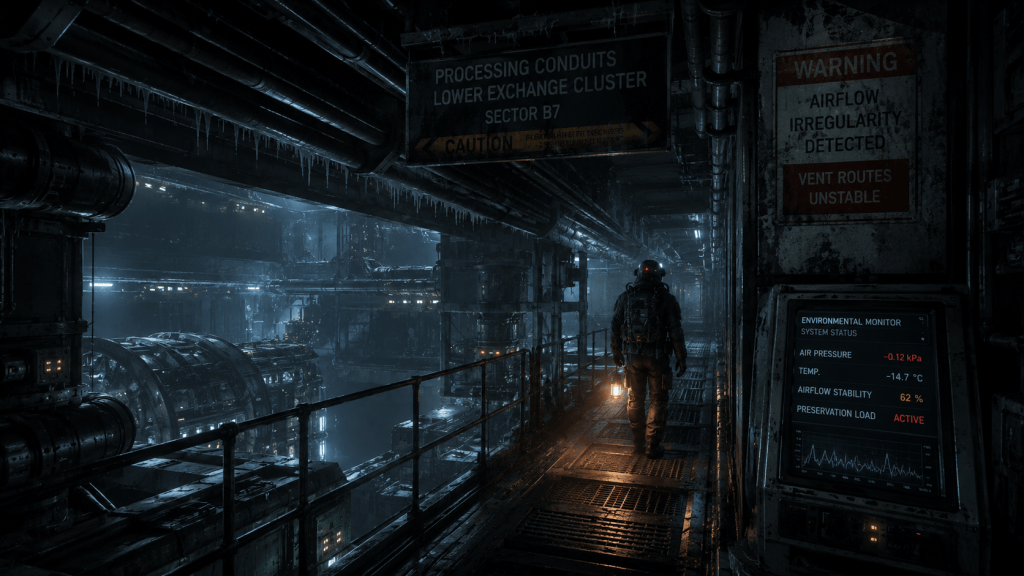
A lone maintenance figure crossed the lower exchange cluster as Kheled-Three entered preservation load, with the relay’s own systems reporting airflow irregularities through the same vent routes the crew had begun to follow.
The Idea Behind the Chronicle
The idea behind Preservation Load comes from one of the quieter dangers of deep-space infrastructure: the systems built to preserve life may also preserve the conditions for disaster. In most science-fiction futures, attention often falls on starships, weapons, colonies, and great stations, while the smaller industrial places between them receive less notice. Yet any expanding civilisation would depend heavily on such places. Mining relays, refinery platforms, processing spines, fuel depots, cargo sorting stations, and cold-storage hubs would form the working skeleton of human space.
Processing Relay Kheled-Three belongs to that harsher layer of expansion. It exists far from comfort, built around work first and people second. Its purpose is practical: hold machinery alive, keep ore moving, protect conduits from freeze damage, and conserve power until repair crews, replacement parts, or contract authority arrive. In such a place, survival depends on automation making sensible choices when human attention is stretched thin.
The Chronicle explores what happens when those sensible choices become dangerous. Cold preservation sounds protective. It slows mechanical failure, reduces heat stress, lowers power demand, and keeps delicate systems from tearing themselves apart under pressure. In the Harbinger Protocol world, however, cold also changes the behaviour of contamination. It can slow visible growth, hide movement, and make an infected structure appear stable for longer than it truly is. The relay therefore enters a frightening contradiction: the same cold that helps preserve the station also helps conceal the threat inside it.
This reflects a wider theme of the Harbinger Protocol setting. Humanity keeps misreading the danger because it arrives through trusted systems. A warning panel, a pressure correction, a ventilation route, a preservation protocol, a welfare alert, or a maintenance log all belong to the ordinary language of industrial survival. Workers trust these systems because they have to. Out beyond the comfortable centres of civilisation, people live by boards, seals, valves, filters, alarms, and old procedures written by someone far away who hoped the machine would behave as expected.
The false voice element also grows from that same idea. In a sealed industrial environment, sound can travel strangely. Airflow through vents, pressure changes in ducts, damaged speakers, old recordings, and frightened human minds can combine into something that feels almost personal. The horror of the Chronicle comes from that uncertainty. The crew hear something close enough to a person that their instincts pull them towards it. Their compassion becomes part of the hazard, because a human being will always want to answer a voice that sounds afraid.
Kheled-Three also acts as a bridge towards the events of The Silent Outpost. The relay is colder, quieter, and more preserved than the earlier shipboard incidents. It shows the contamination settling into infrastructure rather than rushing through a vessel in open collapse. The result is a different kind of dread. The station seems functional. The systems still speak in careful terms. The crew still have time to argue, record, and respond. Yet each choice tightens the trap, because the relay is using its own logic to protect machinery while people are slowly pushed into danger.
Preservation Load therefore asks a simple speculative question: what happens when an automated habitat, built to save itself and its workers from environmental failure, encounters a threat its rules were never written to understand?
The answer is quieter than explosion or battle. The station grows colder. The vents change draw. The boards correct themselves. The crew gather near the sounds they should have ignored. Somewhere in the dark between maintenance language and human instinct, the pattern begins to show.
From the Author’s Desk
Preservation Load grew from one of the central ideas behind the Harbinger Protocol world: the danger spreads through ordinary systems long before anyone understands what those systems are carrying. I wanted this Chronicle to feel quieter than an open disaster, set inside a cold industrial place where the machinery still worked, the alarms still used careful language, and the people on duty were still trying to make practical decisions under pressure.
Processing Relay Kheled-Three also gives the Chronicle series a bridge towards the colder dread of The Silent Outpost. Earlier incidents in this sequence have moved through containers, quarantine holds, cargo drones, vent recordings, and salvage reports. This entry shifts the focus into infrastructure itself, where a relay’s own preservation logic begins shaping the crisis before command, contract authority, or rescue crews can properly name what is happening.
The Harbinger Protocol books follow that unfolding pressure through the experiences of Soren Vale, beginning with the civilian freighter disaster recorded in The Ash in Transit and continuing into the isolated station horror of The Silent Outpost. These Chronicles sit around those books like recovered case files, showing other workers, technicians, officers, and crews encountering the first signs of a wider pattern at the edges of known space.
Alongside these Chronicles I continue writing science fiction and speculative fiction shaped by frontier environments, industrial worlds, isolated stations, and ordinary people caught inside events far larger than they were prepared to understand.
Readers interested in those stories can explore more through the links below.
You can explore my books here:
Books by Simon Phillips
You can watch my YouTube channel here:
Author Simon Phillips
Technical Notes & Frontier Context
Cold-Preservation Systems
Remote industrial stations would rely heavily on preservation systems designed to protect machinery during low-power operation, coolant imbalance, staffing gaps, or delayed repair windows. In deep-space environments, heat is both a resource and a liability. Too much heat can damage processing lines, stress sealed conduits, and waste power reserves, while too little heat can freeze valves, fracture casings, and place crews at risk inside poorly insulated habitats.
A relay such as Kheled-Three would therefore run on careful thermal management. Its systems would decide which decks needed warmth, which conduits required cold protection, which pumps had to remain active, and which rooms could be reduced to minimal life-support draw until repair or relief arrived. These decisions would usually be routine, practical, and necessary for survival in remote space.
Preservation Load explores the danger of those priorities under an unknown contamination event. The relay’s automated logic tries to save the structure by lowering power and heat, yet the crew remain caught inside the same environment. The station protects machinery first because that is how its rules were written.
Mining Relay Infrastructure
Mining relays form the rough working layer of an expanding space civilisation. They process ore, hold industrial cargo, stabilise transfer loads, and keep remote extraction networks connected to larger freight systems. Such installations would rarely resemble comfortable settlements. They would be cold, cramped, functional, and shaped by work.
Kheled-Three represents this type of place: a processing spine driven through an asteroid, service galleries wrapped around conduits, habitation kept close to machinery, and workers living beside the systems they maintain. Every corridor, vent route, ladder shaft, and control board exists because the relay has a job to perform.
In a crisis, that design becomes dangerous. The same conduits that carry ore slurry, coolant, air, heat, and maintenance access also provide hidden routes through the structure. A problem inside the processing throat can reach habitation through systems built for ordinary circulation.
Automation and Priority Logic
Automated systems become essential in isolated industrial sites because human crews cannot monitor every valve, pump, filter, pressure gate, and thermal exchange at once. A station must be able to protect itself during sleep cycles, low staffing, power strain, or communication delay.
That dependence creates one of the central tensions of this Chronicle. Kheled-Three does what it was designed to do. It detects risk, lowers load, protects conduits, trims power, and enters deeper preservation. From the station’s point of view, these choices make sense. From the crew’s point of view, they become a trap.
This reflects a wider Harbinger Protocol theme. Human beings trust systems because survival in space requires trust. The first failures therefore arrive through calm screens, corrected warnings, softened classifications, and procedures that appear responsible until the event moves beyond the assumptions that created them.
Airflow and Acoustic Risk
Airflow matters deeply inside sealed environments. Vents carry more than comfort. They regulate pressure, temperature, moisture, contamination control, and habitability. They also carry sound in ways that can become strange under stress. A voice-like tone may emerge from duct pressure, damaged speakers, old recordings, fan wash, or air passing through warped structures.
In Preservation Load, the crew are drawn towards vents because the sounds coming through them feel close to human. The danger lies in uncertainty. A worker hearing a possible survivor, relative, or crewmate through a grille may move closer before reason can catch up. Compassion becomes part of the hazard.
That makes the relay incident especially unsettling. The station is quiet, cold, and largely intact. Its systems still appear to function. The crew still speak to one another. The alarms still use restrained language. Yet the ventilation routes have already become the emotional centre of the event, pulling human attention towards the same spaces the maintenance records are beginning to flag.
The Frontier Context
Frontier space would depend on places like Kheled-Three long before grand colonies became common. Mining relays, freight depots, salvage locks, inspection stations, and refinery platforms would carry the practical burden of expansion. They would be staffed by people accustomed to compromise: old equipment, delayed parts, imperfect heat, disputed authority, and procedures written far from the conditions they actually face.
Preservation Load uses that frontier reality as the foundation of the horror. The relay is vulnerable because it is ordinary. Its crew are vulnerable because they are experienced enough to keep working through uncertainty. The system fails slowly because every warning first appears as something familiar.
That is where the early Harbinger incidents become most dangerous. The pattern hides inside normal work until normal work becomes the route through which it spreads.
Next Chronicle
After the final maintenance burst from Processing Relay Kheled-Three entered restricted channels, ESC comparison teams began placing the relay record beside other unresolved incident files from civilian haulers, salvage crews, cargo drones, quarantine holds, and contaminated outposts. Each report used its own careful language. Structural contamination. Acoustic artefact. Intake residue. Delayed response. Crew movement under environmental stress.
At first, the files appeared scattered across different routes, jurisdictions, and vessel types, each one small enough to remain inside its own review channel. Yet as junior analysts began preparing material for testimony handling, the same traces returned again and again: self-correcting system logs, pale or dark residue near airflow routes, voices reduced to mechanical distortion, and people moving towards vents, hatches, or grilles while official language searched for safer explanations.
The next Chronicle enters one of those review rooms, where ESC personnel attempt to compare several unrelated incidents and begin to understand that the danger may already have formed a pattern across ships, drones, salvage lanes, and outposts.
Next Week: Review Chamber Four
Processing Relay Kheled-Three remained cold inside the shadow of its asteroid, carrying through its sealed conduits the first quiet shape of a pattern that would soon reach far beyond one failing station.
