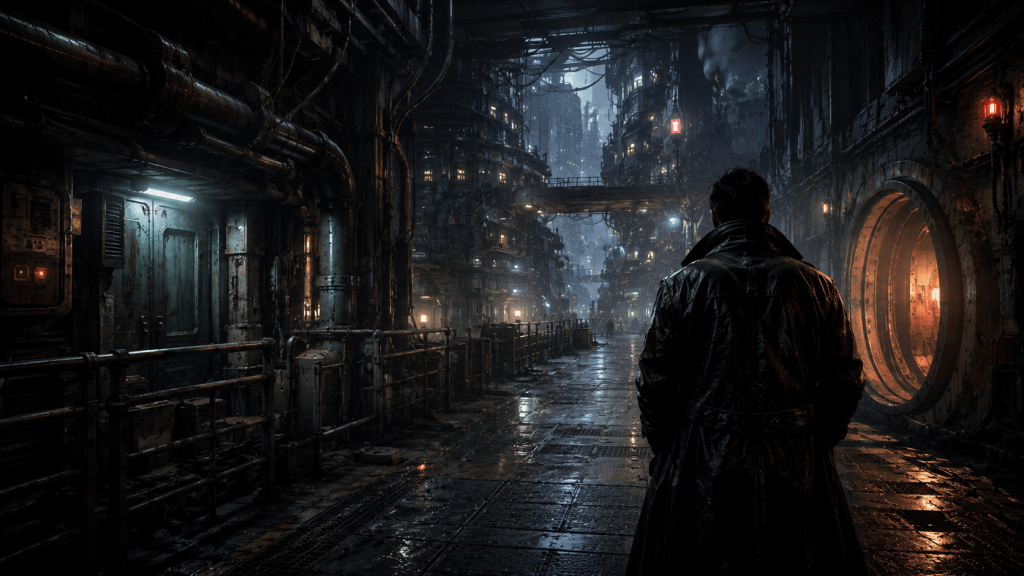
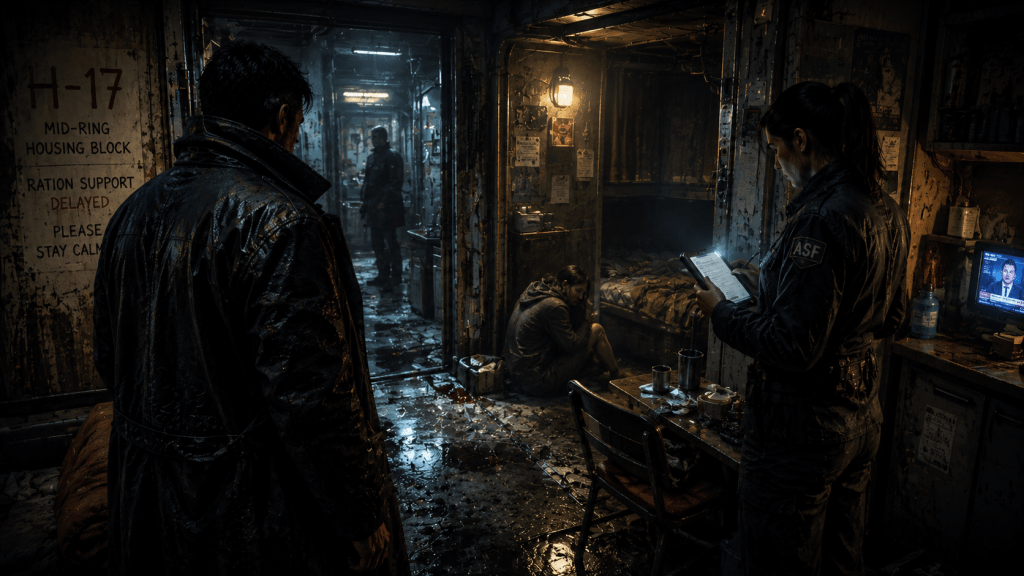
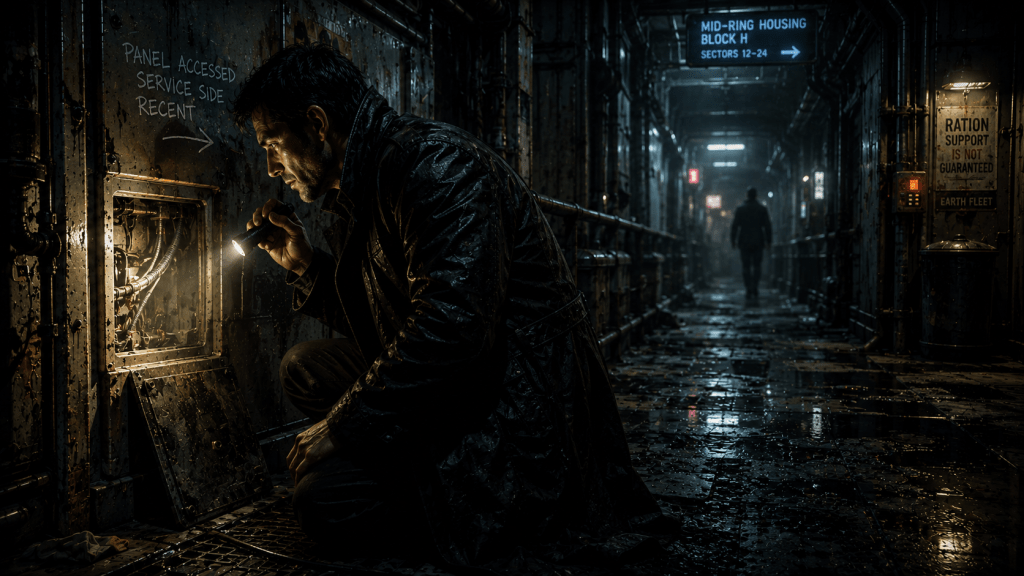
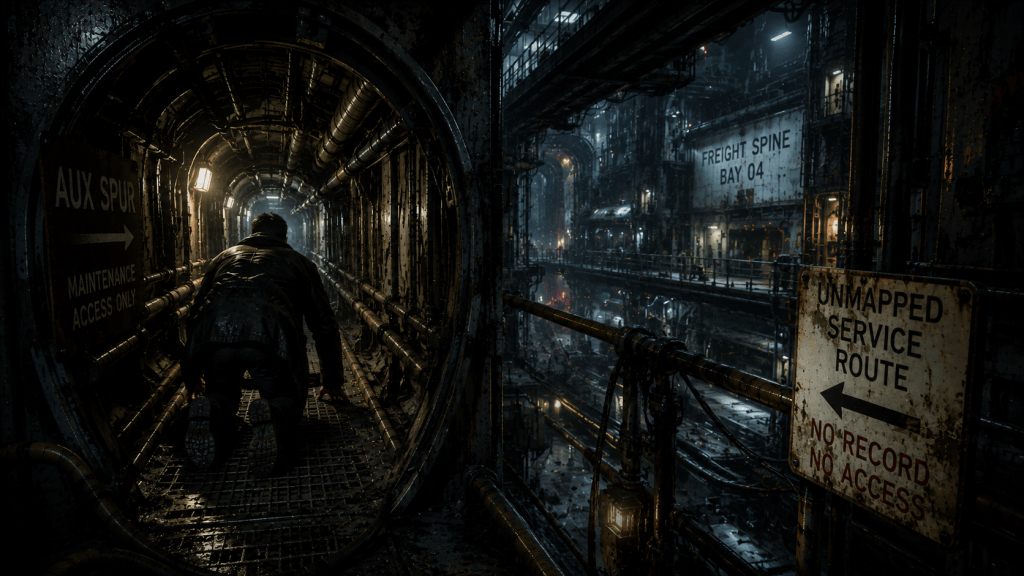
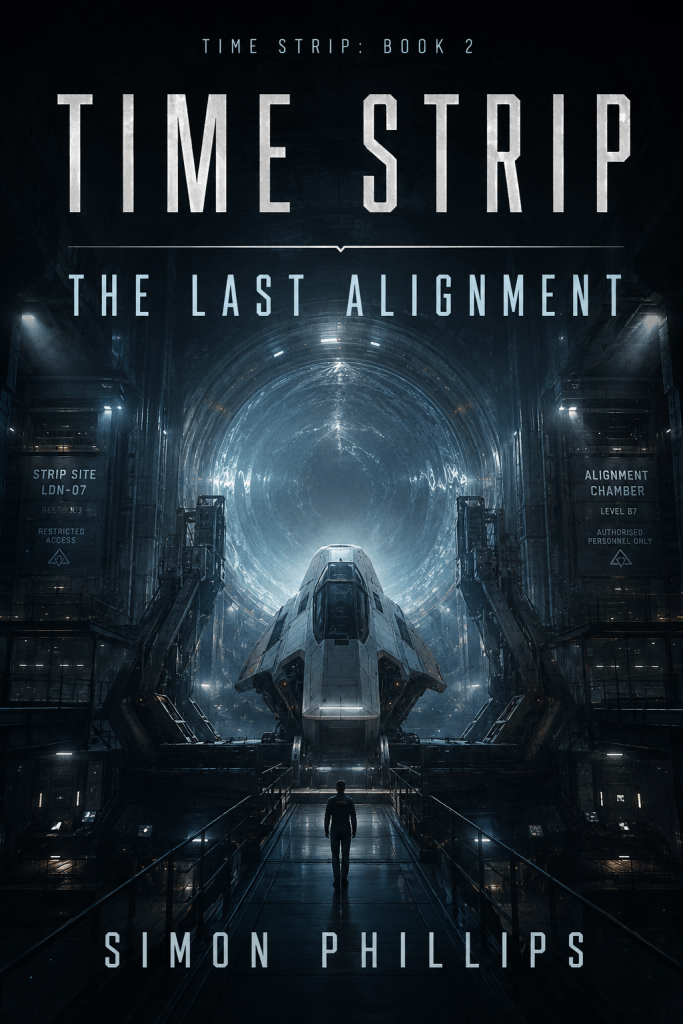
In Time Strip: The Last Alignment, the journey towards time travel begins long before anyone enters the temporal corridor.
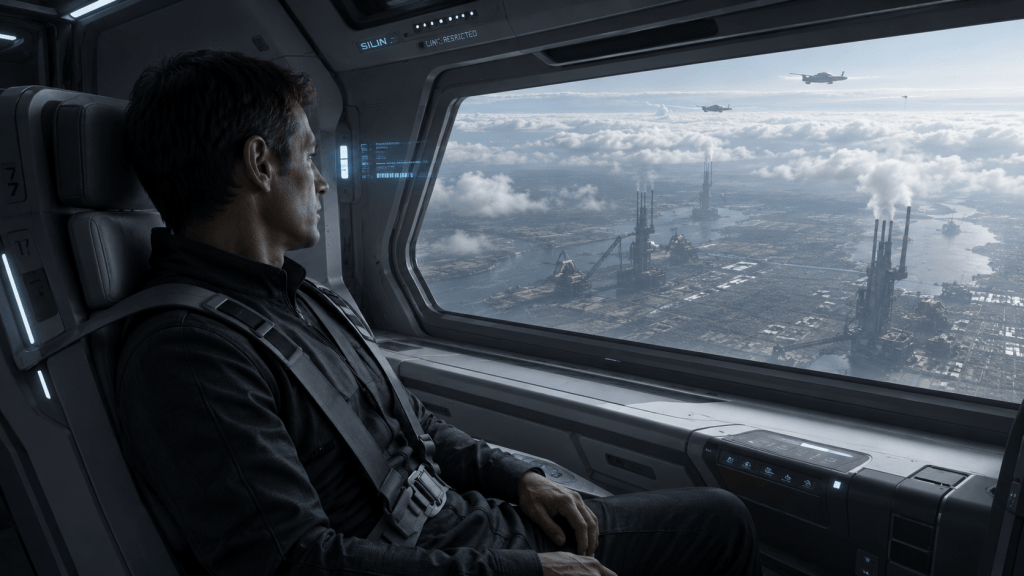
Caelen Marris is already under pressure as London disappears beneath the cloud shelf and his transport carries him west towards a restricted facility in North America. The harness across his chest is secure, the aircraft is following its assigned route, and the future outside the window appears ordered down to its weather systems and managed flight lanes. Inside the cabin, that order has lost the layer that usually makes it bearable.
Silin, Caelen’s bonded AI, has been suppressed.
Her absence leaves him exposed to the engine tone, the vibration running through the seat frame, changes in cabin pressure and the glare travelling across the external display. These are ordinary sensations for everyone else aboard. For Caelen, they arrive without the filtering presence that has accompanied him for most of his life.
This opening establishes the character of The Last Alignment immediately. This is psychological time-travel science fiction in which technology is experienced through the body, authority is expressed through access and restriction, and the approach to the impossible is built through physical consequence rather than distant explanation.
Book One, Before the Fall, drew Caelen out of his ordinary life and placed him under the authority of a mission he could neither refuse nor fully understand. Book Two carries him into that mission. Theories become machines. Briefings become corridors, medical scans, deployment procedures and sealed launch chambers. The people named in mission files become a team whose lives will soon depend upon Caelen’s ability to sense what their instruments cannot.
The controlled future has prepared everything it believes the jump requires. Caelen is the one component it cannot completely explain.
A Mission That Has Finally Become Physical
The Time Strip has already shaped Caelen’s life before he reaches the deployment site. His scientific work has placed him close to unstable temporal conditions, while his unusual sensitivity has made him valuable to the same institutions that once kept him at a distance.
In The Last Alignment, that relationship changes. Caelen is no longer being consulted as a specialist who can be returned to the edge of the system once his usefulness has ended. He has been assigned as a Proximity Navigator, the human operator responsible for holding a jump vessel in alignment when computational certainty begins to fail.
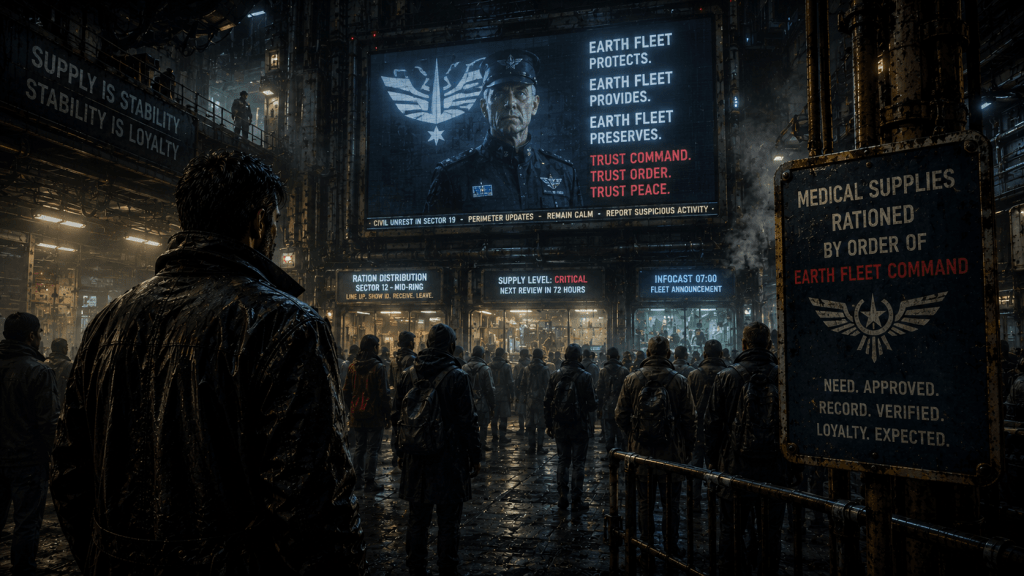
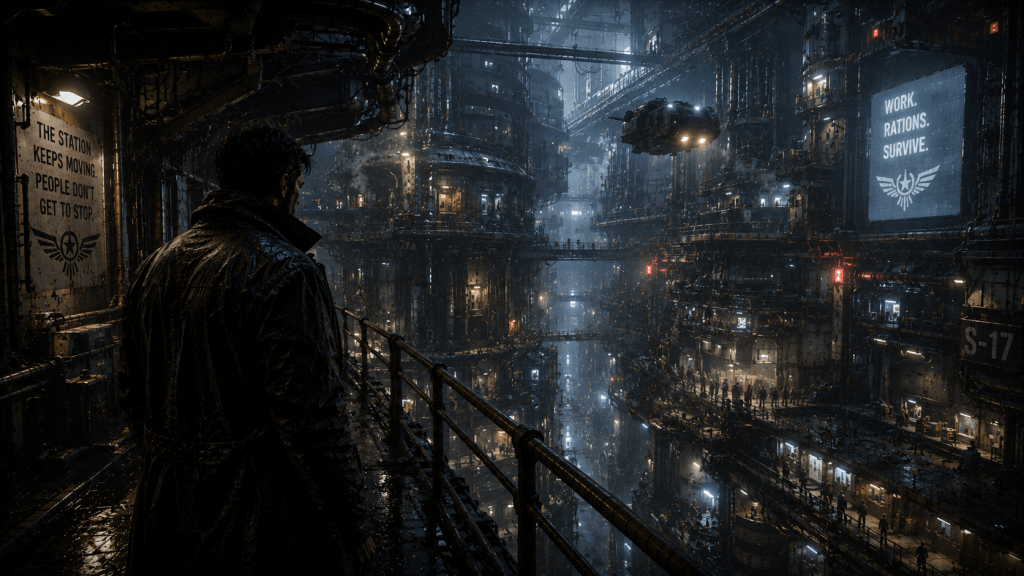
His journey across the Atlantic allows the scale of his future to emerge around him. Atmospheric processors rise through cloud systems. Ocean harvest grids move across the water in coordinated bands. Controlled landscapes and engineered coastlines pass below the aircraft. Reclamation machines dismantle the remains of old cities with methodical precision, separating stone, metal and glass while the world continues around them.
Caelen cannot ignore the contradiction. He is being sent through time to prevent history from being altered while the society that employs him removes its own physical history by the hectare.
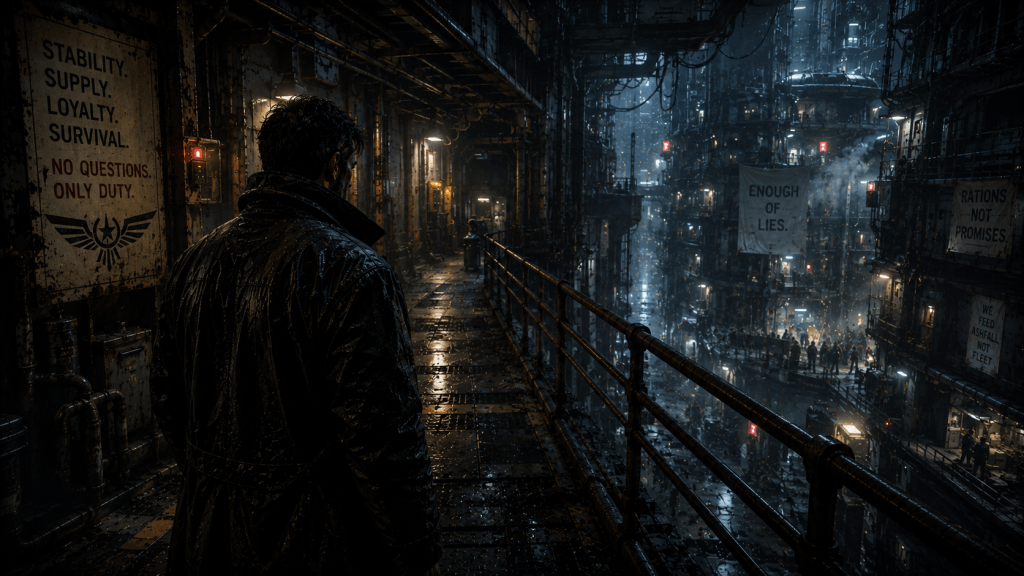
That tension runs through the book. The future is advanced, functional and capable of achievements that would once have appeared miraculous. It has also become comfortable with systems that classify people, narrow their choices and turn extraordinary danger into administrative procedure.
Caelen is transported, routed, scanned and cleared because the mission needs him. Whether he understands what his body is becoming capable of sensing remains secondary to the fact that the institution intends to use it.
Caelen Marris and the Cost of Being Useful
Caelen’s role gives The Last Alignment its distinctive form of temporal science fiction.
He does not approach the Time Strip as an adventurous explorer eager to cross into another age. He approaches it as a scientist who understands enough to recognise the danger, while knowing that the official explanation is incomplete.
His awareness of the Strip begins physically. Pressure settles in his jaw. The floor feels fractionally uneven beneath him. Sound arrives slightly out of place. A field transition reaches his spine before the surrounding equipment visibly confirms that anything has changed.
These reactions do not grant him easy power. They make him more exposed.
The systems around Caelen can measure his responses, record his compatibility and decide that he remains fit for deployment. They cannot fully explain why he recognises inactive alignment equipment through sealed bulkheads, senses field movement before a test has visibly begun, or adjusts himself against temporal pressure before the machines have completed their calculations.
His value comes from that uncertainty. The NAV-craft needs a human presence capable of feeling the relationship between vessel and corridor when precise instruments begin losing authority over what they report.
This leaves Caelen in an uncomfortable position. His unusual perception gives him importance within the mission, although it provides little control over the mission itself. He is essential enough to place at the centre of the craft, yet still subject to permissions, restraints and decisions made elsewhere.
The science-fiction suspense grows from that imbalance. Every stage of preparation proves that Caelen is needed. Each stage also places another mechanism around him.
Silin and the Intimacy of Bonded AI
Silin is one of the most important elements of the Time Strip series because she makes its future feel inhabited rather than displayed.
She is not a robot walking beside Caelen or a holographic personality projected into the room. She exists through continuous bonded presence, environmental regulation, private communication and an intimate awareness of his physical condition.
Silin softens glare before Caelen has to close his eyes. She adjusts intrusive frequencies before they settle into his teeth. She recognises changes in breathing, muscle tension and heart rate before he consciously identifies them. Her work usually happens so close to ordinary perception that Caelen seldom has reason to separate her assistance from the world around him.
Her suppression during the early journey reveals how much she carries.
When Silin is absent, the cabin becomes harder, louder and less manageable. When she returns under restricted permissions, Caelen’s body settles before he has time to explain the relief. The engine vibration becomes easier to place. The glare loses its sharper edge. The aircraft feels less hostile because he is no longer meeting every sensation alone.
Their relationship gives the book an unusually personal approach to artificial intelligence. Silin is supportive and emotionally significant, though her capabilities remain controlled by external authority. At each stage of the mission, she is permitted, narrowed, restored or rebuilt according to the needs of the site.
The institution treats those changes as alterations to system access. Caelen experiences them as changes to a relationship embedded in his daily life.
As the mission advances, Silin’s conversational freedom becomes increasingly restricted. Her role is redirected towards medical monitoring, mission integration and alignment support. She remains beside Caelen, although the terms of that presence no longer belong entirely to either of them.
That quiet removal of control gives the bonded AI element its emotional force. The future has made human life more manageable through constant artificial intelligence, then built institutions capable of withdrawing or reshaping that support whenever procedure demands it.
The Strip Site Turns Authority into Architecture
The North American Strip Site does not announce itself through dramatic military spectacle. Its power lies in the size of the landscape emptied around it, the precision of its restricted routes and the ease with which it assumes control of everyone entering its perimeter.
The transport surrenders its landing authority to the site before Caelen reaches the ground. Passengers are released according to designation. Caelen’s onward route is separated from the other travellers, and Silin’s access changes as soon as they cross the first secure threshold.
The architecture is clean, measured and carefully illuminated. That cleanliness never implies freedom. Floor markings determine where people walk. Gates recognise clearance before individuals reach them. Doors open for authorised movement and remain featureless to everyone else.
The facility has been designed for execution rather than discussion.
Surface intake gives way to deployment processing, medical clearance, lower hangars, rest areas, final compatibility reviews and the descending route towards the launch chamber. Each level removes another piece of ordinary movement. The deeper Caelen travels, the less the site attempts to make its control comfortable.
The Time Strip itself remains hidden through most of this descent, yet its influence grows stronger. Dampening systems protect the upper levels so that personnel can work, eat and rest without constantly feeling the active field below them. As those protections reduce, Caelen begins registering the Strip through his chest, jaw, balance and perception of time.
The site has built enormous technological systems around a temporal corridor that still refuses to behave like a passive machine. Regulator rings, containment structures, field towers, deployment tracks and specialist craft exist because the Strip cannot simply be opened and crossed.
Humanity has built an institution around time travel. The institution has mistaken the ability to contain something for proof that it controls it.
A Jump Team Worth Caring About
The mission becomes emotionally real when Caelen meets the people who will travel with him.
General Nomack commands the Jump Team without relying on speeches or theatrical displays of authority. He allows the group’s long-established habits to continue until the work requires sharper discipline. When he speaks, the room narrows around the decision because everyone understands that his restraint has limits.
Johhnan, the AI integration specialist, provides Caelen’s first connection to the team. He has already argued with site authorities to preserve Silin’s bonded continuity, recognising that removing her would alter Caelen’s baseline before the mission had properly begun. His support is practical, understated and rooted in technical understanding rather than easy reassurance.
Kera Holt is the pilot responsible for conventional flight and the final approach towards the Time Strip. Her dry humour gives the team warmth without weakening the seriousness of the launch. She understands the boundary between her work and Caelen’s more clearly than most: she can bring the craft to the door, while he must keep that door open long enough for everyone to cross.
Tooth, the systems engineer, distrusts reassuring percentages, incomplete inspections and any machine that claims perfect readiness. His arguments about fasteners, structural braces and software assumptions initially appear severe, although his concern for the craft is inseparable from concern for the people it carries.
Vornal Aki manages communications and external continuity as the approaching jump begins to compress the team’s connection with the wider world. She is precise, observant and economical with her words, often cutting cleanly through Tooth’s longer objections or Johhnan’s technical evasions.
Havel, the medical officer, keeps the human body central within a mission dominated by engineering, temporal calculations and artificial intelligence. He watches hydration, posture, food intake, fatigue and physical strain because every theoretical success still has to pass through flesh.
Their relationships are revealed through work, meals, medical checks, shared irritation and long familiarity. A condiment is passed before anyone asks for it. A technical complaint is interrupted because everyone has heard its earlier versions. Havel makes certain they eat. Nomack forces Tooth to rest. Johhnan slows his pace so Caelen does not enter the group alone.
These details matter because the mission is carrying people rather than a collection of functions. Caelen’s responsibility grows heavier as he begins to understand who will be inside the craft with him when ordinary navigation ends.
NAV-Seven and the Human Navigation System
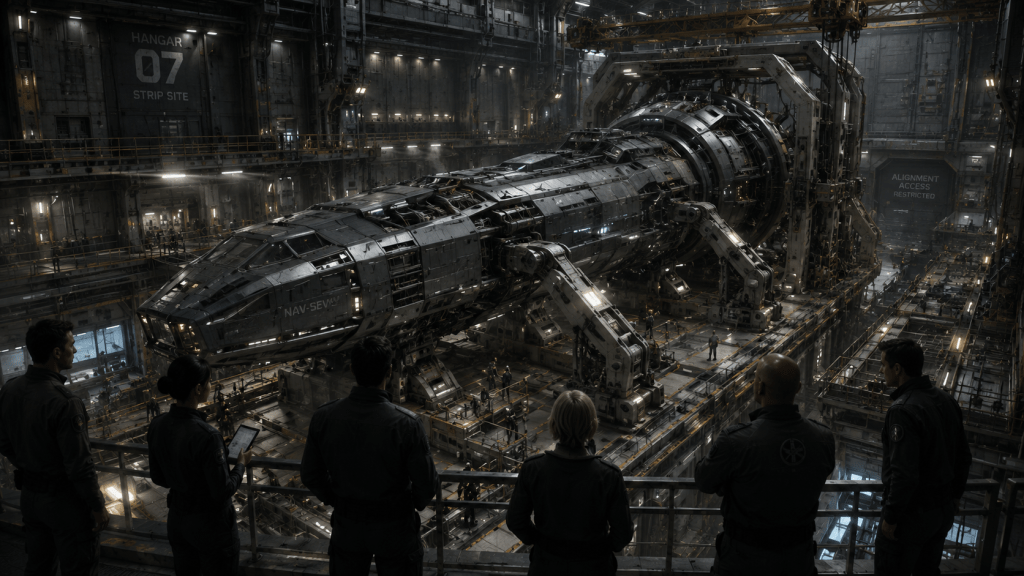
NAV-Seven is not presented as a sleek symbol of future progress. It is a dense, reinforced vessel designed to remain coherent under forces that ordinary craft cannot safely interpret.
The ship is built around an alignment spine running through its central structure. Its cockpit, systems station, communications position, medical seat and mission spaces all support the work taking place in the rearward alignment chamber.
That chamber contains the cradle prepared for Caelen.
The alignment cradle is part restraint, part interface and part navigational system. It secures Caelen across the arms, legs and shoulders while contact points connect with his skull, jaw, spine and nervous system. Silin enters the authorised support layer, and the craft begins translating its orientation through Caelen’s body.
He does not fly NAV-Seven in the conventional sense. Kera controls the vessel while ordinary movement still applies. Caelen holds the relationship between the craft and the Time Strip once conventional navigation can no longer be trusted.
This is where proximity navigation separates Time Strip from familiar portal-based time travel.
The corridor has depth, resistance, timing and unstable relation. The vessel needs more than coordinates. It needs a human being capable of sensing when the Strip is forming differently from the route shown by the machines.
Caelen’s body recognises those differences first. The craft then takes his physical correction and distributes it through its own spine.
The process makes him indispensable while removing almost every possibility of escape. Once seated, he is physically locked into the system. The mission depends upon his perception, and the machinery has been constructed to keep that perception connected even when every instinct may tell him to pull away.
Time Travel Built from Pressure Rather Than Spectacle
The tension in The Last Alignment develops through accumulation.
A permissions layer changes. A medical scan takes longer than expected. An inactive chamber feels active to Caelen before he crosses its threshold. The dampening grid withdraws in stages. Silin’s voice becomes narrower as launch authority rebuilds her around mission requirements.
Each event remains controlled on its own. Together, they create the sense that the institution is moving towards a boundary its procedures may be unable to hold.
This restrained approach allows the scientific and psychological elements to strengthen one another. The book does not pause to lecture the reader about temporal theory. The mechanics become understandable through Caelen’s movement across the site and through the consequences of each system coming online.
The same principle shapes the future world. Technology appears through daily use, transport systems, environmental control, bonded AI, medical infrastructure and the way people move through restricted spaces. The world feels advanced because its inhabitants already know how to live inside it.
That normality makes the Time Strip more disturbing. Every piece of the launch apparatus has been designed by a society accustomed to controlling complex systems. The corridor still presses through those protections, reaching Caelen’s senses before the people monitoring him are ready to acknowledge what he has felt.
The Presence Beyond the Glass
A quieter threat follows Caelen towards the launch.
He has already seen a cloaked figure in London, standing where no person should have been able to stand. Silin cannot retrieve a clear image of the event. Official systems provide no confirmation that the figure existed.
At the Strip Site, surrounded by surveillance, sealed routes and tightly managed access, Caelen sees it again.
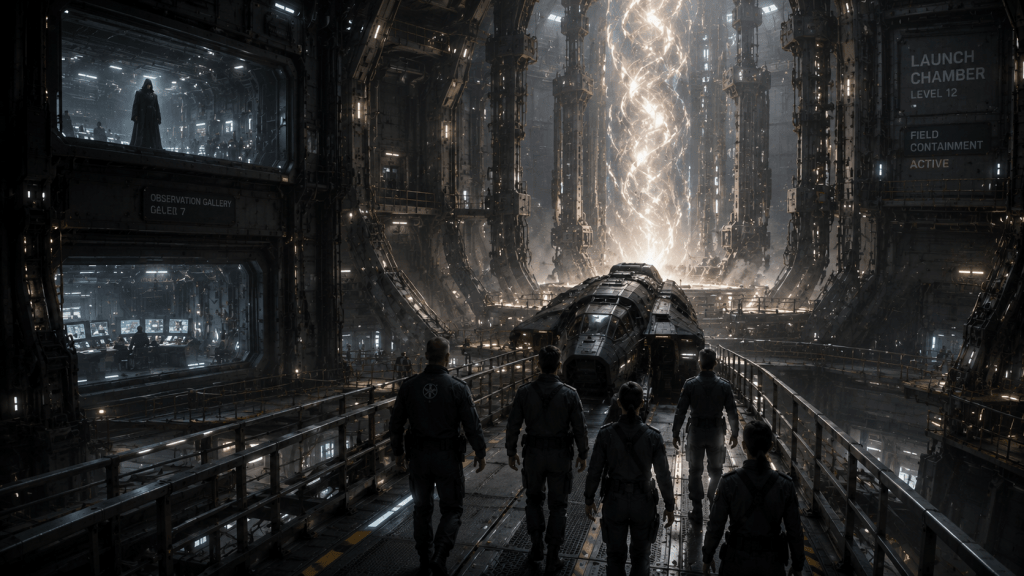
The figure appears across the launch chamber behind observation glass, positioned too close to the active field and outside any visible staff assignment. It does not approach him or offer an explanation. Its presence is disturbing because the site has been designed to know where every person is allowed to stand.
Silin does not register it.
The moment opens a deeper uncertainty within the story. Caelen is entering a system controlled by military authority, scientific oversight and advanced artificial intelligence, while something beyond those systems appears able to observe him unnoticed.
He carries the sighting into the craft because the launch sequence has left no safe place to stop. The team is moving. The Time Strip is active. NAV-Seven is waiting.
The impossible presence reaches the threshold before Caelen does.
The Last Controlled Moment Before the Route Breaks
The Last Alignment is Book Two of Time Strip and continues directly from Before the Fall. It expands the series from institutional selection into full mission deployment, while bringing Caelen, Silin, the Jump Team, the Strip Site and NAV-Seven together inside one narrowing movement.
The book will appeal to readers drawn to psychological science fiction, controlled future societies, human relationships with artificial intelligence, slow-burn time-travel suspense and technology that remains physically consequential. Its tension comes from procedure becoming irreversible, people learning to trust one another under pressure, and a temporal system beginning to respond in ways its creators never authorised.
The ebook is available as Time Strip: The Last Alignment on Amazon Kindle.
By the time the launch machinery reaches readiness and the Jump Team is aboard, the future still believes it controls the route. Caelen is restrained inside the alignment cradle, Silin has been drawn into mission support, and NAV-Seven is moving towards a corridor built to carry them into history.
Then the sequence begins answering in the wrong order.
The team has prepared for instability, structural failure and the loss of ordinary navigation. None of their procedures were written for the possibility that something beyond the authorised route might already know they are coming.