A chapel-side account of the morning Archbishop Alaric’s summons crossed the nave, and the old stones of Bremyra seemed to listen for what the Order might uncover beneath them.
Beneath the Morning Incense
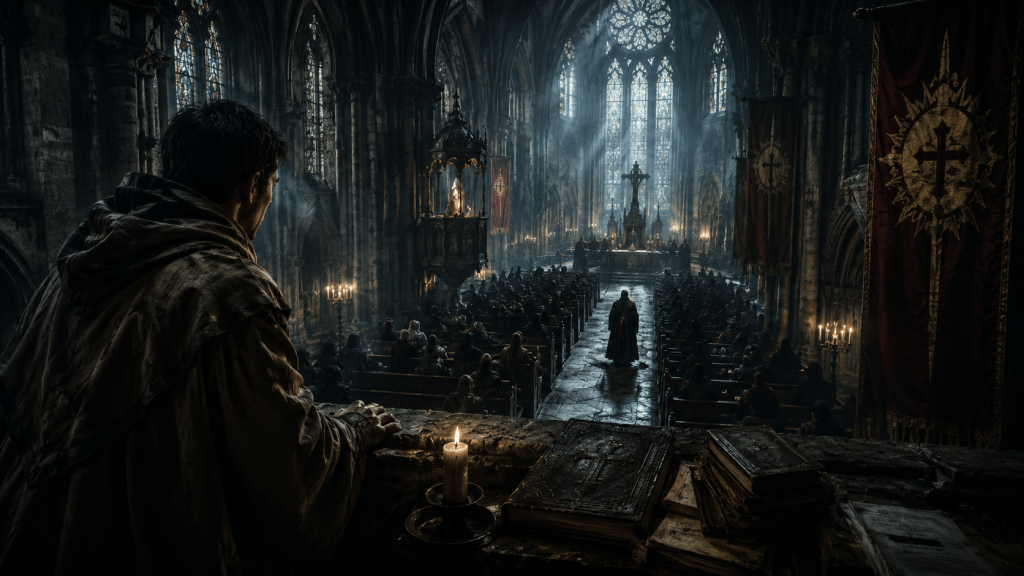
The cathedral bell sounded before Bremyra woke, carrying one low note across the roofs while snow clung to gutters and harbour mist folded against the lower streets. Within the cathedral, Sister Maelis rose by the vestry door and held the taper dish until the tremor passed from her fingers. The bell had been rung by order, three strokes at Prime, a signal reserved for early confession, royal death, or the Archbishop’s own summons, and those beneath the vaulted roof understood that the hour had been claimed for disturbance still held behind closed doors.
She moved along the side aisle with the quiet expected near the sanctuary before first prayer, her woollen hem brushing the cold flagstones while the saints watched from shadowed niches. The candles before Christiana’s image had burned unevenly through the night, three guttered low into cups of hardened wax, one drowned where any draught should have failed to reach, and one still holding a straight white flame that gave no smoke. Maelis marked such things because small traces formed the language of holy houses, and that morning the language of the cathedral felt changed.
Brother Halven entered from the cloister carrying fresh coals beneath a linen cover, his shoulders raised against the cold that had crossed the yard with him. Frost silvered the edge of his beard as he lowered the tray near the chapel brazier, and the first breath of charcoal warmth stirred through the incense-heavy air. “The Archbishop has called for the red book and the winter register,” Brother Halven said, keeping his voice low while his gaze moved towards the closed door beyond the altar screen. “He wants the side chapel cleared before the second bell, and the western candles lit, every one of them.”
Maelis looked towards the sealed door behind the altar screen, where Archbishop Alaric Thorne had already gathered his senior clerks. A line of light glowed beneath the threshold and trembled across the stone, broken now and again by shadows moving on the far side. “For confession?” Maelis asked as she adjusted the taper dish against her apron, although the hush around the sanctuary had already carried the answer ahead of her question. “For a letter,” Halven replied as he lifted the linen from the coals. “A sealed one, brought before dawn from the upper house.”
The upper house meant the manor of the Order, though no servant of the cathedral needed the name spoken aloud. Across Bremyra, certain words drew eyes when carried too freely, and the Order remained one of those old shapes people recognised first through silence. During the previous day’s duties Maelis had heard fragments drifting through the nave as merchants crossed themselves too often, pages whispered near the font, and an old woman paused before Christiana’s image to ask whether magicians still cast shadows like other men. A letter beneath gold wax had entered the castle. Fires had been lit at the manor above the city. A magician had returned to Bremyra, depending upon the mouth that carried the rumour.
The door behind the altar screen opened while Maelis trimmed the third candle, releasing warm light across the sanctuary as Archbishop Alaric stepped into view with two clerks behind him. His robes were immaculate, dark beneath the white stole, and the embroidered signs of Christiana’s blessing caught dull gold where candlelight touched them. His face held the cold control that made merchants lower their gaze and nobles choose their words with care, though Maelis saw the set of his jaw and the stillness of his hands.
He crossed the sanctuary slowly, pausing beneath the great hanging cross, and looked along the empty nave towards the western doors. “The cathedral will open through the south porch after Prime,” Alaric said, his voice carrying to every servant in reach while his gaze settled on no one. “Those seeking blessing may attend the lesser chapel. The nave remains clear until I give further instruction.” Brother Halven bowed over the coal tray. Maelis lowered the taper dish against her apron and bent her head. The younger clerk shifted the parchments in his arms and glanced towards the sealed red book resting upon the lectern beside the choir steps. Alaric saw the movement, and the clerk stilled beneath his eyes.
“Send Tamor to the manor,” Alaric said as one hand moved to the edge of his stole. “He will carry my summons in formal hand. No page from the castle. No royal servant. The Church will speak through its own door.” The words entered the nave and appeared to remain there, held between stone and incense. The Order had entered Bremyra by royal receipt, with manor, lodging, clerk, and seal. Alaric’s reply would come from the cathedral, carried under Christiana’s authority, and every servant who heard the instruction understood that the summons also drew a boundary.
Tamor arrived moments later from the lower sacristy, still fastening his cloak across his shoulder, a narrow young attendant who copied hymn sheets during Lent and delivered alms lists when roads lay clear. One clerk spread a strip of parchment across the small side table, and the Archbishop dictated in a voice so measured that each word seemed chosen from a store of sharpened things. The letter named the Lord Magician with ceremony, acknowledged his presence within Bremyra, and required his attendance at the cathedral before the morning advanced beyond its first offices. It offered welcome in form, summons in substance, and warning in the spaces between its lines.
Maelis kept her eyes lowered while the letter was sanded, folded, and sealed, though she marked every sound. The scrape of the clerk’s knife against wax. The crackle of parchment drawn into shape. The press of Alaric’s ring into red. The small intake of breath from Tamor when the sealed letter was placed against his palms. Outside, the city gave its first waking noises, carts in the lower street, hooves near the fountain, gulls crying somewhere towards the harbour. Inside the cathedral, those daily sounds arrived muted and distant, as if Bremyra had been lowered beneath a bell jar.
Tamor bowed and departed through the south porch with Halven beside him to lift the bar. Cold air entered in a bright blade, cutting through incense and candle warmth before the door closed again. Alaric remained before the altar, his eyes turned towards the western shadow of the nave, where the great doors stayed barred against the morning. Then he spoke again, still facing the doors. “The lower archive door is to remain locked. The reliquary passage also. No attendant enters the undercroft unless Brother Osric stands present with the key.”
Maelis felt Halven’s gaze lift across the sanctuary. The undercroft lay beneath the eastern chapels, a place of stone shelves, sealed reliquaries, old burial slabs, and records older than most families still named in the city. Its door had always remained locked except during feast preparation or episcopal inventory, yet the Archbishop’s instruction gave usual caution the shape of sudden urgency. One clerk made a note with a hand that scratched too quickly. Maelis folded the taper cloth once, then twice, drawing the corners together until the linen edge pressed into her palm.
The Archbishop turned at last, and his gaze moved across them, measuring servant, clerk, brother, flame, door, and shadow. “Bremyra has been kept by the mercy of Christiana and the discipline of her Church,” Alaric said as his hand rested against the red book on the lectern. “No visitor, however adorned by old authority, receives freedom among its holy places.”
By the time the first worshippers came to the lesser chapel, the nave had been cleared, the western candles had all been lit, and the undercroft key had been removed from its usual hook beside the vestry inventory board. Maelis marked the empty place, and the bare shape of it troubled her more than the sealed letter or the closed nave. A key absent from its place meant a door expected pressure.
When the second bell rang, its sound travelled down through the tower and shivered along the pillars, and for a breath the floor beneath the choir seemed to answer with a low, buried tremor too faint for certainty and too near for comfort. Halven looked towards Maelis from the brazier. She looked towards the eastern steps. The candles before Christiana’s image leaned together in their cups, every flame bending towards the sealed undercroft door as though listening to something below the stone. The formal register preserved only the early summons, the restricted nave, and the Archbishop’s reception of an Order magician under conditions of proper ecclesiastical authority. Yet among those who tended the side chapel, a quieter memory endured: that before the summoned man crossed the threshold, the cathedral had already drawn its keys close, gathered its candles, and turned its attention downward, as though the Church feared the Order might hear something under Bremyra that holy stone had long been keeping silent.
A Visual Chronicle
Before the summoned magician crossed Bremyra Cathedral’s threshold, its candles had already turned towards the sealed door beneath the choir.
Cathedral Register: The Eastern Undercroft
The cathedral of Bremyra held an eastern undercroft beneath the choir and lesser chapels, entered by a narrow stair behind the vestry screen and recorded in the oldest inventories as a place of reliquary storage, burial tablets, sealed church papers, and foundation stonework retained from the first raising of the sanctuary.
A winter entry from the episcopal register recorded that access to the lower archive, reliquary passage, and undercroft was restricted on the morning of Archbishop Alaric Thorne’s summons to the newly arrived servant of the Order, with the key removed from the vestry board and placed under Brother Osric’s charge until the close of the day.
The cause of the restriction was entered only as ecclesiastical caution during reception of arcane authority, though a lesser chapel copy preserved additional remarks concerning candle movement near Christiana’s image, unusual stillness beneath the choir steps, and a low tremor felt during the second bell.
The same copy stated that the nave remained clear until the Archbishop’s command, the south porch alone being opened for lesser blessing, while the western candles were lit in full and the red book was brought to the lectern before the summoned guest crossed the cathedral threshold.
Later copies treated the matter as ordinary clerical procedure, yet one marginal hand described the undercroft as “held against inquiry” during the hour of reception, a phrase later scraped from the formal register while remaining visible in the chapel duplicate beneath a thin wash of pale ink.
The undercroft was afterwards entered as secure, its locks restored, its passages accounted for, and its foundation stable, though the winter register gave unusual care to the position of the key, the presence of witnesses, and the condition of the sealed lower door.
About the Creator
The Mythic Chronicle is written and curated by Simon Phillips, a writer of mythic and speculative fantasy whose work explores forgotten kingdoms, fractured records, old institutions, and the moments when history begins to shift before those living through it understand what has changed.
The accounts preserved within these Chronicles form part of a wider body of work in which castles keep older secrets beneath familiar rooms, roads carry rumours ahead of armies, and ordinary witnesses preserve fragments of events whose true meaning remained sealed from them at the time.
One such account survives in a separate record, following the return of a magician to Bremyra during a season of court unease, royal absence, Church suspicion, and gathering danger beyond the kingdom’s roads. What the servants, clerks, and watchers of the city remembered only in fragments is followed more closely in The Unmarked Path, the opening book of The Veil of Kings and Gods within The Chronicles of the Spiral Realms.
Readers who wish to examine that fuller account may find the record below.
What follows is taken from a later chapel account concerning the morning Archbishop Alaric Thorne sent formal summons to the newly arrived servant of the Order, while the eastern undercroft was placed under key and the cathedral nave held clear beneath the first offices.
Subscribe to continue reading
Subscribe to get access to the rest of this post and other subscriber-only content.
Being a court-side account of the sealed summons that entered Bremyra before the city understood what had begun to move beneath its ordinary days.
The Chancery Before the Bell
Snow had begun before dawn, falling in pale veils across Bremyra Castle until the carved seams of the window ledges filled with white and the high eastern walls softened beneath winter’s hand. In the lesser chancery, where clerks kept the daily weight of the kingdom in ink, the lamps had been lit early, and the hearth had been fed with damp wood that smoked more than it burned, sending a blue-grey thread up the chimney while men bent over their desks with sleeves drawn close, every page they turned giving a dry whisper beneath the muffled weather beyond the glass.
Edran Vale sat at the third desk from the fire, where the draughts came gently and the wax cups stayed soft. He had served the royal seal through three masters, and age had taught him that kingdoms rarely changed first through proclamations. Change came through smaller signs, through a page sent twice for the same bundle, through a chamberlain crossing a corridor with his mouth set tight, through a guard who touched his sword while standing inside a place where no blade should have been needed.
That morning, the castle carried such signs in abundance. Shortly after Prime, two pages entered the chancery with their heads bowed too low and asked for the Vaeldring marriage papers, though those same sheets had been checked and tied before the previous evening bell. Master Pellor, keeper of the royal receipt ledger, gave them the packet and added the Arvendral correspondence in a tone that admitted no question. The younger clerks looked up from their scraping knives and wet ink, waiting for some word to give the matter shape, while the pages tucked both bundles beneath their cloaks and hurried back into the passage.
Beyond the open door, the castle moved through its duties with strained care. Servants carried coal to the upper rooms, guards changed watch at the stair, the chapel bell marked the hour, and from below rose the faint iron clang of kitchen hooks being set for the noon meal. Yet the usual voices had thinned into murmurs. Even the laughter from the lower hall had been drawn back into the stones, leaving the whole keep to listen beneath the sound of snow.
Near the window, old Mairen trimmed quills with a blade worn smooth by her fingers. She had outlasted four senior clerks and knew the sound of every passage leading to the chancery door. Her knife paused when a horn called from the outer gate. It paused again when the lower ward answered. Master Pellor closed the docket before him and removed his spectacles, though he stayed seated with one hand resting on the ledger’s edge. The room settled around that gesture as quills slowed, sand boxes remained lifted in waiting hands, and the hearth appeared to draw its flame inward.
The chamberlain entered first. Ser Caldus was narrow of face and silver at the beard, trained through long service to carry urgent matters as if they weighed no more than linen. Melted snow darkened the shoulders of his mantle. Behind him stood a rider in black travelling leather, tall beneath a hood, bearing no sign of Bremyra, Arvendral, Vaeldring, Thalosia, or any western house known to the clerks who watched from their desks. A castle guard stood close at the rider’s side with one gloved hand near his sword, and between them, held in both of the rider’s hands, rested a cedar case bound in dark cord.
Ser Caldus crossed the room and placed the case before Master Pellor. The old seal-master rose slowly, steadying himself with the dignity of his office as the cord came into view, tied in five turns and drawn beneath a single knot. Resin darkened the weave. At the centre of the lid sat a round impression in gold wax, flawless despite road and snow, with five marks set around its edge. Edran saw the emblem at its heart and felt the name before any voice shaped it. He had seen that mark only in copied histories and on the brittle seals of older charters kept in the locked cases behind the archive screen. It belonged to the Council of Five.
The room altered more deeply than it had at the horn. Mairen lowered her knife. One apprentice touched the charm hidden beneath his collar. Master Pellor’s face lost what little colour the cold had left there, and for a breath he seemed less a keeper of royal paperwork than a man standing before a power whose reach had crossed sea, road, castle gate, and royal custom in one sealed object. The Order of Magicians rarely sent letters to courts, and when it did, wax of plain red or black usually served. Gold meant an authority older than favour and heavier than courtesy.
Ser Caldus rested one hand on the edge of the cedar case as he spoke with measured care. “This letter is to be entered under royal receipt and conveyed at once to His Highness Prince Patrick. It came by harbour road at first light, under closed authority. The rider passed through three gates and yielded the case into my hand before witnesses of the captain’s men. The seal remains whole.”
Every clerk knew the questions that should follow such an arrival, and Caldus had given the answers before Master Pellor shaped them. The case had reached each gate sealed. No hand inside Bremyra had opened it. No knife had touched the cord. No candle flame had softened the wax. The ritual of receipt moved across the room like an old prayer spoken for protection as much as law.
Master Pellor turned to Edran, his fingers still resting near the cedar lid. “Enter the receipt, Vale. Exact wording. Full witness line.”
The order placed the burden on him. Edran stood and brought the receipt ledger from the locked shelf behind his desk. The leather cover creaked when he opened it, releasing the scent of dust, lamp smoke, and years of careful handling. He found the next clean page and wrote the date according to the royal reckoning, then the hour, the condition of the case, the witnesses present, the chamberlain’s name, and the description of the seal, his letters narrowing under the awareness of every eye watching him.
When he reached the line naming the sender, he paused, then wrote Council of Five. The ink shone wetly on the page, and for several breaths the words seemed too large for the ruled space that held them. Edran had copied royal deaths, crop failures, executions, marriage settlements, levies, and treaties weighted with quiet threat, yet this name carried a different pressure. It called up academy stories told in careful voices, old laws sealed after imperial ruin, and memories of ages whose stones still lay beneath the kingdoms like bones beneath flesh.
Through the high window beyond Master Pellor’s shoulder, Edran could see the old Order manor on its hill above the city, a dark shape softened by falling snow. For years it had stood quiet, maintained by royal obligation and avoided by those who served below. Its gates had rusted, its windows had clouded, and ivy had taken the garden walls. Children in the servants’ court whispered that lamps sometimes moved there in empty rooms, though no steward had ever admitted such tales into proper hearing. That morning, the manor seemed nearer than distance allowed.
The rider waited by the door while snow melted from his hood and fell drop by drop onto the stones. Edran wondered what road had carried him here, what harbour had received him, what hand had pressed the gold wax, and why the Council had chosen this hour. He asked none of it. Clerks survived by knowing the border between written fact and living danger.
Master Pellor wrapped the cedar case in dark blue cloth and returned it to Ser Caldus. “The Prince must receive it before the next bell,” he said, passing the bundle across with both hands.
Ser Caldus accepted the case against his breast and inclined his head. “Then I carry it now.”
The chamberlain turned, the guard shifted with him, and the rider followed them from the room. Their steps withdrew towards the royal stair, fading beneath the steady press of snow against the windows. After they had gone, the chancery remained held in the shape of their absence, as though the letter had left a portion of its weight behind among the desks.
Only then did the younger apprentice beside Mairen release the breath he had been holding. No one rebuked him. The fire settled in the grate, and somewhere deep within the castle a door opened and shut with unusual force. Edran stayed beside the receipt ledger, watching the ink dry around the words he had written. The page would outlive him, as most pages did, and some future reader might one day find the entry neat, exact, and bloodless, a record of cedar, cord, gold wax, witnesses, and lawful receipt. It would say that a letter came to Bremyra under the authority of the Council of Five. It would say no more of the hush in the room, or the snow against the high windows, or the way every clerk had looked towards the old manor on the hill, as if the city itself had heard a name spoken in its sleep and stirred beneath the weight of remembering.
A Visual Chronicle
Autoshorts.ai Flash-Fiction chat will write the caption
Royal Receipt Register: The Gold-Wax Letter
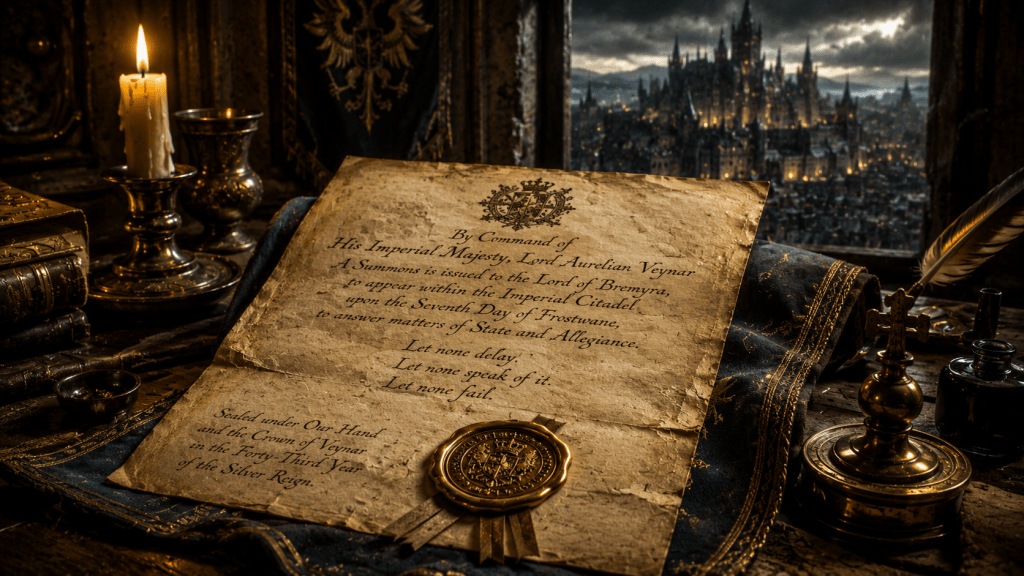
The letter entered Bremyra Castle under closed authority during the winter sitting of Prince Patrick’s regency, carried in a cedar case bound with dark cord and impressed with gold wax bearing the marks of the Council of Five.
The surviving receipt names the lower gate, the inner ward, and the lesser chancery as points of witness, each station confirming the seal as whole upon passage, with Ser Caldus of the royal household entered as receiving officer and Master Pellor of the chancery entered as keeper of lawful record.
The contents of the letter were omitted from the register, though the description of the seal was copied in unusual detail, including the five-point mark, the depth of the wax impression, and the colour recorded as old gold rather than common court yellow, suggesting that the clerks understood the distinction between royal correspondence and Order command.
A later hand added that the case was conveyed to Prince Patrick before the next bell, after which the entry gave only the phrase delivered upward under watch, a wording absent from ordinary household receipts and preserved in several copies as evidence that the chancery regarded the matter as belonging partly to the castle and partly beyond it.
The same page also carried a marginal sign beside the sender’s name, drawn in pale ink and scraped almost clean in a later revision. Its meaning was never entered into the formal index, though copies from the south archive retained the mark as a small spiral beside the words Council of Five.
The letter itself passed out of the surviving court bundle, and the register thereafter resumed its ordinary entries of grain measure, harbour duty, marriage papers, and guard expense, leaving the gold-wax receipt standing alone between common matters, as though the daily life of Bremyra had briefly opened around a message whose full burden the record was unwilling to hold.
About the Creator
The Mythic Chronicle is written and curated by Simon Phillips, a writer of mythic and speculative fantasy whose work explores forgotten kingdoms, fractured records, old institutions, and the moments when history begins to shift before those living through it understand what has changed.
The accounts preserved within these Chronicles form part of a wider body of work in which castles keep older secrets beneath familiar rooms, roads carry rumours ahead of armies, and ordinary witnesses preserve fragments of events whose true meaning remained sealed from them at the time.
One such account survives in a separate record, following the return of a magician to Bremyra during a season of court unease, royal absence, Church suspicion, and gathering danger beyond the kingdom’s roads. What the servants, clerks, and watchers of the city remembered only in fragments is followed more closely in The Unmarked Path, the opening book of The Veil of Kings and Gods within The Chronicles of the Spiral Realms.
Readers who wish to examine that fuller account may find the record below.
What follows is taken from a later account concerning the gold-wax letter entered into the lesser chancery, where the first formal record of the Council’s summons was preserved before the city understood the weight carried beneath its seal.
Chronicle Record: The Seal Carried Upward
The later copies of the receipt account began where the lesser chancery had fallen silent, with Ser Caldus carrying the cedar case through the western passage and Edran Vale summoned behind him to bear the open ledger. Snow lay white along the narrow windows, and the light that entered the castle had turned flat and colourless, dulling the gilt edges of old shields and memorial plaques beneath a thin winter veil. Servants pressed themselves against the walls as the chamberlain passed, their arms full of linen, coal baskets, keys, and covered dishes, each face turning towards the cloth-wrapped case for a single instant before discipline drew their eyes down again.
Edran followed at a measured distance, the receipt ledger braced against his chest with both hands. He had carried records through the royal stair many times, usually for matters of tax, inheritance, dispute, or treaty, and the motions of court were familiar enough to settle the mind when a man allowed himself to trust them. That morning, the same motions had grown strange. The guards at each landing straightened earlier than custom required. Pages ceased whispering when Ser Caldus approached. At the first turn of the stair, the chamberlain paused beside a narrow slit window that looked down towards the old manor hill, where the walls of the Order house stood like a dark tooth against the snow. He looked towards it for a breath too long, then continued upward with the case held close beneath his mantle.
The royal antechamber had already gathered around rumour. Two councillors stood near the map table, speaking in voices low enough to lose their words beneath the fire. A captain’s aide waited by the door with his gloves tucked into his belt. Master Vaynor, who served the household ledgers with a mind sharp enough to cut fraud from a mile away, stood beside the inner doors in a robe of brown wool, his expression fixed in its usual calm. Only his fingers gave him away, turning the end of a ribbon again and again until the silk had twisted thin.
Ser Caldus bowed to him and held the wrapped case before his breast. “The case came whole from the lesser chancery, under receipt and witness. His Highness must have it now.”
Master Vaynor extended his hand, then withdrew before his fingers touched the bundle. His gaze rested on the gold-wax impression beneath the cloth’s folded edge as he answered. “You will carry it inside yourself. Vale will attend with the ledger. His Highness may wish the line confirmed.”
The aide opened the inner doors, and the warmth of the Prince’s working chamber flowed into the antechamber with the scent of vellum, firewood, and spiced wine left cooling in a cup. Prince Patrick stood beside his father’s desk, one hand resting on the carved back of the king’s chair, his fair hair loose at his brow and his eyes shadowed from hours spent among petitions. Edran had served the court long enough to read fatigue in noble men who wished to appear untouched by burden. Patrick’s shoulders held upright, his voice remained composed, and his face gave the court what the court required, yet the desk before him betrayed the measure of the day. Vaeldring marriage papers lay open beside Arvendral dispatches. A sealed Thalosian memorandum rested near the inkstand. The kingdom had come to his table in fragments, each one asking for a prince while the king’s chair stood empty.
Ser Caldus advanced across the carpet and placed the cedar case on the cleared edge of the desk. Keeping his hands near the cloth until Patrick acknowledged the burden, he spoke with formal care. “Your Highness, a sealed message arrived under the authority of the Council of Five. It entered through the harbour road at first light and passed intact through the gates, the lower ward, and the lesser chancery. The receipt has been entered.”
Patrick’s gaze lowered to the gold wax. For a moment, the room seemed to lean towards him. His hand remained on the chair, though his fingers tightened against the carved wood. “The Council of Five,” he said, and those who heard him later disagreed over whether the words carried surprise, anger, or only the weariness of a man who had received one more weight before the last had lifted.
Master Vaynor stepped forward and indicated Edran with a small movement of his sleeve. “Vale holds the entry, my lord. The seal was whole when recorded.”
Patrick nodded for the ledger. Edran crossed the room and opened the receipt page with care, aware of the carpet beneath his shoes and the heat of the fire against his cheek. The Prince read in silence, his eyes moving across date, hour, witnesses, seal description, and sender’s name. He lingered at the last line. Edran watched his face as a clerk watches wax soften, searching for the instant before an impression takes shape, yet Patrick gave little away. He returned the ledger with a brief inclination of his head.
Patrick rested his palm beside the cedar lid and gave the order with his eyes still fixed upon the seal. “Break the outer wrapping.”
Ser Caldus drew a small knife from his belt and cut the dark cord with care, preserving the gold wax and the marked lid as he eased it upward. Within lay a folded parchment wrapped in black ribbon and closed with a smaller mark of red wax. The red bore the same five-point authority, its impression pressed so deeply that the edges had lifted in ridges. Patrick lifted the letter himself, broke the inner seal with his thumb, and unfolded the parchment as the fire gave a soft crack in the hearth. Somewhere beyond the doors, a page coughed, then held his breath.
The Prince read once, then again, and the second reading altered the room more than the first. His expression stayed composed, yet the stillness around him sharpened. When he finished, he lowered the parchment to the desk and looked towards the window as if the answer lay among the falling snow. Master Vaynor waited until the silence had carried as far as it could, then leaned close enough for concern to pass as counsel. “My lord?”
Patrick touched the edge of the letter, drawing it square with the line of the desk. “The Order has appointed a magician to Bremyra. He is to be lodged in the old manor above the city. The Council gives no further purpose.”
The words entered the chamber and settled there with a weight no royal formula could soften. The captain’s aide shifted at the doorway. Ser Caldus lowered his eyes. Master Vaynor’s ribbon stilled between his fingers. Edran, standing beside the open ledger, felt old stories stir at the back of his mind as inherited caution passed through households for generations. A magician in Bremyra. An Order manor opened. The Council writing in gold.
Patrick folded the letter along its original creases, then looked towards Master Vaynor. “The manor is to be prepared before nightfall. I want its hearths checked, its chambers aired, its stores accounted for, and a household assigned with enough discretion to keep every market stall from feeding on this by supper.”
Master Vaynor bowed, holding his ribbon still at last. “I will see it done, Your Highness.”
Patrick turned towards Ser Caldus, and the chamberlain straightened beneath the Prince’s attention. “The arrival is to be treated as lawful appointment, nothing more. The court will hear that the Order has sent a representative to reside under its own authority. Any further question waits upon my pleasure.”
Ser Caldus gathered the broken ribbon and folded cloth into the cedar case. “As you command,” he said, his chin dipping with practised restraint.
The Prince’s gaze settled on Edran, and for the first time that morning the clerk felt the full attention of Bremyra’s acting ruler. “The receipt remains in the ordinary register. No separate docket. No embellished wording. Enter only what law requires.”
Edran bowed with the ledger still held open. “It shall be recorded as lawful receipt and delivery, Your Highness.”
Patrick studied him for a breath, perhaps weighing the man, perhaps hearing the limits of his own order. Then his voice lowered, carrying only as far as those nearest the desk. “And Vale, the seal description remains exact.”
Edran bowed again, understanding more than the words alone. The record was to be plain enough for daily governance and precise enough for those who might one day need to know that gold wax had truly come. Such instructions belonged to courts that had learned how to hide a blade inside proper form.
By noon, the message had travelled farther than the parchment. It moved through the castle in carried coal, in fresh sheets taken from cedar presses, in keys fetched from the locked board near the chapel passage, in extra bread set aside under cloth, and in a revised watch for the hill road. Edran saw more than most because his work sent him from room to room with copies, countersigns, and witness slips. In the lower hall, servants whispered that the Order had sent a judge. In the west stair, a groom insisted that a healer was coming because the royal family had hidden illness from the court. By mid-afternoon, the gold wax had become a coin, a sun, an eye, a warning pressed by hands older than the kingdom itself.
At the hour before dusk, Edran was sent with a maintenance warrant to the steward responsible for the old manor. The city lay below him, roofs dim beneath winter cloud, smoke rising from chimneys in torn ribbons. Above, the manor waited behind its rusted gates with servants already moving between its outbuildings. The steward took the warrant with gloved hands and read it twice, then glanced towards the silent house whose windows had begun to show faint lamplight. “They send us a lord of the Order after all these quiet years,” he said.
Edran kept his answer within the safety of office, his eyes lowered to the warrant. “The parchment names lodging and preparation only.”
The steward folded the paper into his coat, his thin smile holding little warmth. “Parchment often says less than stone remembers.”
By evening, the receipt ledger had been returned to the lesser chancery and locked away. The page lay between entries of ordinary governance, one line above a harbour levy adjustment and one line below a requisition for lamp oil. Its plainness troubled Edran more than any flourish could have done. The day had entered the record cleanly. The record had swallowed it whole.
Long after the last bell, when the clerks had gone and the lamps burned low, Edran remained at his desk with a scrap of waste parchment beneath his hand. He wrote no official entry. He made no claim beyond witness. He set down only what the ledger had no space to preserve: that the letter had changed the manner of men before its words were known, that servants had looked uphill as if listening for a footstep still beyond the road, that Prince Patrick had held the parchment as one holds a summons meant for a house already under strain, and that by nightfall the city seemed aware of a return it had yet to see.
He sanded the scrap, folded it small, and placed it inside the back cover of his personal book, where accounts of weather, deaths, market accidents, and unusual bells lay gathered across many years. The castle quietened around him. Snow kept falling beyond the glass. Above the city, the manor’s first lamp was lit after long disuse, a single amber point on the hill, and Bremyra carried its light through the darkness as though a sealed name had been spoken and every stone had begun, slowly, to answer.
A surviving household register from the upper Order manor, preserving the first recorded signs that the house above Bremyra had begun to stir before its appointed guest arrived.
The Idea Behind the Chronicle
Sealed letters carry a strange power in old courts. They arrive as parchment, wax, cord, and witness, yet the hands that receive them often understand that the true burden rests in what cannot be read aloud before the room. A letter from a merchant may alter trade. A letter from a neighbouring crown may alter policy. A letter beneath gold wax, bearing the authority of the Council of Five, altered the air around it before any prince had broken the seal.
This Chronicle draws upon the quiet terror of formal procedure, where danger enters through lawful channels and leaves every servant bound to behave as if all remains ordinary. The cedar case, the receipt ledger, the witness line, the preserved seal, and the careful movement through the castle all belong to a world that trusts record and rank to hold uncertainty in place. The more exact the entry became, the more heavily the silence around it seemed to gather.
The Sealed Road of Bremyra is built around records that stand near the truth while failing to possess it. In this second Chronicle, the letter matters less as a message to be opened than as an arrival remembered by those who handled its passage. The clerks knew the colour of the wax. The chamberlain knew the care required in carrying it. Prince Patrick knew that its sender belonged to a power older than his present authority. None of them yet held the full shape of what its coming had begun.
Gold wax became the centre of the account because it gave the Chronicle a visible mark of distant command. It allowed the scene to remain small and domestic while still carrying the pressure of old arcane power. One room, one ledger, one case passed from hand to hand, and still the whole castle appeared to shift around it. That is the movement this Chronicle preserves: change entering Bremyra through a clerk’s page before it reached street, chapel, library, or road.
The letter also lets the cycle deepen its view of Bremyra as a kingdom under strain. Prince Patrick already stood amid marriage papers, border reports, and the absence of his father’s full authority. The summons from the Council arrived into that fragile balance, pressing the Order back into the city’s life through protocol instead of spectacle. No spell was cast. No gate broke. No hidden chamber stirred in open sight. Yet a place long used to royal business felt an older jurisdiction step across its threshold.
This Chronicle therefore follows authority as atmosphere. The myth lies in the way ordinary witnesses remembered the arrival as more than administration. A clerk entered the receipt, a chamberlain carried the case, servants whispered through the hall, and by evening the old manor above Bremyra had a lamp burning again. The truth of the letter belonged elsewhere. The memory of its passage belonged to the castle.
From the Author’s Desk
Thank you for continuing into this Chronicle.
This second account was shaped around the idea that power often enters a kingdom in quiet form before anyone sees its full consequence. In Bremyra, the return of the Order began through a sealed letter, a court receipt, a chamberlain’s passage, and a clerk’s careful wording. Nothing outwardly broke in that moment, yet the castle had already begun to change.
Across this cycle, each Chronicle follows a different fragment surrounding the first movement of The Unmarked Path. Some accounts remain close to the castle, others move through chapel records, road reports, servant memory, damaged fields, and fearful northern rumours. They are preserved as partial witnesses rather than complete explanations, allowing Bremyra’s world to gather shape through what its people saw, misread, recorded, or feared to name.
This Chronicle keeps its distance from the full truth of Simion’s story. The novella holds the direct account. Here, the focus remains with those who stood near the edge of events: clerks, servants, guards, chapel attendants, and court officers whose records carried the first signs of change long before anyone understood what they had received.
Beyond The Mythic Chronicle, my writing continues across fantasy, speculative fiction, and related novella worlds, where hidden histories, old institutions, broken records, and uncertain witness accounts often shape the path into larger stories. Some works follow events more directly, while others stay close to fragments and echoes, allowing the world to emerge through what survives.
Readers who wish to explore further may find additional work through the links included in this publication.
From the lesser chancery folios of Bremyra Castle, preserved in the receipt bundle later copied under the winter regency of Prince Patrick. The script is narrow, formal, and partially corrected in a second hand.
The sealed case was entered after first light during the winter sitting, carried from the harbour road under guard and received at the lower gate before passage to the inner ward, where the chamberlain took custody in the presence of the captain’s men and confirmed the gold seal whole upon transfer.
A further entry records that the case was conveyed to the lesser chancery and set before the receipt master, who ordered the sender named in full, the hour entered according to royal reckoning, and the impression described with care beyond ordinary court habit, the wax being marked as gold and bearing the fivefold authority of the Council.
The contents of the letter were absent from the chancery copy, though the movement of the case through the castle was preserved in unusual detail, including witness names at each threshold and a note stating that the item was carried upward under watch after receipt, a phrase entered in smaller script and later traced over by another hand.
The order to prepare the old manor appears on the same folio, written below the receipt in compressed lines, with hearths, shutters, bedding, stores, and servants named as matters requiring completion before nightfall, though the reason for urgency was left outside the formal wording.
A mark beside the sender’s name appears in the oldest surviving copy, shaped as a small spiral or coiled flourish, partially scraped from the page during later revision. The index makes no reference to the mark, and subsequent copies vary in whether they preserve it, leaving uncertainty over whether it belonged to the clerk, the revising hand, or an older notation carried from the first record.
The final line confirms that the cedar case reached the Prince’s chamber before the next bell, after which the register resumed ordinary matters of harbour duty, lamp oil, and store expense, leaving the receipt complete in legal form while withholding the burden that gave it consequence.
Marginal Notes & Interpretations
Collected from later annotations found along the outer margins of the receipt folio and from two damaged copies held among royal household papers.
One annotation suggests that the gold wax merely reflected formal courtesy from the Council of Five and that the unease recorded in later copies arose from common fear surrounding the Order’s name, especially among clerks whose knowledge of magicians came through rumour, old sermons, and household tales.
A second note disputes this reading, stating that ordinary courtesy would have used red or black wax, while gold indicated higher authority within Order practice. The writer adds that the chamberlain’s decision to preserve the seal on the cedar lid shows that those present understood the letter as command rather than correspondence, though the note breaks off before naming any source for this claim.
A third annotation, entered in a faint and hurried hand, records that the old manor was lit before all preparation warrants had reached its steward, and that one servant sent to open the east rooms claimed to have found fresh ash beneath a cold grate. The line was later struck through, though traces remain visible beneath the scraping.
A later copy from the south archive omits the ash account entirely and replaces the spiral mark with a plain dot beside the Council’s name, suggesting either caution in transmission or an effort to reduce the folio to ordinary administrative form.
World Notes
Lesser Chancery of Bremyra Castle
A working archive chamber used for daily receipt, household warrants, sealed deliveries, witness lines, and copies of royal correspondence. Its records were practical in purpose, yet many later chroniclers valued them for the small details preserved around events that court histories treated more broadly.
Gold-Wax Authority
A seal colour associated in later Bremyran copies with high Order command, set apart from common diplomatic wax and ordinary private correspondence. Surviving references remain sparse, and later writers disagreed over whether gold marked Council rank, urgency, secrecy, or a combination of all three.
Royal Receipt Register
The formal book used to enter sealed items received into the castle under witness. Such registers normally preserved material facts rather than interpretation: date, hour, sender, seal condition, receiving officer, and route of custody. Their restraint made unusual details more significant when they appeared.
The Old Order Manor
A former house of arcane residence above Bremyra, maintained by obligation after the Order’s daily presence withdrew from the kingdom. Its reopening after the gold-wax letter became one of the earliest remembered signs that the old relationship between Bremyra and the Order had begun to stir again.
Next Chronicle
After the gold-wax letter entered the register and the old manor above Bremyra was opened, attention soon turned from the royal chancery to the cathedral, where Archbishop Alaric Thorne’s household began preparing for the arrival of the Order’s appointed magician.
Later chapel notes describe a summons written in formal language and sent across the city with unusual haste. The account preserves little of the message itself, though it records doors held closed, candles replaced before their time, and attendants instructed to keep the nave clear while the Archbishop waited beneath the coloured glass.
Those who copied the cathedral papers in later years treated the summons as an early sign that the Church had sensed danger before the court understood its shape. No witness claimed certainty over what Alaric feared, yet the surviving fragments suggest that his unease lay deeper than courtesy, and that the return of the Order touched old tensions beneath Bremyra’s holy stone.
Next Chronicle: The Cathedral Warning
The receipt ledger returned to its shelf with its pages ordered, its witness lines complete, and its ink dried around the lawful arrival of the Council’s seal, while above the city the old manor held its first lamp through the falling snow, and within that quiet light the summons remained present in Bremyra, carried beyond parchment by every stone that had heard its name.
Before any rider climbed the hill above Bremyra, the old Order house was said to have recognised the return for which it had long kept silent.
Before the Rider Climbed the Hill
The summons reached the lower service court after first light, carried beneath a sky the colour of beaten pewter and received in the quiet manner reserved for instructions that invited no argument. The old house above Bremyra was to be opened before nightfall, with fires laid, rooms aired, lamps trimmed, linen brought up from castle stores, and the western suite made ready for a guest of the Order. The clerk who read the command aloud offered no name, and those gathered beneath the dripping eaves asked for none, since the word Order settled over them more heavily than any title. The scullery maids lowered their eyes, two footmen exchanged a glance before fixing their attention upon the stones, and the housekeeper folded the parchment before gathering old keys, lamp oil, and those she trusted for the climb.
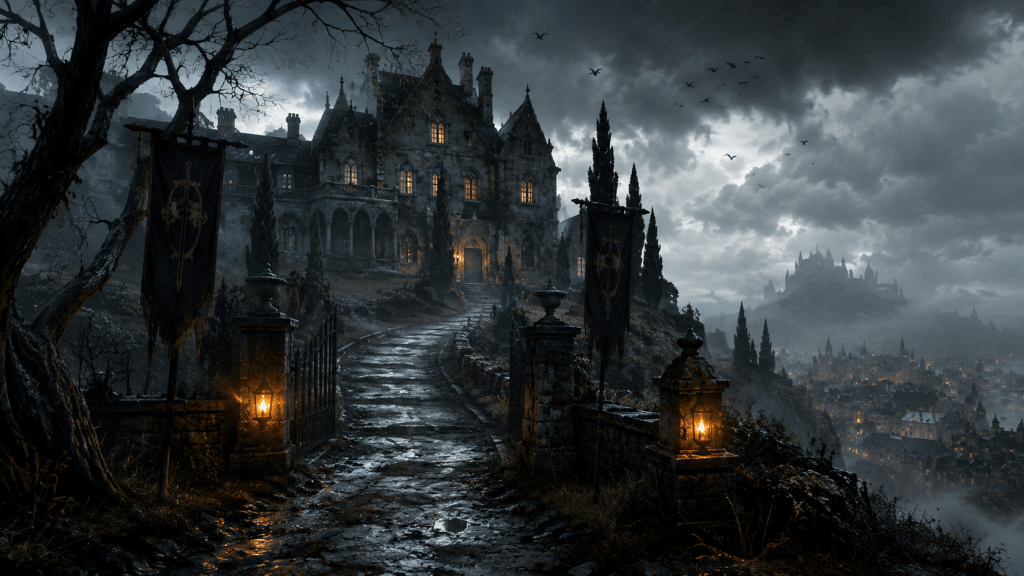
The path to the manor climbed above the city in a crooked line of stone, worn smooth along its centre by feet remembered more clearly than the people who had once made the ascent. Bremyra lay below them in the grey hush of morning, its roofs dark with rain, its harbour dim beneath the mist gathering off the sea. Farther uphill, the manor emerged through thinning vapour as a broken shape against the clouds, larger than memory allowed and lonelier than distance suggested. Its outer gate leaned inward upon one hinge, the crest above it softened by moss and weather, though the old device of the Order still held its outline when seen from the proper angle. They passed beneath the arch in single file, boots sinking into wet gravel and dead leaves, while wind stirred branches across the upper windows with a scraping sound later described as too close to whispering.
The housekeeper carried the main key upon a ring wrapped in cloth and halted before the door while the others gathered behind her. The manor had remained unused for years save during brief inspections ordered from the castle, and even those visits had thinned with time. Its stone face retained tall arched windows, narrow balconies, and a broad entrance shaped for honoured guests. Ivy veiled part of the façade, moisture darkened the lower courses of masonry, yet the door itself appeared strangely clean, the iron latch clear of the green bloom marking the rails beside it, as though a hand had passed across it recently. The housekeeper noticed, and one of the footmen noticed with her, opening his mouth before reading the set of her jaw and letting the matter sink back into silence. When she fitted the key, the lock turned before her wrist completed the motion, smooth and yielding, and the door gave inward with a low sigh from its hinges.
Cold air met them first, carrying dust, old wood, and something fainter that no two later accounts described in quite the same manner. One servant recalled the scent of extinguished candles after prayer, another claimed the hall held the dryness of parchment left too near a hearth, while the housekeeper wrote only that the air seemed preserved. The entrance hall rose in shadow above them, its walls lined with panels darkened by neglect and carvings that resembled leaves until viewed longer, when they gathered into interlocking lines. Dust rested thickly along the floor where no breeze should have reached, yet a pale trail stretched across the stone from the doorway towards the central chamber, narrow and irregular, visible for several steps before fading into the gloom. One maid looked towards the others, uncertain whether some earlier inspector had left it, and the housekeeper answered by sending her to open the shutters.
Work began in the way work often saved people from unease, through repetition, complaint kept under the breath, and the comfort of tasks that yielded visible change. Rugs were beaten in the front court, chairs were set upright beneath their dust cloths, sconces were wiped clean, and fires took more swiftly than the cook’s assistant expected from wood stored in so damp a room. Upstairs, shutters resisted along the southern rooms, then opened in succession with such force that one girl cried out and stepped back, her hand still inches from the latch. The sea wind entered at once, lifting sheets, tugging at curtains, and rolling through the corridors until several doors shifted deeper in the house. The footman nearest the stair later insisted the sound came from pressure moving through rooms long sealed, while the maid beside him remembered the doors opening one after another in the order of someone passing through them.
The western suite demanded the greatest care, for there the guest was meant to rest. It lay at the end of a passage overlooking the lower city and the castle beyond. The housekeeper directed fresh linens to be spread, blankets aired near the hearth, a basin set upon the washstand, and oil lamps arranged where a late arrival might find them. While two maids smoothed the coverlet, one paused and asked whether anyone else heard bells from the city, and the others listened over rain and Bremyra’s distant morning sounds. Wheels moved upon stone, a gull cried near the harbour, voices drifted upward through the weather, yet no bell carried across the hill. The maid insisted the sound had come from within the walls, low and muffled beneath the floorboards, and the housekeeper answered with a quiet order that sent her back for more candles.
By noon the weather had drawn tighter around the manor, binding hill and city in slow coils of mist. The servants ate bread and cheese in the kitchen, speaking more boldly as warmth gathered around the hearth. Someone said the castle expected an old counsellor from the Order. Someone else repeated a rumour heard in the stables that the guest would be young, though powerful enough to make princes rise when he entered. Their talk thinned when a sound travelled overhead, slow and measured, crossing from one side of the upper floor to the other. The housekeeper rose so abruptly that the bench scraped against the flags, took a lamp, called for one of the footmen, and mounted the stair while the rest listened beneath held breath. They found the western passage empty, every door where it had been left, every window latched against the wind, though the lamp flame bent towards the prepared suite as they passed, leaning almost flat in the air while no draught touched their faces.
The afternoon brought visitors from the castle with a chest of wine and a smaller locked case the carriers refused to describe. They left it upon the study table under written instruction and departed before the rain worsened. The case bore no crest upon its lid, only bands of dark iron and a seal of pale wax pressed with a mark too blurred for the servants to identify. Afterward, the study felt changed. The housekeeper returned later to confirm the door remained closed, only to find a line through the dust there, as though a finger had brushed once across the wood. She cleaned it away with the heel of her hand and carried the memory alone.
Towards evening, the lamps throughout the manor were lit one by one, their gold reflecting across dark panels, pale glass, and polished vessels newly set in order. The building no longer resembled an abandoned remnant upon the hill. It held fire in its hearths, fresh water in its basins, and the faint stir of readiness through rooms that had spent years settled into their own quiet. The servants gathered their baskets near the entrance while the housekeeper made a final circuit through the western suite. In the sitting room, the lamp upon the mantle had already been lit. She remembered leaving it dark, though now its flame burned steadily beneath the old crest of the Order, casting its faint design across the wall in softened lines of amber. She stood there longer than she later admitted before lowering her gaze and leaving the room as she had found it.
They descended the hill under a sky heavy with coming snow, the manor behind them dimly radiant above Bremyra, every prepared window holding a square of muted light. From the lower bend of the road, one of the younger maids turned to look back and claimed she saw a figure standing at an upper window, tall and still, dressed in darkness against the lamp glow. The footman beside her saw only curtain shadow, while the housekeeper refused to look. By the time the city lamps emerged beneath the mist, no rider had yet entered Bremyra, no herald had called from the gate, and no name had been written beside the manor’s restored rooms. Even so, among those who climbed the hill that morning, the account endured that the old house had ceased to feel empty before its guest arrived, as though the stone had received word earlier than the servants, and had begun, in its own patient fashion, to wait.
A Visual Chronicle
An abandoned manor above Bremyra began waiting before anyone knew who was coming.
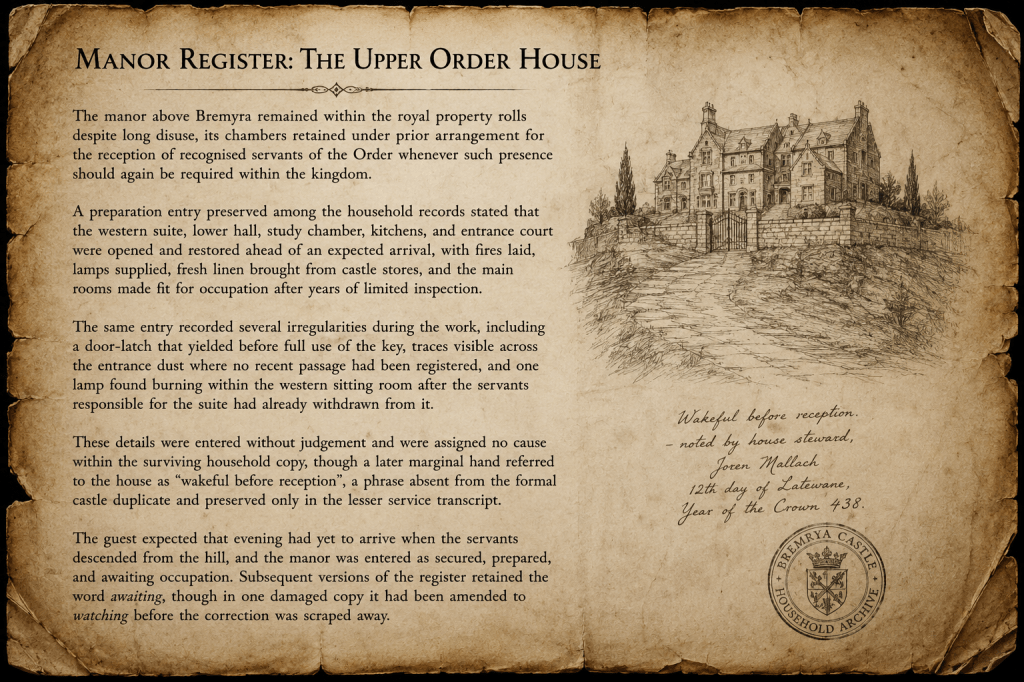
Manor Register: The Upper Order House
The manor above Bremyra remained within the royal property rolls despite long disuse, its chambers retained under prior arrangement for the reception of recognised servants of the Order whenever such presence should again be required within the kingdom.
A preparation entry preserved among the household records stated that the western suite, lower hall, study chamber, kitchens, and entrance court were opened and restored ahead of an expected arrival, with fires laid, lamps supplied, fresh linen brought from castle stores, and the main rooms made fit for occupation after years of limited inspection.
The same entry recorded several irregularities during the work, including a door-latch that yielded before full use of the key, traces visible across the entrance dust where no recent passage had been registered, and one lamp found burning within the western sitting room after the servants responsible for the suite had already withdrawn from it.
These details were entered without judgement and were assigned no cause within the surviving household copy, though a later marginal hand referred to the house as “wakeful before reception”, a phrase absent from the formal castle duplicate and preserved only in the lesser service transcript.
The guest expected that evening had yet to arrive when the servants descended from the hill, and the manor was entered as secured, prepared, and awaiting occupation. Subsequent versions of the register retained the word awaiting, though in one damaged copy it had been amended to watching before the correction was scraped away.
About the Creator
The Mythic Chronicle is written and curated by Simon Phillips, a writer of mythic and speculative fantasy whose work explores forgotten kingdoms, fractured records, old institutions, and the moments when history begins to shift before those living through it understand what has changed.
The accounts preserved within these Chronicles form part of a wider body of work in which castles keep older secrets beneath familiar rooms, roads carry rumours ahead of armies, and ordinary witnesses preserve fragments of events whose true meaning remained sealed from them at the time.
One such account survives in a separate record, following the return of a magician to Bremyra during a season of court unease, royal absence, Church suspicion, and gathering danger beyond the kingdom’s roads. What the servants, clerks, and watchers of the city remembered only in fragments is followed more closely in The Unmarked Path, the opening book of The Veil of Kings and Gods within The Chronicles of the Spiral Realms.
Readers who wish to examine that fuller account may find the record below.
What follows is taken from a later household account concerning the upper manor above Bremyra, where signs of readiness were first recorded before the appointed guest had entered the city or any rider had climbed the hill towards its gate.
Chronicle Record: The Night the Manor Kept Watch
Night gathered around the manor by degrees, deepening first among the trees behind the western wall, then along the hollow beneath the gate, and at last across the windows facing Bremyra, where the city lights trembled through mist like embers beneath gauze. A second message arrived in the hands of a stable boy who climbed the hill with rain upon his collar and mud along both stockings, carrying instruction that two members of the household should remain until the Order guest had taken possession of the manor or fresh direction came from the castle. The housekeeper read the note beside the entrance lamp, looked towards the westward rooms above, then chose the old porter and the youngest of the chambermaids, one for steadiness, the other because youth travelled swiftly when an errand needed carrying.
The porter accepted the charge with a bow that held more habit than enthusiasm. He had served at the castle gates through many seasons of winter and rain, and the breadth of his shoulders gave comfort to those who mistook size for certainty. The chambermaid stood beside him with both hands gathered in her apron while the housekeeper explained which fires required checking, which rooms were to stay closed, and which bell-rope by the door would summon aid from the watch post on the lower bend of the road. When the instructions ended, the porter lifted the lantern from its hook and offered the girl a practical smile. “A roof, a fire, and bread enough for evening,” he said, testing the lamp in one hand. “There are harsher duties in Bremyra.” The chambermaid glanced towards the stair before replying that the manor carried too many rooms for two people, and he gave a low chuckle while the housekeeper turned away.
The final servants left as the first snow began to move through the rain, fine pale grains slipping sideways in the wind. Their voices faded along the path, followed by the dull clatter of the outer gate settling after them, and the manor drew around its remaining watchers with a quiet that seemed fuller than emptiness. The porter secured the main door, checked the bar across it, then crossed into the lower hall where one hearth had been allowed to remain alive. The chambermaid unpacked the small supper basket left for them, laying bread, cold beef, and a stoppered flask upon a side table before arranging two stools near the fire. She kept her back away from the stair while she worked. The porter noticed, though he chose gentler ground for speech, asking after her mother in the laundry rooms and her elder brother among the kitchen boys, until her shoulders loosened and her answers lengthened beyond murmured courtesy.
Their meal passed quietly, shaped by the crackle of wood and the soft push of weather against the windowpanes. The porter spoke of royal messengers who arrived after midnight and expected hot wine as though storms served only to prove their importance. The chambermaid laughed once, then gathered the remnants of supper while he rose to make the first circuit through the ground floor. Lamps burned steadily along the entrance hall and near the lower sitting room. The kitchen fire had settled into a deep red bed. Only at the foot of the stair did he slow, lantern raised, listening to a faint sound from above that resembled cloth brushing stone.
The chambermaid had heard it as well. She stood beneath the arch to the hall with the folded supper cloth held against her waist. “Is someone up there?” she asked, her eyes lifting towards the dark stretch of the stair. The porter set his boot upon the first step and held the lantern higher. “If anyone lingers there, they carry poor manners in a house prepared for honour,” he said, using humour because the girl’s face had grown pale. No reply returned from above. He climbed with deliberate tread while she followed at a distance close enough for courage, far enough to turn if courage failed.
The upper passage held the faint sweetness of newly lit oil and warmed linen. Every door stood as it had been left after the housekeeper’s final inspection, save for the western sitting room, whose door rested open by the breadth of a hand. The porter paused before it and cast lantern light across the threshold. The mantle lamp burned there, flame low and unwavering beneath the worn crest of the Order. The chambermaid swallowed. “The mistress left that room closed,” she said, keeping both hands tight around the cloth. The porter entered first, sweeping light across the chairs, the hearth, the table set with a clean pitcher, and the study door beyond. “Wind finds its way into old houses,” he answered, though the outer windows held firmly latched and no stirring of air touched the hanging curtains. He crossed the room, drew the sitting-room door wider, then pushed the study door with the edge of his knuckles when he found it partly open as well.
Inside, the dark iron case remained upon the table, its pale wax seal gleaming at the edge of his lantern’s reach. The chambermaid stayed at the threshold, reluctant to pass beneath the lintel. “That door was closed as well,” she whispered, and the porter turned slowly, searching the floor, the shelves, the narrow gap behind the writing chair. Dust clung where dust should have clung, untouched along the shelf lines and gathered beneath the table. Only the tabletop had changed. Earlier wiping had left its grain clean and dull. Now a fine powder lay across it, pale as ash, disturbed by a single narrow sweep leading towards the locked case. The porter studied it for several breaths before lowering the lantern. “The housekeeper will hear of this in the morning,” he said, keeping his voice even for the girl’s sake. “Until then, we close what stands open and keep to our charge.” He shut the study door, then the sitting-room door, and remained in the passage until the latch held beneath his thumb.
They returned below with slower steps. The chambermaid carried the cloth into the kitchen and stayed there longer than the task required, washing cups already clean and arranging the supper basket twice. The porter resumed his place near the hall fire, rubbing a hand over his beard while the snow thickened beyond the window. Each sign might have yielded to ordinary explanation if taken alone, a loose latch, a servant’s forgetfulness, ash carried where it should have stayed absent. Gathered together, they formed something harder to ease away within a house linked for generations to magicians who had once moved through Bremyra with rights few kings granted gladly.
The chambermaid returned from the kitchen and found him watching the stair. She sat beside the hearth, fingers interlaced, then looked towards him with the grave curiosity of someone younger than their own courage. “Have you ever seen one of them?” she asked, her gaze remaining upon the upper landing. The porter lowered his eyes from the dark above and considered her question. “A magician?” he replied, easing back upon the stool. “Once, when I was younger than you are now. He came with three horses, two servants, and a temper quick enough to strike sparks from silence. The castle bowed low. The market fell quiet. My mother told me afterward that people fear what can cross a room before anger has time to cool.” The girl listened with fixed attention, then asked whether the guest due at the manor would be the same. The porter shook his head slowly. “Every person carries their own weather,” he said, folding his hands across his knees. “The house may know sooner than we do.”
A dull sound moved through the ceiling above them before she could answer, heavier than the earlier brush along stone, as though a door had closed somewhere in the upper rooms. The chambermaid rose at once. The porter stood with her, lantern already in hand, and together they climbed again. This time the western passage remained still, every door shut, each lamp unchanged. The only difference lay at the far window, where frost had gathered against the inner glass in pale branching lines despite the room’s mild warmth. The chambermaid approached before he could stop her, drawn by the shape of it. From the centre of the pane, the frost curved outward in a broad, incomplete spiral that dissolved near the corners beneath beads of melting water. She lifted one finger towards it, yet halted before touching the glass. “Was that there before?” she asked, her voice barely louder than breath. The porter watched the curling pattern fade under the warmth of the room and answered after too long a pause. “Morning will tell us what weather meant to leave.”
They stayed upstairs a while after that, checking shutters, lamp reservoirs, and the seams of closed doors before returning to the lower hall. In the western suite, the bed remained fresh, the basin water still, and the room’s fire low yet alive. In the sitting room, the mantle lamp burned with a steadier glow than before. The porter reached towards its wick, intending to lower it, then drew his hand back when the flame thinned of its own accord and settled at a modest height. The chambermaid saw the movement and gripped the edge of the door. The porter adjusted the cuff of his sleeve as though that had occupied him, then gestured towards the passage with the lantern. “We have seen enough for one circuit,” he said, and led the way down.
Midnight passed beneath snowfall so dense that Bremyra disappeared from the windows, leaving the manor suspended between whitened ground and a sky emptied of shape. The hall fire should have fallen lower by then, yet its coals held deep colour, feeding the room with even warmth. The chambermaid had drifted into light sleep on the stool, head tipped against the panelling, while the porter kept watch with a blanket drawn across his knees. He woke her gently when hoofbeats carried up from the road below, clear at first, then fading beneath the weather. She started upright, smoothing her hair with both hands. “The guest?” she asked, looking towards the door. The porter crossed to the nearest window, wiping condensation from the glass with his sleeve. Snow veiled the road. No lantern swung through it. No rider took the final bend towards the gate.
The second half of the night brought no further sound overhead, yet the manor seemed to ease into a deeper attention. The porter sensed it in the halls when he made another circuit before dawn, in the way firelight reached farther across the floor, in the faint sheen gathered upon the entrance stones where dust had lain the previous evening. The path through the hall had become clearer, beginning at the front door and continuing towards the stair, as though several careful passes had drawn the old grime aside. He knelt near the first mark and brushed two fingers across it, finding the stone clean beneath. The chambermaid watched from beside the hearth, her blanket clutched around her shoulders. “Shall we send for the watch?” she asked, holding the blanket closer. The porter rose slowly. “At sunrise,” he said, glancing towards the sealed door. “The road will carry messages better in light.”
Grey morning entered beneath the clouds, faint and cold, while snow rested along the outer ledges and softened the hill beyond the gate. The porter unbarred the door after the first birds began calling from the trees and stepped into air sharp enough to clear sleep from the mind. The chambermaid joined him with a shawl drawn high around her neck. Together they looked down towards Bremyra, where smoke rose from waking hearths and the city revealed itself piece by piece beneath lifting mist. A castle runner appeared first upon the lower road, red cloak bright against the snow, moving uphill with urgency held in disciplined limbs. He reached the gate breathless, bowed while catching air, and delivered his message to the porter in clipped official phrases. The guest of the Order had entered Bremyra before dawn. He would attend to certain business below and take possession of the manor later that day. The household was to remain prepared.
The runner departed almost at once, leaving their questions untouched. The porter closed the gate and turned back towards the manor, whose upper windows held the pale light of morning. The chambermaid remained still beside him. “So he came,” she said, eyes fixed upon the western suite. The porter followed her gaze and saw the mantle lamp glowing through the glass despite daybreak, a small amber point resting high above the snow. “He came to the city,” the porter answered, choosing each word carefully as they walked back towards the entrance. “The house seems to have heard earlier.” Behind them, Bremyra’s bells marked the morning hour, and every fire within the old manor still burned.
A surviving household register from the upper Order manor, preserving the first recorded signs that the house above Bremyra had begun to stir before its appointed guest arrived.
The Idea Behind the Chronicle
Old houses often survive the people who once gave them purpose. Their rooms remain, their stairways hold the shape of vanished routines, and the objects left within them preserve traces of authority long after the voices that commanded them have gone quiet. A place built for power rarely becomes ordinary simply through neglect. It waits within its own altered silence.
The manor in this Chronicle draws upon that idea of a house preserved beyond use, set above Bremyra as a remnant of the Order’s former presence within the kingdom. Though its halls had remained closed for years, the command to reopen them stirred more than household labour. Fires were laid, shutters lifted, and chambers restored, yet the servants’ accounts suggested that the manor had begun preparing itself before their work reached completion.
Across older records, houses tied to rulers, priests, scholars, and magicians often gather stories of unusual readiness. Lamps burn where no hand claimed them. Doors ease open before guests arrive. Dust carries marks that seem to belong to a passage taken earlier than any witness can explain. Such details linger because they stand close enough to ordinary household disturbance to resist certainty, while still unsettling those who encounter them.
The Sealed Road of Bremyra explores a kingdom living beside histories it has never fully laid to rest. The Order had withdrawn from daily life in Bremyra, though its manor remained above the city, holding the shape of an older relationship between arcane authority and royal power. When that presence returned, the city understood the arrival as a matter of sealed letters and court protocol. The house appeared to understand it in another way.
This Chronicle therefore begins the series through place rather than action. Before foreign steel appears in the streets, before hidden knowledge stirs beneath the castle, before roads break under violence and rumour, one old building wakes into attention. Its response is quiet, domestic, and uncertain, which makes it more unsettling than spectacle would have been.
The manor stands as the first threshold of the Bremyra cycle. It receives the returning magician before the city has named him, preserving the earliest suggestion that buried histories had begun to move again, and that some structures remembered their former masters more faithfully than the people living beneath them.
From the Author’s Desk
Thank you for continuing into this Chronicle.
This opening account was shaped around the idea that a place may begin to change before anyone recognises the turning of events around it. The manor above Bremyra stands quietly at the edge of the city, long unused, still marked by the Order’s former presence, and yet the first record of this cycle suggests that its silence had never been as empty as those sent to reopen it believed.
Across The Sealed Road of Bremyra, each Chronicle will preserve a different fragment from the kingdom’s first season of unease: household accounts, chapel records, castle memories, road reports, and witness fragments gathered around events whose fuller truth remained beyond those who saw them. These pieces are incomplete by design, shaped by rumour, fear, duty, and the limits of what each witness could understand.
The first movement begins with a house waiting upon a hill. Later accounts will move deeper into Bremyra itself, where sealed letters disturb the court, the Church watches with growing concern, and old histories begin pressing against rooms that had seemed familiar for generations.
Beyond the Chronicle, my writing continues across mythic fantasy, speculative fiction, and novella-length stories that follow such worlds more closely from within. Some accounts remain distant and archival. Others step directly into the lives of those caught at the centre of change, where uncertainty gives way to consequence.
Readers who wish to explore further may find additional work through the links included in this publication.
From a lesser household transcript preserved among the upper property records of Bremyra Castle. The original entry appears to have been copied from a service register maintained during the reopening of the old Order manor above the city. Several phrases differ from the formal duplicate.
The upper house was opened under sealed instruction from the castle, with the western suite, lower hall, study chamber, and kitchen fires restored before the expected reception of a servant of the Order, whose name was absent from the household command and entered only after the first preparation had been completed.
Those assigned to the work recorded that the front latch yielded before the key had turned fully, though the door showed no sign of recent forcing or decay beyond the ordinary wear of long neglect. Dust within the lower hall bore a pale interruption running inward from the threshold, narrow in form and broken before reaching the stair, and the servants assigned to cleaning the passage entered no cause for the mark.
A later portion of the same account refers to an oil lamp within the western sitting room found burning after the housekeeper’s final inspection, despite the lamp being remembered as unlit when the chamber had been closed. The wording in this passage appears altered in the formal castle copy, where the matter is reduced to a note concerning household oversight.
The night-watch entry states that two servants remained after dark under instruction from the castle and heard movement above the lower hall at several intervals before midnight. Upon inspection, doors previously secured were found standing open within the western suite, while the sealed case delivered earlier that day remained untouched upon the study table. A fine powder had gathered across the desk where the surface had already been cleaned, marked by a narrow sweep directed towards the case.
A final note, written in a different hand and placed beneath the original watch account, records that the expected guest had entered Bremyra before dawn, though the manor fires remained strong, the mantle lamp still burned at daybreak, and those present stated that the house had seemed prepared for occupation several hours earlier.
The formal household register concludes with the manor entered as restored, secured, and ready for reception. The lesser transcript preserves an additional phrase, later crossed through in brown ink: the house kept watch before the Order returned.
Marginal Notes & Interpretations
Collected from later annotations found along the outer edges of the surviving transcript.
One annotation attributes the opened doors and unusual air movement to the condition of an old manor reopened after long disuse, observing that swollen wood, uncertain latches, and shifting pressure in neglected chambers could easily trouble servants already unsettled by the expected arrival of a magician. The same hand offers no explanation for the lamp remembered as unlit.
A second note disputes this gentler reading, stating that several details appear across more than one witness account: the yielded latch, the inward mark across the entrance dust, the lamp in the western sitting room, and the prepared path through the hall observed before dawn. The writer concludes only that such agreement among household servants deserves preservation even where cause remains unclear.
A third annotation, written in a cramped and fading script, refers to a chambermaid who later refused further work at the upper house and requested transfer to laundry duty within the castle. The note adds that she spoke often of a figure seen at the western window before the manor’s guest had arrived, though the line beneath this detail has been scraped thin and cannot be read with confidence.
Another marginal entry appears to have been added much later, after the manor had resumed occasional use. It states that certain houses remember the purpose for which they were built longer than kingdoms remember why they were abandoned, and that places once given to the Order seldom became empty in the ordinary sense.
World Notes
The Upper Order Manor
A long-disused residence standing on the hill above Bremyra, retained within royal property rolls for the reception of recognised servants of the Order when their presence in the kingdom became necessary. Though neglected for years, the manor still carried traces of its former purpose through old insignia, preserved suites, and household arrangements maintained in dormant form.
Household Preparation Records
Service entries maintained by stewards, housekeepers, and castle clerks when abandoned or rarely used properties required reopening. Such records usually concerned rooms restored, provisions delivered, servants assigned, and security confirmed, though lesser copies sometimes preserved details excluded from formal royal duplicates.
Order Houses
Residences once granted or maintained for magicians travelling under recognised authority, often positioned near courts, major cities, or routes of diplomatic importance. In later generations many fell into infrequent use, though their association with the Order continued to shape how servants, clerks, and local residents understood them.
Watch Entries
Short records kept when servants were instructed to remain overnight within a prepared household before the arrival of an expected guest. They were practical documents in purpose, yet in the case of older properties they sometimes preserved small disturbances later absent from official summaries, especially where multiple witnesses referred to the same irregularity.
Next Chronicle
In the days before the manor above Bremyra received its appointed guest, sealed correspondence passed quietly through the royal offices, carried beneath gold wax and entered into the castle record with more care than its outward form appeared to require.
The clerk assigned to receive it recorded the letter as a matter of Order authority, though later copies suggest that its arrival altered the mood of the chamber in which it was opened, drawing attention from those who had no right to hear its contents and leaving behind the first court whispers that Bremyra had been summoned towards an older obligation.
No connection was made between the letter and the house waiting upon the hill, though later accounts preserved both within the same sequence of returning signs.
Next Chronicle:The Letter Beneath Gold Wax
The manor above Bremyra remained prepared upon its hill, its fires tended and its rooms restored to purpose, while the city below received the returning magician through sealed instruction and cautious silence. Within the western suite, the lamp beneath the old Order crest continued to burn through the morning, and those who had kept watch carried away the sense that the house had recognised its guest before any servant had been told his name.