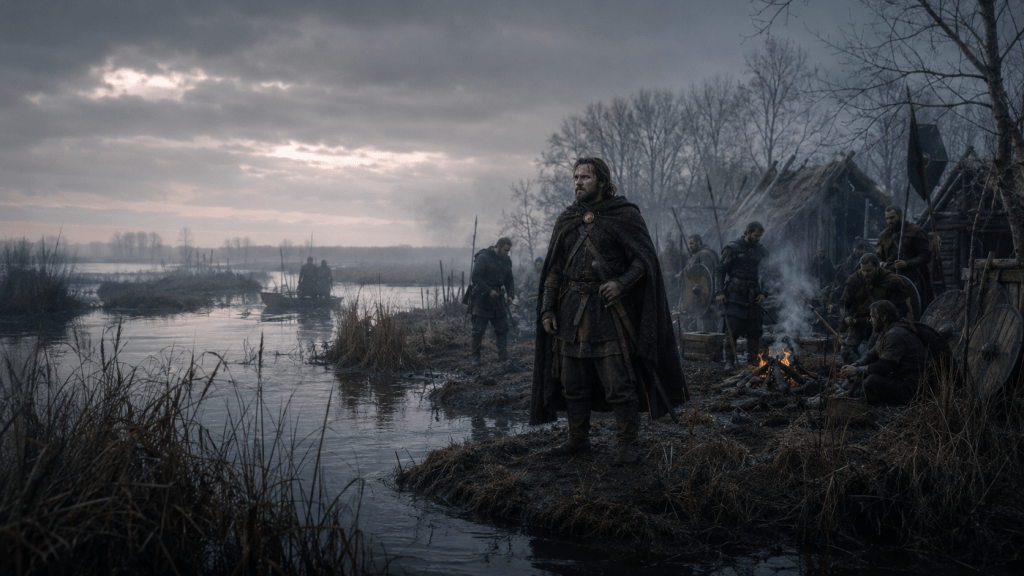
The fugitive king of Wessex, the hidden refuge of Athelney, and the fragile resistance that kept Anglo-Saxon England from disappearing.
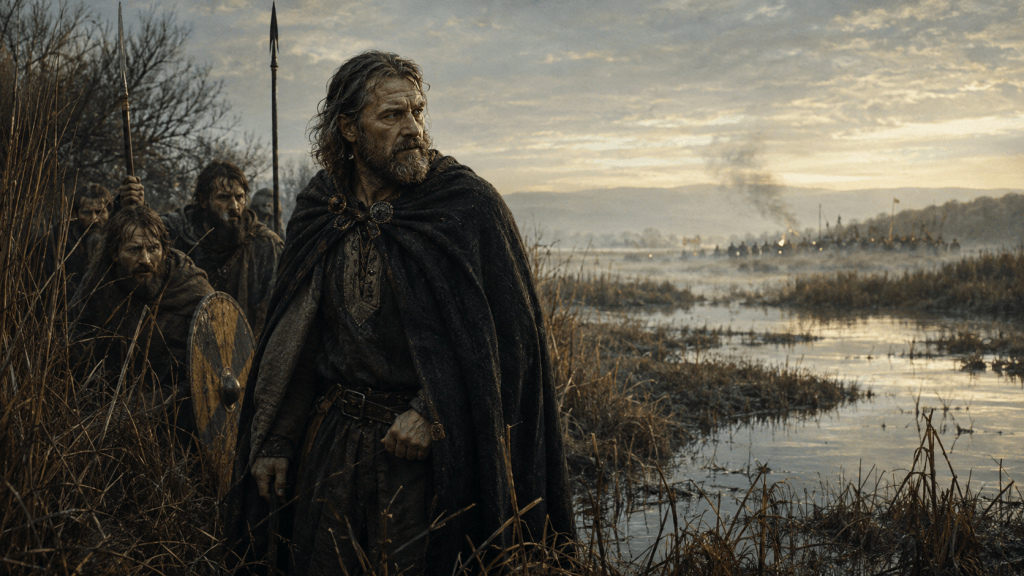
The King Among the Reeds
The winter light lay thin across the marshes, silvering the reed beds and the slow black water that wound through the hidden places of Somerset. Mist gathered low over the channels, drifting between alder roots and drowned grass, softening the world until land and water seemed to fold into one muted expanse. Somewhere beyond that quiet reach, Viking fires burned in captured halls, and the roads of Wessex carried rumours of defeat from village to village. The king who had once ridden beneath the protection of household men, priests, messengers, and royal expectation now moved through wet earth and secrecy, wrapped in the rough cloak of a man hunted by the enemies who had broken into the heart of his kingdom.
Alfred had reached the marshes after the blow at Chippenham, when Guthrum’s army struck deep into Wessex during the cold season and shattered the confidence that remained around the royal house. The attack came during a time when men expected feasting, rest, and the slower duties of winter, yet war seldom honoured the habits of Christian kingdoms. Royal halls emptied into fear. Companions scattered into the countryside. Oaths bent beneath pressure as families weighed survival against loyalty, while across Wessex some submitted, some fled, and others waited in silence to see whether the house of Cerdic still possessed a king worth following.
Athelney offered little splendour to a ruler born into sacred ancestry and trained amid the burdens of command. It was a low island amid water and reeds, half-hidden from the roads that carried armies, surrounded by marshland that swallowed careless footsteps and confused strangers who lacked local knowledge. To those who knew its paths, it offered concealment, and to Alfred it became refuge, fortress, chapel, and council chamber within the same narrow refuge. Here, kingship shed its gold. Authority became a damp cloak, a shared fire, a whispered message carried after dusk, a blade kept dry beneath cloth, and a prayer spoken softly while enemies held the roads beyond the wetlands.
The men who gathered around him came in fragments from the broken edges of the kingdom. A loyal thegn came by one hidden path, a household warrior by another, a messenger crossing through mist and water with news from estates and villages still willing to resist. Each arrival mattered because each man brought more than strength. He brought proof that Wessex still remembered itself. A kingdom could lose towns, treasure, open roads, and royal halls, yet endure for a time if its people still believed the centre lived somewhere beyond sight.
In later memory, Alfred’s time in the marshes gathered stories around itself: the hidden king, the poor shelter, the cakes left to burn while his thoughts remained fixed upon war and survival. Whether every detail belonged to truth or legend, the deeper meaning endured. A king had been driven to the edge of his realm and stripped almost bare, and that edge became the place where endurance hardened. In the reeds of Athelney, beneath winter sky and watchful silence, the future of Anglo-Saxon England rested upon a fugitive king who still refused to yield.
Timeline of Events
871 AD – Alfred becomes king of Wessex after the death of his brother Æthelred, inheriting a kingdom already strained by repeated Viking attacks.
876 AD – Guthrum’s Viking army enters Wessex and takes Wareham, forcing Alfred into negotiation while the threat to his kingdom deepens.
877 AD – Viking pressure continues across southern England, leaving Wessex increasingly isolated as other Anglo-Saxon kingdoms weaken or fall under Scandinavian control.
January 878 AD – Guthrum launches a surprise winter attack on Chippenham, driving Alfred from the royal centre and scattering much of the West Saxon resistance.
878 AD – Alfred withdraws into the marshes of Athelney, where he gathers loyal men, rebuilds his strength, and prepares the resistance that will soon return from hiding.
A Visual Chronicle
Driven from his kingdom and hidden among the reeds of Athelney, Alfred the Great began gathering the scattered resistance that would keep Wessex alive.
About the Creator
This Chronicle is written by Simon Phillips, author of several historical and speculative fiction works exploring forgotten worlds, myth, and the turning points of history.
You can explore his books here:
Books by Simon Phillips
You can watch his YouTube channel here:
Author Simon Phillips
Continuing the Chronicle
The account that follows moves deeper into the marshes of Athelney, where Alfred’s kingship passed through its darkest test after the winter attack on Chippenham, and where the survival of Wessex depended upon hidden paths, loyal men, and the quiet endurance of a fugitive king gathering strength among the reeds.
Readers supporting The Forgotten Chronicle may continue into the full record below.
The Hidden King of Athelney
The marshes of Athelney lay far from the clean roads and open halls of Wessex, hidden among water, reed beds, alder roots, and low islands where a stranger’s horse could sink into black earth before its rider understood the ground beneath him. In winter, mist rose from the channels and moved across the wetland in pale sheets, softening the edges of trees, banks, and paths until the whole place seemed shaped for secrecy. Alfred came into that silence stripped of the splendour that usually surrounded kingship. The royal hall had fallen behind him, his household had scattered, and Guthrum’s men held the advantage gained through sudden winter violence. Around the fugitive king gathered only the few who had found their way through fear, water, and darkness to reach him.
The blow at Chippenham had cut deep into Wessex at the opening of 878, when the cold season should have slowed the business of war. The Christmas feasts had only recently passed, and men across the kingdom would have expected hearths, prayers, repairs, and the hard quiet of winter. Guthrum chose that moment for speed. His army struck into the royal centre and shattered the fragile order Alfred had fought to preserve since taking the crown. In the confusion that followed, loyalty became a test carried in each man’s chest. Some sought safety under Viking authority. Some vanished into the countryside. Others watched the roads and waited for a rumour that might prove the king still lived.
In Athelney, the world narrowed to survival. Firewood had to be gathered where smoke would draw few eyes. Food had to be carried across wet ground and shared among men whose strength would soon be needed. Weapons had to be wrapped against damp and held close through long nights. The men around Alfred slept lightly, waking at the shift of reeds or the distant call of birds, hearing danger in every broken sound from the marsh. A king who had heard Latin in royal instruction, who had ridden beside warriors and spoken with bishops, now shared the same cold, hunger, and watchful silence as the companions who stayed with him. The marshes allowed no illusion of grandeur. They accepted only endurance.
Athelney’s strength lived in its hidden nature. Roads rarely favoured it. Armies could find little ease there. Water divided the land into passages known best by local people, and each pool, bank, and channel worked against those who came in haste. To Viking warriors used to speed along roads and rivers, the wetland offered frustration. To Alfred and those who guided him, it became a shield wider than any wall. The place guarded him by confusion, by distance, by the plain difficulty of moving through a landscape that seemed to shift beneath the weather. There, among the reeds, royal power survived by becoming small enough to escape notice.
The first men who gathered around Alfred came by fragments, each arrival bringing more than a body to the hidden camp. A thegn crossing by a secret path brought news from estates still loyal. A household warrior carried memory of the king’s earlier battles. A messenger arriving through dusk brought word of villages where men still kept weapons close and waited for a summons. These men arrived cold, tired, and careful, yet every arrival strengthened the same quiet truth. Wessex had lost its centre in sight of the world, yet its centre still breathed somewhere in the marshes. A kingdom could lose halls, treasure, and open roads, while its will survived inside men who still answered their king.
Alfred’s task in those weeks reached beyond concealment. He had to become a living sign that the kingdom had a future. A dead king would have ended much. A king lost to silence might have achieved almost the same. A king hidden, breathing, planning, and sending messages through the wetland edge became something far more dangerous to Guthrum than a defeated ruler fleeing through winter mud. He became a promise that Wessex had only bent beneath the blow. The work around him must have been patient and exacting: names remembered, loyalties tested, meeting places chosen, food secured, scouts sent, and hope passed quietly from one trusted hand to the next.
Later memory placed one of its most human stories within this hardship. The tale of the burned cakes showed Alfred sheltering in a poor woman’s dwelling, so burdened by thought that he allowed cakes beside the fire to blacken while his mind remained fixed upon war and survival. The story belonged to legend as much as record, shaped through generations that wished to see the great king humbled before his return. Its exact shape lay beyond certainty, yet its meaning endured because it brought Alfred close to ordinary life. In that tale, he was a weary man beside a hearth, subject to rebuke, weighed down by a kingdom’s ruin while small domestic labour continued around him.
The deeper truth of the marshes required no legend. Alfred held fast while the land around him remained uncertain. The men who supported him worked through shadows, carrying news through Somerset and beyond, keeping alive the channels of obedience that had once flowed openly through the kingdom. Priests, local landholders, warriors, guides, and families whose names slipped from record all helped preserve the line of resistance. Their part rarely received the brightness of battle, yet the recovery of Wessex depended upon such hidden labour. The future being formed in Athelney rested as much upon quiet service as upon the king’s own resolve.
As winter loosened and spring approached, Alfred’s refuge became more than a place of escape. A small stronghold rose there, giving shape to the resistance that had gathered in secrecy. From Athelney, men could raid, watch, and prepare, striking at the edges of Viking control while Alfred rebuilt the confidence needed for open war. Each act carried meaning beyond its immediate gain. A road watched again, a band of men gathered again, a message answered again; these signs told Wessex that the royal line had regained movement. The Vikings had seized the visible heart of the kingdom, yet the heart beyond sight had begun to beat with greater force.
Then came the moment when hiding could turn toward action. Alfred sent word for the fighting men of Somerset, Wiltshire, and Hampshire to gather at Egbert’s Stone. The summons carried the weight of everything endured in the marshes. Men who had waited through fear now had a place to go. Those who had doubted the kingdom’s survival now had proof of its return. The gathering at Egbert’s Stone would lead toward the field at Edington, where Alfred would face Guthrum in open battle and change the course of the war. Yet that visible victory began in the hidden places, in the damp nights and secret paths of Athelney, where defeat had been held back one breath at a time.
The marshes stripped kingship down to its last foundation. A crown held meaning only while men still believed in the one who wore it, and Alfred’s authority survived because enough people chose to carry that belief through danger. He entered Athelney as a fugitive, pursued by the consequences of a shattered kingdom. He emerged with resistance gathered around him and the road to renewal opening ahead. The reeds and mist had sheltered more than a hidden king. They had guarded the remaining will of Wessex, and through that fragile endurance, the making of England continued.
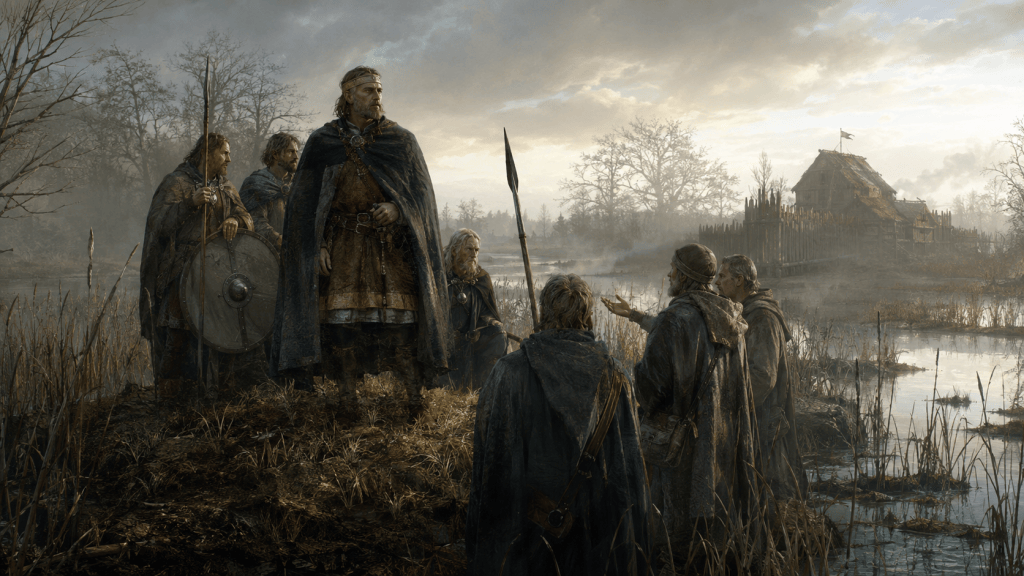
Alfred stands among the marshes of Athelney, where the hidden strength of Wessex began to gather again beneath mist, water, and winter light.
Inspiration Behind the Story
Alfred’s time in the marshes holds its power because it begins with loss instead of triumph. The image of a king hidden among reeds, water, mist, and uncertain paths carries a quieter force than any battlefield. Wessex had been wounded almost to breaking, its royal centre shaken, its loyalties strained, and its future reduced to the survival of one hunted ruler in a place far from splendour.
What fascinates me about this moment is how history sometimes turns in hidden spaces before it returns to the open field. The marshes of Athelney gave Alfred more than shelter. They gave him time, concealment, and the chance to gather scattered courage into something that could move again. The great victory that followed at Edington began here, in hardship, secrecy, and endurance.
For storytelling, this is one of the strongest images in Anglo-Saxon history. A king who had nearly lost everything survived in a landscape that seemed poor, cold, and forgotten, while the future of a kingdom gathered around him in fragments. That contrast gives the Chronicle its emotional centre.
This Chronicle matters because it reminds us that survival can become its own form of command, and that a kingdom’s future can sometimes begin again in the places where power appears to have vanished.
From the Author’s Desk
What stayed with me while writing this Chronicle was the image of kingship reduced to its barest form. Alfred’s story in the marshes carries none of the splendour usually attached to royal power. There were no shining halls, no easy procession of loyal nobles, no visible centre from which command could be seen. There was water, cold ground, hidden paths, and the quiet labour of staying alive long enough for resistance to gather again.
That is what makes Athelney so powerful to me. It shows history at the point where everything grand has fallen away, leaving only endurance. Alfred’s authority survived because men still chose to answer him, even when the roads were dangerous and the kingdom’s future looked uncertain. A crown meant very little in the reeds unless loyalty still moved through the hands of those willing to carry messages, food, weapons, and hope.
There is a strong storytelling truth inside this moment. The turning point arrives before the famous battle. It begins in secrecy, hardship, patience, and the decision to keep going when defeat appears almost complete. Athelney reminds us that survival can become the foundation of renewal.
This series continues to interest me because the making of England passed through fragile places. Before unity, before victory, before later memory shaped Alfred into a legendary king, there was a hunted ruler in the marshes, waiting for the moment when Wessex could rise again.
You can explore my books here:
Books by Simon Phillips
You can watch my YouTube channel here:
Author Simon Phillips
Historical Notes & Context
Additional Historical Notes
Alfred’s withdrawal into the Somerset marshes followed Guthrum’s surprise attack on Chippenham in early 878 AD. The attack struck at the royal centre of Wessex during the winter season, scattering Alfred’s followers and placing the kingdom under severe pressure. The Anglo-Saxon Chronicle records that Alfred escaped with a small company into the woods and marsh-fastnesses, a detail that gives this episode its enduring sense of danger and isolation.
Athelney itself lay within the wetland landscape of the Somerset Levels. Its value came from concealment, difficult access, and local knowledge. To an army seeking swift movement, the marshes formed a frustrating and uncertain environment. To Alfred and his supporters, they offered protection, time, and a base from which resistance could survive. Later tradition remembered Alfred building a stronghold there, turning a hidden refuge into the centre of renewed West Saxon resistance.
The famous story of Alfred and the burned cakes came from later tradition, especially through accounts associated with Alfred’s growing legend. Its historical detail remains open to question, yet its symbolic force explains why it survived. It presents Alfred as humbled, distracted, and human during a moment of extreme pressure, far from royal splendour and close to ordinary life. Whether literal event or moral tale, it deepened the image of a king tested in hardship before his return.
Related Events
Alfred had become king of Wessex in 871 AD after the death of his brother Æthelred. His early reign was shaped by repeated conflict with Viking forces, including the battles and negotiations that followed the arrival of large Scandinavian armies in southern England. By 878 AD, Wessex stood as the main surviving Anglo-Saxon kingdom still capable of organised resistance.
Guthrum’s attack at Chippenham marked one of the greatest crises of Alfred’s reign. The Viking leader came close to breaking Wessex as an independent kingdom, forcing Alfred into hiding and compelling many West Saxons to submit or wait in uncertainty. The months at Athelney became the bridge between near-collapse and renewed action.
After gathering strength in the marshes, Alfred summoned men from Somerset, Wiltshire, and Hampshire to Egbert’s Stone. From there, the restored West Saxon force moved toward the Battle of Edington, where Alfred defeated Guthrum and forced a settlement that reshaped the struggle between Saxon and Viking power. Athelney therefore stands as the hidden beginning of the victory that followed.
Further Reading
Alfred the Great: Asser’s Life of King Alfred and Other Contemporary Sources – translated by Simon Keynes and Michael Lapidge
Alfred the Great: War, Kingship and Culture in Anglo-Saxon England – Richard Abels
The Anglo-Saxon World – Nicholas J. Higham and Martin J. Ryan
The Viking Wars of Alfred the Great – Paul Hill
Next Chronicle
Alfred had survived the marshes, gathered the strength of Wessex from hidden places, and prepared to return from the edge of ruin. Athelney had stripped kingship down to endurance, secrecy, loyalty, and faith, yet survival alone could never secure a kingdom for long. Once the danger had passed its darkest hour, Alfred faced a greater task: rebuilding a realm strong enough to endure the next storm.
The victory that followed at Edington gave Wessex breathing space, although it also revealed how fragile the old order had become. Roads, towns, defences, learning, law, and royal authority all required renewal. Alfred’s greatness rests in more than the defeat of Guthrum. It rests in what came after, when a king shaped by hardship began turning survival into structure.
What makes this next Chronicle so important is that Alfred’s England shows the making of a kingdom through deliberate repair. The burhs strengthened defence. Law gave order. Learning restored memory. Ships, roads, fortified towns, and written wisdom became part of a wider vision in which Wessex could stand firm while the wider Anglo-Saxon world continued to change around it.
The next Chronicle moves from the hidden refuge of Athelney into the rebuilding of a kingdom, where Alfred’s rule became more than resistance and began to shape the foundations of an England that could outlast invasion, fear, and the broken years that had almost consumed it.
Next Chronicle: Alfred’s England
The marshes kept their silence, yet from that silence Wessex began to rise again.