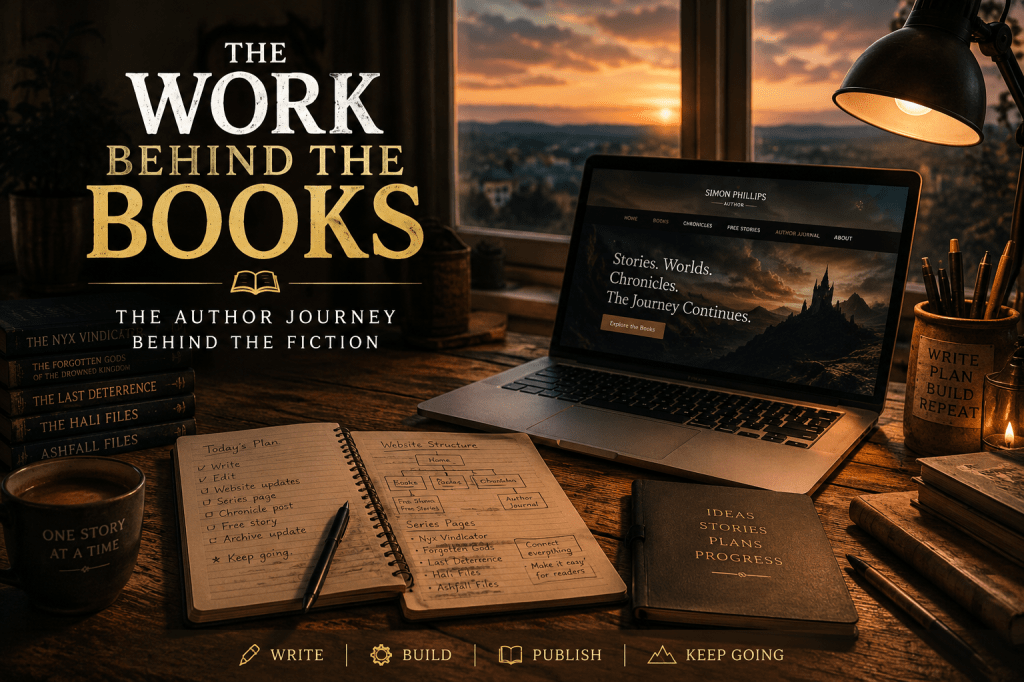
The Work Behind the Books

Why I Wanted to Start This Section

Most author websites naturally place the finished book first. That makes sense, because the book is usually the reason someone has arrived on the site. A reader wants to know what the story is, what kind of world they are entering, where to begin, and whether there is another book waiting after the first one.

I still want that to remain true here. The books, stories, series pages, Chronicles, free fiction, and paid archive are the main parts of this website. They are the reason the site exists. They are also the work I want readers to find, follow, and hopefully return to over time.

Even so, there is another side to the work that does not always fit neatly on a book page or a story page. It is the planning, the testing, the rebuilding, the slow decisions, and the small corrections that happen before a reader ever sees the finished result. That side is quieter, but it matters.

This Author Journey section is where I want to write about that part of the work.


What Readers Usually See First

By the time a book appears on a website, it can look fixed and simple. There is a cover, a title, a description, a purchase link, and perhaps a short note about the series. Everything seems clean because the messy part has already happened somewhere else.

The same is true of a Chronicle issue, a free story, or a new page on the site. The visible result is only the final layer. Behind it are choices about structure, timing, categories, images, links, tone, format, and how the piece fits into the wider author platform.

I have been thinking about that more as I rebuild the WordPress side of my author work. A website can easily become a list of books with a few links attached. There is nothing wrong with that in a basic sense, but it does not give much sense of the author behind the work, or the shape of the larger project being built.

I wanted a place where I could talk about that without turning every update into an announcement or a sales post.


The Work That Sits Behind a Finished Page
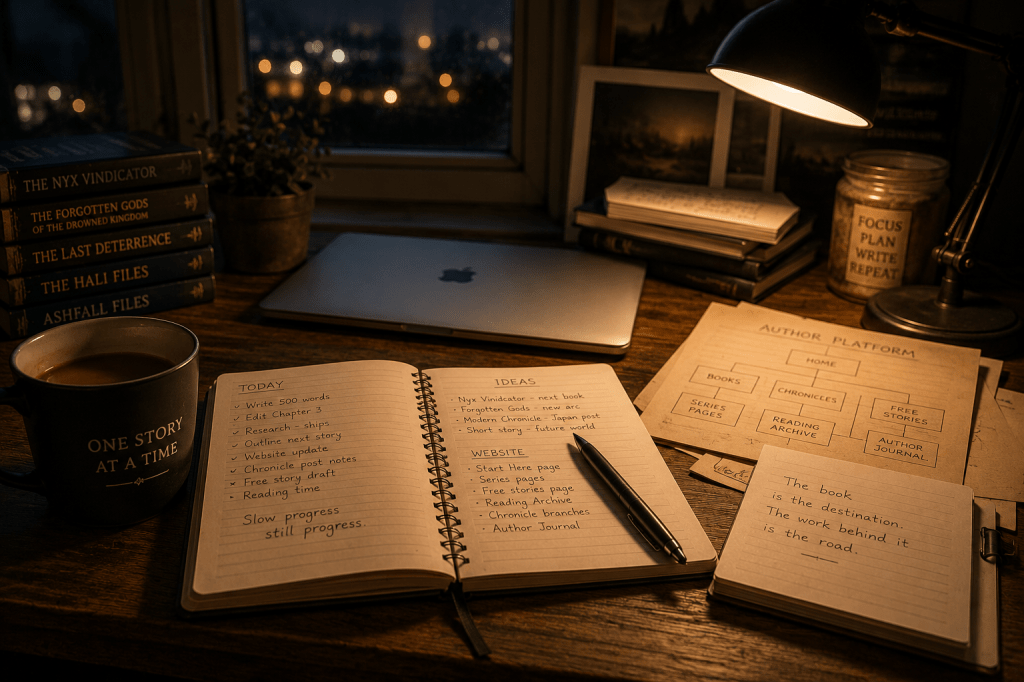
A lot of the work behind the books is not dramatic. It is often a matter of deciding where something belongs, what it connects to, and how a reader might find it later.

A story has to sit in the right place. A series needs a page that can grow over time. A Chronicle post needs to connect to the right branch without overwhelming the fiction it is meant to support. A free story should be easy to find, but it should not confuse the paid archive. A writing update should help readers understand what is happening without pulling attention away from the books themselves.

These decisions are small on their own, but they add up. They decide whether the website feels clear or scattered. They decide whether a reader has a simple path through the work, or whether everything becomes a pile of posts with no real direction.

That is one reason I have been treating WordPress as a serious part of the author platform rather than a spare noticeboard. I do not want the site to exist only as a bridge to somewhere else. I want it to hold the books, the story worlds, the Chronicles, the free fiction, the paid material, and the author updates in one organised place.


Building the Website Around the Fiction

The website is being built around the fiction first. That matters to me because it keeps the whole project honest.

The series pages are there for the books. The Chronicle branches are there to support discovery and give readers another route into the work. The free stories are there to let readers try the fiction without needing to pay first. The paid archive gives some of the longer material a proper home. The Author Journal sits beside those things, but it does not replace them.

That balance is important. I do not want the website to become a general blog where the books are pushed into the background. I also do not want every post to feel as though it is trying to sell something. Readers can usually sense that, and I do not think it helps build trust.

For me, the better path is to show the work clearly. Some posts will be about new stories or releases. Some will be about changes to the website. Some will be about what I am learning as I publish, organise, and keep going. The fiction remains the centre, but the process around it can still be worth sharing.


Why Every Update Should Not Be an Advertisement

A book advertisement has its place. A release post has its place. A paid archive update also has its place. Those posts are useful because readers need to know what is available and where to find it.

Still, if every update is only about buying, subscribing, or clicking through to something, the author begins to disappear behind the promotion. That is not what I want from this section.

I want some posts to feel quieter than that. I want room to write about decisions that are still forming, changes that have taken longer than expected, and practical lessons that might not sound impressive but are part of building something that lasts.

There is also value in admitting that not every part of the work is clean or fast. Some pages need rebuilding. Some ideas need sorting out before they make sense. Some stories take longer to place within the wider structure. Some plans look clear at the start and then need adjusting once the real work begins.

That does not mean the project is failing. It usually means the project is becoming more honest.


Writing Around Real Life
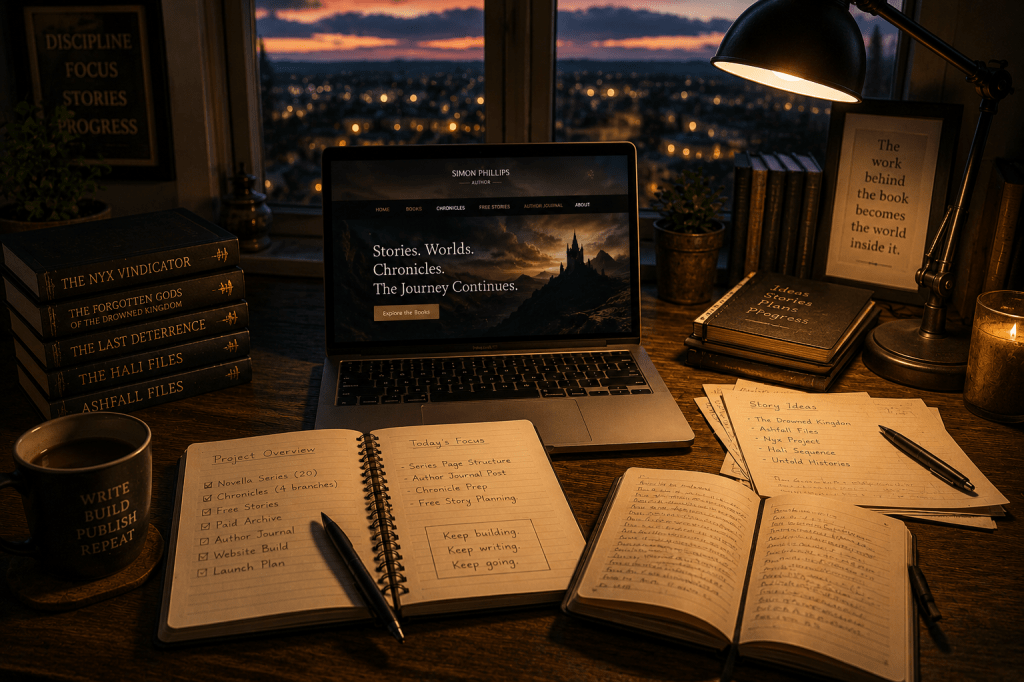
Another reason I wanted this section is that writing does not happen in a perfect empty space. It happens around work, family, tiredness, time pressure, and ordinary responsibilities. I do not want to turn that into the main subject of the website, but it is part of the truth behind the books.

There are days when the work moves quickly. There are other days when the most useful thing I can do is fix a category, update a page, make a note for a future story, or check whether the website still makes sense from a reader’s point of view. That kind of progress does not look impressive from outside, but it keeps the larger structure moving.

I have learned to take those smaller steps more seriously. A finished story matters, of course. A published book matters. A complete series page matters. Still, the quiet maintenance matters too, because without it the website becomes harder to use and the work becomes harder to follow.

The long-term goal is not to appear busy. The goal is to keep building in a way that readers can understand.


The Value of Small Progress

One thing I have had to accept is that slow progress is still progress when it is moving in the right direction. That sounds simple, but it is easy to forget when there are several books, several story worlds, different content streams, and a website that needs to hold all of them properly.

Small progress might mean writing a post like this. It might mean making the Author Journey section clearer. It might mean giving the Monthly Free Stories page a proper place. It might mean making sure a Chronicle issue links back to the right series page. It might mean writing a better excerpt, choosing a cleaner title, or deciding that a page should not try to do too many jobs at once.

Those things are not as visible as a new book cover, but they shape how the whole site works. They help the fiction feel less scattered. They also help me see the project more clearly as I build it.

That is one of the main reasons I want to write these posts. They give me a place to record the practical thinking behind the work while giving readers a clearer sense of what is being built.


What I Will Share Here

This section will mostly be about the writing life behind the books and the author platform around them. I expect to write about story progress, series planning, publishing decisions, KDP lessons, website building, WordPress changes, Substack reflections, YouTube experiments, mini-reads, free stories, paid archive updates, and the slow discipline of keeping a large fiction project organised.

Some posts may be simple progress notes. Others may look at a decision in more detail, such as why a page was added, why a series needs its own hub, or why free fiction belongs beside paid content. There may also be posts about setbacks, tiredness, false starts, and the problem of trying to build a writing career in real life rather than in theory.

What I do not want is a section full of empty advice. I am still learning many parts of this. I would rather write honestly about what I am trying, what has helped, what has been slower than expected, and what I am changing as the work develops.

That feels more useful than pretending everything was planned perfectly from the beginning.


Where This Fits on the Website

The Author Journey section is a support layer for the main website. It is here for readers who want to know more about the person building the books, the choices behind the site, and the practical work that sits around the fiction.

It should not take over from the books themselves. The series pages, Chronicle branches, free stories, paid archive, and main book pages remain the main paths through the site. This section simply gives those paths some human context.

I think that matters, especially with a site that is carrying several types of content. A reader might arrive through a free story, a Chronicle issue, a book page, or a post about the writing process. However they arrive, I want the site to feel connected rather than random.

That means building slowly, making careful decisions, and accepting that some of the less visible work is still part of the author life.


A Quiet Starting Point
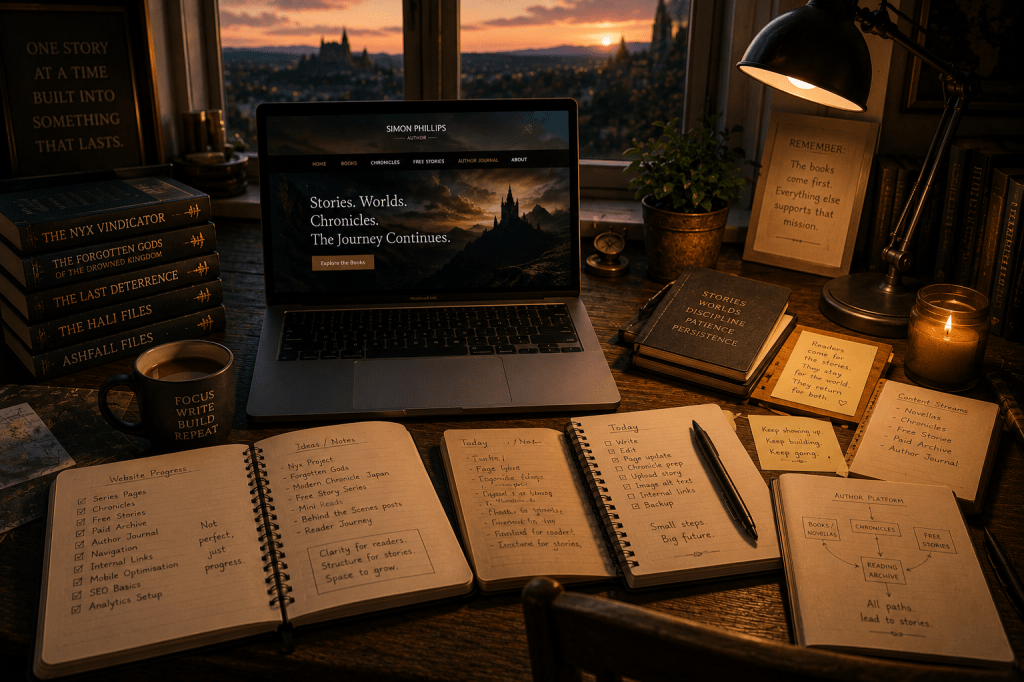
This first post is not a major announcement. It is simply a starting point for a section I think the website needs.

There will still be book updates, story releases, Chronicle posts, free fiction, and paid material. Those are the main reasons the site exists. This section will sit beside them as a place for the quieter work: the planning, the lessons, the adjustments, the doubts, the useful mistakes, and the small steps that help the whole platform become clearer over time.

If you are here for the fiction, that remains the best place to begin. The books and stories are the centre of the site. If you also want to follow how the work is being built behind the scenes, this is where I will write about it.

I will keep adding updates as the site develops.

The Quiet Victory of Persistence in Creativity

A short moment from the life of an author.

There’s a quiet kind of victory that never shows up in stats or milestones. It doesn’t come with applause, a viral short, or a nicely rounded word count. It just arrives with a sigh, a stretch of the fingers, and a whispered, “Alright then… carry on.”

Today was one of those days.

I stared at the draft. Again. I knew what needed rewriting, but every sentence felt heavier than it should. The edits weren’t flowing, the coffee wasn’t helping, and the background noise of daily life, bills, work, sleep I didn’t get, was louder than usual.

And yet… I didn’t close the document. I didn’t shelve the idea. I didn’t let the doubt win.

I wrote a sentence. Then another. Then reworded the first one and deleted the second but stayed with it. And that, strangely enough, felt like something.

I didn’t give up.

Not for the first time. Not for the last. But this was today’s win, and I think it’s one worth sharing.

If you’re working on something creative, whether it’s a novel, a painting, a video, or just the courage to start, know this: continuing is often the bravest thing we do.

So if today you didn’t give up either… I’m glad you’re still here.

Let’s keep going.

Simon

One Small Win That Kept Me Going A Comment That Changed My Day

There’s a strange kind of silence that follows uploading something into the void.

You spend days crafting a video or refining a chapter. You rewrite a line fourteen times until it stops sounding like bad theatre. You export, upload, tweak the thumbnail, write a caption that doesn’t sound desperate, and finally, finally, you press “Publish.”

And then… nothing.

At least, not right away. Maybe a view or two trickles in. A quiet like. You start questioning everything, your voice, your tone, your hair in that shot, whether this story was worth the time it took to write.

But then it happens. Someone, somewhere, leaves a comment that says:

“I want to read this.”

Five words. That’s it. No in-depth critique, no elaborate praise. Just a quiet little statement from a stranger who paused long enough to want more.

And that changed my entire day.

Not because it went viral. Not because I gained a hundred new followers or sold a book. But because it reminded me that the story I’m telling, the one I’ve dragged through sleepless nights, multiple rewrites, and far too many cups of tea, is reaching someone.

That’s the win.

It’s easy to talk about milestones and big launches. But for many writers, especially those still building something from the ground up, it’s the small, often invisible victories that keep the wheels turning.

So if you’re out there, watching someone’s book video or reading a blog post about a novel that hasn’t even launched yet, don’t underestimate what a simple comment can do.

To whoever left that message: thank you. You may not remember it, but I do.

The Unexpected Challenges of Being a Self-Publishing Author

There’s something rather thrilling about building a world from scratch. You craft your kingdoms, shape your gods, breathe life into characters who, over time, start talking back to you. But once you decide you actually want people to read what you’ve written, that’s when the reality sets in.

When I first began writing The Veil of Kings and Gods, I wasn’t thinking about publishing at all. I was just trying to write the story I’d been carrying around in my head for years. But now, with the second draft taking shape and the word count tipping well past 200,000, I’ve had to ask myself the real question: do I go down the traditional route, or do I take the leap into self-publishing?

For now, I’m leaning toward the latter. Not because I don’t believe in the traditional path, it has its strengths but because I believe in the world I’ve created, and I want the freedom to build it my way. That said, the journey to self-publishing isn’t all late-night writing sessions and dreamy cover design mockups. There are challenges you don’t quite anticipate until you’re knee-deep in them.

One of the trickiest is time. I work multiple jobs, juggle family responsibilities, and still try to make space for the novel. It’s not glamorous. Most of my writing happens in brief snatches, at school during breaks, late in the evening when the rest of the world has quieted down. Managing that with content creation for YouTube, blog writing, and building an author presence online is like spinning several plates while plotting a civil war between two kingdoms.

Then there’s the learning curve. Book formatting, ISBNs, metadata, newsletter tools, SEO, and reader psychology, none of it has anything to do with actually writing, and yet all of it matters if you want your book to reach readers. I’ve spent more time Googling “how to not look like an amateur author” than I care to admit.

Another odd challenge: sharing your work in public before it’s finished. Through Shorts, blog posts, and early lore reveals, I’ve let people peek into the world of The Veil of Kings and Gods before the final draft is done. It’s exciting but vulnerable. You’re inviting feedback, forming connections, and trying to grow a following, all while the foundations of your novel are still shifting beneath your feet.

The last thing I didn’t expect? The silence. Sometimes you pour yourself into a post, a video, a piece of lore, and it gets a handful of views, maybe a like or two. No comments. No shares. And that’s when you realise: you’re not just writing stories. You’re building faith. Quietly. Steadily. On days when no one is watching.

So yes, I’m leaning towards self-publishing. Because despite all that, I believe in this story and I believe in the long game. Traditional publishing may still be an option one day, but for now, the creative control, the direct connection to readers, and the freedom to pace this journey in a way that suits both the book and my life, that’s what I need.

If you’re also on this path, or thinking about it, I’d love to know what’s been the hardest part for you so far. Or maybe the most rewarding. Feel free to share it in the comments or just quietly know that you’re not the only one spinning the plates and chasing the dream.

5 Things I’ve Learned Writing My First Novel

When I first sat down to write The Veil of Kings and Gods, I thought I had a pretty good idea of what I was getting into. Turns out, I didn’t. Not entirely. What started as a story I’d been carrying around for years quickly became something bigger, more demanding, and surprisingly personal.

So here are five honest things I’ve learned while writing my first novel. No fluff, no glory, just the raw truths behind the word count.

1. Writing a novel is 20% writing, 80% rewriting

When people talk about “finishing a book,” what they usually mean is “finishing a first draft.” The actual writing is just the beginning. What follows is a long dance of trimming, reshaping, rewriting, and wondering what on earth you were thinking when you named a city “Flarnrath.”

Most of my real progress has come in the second draft, when characters became real, scenes started breathing, and I finally admitted that yes, that one chapter was absolute rubbish and needed to go.

2. Plot holes are sneaky little things

You can outline. You can plan. You can spend hours naming every town and hill. But I promise you, by Chapter 20, a plot hole you never saw coming will sneak up behind you like a fantasy tax collector.

Sometimes it’s a missing motivation. Sometimes a character forgets something they knew two chapters ago. Sometimes your own world’s logic turns on you. And that’s okay. Spotting the flaws means you’re actually building something worth fixing.

3. Characters have a mind of their own

This one still baffles me.

You give a character a role, supportive friend, rival noble, doomed warrior and before you know it, they’re wandering off-script, falling in love with the wrong person, or refusing to die when they’re supposed to.

It’s frustrating and brilliant. Because when a character surprises you, they’re starting to feel real. That’s when the story stops being yours alone and starts becoming something living on the page.

4. Worldbuilding is addictive (and dangerous)

Creating maps, lore, languages, timelines, ancient conflicts, it’s endlessly fun. But it can also become a brilliant excuse to avoid actual writing.

I’ve spent entire evenings designing a river system no one will probably ever look at, just to avoid a tough scene. It’s a delicate balance: build the world deep enough to feel real, but not so deep you never come up for air.

5. Progress isn’t linear, but momentum is everything

Some weeks I write two thousand words a day. Other weeks I barely manage two hundred. And that’s alright. It doesn’t mean I’m failing. It just means I’m human.

The trick is to keep showing up, to keep the story alive in your head and your heart, even when life pulls you in five different directions. Momentum builds when you stay close to the work, even if it’s just scribbling a line on your phone while riding the train.

Final Thoughts

Writing this novel has been one of the hardest and most rewarding things I’ve ever done. It’s taught me patience, discipline, and the strange kind of joy that comes from creating something nobody else can quite see, yet.

If you’re writing something of your own, or just thinking about it, I hope this little list reminds you that the struggle is part of the journey. And that you’re not alone in it.

Feel free to drop a comment below or subscribe to the blog if you’d like updates on my novel progress, lore posts, or random ramblings from the author cave.

See you in the next post.

Writing While Working Two Jobs: Why I Still Do It

People often ask me how I find the time to write while working two jobs. The short answer is: I don’t. Not really. Not the way I wish I could. But I do write, every week, sometimes every day, usually when I should be resting. And despite the exhaustion, the long nights, the early mornings, and the occasional doubt, I keep going. Because the story matters.

The Chaos Behind the Chapters

Right now, my life is split between running a small school, working night shifts, and squeezing in writing during stolen hours. Most days, I get by on sheer routine. Coffee helps. So does knowing that every chapter I finish brings me one step closer to the book I’ve dreamed of releasing for years: The Veil of Kings and Gods.

I’m not writing from a cabin in the woods or some serene studio. I’m writing at school, on the dinning room table, between shifts, and late into the night when everything else is quiet. This novel is being built between real life’s demands and that, in a strange way, makes it even more personal.

Why Not Wait?

It would be easy to say, “I’ll write when life slows down.” But the truth is, life might not. And if I wait for the perfect time, I might never finish the story I’ve already poured so much of myself into.

So instead, I chip away. One scene, one chapter, one revision at a time. And you know what? That consistency adds up. Even if I’m tired. Even if I sometimes question whether it’s worth it.

The Deeper Reason

I write because I love this world I’ve created. I believe in the characters. Simion, Elana, the fractured kingdoms of Ældorra, they’ve stayed with me through everything. And if they’ve stayed with me, maybe they’ll stay with readers too.

Writing gives me a sense of purpose beyond the day-to-day. It’s a reminder that I’m building something for myself, something that might one day outlive the jobs, the side gigs, and even the fatigue.

If You’re in the Same Boat

To anyone reading this who’s also juggling too much while trying to create something: keep going. Your work is valid, even if it’s slow. Even if it’s messy. Even if no one sees it yet. Just showing up matters.

What’s Next?

I’ve just finished proofreading and editing three more chapters, and it’s starting to feel real. I’ll be sharing more about the process and the book itself, both here and on my YouTube channel soon. If you’re curious about how a fantasy novel gets written under pressure (and often after midnight), subscribe or follow along.

Until then, thank you for reading, and thank you for letting me share this chaotic, hopeful journey.

Inside the Life of an Aspiring Author

Most people imagine authors as curled up in quiet rooms, sipping tea and watching the words pour effortlessly onto the page. A kind of literary tranquillity, wrapped in books and warmed by candlelight.

I wish that were true.

The reality, at least for me, is far from romantic. It’s writing between real-life responsibilities, when the house is quiet and the world finally pauses. I’ve made a decision to pursue this dream fully, working extra hours not because I love the grind, but because that income, after family needs, goes straight into editing, proofreading, and eventually publishing. I’m investing in my own story, one sacrifice at a time.

My day is a patchwork of obligations. I run a small English school in Japan, manage creative routines around work and home life, and still find time to draw maps, script lore videos, and edit chapters that feel like they’ll never end. I’m not yet published. I’m not famous. But I’m building something, page by page, post by post.

There’s a mental weight to this work that few talk about. Some days, I stare at a sentence for an hour, unsure if it even belongs. Other days, it all flows so quickly I can barely keep up. The emotional shifts are real, self-doubt, exhaustion, the nagging feeling that I should be doing something more “practical.” But then a scene clicks. A piece of world-building locks into place. And for a moment, it feels like magic again.

So why do I keep going?

Because I believe in the stories I’m telling. The Veil of Kings and Gods is more than a novel, it’s a world I’ve carried for years. The short stories of Ældorra let me explore lost myths and haunted corners I’ve only glimpsed in dreams. And my sci-fi series, still in early development, pushes me to imagine a future I can barely articulate.

I don’t know when success will come, or even what it’ll look like when it does. But I know this: I want to create worlds that feel real, dangerous, and beautiful. Worlds where characters fight for something, where gods whisper from beyond, and where the weight of time never fully lifts.

Why I Wrote The Veil of Kings and Gods

There was a moment, years ago, when I finished reading a fantasy book and set it down with that lingering ache only good stories leave behind. But this time, something different stirred. I remember thinking, I love this world… but I would have done the magic differently.

That thought, quiet but persistent, was the spark that began this journey.


A Quiet Beginning

I’ve always loved stories. I was sketching characters and scribbling in notebooks before I knew what genre even meant. For me, storytelling wasn’t about ambition. It wasn’t about publishing or platforms or careers.

It was something I did because I loved the word-building and the idea of losing myself in my fantasies.

Writing, like painting, was my calm space in a world that often felt too loud.


The Question That Wouldn’t Let Go

Years later, I read a fantasy series that changed something in me. I won’t name it, but I remember wishing that the magic system worked differently. I wanted to see a kind of magic that wasn’t spoken or shouted, but silent. What if casting spells required nothing but will and cost? What if power came from absence, not control?

That question sat with me. And over time, it grew.

It became the foundation for The Veil of Kings and Gods.


Years of Silence and Sparks

Writing this novel wasn’t quick, and it certainly wasn’t easy. Life was full, sometimes too full. Jobs, exhaustion, raising a newborn, moments of doubt. There were months where I barely touched the manuscript… and others where I couldn’t stop.

I rewrote chapters. Deleted scenes. Rethought characters. Rebuilt the entire world from scratch. But I never stopped, because the story wouldn’t let me go.

What began as a simple idea, a magician who doesn’t speak, turned into something far bigger. A world where gods have gone silent. Where prophecy falters. Where fate rewrites itself.


What This Story Truly Is

I won’t spoil too much, but here’s the heart of it:

The Veil of Kings and Gods is set in Ældorra, a fractured realm of forgotten empires and divine silence. The old god-chosen magicians are gone. The demon they once sealed away is stirring again.

At the centre is Simion, a quiet magician who doesn’t cast spells the way others do. He doesn’t speak incantations. He doesn’t crave power. But he’s the one who will break the Spiral and reshape prophecy.

There’s a prince scarred by loyalty and forbidden sexual preference.

A noble sister caught between obedience and rebellion.

Secret orders. Collapsing kingdoms. Ancient ruins that whisper truths long buried.

And above it all, the Spiral, a symbol that marks not just fate, but the collapse and rebirth of magic itself.


Why Now?

Because I stopped waiting.

For years I told myself the same things: “When life settles down… when I’ve got more time… when it’s perfect.” But none of that ever came.

So I’ve decided to start where I am.

I’m sharing this novel. I’m building this world aloud. Not because I believe I’m the next great fantasy author, but because I believe this story matters. And maybe… it will matter to someone else too.


Watch the Video

If you’d like to hear the more personal version of this journey, I recorded a video where I speak directly about why I wrote this book, how long it’s taken, and what’s still to come. You can watch it below:


Join Me

If this world sounds like something you’d like to explore, you’re in the right place.

I’ll be sharing lore, character art, short stories, and behind-the-scenes posts as I bring The Veil of Kings and Gods to life. You can follow the blog or subscribe to the YouTube channel.

This is just the beginning and I’m glad you’re here.