A guard-side account of the day foreign steel was found in Bremyra’s streets, and death was said to have risen from the stones before
Beneath the Market Snow
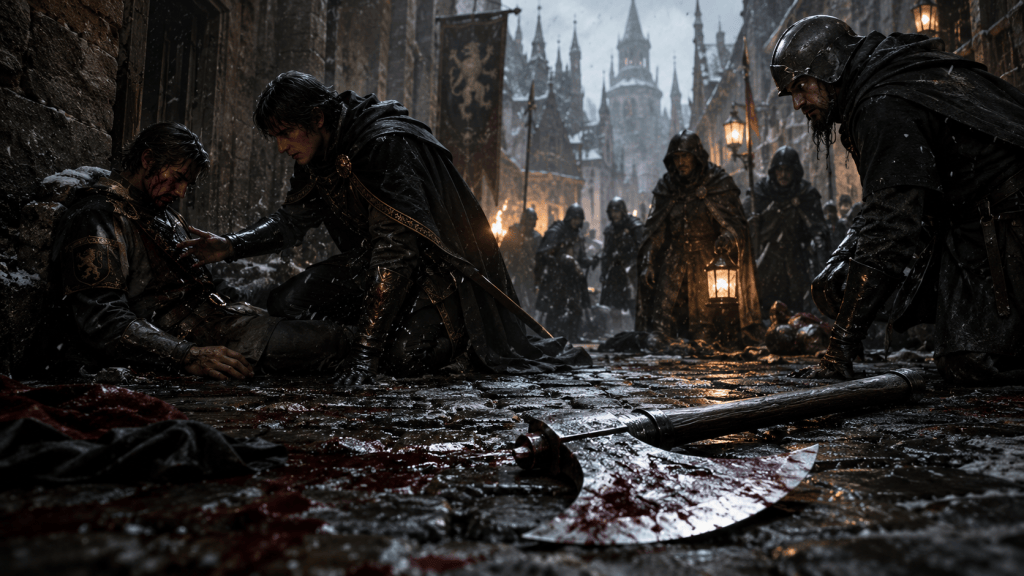
The first blood reached the gutter before the bell, running black through old snow beneath the lower market eaves while the lamps along Tanner’s Row struggled against the thickening dusk. Winter had pressed Bremyra into a low, grey hush since morning, and by the hour the cry rose near the grain steps, the street had already emptied of its softer life. Shutters hung half drawn across the houses above the workshops, stall cloths had been dragged inward from the slush, and a woman gathering turnips from the frost-slick stones froze with both hands full as she stared down the narrow way where a guard’s horn gave one strained call, then broke into breath and shouting.
Corporal Maeran Holt came from the west watch post with four men behind him, his cloak dragging wet across his boots and his gloved hand closed around the haft of his spear. He had served in Bremyra’s streets for seventeen winters, long enough to know the difference between tavern steel, debtor’s rage, hired knives, and the sharper silence that followed an attack meant for rank. The cry in Tanner’s Row belonged to the last kind. It scattered people first, then drew them back by inches, face after face appearing in upper windows, children pulled behind doorframes, apprentices peering through the slats of closed stalls while pretending courage came from distance.
“Keep them back,” Maeran said as he reached the mouth of the alley and raised his spear across the passage, his voice steady enough for the men behind him to borrow from it. “Joren, set yourself along the left wall where the shadows gather, and Pell, keep your bow towards the roofline until every window and drain mouth has answered your eye. Any man with a blade in hand answers to me before he answers to fear.”
Joren, broad-faced and young beneath his iron cap, swallowed hard as he set himself beside the stone wall, his eyes fixed beyond Maeran’s shoulder. “Christiana preserve us,” Joren said as his knuckles whitened around his spear. “That one has been lifted clean from his own bones, Corporal, as if the stones themselves grew hands and threw him down.”
Maeran gave him one sharp look, then turned into the alley and saw what had stolen the boy’s colour. The place lay between a cooper’s yard and the rear wall of a dye house, paved with uneven stones that held rainwater, soot, and streaks of red in every hollow. A royal guard crouched near the far wall, breathing through clenched teeth while blood ran from a cut beneath his ribs into the leather of his belt. Two pages huddled beside him, their faces ashen, their hands pressed over wounds they lacked the skill to bind. Farther along the alley, near the overturned crate of kindling, a stranger lay twisted across the stones with a round shield fallen under one arm and a broad axe beside him, its iron head blackened where wet blood clung along the edge.
The dead man’s face had changed in the final moment. Maeran had seen men die in alleys, at gates, on coastal roads, and beneath castle walls during riot years when hunger made every rumour sharp. Faces slackened, hardened, gaped, or grew still according to pain, prayer, wine, or terror. This one looked as if a hand much larger than any mortal hand had caught him by the chest and drawn the last breath upward before releasing flesh back to earth. His eyes remained open towards the grey strip of sky between the roofs. His mouth stretched around a sound that had escaped into the cold and left only its shape behind.
“Where is His Highness?” Maeran asked as he crossed the stones, lowering himself beside the injured guard while one of his men knelt with bandage cloth.
The wounded guard gripped Maeran’s wrist with surprising force, his breath rough as gravel. “Gone upward,” the guard said as his eyes fought to hold focus. “Prince Patrick walks. The Lord Magician walks beside him. I saw the axe rise towards the Prince, Corporal, and I saw the hour turn before the blade could fall.”
Pell came closer from the alley mouth, keeping his bow angled low as snowmelt dripped from the brim of his helmet. “For the Prince?” Pell asked as his gaze moved from the fallen stranger to the blood trail near the crate.
The wounded guard turned his head with effort, his fingers still locked around Maeran’s sleeve. “Aye, for the Prince,” the guard said as pain pulled the words thin. “The beast came through my guard like I was straw. His Highness had steel half drawn. Then the air changed around us, and every sound in the alley went small.”
Maeran felt the words settle against the wet stone around them. Behind him, the crowd pressed nearer until Joren struck the butt of his spear against the paving and barked for space. The noise withdrew by half, leaving breath, whispers, and the thin drip of water from a broken gutter. Maeran looked towards the axe, then towards the stranger’s boots, shield, cloak pins, and the strange cut of his tunic. He wore leather layered in a fashion Maeran knew from no Bremyran forge, no Arvendral patrol, no Thalosian envoy guard who had crossed these streets under record. A short blade sat near his left hand, curved at the tip, its grip bound in dark cord. The axe itself held the room’s attention, broad as a butcher’s block, shaped for a killing stroke in close passage, ugly in its efficiency and made by hands raised outside the western kingdoms.
“Fetch Captain Rylas,” Maeran said as he rose. “Send word to the castle that one attacker lies here whole enough for examination, and one royal guard needs a litter before his blood takes him from us.”
A grey-haired cooper had edged close to the alley mouth with both hands held open, his apron streaked with sawdust and old ale. “Corporal,” the cooper said as his eyes darted towards the corpse, “I heard the shout from my yard. Two men came through, both large enough to fill the lane, and their speech had iron in it from some shore I have never heard named.”
Maeran turned towards him, studying the man’s face for ale, panic, or invention. “You saw them come?” Maeran asked as he stepped nearer, leaving just enough distance to keep authority between them.
The cooper rubbed sawdust from his palm across his sleeve and kept his gaze low, as if the dead man might resent being named. “I saw the first one cross from the grain steps with his hood down,” the cooper said, forcing himself to look towards the body. “Pale hair, beard rings, axe under cloak. The second came along the dye wall. They moved like men who knew where the Prince would pass.”
“Who stood with His Highness?” Maeran asked as his gaze moved towards the far stones where the blood had spread.
“The black-robed one,” the cooper said, lifting his eyes at last. “The magician. He raised his hand, Corporal. That is what I saw. He raised his hand, and the large one stopped in the air as if the street itself had caught him.”
A murmur moved through the gathered faces, quick and fearful, until Joren swung his spear across the mouth of the alley again. Maeran heard the word magician pass from one mouth to the next, carrying awe first, then dread, then something close to hunger. People loved a tale once danger had chosen some other body to inhabit. By nightfall, if care failed, the whole lower market would have the dead stranger flying above rooftops, his axe melting into flame, Prince Patrick crowned with saint-light, and the Lord Magician speaking words that cracked the dye house stones from wall to wall.
Maeran glanced at the corpse and took in the details before the street could turn them fully into story. The cooper’s account had already found roots in the shape of the body. One leg bent beneath the dead man at a useless angle. One hand curled claw-like above his breast, fingers sunk into the air even in death. Around him, the spatter on the stones rose in a strange arc across the wall, higher than a wound made by ordinary fall should have carried it. A man lifted, then dropped, might have left such signs. So might a crowd’s imagination once fear had done its work. Maeran kept both thoughts behind his teeth.
A young woman came from the dye house door with a basin in her hands, her sleeves rolled above her elbows and her hair escaping its pins. She took one look at the injured guard and moved forward before Joren could stop her. “My mother kept a surgery table when fever passed through Mill Lane,” the woman said as she knelt beside the wounded man and set the basin down. “That cloth is too loose, and he will bleed through it before your captain comes unless somebody with sense presses harder.”
Pell shifted uncertainly, then looked to Maeran. Maeran gave a single nod, and the woman pressed clean linen against the wound with firm, practised hands. The guard groaned, teeth bared, and she leaned closer, her voice low enough for him alone, though Maeran heard each word. “Stay with the bell, soldier, and hear it when it rings above the market, because you follow that sound back to us.”
The wounded guard’s eyes fluttered towards her. “I failed him,” the guard said through shallow breath.
“You lived near enough to tell us where steel came from,” the woman said as she tightened the fold beneath his belt and held his gaze with a steadiness that softened the fear around him. “That is service enough for one winter evening.”
Maeran looked away from them and turned his attention to the axe. He crouched near it, careful to keep his cloak from the blood, and studied the iron head in the gloom. The edge bore fresh nicks from shield or stone. Near the socket, three marks had been punched into the metal, angular strokes arranged around a line that might have been a maker’s sign, a clan mark, or a word in a tongue beyond his reach. Snow gathered along the haft where the attacker’s hand had gripped it. Maeran reached for the weapon, then stopped as a faint ripple of unease passed through the alley, though no wind had entered between the walls. The axe seemed less abandoned than waiting, a foreign thing lying in Bremyra’s blood as if it had come ahead of its own war.
“Corporal,” Joren said from the alley mouth as hoofbeats sounded on the street beyond, “castle riders have turned from the grain steps, and Captain Rylas rides with them.”
Maeran stood slowly. “Then make way for them,” Maeran said as he stepped back from the axe and lifted his hand towards the gathered crowd. “Keep every witness within reach, keep every tale tied to the ground, and let the dead man lie where the truth has left him.”
The crowd stirred, parting around the arrival of mounted guards whose lanterns threw gold across wet stone and frightened faces. Snow had begun again, fine and pale, settling upon shoulders, roof tiles, crates, the round shield, the spilled blood, and the dead man’s open eyes. The axe lay at Maeran’s feet, its broad blade catching lamplight in a dull red gleam. He knew then that the official report would have its proper shape by morning, with time, place, witnesses, wounds, weapon, royal party, dead attacker, and surviving guard entered in serviceable lines. Yet the street had already chosen a different record, one carried in lowered voices from shutter to stair, from market to kitchen, from guardroom to chapel step: foreign steel had reached for Bremyra’s prince, and some unseen force had lifted death from the stones before death could finish its work.
A Visual Chronicle
A foreign axe fell towards a prince in Bremyra’s winter streets, yet before the blow could land, witnesses swore an unseen force lifted the attacker from the stones and left the city asking who had sent him.
Guard Register: The Lower Market Alley
The lower market alley behind Tanner’s Row was entered in the watch ledger as the site of an assault upon Prince Patrick during the winter sitting of his regency, the record naming two armed strangers, one fallen royal guard, one surviving guard of the Prince’s escort, and one foreign axe recovered from the stones beside the dead attacker.
The weapon was described as broad-headed, heavy through the haft, and unlike the common war axes carried by Bremyran guards, Arvendral border men, or Thalosian household soldiers, with three marks punched near the socket in a script or maker’s sign that the watch officers left untranslated within the first entry.
The formal report stated that the Prince survived the attack and was removed from the alley under guard, while the Lord Magician who had accompanied him was recorded only as present at the disturbance, with no further description of his action entered into the primary watch copy.
A lesser street witness account preserved by the west watch referred to sudden pressure in the air before the attacker fell, and to the dead man rising from the stones as though seized by a force unseen by those gathered near the grain steps, though the wording was later reduced in the official duplicate to irregular movement during armed struggle.
The body and weapon were placed under castle authority before nightfall, with instruction that the corpse be examined swiftly while memory remained close to flesh, though the name, origin, and purpose of the attacker were absent from the surviving guard register.
Later copies retained the axe under the phrase foreign steel found within Bremyra’s street, while one damaged margin beside the weapon entry carried the words lifted before death struck, written in a hand never identified by the watch clerks.
About the Creator
The Mythic Chronicle is written and curated by Simon Phillips, a writer of mythic and speculative fantasy whose work explores forgotten kingdoms, fractured records, old institutions, and the moments when history begins to shift before those living through it understand what has changed.
The accounts preserved within these Chronicles form part of a wider body of work in which castles keep older secrets beneath familiar rooms, roads carry rumours ahead of armies, and ordinary witnesses preserve fragments of events whose true meaning remained sealed from them at the time.
One such account survives in a separate record, following the return of a magician to Bremyra during a season of court unease, royal absence, Church suspicion, and gathering danger beyond the kingdom’s roads. What the servants, clerks, and watchers of the city remembered only in fragments is followed more closely in The Unmarked Path, the opening book of The Veil of Kings and Gods within The Chronicles of the Spiral Realms.
Readers who wish to examine that fuller account may find the record below.
Read the book:
The Unmarked Path
Explore the wider saga:
The Chronicles of the Spiral Realms
You can watch his YouTube channel here:
Author Simon Phillips
Continuation of the Record
What follows is taken from a later watch account concerning the lower market alley behind Tanner’s Row, where foreign steel was recovered after the assault upon Prince Patrick, and where witnesses first spoke of a death lifted from the stones before it could fall upon him.
Chronicle Record: The Axe Under Watch
Captain Rylas Fennar reached Tanner’s Row as the last of the daylight drained from the low clouds above Bremyra, leaving the market caught between lantern glow, winter slush, and the kind of strained quiet that followed violence closely enough to remain warm from it. His horse slowed before the grain steps, where stallholders, carters, dye-house women, apprentices, and two frightened children had been gathered beneath guard watch, each face turned towards the alley with that same hungry dread by which common folk measured danger once rank had survived it. The captain dismounted near the cooper’s yard, passed the reins to a rider at his side, and looked first at the people, then at the stone passage where Corporal Maeran Holt stood with spear grounded, cloak spattered dark along the hem, and eyes fixed upon the broad axe lying beside the dead stranger.
“Report it from the ground upward,” Captain Rylas said as he stepped beneath the overhanging eaves, drawing one glove from his hand while snow began again in thin drifting flecks. “Leave wonder for the chapel and shame for men who earn it later. I want the stones, the steel, the wounds, and the witnesses before the street teaches each of them how to lie.”
Corporal Maeran bowed with the stiffness of a man who had held himself steady long past comfort. “The Prince had already been led clear when I arrived, Captain,” Maeran said as he gestured towards the far wall. “One guard dead before our coming. One wounded, still breathing when the litter took him. One attacker dead upon the stones, armed with axe and shield of foreign make. Street witnesses speak of two assailants, perhaps more eyes hidden above the passage, although none here claims a clean count.”
Rylas walked deeper into the alley. The place narrowed around him, stone walls rising close enough that a drawn sword might strike plaster from either side. Meltwater ran down the middle channel and carried watered blood towards the gutter, where it gathered in red-brown ribbons beneath a crust of dirty snow. A broken crate lay near the cooper’s door. Splinters had scattered beneath the dead man’s boots. Three marks scored the far wall at shoulder height, fresh and pale against old grime, as if iron had scraped there during the struggle. Higher still, a spatter of blood reached the dye-house plaster in an arc that drew Rylas’s gaze and held it.
He crouched beside the dead attacker, careful of the slush around the body. The man was powerfully built, broad through shoulder and jaw, with pale hair braided near one temple and small iron rings worked into his beard. His cloak had been cut short for movement. His boots were sealed against wet by dark pitch. Beneath leather and fur, his tunic carried stitching unfamiliar to Bremyran hands, and along his belt hung a pouch of bone toggles, a whetstone, and a strip of dried meat wrapped in skin. Rylas lifted the edge of the round shield with his boot and found its inner grip worn smooth by long use.
“This came from across water,” Rylas said as he angled the shield towards Maeran. “River men carry different wood. Border raiders favour lighter boards. Whoever made this expected shield-wall pressure and close killing.”
Maeran glanced towards the weapon. “The axe bears three marks near the socket,” the corporal said as one hand rested near his spear. “None of the watch knew them.”
Rylas bent over the axe. It lay with the haft angled towards the gutter, as though dropped mid-swing, its head broad, wedge-heavy, and ugly in purpose. Near the socket, three angular cuts had been stamped into the metal around a narrow line. He looked long enough for the shape to settle into memory, then reached into his belt pouch for a waxed cloth and folded it around the haft before lifting the weapon. Its weight surprised even him.
A boy among the gathered witnesses made a strangled sound, and one of the guards turned at once. Rylas looked over his shoulder. “Bring him forward,” the captain said, his voice level. “Fear runs fastest when it hides behind taller backs.”
The boy came between two watchmen, thin as a reed, perhaps twelve years old, with sawdust caught in his hair and a coat too large for his arms. He tried to bow and nearly stumbled. Rylas lowered the axe back to the stones before speaking.
“Name yourself,” Rylas said as he crouched enough to meet the boy’s eyes. “Speak plainly, and take your time.”
“Tavin Reed, Captain,” the boy said as his fingers twisted in the edge of his coat. “I work in Master Holl’s yard. I was by the back gate when the shouting came.”
Rylas held his gaze. “You saw the dead man move?”
Tavin’s mouth trembled. “I saw him rise, Captain,” the boy said, and his eyes slid towards the corpse before darting away. “He had the axe high. Then he was above the street, maybe a handspan, maybe more. His boots left the stones. His face went red. He clawed at his own throat.”
A murmur pressed in from the alley mouth. Maeran stepped across it with a hard glance, and the nearest witnesses lowered their voices.
Rylas kept his tone gentle. “Who stood before him when that happened?”
“The Prince had fallen back,” Tavin said as he rubbed at his sleeve. “The black-robed lord stood near him. His hand was out. I thought he meant to push the man away from where he stood, only the hand never touched him.”
A woman near the dye-house door crossed herself, and the movement rippled among those around her. Rylas let the silence linger, allowing the boy’s words to settle inside the cold air. The account matched what the wounded guard had given before pain took him into muttering. It matched the shape of the blood on the wall. It matched the broken angle of the dead man’s leg and the terror left in his face. A report could carry all such things and still leave judgement for those seated higher than the watch.
“Did you hear the foreign man speak?” Rylas asked as he rose.
Tavin nodded quickly. “Before he swung, Captain. He shouted something. It sounded like stones in a bucket.”
“Repeat what you can,” Rylas said, lifting one hand when the boy shrank. “Even a broken piece may serve.”
The boy shaped sounds with care, rough syllables caught from fear and distance. The words meant little to the guards. Rylas listened, then looked towards Maeran. “Enter the sound as given,” he said. “Send the line to the castle scribes and to Intelligence before midnight. I want the corpse held under guard and the memory-men warned that delay will thin what remains.”
Maeran dipped his head. “Aye, Captain. Shall the Lord Magician be named in full?”
Rylas turned back towards the alley, where the last light had left the corpse’s open eyes glass-dark beneath falling snow. “He is to be entered as attendant upon His Highness during the disturbance,” the captain said after a pause. “His action will be recorded through witness statement, with guard judgement left aside. The watch saw aftermath. The court may name power as it pleases.”
The corporal’s jaw tightened as he glanced towards the crowd. “The market has already named it.”
“The market names storms after the roofs they tear away,” Rylas said as he took the wax tablet from the clerk who had arrived behind him. “We record where the rain entered.”
The clerk, a narrow man wrapped in a fur-edged hood, rested his tablet against a leather board and began marking the ordered lines. Date, hour, place, officer present, royal person endangered, dead attacker, weapon recovered, wounds observed, witnesses held. Rylas watched the signs take shape. Ink and wax made events smaller, at least for those trained to trust them. A blade became a measure. A death became a position on stone. Magic, when present, became irregular force unless a lord, bishop, or Council hand gave it a finer name.
The wounded guard’s blood still streaked the paving where the litter bearers had knelt. Rylas followed the marks to the wall, then studied the gouges at shoulder height. “Maeran,” he said as he touched one pale scrape with his bare thumb, “stand where the Prince stood according to the first account.”
Maeran moved reluctantly to the patch beside the overturned crate. His boots settled into slush darkened by trampled blood. Rylas stood where the dead man had fallen and lifted one hand towards the wall.
“If the axe came down from here,” Rylas said, moving his arm through the path of a swing, “the scrape should sit lower after the blow met shield or stone. This mark climbed.”
Maeran looked from the wall to the body. “As if the arm rose while the stroke failed.”
“As if the man rose with it,” Rylas said, his voice quiet enough that only the corporal and clerk heard. He lowered his hand and drew his glove back on finger by finger. “Write the scrape height, the wall position, and the body’s distance from the Prince’s last marked place.”
The clerk looked up from his board. “Shall I write lifted, Captain?”
Rylas studied him until the man’s eyes dropped back to the tablet. “Write displaced upward before fall, as reported by witnesses,” Rylas said. “The word lifted belongs to tongues by firesides unless a higher seal wants it.”
Hoofbeats sounded again beyond the market steps, followed by the arrival of a household officer and two men bearing a covered handcart. The officer entered the alley with a household seal visible on his cloak clasp and a face pale beneath his trimmed beard. He looked first towards the corpse, then towards the axe, then towards Rylas.
“Captain Fennar,” the officer said as he inclined his head. “The Master of House requests the body, weapon, and first witness marks under castle authority. His Highness has returned to the inner ward. The Lord Magician remains with him.”
“The body stays here until my clerk has finished the primary watch lines,” Rylas said as he folded his arms. “Castle authority receives what the watch has first named.”
The officer’s expression tightened. “The Prince was attacked under open street conditions. The household has interest.”
“The kingdom has interest,” Rylas said as he stepped nearer, calm in the manner men used when anger might grant too much. “The watch keeps the first blood where it fell until the blood has been read. Then you may carry the body upward with witnesses and seal.”
The officer looked towards the crowd, perhaps measuring who would repeat this exchange. His hand moved to the seal at his clasp, then fell. “Then read swiftly, Captain,” he said. “The court is already full of voices.”
Rylas gave a short nod. “Courts are made of voices. Streets are made of eyes. Tonight we need both.”
The work continued under lanterns while snow thickened on the roofs. The axe was wrapped in oiled cloth and sealed with a lead tag. The shield followed. The short blade, pouch, cloak pin, boot bindings, and belt contents were listed in order. The corpse was turned once beneath four guards, and the mark across his throat drew all speech from the alley for several breaths. No blade had cut there. A dark pressure bruise circled the skin, uneven and deep, with the flesh beneath the jaw mottled almost black. Tavin began to cry when he saw it. The dye-house woman who had tended the wounded guard pulled him against her apron and shielded his face.
“He should go home,” the woman said as she looked towards Rylas, one hand firm on the boy’s shoulder. “He has given more truth than his bones can hold.”
Rylas softened his voice. “Take his name and dwelling,” he said to the clerk, then gave the woman a measured bow. “Mistress, see him to his people. A guard will come by morning for formal witness, and he will be questioned gently.”
The woman held his gaze. “Gentleness after fear still feels like fear to a child, Captain.”
“Aye,” Rylas said as he looked at the boy’s shaking hands. “Then tell his mother the first question has already been answered, and tomorrow asks only for memory.”
She nodded once and led Tavin away through the parted crowd. That small mercy did more to calm the watchers than any command. People made room. Faces lowered. The alley seemed to exhale, though the corpse still lay at its centre and the foreign axe had already begun its climb towards rumour.
Near the sixth bell, the body was covered and placed upon the cart. Rylas walked beside it as far as the grain steps, where the market opened into a wider street climbing towards the castle. From there, the towers of Bremyra rose through veils of snow, their windows burning with scattered lamps. Somewhere within those walls, Prince Patrick lived because steel had failed to finish its stroke. Somewhere near him, the Lord Magician carried whatever silence followed such power. The captain had met magicians only at distance before this winter, men wrapped in old law and older unease. Now one had stood in a poor alley and turned a killing blow into a tale the city would carry for years.
The household officer took the cart under seal at the first rise of the road. Rylas watched the body go upward, then returned to the alley for the closing mark. Maeran stood near the wall, shoulders bowed with cold and strain.
“Will they tell us what he was?” Maeran asked as he looked towards the dark line the cart had left in the slush.
Rylas picked up a pinch of snow and rubbed blood from his glove. “They may tell us where his axe was forged, who sent him, and what tongue he carried,” the captain said as he turned towards the market. “What he was has already entered Bremyra. Foreign steel in a prince’s path. That is enough to change how men bolt their doors.”
Maeran followed his gaze towards the shuttered houses. “And the Lord Magician?”
Rylas drew his cloak closer as the wind pushed snow beneath the eaves. “He will change how they speak inside those doors,” the captain said. “That may travel farther than steel.”
By full dark, the alley had been washed only enough to keep the blood from freezing in ridges along the passage. Maeran sealed the watch line with two guards for the night. The cooper closed his yard. The dye-house lamps went out one by one. Still, when Rylas passed the mouth of Tanner’s Row on his way back towards the barracks, he saw three figures standing in the market snow, looking towards the place where the axe had lain. They spoke softly, then parted in different directions, carrying the account into the lower city.
The official copy entered the assault as a royal street disturbance involving foreign assailants of unidentified origin, one recovered axe, witness statements pending, and arcane intervention unclassified. The lesser watch copy held a fuller shape, written in Maeran Holt’s stiff hand after midnight, when the barracks fire had sunk low and the wounded guard still breathed under the healer’s cloth. It recorded that death had entered the alley with a foreign blade raised high, that Prince Patrick had stood within reach of its fall, and that before the blow could claim him, the attacker rose from the stones as though some hidden judgement had taken him by the throat.
In later winters, when the sea-raids had given Bremyra harsher names for pale hair, round shields, and heavy axes, people returned to the Tanner’s Row account as the first small wound in the city’s certainty. The alley remained ordinary by daylight, with barrels stacked against the cooper’s wall and dyed cloth hung from upper lines in summer. Yet watchmen walking there after dusk often lowered their voices, and market children learned to point towards the stones where foreign steel had lain. Some said the Prince had been saved by Order craft. Some said the dead man had been seized by the castle’s own old memory. Others, speaking only when lamps burned low, said Bremyra itself had rejected the axe before the kingdoms understood whose war had reached the street.
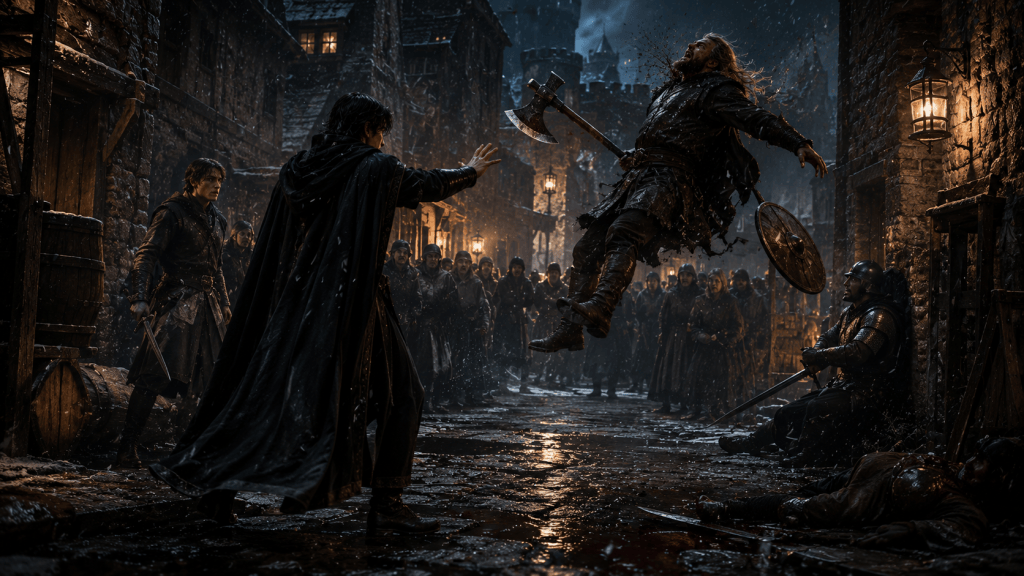
A foreign axe rose in Bremyra’s lower streets, and before its fall could claim the Prince, witnesses swore that death itself was lifted from the stones.
The Idea Behind the Chronicle
Weapons carry memory long before records give them names. A blade found upon familiar stones can alter the meaning of a street more quickly than any proclamation, for people understand danger first through what has been left behind. An axe beside a body, a shield marked by an unknown hand, blood running between market stones, and a prince hurried away under guard all speak before clerks begin their careful work.
This Chronicle draws upon that first intrusion of foreign violence into Bremyra’s ordinary life. The lower market was a place of trade, labour, errand, and household movement, far from the formal weight of throne rooms and council chambers. When the attack came there, among cooper’s yards, dye-house walls, market steps, and winter slush, danger crossed from rumour into the city’s daily body. The threat ceased to belong only to borders, letters, or northern reports. It had reached a street where common people stood close enough to see the shape of the axe.
The guard account matters because it preserves aftermath rather than certainty. Those who arrived after the blow saw blood, weapon marks, a dead attacker, injured men, frightened witnesses, and a Prince already carried back towards the protection of the castle. Their duty was to measure, secure, question, and record. Yet every practical act took place beside something harder to name, since the body, the wall marks, and the words of those gathered in the alley suggested that ordinary force had failed to finish its work.
Across the Bremyran cycle, the Chronicle keeps its distance from the fuller truth. It does this here through watch testimony, market rumour, weapon inventory, and the careful language of officers who understood that records could steady a kingdom only when they kept wonder at the edge of the page. The Lord Magician remained present in the account, yet the record avoided turning him into explanation. The witnesses spoke of a hand raised, a body lifted, and death interrupted, while the official register reduced the matter into terms safer for governance.
The foreign axe therefore becomes more than a weapon. It is the first hard sign that Bremyra’s trouble had widened beyond Church suspicion, Order secrecy, and hidden rooms beneath familiar walls. Something from outside the kingdom had entered its streets with intent, knowledge, and steel. The marks upon the axe remained unread, which made the object more unsettling. It could be held, weighed, wrapped, sealed, and carried to the castle, yet its meaning still escaped the men ordered to preserve it.
This Chronicle stands at the point where Bremyra begins to understand that old power and foreign violence have arrived together. The manor had waited, the letter had come, the cathedral had guarded its foundations, the kitchens had remembered the boy, and the library had stirred behind its shelves. Now the street itself carried witness. A prince survived, a stranger died, and the city learned that the roads beyond its gates had already begun sending their war inward.
From the Author’s Desk
Thank you for continuing into this Chronicle.
This account was shaped around the moment when danger enters a familiar place and leaves behind an object too plain to ignore. A foreign axe upon Bremyra’s stones carries a different kind of disturbance from a sealed letter, an uneasy chapel, or a hidden shelf. It is physical, visible, and immediate. It can be weighed by the watch, wrapped in cloth, entered into a ledger, and still remain mysterious.
Across this series, each Chronicle follows the fragments left around the true events of The Unmarked Path. The records come from servants, clerks, chapel attendants, librarians, guards, and street witnesses: people close enough to feel history moving, yet too far from the centre to understand its full shape. Their accounts preserve uncertainty, rumour, fear, and small details that formal histories often smooth away.
This Chronicle belongs to the streets of Bremyra, where royal danger crossed into ordinary ground. The attack upon Prince Patrick is remembered here through guard procedure and market testimony, through what was found after violence passed, and through the way witnesses tried to describe power they had seen only for a breath. The axe matters because it suggests that the kingdom’s troubles were already widening beyond court chambers and old foundations.
Beyond The Mythic Chronicle, my writing continues across fantasy and speculative worlds that explore forgotten histories, buried power, old institutions, and the fragile moment when ordinary lives are drawn into something larger than they can name. Some accounts follow events directly, while others, like these Chronicles, preserve the edges of those events through recovered memory and partial record.
Readers who wish to explore further may find additional work through the links included in this publication.
You can explore my books here:
Books by Simon Phillips
You can watch my YouTube channel here:
Author Simon Phillips
Archive & Interpretations
Fragment from the Archive
From a damaged watch folio held among the lesser guard copies of Bremyra Castle, copied from an earlier street report concerning the lower market assault during Prince Patrick’s regency. Several lines show later compression by a household hand.
The weapon was first entered under sealed watch custody after its recovery from the stones behind Tanner’s Row, where it had fallen beside the dead stranger whose body was removed under castle order before full dark. The axe was described as heavy through the haft, broad across the blade, and made for close killing in confined passage, its edge bearing fresh damage from stone or armour and its socket marked by three angular cuts that the watch clerks left untranslated.
A second entry records that the fallen man carried a round shield of unfamiliar timber, a short curved blade, and leather bindings pitched against wet weather, with clothing judged unsuitable to the usual western companies known to Bremyran patrols. The first officer to inspect the body marked the attacker as foreign by craft, speech, and equipment, though the folio preserves no agreed kingdom, clan, or harbour of origin.
Witness testimony was entered in broken sequence. One account, attributed to a cooper’s boy, stated that the attacker raised his axe against the Prince before being drawn upward from the stones by a force the witness could neither see nor name. Another account, given by a wounded royal guard before removal to the castle infirmary, recorded a sudden pressure in the alley and the failure of the killing stroke before the attacker struck the ground.
The official copy reduced these statements to unusual displacement during armed struggle, yet the lesser folio retained the earlier phrasing in the margin, where the words lifted before death struck appear beside the weapon entry in a smaller hand. The identity of that hand was never entered, and later correction marks suggest an attempt to scrape the phrase away while preserving the remainder of the report.
The corpse was carried under guard to the castle for examination, with instruction that those trained in memory extraction be summoned before flesh cooled past useful recall. The result of that examination appears absent from the surviving watch bundle, leaving the weapon, the witness statements, and the blood marks upon the alley wall as the principal remnants of the event.
A final line, added after the weapon had been wrapped and sealed, records the axe as foreign steel recovered within Bremyra’s street. The phrase passed into later copies with little alteration, and by the next winter several guardroom summaries used foreign axe as shorthand for the first confirmed sign that outside violence had entered the lower city under purpose rather than chance.
Marginal Notes & Interpretations
Collected from later annotations found beside the weapon entry in the west watch copy and two damaged household duplicates.
One annotation argues that the accounts of the attacker rising from the stones arose from confusion during a close struggle, citing poor light, snow, fear, and injury among the witnesses. The writer places emphasis on the narrowness of the alley, the uneven stones, and the possibility that the attacker stumbled against the wall after his killing stroke failed, though this reading leaves the higher blood arc and throat bruising unexplained.
A second annotation challenges the safer interpretation, stating that the dead man’s final position, the angle of his leg, and the marks along the wall suggest movement inconsistent with a simple fall. The writer avoids naming magic directly, instead referring to force applied upward and inward before collapse, language unusually precise for a marginal correction.
A third annotation, written in a looser hand, records that the wounded guard repeated the same account during fever, saying that the axe had already begun to fall before the air took hold of the attacker. The same line adds that the guard grew silent whenever asked what he saw in the Lord Magician’s face, and that he made the sign of Christiana before each answer.
A final marginal fragment, badly stained along its lower edge, states that the weapon felt colder than the room when unwrapped in the castle stores, despite having been kept near a brazier after recovery. The comment ends with the phrase as if the road still clung to it, after which the lower portion of the page has been lost.
World Notes
Tanner’s Row
A lower market passage in Bremyra associated with cooper’s yards, dye-house walls, grain steps, and service movement between the commercial quarter and the castle road. Its narrow lanes made it suitable for ambush, concealment, and sudden escape, while its ordinary use gave the attack particular weight in later city memory.
Foreign Steel
A watch phrase later used for weapons recovered from assailants whose craft, markings, or use suggested origin beyond the familiar western kingdoms. In early Bremyran records, the phrase carried uncertainty as much as identification, marking a weapon as alien to local manufacture while leaving its wider source unresolved.
Watch Folios
Working records kept by street officers before formal court copies were prepared. These folios often preserved rougher witness statements, practical observations, and phrases later removed from official duplicates, making them valuable where rumour, fear, and formal record crossed over one another.
Memory Extraction
A specialised intelligence practice referenced in guard and court records, usually requested when a corpse was believed to contain information too urgent to await ordinary inquiry. The process remained rare, time-bound, and closely controlled, especially where royal danger, foreign speech, or arcane presence entered the same account.
Next Chronicle
In the days after foreign steel was recovered from the lower streets of Bremyra, road reports began to arrive from the northern route, each one carrying unease in a different hand. A royal escort had passed beyond the safer reach of the city, bound towards Vaeldring under marriage duty and court expectation, yet the accounts that followed gave no single shape to what had occurred beyond the watched roads.
Some records spoke of broken wheel tracks and scattered harness leather. Others preserved mention of riderless horses, torn cloaks, and signs of struggle found where the road bent through poorer ground for defence. A few witnesses claimed they heard shouting before the trees fell silent, though none agreed upon the number of voices, the direction of flight, or the tongue carried by those who struck.
The formal entries preserved the matter as disruption upon Princess Elana’s road, though later copies treated the same event with greater fear, naming the place as one where royal passage vanished from ordinary record and returned only through fragment, rumour, and blood-darkened snow.
Next Chronicle: The Road Where the Princess Vanished
Tanner’s Row returned to its trade after the blood was washed from the stones, its barrels stacked, its shutters opened, and its market voices restored beneath the winter sky, while somewhere within the castle a foreign axe lay wrapped under seal, carrying into Bremyra’s records the first hard proof that violence from beyond the known roads had already found its way inside the city.
