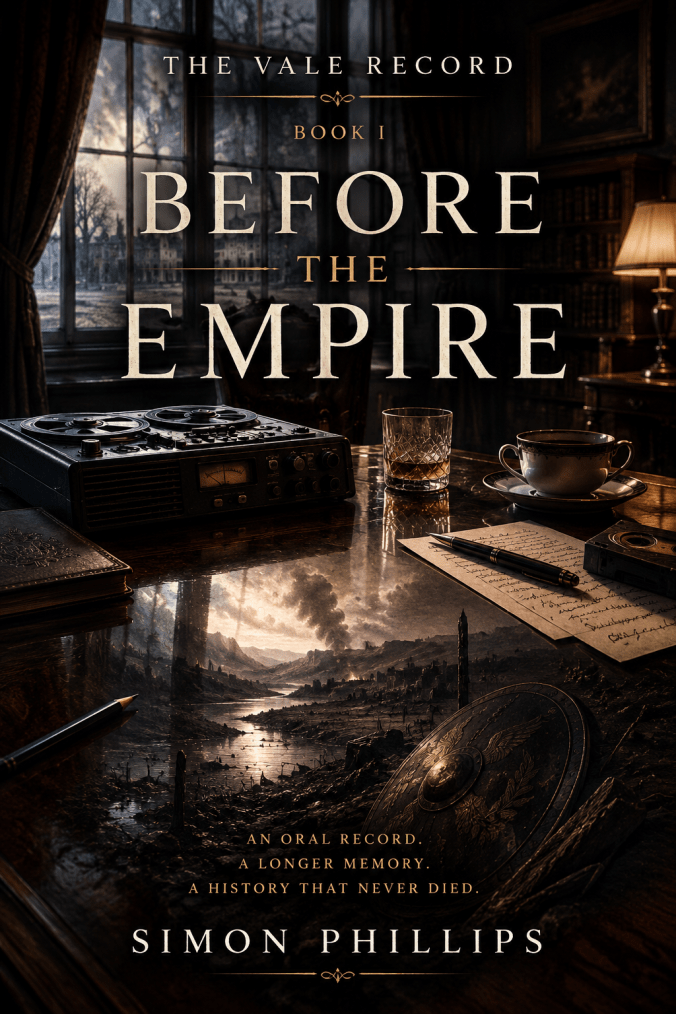
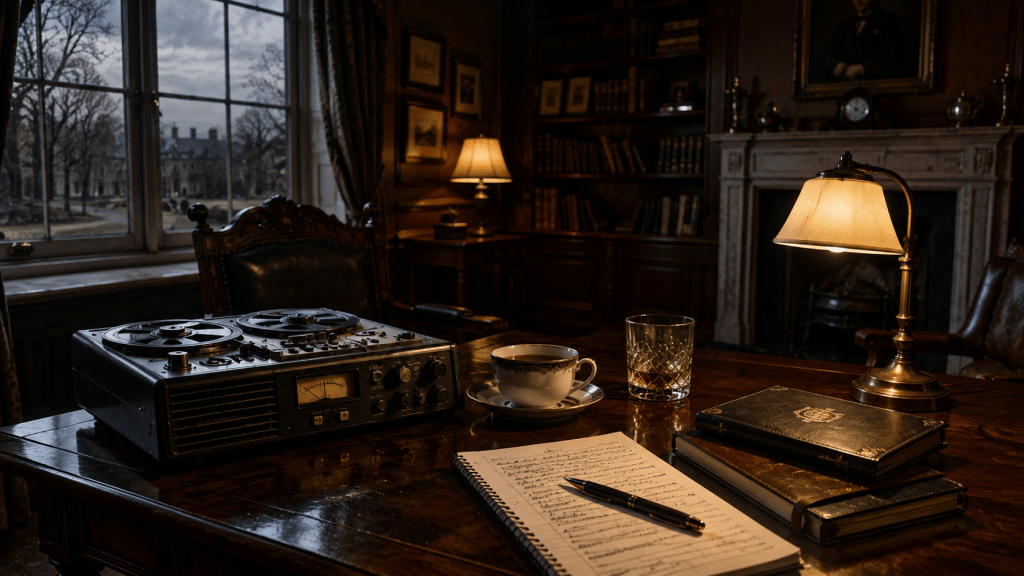
The room is quiet before the record begins. A table holds its polished surface against the morning light. A recorder waits beside paper, pencils, and the small, careful equipment of a man trained to preserve what others are usually content to forget. Outside the windows, winter sits against the glass. Inside Vale House, the ordinary sounds of family life continue through walls and corridors, steady enough to suggest that nothing truly dangerous has entered the room.
Then Marcus Vale begins to speak.
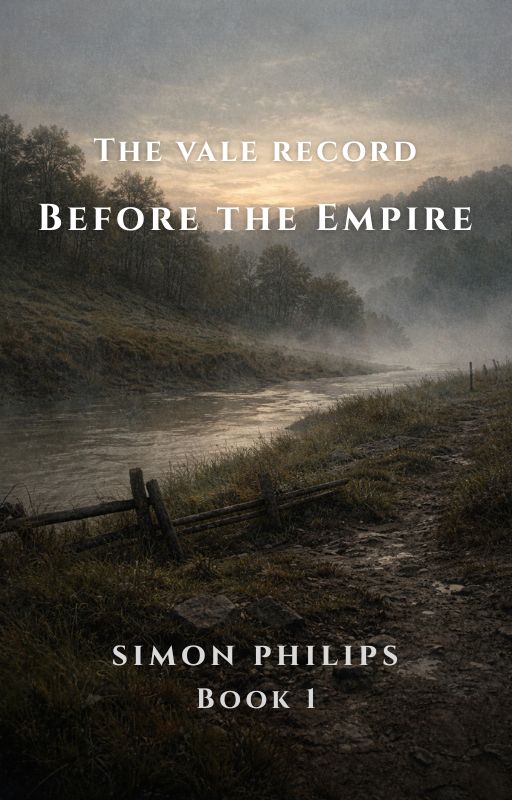
The Vale Record: Before the Empire opens a historical vampire fiction series built around memory rather than spectacle, decline rather than glamour, and survival rather than conquest. This is literary supernatural historical fiction where the vampire is first encountered as an ageing family patriarch, seated in an old house with tea cooling beside him, preparing to have his memories recorded before they disappear with him. The unease does not arrive through fangs, seduction, or gothic excess. It arrives through dates that refuse to fit, through a body that has outlived its own explanation, and through the quiet understanding that some histories were never meant to be spoken aloud in a family home.
For readers looking for vampire fiction without romance, quiet vampire horror, Roman Britain vampire fiction, or gothic historical fiction grounded in human consequence, this first book in The Vale Record offers something deliberately different. It does not ask what power immortality might bring. It asks what remains after survival has gone on too long.
The Old House Where History Begins to Speak
Vale House is not presented as a ruined gothic mansion or a theatrical lair. It is older, quieter, and more dangerous because it remains domestic. Doors close. Tea is made. Family members cross landings. Julian Vale watches too closely. Eleanor Vale loves her grandfather without knowing how near she stands to the truth. Thomas Hargreave arrives with analogue recording equipment and the professional restraint of an archivist who believes that every life, however complicated, can eventually be placed into order.
The danger is that Marcus Vale cannot be placed into order.
He gives Thomas ordinary answers at first. A name. A place. A year. A human life that appears to belong safely to the twentieth and twenty-first centuries. Yet his body betrays strain before his testimony breaks chronology. His hand trembles. Words fail and return. Fatigue gathers beneath his composure. The act of remembering is not a decorative frame around the story; it is physical labour, and every question asked in that room changes the air around it.
This is where The Vale Record finds its true shape. The series is not built around a monster revealing himself in dramatic fashion. It is built around an old man choosing what to say while his family remains close enough to be harmed by the truth. Thomas is not a hunter or a sceptical investigator barging into forbidden rooms. He is a listener. That makes the recording more intimate, and far more unsettling. He is there to preserve memory, but memory in this world does not sit quietly once released.
Marcus says he will not give Thomas an origin story. That refusal matters. Before the Empire does not flatten itself into a familiar vampire explanation. It begins, as Marcus chooses, with land.
Before Rome, Before Explanation, Before the Myth
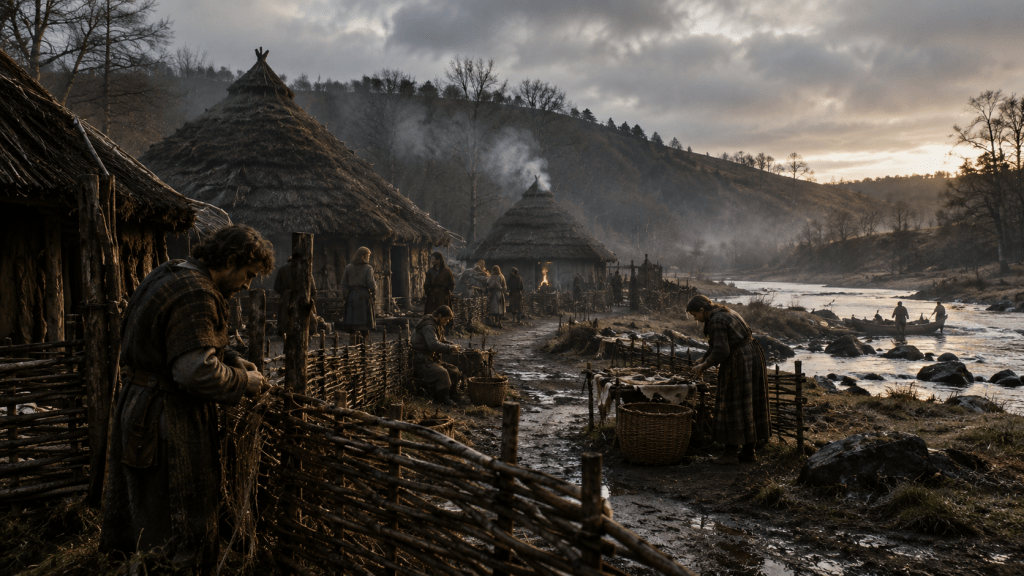
When the first memory opens, the polished table of Vale House gives way to damp ground, cold air, river water, smoke, leather, leaf mould, and the communal rhythms of pre-Roman Britain. Marcus belongs to a world where identity is carried through work, kin, weather, firelight, and the ground beneath the feet. There is no grand speech about empire, no distant historical lecture, no modern explanation imposed over ancient life. The reader enters through the body.
This is one of the strongest promises of the book. History is felt before it is interpreted.
Marcus repairs fences, shares water, listens by the fire, watches the river, and hears rumours that do not yet know how to become history. Strange metal passes from hand to hand. Roads are said to be cut in straight lines, laid with no care for the land already there. Soldiers are mentioned as something distant, perhaps exaggerated, perhaps manageable. In that early part of the memory, Rome is not yet the empire of schoolbooks and monuments. It is pressure moving nearer through objects, reports, unease, and the slight alteration of familiar paths.
That restraint gives the Roman arrival its weight. The invasion does not come as spectacle. It comes as order imposed on a world that has no time to understand it. Shields catch the light. Boots strike in rhythm. Lines form where bodies once moved by habit and local knowledge. Marcus’s settlement is not defeated as an abstract political unit. It is broken as a lived place. People shout for children. Huts burn. The river darkens. A repaired fence becomes the place where a friend dies.
For readers drawn to ancient Britain historical fiction, Roman Britain fiction, or supernatural historical fiction that respects the human scale of the past, Before the Empire offers a deeply grounded entry point. The historical world does not exist as a painted backdrop for vampire lore. It exists as a place Marcus once belonged to, and that is why its destruction matters.
Marcus Vale and the Horror of Continuing
The supernatural element in Before the Empire is powerful because it remains restrained. Marcus is not shown as an invincible creature striding through Roman violence. He is struck, thrown down, hurt, exhausted, and overwhelmed. He fights because others fight. He helps where he can. He fails where anyone would fail. He survives when others do not, and that survival is the wound the book leaves open.
This is quiet vampire horror in its most human form. The frightening question is not how Marcus feeds, how strong he is, or what ancient powers he possesses. The frightening question is what it means to continue when the people, places, and meanings that shaped the self have been destroyed.
In the historical memory, Marcus’s survival is interpreted by others through the language available to them. Perhaps the gods have hold of him. Perhaps luck has refused to release him. Perhaps the body has simply failed to do what death expected of it. The book does not rush to correct them. It allows the moment to remain human, confused, and painful. Marcus is taken up again by the same earth on which others remain dead, and the ground marks no difference.
That image is central to the entire series. Immortality here is not a fantasy of endless youth. It is erosion. It is being carried forward while the world repeatedly removes the people who made continuation meaningful. Marcus Vale is compelling because he remains human in feeling even when his body proves otherwise. He can be dry, affectionate, controlled, irritated, protective, and tired. His age does not turn him into a mythic voice above history. It makes him a witness burdened by too much of it.
A Vampire Story Without Romance or Spectacle
Many vampire books lean towards seduction, eternal beauty, violent glamour, or power fantasy. The Vale Record: Before the Empire moves in another direction entirely. It is vampire fiction without romance, built for readers who want atmosphere, historical pressure, family secrecy, and literary supernatural unease rather than paranormal courtship or theatrical monster mythology.
The vampire condition is treated through consequence. Marcus’s body is old, altered, and failing. His memory reaches beyond any human lifespan. His presence in Vale House is both beloved and dangerous. Julian’s vigilance suggests that the family has survived by controlling knowledge, timing, and access. Eleanor’s closeness makes secrecy emotionally costly. Thomas’s recording work turns private memory into an object that can be preserved, misread, stolen, believed, or feared.
That is where the modern frame becomes essential. Vale House is not a pause between historical sections. It is the pressure chamber where each memory returns changed. Thomas begins with method, but method cannot easily hold a testimony that contradicts the official record of a man’s life. Eleanor senses tension without being given its source. Margaret Vale arrives with the instinctive suspicion of someone who understands that family stories can damage reputation, inheritance, and control once they escape their proper boundaries.
The result is a book where the present and the past press against one another. Roman roads, burned settlements, family rooms, archive notes, pencils, analogue tape, old money, and old blood all belong to the same slow unease.
Thomas Hargreave and the Danger of Listening
Thomas Hargreave gives the book one of its most important human tensions. He does not arrive looking for monsters. He arrives to do a job properly. His equipment is practical, deliberately restricted, and almost humble beside the scale of what Marcus carries. He is careful with questions. He respects boundaries. He notices strain. He writes things down.
That is what makes his position dangerous.
To record Marcus Vale is to become responsible for something that cannot be comfortably filed. Thomas hears a man who claims a modern birth date speak of pre-Roman Britain as remembered life, not research, fantasy, or inherited story. He hears details carried through the senses rather than through historical summary. He understands enough to be unsettled, and not enough to be safe.
This is one reason Before the Empire works so well as the opening entry in a larger historical supernatural series. It does not explain everything at once. It lets Thomas stand where the reader stands, close to the impossible, aware that something has changed, unable to force the truth into a convenient shape. His unease becomes part of the reading experience. The archive is no longer neutral. The record has begun to act upon the people preserving it.
Family Secrecy, Old Blood, and the Cost of Protection
At the heart of The Vale Record lies a family arrangement built on love and concealment. Marcus has protected Eleanor from the truth because he wants her to love him as her grandfather, not as a legend, monster, miracle, or historical impossibility. That protection may be tender, yet it is also a form of control. Eleanor is close enough to notice his tremor, his fatigue, and the strange tension surrounding Thomas’s visits, while still being kept outside the knowledge that would allow her to understand what she is seeing.
Julian Vale represents another layer of the same secrecy. He watches, calculates, and contains. His presence is quiet, controlled, and edged with the threat of action if exposure becomes too great. He is not written as a flamboyant supernatural guardian. He is far more interesting than that: a family member shaped by vigilance, loyalty, danger, and long practice.
Margaret Vale brings a different pressure into the house. Her concern is not wonder. It is damage. Archives can disturb reputations. Testimony can unsettle businesses, inheritance, and family order. She understands that the past is never harmless once preserved in a form that can travel beyond a room. Her arrival turns the recording from private arrangement into family risk.
For readers drawn to books about family secrets and immortality, this is where The Vale Record gains much of its emotional force. The vampire truth matters, but the human relationships around that truth matter just as much. Every silence has a cost. Every protection creates another danger. Every memory Marcus releases brings someone else closer to what he has spent generations controlling.
Why Before the Empire Belongs on the Shelf of Adult Historical Vampire Fiction
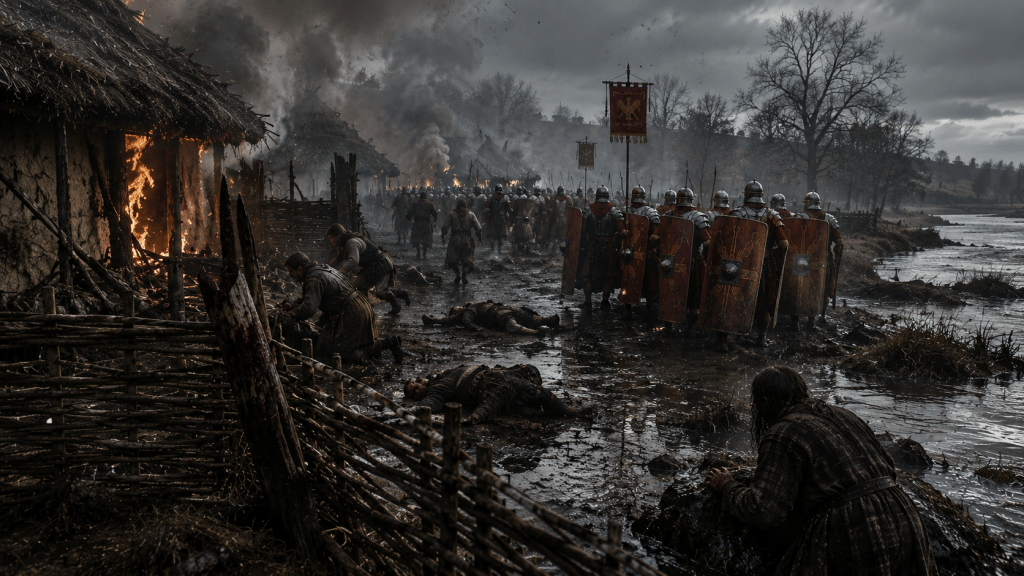
The Vale Record: Before the Empire is historical fiction with vampires, but it resists the easy path of making the vampire responsible for history. Marcus does not create Rome, guide rebellion, command armies from the shadows, or stand behind famous events as their hidden author. Human history remains human. That choice gives the book its integrity.
Marcus survives history; he does not own it.
This makes the series especially appealing for readers who enjoy British historical vampire fiction, literary vampire fiction, immortal protagonist fiction, and adult supernatural historical fiction where atmosphere and character carry more weight than spectacle. The book understands that a long life would not simply accumulate power. It would accumulate grief, omissions, practical adaptations, and memories that no longer fit the identities required by the present.
The Roman material in Before the Empire is not there for grandeur. It is there because empire changes the shape of ordinary ground. Roads cut through older paths. Military discipline overwhelms local rhythm. The settlement, once held together by work, speech, repair, and familiarity, becomes an arranged aftermath. Marcus’s first great fracture is not the discovery of supernatural power. It is the loss of belonging.
That makes the title feel quietly exact. Before the empire, Marcus had a place. After it, survival continues, and everything begins to move away from what he once understood.
Entering the Record
The best way to approach The Vale Record: Before the Empire is not as a conventional vampire tale, nor as a simple piece of Roman Britain fiction. It is the beginning of a record, and records carry their own dangers. They preserve, but they also expose. They give shape, while changing what they hold. Once Marcus speaks, the memory no longer belongs only to him.
The book invites the reader into a room where an old man sits beside a recorder, watched by people who love him, fear for him, or fear what he may reveal. From there it moves into mud, smoke, iron, blood, cold water, and the first terrible understanding that survival can become its own form of loss. It returns to Vale House with that pressure still clinging to the body, leaving Thomas with impossible notes, Eleanor with unanswered unease, Julian with strained restraint, and Marcus with the knowledge that another memory is already waiting.
For readers seeking indie vampire books with a serious historical atmosphere, Kindle vampire books for adults, or literary supernatural fiction centred on memory, family secrecy, and old blood, Before the Empire offers an opening that is quiet, controlled, and difficult to shake loose.
The record has begun. The first memory has been spoken. The house still stands, outwardly ordinary, yet something has moved through it that cannot be put back exactly where it was.