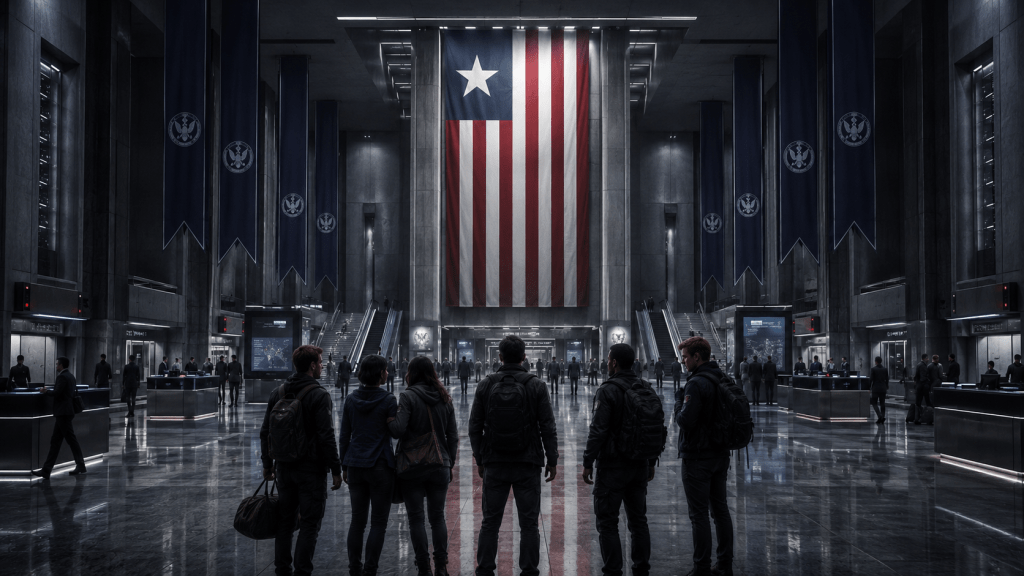
The American flag is the first thing Aaron Cole knows is wrong, although for several seconds he cannot understand why. The familiar red and white stripes hang exactly where they should beneath the controlled lighting of the staging hall, the fabric arranged with institutional precision and treated by everyone passing beneath it as something too ordinary to deserve attention, yet the blue canton no longer carries the constellation he has known since childhood. There is only one white star, large and uncompromising, suspended at the centre of a design that seems familiar until memory attempts to complete it.
Then Aaron looks for the Union Jack.
It is not there.
For Aaron, Rei Nakamura, Marcus Reed, Connor Blake, Declan O’Shea and Sofia Alvarez, the discovery should not matter as much as the crisis they have only just survived. They have already endured an experience so physically convincing that the language of advanced simulation has begun to feel inadequate, and they have returned carrying injuries that should have disappeared when the experiment ended. Sofia’s ankle remains swollen and painful, Aaron’s hands still carry abrasions, Marcus bears bruising from impacts that belong to another place, and exhaustion sits inside all of them with the stubborn weight of something the transition back has failed to remove.
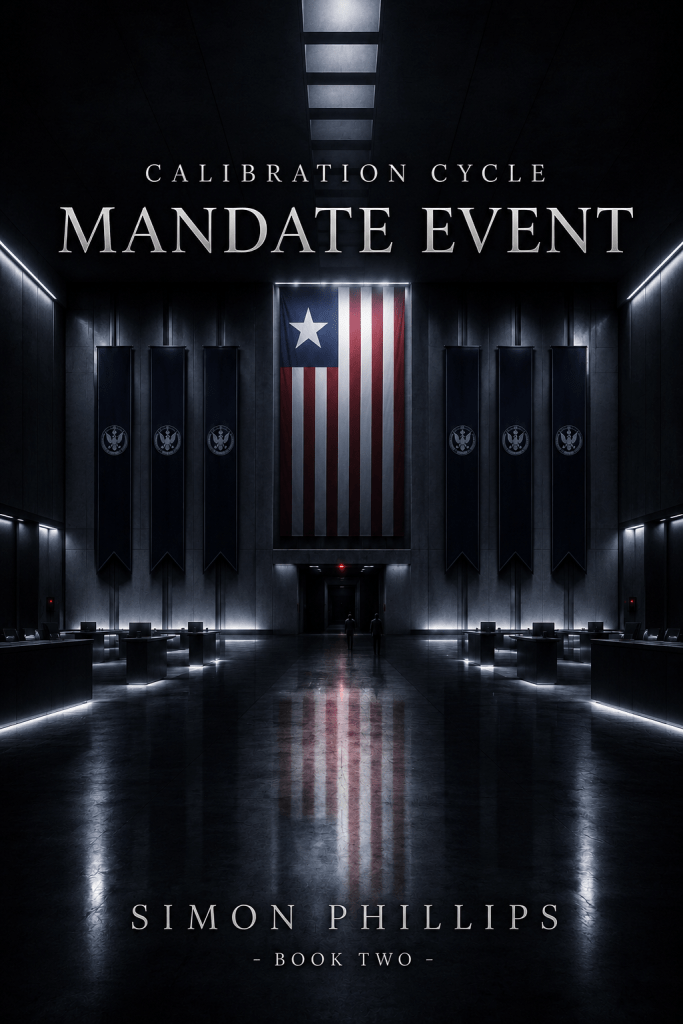
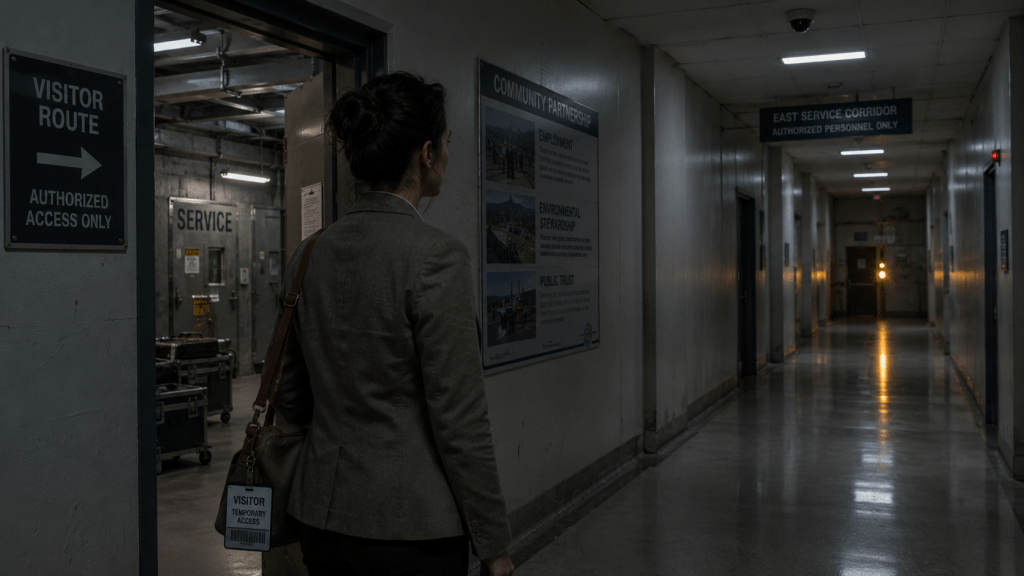
The hall around them, however, remains composed. Personnel move between desks. Announcements direct arrivals through processing. Screens display ordinary public information. No one appears concerned by the altered flag because, within this place, nothing about it is altered at all.
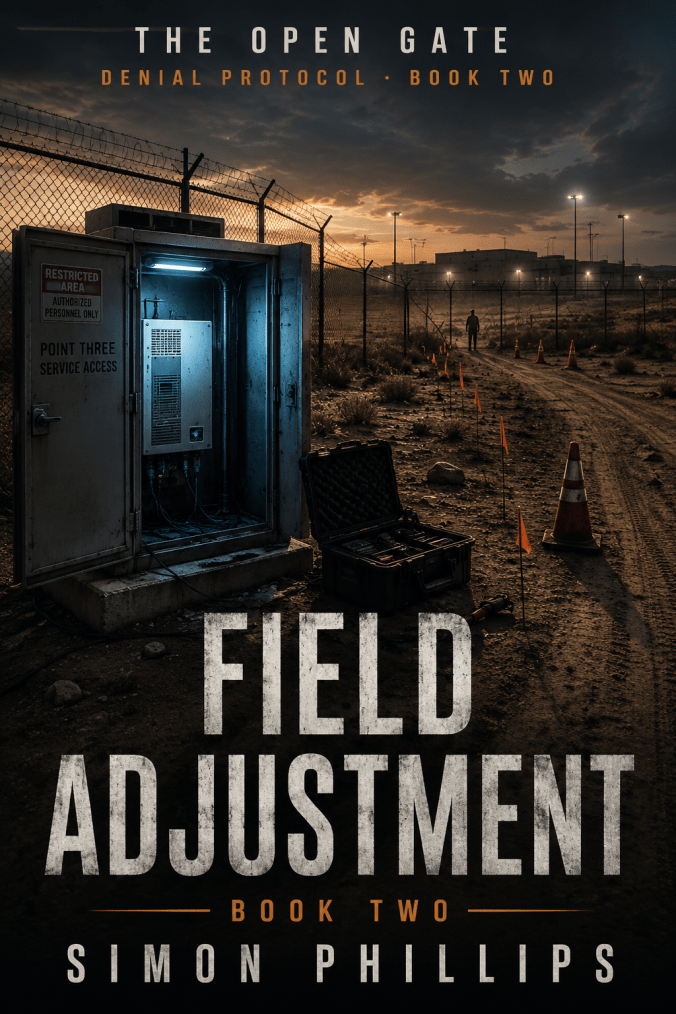
Calibration Cycle: Mandate Event begins at precisely that point of uncertainty, carrying the consequences of Meteor Event forward instead of allowing the characters the comfort of beginning again. The first book forced six volunteers to question whether an experimental immersive environment could produce consequences beyond anything they had been promised. Book Two asks something more dangerous: what happens when the world outside the supposed experiment appears perfectly stable, yet the history supporting that stability is not the history they remember?
The Return They Wanted Does Not Behave Like Home
The six entered the Calibration Cycle believing they had volunteered for a classified programme involving advanced immersive technology, adaptive crisis modelling and sensory feedback far beyond anything available to the public. That original explanation gave them something to hold onto when the first experience became difficult to distinguish from physical reality, because even impossible sensations could still be fitted inside the possibility of extraordinary technology if they were willing to stretch the definition far enough.
Mandate Event begins putting that explanation under a different kind of pressure.
Sofia’s ankle is not merely remembered as painful. It remains injured. The swelling is present beneath institutional lighting that belongs to the supposedly safe side of the experience, and when medical personnel eventually examine it, they do not respond with astonishment. They possess terminology for injuries that persist across what should have been a clean transition, and the casual professionalism with which those terms are used becomes more disturbing than panic would have been.
Aaron carries smaller marks, though their significance is no easier to dismiss. Marcus feels damage that should have belonged to a completed crisis. The six have returned carrying evidence in their own bodies, and every attempt to explain that evidence requires another layer of technology they were never told existed.
Connor, whose instinct is to understand a system before allowing himself to fear it, continues searching for a technical explanation because that is still more manageable than accepting that the original explanation may have been fundamentally wrong. Rei pays closer attention to the bodies themselves, noticing what pain does, how exhaustion remains, and how physical consequence refuses to respect the boundary everyone was told would exist.
Nothing provides them with a definitive answer, which is precisely what makes the uncertainty work. They are not handed a revelation about what has happened to them. They are forced to continue moving while the explanation they trusted becomes increasingly expensive to maintain.
The Single Star Belongs to a World That Thinks It Is Normal
The altered flag is only the beginning.
Announcements inside the facility direct people towards return processing. Administrative staff speak about return groups and return blocks as though those categories have existed long enough to become boring. Public devices connect to something called the Imperial Civic Mesh. Transport information identifies the wider region as part of an Imperial Union, and Britain no longer appears under the name Aaron expects to find.
It has become the Albion Administrative Territory.
The significance of that change does not arrive through an explanation delivered by an authority figure. It emerges from the ordinary machinery of public life, which makes the altered history far harder to dismiss as an artificial backdrop. Britain has not disappeared beneath rubble, and the world has not been thrown into a visibly dystopian collapse. People buy coffee, complain about delays, take children to school, work behind desks, scan travel documents and hurry through transport concourses beneath symbols they stopped consciously noticing years ago.
The single-star emblem appears on uniforms, public screens, transport notices and civic material because it belongs there.
Albion appears in official language because, within this history, that is simply what the country is called.
The effect is deliberately quieter than a ruined skyline or military occupation because Mandate Event is interested in something more unsettling than obvious conquest. It examines the way political transformation can become ordinary once enough time has passed for institutions, education, paperwork and language to make the new arrangement feel inevitable.
The Imperial Union does not need soldiers standing on every corner shouting about power. Its authority is already built into the names people use, the documents they carry and the systems through which ordinary life is allowed to move.
The Imperial Union Was Built Through the Language of Rescue
As Aaron and the others begin cautiously reading the world around them, the altered history reveals a political structure that is far more complicated than a simple empire imposed overnight.
The Imperial Union presents its origins through reconstruction, relief, stability and protection. The history taught within its civic systems describes a world emerging from the devastation of the Second World War under increasingly permanent American leadership, where humanitarian supply networks, military security, reconstruction programmes and international coordination gradually became something larger than the emergency structures that first justified them.
Connor can see why such a system might once have looked brilliant.
Shared logistics could prevent famine. Coordinated security could limit another continental war. Common infrastructure could move medicine, refugees and aid across borders more efficiently than fractured governments acting alone. A world that had watched nations destroy one another might willingly tolerate extraordinary central authority if that authority appeared to offer stability.
Marcus understands another part of the problem because military history is full of temporary structures that survive the emergencies that created them. Once command systems work, dismantling them carries risk, and the person suggesting that the guardrail should be removed becomes responsible for whatever happens afterwards.
Declan sees the trap hidden inside that logic. Temporary necessity becomes permanent authority, permanent authority becomes administrative expectation, and eventually people forget that the structure was ever supposed to be temporary at all.
What makes the Imperial Union effective as political science fiction is that its public argument contains enough truth to make its later form uncomfortable. It is not frightening because every part of it was designed by obvious monsters. It is frightening because many of the mechanisms that eventually erased sovereignty can be traced back to decisions that could once have been defended as reasonable.
That history gives Mandate Event its political depth without turning the story into a lecture. Aaron and the others discover it because they must understand the rules of the world before those rules classify them as threats.
Aaron’s Passport Becomes More Dangerous Than a Weapon

For Aaron, the altered history stops being theoretical when the group reaches identity processing.
The passports they carried into the original programme have travelled with them, small pieces of ordinary life preserved through experiences that have already damaged almost every other assumption. Connor’s American passport produces confusion because its design does not match local federal standards. Rei’s Japanese documentation requires manual review. Sofia’s Mexican identity and Declan’s Irish passport fit imperfectly into a world whose international order followed another path.
Aaron’s British passport produces something else entirely.
The United Kingdom of Great Britain and Northern Ireland is not recognised as a legitimate sovereign state.
The familiar crest inside his passport is treated as proscribed political material connected to Albion separatism, and an object that once allowed him to pass through airports becomes evidence that he may belong to a movement the authorities consider dangerous.
The moment changes the nature of the story because Aaron has done nothing except prove who he is.
His nationality has become suspicious.
His passport carries symbols the state regards as politically destabilising.
The country printed inside it is treated as an obsolete claim preserved by people unwilling to accept history’s correction.
That idea sits at the centre of Mandate Event: power does not only control territory when it can also control the vocabulary through which territory is remembered. Once Britain becomes Albion, anyone insisting on the older name can be described as refusing reality rather than defending identity. Once sovereign symbols become prohibited emblems, preserving them can be treated as radical behaviour. Once an entire generation is educated inside the revised language, the argument over what was lost becomes easier for authority to dismiss as nostalgia, extremism or historical misinformation.
Aaron entered the experiment without thinking very much about what being British meant.
This world forces him to discover what happens when somebody else has already decided that the identity no longer exists.
Berlin Makes the Wrong History Feel Real
Beyond the controlled processing areas lies Berlin, and the city gives the altered world the texture that makes it difficult to dismiss.
Nothing about everyday life pauses to acknowledge the six outsiders’ confusion. Buses run. Shops open. Delivery drivers argue with staff. Public terminals charge fees. Schoolchildren carry bags beneath civic emblems. News broadcasts move between transport information, security notices and political ceremonies while people glance at them with varying degrees of interest.
That normality is important because Mandate Event never treats the altered world as a decorative setting waiting for Aaron’s group to arrive. People have lived here their entire lives. They possess loyalties, compromises, resentments and memories that existed before six strangers appeared inside their political reality.
Some accept the Imperial Union because it is the only structure they have ever known.
Some believe its promise of order.
Some dislike it without being willing to risk their lives opposing it.
Some have learned to conceal forbidden symbols beneath clothing.
Some belong to networks attempting to preserve identities that official history has taught the public to regard as dangerous.
The city therefore becomes more than an alternate-history curiosity. It becomes a functioning society whose contradictions must be understood before the characters can safely act inside it.
Steven Hale, another survivor caught in the same impossible chain of events, becomes especially important because he recognises that language itself has become part of the terrain. His instinct is to read signs, official categories, school history, public warnings and bureaucratic terminology before trusting any interpretation. He understands that governments often reveal more through the words they treat as ordinary than through the speeches they make deliberately.
For a group accustomed to waiting for instructions, that becomes an important change.
They begin learning to read the world before allowing the world to tell them what to do.
Nathaniel Crowe Is Dead, Yet Berlin Recognises His Face
Aaron’s British passport makes him dangerous to the Imperial authorities, although it is not the strangest problem attached to his identity.
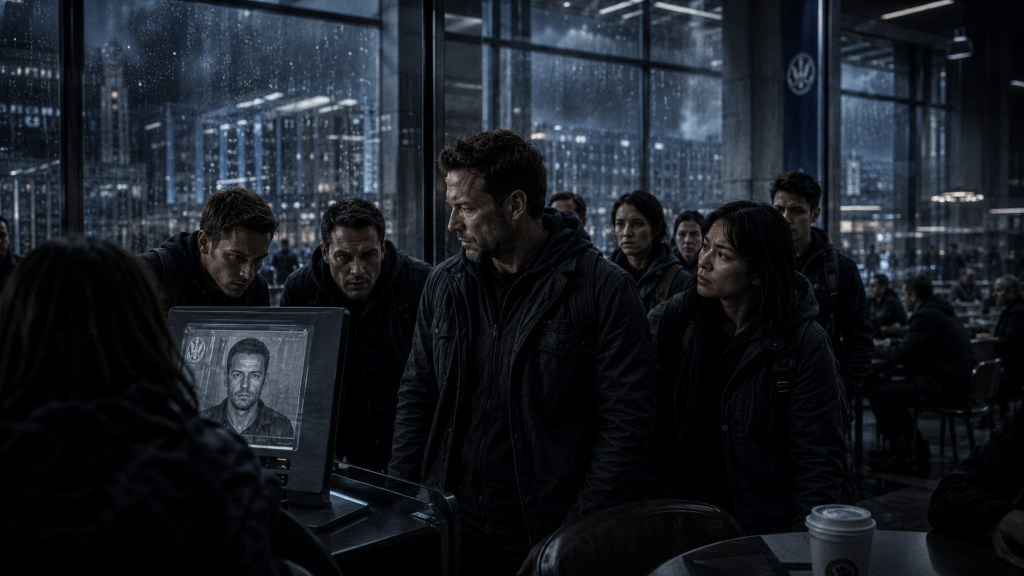
A records clerk named Tomas Rale sees Aaron and reacts as though somebody long dead has stepped into the fluorescent light.
The man he recognises is Nathaniel Crowe.
Within sections of the Albion resistance, Crowe is better known as the Ghost, a figure surrounded by enough conflicting history to make certainty almost impossible. Official sources connect him to extremist violence and attacks against Imperial structures. Resistance accounts describe someone who became a symbol of survival, defiance and the refusal to allow Britain’s identity to be administratively erased.
Crowe is also supposed to be dead.
The resemblance between him and Aaron is close enough to make disbelief difficult and acceptance even worse.
For Aaron, the danger lies in the fact that he knows perfectly well who he is while everybody around him begins responding to somebody else.
He has no memories of Crowe’s life.
He does not know the people who speak about him with grief.
He has no understanding of the decisions that turned the Ghost into both a security threat and a resistance symbol.
Yet a face can carry authority before a person has spoken a word, and once the possibility of Crowe’s return begins moving through hidden networks, Aaron discovers that denying the identity may not be enough to prevent other people using it.
That pressure suits Aaron particularly well because leadership has never been something he sought. In Meteor Event, people began looking towards him because he remained capable of organising movement while certainty collapsed. In Mandate Event, an entire political network begins seeing significance in him for reasons that have nothing to do with the choices he has actually made.
He is no longer simply being asked to decide.
He is being asked to inhabit expectation.
The Resistance Has Preserved What the State Tried to Make Obsolete
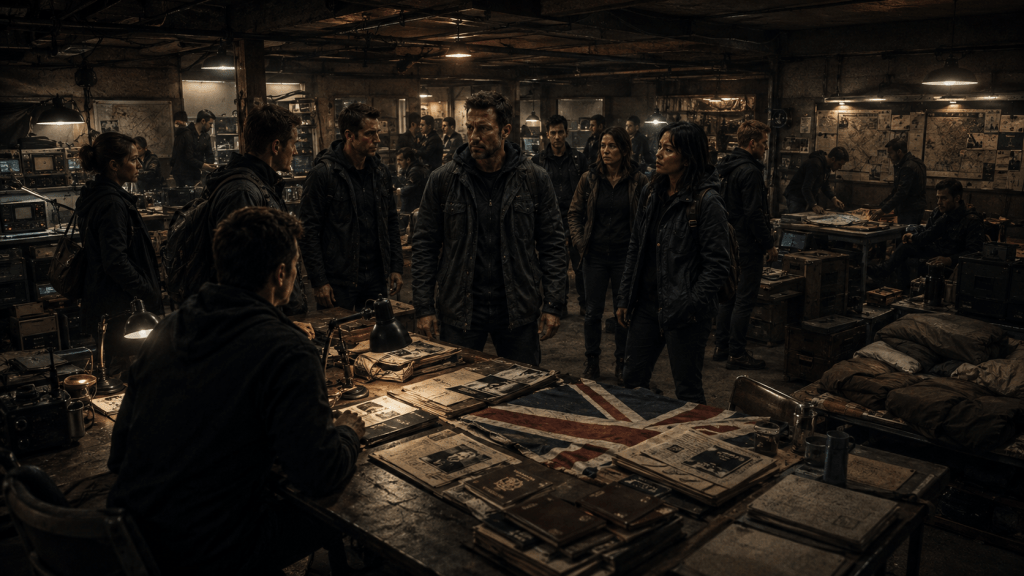
The resistance Aaron encounters is not presented as a polished underground army waiting for the arrival of its rightful hero. Its rooms are crowded with practical work, exhausted people and the accumulated objects of a history that has become dangerous to possess.
Old flags are hidden.
Passports from the United Kingdom are preserved after official recognition has vanished.
School material is collected alongside forbidden records.
People maintain routes, falsify paperwork, move information, repair equipment and support families whose lives have been reshaped by political decisions made long before Aaron entered the city.
That detail keeps the resistance grounded.
The struggle is not initially defined by weapons. It is defined by memory.
People preserve names because names disappear first. They preserve documents because documents prove that something existed before an authority decided it did not. They teach history privately because public education has replaced political loss with a story of rescue, stability and inevitable progress.
Only later does that preservation become entangled with violence.
This is where the story refuses to give either side an easy moral position. The Imperial Union has erased sovereignty, suppressed prohibited symbols and turned national memory into a security concern. The resistance has understandable reasons to exist, although understandable reasons do not guarantee that every action taken in their name becomes morally acceptable.
That distinction becomes increasingly important as Aaron is pulled closer to people who see his resemblance to Crowe as an opportunity.
Cerys Thorne Sees a Man and a Weapon in the Same Face
Among the resistance figures Aaron encounters, Cerys Thorne carries perhaps the most difficult relationship with the identity being placed over him.
Crowe was not an abstract figure to her.
The history between them is personal enough that Aaron’s face causes an immediate reaction, although Cerys does not allow grief to become certainty. She understands the danger of believing too easily, particularly when the Imperial Union would have every reason to exploit a symbol capable of disrupting resistance judgement.
At the same time, she cannot ignore the practical effect Aaron has on the people around her.
Some believe Crowe survived.
Others believe Aaron may be damaged, altered or deliberately planted.
Some do not care which explanation is correct because the sight of his face gives exhausted people something they have not felt for years.
Hope.
That becomes dangerous because hope is another form of leverage.
Cerys understands it.
Aaron begins understanding it.
The harder question is whether recognising that leverage prevents them from using it.
The political conflict in Mandate Event becomes much more personal at this point. Aaron is no longer simply hiding from Imperial authorities. He is being drawn into a struggle where his face can influence frightened people, his name can alter trust, and remaining completely outside the conflict may no longer be possible.
Something Knows Exactly Which Identity Will Open the Next Door
The external guidance that helped drive the crisis in Meteor Event has changed as well.
The wrist-mounted prompts that previously offered direction are no longer the only route through which instructions appear. Phones connected to the Imperial Civic Mesh begin receiving language that resembles both the local political system and the clinical direction the group encountered before.
The distinction becomes increasingly difficult to maintain.
Are the messages part of the Imperial network?
Are they part of the original experiment using local infrastructure?
Are the two being deliberately blended so that the characters can no longer tell where one authority ends and another begins?
Connor is particularly disturbed by the way terminology changes after the group learns it. New phrases appear only after local people have introduced those concepts. Role descriptions shift as the resistance begins assigning its own structures. The language surrounding Aaron starts acknowledging the importance of the Crowe identity as though something has recognised that other people’s belief can be used to change behaviour.
Then the intrusion becomes more personal.
Aaron is confronted with a resistance challenge that requires knowledge he cannot possess.
Instead of receiving a simple written answer, he experiences something closer to a memory.
Rain against water.
Stone beneathfoot.
Soot.
A voice carrying words that feel remembered despite belonging to a life Aaron has never lived.
The moment is deeply unsettling because it crosses a boundary that external instructions had left intact. Telling someone where to go is one kind of control. Supplying the internal texture necessary for them to behave like somebody else is another.
For the resistance, Aaron’s answer appears to confirm something.
For Aaron, it confirms almost nothing except that whatever is guiding them can reach further into him than he realised.
Rei Nakamura Keeps Looking for Aaron Beneath the Ghost
The growing Crowe identity also strengthens one of the quieter relationships inside the group.
Rei has never needed Aaron to become a conventional leader. Her connection to him grows through shared responsibility, observation and the small acts required to keep people moving under pressure. She sees when he is carrying too much before he says it, and in Berlin she becomes increasingly aware that the danger surrounding him is not only physical.
Everyone else has reasons to see Crowe.
The resistance sees history.
Cerys sees grief.
Tomas sees possibility.
The authorities see a threat.
Whatever is guiding the group appears to see an identity that can be used.
Rei continues seeing Aaron.
That distinction does not require sentimental declarations because it works more effectively through restraint. A glance held for a fraction longer, a question asked quietly while everyone else talks about the Ghost, a deliberate use of Aaron’s real name when the room has begun treating Crowe as more useful.
The relationship matters because identity pressure only works if there is something being lost beneath it.
Aaron cannot be frightened by becoming Crowe unless being Aaron still has weight.
Marcus, Connor, Declan and Sofia Read Different Dangers in the Same World
Book Two also gives the rest of the core group increasingly distinct ways of interpreting the altered political reality.
Marcus Reed reads structures of force. His military experience allows him to recognise security posture, command hierarchy, access routes and the difference between authority that expects obedience and authority that has begun preparing for violence. The Imperial Union unsettles him partly because much of its machinery is recognisable. Its worst instincts do not look alien to him; they look like familiar systems pushed far enough that necessity has become permanent doctrine.
Connor Blake approaches the world through architecture and information. He can admire the efficiency of civic networks while being disturbed by what that efficiency enables, and his willingness to understand the mechanisms around them becomes both essential and dangerous. Every time he discovers another pattern, he moves closer to something none of them yet understands.
Declan O’Shea reacts through suspicion shaped by money, incentives and the public language of power. He understands that empires can benefit from being attacked if an attack provides the justification for greater control, and his cynicism becomes increasingly valuable whenever everyone else begins confusing movement with progress.
Sofia Alvarez continues carrying the most visible physical connection to the previous event through her injured ankle, though Book Two develops her far beyond that vulnerability. She watches people rather than structures and frequently notices emotional realities others miss. She recognises when civilians are afraid of being seen reacting. She sees rooms building expectations around Aaron before he fully recognises what is happening. Her sensitivity, which initially appeared to make her the least suited to sustained crisis, increasingly allows her to perceive what more confident people overlook.
The six are therefore becoming more capable as a group, although capability is not presented as uncomplicated progress.
The better they become at surviving these situations, the more dangerous the question becomes of what survival is teaching them to accept.
The Continental Mandate Forum Turns Politics Into a Moral Trap
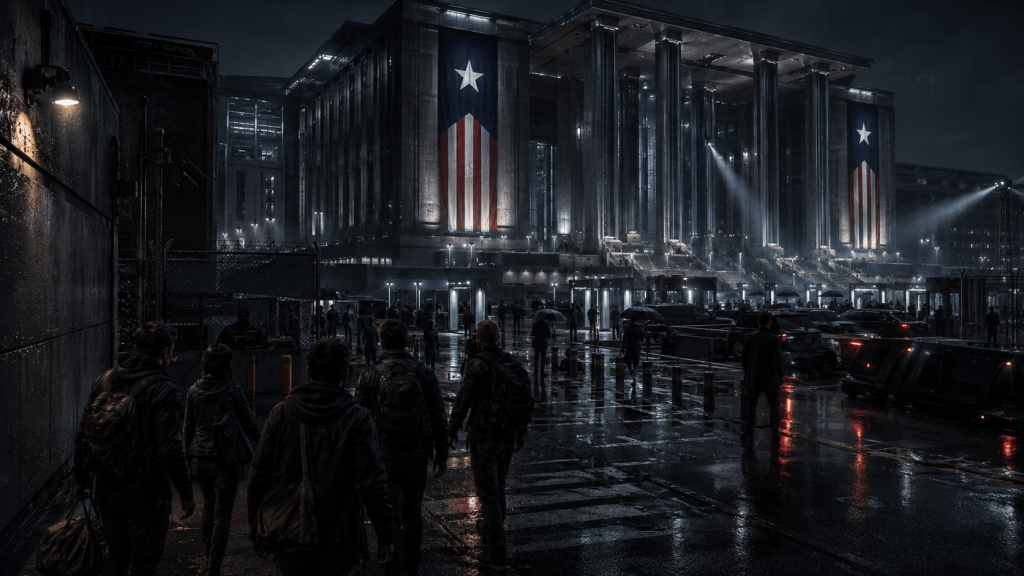
The resistance eventually identifies an opportunity created by the Continental Mandate Forum in Berlin, where political, security, financial and administrative power has been brought unusually close together.
For an organisation that has spent years surviving beneath Imperial surveillance, the convergence appears almost impossible to ignore.
This is where Mandate Event moves from political discovery into moral pressure.
The Imperial Union has given the resistance countless reasons to oppose it. Britain has been administratively reduced to Albion. Sovereign symbols have been criminalised. Historical identity has been recast as dangerous nostalgia. People have disappeared into institutions whose language makes coercion sound procedural.
None of that automatically makes a violent response clean.
The Forum contains people rather than abstract structures.
Workers move through it.
Security personnel protect it.
Political figures carry responsibility in different degrees.
Civilians exist around every plan.
The resistance understands that striking the right points could weaken the machinery holding the Imperial system together, while Declan immediately understands that the wrong attack could provide the Union with exactly the fear required to justify even greater control.
Aaron and the others are therefore placed inside a political conflict where the obvious enemy does not produce an obvious moral answer.
Helping the resistance may contribute to liberation.
Helping the resistance may also contribute to deaths none of them can justify afterwards.
Refusing involvement may preserve their consciences.
Refusing may also abandon people already living under an authority that has erased parts of their identity for generations.
There is no choice capable of leaving everyone innocent.
That is exactly where Calibration Cycle wants its characters.
Mandate Event Is About What Happens When Success Has No Moral Definition
The first book presented a crisis that looked straightforward from a distance. Something catastrophic was approaching. An intervention was possible. The difficulty lay in not knowing whether acting would prevent disaster or create another form of it.
Mandate Event takes the same underlying pressure and removes the clarity of a physical object falling from the sky.
Political systems do not offer a single impact point.
Resistance movements do not come with clean success probabilities.
History cannot be corrected by pressing the right sequence of controls.
Every decision changes people who have already been living inside the consequences long before Aaron’s group arrived.
That makes Book Two particularly suited to readers who enjoy psychological science fiction where the speculative element is inseparable from character, politics and moral uncertainty. The technology matters, although the story is never about technology for its own sake. The alternate history matters, although it is never presented simply as an exercise in imagining different flags and borders.
What matters is what those structures do to the people forced to live inside them.
Aaron is pushed towards leadership through an identity that is not his.
Rei watches the person beneath that identity become harder to protect.
Marcus confronts the danger of thinking too easily in operational terms.
Connor begins recognising that understanding a system does not mean controlling it.
Declan sees how power converts violence into justification.
Sofia notices the human cost while everyone else is still arguing about structure.
The deeper the group moves into Berlin, the harder it becomes to tell whether the next successful action is bringing them closer to safety or merely proving how effectively they can be made to function under pressure.
Read Calibration Cycle: Mandate Event
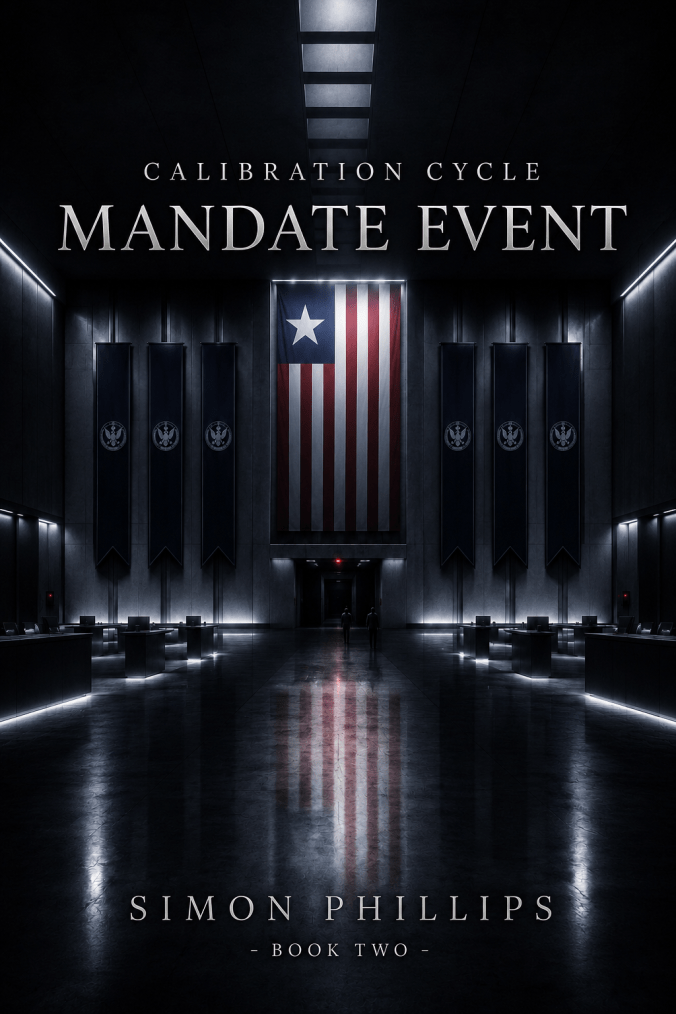
Calibration Cycle: Mandate Event continues the story begun in Meteor Event while expanding its psychological and political pressure considerably beyond the first crisis. Readers who enjoy psychological science fiction, alternate-history thrillers, political dystopian fiction, unreliable reality, artificial-intelligence ethics, resistance narratives and character-driven speculative fiction will find a story concerned less with explaining an impossible world than with forcing ordinary people to live inside it long enough for every easy explanation to begin failing.
Aaron Cole survived the first event expecting that survival would eventually lead back towards certainty. Instead he finds himself standing beneath a flag that should not exist, carrying injuries that should have disappeared and presenting a passport from a country this world regards as a dangerous historical fiction. Before he has time to understand the history surrounding him, strangers begin recognising his face as that of Nathaniel Crowe, a dead resistance figure whose legacy carries equal measures of hope, violence and political mythology.
The more useful that resemblance becomes, the less control Aaron has over what other people believe.
The more the group learns about the Imperial Union, the harder it becomes to reduce the conflict to good people fighting bad ones.
And as the technology surrounding them begins adapting to the language, identities and pressures of the world itself, one possibility becomes increasingly difficult to ignore: perhaps completing whatever comes next has never guaranteed that the result will be good.
The experiment was supposed to test how six people responded to crisis. By the time Berlin closes around them, Aaron and the others are beginning to face a much less comfortable possibility: the crisis may be learning how to use what they are becoming.