The House of the First Breath: Ancient Civilisation Fantasy, Sacred Architecture, and the First Monument of the Spiral

When Memory First Learns to Become Stone

The desert in Chronicles of the Spiral Ages is never empty. It carries the weight of vanished paths, old grief, black stone remnants, forgotten names, and marks whose meaning changes as civilisation learns to fear what it has inherited. In this mythic timeline fantasy series, history is more than background. It is the living pressure beneath every story, moving from deep prehistory into the slow rise of settlement, ritual, sacred architecture, priestly authority, and the first dangerous attempts to make memory permanent.

The House of the First Breath enters that world six centuries after the events of The Sand Beyond Memory, when the first sacred wound in the Red Basins has already begun to change. Saehur, once a mortal Teller who listened too deeply to the land, has become remembered by later generations as the First Breath of the Land. His name survives only in guarded fragments, while the Spiral that marked his transformation has passed from wonder into rite, from mystery into ash-mark, from land-memory into the first language of sacred power.

This is ancient civilisation fantasy built around the moment before greatness becomes ruin. The Khevaru people have begun to settle beside wells, reed shelters, ration stones, body-houses, quarry paths, and the fragile promise that remaining in one place might teach the land to remember them. They have no empire, no polished cities, no bronze armies, no throne raised above law. What they have is thirst, grief, labour, stone, and the belief that names can be held against vanishing.

For readers drawn to mythic fantasy books, deep-time fantasy, Stone Age fantasy, ancient world fantasy, and stories about forgotten civilisations, The House of the First Breath offers something quieter and more dangerous than spectacle. It asks what happens when a frightened people begin building monuments, and when the first sacred tomb becomes something more than a place for the dead.

Khevar, the Settlement Before the City

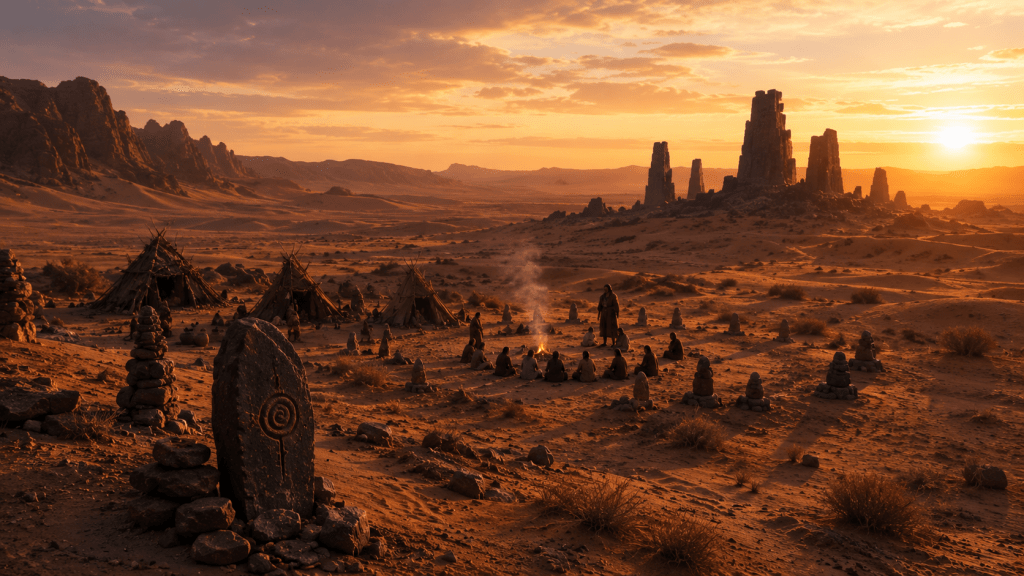
Khevar is still young enough to remember movement, yet settled enough to fear losing what it has gathered. Its people live between the old wandering world and the future shape of civilisation. They store grain against hunger, count water beneath a pitiless sun, carry bodies into the care of death-workers, and draw ash Spirals over the dead so each name might pass into memory with dignity.

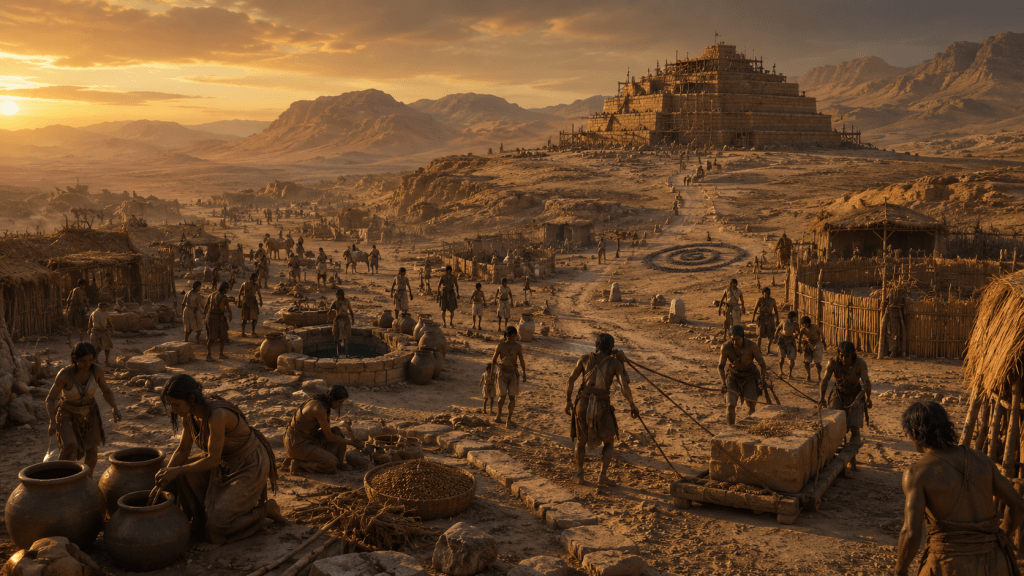
The world of The House of the First Breath is grounded in labour rather than ornament. Water jars scrape against stone. Reed cords tighten around loads. Bodies bend beneath heat. Children watch adults speak of sacred things while hunger waits at the edge of every decision. The settlement has begun to organise itself around wells, stores, body-houses, work paths, and the sacred road leading towards the black Spiral left by Saehur’s transformation. Khevar has crossed a threshold, and the story understands that such thresholds rarely announce themselves as triumph.

Civilisation begins here as an act of survival. It begins with people trying to hold the dead in memory, trying to keep the living fed, trying to stop fear from breaking the fragile order that keeps one household from turning against another. That is what makes the book’s central monument so powerful. The House is raised as an answer to grief, yet every stone teaches Khevar a new kind of obedience.

Neyat, Keeper of Names Beneath the Rising Stone

At the heart of the story stands Neyat, a death-worker whose hands know the human cost of every public decision. She washes bodies, prepares the dead, marks names in clay, and understands that the smallest rites often carry the greatest truths. Through her, the reader sees Khevar from the place authority prefers to pass quickly: the body-house, where grief has no grandeur and where every life must be held as more than symbol.

Neyat’s world is already unequal. A powerful leader’s death gathers speech, resources, and public attention, while ordinary families struggle to give their dead enough ash, cloth, and song. She sees how some names become large before they are even buried, while others depend on sons, daughters, or old women repeating them against the pressure of drought. This makes her a perfect guide through the Age of Dust, since she understands that memory can be sacred while still being vulnerable to control.

Her resistance is quiet, human, and deeply rooted. She is not a battlefield figure, not a chosen ruler, and not a speaker of grand prophecies. Her strength lies in refusing to let bodies become tools too quickly. When captives, workers, debt-bound families, injured labourers, and the ordinary dead begin to disappear beneath the language of sacred purpose, Neyat insists that names still matter. She becomes the first hidden guardian of the small truths that official history will one day try to bury.


Maresh and the Danger of Sacred Certainty

The book’s central tension rises through Maresh, the High Dune-Priest of Khevar. He begins with sincerity, which makes him far more unsettling than a simple villain. He sees a settlement under strain. He understands that Tavren’s death, drought, water-path violence, and social unease could fracture Khevar. He believes sacred architecture can unite the people around a stronger memory.

Then belief hardens.

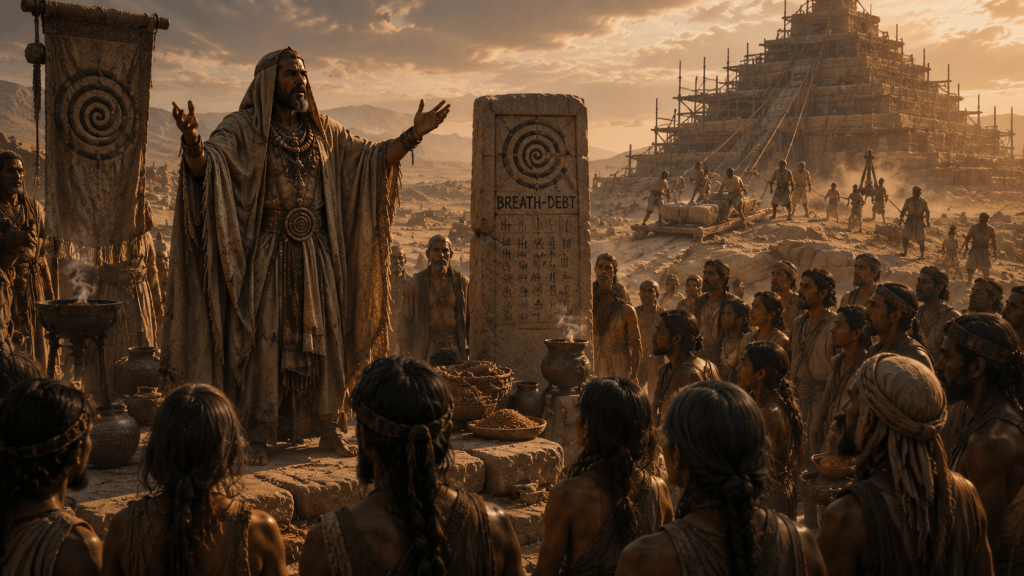
Maresh’s danger grows because his words answer real fear. He gives grief a shape, and frightened people lean towards shape. He speaks of memory, endurance, the First Breath, and the need for Khevar to stand together. Yet each sacred phrase begins to organise bodies around the House. Shared work becomes measured service. Measured service becomes social pressure. Water and rations begin to move through the shadow of obligation. Captured raiders and indebted households are drawn into labour under the name of Breath-Debt.

This is where the horror of The House of the First Breath becomes strongest. The terror does not come from monsters in the desert. It comes from civilisation itself learning how to make need sound holy. It comes from the moment a wounded worker becomes “first pain”, when a dead captive becomes useful labour, when a grieving settlement begins accepting that suffering gains meaning if it feeds the monument.

Orakh and the First Shape of Sacred Blood

Tavren’s death leaves behind his son Orakh, a grieving heir whose vulnerability becomes one of the foundations of future power. Orakh does not begin as a god-king, a tyrant, or a polished ruler. He begins as a son who wants his father remembered and a young leader frightened by the eyes turning towards him.

That makes his transformation believable. The House gathers public attention around Tavren’s body, and Orakh stands beside it. People bring disputes to him. They watch him near the stone. They begin seeing his bloodline differently because Maresh teaches them to read Tavren’s burial as sacred continuity. What begins as mourning becomes authority, and what begins as authority becomes the first seed of divine rulership.

The Age of Dust is built on these dangerous beginnings. Later ages may remember stone-housed rulers, sacred bloodlines, priestly orders, and pyramid fields as ancient facts. This book shows the human moment before the fact becomes unquestioned. It shows the grief, hesitation, pressure, compromise, and need from which sacred kingship first rises.


The House as Tomb, Memory Vessel, and Social Machine

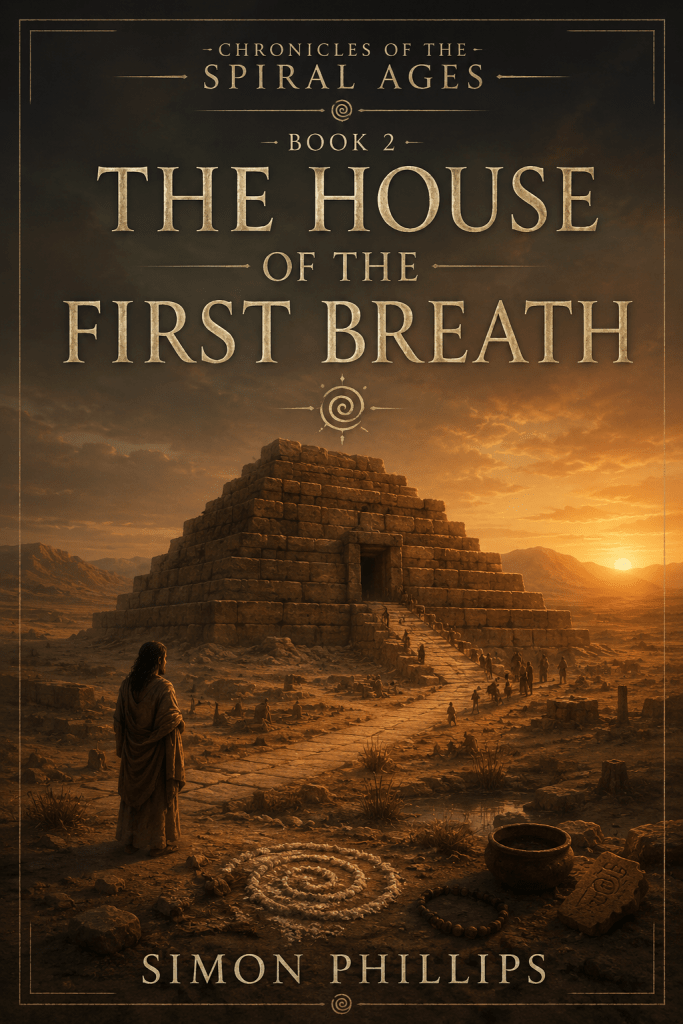
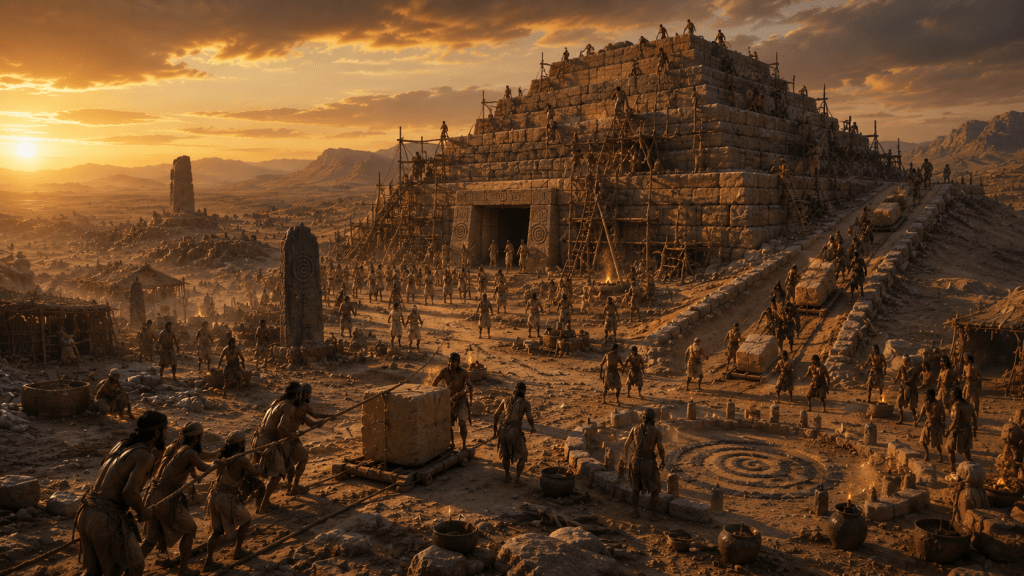
The House itself is one of the strongest images in Chronicles of the Spiral Ages so far. It is not a polished monument from a mature empire. It is crude, stepped, uneven, and built with rough stone, rope, sledges, sand ramps, and exhausted hands. Its power comes from effort, fear, and imitation. The Khevaru are trying to echo older black forms in the desert, remnants they barely understand, and their attempt carries both awe and danger.

The House begins as Tavren’s burial place. It becomes a public vessel for memory. Then it becomes a machine that reorganises the living.

This is sacred architecture fantasy in its most human form. The stones matter because bodies drag them. The shape matters because belief gathers around it. The chamber matters because Neyat must decide what truth can be hidden inside it before public doctrine closes over everything. The House is beautiful because it proves that people can build meaning against drought and death. It is frightening because that same meaning begins to consume them.

Every civilisation leaves monuments behind. The House of the First Breath remembers that every monument also leaves bodies beneath its story.

The Spiral and the First Breath Across the Long Timeline

The wider strength of Chronicles of the Spiral Ages lies in the way each book adds another layer to one world history. The Spiral is no longer only an ancient mark in forbidden stone. In Khevar, it has become a burial sign, a mourning path, a priestly phrase, a threshold mark, a sign of sacred authority, and a hidden counter-memory. Its meaning is already changing because culture has begun to claim it.

Saehur’s presence remains restrained, which makes it more powerful. He does not stride into the story to correct Maresh, save Khevar, or explain the truth. He returns only through warmth, fragment, vision, and the almost unbearable reminder that the First Breath was once a mortal man. The more Khevar worships him, the less cleanly it remembers him. That tragedy sits at the centre of the series’ mythic worldbuilding.

This is what makes the book matter beyond its own plot. It is not simply the next story after The Sand Beyond Memory. It is the first great distortion. It shows memory becoming ritual, ritual becoming authority, and authority learning to preserve itself through stone. Later cultures will inherit the result. They may find the ruins, copy the signs, misunderstand the records, and call the old wrongness holy.


A Book for Readers Who Want Fantasy to Feel Ancient

Readers who enjoy fantasy about ruins, memory, lost civilisations, ancient gods, sacred architecture, and the slow rise of belief will find The House of the First Breath shaped by atmosphere and consequence. It carries the texture of Stone Age fantasy, the emotional weight of mythic history, and the long pressure of ancient civilisation fantasy without turning the world into a direct copy of Earth’s past.

The desert setting has echoes of early tomb cultures and Egyptian-inspired fantasy, yet Khevar remains its own world, its own wound, its own threshold. The people do not know they are becoming history. They are trying to survive. They are trying to honour the dead. They are trying to keep water in jars and names in memory. That is why the story carries force. The future ruin begins as someone’s present need.

As Book Two of Chronicles of the Spiral Ages, The House of the First Breath deepens the series’ central promise: every age remembers wrongly, every sacred sign changes hands, and every monument stands over something human that later generations may fail to see.

The book is available now on Kindle: read The House of the First Breath on Amazon UK.
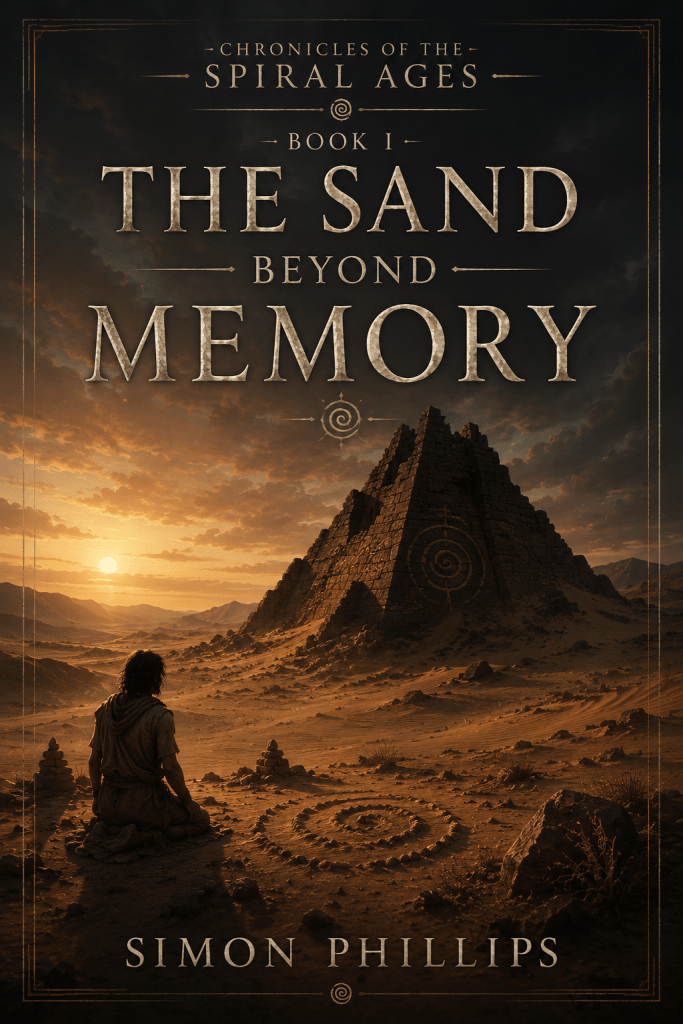
The Sand Beyond Memory and the Birth of Mythic Timeline Fantasy

Before kingdoms raised their walls, before temples named their gods, before scribes pressed memory into clay or priests learned how to turn grief into law, the desert already remembered.

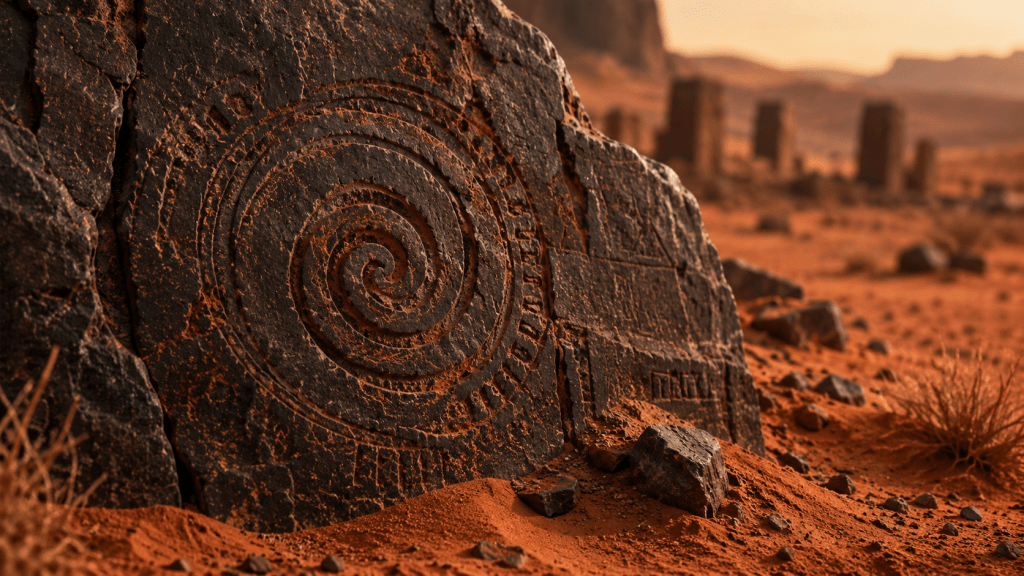
In the Red Basins, heat moved over the sand like a living thing. Cairns stood where names had begun to fade. Black stone ruins broke the horizon, older than any tribe that wandered beneath them, older than the fireside stories used to explain hunger, death, drought, and the terrible patience of the land. Across those ancient forms, weathered by ages no living voice could measure, the Spiral waited.

This is where Chronicles of the Spiral Ages begins.

The Sand Beyond Memory opens the first movement of a mythic timeline fantasy series built around deep time, forgotten civilisations, sacred architecture, ruins, memory, and the long transformation of human belief. It is ancient fantasy shaped by dust, silence, stone, grief, and wonder, a story set before written history, before empire, before doctrine, in an original world where humanity first begins to sense that the past beneath its feet may be far older than any elder’s tale.


Where History Becomes the Story

Most fantasy begins with a chosen hero, a threatened kingdom, a war for a throne, or a magic system already understood by those who wield it. Chronicles of the Spiral Ages begins earlier, in a place where people have no clean language for what they have found. The world has no grand libraries, no royal maps, no polished temples, no armies marching beneath crowned banners. It has heat, stone, family, hunger, ritual, fear, memory, and the need to survive long enough for one generation to speak to the next.

That choice gives the series its strength.

This is not only mythic fantasy, nor only historical fantasy in an invented world. It is mythic timeline fantasy, a form of deep-time fantasy where civilisation itself becomes the central movement. Each book reveals a different age, a different people, a different pressure placed upon the world. Cultures rise, misunderstand what came before, build meaning around fragments they cannot fully explain, and leave behind ruins for later ages to misread in turn.

In The Sand Beyond Memory, the focus rests on the earliest wound in that long history. Saehur, a mortal Teller among a desert people, listens to the land with a sensitivity others struggle to trust. He moves among cairns, memory rites, warnings, and forbidden ruins, sensing that the desert carries a truth older than the tribe’s spoken past. What begins as unease becomes discovery, and what begins as discovery becomes the first god-memory of the world.

The power of the book lies in that threshold. It stands at the moment before religion hardens, before architecture becomes authority, before symbols are owned by priests or rulers. The Spiral has not yet become doctrine. It has not yet been carved into royal seals, temple walls, burial houses, bronze plates, iron roads, or future machines. It is still a pressure in the land, a mark in black stone, a shape that seems to recognise humanity before humanity understands it.


The Red Basins and the First Remnants

The desert of The Sand Beyond Memory is not empty scenery. It is the first great historical stage of the series, a land of heat, dust, cairns, shifting dunes, and ancient black stone remnants rising like broken memories from a world already lost.

The Red Basins shape every action. Water matters because life is fragile. Shade matters because heat has power. A path across the sand matters because those who lose it may vanish before their names can be carried home. The tribes who live there understand the land through movement and remembrance, through rites spoken over stones, through the care of the dead, through the caution passed from elder to child.

Against that human scale stand the First Remnants.

They are vast, blackened, and impossible within the knowledge of the age. They suggest architecture before architecture, sacred geometry before doctrine, memory before record. Their presence gives the book its ancient civilisation fantasy atmosphere, although the civilisation that made them has already passed into mystery before the story begins. The people of Saehur’s age live in the shadow of something they cannot inherit cleanly. They can fear it, avoid it, dream of it, warn one another away from it, and still feel drawn towards it.

That tension is central to the series. Every later culture will do the same in its own way. A desert settlement may build a burial house in imitation of older forms. A priesthood may turn memory into power. A frost people may find the Spiral beneath ice. River builders may press signs into wet clay. Bronze rulers may claim sacred authority from symbols they barely understand. Iron kings may make myth serve conquest. Industrial scholars may wire ancient sites into machines. Spacefaring descendants may rediscover the same form in orbital paths and star maps.

Yet in Book One, everything remains close to the body. Heat on skin. Sand beneath knees. The tremor under stone. The fear of stepping where elders have forbidden. The ache of becoming responsible for a truth no one else may be ready to receive.


Saehur and the First Breath of the Land

Saehur’s importance comes from his humanity.

He is not introduced as a king, priest, warrior, or divine ruler. He is a Teller, someone trained to listen for memory where others might see only stone and silence. His role is fragile and intimate. He belongs to a culture where remembrance is carried by voice, gesture, cairn, and ritual, where the dead remain close because forgetting them would be a second loss.

That makes his transformation into the First Breath of the Land feel less like spectacle and more like consequence.

The book does not treat divinity as something simple or clean. It grows from contact with the ancient, from listening too deeply, from entering a truth that mortal life cannot hold in an ordinary way. Saehur becomes the first god-memory of the timeline, although the tragedy of such a beginning is clear from the moment it occurs. Later cultures may remember him as sacred presence, desert god, buried ancestor, breath beneath stone, hidden warmth, or nameless power. They may rename him, worship him, exploit him, or erase the fact that he was ever mortal.

That is where The Sand Beyond Memory becomes more than a Stone Age fantasy story. It becomes the foundation of a civilisation fantasy about how memory changes when people need it to serve survival, authority, comfort, or control. The first truth is intimate. Later ages will make it public. Later still, it may become law, architecture, empire, doctrine, ruin, and rediscovery.

For readers who enjoy fantasy about ancient gods and ruins, the power here lies in restraint. Saehur’s transformation does not empty the world of mystery. It deepens it. The divine remains distant, sorrowful, and difficult to name, which makes it stronger than a pantheon walking openly through the story. The sacred is felt through land, silence, stone, and loss.


The Spiral as Memory, Symbol, and Inheritance

The Spiral is the mark that binds the series together, although it should never be mistaken for a simple emblem. In The Sand Beyond Memory, it is ancient and uncanny. It appears before anyone knows how to explain it. It belongs to black stone, buried movement, forbidden ruins, and sensations too old for the tribe’s inherited language.

That first appearance matters because the Spiral will never remain one thing.

Across Chronicles of the Spiral Ages, the same form can become instinct, sacred sign, burial mark, priestly emblem, royal seal, scholar’s puzzle, machine pattern, and perhaps one day a cosmic structure recognised only by descendants who believe themselves far removed from the first desert cairns. The shape endures, while meaning changes around it.

This is one of the reasons the series stands apart from more familiar epic fantasy. The symbol is not merely there to identify magic. It is a historical object. It passes through cultures. It gains authority, loses truth, gathers false meanings, and survives long after those meanings collapse. One people may carve it with reverence. Another may stamp it onto law. Another may fear it as a sign of buried gods. Another may copy it onto temple doors without knowing it once trembled beneath Saehur’s hands in the Red Basins.

That slow transformation gives the series its deep-time weight. It lets readers feel how myth changes because people change. The Spiral remains, yet every age remembers wrongly.


Ancient Civilisation Fantasy Before Civilisation Fully Rises

The first book occupies a powerful place because it stands before the rise of the Khevaru desert civilisation. It shows the mythic wound that future cultures will build upon, misunderstand, sanctify, and eventually bury beneath stone.

This matters for readers drawn to Egyptian-inspired fantasy, sacred architecture fantasy, books about forgotten civilisations, and literary fantasy grounded in human consequence. The Sand Beyond Memory does not copy Earth’s ancient history. It mirrors the emotional and cultural pressure behind early civilisation: the fear of death, the need for memory, the awe of ruins, the authority of those who claim to interpret the sacred, and the impulse to build something permanent in a world that keeps taking everything back into dust.

The later Age of Dust will move towards tombs, pyramids, priesthood, sacred labour, divine rulership, and collapse. Yet Book One begins before all of that hardens. It gives readers the origin point, the first encounter, the first mark in stone, the first transformation that later generations will struggle to understand.

That is why the book carries such importance within the wider series. It is not simply an opening entry. It is the foundation myth. Every later desert monument, every distorted doctrine, every god-king claim, every sacred road, every burial chamber, every future ruin touched by the Spiral will stand in some relationship to what happens here.

Readers entering The Sand Beyond Memory are not being asked to memorise a timeline. They are being invited to stand at the beginning of one.


A Fantasy World Built Through Ages

The promise of Chronicles of the Spiral Ages is scale, although its scale grows through memory rather than noise.

The series begins in the Stone Age, in desert heat and black stone, then moves through the rise of settlement, sacred architecture, priestly authority, and the first great civilisation arc. Beyond the Age of Dust, the world will turn towards other climates and other peoples: frost lands, river valleys, bronze courts, iron roads, imperial archives, cathedral ages, industrial excavation, machines, orbit, stars, and whatever remains of memory beyond flesh.

Each age changes the meaning of what came before.

That is the quiet force behind the series. A ruin in one book may become a sacred site in another. A sacred site may become a royal tomb field. A tomb field may become a forbidden archive. An archive may become an archaeological wound. A symbol scratched into stone by one frightened people may later be measured by astronomers who have no idea that its first human meaning was grief.

This gives the books their emotional and historical depth. The world is not built as a backdrop for adventure alone. It is built as a living record of human fear, hunger, belief, labour, reverence, ambition, and misunderstanding. Every culture leaves something behind, and every later culture inherits less than it thinks.


Entering The Sand Beyond Memory

The Sand Beyond Memory is for readers who want fantasy with atmosphere, mythic depth, ancient mystery, and a sense of history moving beneath the story. It belongs to the tradition of fantasy books for adults that value mood, symbol, culture, and consequence as much as action. It is a story of desert ruins, land-memory, sacred unease, and the moment when one mortal listener becomes something future ages will never fully understand.

The book does not rush to explain the world. It lets the reader feel it first: the heat of the Red Basins, the silence around the cairns, the danger of forbidden ruins, the Spiral carved into black stone, the fragile life of a people whose stories are carried by memory rather than record. Its mystery is not a puzzle box designed to be solved in a single scene. It is the first pressure in a much longer historical movement.

For those beginning Chronicles of the Spiral Ages, this is the place to start. The first mark. The first wound. The first god-memory. The first sign that history in this world will be shaped by what people remember, what they forget, and what they choose to build over the truth.

Begin Book One here: The Sand Beyond Memory on Amazon Kindle.


What the Desert Leaves Behind

Every myth begins somewhere smaller than later generations imagine.

Before the god, there was a man listening beside stone. Before the doctrine, there was a tremor beneath the sand. Before the monument, there was fear of forgetting the dead. Before sacred architecture rose from the desert floor, there was a people trying to understand why the land seemed to remember more than they did.

That is the heart of The Sand Beyond Memory.

It begins the long movement of Chronicles of the Spiral Ages with dust rather than glory, with silence rather than proclamation, with a Spiral whose meaning is older than the mouths that first try to name it. Later ages will build over this beginning. They will carve, chant, bury, crown, measure, and misread. They will turn memory into ritual, ritual into authority, authority into civilisation, and civilisation into ruin.

The desert will remain.

The stone will remain.

The Spiral will wait for the next age to misunderstand it.