A salvage vessel returning from the silent debris field delivers a fragment that does not appear in any Fleet registry.
The Salvage Run Beyond the Debris Perimeter
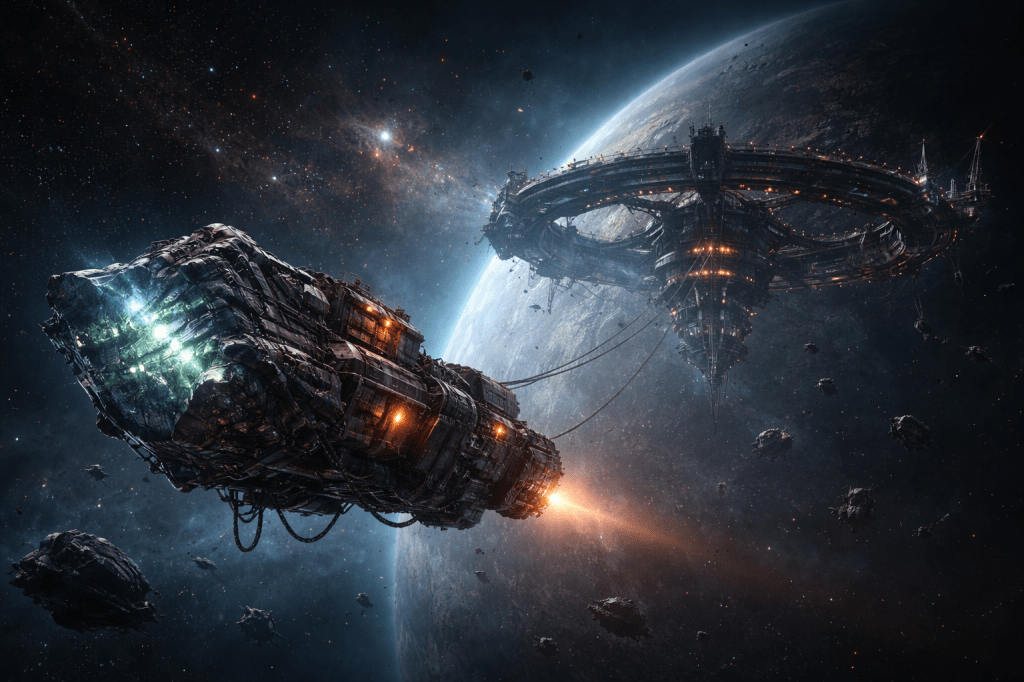
The salvage vessel Kestrel Drift emerged slowly from the outer debris field, with engines glowing a faint amber against the darkness. Its heavy hull moved with the deliberate patience of a ship that had travelled far beyond the mapped traffic lanes surrounding Kestren-4. Far ahead, the vast ring of Ashfall Station turned in silent orbit above the pale curve of the exhausted mining world. Its long industrial spines caught thin starlight while docking lights burned like distant embers along the station’s outer arms. Around the vessel, fragments of abandoned machinery and forgotten satellites drifted through the wide expanse of the system’s outer graveyard. These were remnants of earlier decades when cargo fleets and refinery platforms filled this region with activity that had long since faded into quiet isolation. The deeper edges of the debris field stretched outward into a quieter region of orbit, where salvage crews occasionally ventured in search of forgotten structures whose value lay hidden beneath years of drifting metal and silence.
Captain Elia Marr stood beside the forward observation console while the ship’s navigation system guided their slow return trajectory toward the station’s approach corridor. Her attention remained fixed upon the massive structure secured within the vessel’s external tow frame. The object followed the salvage ship through space with unsettling stillness, its surface reflecting faint bands of light across plates of metal whose design resembled no vessel recorded within the station registry. Salvage crews recovered thousands of fragments across the debris perimeter each year, pieces of forgotten cargo carriers or broken relay towers scattered across the long history of frontier industry. This fragment carried a different presence entirely. It was an immense cylinder of dark alloy whose structure appeared older than the wreckage surrounding it, its edges carved with patterns that drifted across the surface like weathered markings left behind by an unknown engineering language.
The discovery had occurred several hours earlier during a routine sweep along the fading edge of the debris perimeter, where the density of wreckage fell away into the darker reaches of the system’s outer orbit. The Kestrel Drift had traced its scanning pattern through a cloud of drifting relay antennae and shattered docking pylons when the object appeared upon the ship’s long-range sensors. Its dense mass stood out among the scattered fragments of abandoned industry. At first Marr assumed the reading belonged to the broken core of a transport module whose hull plating had collapsed long ago. When the ship closed the distance, the fragment revealed itself as something far stranger. It was an intact structure rotating slowly through open space, as though it had arrived from somewhere far beyond the ordinary boundaries of the debris field.
Inside the cockpit, the ship’s systems hummed steadily while Kestrel Drift advanced toward Ashfall Station, with its unusual cargo trailing silently behind. Marr allowed her gaze to follow the faint glow emanating from narrow seams running along the fragment’s exterior. Those lights pulsed at irregular intervals, subtle shifts of colour moving through the object’s surface in a pattern that resisted simple explanation. Salvage crews possessed equipment capable of identifying most known alloys circulating through the frontier systems. Yet every scan performed during the recovery process returned incomplete results, as if the fragment belonged to a category of construction that station registries had never recorded.
“Captain,” the navigation officer said quietly from the secondary console while the sensor displays flickered across his station. “Dock control is requesting cargo classification for the tow frame. They want confirmation before opening Docking Arm Twelve.”
Marr continued watching the fragment drift behind the ship, its dark surface turning slowly through the thin light of distant stars while Ashfall Station grew larger across the forward viewport.
“Transmit standard salvage clearance,” she replied after a moment of consideration. “Independent recovery operation. Unknown industrial fragment recovered beyond the debris perimeter.”
The navigation officer hesitated while entering the classification codes into the communication console. “That description leaves plenty of room for interpretation.”
“Ashfall specialises in interpretation,” Marr said calmly. “Let the station decide what it believes that thing might be.”
Ashfall Station continued its slow rotation ahead while the salvage vessel threaded its course toward Docking Arm Twelve, the station’s long industrial corridor reserved for freight traffic and independent recovery crews returning from the distant wreckage zones. The immense structure filled the viewport with growing detail as the ship advanced through the traffic corridor. It revealed layers of docking arms, maintenance gantries, and habitation sectors that had accumulated across decades of frontier construction. Amber guidance lights flickered along the docking arm while cargo tugs drifted between the outer platforms, guiding freight containers toward interior transit lifts. Life inside the station carried on with the steady rhythm of a place that had endured long enough to become part of the frontier itself.
Docking control acknowledged the vessel’s approach with routine clearance codes, unaware that the salvage ship carried something far older than the frontier installations scattered across the system. Within a few hours, the fragment would pass quietly through the station’s cargo registry and vanish behind sealed research doors deep within Ashfall’s inner decks. It would leave only the faintest trace within the official records of a salvage run that had recovered an object whose origins lay far beyond the station’s forgotten debris fields.
Station Record: Docking Arm Twelve
Station cargo archives record that the independent salvage vessel Kestrel Drift entered the Ashfall traffic corridor during the early maintenance cycle of Sector Rotation 4481. It approached through the outer freight lane used by vessels returning from the distant debris fields surrounding the Kestren system. Docking guidance systems directed the ship toward Docking Arm Twelve, a freight corridor commonly assigned to recovery crews operating beyond the mapped salvage perimeter.
The vessel reported the retrieval of a large unidentified fragment recovered from deep orbit several hundred kilometres beyond the outer debris boundary. Salvage operations within that region occasionally return damaged infrastructure from abandoned industrial platforms or fragments of transport vessels lost during earlier decades of frontier expansion. Initial cargo declarations submitted by the crew of Kestrel Drift classified the object simply as an industrial structure of unknown origin.
Dock control authorised standard recovery clearance and assigned the vessel a temporary cargo transfer window within the station’s external freight platforms. Maintenance records indicate that the fragment remained secured within the vessel’s tow frame during docking. Its transfer required the use of a heavy cargo crane normally reserved for refinery modules and structural salvage recovered from the deeper sectors of the debris field.
Internal station documentation confirms that the object was moved into Ashfall’s cargo network shortly after the vessel completed its docking sequence. Transport logs show the fragment passing through several internal freight elevators before arriving in a sealed research hold located deep within the station’s interior industrial sectors.
Public cargo registry entries referencing the object remained visible within the station’s open records for only a short period. Access to the documentation was then restricted under research authority protocols. Subsequent references to the recovered fragment appear only within internal archive systems accessible to a limited number of station departments.
Within the wider operational records of Ashfall Station, the salvage run conducted by Kestrel Drift appears at first glance to have been routine. Yet later archive reviews would identify this docking record as the earliest documented reference to an object whose arrival quietly altered the future of the station itself.
About the Creator
The Future Chronicle is written and curated by Simon Phillips, a writer of science fiction and speculative storytelling who explores the quiet edges of human expansion, where ageing stations, distant worlds, and forgotten technologies continue their slow existence beyond the reach of the central worlds.
Many of the stories presented in these Chronicles exist within a wider fictional universe that follows the lives of investigators, engineers, and frontier workers living far from the comfort of the inner systems, where the machinery of civilisation continues to function long after its original purpose has begun to fade.
One such story unfolds aboard Ashfall Station, an ageing orbital installation whose corridors and industrial sectors form the setting for the science-fiction mystery novella Ashfall Station: The Dead Girl in Sector Twelve. What begins as a routine investigation gradually reveals that something hidden within the station’s structure may have been present for far longer than the official records suggest.
Readers who wish to explore the full investigation and its unfolding events can find the novella below.
Explore the book:
Ashfall Station: The Dead Girl in Sector Twelve
You can watch his YouTube channel here:
Author Simon Phillips
Continuing the Chronicle
The following Chronicle reconstructs the arrival of the salvage vessel Kestrel Drift at Ashfall Station and the quiet transfer of the unidentified fragment recovered from deep orbit beyond the system’s outer debris field.
Station records describe the event as routine salvage processing. Later archival reviews suggest that the object brought aboard the station that day would become the earliest trace of changes whose significance remained unrecognised for many years.
Readers supporting The Future Chronicle can continue the record below.
The Transfer into the Inner Holds
Docking Arm Twelve extended from the outer industrial ring of Ashfall Station like a long skeletal bridge reaching into the quiet of orbit. Its massive framework was illuminated by rows of amber maintenance lights that cast slow reflections across the drifting freight platforms surrounding the arm’s entrance. Cargo tugs moved through the corridor with the unhurried rhythm of a place accustomed to the steady labour of frontier industry, guiding containers toward loading gantries while station workers in magnetised suits drifted between hull surfaces and scaffold rails that had accumulated across decades of repairs and expansion. Within this immense structure, the arrival of an independent salvage vessel rarely drew more than passing interest. Ashfall’s outer docks received a constant flow of battered transports, survey craft, and recovery ships returning from the wide fields of abandoned machinery that circled the system beyond the mining world below.
The salvage vessel Kestrel Drift entered the docking corridor under guidance thrusters that glowed softly against the dark metal of the arm’s interior walls. Its tow frame carried the recovered fragment with slow and deliberate motion while the station’s automated traffic beacons adjusted the vessel’s path toward the heavy freight platform positioned halfway along the arm. From the observation gallery above the docking grid, a small group of station engineers watched the approach through thick viewing panels whose surfaces bore the faint scratches of earlier decades, when Ashfall still received traffic from the central trade lanes. Among them stood Cargo Supervisor Dalen Rhyse, whose responsibility for coordinating heavy salvage transfers had accustomed him to the strange assortment of objects occasionally dragged in from the deeper reaches of the debris field.
Even from the gallery, the fragment attached to the salvage ship appeared unusual. Salvage debris recovered from the system’s outer perimeter often carried the battered shapes of broken transports or collapsed refinery structures whose origins could be traced through registry numbers etched into their hull plating. The object following the Kestrel Drift revealed no such markings. Its surface displayed broad plates of dark alloy whose faint seams emitted a dull internal glow. The light shifted across the metal with a quiet persistence that unsettled several of the engineers observing the approach.
“That piece came from the outer perimeter?” one of the younger technicians asked while leaning toward the viewing glass.
Rhyse studied the fragment with the patient attention of someone accustomed to measuring unfamiliar salvage against the long catalogue of industrial wreckage that had passed through the station during his years of service.
“According to the docking request,” he replied, his voice carrying the steady calm of routine authority. “Recovered beyond the debris boundary during a deep sweep.”
The technician continued watching the fragment rotate behind the salvage vessel as its strange surface reflected the station lights drifting across Docking Arm Twelve.
“That alloy carries a strange sheen,” he said quietly.
Rhyse allowed a faint smile to cross his expression while the salvage ship completed its slow alignment with the freight platform below.
“Everything looks strange when it drifts in from the graveyard long enough,” he answered. “Give the registry office a few hours and someone will decide which forgotten construction yard left it behind.”
Below the gallery, the heavy clamps of the freight platform locked around the salvage ship’s hull while docking cranes unfolded from their storage housings along the arm’s structural beams. The cranes moved with deliberate strength, extending long articulated arms toward the fragment secured within the vessel’s tow frame while the cargo crew guided the machinery through precise adjustments transmitted from the platform’s control station. Ashfall’s salvage infrastructure had grown formidable across the decades, designed to recover entire refinery segments from the drifting wreckage fields that surrounded the system. Even so, the recovered fragment demanded careful handling. Its dense mass forced the crane operators to adjust the lifting sequence through several cautious increments before the object finally rose free of the salvage ship’s frame.
For a brief moment, the fragment hung suspended within the wide chamber of Docking Arm Twelve. Its strange alloy surface reflected the amber lights that stretched along the arm’s immense corridor. Several workers below paused in their tasks to watch the slow movement of the cargo as the cranes guided it toward the freight platform’s interior rail system.
“Registry classification pending,” one of the control operators announced through the platform intercom while scanning the incomplete data arriving from the salvage crew’s recovery logs. “Temporary designation assigned under unidentified industrial structure.”
The words echoed across the control station with the calm authority of routine cargo processing. No one within the docking arm suspected that the object drifting slowly through the rail corridor carried origins far removed from the abandoned machinery of the debris fields.
The fragment settled onto the transport carriage with a low vibration that travelled through the platform’s framework while the crane arms withdrew into their resting positions. Once secured, the carriage engaged the internal freight rails that connected Docking Arm Twelve with the deeper cargo elevators buried within Ashfall’s industrial sectors. The movement began with a slow metallic shudder as the transport system drew the fragment away from the docking grid and into the long tunnel leading toward the station’s interior.
Rhyse remained beside the observation gallery window while the carriage disappeared into the dim freight corridor beyond the platform.
“Research hold transfer request,” the control operator said after reviewing the cargo routing instructions arriving through the station network. “Authorisation received from the inner systems office.”
One of the engineers raised an eyebrow while glancing toward Rhyse.
“Research division moves quickly,” he remarked.
Rhyse folded his arms across the railing while watching the fading lights of the freight carriage retreat deeper into the station.
“Anything without a clear registry attracts their curiosity,” he replied. “Give them a few days and the piece will return to storage with a catalogue number attached.”
Beyond the walls of Docking Arm Twelve, the transport carriage travelled steadily through the vast mechanical arteries that connected Ashfall’s outer docks with the station’s inner industrial decks. Freight tunnels stretched through layers of steel corridors and maintenance shafts where automated lifts guided cargo between sectors that had grown labyrinthine through years of incremental construction. Few workers travelled these interior routes unless assigned to maintenance duties. The passageways remained silent except for the distant hum of power conduits and the rhythmic movement of the freight system carrying materials across the station’s immense structure.
Within one such tunnel, the carriage bearing the recovered fragment slowed as it approached a sealed bulkhead whose heavy doors protected a research hold rarely accessed by the ordinary cargo network. Security lights along the corridor flickered to life while the carriage halted before the bulkhead’s sensor array. Moments later, the doors parted with a deep mechanical resonance that echoed across the empty passage.
Inside the chamber, the lighting remained dim. It revealed rows of reinforced containment frames designed to secure experimental machinery awaiting analysis by Ashfall’s internal research staff. The carriage advanced through the open bulkhead until the fragment reached the centre of the hold, where automated clamps secured the object within a circular support ring built to stabilise unusually heavy cargo.
As the freight system disengaged and withdrew toward the corridor outside, the bulkhead doors closed once more with the slow finality of a sealed archive chamber returning to silence.
Within the quiet of the research hold, the fragment rested beneath the faint glow of overhead inspection lamps whose pale light revealed subtle patterns etched across the alloy plates forming its surface. The seams running through the object continued their quiet pulsation. Faint shifts of colour moved through the metal like distant signals travelling across the skin of a machine whose purpose remained unrecorded within Ashfall’s official systems.
Elsewhere across the station, the arrival of the salvage ship passed into the long stream of routine events that filled the operational records of frontier installations. Cargo transfers continued across the docks, refinery shipments departed for distant trade routes, and the workers of Ashfall Station carried on with their ordinary lives beneath the rotating structure that circled the silent world of Kestren-4.
Deep within the sealed research chamber, the fragment remained alone within its containment frame. It waited quietly within the station’s vast interior while the earliest movements of a much larger story began to unfold beyond the reach of the records that first attempted to describe its arrival.
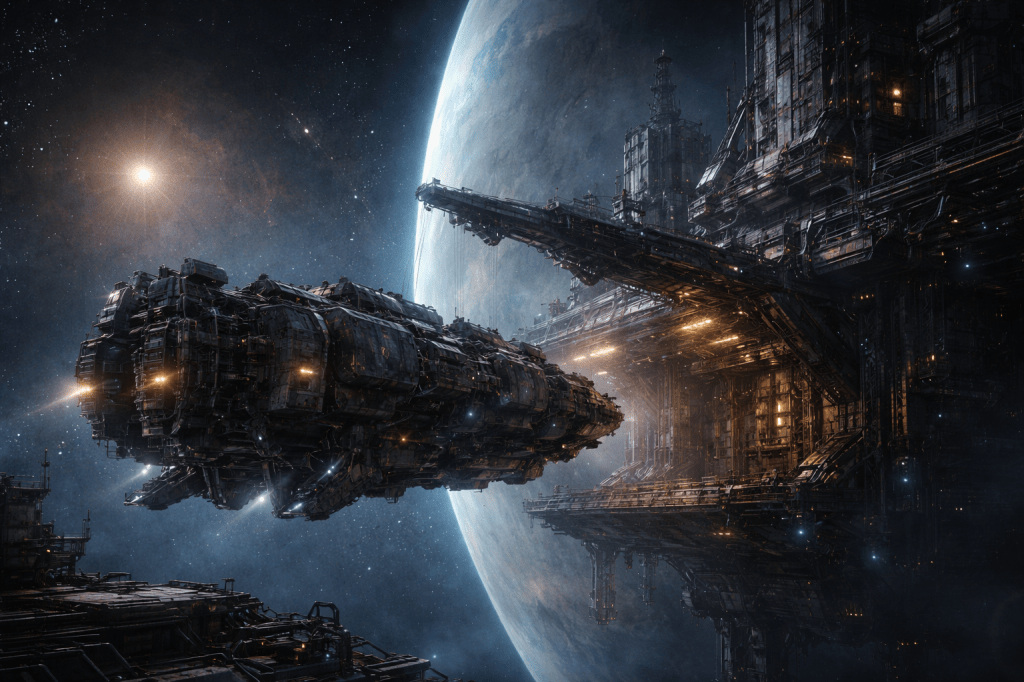
The salvage vessel Kestrel Drift approaches Docking Arm Twelve at Ashfall Station, carrying a fragment recovered from deep orbit beyond the system’s outer debris field.
The Idea Behind the Chronicle
Many of the earliest events that shape larger stories begin in moments that appear routine to those who witness them. Frontier stations such as Ashfall receive a constant flow of vessels returning from survey missions, mining expeditions, and salvage runs carried out in the distant debris fields surrounding exhausted industrial worlds. Most of these arrivals pass through the station’s docks with little attention beyond the ordinary procedures of cargo registration and freight transfer.
Salvage crews play a particularly important role within these frontier economies. Operating far beyond the established navigation corridors, their ships recover abandoned machinery, broken transports, and fragments of industrial infrastructure drifting through the quiet regions of orbit where earlier generations of expansion once left their mark. The work is dangerous and frequently uneventful, since the majority of recovered structures prove to be little more than forgotten wreckage left behind by earlier waves of settlement.
The idea behind this Chronicle explores what might happen when one such routine recovery operation returns with something that does not belong to the familiar catalogue of frontier industry. Within the vast mechanical systems of a station like Ashfall, an unusual object can pass quietly through the normal procedures of docking, registration, and research analysis without anyone immediately recognising its true significance.
In historical records, moments like these often appear ordinary when viewed in isolation. Only years later do investigators recognise that the arrival of a single cargo shipment or the discovery of an unidentified fragment marked the beginning of events whose consequences would slowly reshape the future of the station itself.
This Chronicle revisits one such moment in Ashfall’s past, when a salvage vessel returned from deep orbit carrying an object that would soon disappear into the station’s sealed research holds.
From the Author’s Desk
The Chronicle you have just read returns to one of the quieter moments in Ashfall Station’s early history, when a routine salvage operation carried something unusual back from the distant debris fields surrounding the Kestren system. Events like this rarely attract attention when they first occur. A cargo transfer is completed, the object is catalogued, and the station continues its work. Only later do historians begin to notice that certain small records mark the beginning of much larger stories.
Ashfall Station began as a simple image that lingered in my imagination for several years: the idea of an immense industrial structure drifting at the far edge of human space long after the frontier that created it had moved on. Science fiction often grows most naturally from such quiet beginnings, where a single place or moment suggests a much larger history waiting somewhere beyond the visible story.
The Chronicles presented here explore the earlier life of that station, revealing fragments of its past through the people who lived and worked within its corridors. Each episode focuses on a single event or encounter, gradually uncovering how Ashfall evolved from an ordinary frontier installation into a place carrying deeper layers of history hidden within its structure.
The novella Ashfall Station: The Dead Girl in Sector Twelve takes place much later in that timeline, when the station has already accumulated decades of expansion, modification, and quiet mystery. Writing the Chronicle series offers the opportunity to step backwards into that earlier period and observe the smaller moments that shaped the station long before the events of that investigation began.
Alongside these Chronicles I continue writing fiction across several science fiction and speculative projects, many of which explore frontier environments where technology, distance, and human persistence intersect in unexpected ways.
Readers interested in those stories can explore more through the links below.
You can explore my books here::
Books by Simon Phillips
You can watch my YouTube channel here:
Author Simon Phillips
Technical Notes & Frontier Context
Deep Orbit Salvage
Salvage work in frontier systems often extends far beyond the formal navigation corridors used by freight vessels and survey ships. Over time the outer regions of industrial star systems accumulate large fields of abandoned machinery, ranging from broken relay platforms and transport hulls to fragments of mining infrastructure left behind during earlier phases of expansion.
These regions become natural targets for independent recovery crews willing to operate at considerable distance from established ports. Equipped with long-range scanners and heavy tow frames, salvage vessels travel through the quieter edges of orbital space searching for structures whose remaining materials retain economic value. Many discoveries prove mundane, consisting of collapsed hull sections or obsolete machinery drifting through vacuum after decades of neglect.
Occasionally, however, salvage crews encounter objects whose origins remain unclear even after initial scans. In such cases the safest course of action is to transport the structure intact to the nearest frontier station, where specialised equipment and research staff can examine the material under controlled conditions.
Cargo Transfer Systems
Large orbital installations require extensive freight-handling infrastructure capable of moving cargo between external docking arms and the deeper sectors of the station. Heavy salvage items recovered from deep orbit frequently exceed the mass limits of standard loading systems, requiring reinforced cranes, magnetic clamps, and rail-mounted transport platforms designed to guide unusually large structures through the station’s internal freight corridors.
These transport networks function as the industrial arteries of the installation, linking the exposed docking arms with cargo elevators, storage vaults, and research facilities hidden within the station’s interior layers. Much of this machinery operates far from the public habitation districts, occupying maintenance tunnels and structural compartments whose existence remains invisible to most residents.
For stations that serve as salvage hubs, such systems become particularly important. Entire modules of abandoned spacecraft or refinery equipment may pass through these internal corridors on their way to storage or dismantling facilities.
Research Containment
When unidentified technology arrives at a frontier station, the object is normally transferred to a controlled research environment before any attempt is made to dismantle or catalogue its components. These research holds are typically located deep within the station’s interior where structural reinforcement and environmental isolation reduce the risk of accidental damage to surrounding systems.
Containment frameworks inside these chambers allow technicians to stabilise large objects while scanning equipment analyses structural composition and internal energy signatures. The majority of unidentified fragments eventually prove to be rare alloys or unfamiliar industrial designs originating from distant manufacturing centres.
Even so, the precaution of isolating such discoveries reflects a practical understanding common among frontier engineers: objects recovered from deep orbit sometimes carry histories that extend far beyond the debris fields where they are found.
Salvage Stations as Frontier Archives
Over long periods of operation, salvage ports such as Ashfall accumulate a vast and often incomplete archive of technological history. Each recovered fragment represents a small surviving trace of earlier exploration, industrial experimentation, or abandoned infrastructure scattered throughout human space.
Most of these objects eventually disappear into recycling facilities where their materials are reused for new construction. Yet some pieces remain stored within research holds or forgotten storage sectors, preserved simply because no one ever finished the process of analysing them.
In this way a frontier station gradually becomes a layered record of the expansion that created it, carrying within its structure the silent remains of many different eras of human activity.
Next Chronicle
Several hours after the salvage vessel Kestrel Drift completed its docking sequence, the fragment recovered from deep orbit briefly appeared within Ashfall Station’s cargo registry system under a temporary industrial classification.
The entry remained visible for only a short period before access to the record was quietly restricted, leaving behind a small gap in the station’s otherwise meticulous administrative archives.
The next Chronicle returns to that moment inside Ashfall’s cargo offices, where routine registration procedures would produce one of the earliest documented traces of the object whose arrival had already begun to alter the station’s future.
Next Week: The Cargo Registry
Ashfall Station continued its slow orbit above the silent world of Kestren-4, while deep within its inner research holds an unidentified fragment from the distant debris fields rested quietly inside a structure whose long history had only just begun to record its arrival.