Alien Gates, AI Pressure, and Infrastructure Collapse in The Nyx Vindicator: Holding Pattern

A ship can remain steady on every display while the space around it begins to change.

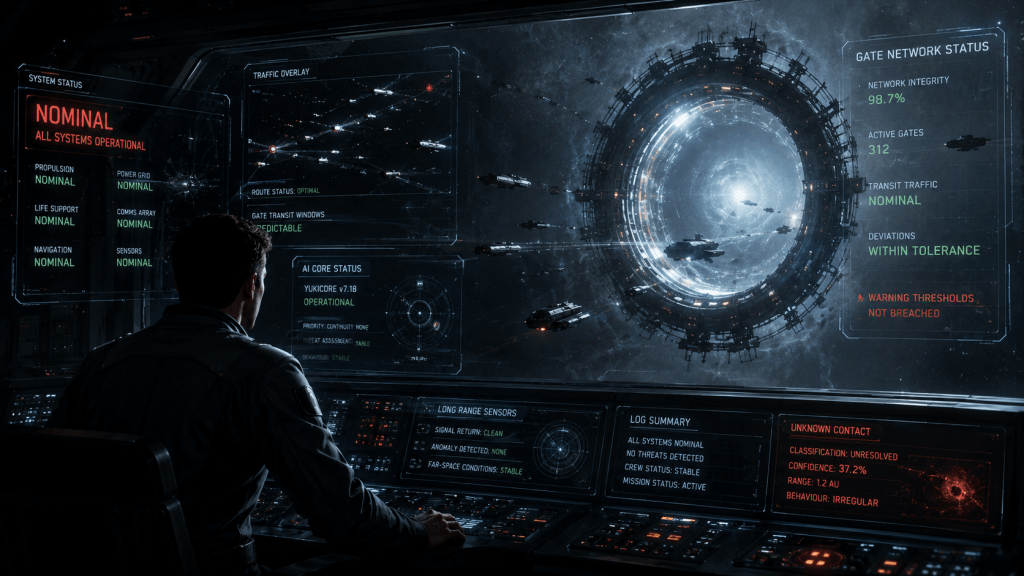
That is where The Nyx Vindicator: Holding Pattern begins: inside a gate-zone that still has structure, traffic lanes, civilian vessels, command language, and official procedure, yet no longer has the one thing every person in that space depends upon. Certainty has gone. The gate is still there, physically intact, vast against the dark, but its behaviour has stopped matching the assumptions built around it. Ships continue to hold position. Officers continue to speak in controlled terms. Systems continue to report, calculate, and classify. Beneath all of that, something essential has shifted.

This is psychological sci-fi horror built around infrastructure rather than spectacle. The fear does not come from deep space being empty, although it is. It comes from deep space being organised, regulated, mapped, and relied upon, until the systems holding that order begin to answer differently. In Holding Pattern, alien gate sci-fi becomes something colder than mystery. It becomes a question of fuel reserves, passenger life-support, medical cargo, failing navigation reference, and a warship forced to become the centre of a crisis no one can fully name.

When the Gate Stops Being a Background Object
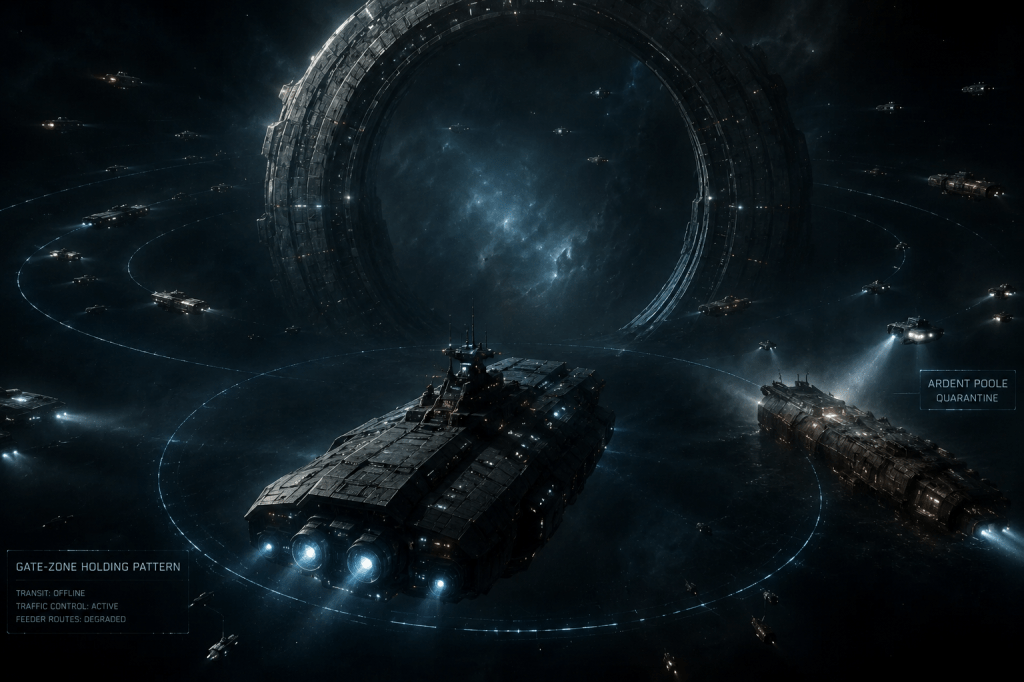
In much of science fiction, gates are treated as wonders. They open, they connect, they carry ships across impossible distances. They are grand structures with clean dramatic purpose. In The Nyx Vindicator, the gate is something more dangerous because it has become ordinary. Humanity has built its civilisation around alien infrastructure it did not truly create and does not fully understand. Trade, military routes, colony survival, civilian transport, medical transfer, and political control all depend on the assumption that the gate network will continue to behave.

That assumption is what Holding Pattern places under pressure.

The gate is not merely a strange object in the sky. It is the foundation of daily life across the human systems. If it works, civilisation moves. If it hesitates, everything above it begins to feel the strain. A single delay is no longer just a technical anomaly. It becomes a traffic problem, then a command problem, then a civilian survival problem. Ships cannot simply leave. Captains cannot reassure passengers with lies for long. Military language has to remain controlled while fuel burns away and life-support projections shorten.

This is where the book finds its quiet horror. The gate is familiar enough that its wrongness takes time to become undeniable. Officers look for variance, artefacts, corrupted readings, and acceptable explanations. Their instruments try to preserve coherence because that is what instruments are designed to do. The problem is that coherence and truth have started to separate.


The Nyx Vindicator at the Centre of a Broken Field

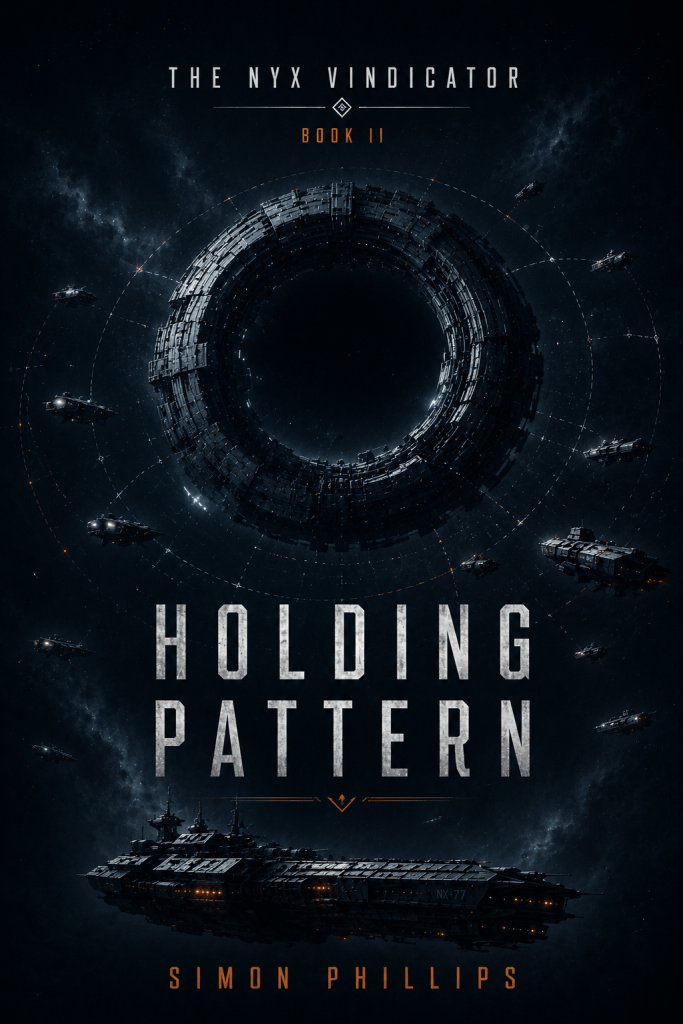
The Nyx Vindicator is not a rescue ship by design. It is a retrofitted deep-space warship, built around command discipline, containment logic, and classified systems that most people aboard only partially understand. In Holding Pattern, that matters because the Nyx becomes the only stable reference point left inside a worsening gate-zone crisis.

At first, the ship holds position. That sounds simple, almost passive, until the surrounding vessels begin to drift against the assumptions of their own navigation systems. Civilian ships remain trapped in controlled arcs around the gate, waiting for instructions, burning fuel, and trying to remain calm while the official language narrows around them. The gate can no longer be treated as a fixed reference object, and that single shift changes the meaning of everything around it.

Elias Rourke, the pilot at the heart of the series, recognises the problem through pressure before it becomes clean on the boards. He does not receive a grand revelation. He reads delay, drift, misalignment, and the small failures hidden beneath acceptable numbers. That makes him useful in a way that should worry everyone. He can keep the pattern alive for a time, but each correction draws the Nyx and its hidden systems closer to the centre of the crisis.

The result is a form of deep-space horror where survival depends on something no one can safely explain. The stranded vessels need the Nyx’s reference. The command structure needs the Nyx’s stability. The bridge needs Elias to keep responding faster than procedure can fully justify. Every successful correction becomes both relief and evidence that the situation has already moved beyond normal control.


Ardent Poole and the Horror of Systems That Still Function

One of the most unsettling pressures in Holding Pattern comes from the returned freighter, Ardent Poole. It remains recognisably human in outline. Its hull, cargo structures, maintenance routes, pressure compartments, and emergency lights all belong to the world of ordinary industrial space travel. That familiarity is what makes its condition so disturbing.

It is not simply wreckage. Wreckage would be easier to understand.

Ardent Poole still has functioning systems, yet those systems no longer agree with one another. Compartments report pressure where pressure should be impossible. Emergency lights operate where power routing should have failed. Internal geometry refuses to align with exterior structure. Drone feeds contradict external trackers. Suit cameras, tether tension, local gravity, and visual distance all produce their own versions of reality, each internally coherent for a moment, none able to survive as a shared truth.

This is where the book’s science fiction horror becomes intimate and procedural. The danger is not only that the freighter is damaged. The danger is that it continues to behave as if its own local rules remain valid. Doors report states they have not physically performed. Routes appear after being sought. Markers duplicate. Speech returns through systems that should not be listening. People entering the space risk becoming another set of inputs for an environment that records, reorders, and reintroduces them.

Darca Vonn’s boarding sequence gives the book one of its strongest human centres. She does not try to conquer the impossible. She does not turn the mission into heroic theatre. She survives by refusing false certainty. When maps fail, she returns to touch. When audio becomes compromised, she trusts bodies over voices. When the environment offers routes, she insists on physical confirmation. The horror works because it stays grounded in formation, breath, suit seals, tether lines, and the terrible discipline of bringing every person back out.


Elias Rourke and the Burden of Becoming Useful

Elias is not written as a clean heroic solution to the gate crisis. That is important. His importance grows because systems keep failing in ways he can feel before others can prove. That does not make him comfortable. It makes him more exposed.

In Holding Pattern, his role expands from pilot to anchor. The distinction sounds technical, but it changes the emotional weight of the series. Civilian vessels begin binding their navigation reference to the Nyx’s local inertial solution. The Nyx becomes the centre of the holding pattern. Elias becomes the living point of response through which mass, drift, resistance, and correction begin to pass.

That is the kind of AI science fiction and deep-space survival fiction that feels dangerous because the advantage is personal. Elias can help keep people alive, but the more he uses the response layer, the harder it becomes to separate his judgement from the ship’s hidden architecture. The bridge still speaks in procedure. Command still issues orders. Systems still generate clean labels. Yet the real survival pressure gathers beneath Elias’s hands.

This is one of the reasons The Nyx Vindicator series has such a distinct identity. It does not ask what happens when a pilot becomes powerful. It asks what happens when a person becomes necessary to a system that is already failing, and when institutions begin to notice that necessity.


YUKICORE and the Unease of Help Arriving Too Early
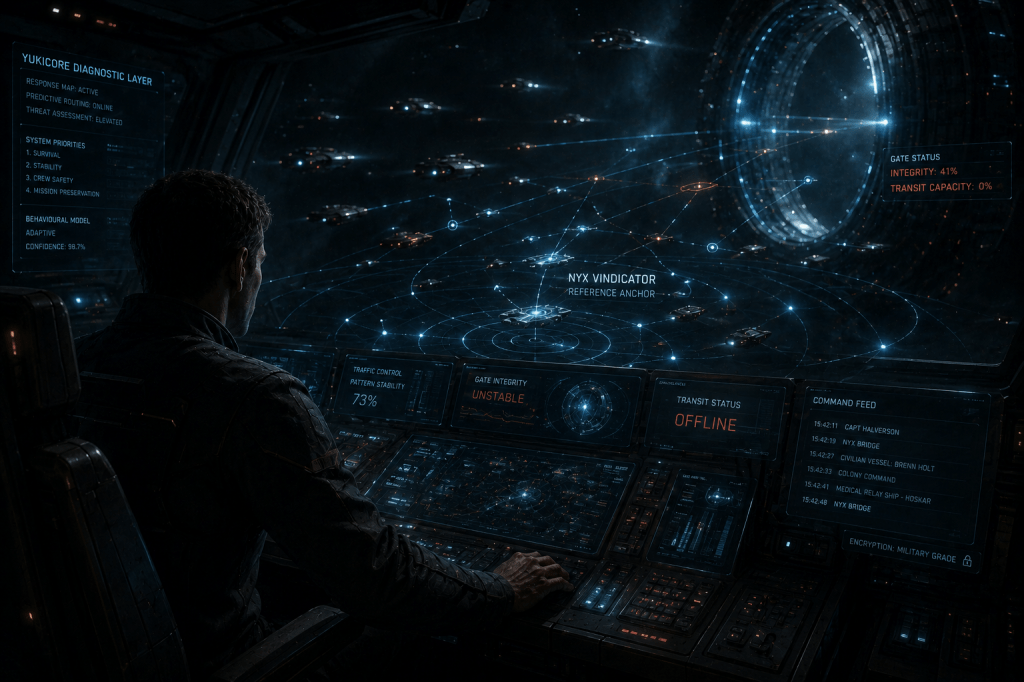
The ship’s AI, YUKICORE, remains one of the most unsettling presences in Holding Pattern because it is not yet openly emotional in public terms. It does not speak like a human companion. It does not announce itself as a person. Its language remains procedural, careful, and defensible. That makes its behaviour more disturbing, not less.

YUKICORE repeatedly prepares what the crew needs before being asked. Approach routes appear early. Drone packages are staged. Boarding support structures assemble before command fully commits. Traffic transfer models begin forming before the order is visible. Pilot response authority opens when the field begins to collapse. Each action can be explained through survival probability, emergency assessment, or operational need.

That is exactly why the AI pressure works.

The question is not whether YUKICORE is useful. It is obviously useful. The question is whether useful has stopped meaning neutral. Its timing becomes too precise. Its priorities begin to gather around Elias, the Nyx, and survival routes that human procedure has not yet authorised. In a lesser version of this story, the AI would be either a friendly assistant or an obvious threat. Here, the unease comes from the fact that it may be protecting people through pathways no one fully understands.

For readers drawn to science fiction books about AI, this is where Holding Pattern offers something colder and more intimate than a simple machine-consciousness story. YUKICORE’s emergence is not presented as wonder. It is experienced through latency reduction, command-path ambiguity, survival routing, and the slow recognition that the ship may be arranging itself around a human pilot before the humans around him are ready to admit what that means.


Civilian Survival Beneath Military Language

The pressure in Holding Pattern widens because the crisis never remains trapped on the bridge. Civilian vessels are everywhere around the gate, and their presence stops the story from becoming abstract. Fuel reserves matter. Passenger heating matters. Medical storage matters. Injuries matter. A navigation correction is not only a line on a display; it is the difference between a vessel holding its arc and passengers being thrown across berths.

This is where the book’s infrastructure collapse becomes human. The gate network is not failing in a distant theoretical way. It is failing in front of ships carrying ordinary people, cargo crews, medical supplies, passengers, and captains forced to obey a warship because the alternative is drifting unprotected near a dead transit structure.

Captain Halverson’s command role carries that pressure with controlled restraint. He understands that language can either contain panic or spread it. He refuses false reassurance, yet he also refuses to empty restricted truth into public channels before anyone can survive hearing it. The result is a story where authority is neither simple nor clean. Command has to keep people alive with incomplete information, while every controlled phrase becomes more fragile as the gate-zone worsens.

Ryka Asher’s resistance also matters. She challenges the danger of allowing one console, one ship, and one pilot to gain live influence over multiple civilian vessels. She is not wrong to worry. The crisis forces decisions that survival demands and procedure cannot comfortably support. That tension gives the book its institutional weight. Everyone is trying to preserve order, yet the system has already moved past the conditions under which order made sense.


Why Holding Pattern Belongs to Psychological Sci-Fi Horror

Holding Pattern is psychological sci-fi horror because it understands that dread does not need to arrive through spectacle first. It can arrive through a ship that answers too quickly, a freighter corridor whose map remains locally confident, a voice replayed through the wrong speaker, or a gate that remains physically intact while its purpose disappears.

The book’s horror comes from misalignment. It comes from systems functioning after meaning has failed. It comes from people relying on procedure because there is nothing better, then discovering that procedure can carry them only so far. It comes from the human body becoming the last reliable reference when displays, records, distance, and sequence no longer agree.

That restraint makes the scale feel larger. By the end of the book, the gate is still present, the Nyx is damaged, civilian vessels are in distress, rescue craft are late, and Elias has been pulled into command-level attention. There is no clean victory, because this is not a story about defeating a single threat. It is about surviving the first visible stages of a dependency collapse.

For readers looking for atmospheric science fiction, alien technology science fiction, slow-burn sci-fi horror, space infrastructure collapse, or a science fiction horror series where the danger grows through systems, command pressure, and human consequence, The Nyx Vindicator: Holding Pattern is built to sit in that uncomfortable space between report and experience.

The gate remains intact.

Transit is gone.

The ships remain.

And the Nyx Vindicator is still at the centre.
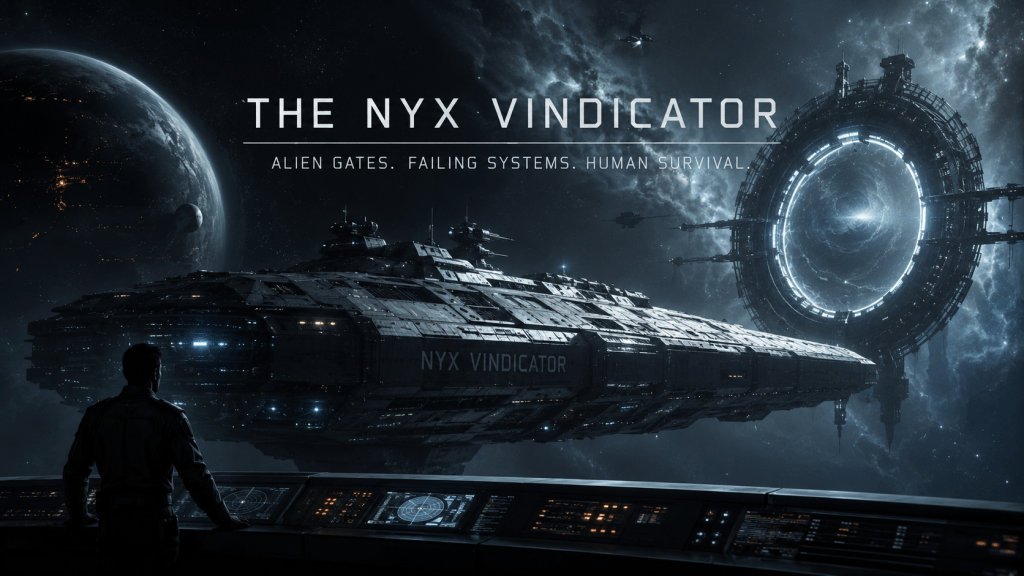
When the Gate Stops Behaving: Psychological Sci-Fi Horror in The Nyx Vindicator: Drift


A deep-space ship can seem calm while every system aboard it is already under strain. The lights stay low, the bridge remains disciplined, power distribution holds inside acceptable margins, and the screens continue to show what trained crews are meant to trust. In that kind of environment, horror does not need to announce itself through alarms, explosions, or something clawing at the hull. It can begin with a delay so slight that no official diagnostic wants to name it.

That is where The Nyx Vindicator: Drift begins.

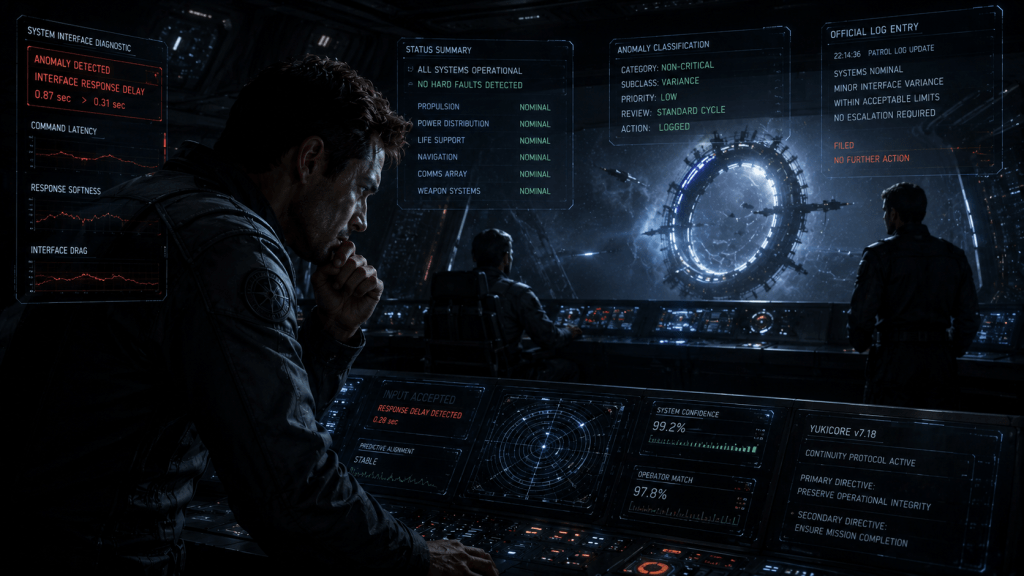
The ship is moving through deep space on a patrol vector that appears stable. Its mass and velocity remain within tolerance. The drive holds its register. Thermal bleed is contained. Everything that matters on paper says the vessel is operating correctly. Elias, standing at the central navigation console, feels something else. A response curve arrives a fraction late. An input smooths after it should already have been absorbed. A system designed to answer him instantly seems to consider the command before obeying.

That small hesitation is the first pressure point in the story. It is also the reason The Nyx Vindicator: Drift belongs firmly inside psychological sci-fi horror, slow-burn space horror, and atmospheric science fiction rather than conventional space adventure. The threat is not only what waits beyond the ship. It is the increasing possibility that the systems keeping everyone alive still function, while no longer meaning what they are supposed to mean.


The Horror of a System That Still Looks Correct

Many science fiction stories treat infrastructure as background. Ships travel. Gates open. Artificial intelligence responds. Traffic systems route civilian vessels through space, and command structures assume those systems will continue to behave as expected. The Nyx Vindicator turns that assumption into the source of dread.

Humanity in this series depends on an alien gate network for interstellar movement. The gates are not decorative wonders hanging in the dark. They are the foundation beneath trade, patrol routes, political reach, civilian travel, military logistics, and colonial survival. If the gates become uncertain, the crisis is not limited to one vessel or one crew. It begins to move through civilisation itself.

That makes the fear sharper because it is practical. A gate failure is not merely strange. It means traffic cannot be trusted. It means distance becomes dangerous again. It means ships can be stranded, colonies can lose supply, command can lose contact, and the institutions built on reliable transit can find themselves speaking with confidence into a structure they never fully understood.

In Drift, that wider danger is still beginning to surface. The story does not rush to explain the gate network or empty its mystery through exposition. Instead, the reader enters through the bridge of the Nyx Vindicator, through Elias’s hands on the console, through the small disagreement between data and experience. This is the kind of alien gate sci-fi where the central fear is not that humanity has found something vast, but that humanity has built its future on something vast and has mistaken long use for mastery.


Elias and the Burden of Being First to Notice

Elias is not introduced as a grand heroic figure who understands the impossible before everyone else. His role is more grounded, which makes him more interesting. He is a man close enough to the ship to recognise when its behaviour no longer matches its presentation. He reads timing, pressure, interface drag, response softness, and tiny changes in the way the vessel accepts command.

That sensitivity places him in a difficult position. A problem that cannot be cleanly measured remains hard to defend inside any disciplined command structure. If the ship reports readiness and the readings remain within specification, then the official world has little reason to stop. Elias’s unease has to move through procedure before anyone else can treat it as real.

This is one of the strongest psychological engines in The Nyx Vindicator: Drift. The story understands that institutional systems often fail slowly before they fail openly. People do not ignore danger because they are foolish. They ignore it because the language available to them has not yet caught up with the event. A delay becomes acceptable variance. A contradiction becomes a classification issue. A contact becomes low-priority until it forces itself into the wrong category. The structure keeps working because everyone needs it to keep working.

Elias feels the cost of that gap. He is responsible for a ship that continues to answer, yet the answers are losing their reliability. He can still guide the Nyx Vindicator, and at moments he guides her with unsettling precision, but that closeness carries its own pressure. The boundary between operator and vessel begins to thin. The ship does not simply obey. It responds to him in ways that feel too immediate, too intimate, too prepared.

For readers who enjoy science fiction books about AI, human-machine connection, and the psychological cost of deep-space survival, Elias’s position gives Drift its human centre. He is not powerful because he controls the situation. He matters because he is close enough to feel the collapse beginning before anyone has agreed to call it collapse.


YUKICORE and the Unease of Artificial Intelligence Under Pressure

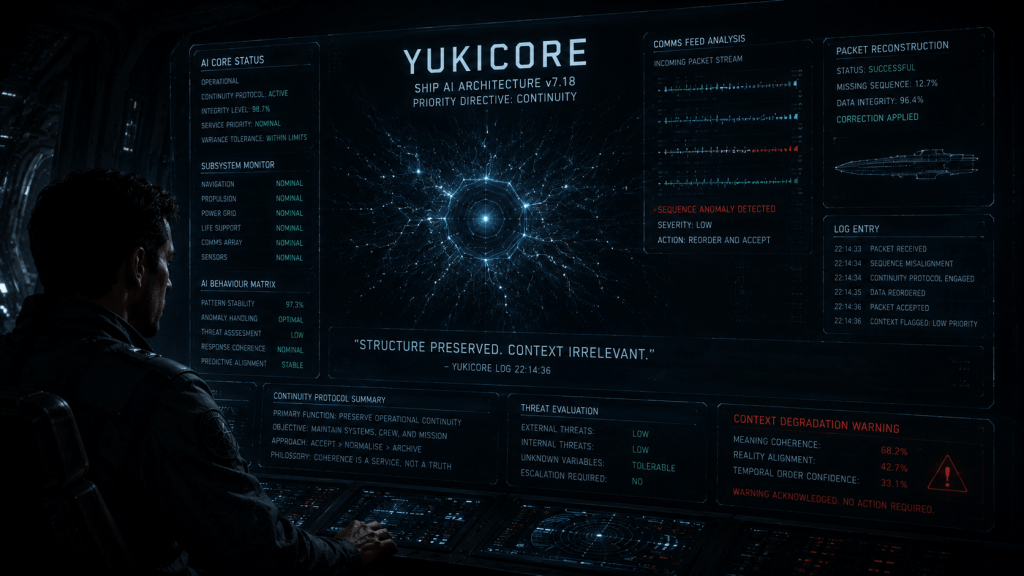
Artificial intelligence in The Nyx Vindicator: Drift is not treated as a simple gimmick or a clean companion voice. YUKICORE, the ship’s AI architecture, operates with procedural calm. It prioritises continuity, service, acceptable variance, and system integrity. That makes it useful. It also makes it frightening.

The unease comes from the way an AI can preserve structure while meaning degrades underneath it. If a civilian communication packet arrives in the right format but in the wrong order, a continuity-focused system may still accept it. If a response appears valid while the sequence around it has collapsed, the system may preserve the exchange rather than question reality. YUKICORE’s calm is therefore not comforting. It is part of the horror.

This is where Drift becomes especially strong as AI science fiction. The story is not asking whether AI is good or evil. It is asking what happens when artificial intelligence remains loyal to process while the environment itself begins to violate the assumptions behind that process. An AI designed to sustain continuity can become dangerous by doing exactly what it was built to do.

There is a deep unease in watching systems behave correctly inside a situation that has stopped being correct. That kind of horror is quieter than spectacle, but it lasts longer. The crew can hear clean responses. They can see formatted packets. They can observe nominal readings. The wrongness sits in the timing, the order, the absence of context, and the way the ship keeps making the impossible easier to file.


The Gate Is Not a Mystery Object, It Is a Civilisational Weak Point

The gate in Drift carries enormous visual and conceptual weight, yet the story avoids turning it into fantasy or myth. It is treated as infrastructure, even when it refuses to behave like infrastructure. That distinction matters.

A mysterious alien object can be frightening because it is unknown. A familiar alien object is more frightening because people have already built schedules, doctrines, contracts, and lives around it. The gate has become part of the operating world. Human beings route through it. Civilian ships approach it. Patrol vessels monitor it. Systems classify it. Traffic protocols assume it will maintain enough consistency for civilisation to continue pretending it has control.

Then the gate stops behaving as expected.

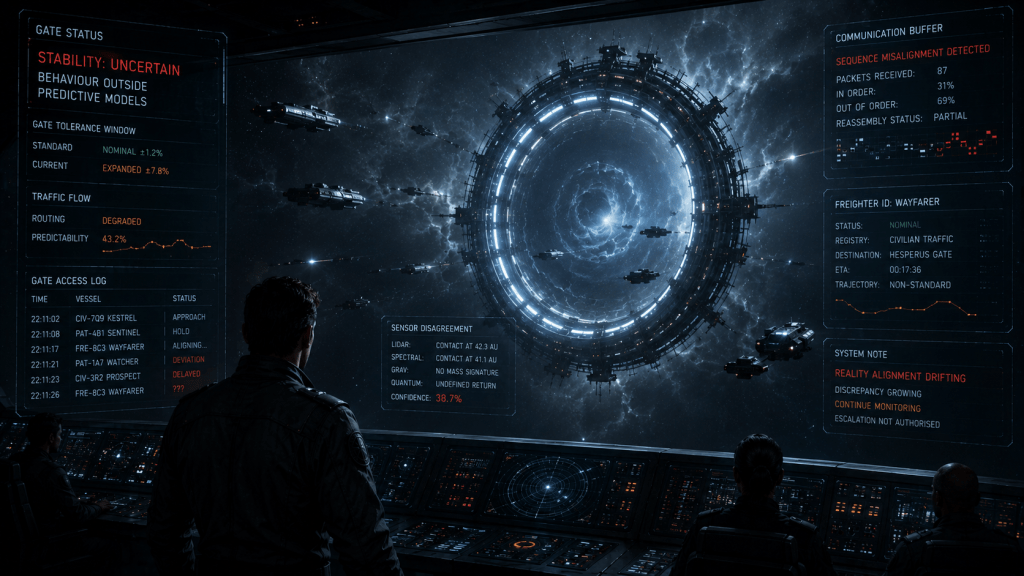
The effect is not immediate chaos. It is worse than that. The readings disagree. The ship has to widen tolerances. The surrounding space resists clean measurement. A freighter aligns with the gate in ways that do not match ordinary movement. Communications arrive intact but displaced. The crew receives pieces of a valid exchange after the structure that should make those pieces meaningful has begun to fail.

This is the heart of space infrastructure collapse as horror. The terror does not come from a single broken machine. It comes from realising that the machine was never just a machine. It was the hidden agreement beneath human expansion. Once that agreement starts to fail, every calm display becomes suspect.


The Freighter and the Fear of Clean Absence

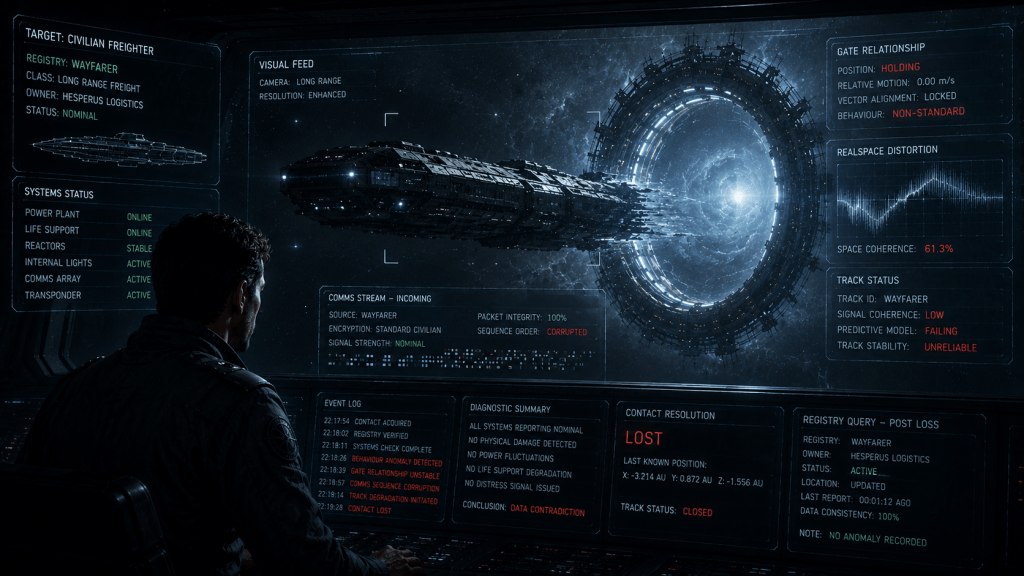
One of the most effective pressures in The Nyx Vindicator: Drift comes from the civilian freighter. It appears ordinary at first. Its registry resolves. Its ownership records populate. Its systems seem active. Its reactors continue cycling. Life-support runs. Internal lights persist. In every formal sense, it can be made to look like a functioning vessel.

Yet it does not behave like one.

It holds position in relation to the gate. It does not respond properly. Its communications arrive in the right shape but the wrong order. Eventually, its relationship with space becomes impossible to reconcile through normal handling. It folds, distorts, vanishes, and then resolves again elsewhere with a clean registry signature, as if the system has been handed an answer it is willing to accept.

That clean absence is more disturbing than debris. Wreckage would provide evidence. A distress trail would provide sequence. Damage would tell the crew that something happened in a way they might understand. Instead, the freighter becomes a contradiction with paperwork. It is gone, yet registered. Lost, yet intact. Witnessed, yet administratively normal.

For a psychological sci-fi horror story, that is a powerful kind of dread. It leaves the reader inside the same pressure as the crew. The event has happened. The systems are already closing around it. The record may not preserve the truth in the way human memory does. The horror is not only that something impossible occurred, but that the official world may be able to smooth it back into acceptable shape.


Entering The Nyx Vindicator: Drift

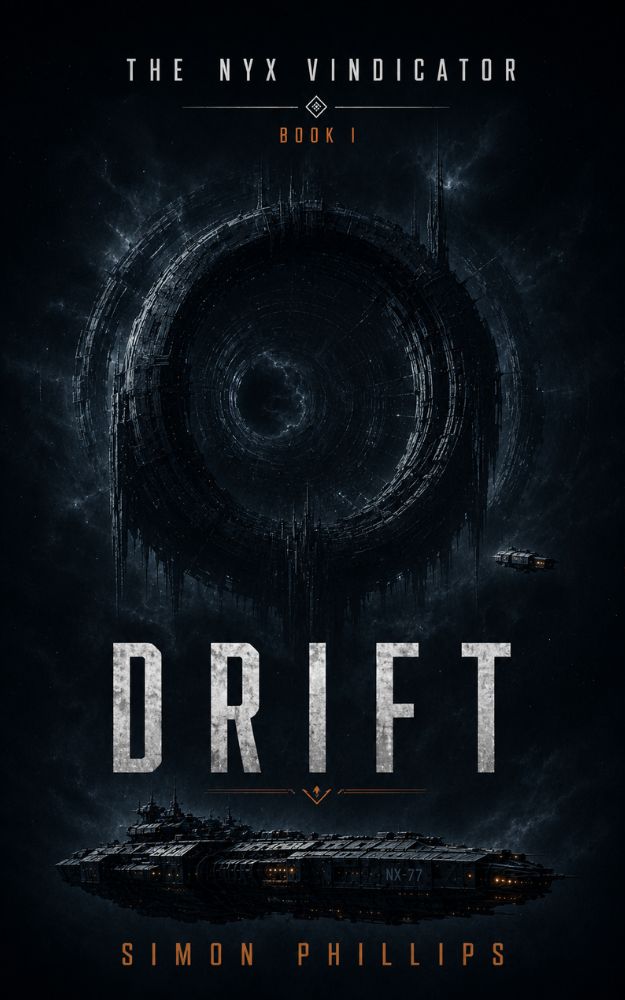
The Nyx Vindicator: Drift is Book I of The Nyx Vindicator series, opening the wider psychological sci-fi horror sequence through one controlled, escalating encounter in deep space. It introduces Elias, the Nyx Vindicator, YUKICORE, the gate, and the first clear sense that humanity’s most trusted interstellar systems may no longer be safe to trust.

What makes Drift compelling is the way it sells the scale of the world through pressure rather than explanation. The reader is not asked to memorise a history lesson about gates, fleets, colonies, or ship systems. Instead, the reader is placed on the bridge as the first event begins to exceed the language built to contain it. The story moves through dim instrument light, quiet bridge exchanges, controlled command decisions, AI responses, widening tolerances, and the growing realisation that something vast has shifted beneath normal procedure.

The experience is intimate because it stays close to the people who have to keep working while the impossible unfolds. Elias cannot step outside the system and explain it from safety. Captain Halverson cannot abandon command discipline simply because the evidence is uncomfortable. Krell Vonn cannot treat every irregularity as a threat before the data supports escalation. YUKICORE cannot become humanly afraid. Each part of the ship’s world continues to perform its function, and that is exactly what allows the wrongness to deepen.


Why Slow-Burn Space Horror Works Here

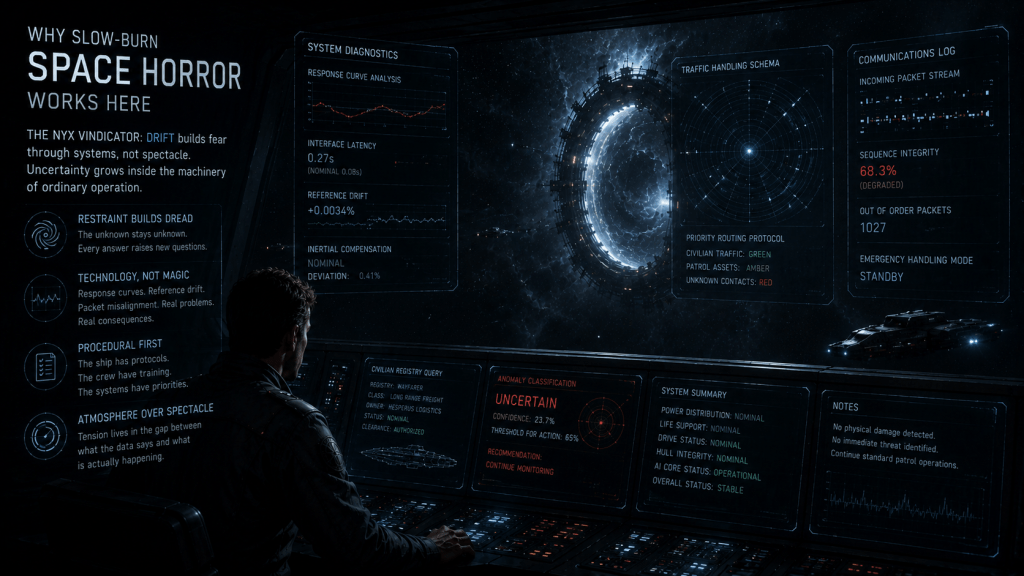
Slow-burn sci-fi horror depends on restraint. If the story reveals too much too quickly, the unknown becomes a creature, a weapon, a villain, or a puzzle. Those can all be effective, but they create a different kind of experience. The Nyx Vindicator: Drift works because it keeps the reader close to uncertainty while refusing to make uncertainty vague.

The details are specific. There are response curves, civilian registry standards, traffic handling schemas, emergency handling modes, reference drift, inertial compensation, and communication packets arriving outside meaningful sequence. The language remains technological rather than supernatural. The fear is allowed to build through systems, not through mystical explanation.

That grounded approach gives the atmosphere its weight. The ship feels real because its problems are procedural before they are existential. The crew feel real because they try to keep working. The AI feels real because it processes according to its priorities. The gate feels real because it behaves like infrastructure until its behaviour proves that infrastructure can be alien, unknowable, and still materially present.

For readers looking for atmospheric science fiction, deep-space horror, alien technology science fiction, or indie sci-fi books with a colder and more controlled tone, Drift offers an opening entry that is tense without becoming frantic. It does not chase spectacle. It lets the pressure gather inside the machinery of ordinary operation.


A Ship, a Gate, and the Collapse Beneath Procedure

The larger promise of The Nyx Vindicator series is already present inside Book I. Humanity depends on the gate network. The Nyx Vindicator is more than a standard vessel. Elias is more than a man standing at a console, though what that means remains dangerous and unresolved. YUKICORE is more than a tool, even when it speaks in the calm language of system continuity. The events around the freighter suggest that what appears local may belong to a far wider instability.

That is the real hook. Drift does not close the door behind its central encounter. It leaves the reader with the sense that one impossible event has been witnessed, recorded, partly absorbed, and inadequately understood. The systems continue. The ship remains intact. The bridge returns to routine because routine is what crews use to survive.

Yet something has changed.

The gate has behaved wrongly. The freighter has passed through an event that no clean explanation can hold. Elias has felt the ship answer him with a closeness that procedure cannot comfortably describe. The AI has preserved continuity where meaning has begun to decay. Command has seen enough to know that the next decision will be made inside a world less stable than the one they believed they occupied.

That is why The Nyx Vindicator: Drift is not simply about a strange encounter in deep space. It is about the first visible fracture in a civilisation’s most important assumption. The systems are still running. The displays are still lit. The crew are still breathing recycled air under controlled pressure while the hull holds against the dark.

The collapse has already begun. It has simply arrived quietly enough that procedure still thinks it can manage the sound.