Before a country admitted that war was approaching, its roads had already begun making room for it.
Military transporters moved through motorway junctions under police escort, while commercial vehicles waited for the barriers to lift. At ports, civilian freight remained stacked beneath working cranes as protected military movements took the earlier rail connections. Schools adjusted collection arrangements around disrupted traffic, and families encountered unfamiliar armed security at facilities they had previously passed without much thought.
Nothing had stopped functioning. Shops remained open, trains continued running, Parliament assembled and ordinary life retained enough of its familiar structure to make the changes appear temporary. Yet beneath that continuity, the organisation of the country had begun to alter.
This was the uneasy territory inhabited by grounded modern war fiction, particularly stories concerned with Britain, NATO and the uncertain passage from military assistance into direct involvement. The approach of war was not necessarily announced by an invasion, a declaration or a single catastrophic event. It could emerge through a succession of administrative decisions, each defensible in isolation, until the country found itself operating under conditions it had never collectively agreed to call wartime.
The difficulty was not simply recognising danger. It was recognising how far preparations made in the name of preventing conflict had already changed the society making them.
The Language of Defence and the Weight of Commitment
Inside government, words retained their importance long after the physical circumstances they described had begun to change.
Defensive reinforcement, infrastructure protection, alliance reassurance and strategic resilience were all terms with legitimate meanings. Military planners needed language that distinguished preparation from aggression, while elected officials had obligations to explain their decisions without revealing information that might endanger personnel or compromise allied operations.
Yet the distinction between an accurate description and an adequate explanation could become increasingly difficult to maintain.
A government might authorise additional protection around an airfield because the threat to military infrastructure had increased. It might approve further engineering movements through a European port, strengthen security around railheads or deploy personnel to support an allied logistics network. Each measure could be justified on its own merits.
Taken together, those measures could begin resembling a national commitment considerably larger than the original public explanation suggested.
In political military fiction set around Britain, this gap offered a more substantial source of tension than the familiar spectacle of ministers arguing over whether to fight. The deeper question concerned responsibility for decisions whose consequences accumulated gradually, without a single moment at which their character undeniably changed.
Parliament could scrutinise deployments, challenge executive authority and demand accountability. Ministers could defend the necessity of preserving operational flexibility. Opposition politicians could support national security while questioning whether the public had been given a sufficiently complete account of what was already happening.
None of those positions required dishonesty or incompetence.
The conflict emerged because legal authority, political consent and military necessity were related but not interchangeable. A government could possess the power to make each individual decision while struggling to define the wider commitment those decisions had created.
Meanwhile, the vehicles kept moving.
The Infrastructure That Carried a Country Towards War
Modern warfare depended upon systems that were rarely visible in the most familiar images of conflict.
Armoured vehicles, aircraft and armed personnel gave military preparation its recognisable appearance, but their continued usefulness depended upon fuel, spare parts, repair capacity, medical support, communications, shipping and the routes connecting them.
A transport aircraft arriving at a European base was only one part of a much longer movement. Behind it stood loading teams, civilian contractors, protected road journeys, airfield services, accommodation, equipment accounting and people working through changes that had arrived too late to be incorporated neatly into the original plan.
Every stage competed with another demand.
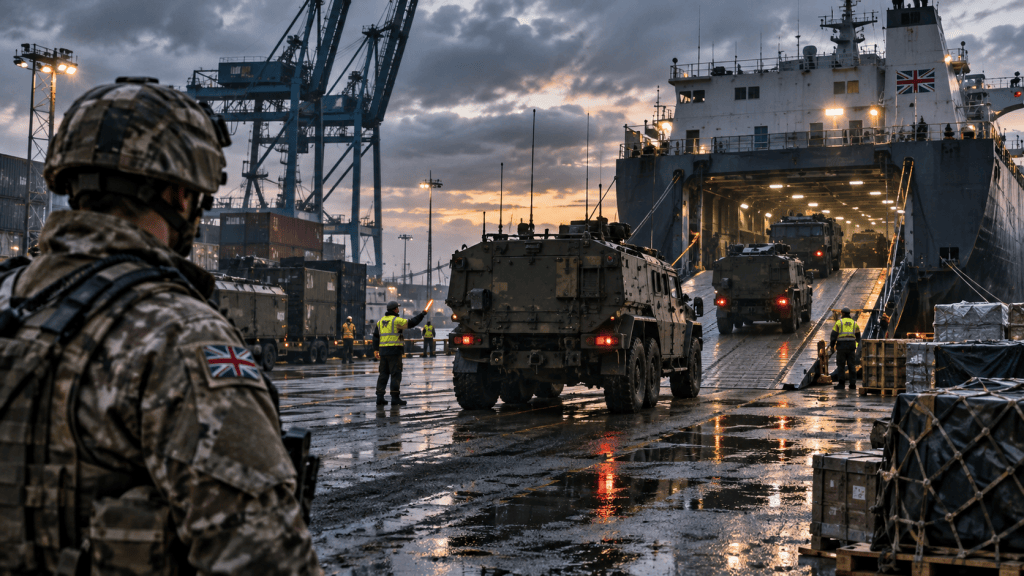
At a British port, a military movement might receive priority without anything being physically wrong with the civilian freight delayed behind it. Refrigerated food remained within its required temperature. Medical supplies sat safely inside powered containers. Commercial vehicle components were available and correctly documented.
What had changed was the allocation of time and transport.
The existence of a product no longer guaranteed its arrival when expected. A hospital distribution network could still have its stock while waiting for the connection required to move it onwards. A transport company could retain its vehicles while losing the drivers needed to fulfil a commercial contract. A bus operator could have passengers, routes and staff but be unable to return a vehicle to service because essential components were travelling later than planned.
Such consequences seldom resembled the destruction associated with war. They were quieter, often recoverable individually and therefore easier to overlook.
Collectively, however, they revealed how military priority could enter civilian life before the country itself became a battlefield.
This was one of the defining strengths of fiction concerned with modern European war: the recognition that infrastructure was not merely background to combat. It determined how long military forces remained useful, how quickly civilians received essential goods and how much strain national institutions could absorb without losing the appearance of normality.
The problem was rarely that nothing worked. It was that too many necessary things depended upon the same limited capacity.
The Soldier Inside the Alliance
Across the Channel, reinforcement looked different from the perspective of the people expected to make it function.
At an operating base in the Netherlands, the scale of military preparation became visible through aircraft arriving in darkness, vehicle parks extending beneath floodlights and personnel moving between temporary processing buildings. Dutch, British and German military systems met through paperwork, radio allocations, movement schedules and practical disagreements about equipment that did not always fit where it was supposed to.
The physical presence of an alliance was less orderly than its political description.
There were delayed cases, accommodation problems, missing equipment references, tired soldiers and officers negotiating procedures inherited from different national services. Professionalism mattered, but so did familiarity, humour and the ability to continue working when a routine arrangement became unexpectedly complicated.
Soldiers formed friendships through shared tasks more readily than through declarations of unity. They argued about football, compared photographs of children, complained about coffee and discovered that another country’s bureaucracy could be as irritating as their own.
These ordinary exchanges were essential to the human texture of NATO crisis fiction. Allied personnel could not remain anonymous uniforms if their cooperation, exposure and losses were to carry emotional weight.
The same was true of the environments they occupied.
An airfield was not simply a strategic location. It was somewhere people struggled to find food after a late arrival, carried equipment through rain, waited for transport and learned which colleague could be trusted to repair a failed radio without turning the problem into an unnecessary argument.
As the wider security situation deteriorated, those familiar routines became part of preparation for conditions no longer safely confined to training.
Military exercises increasingly considered disrupted roads, communications failures, unavailable routes, displaced medical facilities and the difficulty of maintaining movement when the original plan had become unusable.
The central requirement was no longer simply to reach an objective.
It was to keep people and equipment functioning after the assumptions supporting the movement had failed.
Modern surveillance, drones, long-range missiles and exposed logistics made that requirement increasingly important. Concentrated forces could be discovered. Routes could become dangerous without an enemy occupying them. Supporting infrastructure could be threatened far behind any conventional front line.
A soldier might spend far more time preparing vehicles, securing temporary positions, recovering equipment and waiting for uncertain instructions than engaging directly with an enemy.
None of that made the work safe.
It merely complicated the question of where the battlefield began.
When Military Preparation Entered the Family Home
The political meaning of reinforcement remained difficult to separate from its domestic consequences.
For a teacher, increased military traffic could arrive first as a late school bus rather than a national security question. Catering deliveries might be incomplete, parents might struggle to collect children, and staff could find themselves reorganising an afternoon around transport decisions made far beyond their authority.
The school remained responsible for its pupils regardless of the reasons behind the disruption.
This was how national policy became personal.
A parent whose working hours had been reduced after drivers were reassigned to defence contracts could understand the need for military preparation and still resent losing income. A teenager could be fascinated by armoured vehicles passing through her town while discovering that the same movements had created difficulties for a friend’s family.
Neither experience cancelled the other.
Military family war fiction became more convincing when it allowed those contradictions to remain unresolved. People could believe that their country needed defending without accepting every burden placed upon them as fair. They could support soldiers abroad while questioning ministers at home. They could be frightened by military preparations and reassured that somebody was finally making them.
Within families linked to government, military service and civilian employment, the divisions became more intimate.
A daughter working near the centre of political power might understand why information had to remain protected. Her mother might experience the same decisions as transport disruption, worry and an increasing inability to explain events to children. A son serving overseas might possess immediate knowledge of military conditions while remaining almost entirely removed from the calculations determining his next movement.
Their understanding did not naturally converge simply because they loved one another.
Sometimes affection made the gaps harder to bear.
A soldier who spoke reassuringly on the telephone might be withholding details to protect his family, but he might also be unable to explain events because nobody around him had established what had happened. A mother could recognise that distinction without finding it comforting.
The pressure lay in the difference between wanting an answer and having one available.
The Dangerous Comfort of Certainty
Modern conflict produced information faster than institutions could reliably understand it.
A photograph of a convoy might establish that military equipment was travelling along a particular road. It did not establish the intended mission, final destination or strategic significance of the movement.
A fragment of radio traffic could reveal confusion without identifying its cause. An unexplained incident could generate several plausible accounts before investigators had established which details were sufficiently reliable to use.
Those accounts travelled through different systems.
Soldiers remembered sounds, movements and physical positions. Military investigators collected statements, timing records and technical evidence. Governments received preliminary assessments shaped by what was available and what could responsibly be passed onwards. The public encountered selected facts alongside commentary, speculation and increasingly confident explanations.
The people closest to an event were not necessarily capable of explaining its cause.
That distinction gave modern war fiction an important alternative to the conventional political thriller, where hidden information often led towards a decisive revelation. In a more grounded setting, uncertainty could remain genuine even after considerable effort had been made to resolve it.
An investigation might fail to establish attribution because witnesses had experienced different parts of the same event, equipment records were incomplete or the available timings did not agree.
Refusing to name a culprit in those circumstances was not automatically evidence of concealment.
Yet governments could also use technically accurate language to describe known developments in ways that understated their importance.
Both conditions could exist within the same crisis.
The challenge for political leadership was knowing when restraint protected the truth and when caution had become a way of avoiding its meaning.
For ordinary citizens, that distinction was much harder to judge. Public confidence could weaken not only because officials had been caught withholding information, but because their inability to supply certainty became increasingly difficult to distinguish from unwillingness.
The damage to trust could begin before anyone established that a deliberate deception had occurred.
The Visible Commitment and the World of The Last Deterrence
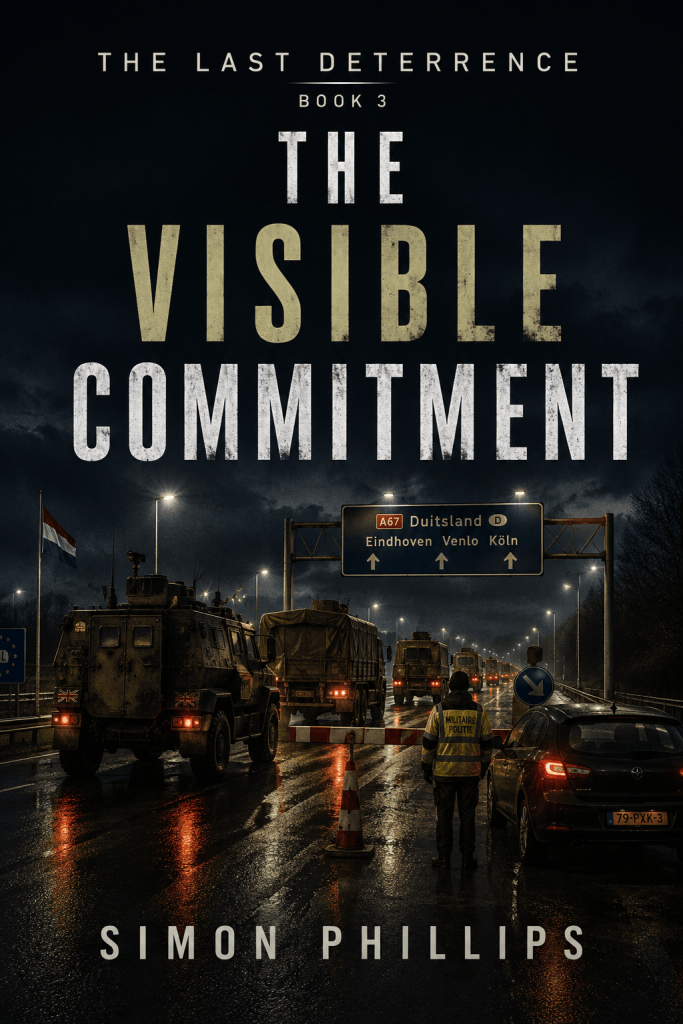
These tensions formed part of the world surrounding The Visible Commitment, the third book in Simon Phillips’s The Last Deterrence series.
The story occupied a period in which Britain’s military involvement had become difficult to disguise through the familiar distinction between assistance and participation. Political decisions reached into European military movements, port schedules, civilian employment, schools and family relationships, while the people carrying out those decisions encountered danger and uncertainty that could not be managed through official terminology alone.
Its setting belonged to a broader tradition of British military and political fiction concerned with the space between national decision-making and the people required to live with its consequences.
Yet the central pressure was not confined to Westminster or the armed forces.
It travelled between them.
A protected military movement in Britain could displace civilian work. A European exercise could expose the practical difficulties of multinational cooperation. A parliamentary argument could acquire greater force because ordinary people had already witnessed the activity ministers were attempting to describe.
The visible movement of equipment became inseparable from the less visible movement of responsibility.
Beyond the immediate story, The Last Deterrence followed a world in which regional conflicts and alliance obligations threatened to overwhelm the arrangements intended to contain them. European security, global shipping, industrial capacity, military readiness and domestic legitimacy belonged to the same increasingly strained system.
The question was not simply whether governments possessed enough military strength to respond to worsening danger.
It was whether their political authority, civilian infrastructure and public explanations could withstand the consequences of using that strength.
The Road Beyond Preparation
There was a particular unease in a country that had not declared war but had already begun changing the order in which ordinary things were allowed to happen.
A road remained a road, though a civilian driver increasingly waited while military traffic passed. A port continued to receive food and medicines, though some deliveries travelled later because another movement had gained priority. A school continued teaching, though staff found themselves explaining disruption whose larger purpose they could not fully know.
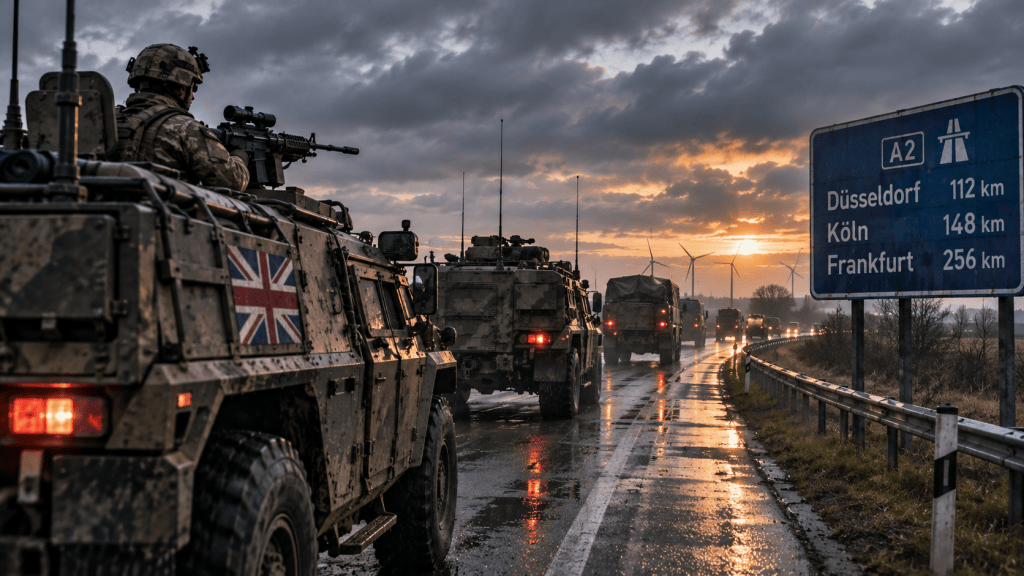
Farther east, the movement of military personnel continued through routes increasingly shaped by the expectation that normal plans might fail.
No single convoy settled the question of national involvement. No parliamentary answer could make an alliance commitment perfectly bounded. No amount of preparation could guarantee that events would remain within the categories designed to describe them.
That was where the emotional force of grounded world war fiction began to emerge, before ruined cities or the larger violence associated with open conflict had become the dominant landscape.
The country still possessed functioning institutions. People continued working, arguing, raising children and making plans. The machinery of everyday life remained recognisable, even as a growing share of its capacity was reserved for a danger whose arrival nobody could confidently date.
At the edge of a military road, a driver could still watch the final vehicle pass and expect the barrier to rise. Somewhere farther along the same network, another movement was already being prepared, its route subject to change and its destination known to fewer people than the number required to make the journey possible.
The distinction between preparation and participation had not disappeared in law or language.
It had simply become harder to find in the places where people lived and worked.
