The Battle of Edington (878)

Where a kingdom returned from exile and the fate of England was decided on open ground.
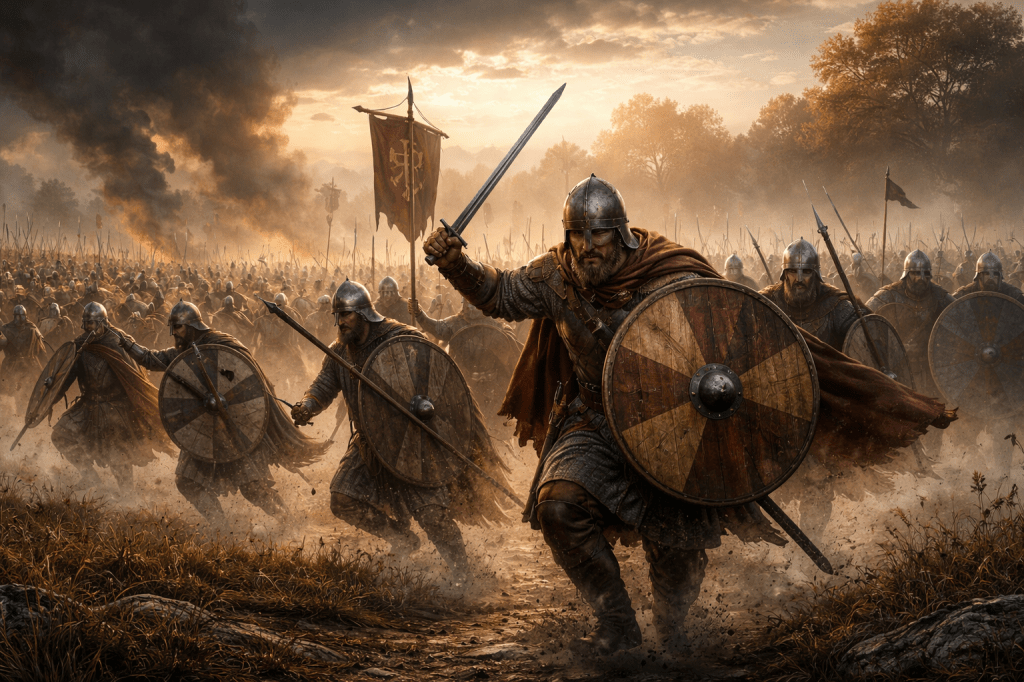

Where the Mist Lifted from Field and Shield, and a Kingdom Chose Its Ground

Morning gathered slowly over the fields of Wiltshire, where low hills rolled away beneath a sky still holding the pale remains of night. A thin veil of mist lay across the grass, drifting in slow currents that caught upon hedgerows and shallow rises, softening the edges of the land until distance and direction seemed to waver. Dew clung to every blade, and the earth beneath carried the weight of recent rain, dark and firm beneath the tread of men who had come in silence before the light.

Along the higher ground, shapes emerged through the fading haze as lines of warriors took their places upon the slope. Shields rested against legs clad in wool and leather, their painted faces dulled by travel and long use, while spearheads caught the first suggestion of dawn as it pressed through the thinning cloud. Cloaks hung heavy with moisture, their edges brushing the grass as men shifted their footing upon ground that would soon bear the weight of something far greater than the quiet that held it.

There was little sound beyond the low murmur of movement, the creak of wood and strap, and the faint rustle of wind passing across the field. Voices were kept close, carried only as far as the man beside them, for the moment demanded a steadiness that words alone could not shape. Many among those gathered had come from scattered places, drawn by summons passed in secrecy through farm and village, through woodland paths and river crossings, until they had reached this ground where the fate of Wessex would be tested.

At the centre of the line, a figure stood with his gaze fixed upon the land beyond the mist, where another army waited beyond sight, its presence felt through the weight of expectation that settled across the field. The months that had passed since exile in the marshes had left their mark, shaping both the man and those who had followed him through uncertainty and loss. What had begun in concealment now stood revealed beneath the rising light, no longer hidden among reed and water, carried into the open where resolve would be measured against strength long established upon the land.

Beyond the slope, the ground fell away towards lower fields where the mist held thicker, masking the movement of those who had taken their own positions before dawn. Somewhere within that shifting veil stood the forces of Guthrum, hardened through years of campaign and settlement, their presence woven into the land through camps, roads, and the quiet control of fields once held by others. They had come to meet this challenge with the same certainty that had carried them across the island, confident in the strength that had already broken kingdoms and driven their rulers into exile.

Between these two forces, the field waited in a stillness that seemed to gather the breath of both armies into a single suspended moment. The wind moved lightly across the grass, lifting the mist in slow folds that revealed and concealed in equal measure, offering brief glimpses of shapes beyond before closing again upon them. Time stretched across that quiet space, held between what had been endured and what would soon unfold, as men stood with their thoughts turned towards the same uncertain horizon.

As the light strengthened, the shapes upon the far ground began to take clearer form, dark lines rising through the mist where the opposing force held its place. The distance between them shortened with each passing moment, not through movement, but through the slow unveiling of what had always been there, waiting beyond sight. In that gradual revealing, the field of Edington ceased to be a place of quiet gathering and became something else entirely: a ground upon which the struggle for a kingdom would be carried into the open, where concealment gave way to confrontation, and the silence of the morning prepared to break beneath the weight of shield and spear.


Timeline of Events

793 AD — Viking ships attack the monastery of Lindisfarne, marking the beginning of the Viking Age in England.

865 AD — The Great Heathen Army lands in East Anglia, signalling a shift from raiding to organised invasion.

866 AD — Viking forces capture York (Jórvík), securing a stronghold in northern England.

870–877 AD — Viking armies campaign across the Anglo-Saxon kingdoms, defeating Mercia and pushing deep into Wessex.

878 AD — King Alfred is driven into the marshes of Athelney after a sudden Viking advance in Wessex.

878 AD — From exile, Alfred gathers forces and calls his followers to meet at Egbert’s Stone.

878 AD — The armies of Alfred and Guthrum meet at Edington, where the future of Wessex is decided.


About the Creator

This Chronicle is written by Simon Phillips, author of several historical and speculative fiction works exploring forgotten worlds, myth, and the turning points of history.

You can explore his books here:
Books by Simon Phillips

You can watch his YouTube channel here:
Author Simon Phillips


Continuing the Chronicle

The account that follows moves from the stillness of the field into the moment when silence gave way to movement, as the armies of Wessex and the Viking host advanced across the ground at Edington, and the struggle for a kingdom was carried into open conflict.
Readers supporting The Forgotten Chronicle may continue into the full record below.

Subscribe to continue reading

Subscribe to get access to the rest of this post and other subscriber-only content.
The Battle of Edington and the Field Where Wessex Turned the Viking War

The Battle of Edington stands among the defining moments of Viking Age England, though its force came from more than one clash of shield walls. By the spring of 878, Wessex had endured months of fear, retreat, and narrowing hope. King Alfred had been driven into the marshes, Guthrum’s power pressed deep into the land, and the last major Anglo-Saxon kingdom still standing faced the real prospect of being swallowed into a wider Scandinavian dominion. Edington matters because it was the place where that pressure met resistance strong enough to hold, turn, and endure.

Fields such as these rarely keep their shape in memory. Names survive. Chronicles compress. Later generations return to a few hard facts, then leave the land itself behind. Yet the ground at Edington, most commonly associated with Wiltshire, belonged to a world where slope, weather, footing, and visibility could shape the fate of kingdoms as surely as kings or captains. The battle emerged from a season of concealment, from the marshland refuge at Athelney, from summons carried quietly through farms and tracks, and from a gathering at Egbert’s Stone that transformed hidden loyalty into open resolve.

A Kingdom Pressed to the Edge

Late ninth-century England carried the strain of repeated Viking campaigns. Earlier raids had already altered the imagination of Christian Britain, beginning with the shock at Lindisfarne and growing into something broader and heavier as longships returned along coasts and riverways. By the 860s and 870s, the conflict had moved far beyond plunder. The Great Heathen Army had shifted the pattern from seasonal assault to organised invasion, and major Anglo-Saxon kingdoms felt the consequence in succession. Northumbria suffered collapse, Mercia fractured, and Wessex came under gathering pressure until its survival seemed uncertain.

That wider pressure gives Edington its true shape. A single battle can attract attention through scale or drama alone, though Edington carries a deeper pull because it rose from exhaustion. Alfred’s retreat into Athelney in early 878 has often been remembered as an image of refuge, a king hidden among reed beds while the rest of his world stood under hostile power. The image remains powerful because it speaks of reduction. Royal authority had narrowed to survival. The kingdom endured, though in diminished form, held together through memory, loyalty, and whatever could still be gathered in secret.

This is where the story acquires its distinctive weight. Edington was never simply a day of battle. It was the visible release of months lived under strain. Men arrived there through hidden roads and uncertain loyalties. Messages passed quietly across Wessex. Fragments of resistance began to recognise themselves as a force. At Egbert’s Stone, concealment gave way to muster, and with that shift the kingdom moved from endurance towards confrontation.


From Athelney to Edington

The journey from marsh refuge to battlefield was as important as the clash itself. Historical memory often prefers the instant where armies meet, since battle offers a clean edge in the record. Life within the months before it resists that kind of neatness. Alfred’s movement out of hiding and into command marked a return of structure at a moment when disorder had spread widely across the land. He was no longer surviving at the edge of his kingdom. He was gathering it back into form.

That motion towards Edington signalled something larger than military readiness. It restored the idea of Wessex in visible form. Men who had endured the same fear now stood together beneath shared authority. The countryside they crossed had already been shaped by recent campaigning, and every mile towards confrontation narrowed the space in which Viking control could appear secure. A battle fought in such a setting carried symbolic force long before the first shield struck. It told the land that resistance had returned from concealment and was willing to stand in the open.

The likely site in Wiltshire also suits the feel of the event. Open ground, rising slopes, damp earth, and the slow lifting of mist all belong naturally to the Chronicle’s treatment of Edington, and they belong to the logic of ninth-century warfare as well. This was a military world shaped by formation, cohesion, and physical pressure. A battlefield was never a blank stage. Ground mattered. Pace mattered. The firmness beneath a warrior’s feet mattered.


Why the Battle of Edington Mattered

The Battle of Edington mattered because it interrupted a direction of travel that had seemed increasingly difficult to reverse. Viking expansion across England had developed through speed, adaptability, winter campaigning, and the ability to turn mobility into settlement. Guthrum’s force entered Edington with the confidence of men shaped by earlier success. Alfred’s army entered it with something different: the knowledge that defeat could mean the loss of the final independent Anglo-Saxon kingdom.

Combat in this period relied heavily on the shield wall, on tightly formed ranks, disciplined pressure, and endurance within close fighting. This was no age of sweeping cavalry charge or elegant battlefield manoeuvre. Such encounters could become grim tests of steadiness, where a small failure in the line might widen into collapse. Alfred’s advantage lay partly in position. The Chronicle’s account places the West Saxon line on higher ground, a subtle factor with practical consequence. Firmer footing, resistance against an upward press, and the ability to hold formation under strain all contributed to a turn that began slowly and then became decisive.

That gradual turn is one of the most compelling elements in the whole episode. Edington was no sudden miracle. It was pressure answered by greater steadiness. The Viking line bent, then yielded. Guthrum’s men withdrew towards a fortified position, and the campaign moved into siege. Victory on the field alone would already have mattered. Victory followed through into confinement and submission changed the political future of England. Guthrum sought terms. His later baptism carried both religious symbolism and political weight, and the settlement opened the way towards the territorial division that would become associated with the Danelaw.

Seen in that light, Edington was a hinge. It preserved Wessex, checked a conquest that had seemed close to completion, and reshaped the terms by which Saxon and Viking power would coexist across England. The aftermath extended far beyond the battlefield. Law, identity, frontier, and settlement all moved within the current released by that victory.


The Weight of the Field in The Forgotten Chronicle

This is one reason The Forgotten Chronicle approaches Edington through atmosphere before explanation. The publication’s voice is built around slow immersion, environmental storytelling, and a calm authority that allows historical pressure to emerge through place, weather, silence, and consequence. In Chronicle 8, the field appears through mist, dew, slope, and waiting lines of men before the larger argument of history becomes visible. That approach gives the battle back its human scale.

Readers arriving through the Chronicle encounter Edington as a threshold rather than a summary. The free opening enters the field at dawn, with Alfred’s army standing above the lower ground where Guthrum’s force waits within the haze. From there the full Chronicle carries the reader into the clash itself, the retreat, the siege, and the political consequence that followed. The piece belongs to the wider Viking Age in England sequence, where earlier entries chart the movement from first coastal shock towards invasion, settlement, exile, and eventual reversal. Chronicle 8 sits at the point where that arc tightens and breaks open.

For readers who want a visual threshold into the same moment, the short companion video offers another entry into the atmosphere of the field: watch the Visual Chronicle on YouTube. The focus remains the same: mist-covered ground, gathered ranks, and the sense that a kingdom has reached the place where concealment ends and decision begins. The aim is less explanation than pressure, less lecture than recovered fragment.

The wider body of Simon Phillips’s work also sits beside the Chronicle in useful ways for readers drawn to historical atmosphere, memory, and worlds shaped by hidden turning points. The books page linked through the Chronicle offers that further route: explore the books here.


A First Step into Chronicle 8

For anyone approaching the Viking series for the first time, Edington makes a strong threshold because it holds several layers at once. It is a battle. It is a recovery from exile. It is a study in how kingdoms survive through patience before they survive through force. It is also the beginning of another kind of settlement, since the defeat of Guthrum did more than preserve Wessex. It prepared the ground for a divided England, for a world in which Viking presence would remain embedded across law, language, and place long after the shield walls had broken apart.

That movement from battlefield into settlement gives Chronicle 8 its lingering force. The field itself falls quiet again, as all battlefields do. Grass returns. Paths resume. Names outlast the voices that once carried across the slope. Yet some places continue to hold a larger shape in memory because what was decided there kept moving long after the fighting ended. Edington belongs to that kind of ground.


Where the Past Keeps Its Pressure

The past rarely survives in full. More often it reaches us in fragments, in names, in a contested location, in a chronicle line, in the memory of a king who vanished into marshland and reappeared with an army. The Battle of Edington endures because the record still carries the pressure of that return. Wessex stood close to eclipse. Alfred gathered what remained. A field in Wiltshire became the place where retreat ended and a kingdom recovered its footing.

That is why Edington continues to draw readers. It offers more than victory. It offers the moment when hidden endurance takes visible form. Through The Forgotten Chronicle’s Chronicle 8, that field opens again, quiet at first, then filled with weight, until the mist lifts and the shape of the struggle stands clear. History remains there, waiting in the grass and slope, carrying forward the old pressure of a morning when Wessex chose its ground.