In The Unmarked Path, Elana enters the story as a princess shaped by duty, family expectation, and the cold machinery of royal alliance. She is not introduced as a warrior, a ruler, or a magician. She stands beside the burdens of others, close enough to see what they hide, yet bound by a role that expects silence, obedience, and grace.
That is what makes her so important.
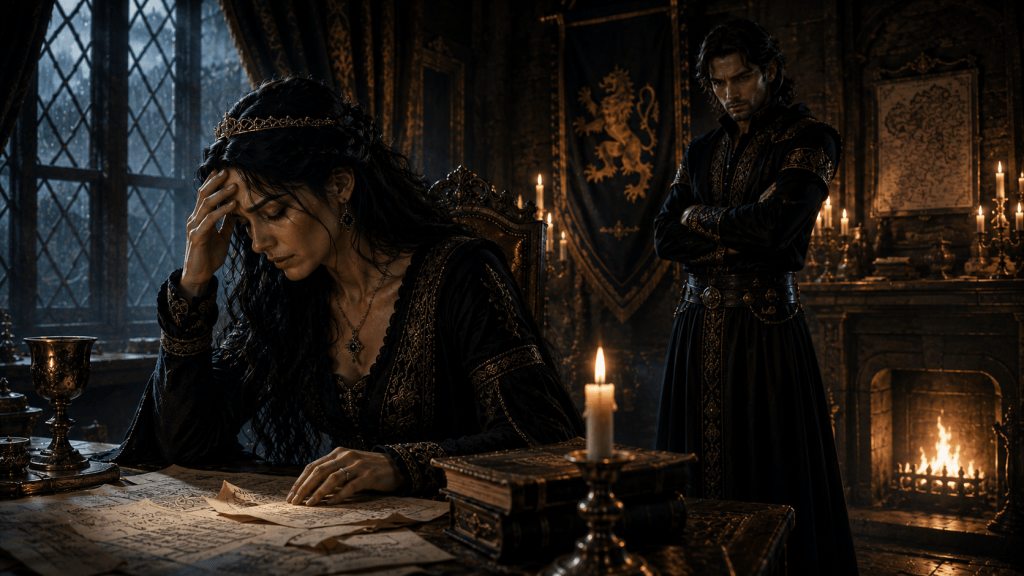
Elana begins in Bremyra as Prince Patrick’s sister, a sharp and thoughtful presence within a court already strained by absence. King Cedric is gone. Patrick’s brothers are gone. The kingdom continues to function, but the foundations beneath it feel uncertain. Elana understands this more clearly than most. She sees Patrick’s exhaustion, his isolation, and the pressure gathering around him before the wider court fully recognises it.
She is preparing to leave for Vaeldring and an arranged marriage, yet she is not written as a passive royal figure being moved from one kingdom to another. Her duty is real, but so is her mind. Her compassion is real, but so is her judgement. Elana carries warmth, intelligence, and restraint, and those qualities make her one of the quietest forces in the opening movement of the story.
The Bond Between Elana and Patrick
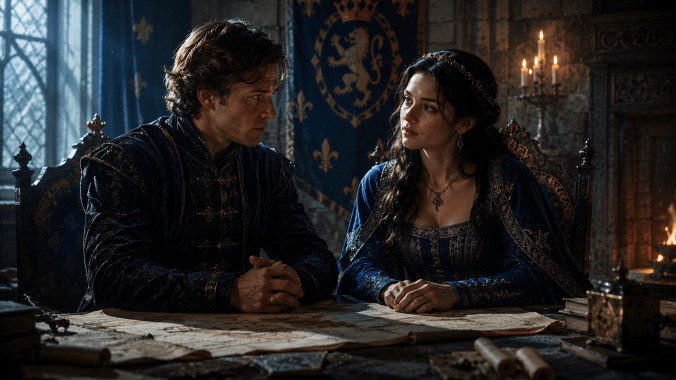
Elana’s relationship with Patrick gives the reader a softer entry into the political weight of Bremyra. Patrick is acting in his father’s place, but he is not yet settled inside authority. He works through petitions, letters, border concerns, marriage arrangements, and the silence left by his missing family. Elana is one of the few people who can speak to him without ceremony.
Their conversations show the human cost of royal duty. Patrick must think like a ruler before he is ready to become one. Elana must leave her home because marriage is part of the kingdom’s strategy. Neither of them is free, yet they still try to comfort one another within the limits their world allows.
This matters because The Unmarked Path is not only about magic and ancient danger. It is about institutions pressing down on people before they understand the shape of the storm around them. Elana’s presence beside Patrick reveals the emotional life beneath the politics. She reminds the reader that kingdoms are not held together by banners and titles alone. They are held together by people trying not to break under the weight of what is expected from them.
The Return of Simion
Elana’s importance deepens when Simion returns to Bremyra.
To the court, Simion is a magician of the Order, a figure of authority and unease. To the Church, he is a threat. To Patrick, he is both a possible ally and a mystery. Yet to Elana, he is also a memory.
She remembers him from childhood, before black robes and formal titles stood between them. She remembers the boy from the kitchens, the fireflies, the warmth of a life that no longer exists. That recognition cuts through the distance Simion tries to maintain. For a moment, he is not only Lord Magician. He is someone who once belonged to the halls of Bremyra in a far more human way.
This is one of Elana’s strengths. She sees through the surface of people. She sees Patrick’s burden. She sees Simion’s guarded sorrow. She sees that something weighs on him even when he tries to hide it behind silence.
Her questions are gentle, but they are not weak. She does not force the truth from him, yet she lets him know she has noticed. In a world of court suspicion, Church authority, and Order secrecy, Elana’s insight feels dangerous precisely because it is so human.
More Than a Royal Daughter
Elana’s arranged marriage to Vaeldring could easily make her seem like a political piece. The story refuses to leave her there.
She is part of Bremyra’s diplomacy, but she is not defined by diplomacy. She is Patrick’s sister, but not only Patrick’s sister. She is linked to Simion’s past, but not only through memory. Her role grows through small moments of perception before it becomes something impossible to ignore.
When Elana leaves Bremyra, the road itself becomes a threshold. The journey that should carry her towards marriage instead carries her into violence. Her escort is attacked. The carriage is destroyed. Guards fall. The world that expected her to travel quietly between kingdoms is suddenly stripped of its formal order.
That is when the hidden truth within Elana begins to surface.
The Road, the Poison, and the Golden Light
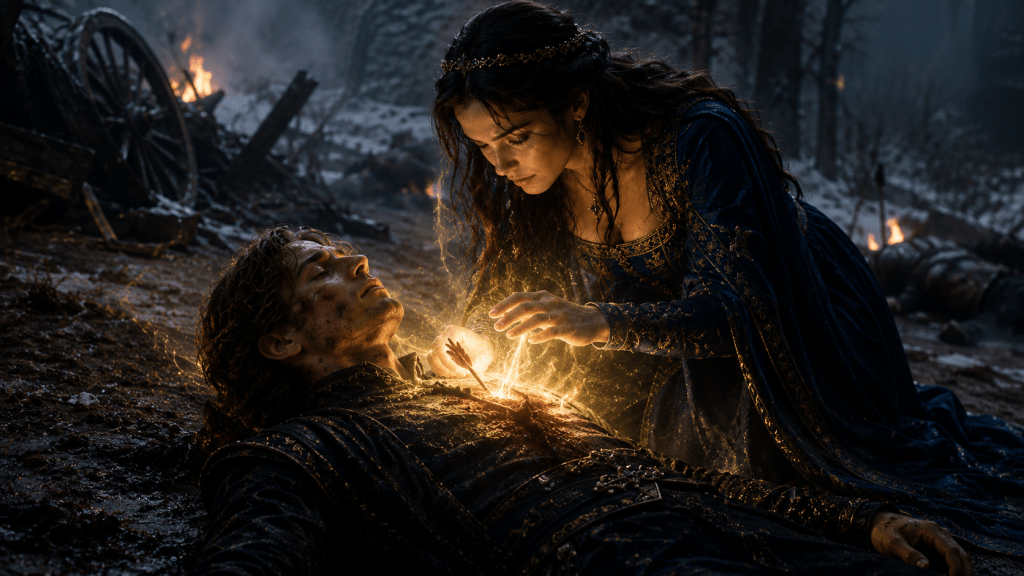
Simion reaches Elana after the ambush and destroys the attackers, but victory does not save him. A poisoned arrow has already struck him. The danger becomes intimate and immediate. This is not a distant battle or a council debate. It is Elana kneeling beside him on scorched earth, watching death move through his body.
What follows is one of the most important moments in Book 1.
Elana does not call for someone else to save him. She does not collapse into helplessness. She acts. Golden healing light answers her fear, her will, and her refusal to let him die.
The scene matters because it changes what the reader understands about Elana. Until this point, her strength has been emotional, political, and perceptive. In this moment, that strength becomes magical. The story does not pause to explain everything. It does not flatten the mystery into a rulebook. It simply shows that something powerful has been living beneath the surface of a princess the world underestimated.
Elana’s magic is not presented as spectacle. It is urgent, costly, and deeply personal. It rises because someone she cares for is dying in front of her, and she refuses to accept that outcome.
What the World Failed to Notice
By the end of The Unmarked Path, Elana has become far more than she first appeared to be. She has supported Patrick in a court shaped by uncertainty. She has recognised the humanity still buried inside Simion. She has walked towards a political future she did not choose. She has survived violence on the road. Most importantly, she has revealed a hidden power that the world around her had not seen.
That is the heart of Elana’s role in Book 1.
She is not explained. She is revealed.
Her story draws readers into one of the central tensions of The Veil of Kings and Gods: power is often present before anyone understands it. Magic does not always arrive through titles, institutions, or formal permission. Sometimes it appears in a moment of fear, love, and refusal. Sometimes the person who changes everything is the one others thought they had already understood.
Watch the Elana Lore Short
I have also created a short lore video exploring Elana’s hidden magic and her role in The Unmarked Path. Rather than retelling the entire story, it introduces one of Book One’s most intriguing characters and the quiet mystery surrounding her. From her life as a princess bound by duty to the unexpected awakening of her healing magic, the video offers a glimpse into the emotional and mythic foundations of her journey without revealing the wider story.
Whether you have already begun reading The Veil of Kings and Gods or are discovering the world of Ældorra for the first time, it serves as a short introduction to the atmosphere, characters, and hidden threads that shape the opening of the series.
Read The Unmarked Path
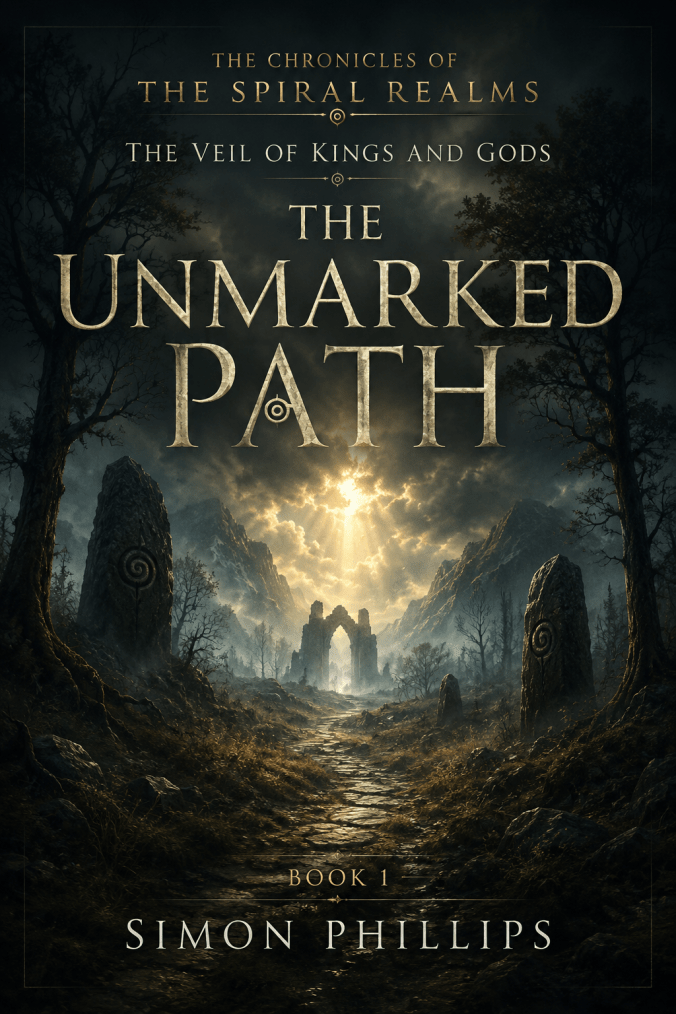
The Unmarked Path opens the world of The Veil of Kings and Gods, a high fantasy story of forbidden magic, royal pressure, ancient divine history, political unrest, and the first stirrings of a power long buried beneath Ældorra.
Within its opening pages, a magician returns to a kingdom that fears his Order, a prince struggles beneath the weight of a throne he was never meant to inherit, a northern war leader crosses the sea under a shadowed cause, and a princess begins to reveal a power the world has not yet noticed.
If you enjoy character-driven epic fantasy, hidden magic, ancient gods, royal intrigue, dangerous journeys, and slow-burning mythic tension, this is where the path begins.
In The Unmarked Path, the first book of The Veil of Kings and Gods, Prince Patrick begins in a place of uneasy authority.
He is not introduced as a king in waiting, nor as a prince hungry for power. He is third in line to Bremyra’s throne, shaped by tutors, court duties, and the quiet expectation that others would stand before him when history made its demands. His father, King Cedric, carried the crown. His elder brothers, Aric and Aiden, carried the future.
Patrick was meant to serve beside them, to advise, to support, to understand the workings of power without being forced to become its centre.
Their absence changes everything.
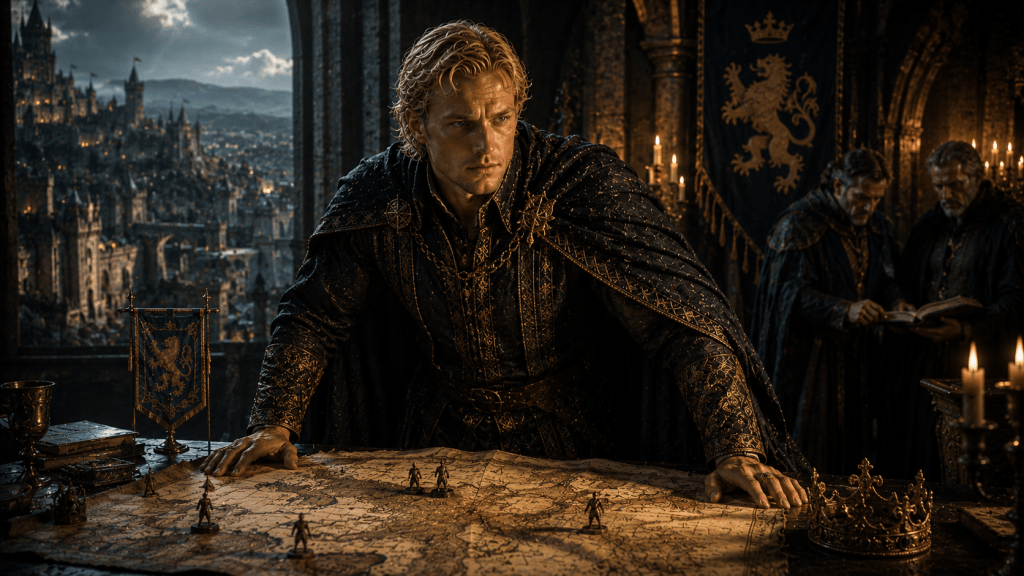
With the King and the twin princes gone beyond the familiar borders of the realm, Patrick is left at a desk that still feels like his father’s, answering petitions beneath banners that seem to remember stronger hands. The kingdom has not stopped to mourn their silence. Bremyra still requires judgement, diplomacy, restraint, and command. Each sealed letter and whispered report draws him deeper into a role he never sought, while the court watches to see whether the third son can hold steady beneath the weight of a crown that has not yet been placed upon his head.
A Prince Left at His Father’s Desk
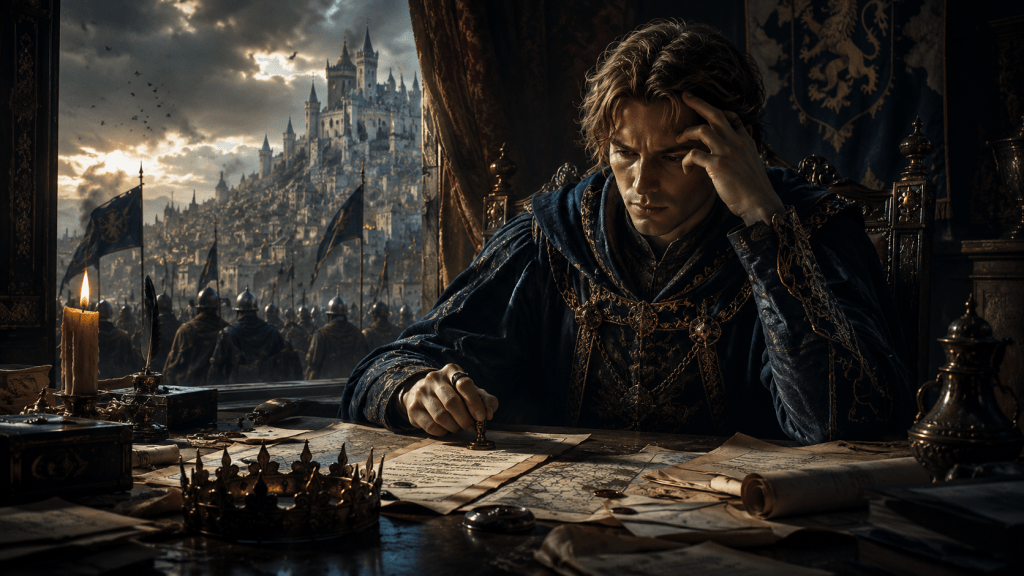
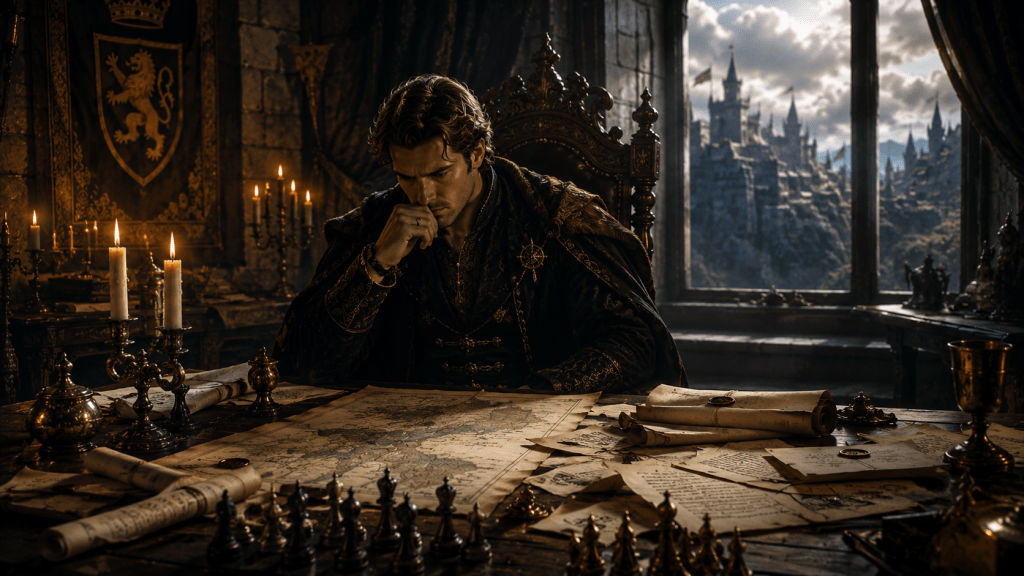
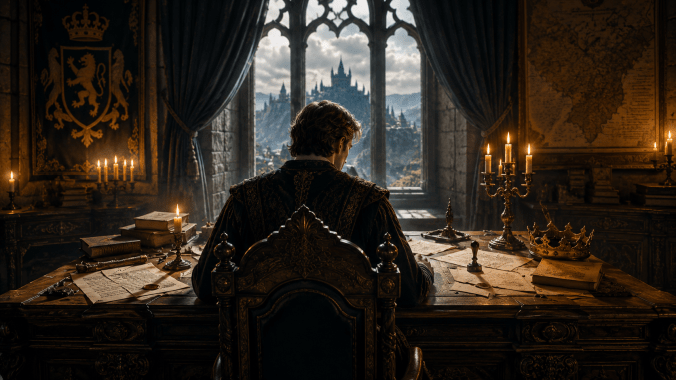
Patrick’s first appearance places him at his father’s desk, surrounded by court proceedings, petitions, diplomatic letters, and the ordinary machinery of rule. The scene is quiet, yet it carries pressure from the beginning. Bremyra has not collapsed. The castle still functions. Servants still move through its halls, guards still hold their posts, and the court still expects decisions.
That is what makes Patrick’s position so difficult.
There is no grand ceremony announcing that power has shifted. There is no clean moment where he chooses the burden. Instead, responsibility gathers around him slowly, page by page, seal by seal, until the absence of his father becomes its own form of command.
The desk itself matters. It is more than furniture in this scene. It is the place where King Cedric once shaped the movement of the kingdom, where treaties were read, roads considered, disputes answered, and royal judgement turned into law. For Patrick, sitting there is not an act of possession. It is an intrusion into a space that still belongs to someone else.
Every object around him reminds him of that. The papers waiting for his seal, the chair beside him, the formal language of court proceedings, even the silence of the room all point towards the same truth. Bremyra has continued, but it has continued around an absence.
King Cedric and the twin princes have been gone too long. Their expedition beyond the known reaches of the old empire has fallen into silence, and the court cannot live on hope alone. Patrick feels that silence every time he sits in the chair that should not yet belong to him.
This is where his burden begins. Not on a battlefield. Not before cheering banners. Not with a crown lowered onto his head.
It begins in paperwork, in waiting, and in the uneasy knowledge that a kingdom still needs ruling even when the rightful voices have gone quiet.
Patrick is trained, intelligent, and capable, yet capability is not the same as certainty.
He understands statecraft. He understands alliances. He understands that kingdoms survive through careful balances rather than noble feeling alone. His education has prepared him to read treaties, weigh counsel, manage factions, and recognise the danger hidden inside polite words. Yet Book 1 catches him at the moment where knowledge begins to harden into lived responsibility.
Bremyra is not waiting for him to feel ready.
Arvendral stirs with uncertain intentions, offering the language of peace while its movements suggest something more cautious and dangerous. Vaeldring becomes vital through Elana’s arranged marriage, turning his sister’s future into part of Bremyra’s political survival. Thalosia presses its own designs upon Patrick’s future, reminding him that even his personal life is no longer fully his own.
Every alliance has a cost, and every delay invites danger.
Patrick must decide while still grieving absence. He must govern while wondering whether his father and brothers will return. He must listen to advisers who expect steadiness from him, even as he feels the shape of his own inexperience beneath every command. The court sees a prince at the centre of power, but Patrick feels the empty spaces around him more sharply than the authority in his hands.
He is forced to think not as a younger son waiting behind the true heirs, but as the man currently holding the centre of the realm together.
This is the quiet tragedy of his opening arc. He has inherited pressure without inheriting clarity, and the kingdom has begun asking him for the certainty that no one has given him.
Elana and the Human Cost of Royal Duty
Patrick’s bond with Princess Elana gives his story its human warmth.
Their conversations carry the ease of siblings who have known one another beyond titles, ceremony, and court expectation. Elana does not look at Patrick only as the acting ruler of Bremyra. She sees the brother beneath the office, the young man sitting at their father’s desk before he has fully learned how to bear its weight. Patrick, in turn, sees more in Elana than the court allows. She is not merely a princess to be sent towards Vaeldring, nor a name placed into marriage negotiations. She is his sister, perceptive, spirited, and quietly braver than many of the men who speak around her.
That makes her departure harder.
Her marriage to Vaeldring is not treated as decoration. It is political architecture. Through her, Bremyra reaches towards stability, alliance, and protection at a time when the kingdom cannot afford isolation. Through Patrick, the same pressure appears in another form, as Thalosia looks towards him as a future husband and political partner. Their lives are being shaped into bridges between realms, and those bridges are built from obedience, silence, and sacrifice.
For Patrick, Elana’s journey is both necessary and painful. He understands why she must go, yet understanding does not soften the loss. Her absence removes one of the few voices able to speak to him honestly, one of the few people who can meet his burden without turning it into performance.
Both siblings are being moved by the needs of the realm.
Neither is truly free.
Bremyra Beneath Strain
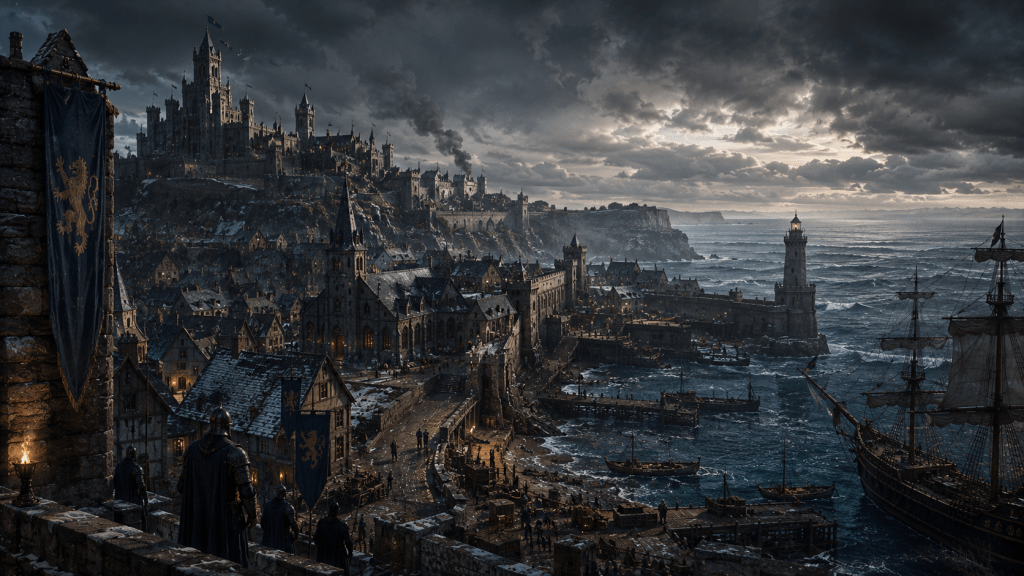
Book 1 presents Bremyra as a kingdom still standing, yet already under pressure from several directions.
The danger is not simple. It does not arrive through one army at the gate or one enemy declaring war. Instead, it comes through rumours, border tension, court unease, foreign movement, and unanswered questions. Patrick must govern inside that uncertainty.
The court watches him. The Church measures the arrival of the Order. The nobles depend upon him while also studying his weakness. Every decision he makes is made beneath the shadow of men who are absent and institutions that remain powerful.
Patrick’s strength in Book 1 is not certainty. It is endurance. He keeps sitting at the desk. He keeps answering. He keeps listening. He keeps choosing, even when every choice feels incomplete.
The Arrival of Simion
The arrival of Simion changes the shape of Patrick’s burden.
Until that point, Patrick’s problems, however heavy, still belong to the visible world of rule: letters, borders, marriages, missing family, restless neighbours, and a court that expects him to answer before he feels ready. Simion brings something different into Bremyra. He brings the Order with him, and the Order is not simply another political body waiting to be managed.
To the court, Simion is a magician, and that alone is enough to unsettle the air inside the castle. The Order does not stand beneath a crown in the way soldiers, servants, and councillors do. It carries older authority, colder memory, and laws of its own. Its presence reminds Bremyra that there are powers in Ældorra which do not bend easily to royal command.
Patrick senses this immediately.
He wants plain answers, yet Simion does not offer them. The magician speaks with restraint, carries himself with controlled distance, and seems to move through Bremyra as both guest and investigator. He has returned to a place he once knew, yet he does not belong to it in any simple way. That makes him difficult for Patrick to read. Simion is familiar and foreign at once, tied to childhood memory through Elana, yet shaped by an institution Patrick cannot fully trust.
His presence stirs different fears in different people. Elana remembers the boy from the kitchens and sees something human beneath the robes. The Church sees the shadow of the Order and answers with suspicion. Patrick stands between both responses, aware that Simion may be dangerous, useful, wounded, or all three at once.
That uncertainty matters.
Patrick is not naïve enough to dismiss the threat a magician might pose, but neither is he foolish enough to ignore what Simion represents. Bremyra’s dangers are widening beyond ordinary court business. Foreign attackers have begun to move where they should not. The silence surrounding King Cedric’s expedition has grown harder to explain. The old world, once safely buried in books and ruins, seems to be pressing closer to the present.
In that atmosphere, Simion becomes more than an unsettling arrival.
He becomes a question Patrick cannot afford to put aside.
That tension becomes one of the important relationships in Book 1. Patrick cannot fully trust Simion, but he cannot ignore him either. He needs answers, yet the man most likely to find them carries secrets of his own. The prince and the magician stand on opposite sides of old authority, crown and Order, yet both are being drawn towards the same gathering storm.
For Patrick, accepting Simion’s presence is not an act of comfort.
It is an act of necessity.
Patrick’s understanding of power changes during the ambush in Bremyra.
Until that moment, magic can still be kept at a distance. It belongs to the Order, to old stories, to political caution, and to the fear other people carry when a magician walks through the room. Patrick can study it as a matter of court risk. He can weigh Simion’s presence as a political complication. He can listen to the Church’s distrust and the council’s unease while still treating magic as something held beyond the ordinary shape of his duties.
Then foreign attackers strike inside Patrick’s own city, and all distance vanishes.
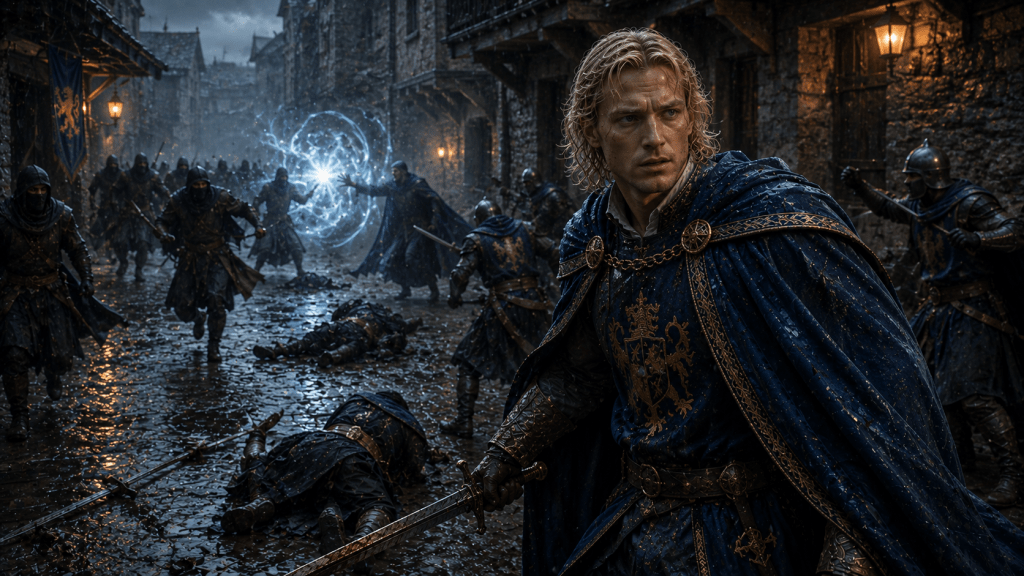
The attack is brutal, immediate, and personal. Patrick is no longer dealing with reports, rumours, or border movement. He is facing steel, strength, and death at close range, with the guards around him struggling to contain a threat that should never have reached him. The street becomes a place of sudden exposure. The prince who has spent his days behind desks, councils, letters, and guarded ceremony is forced into the raw truth of violence.
When Simion intervenes, Patrick sees magic not as theory, but as force.
There is no courtly veil around it. No ancient language softened by distance. No comfortable illusion that such power belongs safely inside the boundaries of the Order. Simion acts with speed and precision, and the world around Patrick changes in the space of a breath. The magician does not merely assist. He alters the outcome entirely.
It saves Patrick’s life.
It also unsettles him.
That is what makes the moment important. Patrick is grateful, yet he is too perceptive to be simple in his gratitude. He understands that the same power which protected him could terrify a court, silence a street, or reshape the balance between crown and Order if misused. He has seen something no council report could fully prepare him for: a man standing beside him who carries a kind of authority no prince can command in the ordinary way.
Patrick does not respond like a fool. He does not dismiss what he has seen, nor does he surrender blindly to it. He recognises the truth placed before him. Bremyra’s troubles may reach beyond ordinary politics, and Simion’s strength may be part of whatever answer the kingdom needs.
From there, Patrick’s relationship with Simion shifts. Gratitude enters the space between them. So does caution. So does necessity.
Patrick may not yet understand what Simion truly is, but he understands this much: Bremyra has stepped onto ground where steel, law, and royal blood may no longer be enough.
The Crown Begins Before the Coronation
Patrick’s arc in The Unmarked Path is not about becoming king in name. It is about the crown beginning to shape him before he is ready to wear it.
He is still a prince. He is still waiting for news of his father. He is still measuring himself against brothers who were meant to stand ahead of him. Aric and Aiden carry the image of succession more naturally in Patrick’s mind, while King Cedric remains the figure whose judgement should steady the realm. Yet their absence leaves no living hand between Patrick and the demands of Bremyra.
That absence becomes a kind of pressure.
Every petition placed before him reminds him that the kingdom cannot pause. Every council meeting asks him to speak with a confidence he does not fully feel. Every border report, marriage negotiation, and whisper from the court presses him closer to the shape of rule. He is not crowned, yet already he is being tested by the crown’s demands.
That is where his story gains its weight.
Patrick does not have Simion’s magic. He does not have Týrnan’s warrior certainty. He does not carry Elana’s hidden brilliance in the same way. His burden is different. He must stand in rooms where everyone wants something. He must listen to soldiers, priests, councillors, nobles, and foreign powers, knowing that each voice carries its own fear, ambition, or concealed truth.
He must make choices with incomplete knowledge. He must protect a kingdom that may already be part of a much older conflict. He must learn that leadership is not always a matter of bold speeches or battlefield glory, but of remaining steady while the world quietly removes every certainty around him.
Patrick’s strength in Book 1 is not triumph. It is endurance under scrutiny. He continues to sit at the desk, answer the summons, weigh the reports, and hold the centre while forces greater than one prince begin to move around Bremyra.
Why Patrick Matters in Book 1
Patrick matters because he gives the opening story its political heart.
Through him, Bremyra becomes more than a backdrop. It becomes a living kingdom, full of fragile alliances, absent rulers, cautious advisers, religious authority, old loyalties, and roads that no longer feel safe. His chapters show what happens when ancient danger begins pressing against ordinary governance, not through prophecy alone, but through letters, councils, rumours, borders, and the silence left by those who should have returned.
He stands between the personal and the political. Elana’s future is not only his sister’s sorrow, but part of Bremyra’s survival. Simion’s arrival is not only the return of a childhood memory, but a threat to the balance between crown, Church, and Order. Every private fear Patrick carries is mirrored by a public consequence waiting beyond the chamber door.
The wider world may be turning towards magic, invasion, and divine memory, but Patrick’s struggle remains deeply human.
He is tired.
He is uncertain.
He is watched.
And still, he must rule.
The Reluctant Heir
By the end of Book 1, Patrick has not solved Bremyra’s troubles. He has not uncovered the full truth of the foreign attackers, his father’s disappearance, or the strange forces gathering around Simion. What he has done is survive the first testing of his authority, and that survival matters.
He has seen that danger can reach him inside his own city, slipping through streets he believed protected by law, guard, and stone.
He has seen that Simion’s power may alter the fate of Bremyra, not as distant legend or court rumour, but as a force standing beside him when steel comes too close.
He has seen that Elana’s path is far more fragile than politics allowed him to believe, and that royal duty cannot always protect those it claims to serve.
Most of all, Patrick has begun to understand that rulership does not arrive with certainty. It arrives through pressure, through fear carefully hidden, through decisions made before every answer is known. His father’s chair remains too large for him, yet the kingdom has already begun looking to him as though he belongs there.
The crown is not waiting politely in the future.
It is already pressing its weight into his hands.
The Unmarked Path begins the first movement of The Veil of Kings and Gods, a fantasy series of political pressure, ancient magic, divine silence, and the people caught at the edge of forces older than kingdoms.