In The Unmarked Path, Elana enters the story as a princess shaped by duty, family expectation, and the cold machinery of royal alliance. She is not introduced as a warrior, a ruler, or a magician. She stands beside the burdens of others, close enough to see what they hide, yet bound by a role that expects silence, obedience, and grace.
That is what makes her so important.
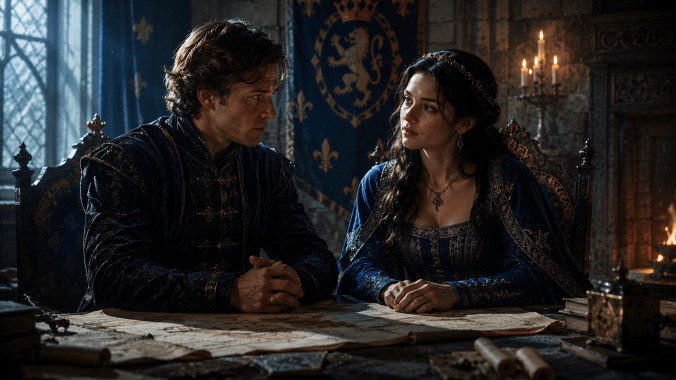
Elana begins in Bremyra as Prince Patrick’s sister, a sharp and thoughtful presence within a court already strained by absence. King Cedric is gone. Patrick’s brothers are gone. The kingdom continues to function, but the foundations beneath it feel uncertain. Elana understands this more clearly than most. She sees Patrick’s exhaustion, his isolation, and the pressure gathering around him before the wider court fully recognises it.
She is preparing to leave for Vaeldring and an arranged marriage, yet she is not written as a passive royal figure being moved from one kingdom to another. Her duty is real, but so is her mind. Her compassion is real, but so is her judgement. Elana carries warmth, intelligence, and restraint, and those qualities make her one of the quietest forces in the opening movement of the story.
The Bond Between Elana and Patrick
Elana’s relationship with Patrick gives the reader a softer entry into the political weight of Bremyra. Patrick is acting in his father’s place, but he is not yet settled inside authority. He works through petitions, letters, border concerns, marriage arrangements, and the silence left by his missing family. Elana is one of the few people who can speak to him without ceremony.
Their conversations show the human cost of royal duty. Patrick must think like a ruler before he is ready to become one. Elana must leave her home because marriage is part of the kingdom’s strategy. Neither of them is free, yet they still try to comfort one another within the limits their world allows.
This matters because The Unmarked Path is not only about magic and ancient danger. It is about institutions pressing down on people before they understand the shape of the storm around them. Elana’s presence beside Patrick reveals the emotional life beneath the politics. She reminds the reader that kingdoms are not held together by banners and titles alone. They are held together by people trying not to break under the weight of what is expected from them.
The Return of Simion
Elana’s importance deepens when Simion returns to Bremyra.
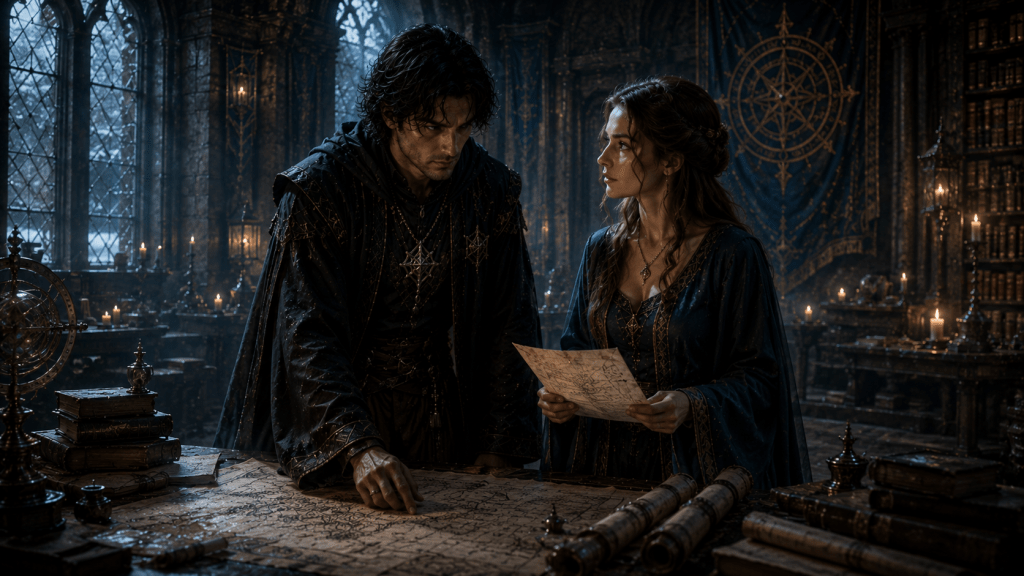
To the court, Simion is a magician of the Order, a figure of authority and unease. To the Church, he is a threat. To Patrick, he is both a possible ally and a mystery. Yet to Elana, he is also a memory.
She remembers him from childhood, before black robes and formal titles stood between them. She remembers the boy from the kitchens, the fireflies, the warmth of a life that no longer exists. That recognition cuts through the distance Simion tries to maintain. For a moment, he is not only Lord Magician. He is someone who once belonged to the halls of Bremyra in a far more human way.
This is one of Elana’s strengths. She sees through the surface of people. She sees Patrick’s burden. She sees Simion’s guarded sorrow. She sees that something weighs on him even when he tries to hide it behind silence.
Her questions are gentle, but they are not weak. She does not force the truth from him, yet she lets him know she has noticed. In a world of court suspicion, Church authority, and Order secrecy, Elana’s insight feels dangerous precisely because it is so human.
More Than a Royal Daughter
Elana’s arranged marriage to Vaeldring could easily make her seem like a political piece. The story refuses to leave her there.
She is part of Bremyra’s diplomacy, but she is not defined by diplomacy. She is Patrick’s sister, but not only Patrick’s sister. She is linked to Simion’s past, but not only through memory. Her role grows through small moments of perception before it becomes something impossible to ignore.
When Elana leaves Bremyra, the road itself becomes a threshold. The journey that should carry her towards marriage instead carries her into violence. Her escort is attacked. The carriage is destroyed. Guards fall. The world that expected her to travel quietly between kingdoms is suddenly stripped of its formal order.
That is when the hidden truth within Elana begins to surface.
The Road, the Poison, and the Golden Light
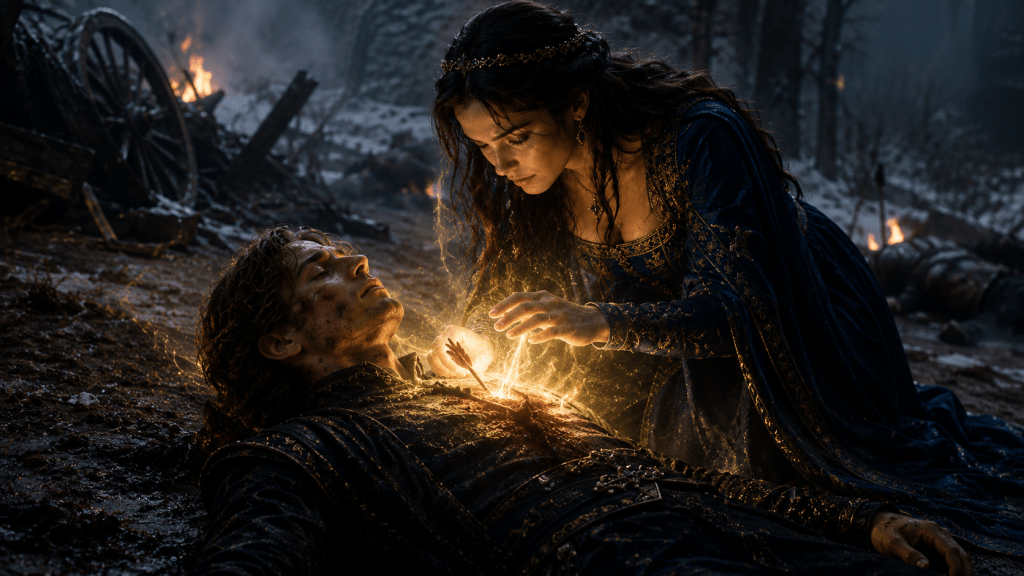
Simion reaches Elana after the ambush and destroys the attackers, but victory does not save him. A poisoned arrow has already struck him. The danger becomes intimate and immediate. This is not a distant battle or a council debate. It is Elana kneeling beside him on scorched earth, watching death move through his body.
What follows is one of the most important moments in Book 1.
Elana does not call for someone else to save him. She does not collapse into helplessness. She acts. Golden healing light answers her fear, her will, and her refusal to let him die.
The scene matters because it changes what the reader understands about Elana. Until this point, her strength has been emotional, political, and perceptive. In this moment, that strength becomes magical. The story does not pause to explain everything. It does not flatten the mystery into a rulebook. It simply shows that something powerful has been living beneath the surface of a princess the world underestimated.
Elana’s magic is not presented as spectacle. It is urgent, costly, and deeply personal. It rises because someone she cares for is dying in front of her, and she refuses to accept that outcome.
What the World Failed to Notice
By the end of The Unmarked Path, Elana has become far more than she first appeared to be. She has supported Patrick in a court shaped by uncertainty. She has recognised the humanity still buried inside Simion. She has walked towards a political future she did not choose. She has survived violence on the road. Most importantly, she has revealed a hidden power that the world around her had not seen.
That is the heart of Elana’s role in Book 1.
She is not explained. She is revealed.
Her story draws readers into one of the central tensions of The Veil of Kings and Gods: power is often present before anyone understands it. Magic does not always arrive through titles, institutions, or formal permission. Sometimes it appears in a moment of fear, love, and refusal. Sometimes the person who changes everything is the one others thought they had already understood.
Watch the Elana Lore Short
I have also created a short lore video exploring Elana’s hidden magic and her role in The Unmarked Path. Rather than retelling the entire story, it introduces one of Book One’s most intriguing characters and the quiet mystery surrounding her. From her life as a princess bound by duty to the unexpected awakening of her healing magic, the video offers a glimpse into the emotional and mythic foundations of her journey without revealing the wider story.
Whether you have already begun reading The Veil of Kings and Gods or are discovering the world of Ældorra for the first time, it serves as a short introduction to the atmosphere, characters, and hidden threads that shape the opening of the series.
Read The Unmarked Path
The Unmarked Path opens the world of The Veil of Kings and Gods, a high fantasy story of forbidden magic, royal pressure, ancient divine history, political unrest, and the first stirrings of a power long buried beneath Ældorra.
Within its opening pages, a magician returns to a kingdom that fears his Order, a prince struggles beneath the weight of a throne he was never meant to inherit, a northern war leader crosses the sea under a shadowed cause, and a princess begins to reveal a power the world has not yet noticed.
If you enjoy character-driven epic fantasy, hidden magic, ancient gods, royal intrigue, dangerous journeys, and slow-burning mythic tension, this is where the path begins.
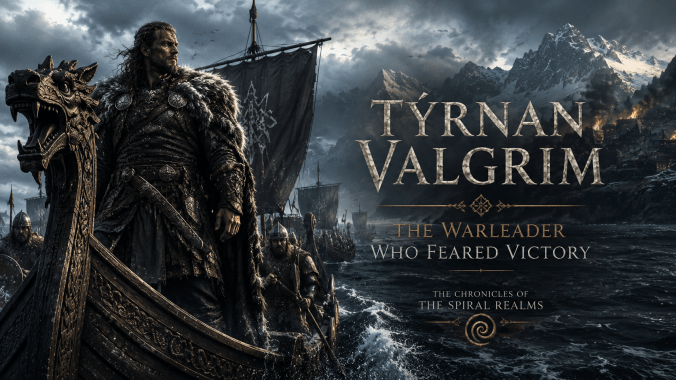
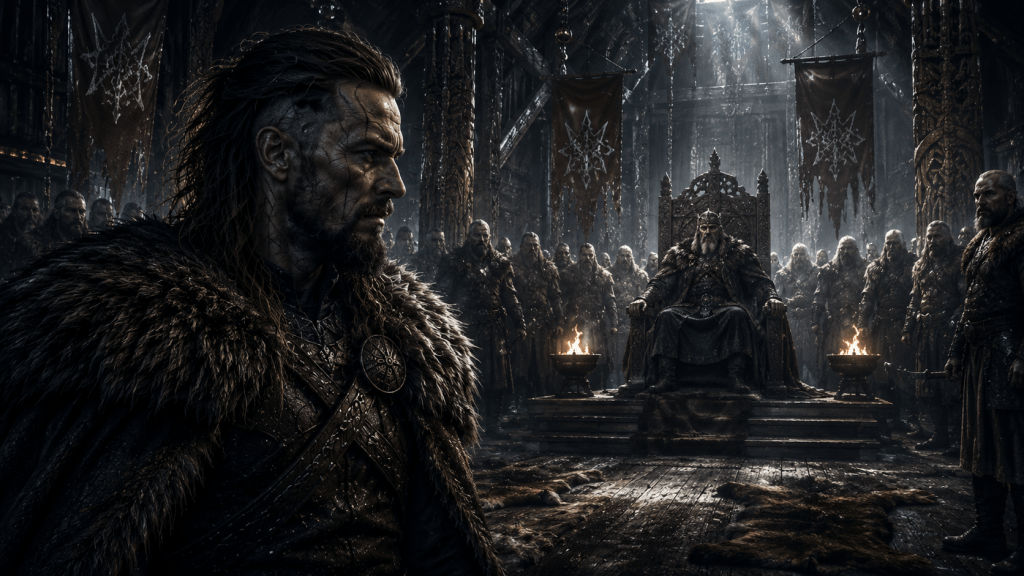
In The Unmarked Path, Book 1 of The Veil of Kings and Gods, Týrnan Valgrim enters the story from the cold edge of Ældorra, where the northern seas carve strength into those who survive them and the people of Njorvik learn early that mercy does not always keep a tribe alive.
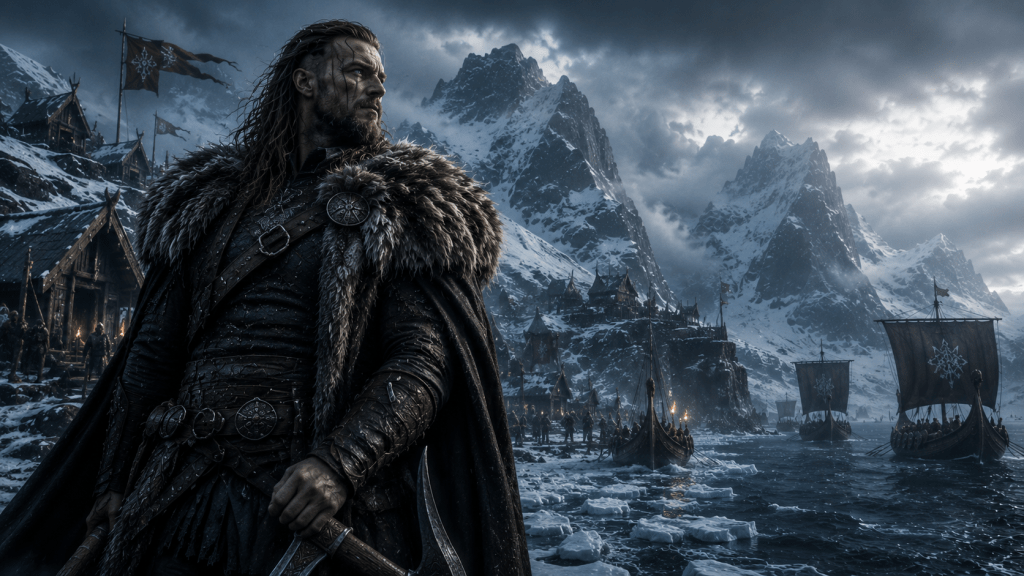
He is introduced as a warleader, yet not as a simple raider hungry for blood or glory. Týrnan stands at the prow of a longboat with the bitter wind pulling at his fur-lined cloak, surrounded by warriors preparing for the voyage south. Behind him are the Frostbane, his own people, bound by loyalty, hardship, and the old belief that endurance is the truest measure of strength. Before him lies the sea, the storm, and the uncertain promise of conquest.
What makes Týrnan compelling is not that he sails towards war, but that he already understands something is wrong before the first battle has truly begun. His world expects strength from him. His warriors expect command. The High Chieftain expects obedience. Yet beneath those demands, Týrnan carries a more difficult burden, because he is beginning to see that victory may require a man to surrender more of himself than defeat ever could.
A Warleader Shaped by the Frozen North
Týrnan belongs to Njorvik, a northern realm of icy fjords, restless seas, and hard coastlines where survival is never treated as a gentle thing. The land itself teaches discipline before any elder or warrior can speak of it. Winter presses close, food must be guarded, ships must be built well enough to withstand storms, and every clan knows that weakness can place an entire people at risk.
That background matters because Týrnan’s violence does not come from emptiness. He has been shaped by a culture that understands war as one of the tools by which a people endure. The Frostbane are not soft men dragged unwillingly into conflict. They are seafarers, fighters, raiders, and survivors, and Týrnan has risen among them because they trust his judgement as much as his strength.
Yet leadership in such a world is never only a matter of being the strongest man with an axe. Týrnan must hold together warriors who carry pride, old grudges, fear, hunger, loyalty, and ambition into the same ships. When men under his command threaten to turn their blades upon one another before the voyage has even begun, he does not answer with rage for its own sake. He steps between them and reminds them that their strength belongs to the tribe, not to private quarrels.
That moment reveals the foundation of his character. Týrnan is dangerous, certainly, but he is not careless. He understands that a warband divided by pride will break long before an enemy army reaches it. His authority rests not merely in his ability to kill, but in his ability to restrain men who might otherwise mistake violence for honour.
The Shadow of the High Chieftain
The southern invasion does not begin under clean banners or noble certainty. It begins under the influence of a High Chieftain whose rule has already darkened into fear. Whispers move through the clans of villages punished for defiance and warriors slain for questioning commands, suggesting that the campaign is being driven by more than survival alone.
For Týrnan, this creates a fracture he cannot easily ignore. He is loyal to his people, and he understands the need for strength, but he also recognises the difference between command and cruelty. The High Chieftain speaks of conquest and unity, yet his rule begins to look less like leadership and more like domination. That distinction becomes important because Týrnan’s own authority depends upon trust, while the High Chieftain’s power increasingly depends upon fear.
Elder Gormund’s warning sharpens this tension. When he tells Týrnan that the Frostbane follow him more than they follow the High Chieftain, he is not simply offering praise. He is placing a weight upon him. It means Týrnan can no longer hide behind obedience. If the campaign becomes brutal, if honour gives way to appetite, if the invasion ceases to be about survival and becomes something uglier, then Týrnan will have to decide how much of it he is willing to carry.
That is where his story begins to deepen. He is not outside the violence. He is part of it. He sails with the invasion, commands warriors within it, and benefits from its victories. Yet the story does not allow him the comfort of pretending that all violence is the same. From the beginning, Týrnan is forced to measure the difference between necessary war and the kind of brutality that consumes the people who practise it.
Across the Storm-Torn Sea
The crossing south is one of Týrnan’s defining early trials because it strips leadership back to its simplest form. There are no walls, councils, thrones, or excuses upon the open sea. There is only the longboat, the storm, the oars, the men, and the question of whether fear will break them before the waves do.
As the sea rises and the sky darkens, Týrnan must become the voice his warriors cling to. He invokes Tharok, the war god revered among the northern tribes, not as decoration, but as a language his people understand in moments of terror. When a young warrior falters and cries that the gods have turned away, Týrnan does not dismiss the fear as weakness. He turns it into endurance, telling the men that the gods test those who would be worthy of their gaze.
This is not simple faith. It is leadership shaped through belief.
Týrnan understands that warriors do not survive because they are never afraid. They survive because someone gives their fear a shape that can be endured. In that storm, he does exactly that. He takes the panic spreading through the crew and binds it back into rhythm, rowing, prayer, and defiance. When lightning reveals the other longboats still moving through the dark sea, the sight becomes more than relief. It becomes proof that the tribes have not yet been scattered, even if the gods remain silent.
The storm therefore becomes a mirror of Týrnan himself. On the surface he is steady, commanding, and immovable. Beneath that strength, uncertainty continues to gather, because surviving the sea only brings him closer to the harder question waiting on land.
The First Shore and the First Doubt
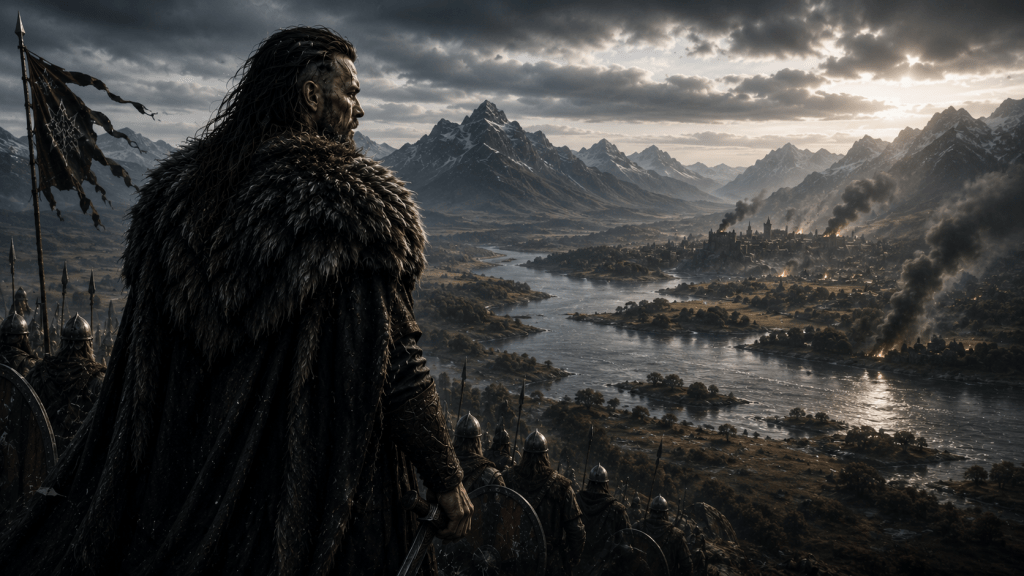
When the longboats reach Vaeldring, the invasion becomes real. The ships grind onto the shore, warriors spill into the shallows, and the first village falls beneath Frostbane steel. It would be easy to frame this moment as triumph, but Týrnan’s reaction complicates it. The victory comes too easily, and that ease unsettles him more than resistance might have done.
The defenders are few. The settlements seem exposed. Villages are abandoned with a speed that suggests preparation rather than cowardice. Other chieftains see weakness and opportunity, while Týrnan sees a pattern he cannot yet explain. Something has drawn Vaeldring’s strength elsewhere, and the silence left behind feels less like surrender than a warning.
This is where Týrnan’s mind separates from the men around him. Some see plunder. Some see captives. Some see a road opening towards greater conquest. Týrnan sees absence, and that absence troubles him because it implies a larger movement beyond the reach of his immediate knowledge.
His refusal to let the Frostbane take slaves matters here. It does not make him innocent, and it does not erase the violence of the invasion, but it marks a boundary within him. He will take resources for war. He will fight enemies. He will march into foreign lands for the future he believes his people need. Yet he refuses to let his tribe become a swarm of men who mistake suffering for spoils.
That line may not be enough to save him from guilt, but it shows that a line still exists.
The Conqueror Who Has Not Yet Chosen Himself
Týrnan’s Book 1 arc matters because he begins as a conqueror who has not fully understood what conquest will ask of him. He believes he is moving towards survival, honour, and perhaps divine favour, yet every step south places him closer to truths that disturb the simplicity of that belief.
He is not a hero standing cleanly apart from the darkness. He is not a villain without conscience. He is a man moving through war while still trying to preserve some inner law against the appetite of the campaign around him. That makes his choices more interesting because they do not come from purity. They come from pressure, contradiction, and the slow recognition that a leader may be judged not only by the victories he wins, but by what he allows victory to turn him into.
The lands ahead are already preparing for another threat, and Týrnan does not yet understand how wide the conflict truly is. The southern kingdoms are not empty prizes waiting for northern hands. They are part of a larger world already strained by hidden forces, political fractures, ancient memory, and powers moving beneath the surface of ordinary war.
By the end of his early movement, Týrnan has crossed the sea, entered the southern kingdoms, and begun the invasion that will shape his future. Yet the most important part of his story is not the land he takes. It is the doubt he carries with him.
The war he crossed the sea to fight is only the beginning, and before long the warleader of the Frostbane will be forced to decide whether strength means obedience, conquest, restraint, or something far harder than any of them.
He will have to decide what kind of man he truly is.
In The Unmarked Path, the first book of The Veil of Kings and Gods, Prince Patrick begins in a place of uneasy authority.
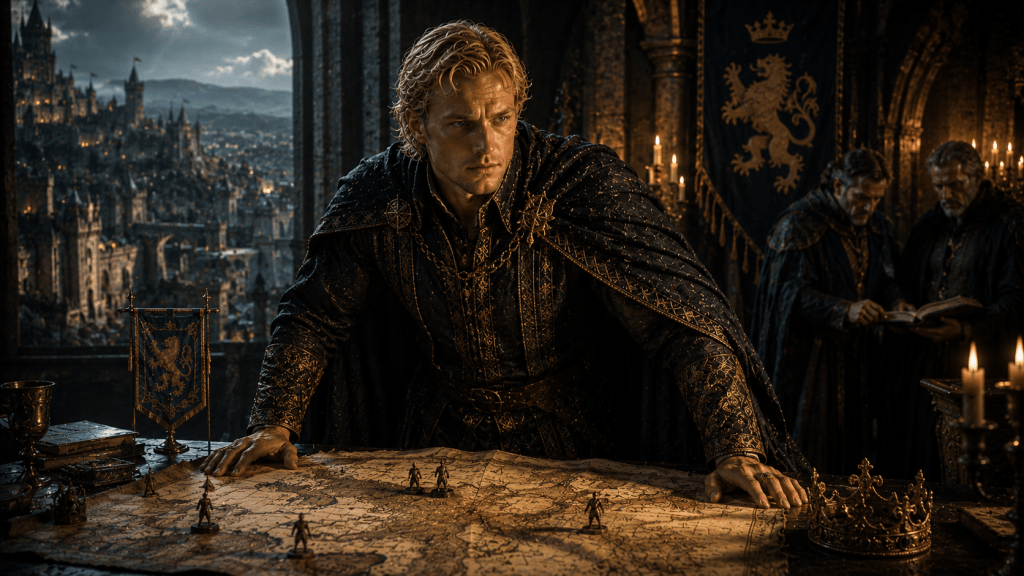
He is not introduced as a king in waiting, nor as a prince hungry for power. He is third in line to Bremyra’s throne, shaped by tutors, court duties, and the quiet expectation that others would stand before him when history made its demands. His father, King Cedric, carried the crown. His elder brothers, Aric and Aiden, carried the future.
Patrick was meant to serve beside them, to advise, to support, to understand the workings of power without being forced to become its centre.
Their absence changes everything.
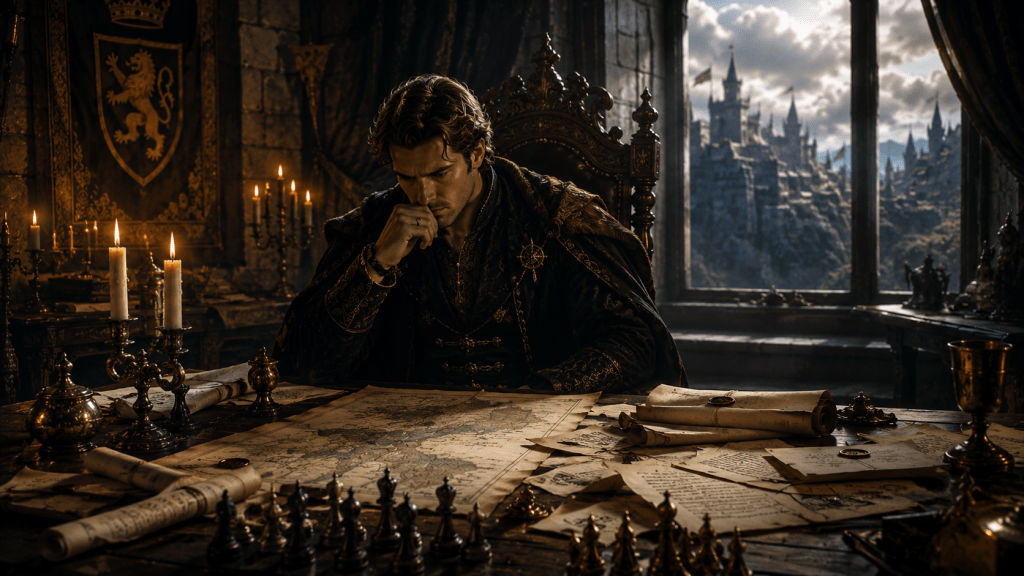
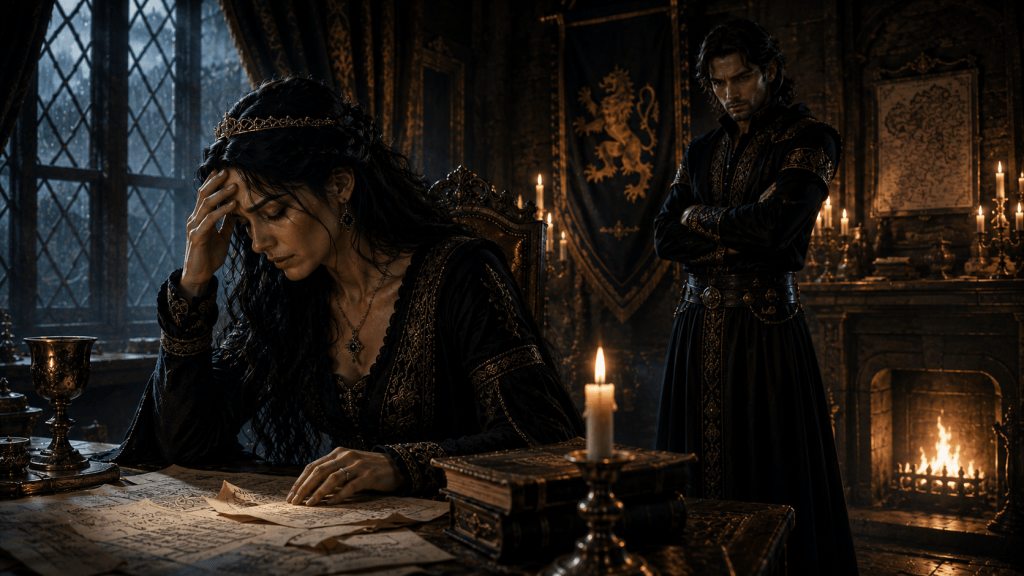
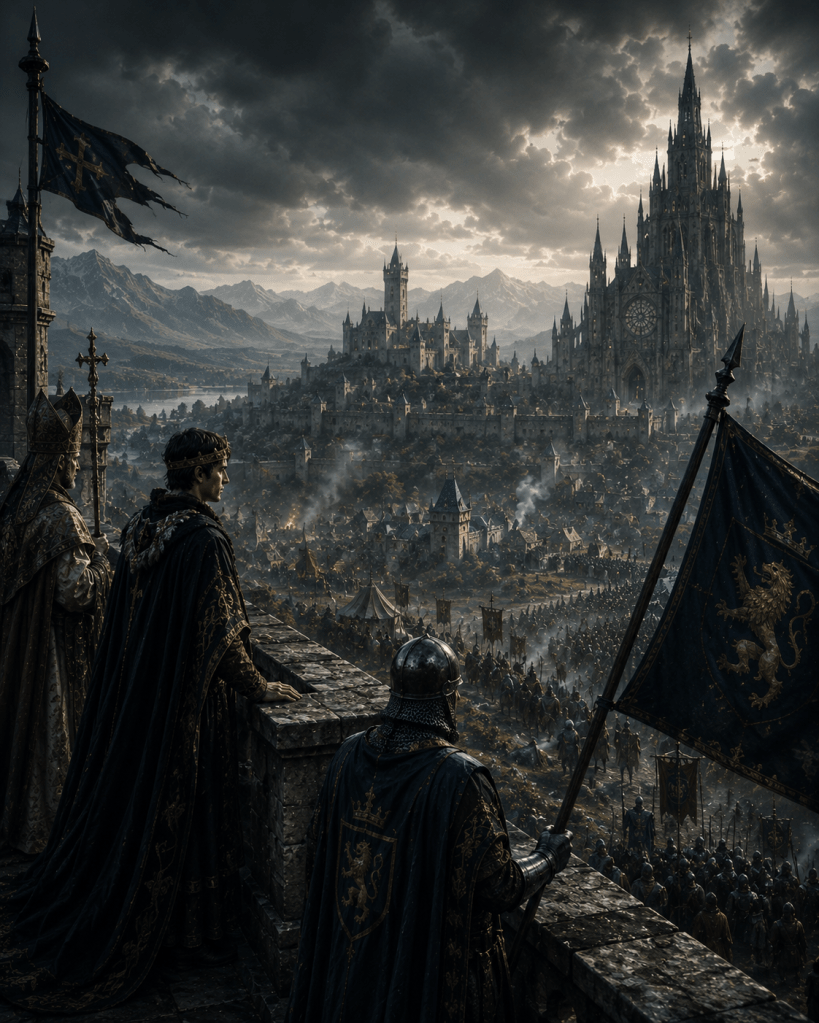
With the King and the twin princes gone beyond the familiar borders of the realm, Patrick is left at a desk that still feels like his father’s, answering petitions beneath banners that seem to remember stronger hands. The kingdom has not stopped to mourn their silence. Bremyra still requires judgement, diplomacy, restraint, and command. Each sealed letter and whispered report draws him deeper into a role he never sought, while the court watches to see whether the third son can hold steady beneath the weight of a crown that has not yet been placed upon his head.
A Prince Left at His Father’s Desk
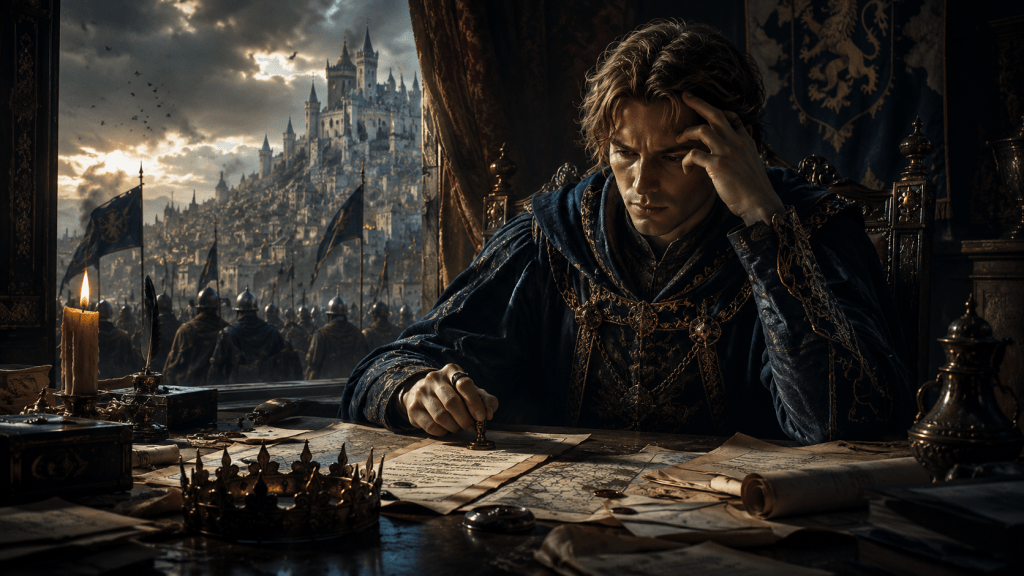
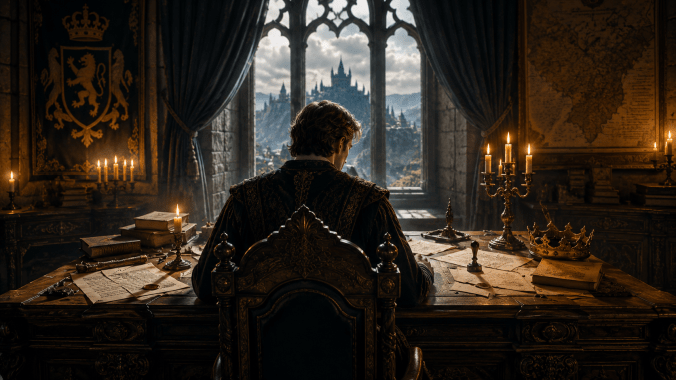
Patrick’s first appearance places him at his father’s desk, surrounded by court proceedings, petitions, diplomatic letters, and the ordinary machinery of rule. The scene is quiet, yet it carries pressure from the beginning. Bremyra has not collapsed. The castle still functions. Servants still move through its halls, guards still hold their posts, and the court still expects decisions.
That is what makes Patrick’s position so difficult.
There is no grand ceremony announcing that power has shifted. There is no clean moment where he chooses the burden. Instead, responsibility gathers around him slowly, page by page, seal by seal, until the absence of his father becomes its own form of command.
The desk itself matters. It is more than furniture in this scene. It is the place where King Cedric once shaped the movement of the kingdom, where treaties were read, roads considered, disputes answered, and royal judgement turned into law. For Patrick, sitting there is not an act of possession. It is an intrusion into a space that still belongs to someone else.
Every object around him reminds him of that. The papers waiting for his seal, the chair beside him, the formal language of court proceedings, even the silence of the room all point towards the same truth. Bremyra has continued, but it has continued around an absence.
King Cedric and the twin princes have been gone too long. Their expedition beyond the known reaches of the old empire has fallen into silence, and the court cannot live on hope alone. Patrick feels that silence every time he sits in the chair that should not yet belong to him.
This is where his burden begins. Not on a battlefield. Not before cheering banners. Not with a crown lowered onto his head.
It begins in paperwork, in waiting, and in the uneasy knowledge that a kingdom still needs ruling even when the rightful voices have gone quiet.
Patrick is trained, intelligent, and capable, yet capability is not the same as certainty.
He understands statecraft. He understands alliances. He understands that kingdoms survive through careful balances rather than noble feeling alone. His education has prepared him to read treaties, weigh counsel, manage factions, and recognise the danger hidden inside polite words. Yet Book 1 catches him at the moment where knowledge begins to harden into lived responsibility.
Bremyra is not waiting for him to feel ready.
Arvendral stirs with uncertain intentions, offering the language of peace while its movements suggest something more cautious and dangerous. Vaeldring becomes vital through Elana’s arranged marriage, turning his sister’s future into part of Bremyra’s political survival. Thalosia presses its own designs upon Patrick’s future, reminding him that even his personal life is no longer fully his own.
Every alliance has a cost, and every delay invites danger.
Patrick must decide while still grieving absence. He must govern while wondering whether his father and brothers will return. He must listen to advisers who expect steadiness from him, even as he feels the shape of his own inexperience beneath every command. The court sees a prince at the centre of power, but Patrick feels the empty spaces around him more sharply than the authority in his hands.
He is forced to think not as a younger son waiting behind the true heirs, but as the man currently holding the centre of the realm together.
This is the quiet tragedy of his opening arc. He has inherited pressure without inheriting clarity, and the kingdom has begun asking him for the certainty that no one has given him.
Elana and the Human Cost of Royal Duty
Patrick’s bond with Princess Elana gives his story its human warmth.
Their conversations carry the ease of siblings who have known one another beyond titles, ceremony, and court expectation. Elana does not look at Patrick only as the acting ruler of Bremyra. She sees the brother beneath the office, the young man sitting at their father’s desk before he has fully learned how to bear its weight. Patrick, in turn, sees more in Elana than the court allows. She is not merely a princess to be sent towards Vaeldring, nor a name placed into marriage negotiations. She is his sister, perceptive, spirited, and quietly braver than many of the men who speak around her.
That makes her departure harder.
Her marriage to Vaeldring is not treated as decoration. It is political architecture. Through her, Bremyra reaches towards stability, alliance, and protection at a time when the kingdom cannot afford isolation. Through Patrick, the same pressure appears in another form, as Thalosia looks towards him as a future husband and political partner. Their lives are being shaped into bridges between realms, and those bridges are built from obedience, silence, and sacrifice.
For Patrick, Elana’s journey is both necessary and painful. He understands why she must go, yet understanding does not soften the loss. Her absence removes one of the few voices able to speak to him honestly, one of the few people who can meet his burden without turning it into performance.
Both siblings are being moved by the needs of the realm.
Neither is truly free.
Bremyra Beneath Strain
Book 1 presents Bremyra as a kingdom still standing, yet already under pressure from several directions.
The danger is not simple. It does not arrive through one army at the gate or one enemy declaring war. Instead, it comes through rumours, border tension, court unease, foreign movement, and unanswered questions. Patrick must govern inside that uncertainty.
The court watches him. The Church measures the arrival of the Order. The nobles depend upon him while also studying his weakness. Every decision he makes is made beneath the shadow of men who are absent and institutions that remain powerful.
Patrick’s strength in Book 1 is not certainty. It is endurance. He keeps sitting at the desk. He keeps answering. He keeps listening. He keeps choosing, even when every choice feels incomplete.
The Arrival of Simion
The arrival of Simion changes the shape of Patrick’s burden.
Until that point, Patrick’s problems, however heavy, still belong to the visible world of rule: letters, borders, marriages, missing family, restless neighbours, and a court that expects him to answer before he feels ready. Simion brings something different into Bremyra. He brings the Order with him, and the Order is not simply another political body waiting to be managed.
To the court, Simion is a magician, and that alone is enough to unsettle the air inside the castle. The Order does not stand beneath a crown in the way soldiers, servants, and councillors do. It carries older authority, colder memory, and laws of its own. Its presence reminds Bremyra that there are powers in Ældorra which do not bend easily to royal command.
Patrick senses this immediately.
He wants plain answers, yet Simion does not offer them. The magician speaks with restraint, carries himself with controlled distance, and seems to move through Bremyra as both guest and investigator. He has returned to a place he once knew, yet he does not belong to it in any simple way. That makes him difficult for Patrick to read. Simion is familiar and foreign at once, tied to childhood memory through Elana, yet shaped by an institution Patrick cannot fully trust.
His presence stirs different fears in different people. Elana remembers the boy from the kitchens and sees something human beneath the robes. The Church sees the shadow of the Order and answers with suspicion. Patrick stands between both responses, aware that Simion may be dangerous, useful, wounded, or all three at once.
That uncertainty matters.
Patrick is not naïve enough to dismiss the threat a magician might pose, but neither is he foolish enough to ignore what Simion represents. Bremyra’s dangers are widening beyond ordinary court business. Foreign attackers have begun to move where they should not. The silence surrounding King Cedric’s expedition has grown harder to explain. The old world, once safely buried in books and ruins, seems to be pressing closer to the present.
In that atmosphere, Simion becomes more than an unsettling arrival.
He becomes a question Patrick cannot afford to put aside.
That tension becomes one of the important relationships in Book 1. Patrick cannot fully trust Simion, but he cannot ignore him either. He needs answers, yet the man most likely to find them carries secrets of his own. The prince and the magician stand on opposite sides of old authority, crown and Order, yet both are being drawn towards the same gathering storm.
For Patrick, accepting Simion’s presence is not an act of comfort.
It is an act of necessity.
Patrick’s understanding of power changes during the ambush in Bremyra.
Until that moment, magic can still be kept at a distance. It belongs to the Order, to old stories, to political caution, and to the fear other people carry when a magician walks through the room. Patrick can study it as a matter of court risk. He can weigh Simion’s presence as a political complication. He can listen to the Church’s distrust and the council’s unease while still treating magic as something held beyond the ordinary shape of his duties.
Then foreign attackers strike inside Patrick’s own city, and all distance vanishes.
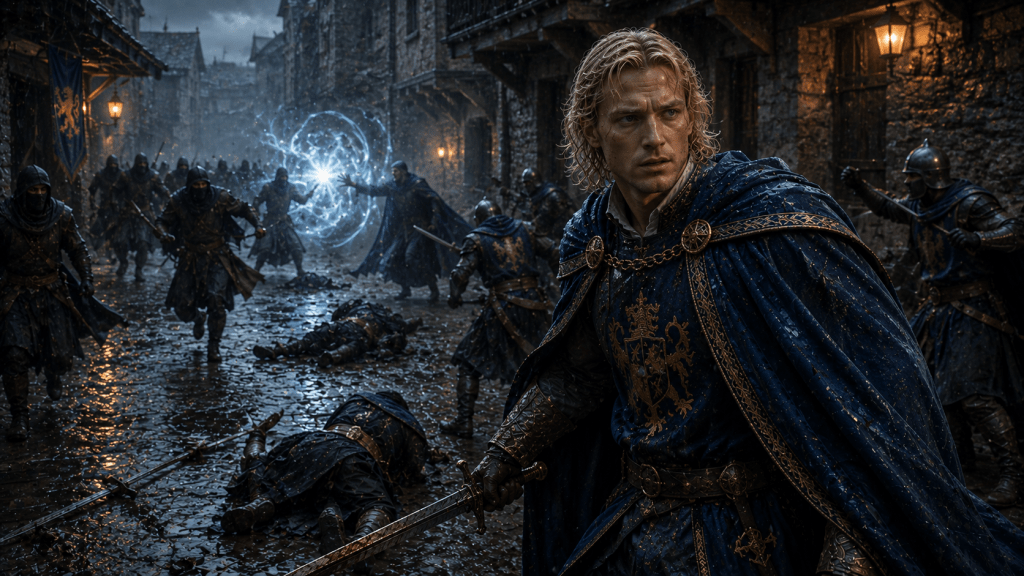
The attack is brutal, immediate, and personal. Patrick is no longer dealing with reports, rumours, or border movement. He is facing steel, strength, and death at close range, with the guards around him struggling to contain a threat that should never have reached him. The street becomes a place of sudden exposure. The prince who has spent his days behind desks, councils, letters, and guarded ceremony is forced into the raw truth of violence.
When Simion intervenes, Patrick sees magic not as theory, but as force.
There is no courtly veil around it. No ancient language softened by distance. No comfortable illusion that such power belongs safely inside the boundaries of the Order. Simion acts with speed and precision, and the world around Patrick changes in the space of a breath. The magician does not merely assist. He alters the outcome entirely.
It saves Patrick’s life.
It also unsettles him.
That is what makes the moment important. Patrick is grateful, yet he is too perceptive to be simple in his gratitude. He understands that the same power which protected him could terrify a court, silence a street, or reshape the balance between crown and Order if misused. He has seen something no council report could fully prepare him for: a man standing beside him who carries a kind of authority no prince can command in the ordinary way.
Patrick does not respond like a fool. He does not dismiss what he has seen, nor does he surrender blindly to it. He recognises the truth placed before him. Bremyra’s troubles may reach beyond ordinary politics, and Simion’s strength may be part of whatever answer the kingdom needs.
From there, Patrick’s relationship with Simion shifts. Gratitude enters the space between them. So does caution. So does necessity.
Patrick may not yet understand what Simion truly is, but he understands this much: Bremyra has stepped onto ground where steel, law, and royal blood may no longer be enough.
The Crown Begins Before the Coronation
Patrick’s arc in The Unmarked Path is not about becoming king in name. It is about the crown beginning to shape him before he is ready to wear it.
He is still a prince. He is still waiting for news of his father. He is still measuring himself against brothers who were meant to stand ahead of him. Aric and Aiden carry the image of succession more naturally in Patrick’s mind, while King Cedric remains the figure whose judgement should steady the realm. Yet their absence leaves no living hand between Patrick and the demands of Bremyra.
That absence becomes a kind of pressure.
Every petition placed before him reminds him that the kingdom cannot pause. Every council meeting asks him to speak with a confidence he does not fully feel. Every border report, marriage negotiation, and whisper from the court presses him closer to the shape of rule. He is not crowned, yet already he is being tested by the crown’s demands.
That is where his story gains its weight.
Patrick does not have Simion’s magic. He does not have Týrnan’s warrior certainty. He does not carry Elana’s hidden brilliance in the same way. His burden is different. He must stand in rooms where everyone wants something. He must listen to soldiers, priests, councillors, nobles, and foreign powers, knowing that each voice carries its own fear, ambition, or concealed truth.
He must make choices with incomplete knowledge. He must protect a kingdom that may already be part of a much older conflict. He must learn that leadership is not always a matter of bold speeches or battlefield glory, but of remaining steady while the world quietly removes every certainty around him.
Patrick’s strength in Book 1 is not triumph. It is endurance under scrutiny. He continues to sit at the desk, answer the summons, weigh the reports, and hold the centre while forces greater than one prince begin to move around Bremyra.
Why Patrick Matters in Book 1
Patrick matters because he gives the opening story its political heart.
Through him, Bremyra becomes more than a backdrop. It becomes a living kingdom, full of fragile alliances, absent rulers, cautious advisers, religious authority, old loyalties, and roads that no longer feel safe. His chapters show what happens when ancient danger begins pressing against ordinary governance, not through prophecy alone, but through letters, councils, rumours, borders, and the silence left by those who should have returned.
He stands between the personal and the political. Elana’s future is not only his sister’s sorrow, but part of Bremyra’s survival. Simion’s arrival is not only the return of a childhood memory, but a threat to the balance between crown, Church, and Order. Every private fear Patrick carries is mirrored by a public consequence waiting beyond the chamber door.
The wider world may be turning towards magic, invasion, and divine memory, but Patrick’s struggle remains deeply human.
He is tired.
He is uncertain.
He is watched.
And still, he must rule.
The Reluctant Heir
By the end of Book 1, Patrick has not solved Bremyra’s troubles. He has not uncovered the full truth of the foreign attackers, his father’s disappearance, or the strange forces gathering around Simion. What he has done is survive the first testing of his authority, and that survival matters.
He has seen that danger can reach him inside his own city, slipping through streets he believed protected by law, guard, and stone.
He has seen that Simion’s power may alter the fate of Bremyra, not as distant legend or court rumour, but as a force standing beside him when steel comes too close.
He has seen that Elana’s path is far more fragile than politics allowed him to believe, and that royal duty cannot always protect those it claims to serve.
Most of all, Patrick has begun to understand that rulership does not arrive with certainty. It arrives through pressure, through fear carefully hidden, through decisions made before every answer is known. His father’s chair remains too large for him, yet the kingdom has already begun looking to him as though he belongs there.
The crown is not waiting politely in the future.
It is already pressing its weight into his hands.
The Unmarked Path begins the first movement of The Veil of Kings and Gods, a fantasy series of political pressure, ancient magic, divine silence, and the people caught at the edge of forces older than kingdoms.
Sometimes that doorway is a battlefield. Sometimes it is a throne room, a prophecy, a blade drawn under stormlight, or a kingdom already burning beneath the weight of war.
In The Unmarked Path, the doorway is quieter.
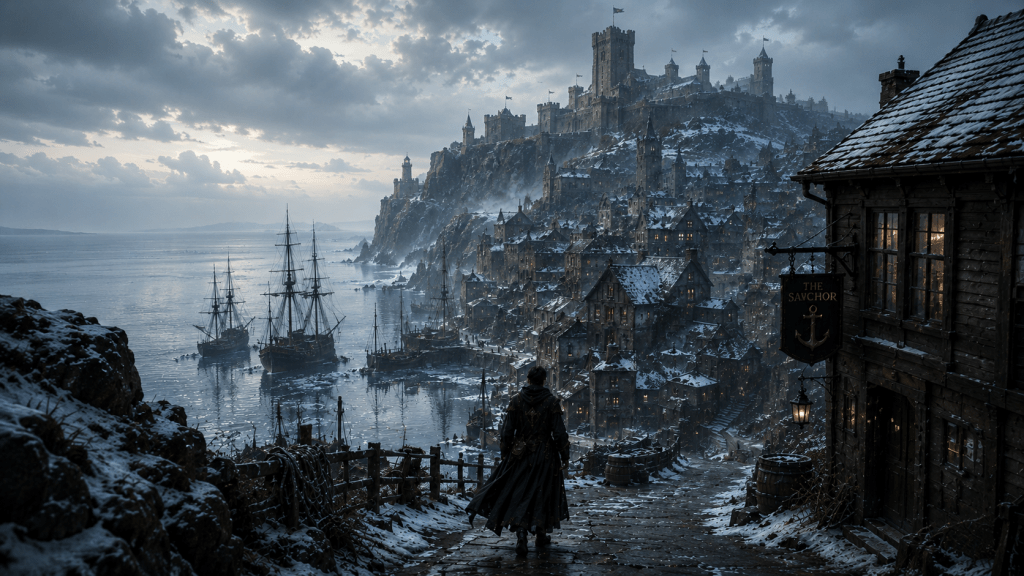
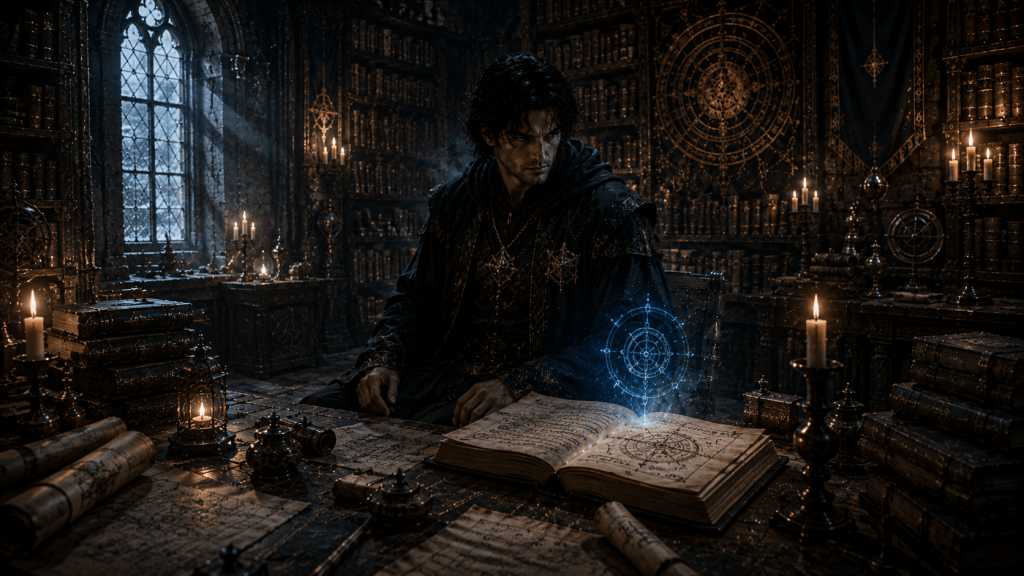
It opens with Simion, a magician of the Order, arriving in the cold coastal kingdom of Bremyra beneath a winter sky. He comes dressed in the black robes of an institution feared across the realm, carrying the authority of ancient magic and the uncertainty of a man who has never fully believed he belongs among those who wield it.
That tension is where his story begins.
Simion is no simple fantasy hero waiting for applause. He is no flawless master of the arcane, no proud champion striding into the world with certainty burning in his hands. He is weary, observant, guarded, and deeply human. He has been trained by the Order of Magicians, shaped by discipline and expectation, yet his place among them has always felt uneasy. Magic answers him in strange ways. Some simple things resist him, while darker and older powers seem to recognise him before he recognises himself.
That makes him dangerous.
It also makes him compelling.
A Magician Who Feels Out of Place
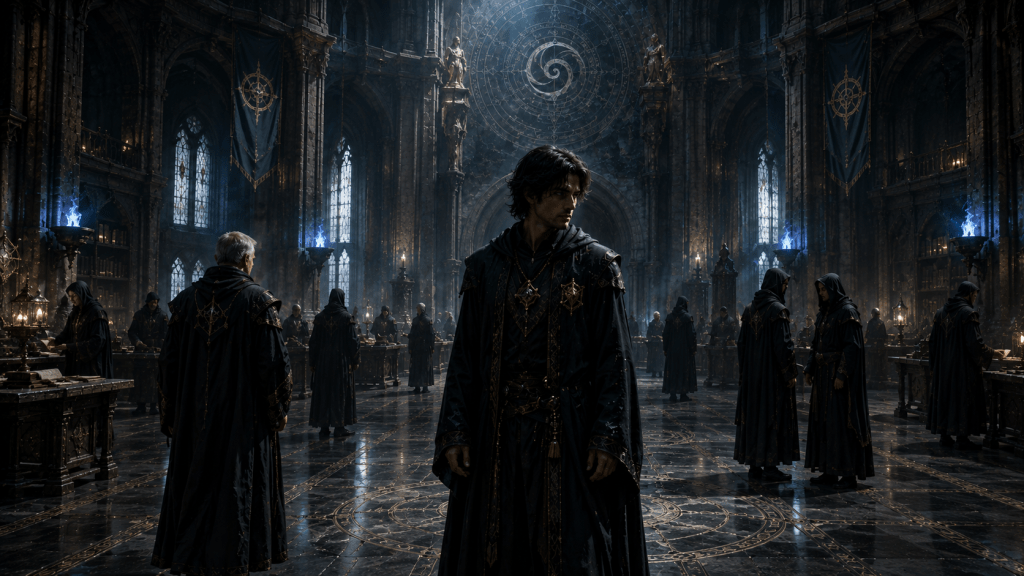
The Order of Magicians stands as one of the great institutions of Ældorra. It is old, powerful, and shaped by a history most of the living world only half-remembers. Its members are trained in discipline, ritual, incantation, and obedience. They carry an authority separate from kings, priests, and ordinary law.
Simion has passed through that world. He has learned its rules. He wears its robes.
Yet from the beginning, he feels like someone standing at the edge of his own life.
He has never been entirely comfortable among magicians who treat power as rank. At the Academy, he struggled where others advanced easily. He lacked the arrogance that often comes with mastery. His gifts seemed uneven, almost unreliable, as though the magic within him moved by some older rhythm than the lessons placed before him.
That uncertainty matters.
Simion begins the story believing himself ordinary by the standards of the Order. Skilled, perhaps. Capable enough to be useful. Still, he sees himself as a man chosen for duty, not destiny. He obeys because obedience is familiar. He studies because study is safer than instinct. He observes because action carries consequences he rarely feels ready to command.
The tragedy and beauty of Simion is that the world has already begun to move around him before he understands why.
Bremyra and the Weight of Return
When Simion arrives in Bremyra, he enters more than a kingdom under political strain. He returns to a place tied to his own buried past.
Before the robes, before the Order, before the careful distance he now keeps between himself and others, Simion once knew Bremyra through smaller rooms, warmer memories, and the overlooked spaces of castle life. He was once close enough to the royal children to carry echoes of childhood mischief, laughter, and belonging.
Years later, he returns as Lord Magician.
That title changes everything.
The servants fear him. The court watches him. The Church distrusts him. Patrick measures him with the caution of a prince carrying too many burdens. Elana remembers the boy beneath the robes, and that memory unsettles him more than suspicion ever could.
This is one of the strongest tensions in Simion’s character. He is treated as a figure of power, yet part of him still remembers being powerless. He is feared by people who once might have ignored him. He is addressed with reverence in halls where he once moved unseen.
Bremyra forces him to confront the distance between who he was and who the world now believes him to be.
The Mission Beneath the Surface
Simion’s official presence in Bremyra carries a polished explanation. He is there to observe, advise, and assist if needed. That is the surface truth presented to the court.
The deeper truth is more troubling.
Three magicians of the Order vanished in connection with King Cedric’s expedition and investigations into remnants of the ancient Imperium Arcana. Simion has been sent to uncover what happened. His task places him at the centre of a dangerous triangle: the Order, the royal household, and the Church.
Every question he asks risks offence. Every answer he finds may damage the fragile balance of the kingdom. If the missing magicians were betrayed, the consequences could reach far beyond Bremyra. If the Order is wrong, then Simion has arrived as a quiet threat inside a court already strained by absence, politics, and approaching war.
This gives his role a constant unease.
He is adviser and investigator. Guest and watcher. Servant of the Order and reluctant participant in royal life. He stands close enough to Patrick to earn trust, close enough to Elana to awaken old feeling, and close enough to hidden history to disturb forces that were meant to stay buried.
A Power Beyond the Lessons He Was Taught
The heart of Simion’s story lies in the gap between learned magic and something older.
In the world of The Veil of Kings and Gods, magic is structured. Magicians speak Flow. They shape power through words, training, and controlled forms. The Order teaches magic as discipline. It gives names to the currents of the world and expects its students to follow them.
Simion’s magic begins to move differently.
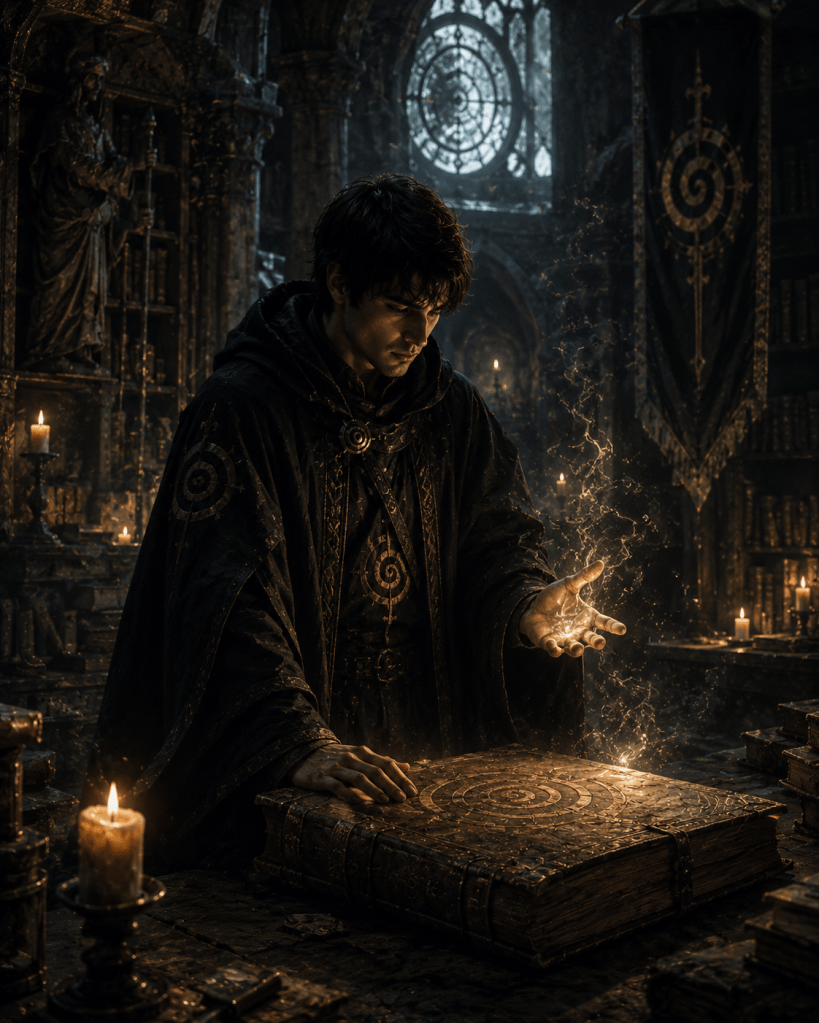
At first, these moments are subtle. A sealed book responds to him. Runes stir beneath his hands. Power gathers in silence, where silence should carry no spell. He feels forces he has no language for, forces that seem to reach past the laws of the Order and into the buried bones of the world.
This does not make him triumphant.
It frightens him.
That fear is important. Simion is powerful, yet he is also careful. He does not rush towards glory. He does not understand what has awakened around him. The old structures that shaped his life offer little comfort once his own magic begins to break their rules.
He begins to realise that the Order may have taught him how magic behaves, while something far older may be showing him what magic remembers.
The Hidden Book and the Call of the Seal
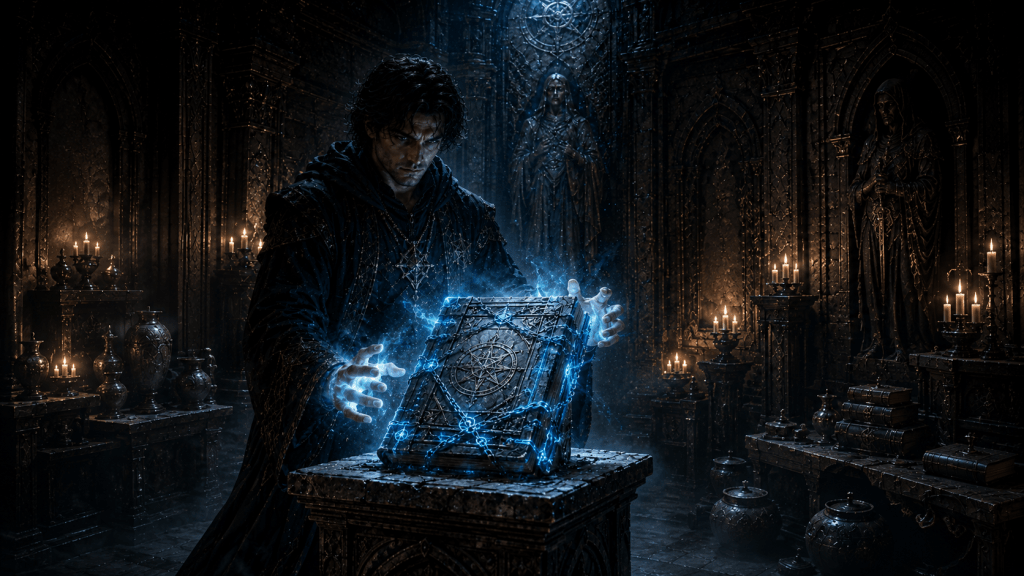
One of the defining images of The Unmarked Path is the hidden book beneath Bremyra.
Simion is drawn into the castle’s depths by whispers and old magic, where the familiar world of court duty, council suspicion, and royal politics gives way to something older. Beneath the halls where princes argue, priests watch, and servants move through their ordinary routines, another Bremyra waits in the dark. Its stones remember an age the kingdom has forgotten, and in that buried chamber, the past begins to reach for him.
At its centre waits an ancient book protected by a weave he does not understand.
The book is more than an object. It is a threshold.
It belongs to the part of Ældorra that survived in ruins, buried rooms, sealed warnings, and fragments of divine memory. It represents everything Simion cannot yet name: hidden history, forgotten magic, divine pressure, and the unsettling sense that his life has been touched by something older than the Order. The magicians who trained him taught rules, forms, and discipline. The book offers none of those comforts. It gives him no easy explanation, no clear command, no gentle revelation. It simply waits.
That waiting is what makes it powerful.
When the warning comes, it arrives in fragments. The seal weakens. The burden waits. The path will reveal itself only when its weight is accepted. There is no grand ceremony, no clean answer, and no voice kind enough to tell Simion exactly what he has become part of. The moment feels less like discovery and more like inheritance, as though something ancient has finally found the one person able to hear it.
For a man who has spent much of his life feeling uncertain of his place, this is devastating.
Simion wants understanding. What he receives is responsibility.
He wants answers. What he receives is a sealed path.
He wants control. What he receives is a mystery that responds to him in ways no ordinary magician should be able to explain.
That is why the hidden book matters so deeply to his story. It marks the point where Simion’s life begins to move beyond the limits of the Order. He can still pretend, for a time, that he is only an advisor, only an investigator, only a magician sent to Bremyra under orders. Yet the book has already changed the shape of the world around him. It has placed a quiet hand on his fate.
From that moment onward, Simion is no longer searching only for missing magicians.
He is searching for the truth of magic itself.
And the deeper he follows that truth, the more dangerous the path becomes.
Elana and the Human Thread
Simion’s story would lose much of its force if it only moved through magic, prophecy, and ancient danger.
Elana gives his arc its human warmth.
She remembers him before the title, before the robes, before the fear others attach to him. Her presence cuts through his formal distance, drawing forward traces of the boy he once was. She is bold, perceptive, and unafraid in a way few people around Simion are. Where others see the Order, she sees the man beneath it.
Their connection is layered with memory, restraint, duty, and danger. Elana is bound to royal obligation. Simion is bound to the Order. Neither of them moves freely, and that makes every exchange carry more weight than open confession could.
Through Elana, Simion is reminded that he is still human. He can still be seen. He can still be unsettled by kindness. He can still feel the pull of a life beyond duty, even as darker forces gather around him.
That matters because Simion’s greatest conflict is not simply whether he has power.
It is whether power will leave enough of him behind to love, fear, hesitate, and choose.
He belongs to the Order, yet his power challenges its laws.
He enters Bremyra as an outsider, yet his past ties him to its royal family.
He seeks missing magicians, yet finds traces of something divine.
He believes he is following instructions, yet the world around him begins to move as though history has taken notice.
That is the kind of character who can carry a long fantasy saga. Not because he knows all the answers, and not because he rushes towards destiny with a raised blade. He matters because he is uncertain in the face of forces that demand certainty. He matters because he resists becoming the thing others expect him to be. He matters because the power awakening around him is vast, yet the emotional core of his story remains intimate.
He is a man caught between institutions, kingdoms, memory, and magic.
He is also the first sign that the forgotten history of Ældorra has begun to return.
The Story Begins With The Unmarked Path
The Unmarked Path is the opening book of The Veil of Kings and Gods, set within The Chronicles of the Spiral Realms. It begins a slow-burn epic fantasy saga of forbidden magic, ancient gods, royal duty, political tension, hidden histories, and divine silence.
For readers who enjoy mythic high fantasy with atmosphere, mystery, and character-driven tension, Simion’s story offers the first step into a much larger world.
He does not begin as a hero.
He begins as a magician sent to Bremyra under orders he barely understands.
Beneath the castle stones, something waits.
Above him, gods remain silent.
Around him, kingdoms begin to shift.
And somewhere within the sealed places of the world, the Spiral begins to turn.
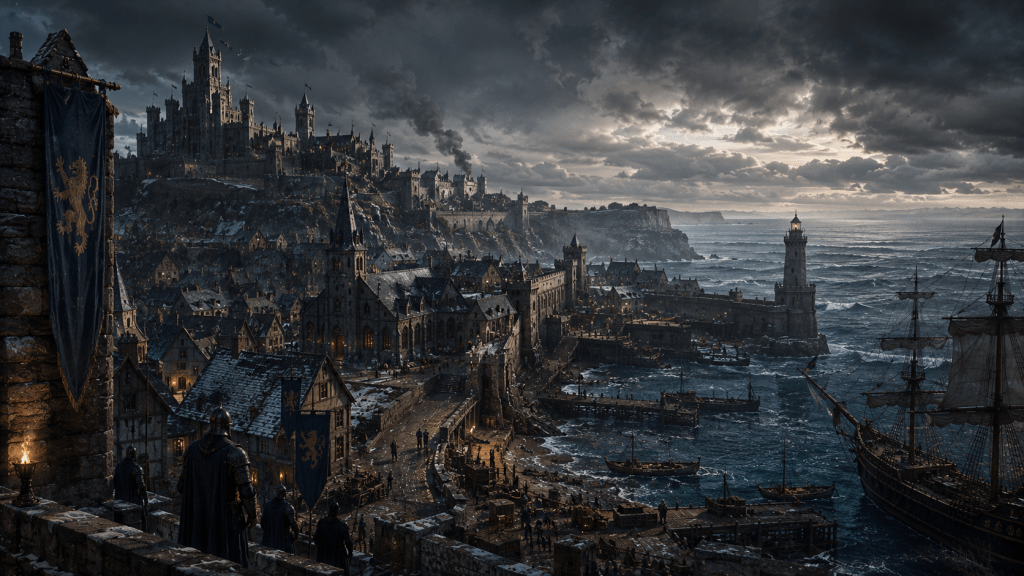
A cold road leads into Bremyra, where the sea wind carries salt through narrow streets and old stone holds more memory than any living court dares to name. In The Unmarked Path, the opening novella of The Veil of Kings and Gods, magic is never treated as ornament. It belongs to law, fear, inheritance, and silence. It lingers beneath castle floors, inside sealed books, in the guarded breath of the Church, and in the hands of a magician who scarcely understands why the world has begun to turn around him.
This is the beginning of The Chronicles of the Spiral Realms, a serious adult high fantasy series shaped by ancient gods, forbidden magic, kingdom politics, fallen empires, and the slow return of truths buried beneath the present age. Ældorra is a world where mortal institutions believe they hold power, yet every crown, altar, and magical order stands upon older ground.
A World Built Over Forgotten Power
The world of Ældorra carries the remains of the Imperium Arcana, a fallen magical empire whose ruins still press through the age of kings. Its laws have decayed into custom. Its divine wounds have hardened into doctrine. Its power survives in fragments, watched over by institutions that remember enough to fear the past, yet never enough to understand it.
The Order of Magicians stands at the centre of that inheritance. Powerful, feared, and separate from crown or Church, the Order preserves magic through discipline and secrecy. Yet preservation is not the same as wisdom. Beneath its authority lies fracture, and beneath its history lies a truth far older than its masters are willing to face.
Opposite it stands the Church of Christiana, sacred and political in equal measure. Its cathedrals offer prayer, order, and memory, yet those memories are guarded by men who understand that truth can unmake authority as easily as war can unmake kingdoms. In this kind of mythic fantasy series, faith and magic are never safely divided. Each claims to serve the world. Each fears what the other might uncover.
Simion and the Burden of Reluctant Power
Simion enters the story as no triumphant chosen hero. He arrives tired, uncertain, and obedient, sent by the Order to Bremyra under instructions he only partly understands. His strength lies not in arrogance, but in restraint. He carries power, yet he also carries doubt, old loneliness, and the uneasy knowledge that magic has never fitted him in the way it fitted others.
That makes him central to the series’ tone. The Unmarked Path is an epic fantasy novella concerned with consequence before spectacle. Simion’s magic matters because it alters rooms, relationships, loyalties, and fear. When he walks through Bremyra, people remember the idea of magicians before they see the man. His black robe is enough to change the air around him.
Yet the deeper pressure comes from what he cannot explain. A hidden book. A seal. A divine whisper. A moment when magic moves through him in silence, beyond the methods the Order taught him. These are not answers. They are openings.
Kingdoms, Churches, and the Shape of War
While Simion is drawn toward buried magic, Prince Patrick struggles beneath the weight of mortal rule. Bremyra is a kingdom under strain, held together by court procedure, family duty, marriage alliances, and the absence of a king whose return grows less certain with every passing day.
Patrick’s world is political fantasy in its most human form. There are borders to guard, letters to answer, marriages to arrange, rumours to test, and enemies to watch. War does not arrive as grand spectacle at first. It arrives through uncertainty, through foreign blades in city streets, through reports from the north, through councils where no one has enough knowledge to feel safe.
Týrnan Valgrim’s northern arc gives that pressure another face. His people move south beneath the command of a High Chieftain whose ambition already carries a shadow. Týrnan is a war leader, yet not a simple raider or clean heroic figure. His path is marked by survival, honour, violence, and doubt. Through him, the series begins to show war as moral corrosion as much as military action.
Why Silent Gods Carry More Weight
The gods of The Chronicles of the Spiral Realms are powerful because they are distant. They do not stride through the mortal world giving simple answers. Their silence hangs over prayer, magic, fear, and memory. When divine presence touches the story, it arrives through pressure, vision, symbol, and burden.
This makes the series closer to ancient gods fantasy than conventional quest fantasy. The divine is not a ladder for characters to climb. It is a cost. Mortals pray into silence, institutions build doctrine around absence, and magicians inherit fragments of power whose origins have been softened by myth.
The Spiral itself belongs to that hidden language. It suggests recurrence, divine memory, forgotten truth, and a pattern returning through the lives of people who believe they are facing isolated crises. In The Unmarked Path, the Spiral is felt before it is understood. That restraint gives the saga much of its force.
Entering The Unmarked Path
Readers can begin the saga with The Unmarked Path, available on Amazon Kindle or paperback.
The novella opens the world without emptying it of mystery. It gives the reader Bremyra’s winter roads, the fear of magicians, the weight of royal duty, the unease of the Church, the first movement of northern war, and the sense that older powers have begun to stir beneath every visible conflict.
This is a fantasy novella series for readers who enjoy slow-burn epic fantasy, ancient gods, forbidden magic, magical orders, political tension, and worlds where history is never truly dead. Its power lies in the way the mortal and divine pressures touch one another. A prince’s council, a hidden chamber, a northern storm, a royal ambush, and a sealed book all belong to the same turning, even before the characters can see the shape of it.
The First Sign of a Larger Chronicle
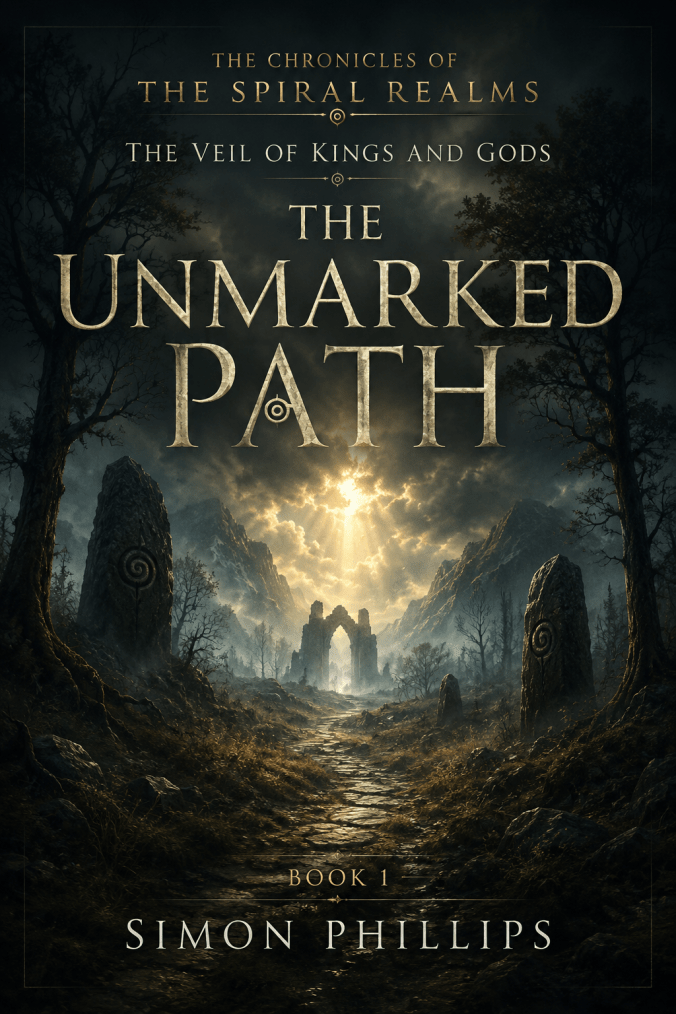
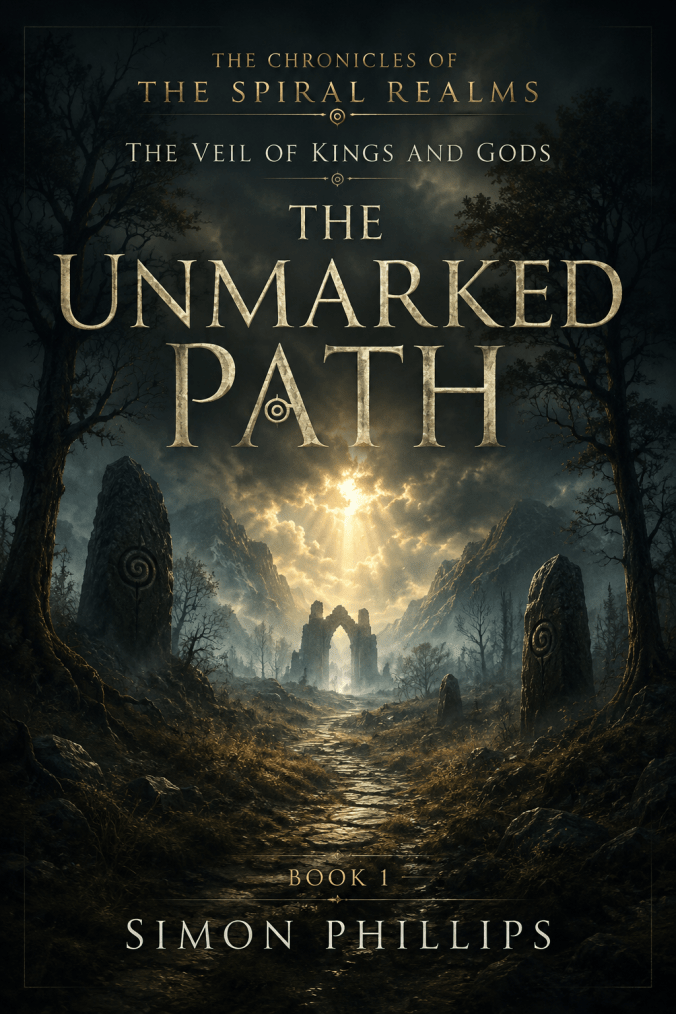
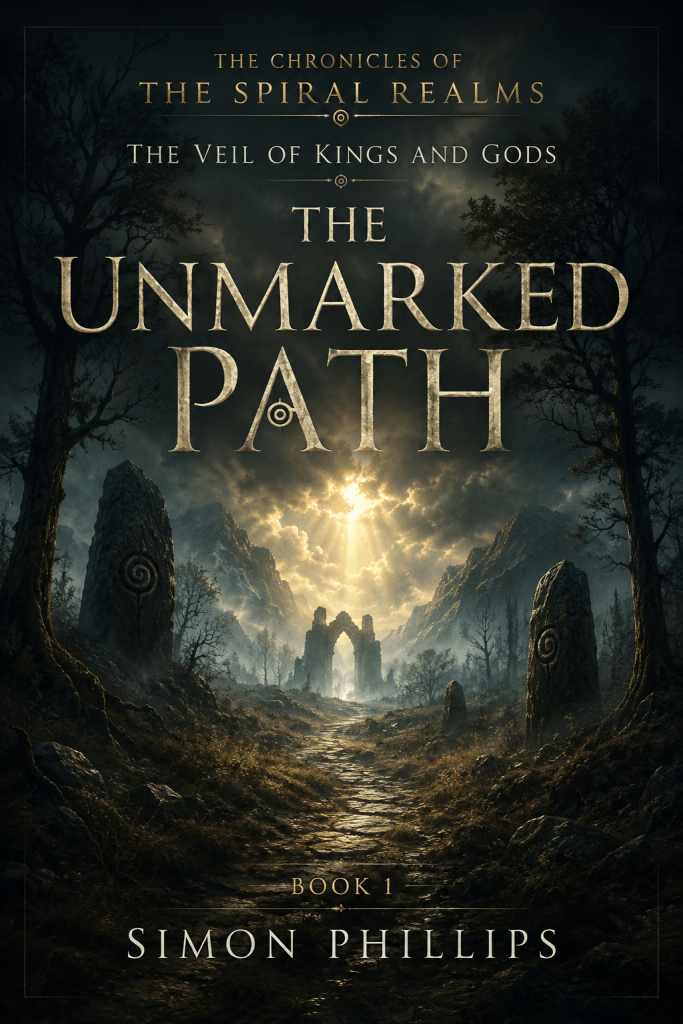
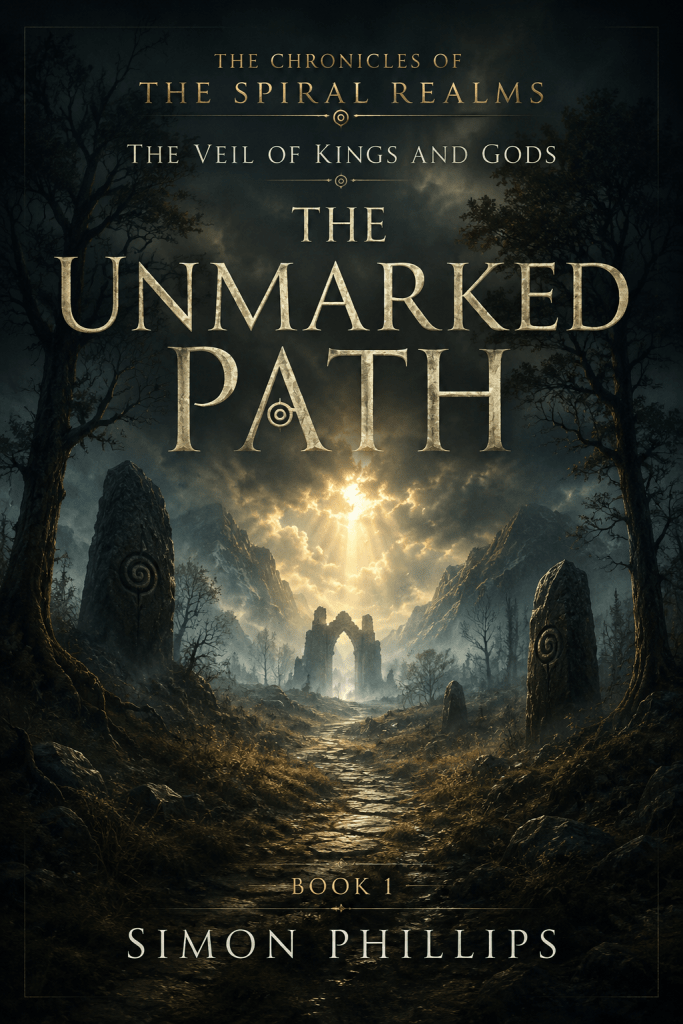
The cover of The Unmarked Path captures that threshold well: a road leading through dark trees and ancient stones, spiral marks cut into a landscape where ruin and destiny seem to share the same breath. It is an image of entry rather than conclusion. The path waits. The title promises no certainty.
That is the heart of the opening novella. The world has not yet broken, yet the first strain is audible. The gods remain silent, yet something divine has already reached toward Simion. The kingdoms continue their ceremonies, yet war gathers beyond their borders. The Order still believes it controls magic, yet magic has begun to move beyond its rules.
The saga is entered through a road, a castle, a book, and a burden. What waits beyond them is older than any king’s claim, deeper than any archive, and far less willing to remain forgotten.
This is the beginning of a new epic fantasy saga within The Chronicles of the Spiral Realms, a world of kingdoms, forbidden magic, ancient gods, buried histories, and mortal lives caught in the shadow of forces far older than they understand.
Every long fantasy series has a first doorway. For this one, that doorway opens in Bremyra, a coastal kingdom of stone, cold sea air, royal duty, old secrets, and the lingering fear of magicians. It begins with Simion, a magician of the Order who arrives under instruction, though even he has little idea why he has truly been sent.
He is not the kind of figure who strides into the story already certain of his destiny. He is uncertain, guarded, and burdened by the feeling that he stands in the wrong place at the wrong time. Yet around him, the world begins to shift. A hidden mission, a royal court under pressure, a princess bound by duty, northern raiders crossing the sea, and whispers of something sealed beneath the old stones all draw the story into motion.
The Unmarked Path is a slow-burn opening to a larger mythic fantasy world. It is built around atmosphere, character, mystery, and consequence. The story is not only about magic as power, but magic as inheritance, memory, fear, and responsibility.
At the heart of the novella is Simion, a reluctant magician shaped by the Order of Magicians, an ancient institution descended from a broken magical empire. He has been trained in power, discipline, and obedience, though he has never truly felt at home among those who taught him. When he arrives in Bremyra, he carries more than a letter from his superiors. He carries the first pressure of a destiny he cannot yet name.
Alongside him stands Prince Patrick, a royal son forced into responsibility while his father and brothers remain absent. Patrick’s world is one of council chambers, alliances, military pressure, marriage arrangements, and decisions made under uncertainty. His story brings the political heart of the novella into focus. Kingdoms are watching one another. Borders are tense. Peace feels formal rather than secure.
Then there is Týrnan Valgrim, a northern warleader whose people begin moving south across dangerous seas. His chapters carry the weight of iron, salt, storm, clan loyalty, and conquest. Through him, the wider world of Ældorra starts to open beyond Bremyra’s walls.
The novella also introduces Elana, Patrick’s sister, whose role reaches beyond royal duty. She brings warmth, intelligence, and emotional force into the story, while also revealing that the laws of magic in this world may be far more fragile than the institutions around her are willing to admit.
What begins as political unease slowly brushes against something older.
The history of Ældorra has been shaped by the Imperium Arcana, the Order of Magicians, the Church, the fallen god Azaroth, and the death of the God of Magic. Much of that history has faded into myth, yet myth has a way of returning when the world grows weak enough to hear it again.
That is where the Spiral begins to matter.
The Spiral is one of the central mysteries of The Chronicles of the Spiral Realms. In this first novella, it is not explained in full. It appears more as pressure, pattern, memory, and warning. It belongs to ruins, divine silence, forgotten truths, and the sense that history is not finished with the living.
For readers who enjoy fantasy that takes its time to build weight and atmosphere, The Unmarked Path offers the first step into a larger saga. It is not a light adventure or a simple quest story. It is a mythic fantasy opening about a world beginning to remember what it buried.
The story is for readers who enjoy:
ancient magical orders, reluctant magicians, royal courts under pressure, forbidden power, divine silence, old books, hidden chambers, political tension, northern warbands, and the feeling that a larger storm is gathering beyond the edge of the page.
This first novella is only the beginning. It opens the path, introduces the key players, and places the first cracks in the world. Simion does not yet understand what is reaching for him. Patrick does not yet understand how far duty will carry him. Elana does not yet understand the cost of the power within her. Týrnan does not yet understand what his people’s march will awaken.
The reader, like them, enters at the point where history begins to turn.
The Unmarked Path is available now on Amazon Kindle.
There are days when the weight of the world feels heavier than ink or fire, when the quiet corners of the soul grow dim beneath the noise of what passes for truth. In such moments, it would be easy to set aside the great tales, to dismiss them as relics, gilded stories carved for brighter ages. Yet I do not.
I still believe in epic fantasy.
That may sound strange to those who favour stark realism, whose shelves are lined with fractured heroes and greyscale worlds. We are told that truth lies in brokenness, that hope is naïve, and that honour is no more than an illusion passed down by old songs and older men. Perhaps. Perhaps the world has earned its doubt.
Even so, I return to the stories where kingdoms rise and fall, where swords gleam beneath ancient skies, and where the soul of a man can alter the course of the stars. I return not because such tales are easy, but because they ask the oldest question with unflinching grace: What is worth fighting for, when the world stands poised on the edge of ruin?
There is power in that question. Quiet, enduring power.
Epic fantasy, when it is true to its roots, does not flinch from sorrow. It walks beside it. It knows the weight of sacrifice, the silence after loss, the slow unwinding of power misused. Yet it dares to offer meaning in the ashes. It does not scoff at faith or nobility. It treats love, be it for a kingdom, a child, a forgotten god, with reverence rather than irony.
That tone, that trust, is something I refuse to let go of.
For me, writing within this tradition is an act of defiance as much as devotion. It is choosing beauty when the world favours bleakness. It is lifting a banner in fog, even when no one watches. And yes, it is believing in things unseen, magic, yes, but also memory, duty, and the soul’s quiet yearning for more.
There are moments in the story I’m shaping where the light fades, where characters stumble beneath burdens they cannot name. In those moments, it would be easy to give in. Yet the story holds steady. Because epic fantasy does not require perfection, it asks only that its heroes rise, however broken they may be.
In a cynical world, that still matters.
So if you find yourself weary of headlines, of noise, of shallow victories and hollow rage, step into a world where the stars still whisper, where the land remembers, and where even the most wounded soul may shape the fate of empires.
You may find, as I have, that there is more truth in those tales than many would dare admit.
There comes a moment in every long series where the world tilts slightly, where what was once a journey across landscapes becomes a passage into myth itself. For The Wheel of Time, that moment arrives in The Shadow Rising, the fourth volume in Robert Jordan’s vast and labyrinthine saga. It is here the tale begins to unfold on a truly epic scale, uncoiling threads of prophecy, heritage, and power that stretch far beyond the Emond’s Field beginnings we once knew.
A Novel of Expansions and Transformations
Unlike the tightly structured urgency of The Dragon Reborn, this book refuses haste. It broadens rather than barrels forward. Rand, now declared the Dragon Reborn, does not simply charge into battle. Instead, he walks into the heart of the Aiel Waste, into a past carved by blood and fire, and into a people whose history reshapes his own. Jordan uses the Aiel journey to expand his world in the most powerful sense, not by adding more, but by revealing depth. The Waste isn’t just a desert; it’s a crucible for a cultural philosophy built on honour, tradition, and hidden sorrow.
Meanwhile, Perrin returns to the Two Rivers in what remains, for me, one of the most emotionally grounded and satisfying arcs in the series. His struggle is heavy with consequence, defending his homeland, confronting loss, becoming a reluctant leader. It’s no grand adventure; it’s resistance. The quiet strength of Perrin’s arc holds the novel together when the other threads drift toward abstraction.
Mat, of course, is dragged forward by the Pattern with coin in hand and complaint on lip. Yet beneath the bravado, something is stirring. His gift or curse, begins to awaken. And with it, we catch glimpses of a man who will one day command entire armies, whether he likes it or not.
Women of Power and Subtle Shifts
Egwene, Nynaeve, and Elayne continue their arc through Tanchico and Tel’aran’rhiod. It is perhaps the portion of the book that divides readers most. At times, their chapters feel drawn out, yet they contain critical developments. The World of Dreams becomes more than a curiosity. It begins to whisper of control, danger, and deeper truths. Nynaeve’s confrontation with Moghedien is quietly devastating, a clash of raw strength and hidden terror. Jordan doesn’t always balance his multiple arcs evenly, but there is no question he gives the women in this story power, danger, and consequence.
The Great Unfolding
What makes The Shadow Rising remarkable is not a single battle or twist. It’s the slow, deliberate shift in the series’ soul. The world feels older. The scope feels wider. Every major character walks deeper into their identity, shaped less by choice and more by necessity. Prophecy is no longer something quoted by Aes Sedai in candlelit chambers, it lives now, in action and aftermath.
It’s also worth noting that Jordan’s prose here becomes more assured. His digressions are longer, yes, and he tests patience now and again with endless politicking and braid-tugging. Yet his command of tone, setting, and foreshadowing has sharpened. He is no longer just building a world, he’s weaving fate.
Final Thoughts
This isn’t the book I’d recommend to first-time fantasy readers. It demands investment. Yet for those already caught in the turning of the Wheel, The Shadow Rising marks a threshold crossed. From here, the story no longer simply follows characters, it chases legacies. Heroes don’t just act; they echo.
If you’ve ever wondered where The Wheel of Time truly begins to feel legendary, it’s here.
If you’d prefer a more informal deep-dive, with visual breakdowns and unscripted thoughts, I’ve also posted a video review of The Shadow Rising on my YouTube channel.
There are days when the words arrive with purpose, unfolding like the tide, steady, inevitable, drawn by unseen moons I never named. And then there are days like this past week, where a single scene becomes something else entirely. Not broken, nor wrong, simply… changed. Unexpected. Alive in a way I had not planned.
I was rewriting a chapter for The Veil of Kings and Gods, one that should have followed the arc I had carefully woven. The notes were there, the pacing mapped, the motivations aligned. Simion was meant to speak. A single line. Firm, measured, final. A rejection. It would have been a turning point of sorts, the moment he chooses distance over duty.
And yet, as I reached that moment, he waited.
Not in defiance. He was simply still. Listening. Watching. And when the words came, they were not rejection, but understanding. A softness I had not intended entered the scene, subtle, unexpected, entirely right. It changed the shape of the moment. It changed him. And through him, the shape of what follows.
This is not the first time a character has shifted beneath my hands. Patrick once delayed a speech for two chapters because his silence held more weight than I had imagined. Elana once turned back when I thought she would walk away. Even Týrnan, who so often walks the edge of fire and certainty, veered off course once to grant mercy where I had written none.
These are not dramatic revisions. They are the quiet revolts, the ones that happen deep in the bones of the work. You do not always see them coming. They’re not betrayals of plan or plot. They are corrections of truth. A character, fully formed, will sometimes remind you that they are no longer yours to shape so easily.
So this is where I am. Still within the final stretch of the book. Still rewriting, refining, listening. Not rushing. Letting the weight of each word find its proper place. Some chapters arrive like stone. Others like river. All must settle before the storm.
Thank you for reading and for walking this strange, shifting path with me.
Third in The Wheel of Time Series By Simon J. Phillips
It’s no secret that The Wheel of Time series demands patience. It builds slowly, chapter by chapter, like a tapestry woven in the dark, you don’t always know what the full picture is until you’ve stepped back. But The Dragon Reborn, the third entry in Robert Jordan’s monumental saga, is where that picture finally begins to emerge from the shadows.
This is where the world stops expanding outward and begins folding back in on itself. The stakes rise, the characters deepen, and the mythic weight of Rand al’Thor’s destiny becomes more than prophecy, it becomes reality.
A Shift in Structure, a Strength in Storytelling
Unlike the previous volumes, The Dragon Reborn follows a bold structural shift. Rand, the titular Dragon, is largely absent. And that’s not a weakness, it’s a strength. His presence lingers on every page but it’s Perrin, Mat, Egwene, Nynaeve, Elayne, and others who take centre stage. Jordan challenges the typical ‘chosen one’ narrative by showing us the world reacting to Rand’s ascent rather than merely following in his wake.
It’s in this reaction that the book finds its strength. We feel the weight of prophecy as the pattern tightens. We see the signs, omens, chaos, and political unrest, as nations begin to stir, and the world reshapes itself to accommodate a Dragon Reborn.
Mat Cauthon Awakens
This is the book where Mat comes into his own. Finally freed from the Shadar Logoth dagger, we get our first real glimpse of the roguish, witty, battle-hardened gambler he’s destined to become. His escape from Tar Valon is one of the most thrilling moments in the book, a chaotic run through city streets, dice in the air, and fate at his heels.
Jordan shows incredible restraint here. Mat doesn’t immediately become the legend; he earns it page by page, through struggle and sheer bloody-mindedness. It’s some of the finest character development in the series.
Dreamers, Wolfbrothers, and the Loom of the Pattern
Perrin’s arc continues to evolve, and though his brooding nature can wear thin at times, his growing bond with the wolves adds a haunting edge. It’s here that we begin to sense the vast, spiritual undercurrents of Jordan’s world, dreamwalking: the World of Dreams, and Talents that feel less like magic and more like fate reaching through.
Egwene’s training in the Tower and her own journey through Tel’aran’rhiod offers a parallel to Rand’s, the rise of another kind of power, more subtle but no less dangerous. The female half of the One Power continues to feel richer and more complex than most fantasy series ever attempt, and Jordan does not shy away from making the women in this world powerful, flawed, and capable of true leadership.
The Stone of Tear and the Dragon’s Claim
The climax of The Dragon Reborn erupts in the heart of Tear, a city long resistant to prophecy, and the prophesied site of the Dragon’s rise. Rand enters the Stone of Tear alone, facing off against one of the Forsaken, Be’lal, and ultimately seizing Callandor, the crystalline sword that no man but the Dragon Reborn can touch.
It’s a moment both personal and mythic. Rand doesn’t just fight a Forsaken, he confronts destiny. He steps fully into the role the Pattern has woven for him. The image of Rand holding Callandor, victorious but shaken, marks a seismic shift not just in his arc, but in the world itself. The prophecies are no longer shadows, they’re real, glowing, and deadly sharp.
Final Thoughts
The Dragon Reborn is not a flawless book, it still carries Jordan’s love of travel scenes, internal repetition, and the occasional pacing lull but it’s where The Wheel of Time begins to feel truly alive.
This isn’t just a continuation. It’s a turning. A reshaping. A slow-burning epic beginning to spark.
If you’ve made it through the first two books and weren’t quite convinced, this is the one that might win you over.
You can also watch my companion review video on YouTube if you’d rather hear my full thoughts aloud. It’s linked below.
Let me know in the comments, how did The Dragon Reborn hit you? Did Rand’s absence bother you, or did it make the book stronger