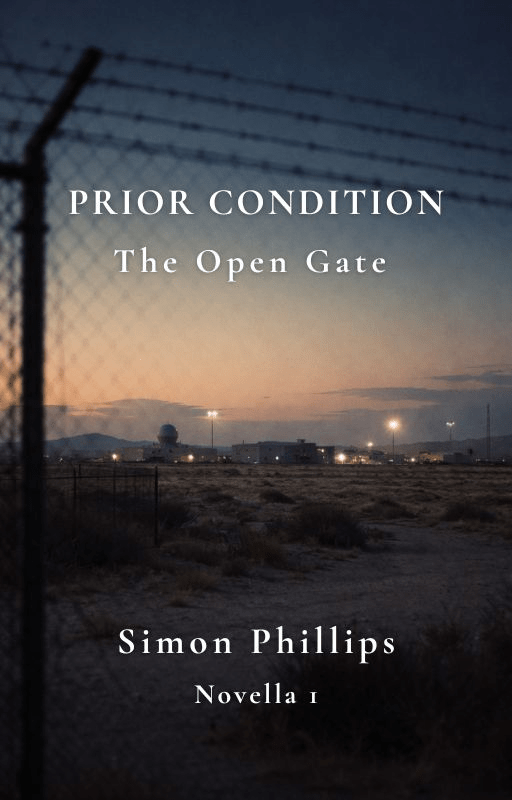
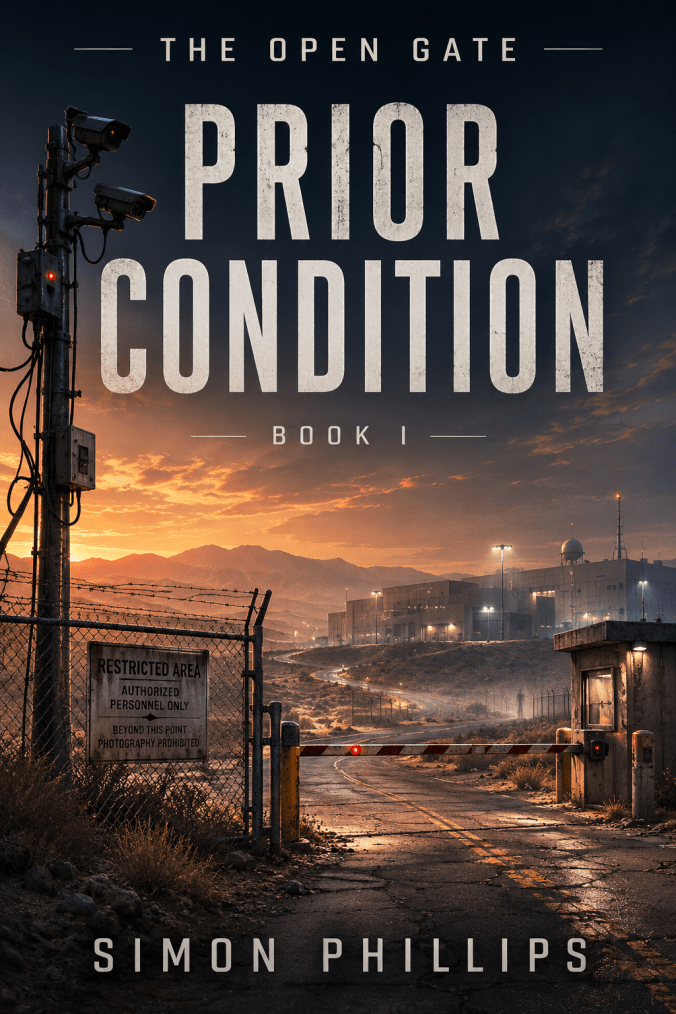
A military patrol jeep follows an old service road beside a perimeter fence. Cameras watch the empty ground through layers of glare. Guard posts repeat along the route, their equipment familiar enough to be ignored until one of the screens fails to behave as expected. Beyond the wire, something human-shaped appears for long enough to trouble the eye, but not long enough to become evidence.
Nothing has publicly collapsed in Prior Condition. The installation continues to operate, soldiers complete their patrols, reporters work through ordinary newsroom disputes, businesses open their doors, and scientists correct the problems placed before them. The world remains recognisable because the first stage of this slow-burn science-fiction horror story does not arrive through open catastrophe. It arrives through systems that continue working after their explanations have begun to fail.
This is where The Open Gate begins.
Simon Phillips’s opening book establishes a contemporary world in which military procedure, investigative journalism and restricted scientific research occupy different sides of the same developing crisis. Each system encounters signs that something is wrong. Each has a reason to contain, minimise or rename what it has encountered. The growing horror lies in the distance between what people experience and what their institutions permit them to acknowledge.
The Perimeter Still Looks Secure
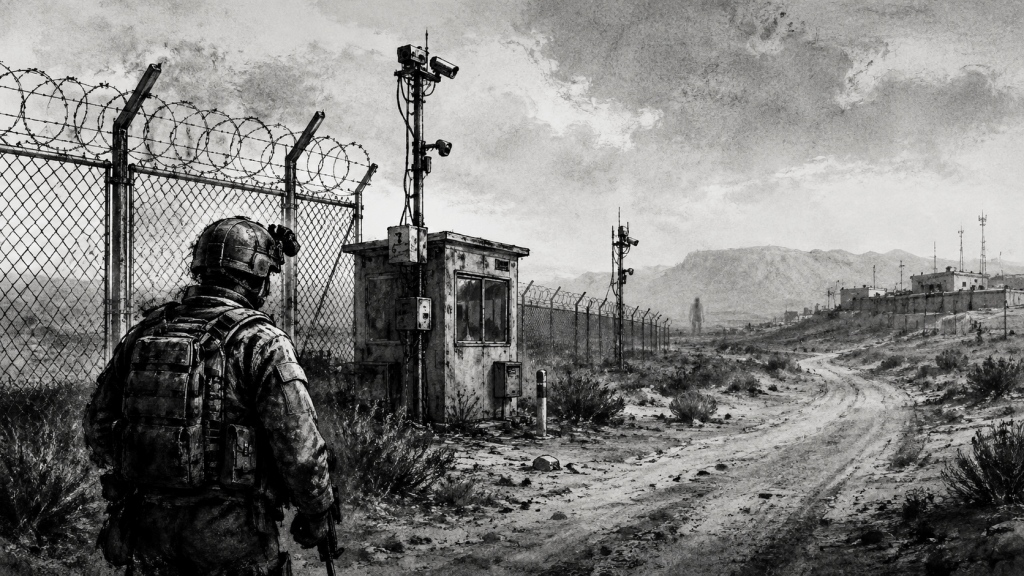
Ethan Ward experiences the opening pressure through military routine.
He understands the perimeter as a working system composed of roads, fencing, cameras, guard posts, radio checks and written logs. Its purpose is to turn uncertainty into procedure. A soldier follows the route, checks the equipment, records anything unusual and reports what cannot be corrected locally. The repetition creates confidence because each patrol resembles the one before it.
When Ethan first notices a figure near the fence, the environment immediately provides several acceptable explanations. The heat is severe. Distance is difficult to judge. The air shimmers above the ground. A tired mind can impose human form upon scrub, shadow or glare.
His patrol partner, Davis, supplies the reassurance almost automatically. Eyes invent things in empty places. Cameras suffer interference. Faults in isolated equipment are normal. Anything genuinely dangerous would become obvious through alarms, orders or visible changes in security.
That assumption carries more weight than the sighting itself. Ethan has been trained to believe that danger enters the system through recognised channels. A threat becomes real when it produces an alert, a command or a response from someone with greater authority. An uneasy sensation beside an apparently intact fence has no official category.
The military system does not ignore the irregularity because its personnel are foolish. It absorbs the irregularity because that is what the system has been built to do.
Equipment failures become maintenance problems. Unclear movement becomes heat distortion. Repeated sensor alerts become paperwork. A malfunctioning post is inspected, logged and passed onwards. Each individual response appears reasonable, but the cumulative pattern begins to suggest that the perimeter is measuring something it cannot interpret.
Ethan’s position makes this especially unsettling. He is neither a reckless action hero nor an expert who understands the wider programme. He is competent within the boundaries of his assignment. He knows how the road should feel beneath the vehicle, how a camera should cycle, how a fence should sound and how animals usually move through open ground. His unease develops through physical recognition rather than sudden revelation.
The familiar environment has not visibly changed. Ethan’s confidence in it has.
Three Perspectives Inside the Same Crisis
The structure of Prior Condition allows the reader to approach the emerging crisis through three separate forms of partial knowledge.
Ethan sees physical irregularities around the installation’s perimeter, but he lacks the context needed to understand them.
Maya Ward hears civilian testimony and begins placing apparently unrelated disruptions beside one another, but she lacks the proof needed to publish a definitive connection.
Dr Adrian Hale works with data, models and restricted system architecture inside the facility, but he is deliberately denied a complete view of what his technical corrections support.
The characters do not exchange their evidence. They do not gather in a room and solve the mystery together. Their separation is central to the story’s institutional horror.
The reader can see proximity where the characters see isolation. A sensor fault near the fence, a power fluctuation in town and an unusual pattern inside a scientific model may belong to the same developing event, but each appears within a different professional language. The military calls it interference. The newsroom calls it unverified testimony. The laboratory calls it drift.
The crisis remains deniable because its fragments are kept apart.
Maya Ward and the Burden of Unprovable Truth
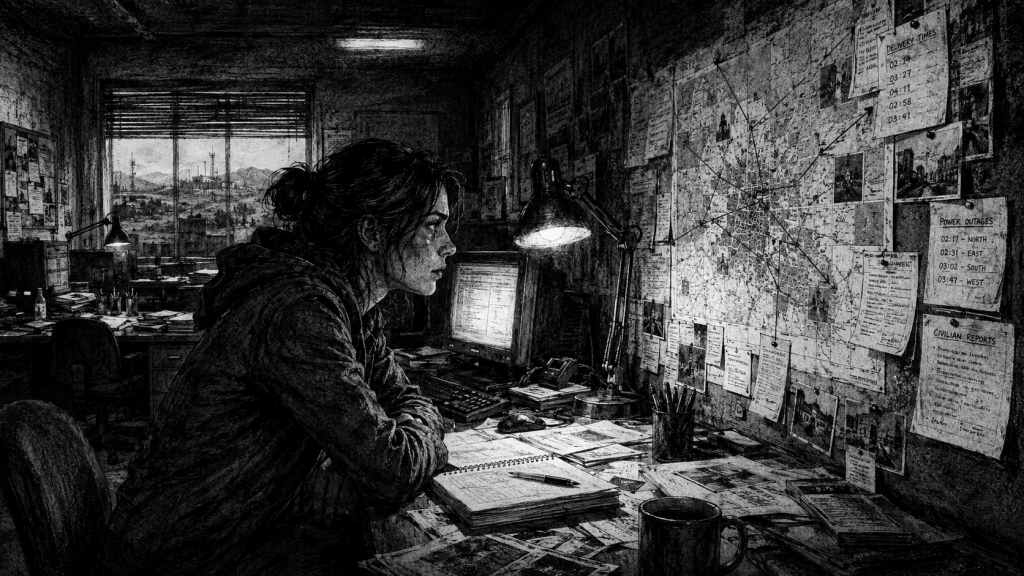
Maya’s investigation begins with details that would be easy to overlook in isolation.
Lights dim and recover before residents decide whether the interruption deserves a complaint. Heavy vehicles move along county roads late at night. Windows tremble. Water pressure changes. Deliveries arrive late, arrive incorrectly or disappear into an ordinary chain of administrative confusion. People experience moments of silence in places where birds, insects and traffic should still be present.
None of these events proves anything.
That absence of proof creates Maya’s professional problem. She recognises a pattern, but recognition is not publication. Her editor does not have to deny that residents are reporting disturbances. He only has to demand verification, caution her against implication and redirect her towards safer material.
This is one of the most convincing expressions of institutional denial in Prior Condition. Maya is not dragged away by secret agents or threatened in a dark car park. The pressure remains professional, measured and plausible. The newspaper depends upon credibility. The installation supports the surrounding area economically. Sources contradict themselves. Witnesses question their own memories. An editor who asks for stronger evidence can still believe that he is protecting the publication.
The result is a form of containment that requires no visible conspiracy.
Information is softened before it is suppressed. A possible connection becomes proximity. A repeated disturbance becomes infrastructure trouble. An investigation becomes speculation. An uncomfortable story becomes a harmless community feature about the local installation.
Maya continues because the individual accounts begin to resist separation. A resident describing rattling windows supports another person’s account of late traffic. A shopkeeper’s delivery problems sit beside reports of power dips. A witness who sounds unreliable may still have noticed something that more credible people have trained themselves not to see.
Her work reflects the patient, uncertain nature of investigative science fiction. She is not an all-knowing reporter who can expose the entire system with one document. She listens, compares, returns to locations and waits for ordinary testimony to reveal its shared shape.
The tension comes from knowing that a pattern may become visible long before it becomes publishable.
Dr Adrian Hale and the Safety of Partial Knowledge
Inside the installation, Adrian encounters the same crisis through technical language.
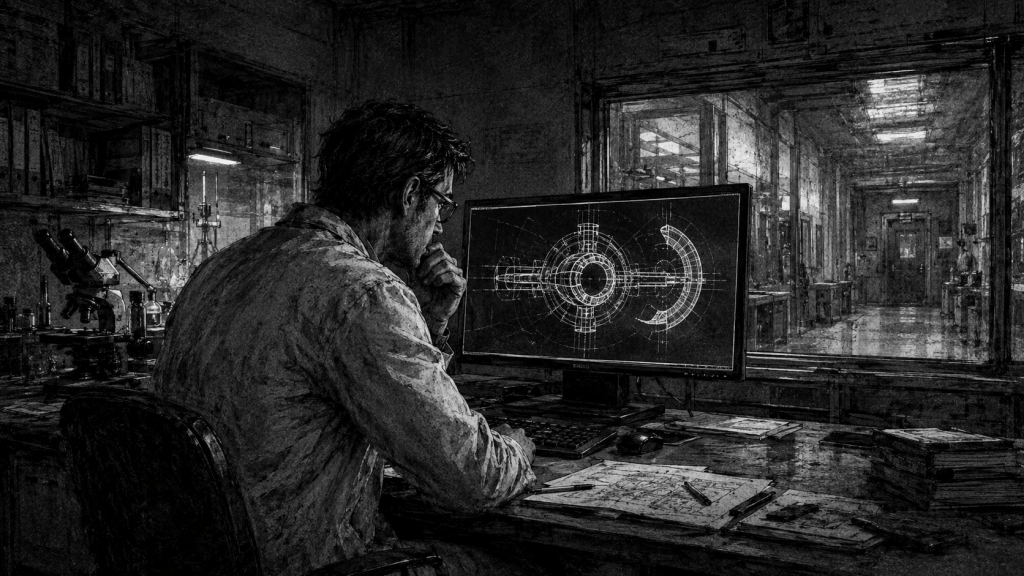
His working environment is controlled, climate-regulated and divided by access permissions. Screens present bounded problems. Data arrives in limited sets. Assignments carry neutral labels that describe immediate function without revealing broader purpose.
Adrian is highly capable within this system. He can recognise a mathematical discontinuity that others have treated incorrectly. He understands how one adjustment affects another and how small errors can magnify further along a process. His ability makes him useful to people who know more about the programme than he does.
His danger is not madness or deliberate malice. It is competence without moral overview.
Adrian receives a problem and solves it. When a model becomes unstable, he corrects it. When a parameter drifts, he brings it back within tolerance. When a task requires information from a restricted cluster, he requests the portion his clearance permits him to see.
The scientific institution does not need to deceive him through an elaborate falsehood. It only needs to ensure that his field of responsibility remains narrow enough for the next task to appear reasonable.
His colleagues occasionally ask what their work is feeding or what the programme is actually building. Adrian answers from the position the institution has given him. Their work creates stability. Projects expand. Technical progress requires structure. Understanding the whole is unnecessary when each department is responsible for only one part.
This makes Adrian one of the most important figures in the book’s examination of scientific responsibility. His intelligence does not protect him from complicity. In some respects, it places him closer to it. The programme advances because capable people continue improving systems whose consequences remain outside their authorised view.
Scientific entitlement in The Open Gate does not begin with a dramatic declaration that humanity should control another reality. It begins with a more ordinary assumption: if a problem can be corrected, correction must be the responsible choice.
When Procedure Becomes the Horror
The institutions in Prior Condition are disturbing because they remain believable.
The military values readiness, clear reporting and an orderly chain of command. The newspaper values evidence, credibility and protection from unsupported claims. The scientific programme values precision, restricted access and efficient distribution of work.
None of those priorities is inherently irrational. The horror develops when the priorities continue operating after they have stopped producing an accurate understanding of reality.
A soldier is told to log an equipment failure rather than treat it as evidence of a wider problem.
A reporter is told to pause until she has proof that the existing system makes almost impossible to obtain.
A scientist is praised for stabilising a process without being told what continued stability might permit.
Institutional science-fiction horror works through this conflict between function and understanding. A system can remain operational while becoming dangerously wrong. Reports can be filed, screens can return to green, meetings can end politely and employees can go home without anyone asking whether the underlying activity should continue.
The people inside these structures are not required to agree upon a lie. They only need to complete their immediate duties.
This gives denial a practical form. It exists in access permissions, softened language, reassignment, professional caution and the belief that responsibility belongs to someone further along the chain.
Dimensional Horror Without Spectacle
The dimensional horror of Prior Condition remains close to ordinary perception.
A form near a fence fails to resolve properly. A moving shape does not match the ground beneath it. Light seems to behave incorrectly around an object. A shaded gap between buildings appears occupied without yielding a clear human outline. Scientific geometry implies a scale and purpose beyond the task visible on the screen.
These moments are unsettling because they remain incomplete.
The book does not immediately transform uncertainty into a catalogue of creatures or a lecture about alternate dimensions. It allows physical wrongness to enter familiar environments without providing the comfort of classification. The body recognises that something is misaligned before the mind can decide what that misalignment means.
This restraint prevents the story from becoming conventional portal fiction. The installation is not opening a colourful doorway into an adventurous second world. It is interacting with something it does not understand while behaving as though improved engineering will eventually make understanding unnecessary.
The gate at the centre of the wider series is dangerous because it belongs to an institution before it belongs to public knowledge. It can be measured, funded, divided into departments and protected by security procedures. Those conditions create the confidence that continued access is legitimate.
The deeper moral pressure follows from that confidence. Technical ability begins to resemble authority. Discovery begins to resemble ownership. Contact becomes something humanity assumes it is entitled to continue.
The Town Absorbs What the Facility Produces
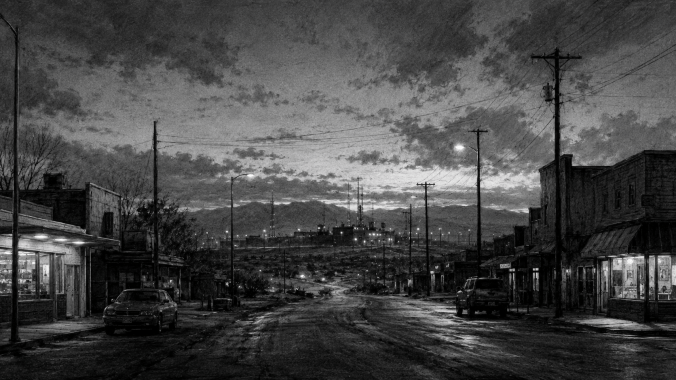
The town surrounding the installation gives the story its civilian weight.
People continue buying bread, attending community meetings, driving to work and arguing about ordinary explanations. Businesses depend upon deliveries and reliable utilities. Residents are accustomed to the installation’s presence even when they know little about its purpose.
This makes the town capable of absorbing disruption for longer than an empty or isolated landscape could.
A flickering light becomes a problem with the grid. A vibration becomes old quarry work, road maintenance or heavy traffic. A missing delivery becomes a supplier error. A vehicle seen late at night becomes evidence of nothing more than military logistics.
The explanations survive because everyday life requires them to survive. Most people cannot stop working while they investigate the cause of a brief power fluctuation. A shopkeeper still has customers to serve. A resident still has bills to pay. A reporter still needs enough evidence to satisfy an editor.
The installation and the town therefore mirror one another. The facility contains irregularities through professional procedure. The town contains them through habit, economic dependence and social embarrassment.
Both remain functional. Neither remains entirely secure.
Secrecy Reaches Beyond the Workplace
The pressure surrounding Ethan and Maya also enters their marriage.
Their domestic distance existed before either of them could name the developing crisis. Ethan withholds parts of himself through habit. Maya becomes increasingly absorbed in an investigation she cannot yet defend. Their conversations have thinned into practical exchanges, leaving each of them close to a different fragment of the same event without recognising the connection.
This human layer prevents the story’s institutional themes from remaining abstract.
Classified information does not stay inside a facility. Professional caution does not remain inside a newsroom. Secrecy alters the way people return home, answer questions and interpret one another’s silence.
The marriage reflects the wider condition of the series. Its structure remains in place. Trust has not disappeared in a single dramatic betrayal, but it has become harder to reach. Each person continues according to familiar routine while something important remains unspoken between them.
The result is a form of domestic suspense that belongs naturally beside the military and scientific pressure. The same habits that allow institutions to avoid uncomfortable truths can also exist inside a home.
Entering The Open Gate
Prior Condition is the point at which recognition begins.
It does not offer immediate collapse, open warfare or an explanation of everything behind the installation. Instead, it introduces a world that still believes its systems are capable of containing whatever those systems have created.
Readers encounter the crisis from three different positions: the soldier standing beside the fence, the reporter listening to people who already doubt their own testimony, and the scientist improving a programme whose larger purpose remains beyond his clearance.
The strength of the story lies in the way these perspectives accumulate. Ethan’s physical unease, Maya’s incomplete pattern and Adrian’s technical success become more troubling when placed beside one another. The reader begins to understand that the problem is not confined to a single malfunction, witness or department.
Something is happening around the installation. The institutions closest to it are already responding. What they cannot yet do is admit that their responses belong to the same event.
Readers who want to begin the series at the moment that ordinary explanations first start to lose their authority can find Prior Condition, Book One of The Open Gate, on Amazon.
The book offers slow-burn science-fiction horror rooted in military routine, investigative pressure, scientific compartmentalisation and the physical unease of familiar places becoming unreliable. Its world remains intact enough for denial to survive, but each character has encountered something that cannot be returned completely to its previous category.
The fence is still standing. The newspaper is still printing. The laboratory screens are still reporting success.
The pressure begins in the space between those facts and what they no longer explain.