When the Page Opens and the World Follows

The moment where certainty fractures is rarely loud, though it alters everything that stands upon it

There are stories that begin with spectacle, with fire or proclamation, with the unmistakable signal that something has already broken beyond repair. This is not one of those stories. This is a story that begins with a page.

A man stands beneath morning light in a conservation studio, surrounded by the quiet labour of preservation, where history is handled gently, corrected carefully, and returned to stability through patience rather than force. The world outside continues as it always has, measured and dependable, its rhythms so deeply understood that they no longer require attention. Within that space, knowledge feels contained, ordered, and complete.

Then the page shifts.

It does not announce itself. It does not tear or burn. It folds inward.

And the world follows.


A Book That Does Not Behave Like a Book

Some objects are not preserved by time. They are waiting within it.

At the centre of The Unclassified, the first entry in The Hollow Flame Cycle, lies an object that resists classification at the most fundamental level. It resembles a book in form, though resemblance is the only certainty it offers. Its script refuses recognition, its structure resists familiarity, and its presence unsettles the very idea of passive material.

Silas Thorn approaches it as he would any artefact: with care, with discipline, and with the quiet confidence of someone who has spent his life restoring the past to coherence. His work is grounded in physical reality, in fibres, ink, binding, and time. Every action is deliberate, reversible, and measured against centuries of accumulated knowledge.

The book does not respond to that framework.

It holds warmth where none should exist. It bends light in ways that resist explanation. It answers touch with something that cannot be reduced to material behaviour.

What unfolds in that moment is not destruction, nor is it revelation in any familiar sense. It is intrusion.

The known world does not break. It gives way.


The Crossing That Leaves No Mark

Not all thresholds are visible. Some exist only in the moment they are crossed.

When Silas falls through the page, the act is not framed as travel. There is no preparation, no ritual, no understanding. The transition occurs in the space between expectation and perception, where reality has not yet had time to correct itself.

He lands not in chaos, though that might have been easier to comprehend.

He arrives in order.

The chamber that receives him is vast, structured, and deliberate. Its architecture carries the weight of centuries, its design shaped by authority rather than accident. Nothing appears broken. Nothing appears disturbed. The world into which he emerges does not recognise itself as interrupted.

This is the first tension the novella establishes with precision: the crossing is not treated as an anomaly by the space itself.

It is treated as an event that must be answered.


Authority Before Understanding

Institutions do not wait for clarity. They respond.

One of the defining tensions within The Unclassified lies in the way power reacts to uncertainty. The Crown, embodied through Princess Lirael and the sovereign, does not hesitate. The event is assessed, contained, and integrated into existing frameworks of control with remarkable efficiency.

There is no panic.

There is no denial.

There is only response.

Silas is not treated as an intruder in the traditional sense, nor is he embraced as a miracle. He is categorised as a problem requiring management. His presence is stabilised through containment, his movement restricted, his existence placed within the boundaries of governance.

This reaction reveals something fundamental about the world itself.

It does not collapse under pressure.

It absorbs it.


The Quiet Fracture Beneath Control

The most dangerous shift is the one that leaves everything looking unchanged.

While the structures of authority hold firm, the novella introduces a quieter, more unsettling movement beneath them. Through Princess Seréne, a different kind of awareness begins to emerge, one less concerned with immediate control and more attuned to what the event represents.

The foundations have opened.

They have closed again.

No mark remains.

This absence of damage becomes the central disturbance.

If the system can admit something without rupture, then the boundaries that define it are not as absolute as they were believed to be. The palace, the Crown, the Guild, and the very idea of structured reality all rest upon assumptions that have not yet been tested in this way.

Seréne does not rush to resolve this contradiction.

She recognises it.

And in doing so, she becomes the first to truly stand within the question the novella poses.


A World That Does Not Recognise Itself

When two systems meet, neither remains untouched.

The introduction of Silas’s world, described in fragments through his attempts to explain it, creates a second layer of tension. His reality is defined by written law, mechanical systems, and a complete absence of what this new world considers foundational.

There is no magic.

There are no sigils.

There is no binding of authority into stone.

And yet he stands within a place where all of those things are not only real, but necessary.

The contrast does not resolve into superiority or dismissal. Instead, it reveals the limits of both systems. Each world contains structures that appear complete within their own context. Each becomes unstable when viewed through the lens of the other.

The crossing does not simply move a man from one place to another.

It introduces incompatibility.


Where the First Movement Ends

The hall settles. The question remains.

By the close of the novella, nothing outwardly catastrophic has occurred. The palace still stands. Authority remains intact. The man has been contained. The Guild has been summoned. The system continues to function.

And yet something irreversible has begun.

The foundations have responded to something they were never meant to receive.

A man from a world without magic stands at the centre of a system built upon it.

The Crown has acted without understanding.

The Guild has arrived without conclusion.

The question has entered the world.

It has not left.


Step Into the Hall

If you want to experience the full unfolding of this first disturbance, you can read The Unclassified here:
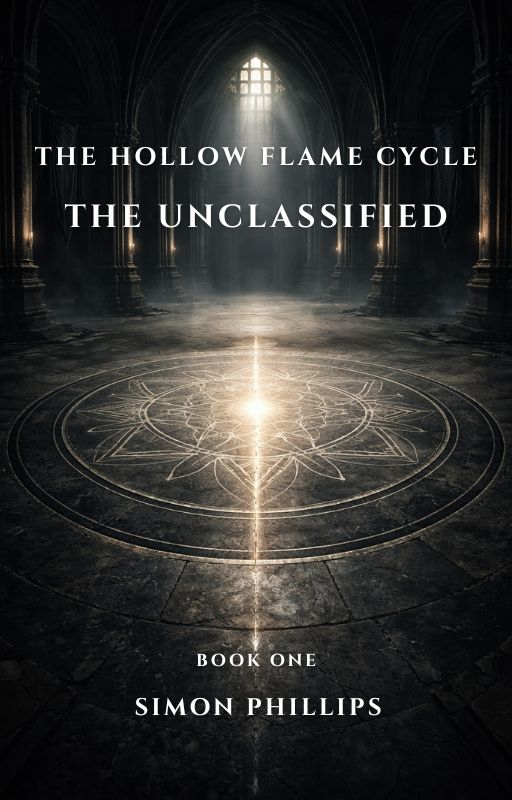
This is the opening movement of The Hollow Flame Cycle, where the story does not begin with collapse, but with the moment just before it becomes possible.

The page has opened.

The world has followed.

And nothing, though it appears unchanged, will remain as it was.

How I Plan Epic Conflicts Without Losing the Characters

If there’s one question I return to again and again while writing The Veil of Kings and Gods, it’s this: how do you make war feel personal? Not just dramatic, not just explosive or large in scale, but real, rooted in the hearts of the people forced to live through it.

High fantasy is often filled with titanic clashes: gods levelling mountains, kings raising armies, ancient orders clashing across the centuries. But if I’m being honest, those scenes only truly work when they grow from something human. When a character you care about walks into the storm and you understand why.

I’ve spent the past year trying to balance these two worlds: the grand and the intimate. The arcane and the emotional. And nowhere has that balance been more important than in planning the major conflicts of this story, political, magical, divine. Today, I want to share how I approach that.

The Characters Always Come First

It sounds simple. Obvious, even. But when you’re building a vast world with kingdoms at the brink and gods whispering from beyond the veil, it’s shockingly easy to forget that someone still has to live through it.

For me, that’s Simion, Patrick, Týrnan. Each of them sees the oncoming storm from a different vantage point and each is wounded by it in ways that are quiet, personal, and rooted in character. Simion is a man caught between divine expectation and the fragile world of expectation. Patrick bears the weight of kingship while hiding parts of himself that would shatter his position. Týrnan fights not for conquest, but to keep his people from losing their soul.

The conflicts around them may escalate. But unless those conflicts are built on the foundation of who they are, their doubts, fears, loyalties, and flaws, the story would ring hollow.

Conflict as Mirror, Not Just Plot Device

One of my guiding principles is that every external conflict must reflect an internal one. If a battle breaks out between kingdoms, it needs to echo the unrest already stirring within the characters.

Take Patrick. His kingdom teeters on the edge of diplomatic collapse, but what drives that tension is not just geopolitics, it’s his own repression. His court senses weakness. His enemies sense distance. And Patrick, for all his strength, has no safe space to be fully himself. The war outside is the war inside.

Likewise with Simion, who is being slowly crushed by the power he once sought. The threats he faces aren’t always from enemies; sometimes they come from within, from his refusal to be the weapon the gods demands, from his fear of harming those he loves, from the ancient force he’s inherited that now forgets its own wisdom. These are personal wars. The divine and the magical are just the landscape they bleed into.

Intimacy in the Midst of Chaos

One of the joys and challenges of writing a large-scale fantasy series is finding the quiet in the chaos. There are scenes in Book 1 where cities are burning or armies are gathering, and yet the most important moment is a hand held too tightly, or a look that lingers a second too long. That’s what I strive for.

When Simion walks into battle, I don’t want the reader to think of fire and ruin. I want them to think of his challenges. Of the weight of the cloak he wears. These are the things that make his power mean something. Without them, he’s just another mage with too much fire in his hands.

And when Patrick makes a decision that could cost him the alliance of a kingdom, it’s not the politics that matter. It’s what he sacrifices to stand firm, the love he denies, the truth he cannot speak, the safety he’ll never truly have. These are the human costs, and they’re what I try never to lose sight of.

Final Thoughts

I love grand fantasy. I always will. But I believe its heart lies not in its spectacle, but in its people. In the ones who stumble through magic and war with bruised hearts and broken promises, doing their best to hold on.

So when I plan my conflicts, magical or mortal, I don’t begin with maps or power levels or ancient histories. I begin with the characters. With their wounds and their wants. And I try, as best I can, not to lose them in the storm.

Because the war may shape the world.
But it’s the people who shape the war.

The Gods of Ældorra: Who They Were Before the Fall

Author’s Note:
In my fantasy novel The Veil of Kings and Gods, the world of Ældorra is shaped by ancient gods, divine betrayal, and the remnants of a shattered empire. This post explores the origin of Ældorra’s divine war, drawn directly from the mythic past within the story itself. If you enjoy deep lore and high fantasy, this is for you.


Before kingdoms warred and magicians stood above kings, Ældorra was shaped by gods, divine beings whose presence touched every corner of the world. In the time of the Imperium Arcana, magic was not a distant force, but a living breath that pulsed through every stone, sea, and soul. This magic, ancient and sacred, came not from study alone, but from the gods themselves.

Among these deities stood the God of Magic, the mightiest of them all. His power was the very source of the arcane that wove the empire together. He was not only a divine figurehead, he was the guardian of all, it was he who anointed the magicians as the empire’s true rulers, custodians of magic who were revered not just as wielders of power, but as the chosen of heaven. To command the arcane was to speak with divine authority, and so the magicians ruled not by bloodline, but by divine will.

The Imperium flourished under this covenant. Cities of marble and gold rose across the land, and every breath of wind, every whisper of light, carried the weight of enchantment. From the fjords of the north to the eastern deserts, magic was life, and life was divine.

But divine creations are not immune to betrayal.

The fall began with a god of the First Heaven, once the deity of balance and insight. His corruption was not a sudden blaze but a slow rot, fed by ambition and the hunger for more. The god descended from his sacred post, abandoning the divine realm to seek darker paths. Deep within the First Hell, his magic became something twisted and foul. No longer a god, he was reborn as a demon: Azaroth.

Azaroth’s rise did not go unnoticed. While the magicians of the Imperium grew complacent, blinded by their own greatness, it was the God of Magic who first sensed the rot. Alone among the heavens, he understood the threat. And so, the two former brethren clashed, not with armies or swords, but with the raw essence of creation itself. Magic and corruption tore through reality. The heavens cracked. The seas rose. The skies burned.

In the end, the God of Magic made the ultimate sacrifice. With the last of his divine essence, he sealed Azaroth within the First Hell, imprisoning the demon for eternity. Yet victory came at a cost: the God of Magic himself was torn apart, his name lost to time, his power shattered.

And with his fall, so too fell the Imperium.

What followed was silence. The gods no longer walked the world. The arcane throne stood empty. The magicians, left to their own devices, could no longer claim divine mandate. But before the empire’s final breath, the last emperor passed one final law: that the magicians would remain autonomous, above kings, above law, outside the reach of Church and Crown. Thus, the Order of Magicians was born.

The gods’ war was long buried by history, but its echoes never faded. In The Veil of Kings and Gods, the seal on Azaroth begins to weaken. Forgotten powers stir. And the divine magic once thought lost whispers again from the shadows of Ældorra.

The gods may be gone.
But their war is not over.


Want more?
This is just the beginning. The divine echoes of this history shape every chapter of The Veil of Kings and Gods, especially through the eyes of Simion the Magician. New blog posts, lore entries, and behind-the-scenes content are released every other day. Subscribe to the blog, follow on YouTube, or check out my short stories for deeper glimpses into Ældorra’s ancient past.