How Alfred’s son carried the Anglo-Saxon recovery into the Danelaw and prepared the ground for England
The Rider from Tamworth
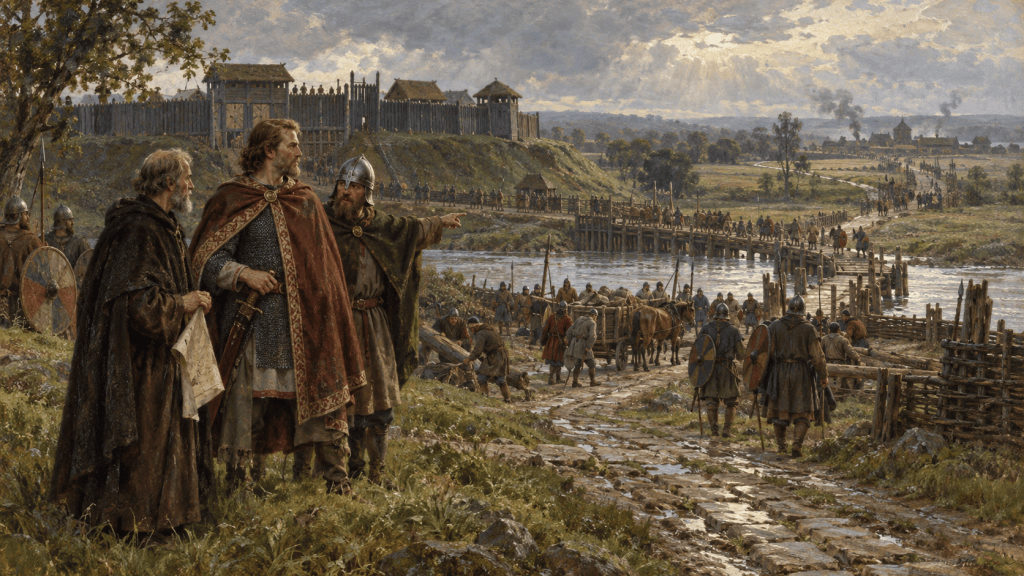
Morning mist lay across the River Welland, gathering among the reeds and whitening the raw earth where Edward’s men had driven a new line of stakes into the southern bank. Across the water, Stamford rose behind its older defences, a Danish borough whose people had watched the West Saxon army arrive, secure the crossing, and turn captured ground into something intended to endure. Axes struck oak, baskets of soil passed from hand to hand, and the breath of men and horses mingled above the unfinished rampart as the king’s frontier took shape beneath a pale summer sky.
“Pack the earth close against the timber, or the river will find every hollow before an enemy reaches us,” the foreman said as he pressed one mud-darkened heel into the bank. A young spearman rested upon his shovel and glanced towards the roofs beyond the water. “If Stamford has yielded, why are we raising a second wall when the first already stands?” he asked as he wiped rain from his cheek. The foreman drew his thumb along the sharpened edge of a stake before answering. “A town may yield for a day, lad, while a strong wall reminds every man what tomorrow will cost.”
Edward stood above them, his cloak drawn close against the wet breeze as he studied the ford, the bridge, and the road leading through the fields. He had learned the value of such places from Alfred, whose burhs had preserved Wessex when open battle could have destroyed it, and he had carried that lesson into enemy country. Every ditch guarded a crossing, every garrison secured a road, and every new enclosure allowed an army to move farther while leaving strength behind. Stamford had become a fresh fastening in a chain stretching through lands once held by Danish armies.
A lone rider came into view before the gate watch called out, his horse dark with sweat and river mud as it struggled across the broken ground. “A Mercian messenger has come from Tamworth, lord king,” one of Edward’s household warriors said as he descended the rampart. Edward turned from the river as the rider dismounted and crossed the yard. “Bring him forward, then see that his horse is watered and rubbed down,” he replied, resting one hand upon his sword belt. The messenger bowed with the weary care of a man who had ridden through much of the night before drawing breath. “My lord king, the Lady of the Mercians died at Tamworth, and news of your sister’s death is already travelling through Mercia,” he said, holding Edward’s gaze as grief tightened his face.
For a moment, the labour around the new burh seemed to recede behind the rush of the Welland. Æthelflæd had been more than Edward’s sister, for she had ruled Mercia, raised fortresses, recovered towns, and pressed the war forward beside him. Her death opened a space across the Midlands while their combined campaigns were breaking Viking power. Her daughter Ælfwynn remained within the Mercian succession, while loyalties shaped in Tamworth and Gloucester could never be treated as possessions passing quietly between rulers.
Edward looked towards Stamford’s roofs, where submission had been secured through patience and the promise of overwhelming strength. “Have fresh horses made ready, and summon every man who can ride before sunset,” he said as he stepped towards the hall where his commanders waited. “We go to Tamworth, and these works will continue until this crossing can hold against any army that approaches it.”
The axes beside the river resumed their steady labour as preparations spread through the camp, carrying Edward from one hard-won frontier towards the uncertain heart of Mercia. Behind him stood a burh of wet earth and newly cut timber, one strongpoint among many, yet the kingdom emerging from those walls would reach far beyond Stamford. Alfred had built so Wessex could survive; Edward was preparing to discover how far that inheritance could advance.
A Visual Chronicle
Edward inherited Alfred’s walls, turned them into weapons of reconquest, and then faced the decision that could reshape the future of England.
Timeline of Events
899 AD – Edward succeeds Alfred as king, inheriting a strengthened Wessex and an unfinished struggle against Viking power.
910 AD – A combined West Saxon and Mercian army defeats a Northumbrian Viking force at Tettenhall, weakening the northern armies that had threatened the Midlands.
912–916 AD – Edward establishes burhs at Hertford, Witham, Buckingham, Bedford and Maldon, securing rivers and roads as his frontier advances into Danish-held territory.
917 AD – Coordinated campaigns led by Edward and Æthelflæd break Danish power across East Anglia and much of the southern Danelaw as strongholds fall or submit.
918 AD – Æthelflæd dies at Tamworth, after which Edward takes control of Mercia and receives the submission of further Danish-held towns, including Stamford and Nottingham.
920 AD – Edward builds a burh near Bakewell, where the Anglo-Saxon Chronicle records northern rulers recognising him as father and lord, signalling the widening reach of his authority.
924 AD – Edward dies at Farndon in Mercia, leaving Æthelstan to inherit the reconquest and carry it towards the creation of a single English kingdom.
About the Creator
This Chronicle is written by Simon Phillips, author of several historical and speculative fiction works exploring forgotten worlds, myth, and the turning points of history.
You can explore his books here:
Books by Simon Phillips
You can watch his YouTube channel here:
Author Simon Phillips
Continuing the Chronicle
The account that follows moves back through the campaigns that carried Edward’s authority beyond Wessex and into the Danelaw, where fortified towns, secured roads, river crossings, and coordinated armies transformed Alfred’s defensive inheritance into a sustained reconquest. It follows the fall of Viking strongholds, the partnership between Edward and Æthelflæd, and the difficult absorption of Mercia after her death, as separate victories began to shape a kingdom wider than either ruler had inherited.
Readers supporting The Forgotten Chronicle may continue into the full record below.
The War of Roads and Walls
Before the southern wall at Stamford rose above the Welland, and before the rider from Tamworth carried grief into Edward’s camp, the reconquest had begun with a disputed crown and a kingdom still shadowed by Alfred’s achievement. When Alfred died in 899, Edward inherited fortified towns, trained armies, and the allegiance of men who had survived the worst years of the Viking war. He also inherited a royal house whose older branches retained their own claims, while Danish rulers remained powerful across East Anglia, eastern Mercia, and Northumbria.
News soon reached Edward that his cousin Æthelwold had seized the royal estates at Wimborne and Christchurch. “He has chosen his ground carefully, lord,” an ealdorman said as he set a wooden tally beside the king’s cup. “Wimborne holds his father’s grave, and every man who enters that hall will understand the claim he is making.” Edward ran one thumb along the tally before returning it to the table. “Then we answer the claim in daylight, where every oath may be heard,” he replied as men gathered their cloaks and prepared to ride.
Æthelwold escaped before Edward could close around him, travelling north into territory governed by Danish armies, where men hostile to Wessex accepted him as king. His return brought war across East Anglia, Mercia, and the northern borders of Wessex. The struggle ended at the Holme in 902, where the Danish army held the field after savage fighting, yet Æthelwold lay among the dead. Edward’s crown had survived its first challenge, though the cost revealed how easily an English claimant could turn Viking power against an English king.
For several years an uneasy peace followed, until a Northumbrian Viking army raided deep into Mercia and began its journey home in 910. A combined West Saxon and Mercian force intercepted it near Tettenhall, where marshy ground and broken routes of retreat turned the encounter into a disaster for the raiders. Several Viking kings and leaders fell during the fighting, and the northern armies lost much of their ability to strike south with the same confidence. The victory opened space for a different kind of war, one measured through timber, earth, guarded bridges, and the patient occupation of routes which had once carried raiders inland.
Edward used that hard-won breathing space with the discipline of an experienced builder. At Hertford his men enclosed both sides of the River Lea, while Witham secured a road through Essex and Buckingham guarded a crossing of the Great Ouse. Bedford, Maldon, Towcester, and other strongpoints followed as each new burh protected settlers, housed a garrison, and allowed the next army to advance beyond the last secure wall. These places grew from Alfred’s defensive system, yet their purpose had changed, since Edward planted them ahead of settled West Saxon power and made the frontier move with him.
“The river gives us three approaches and an enemy will search for the weakest,” a surveyor said as he pushed a willow rod into the wet bank at Hertford. Edward stepped across the marked line and looked towards the higher ground beyond the water. “Then place the gate where our men can reach every approach before the alarm has crossed the town,” he answered as labourers waited beside their spades. The surveyor shifted the rod uphill and called the ditch gangs forward, turning a king’s instruction into another day of mud, timber, and aching hands.
North of Edward’s advancing line, Æthelflæd carried the same method through Mercia after her husband Æthelred died in 911. She fortified Tamworth, Stafford, Warwick, Chirbury, Runcorn, and other exposed places, creating a Mercian network joined to Edward’s campaigns while remaining rooted in Mercian loyalties. Their partnership joined two armies and two political traditions, and its strength came from coordination more than submission. Edward pressed through the east and south as Æthelflæd closed roads from the west, leaving Danish strongholds facing pressure from directions their rulers had once treated as separate kingdoms.
During a meeting before the campaigning season, a map of roads and rivers lay between brother and sister beneath the wavering light of tallow lamps. “If Derby is allowed to draw men from Leicester, the road into northern Mercia stays open,” Æthelflæd said as she rested two fingers beside the crossing. Edward moved a carved marker towards the Ouse and studied the distance between their armies. “Then I shall keep Bedford and Northampton looking east while you close upon Derby,” he replied as a clerk bent over the wax tablet. Æthelflæd lifted her gaze from the map as the lamp flame trembled between them. “Keep them looking towards you long enough, brother, and they may realise too late where the wall has closed.”
The year 917 brought the method to its fiercest test. Danish forces attacked Towcester and other defended places, seeking to break the new chain before it hardened, while garrisons held until help arrived from nearby burhs. Edward’s armies struck Tempsford and Colchester, repaired captured defences, and received the submission of East Anglia and Cambridge. Æthelflæd’s Mercians entered Derby after bitter fighting that killed four of the thegns dearest to her, then gained Leicester through submission during the following year. Each fall loosened the next alliance, since a Danish town facing a fortified enemy on every road could expect less aid from neighbours already fighting for their own survival.
By the summer of 918, Edward had reached Stamford and ordered a second borough raised on the southern bank of the Welland. The town’s northern population accepted his lordship while men worked upon the new defences, bringing another of the Five Boroughs beneath Anglo-Saxon power. Then the messenger arrived from Tamworth with word that Æthelflæd had died, and the partnership that had driven the reconquest forward ended within sight of its greatest success.
Edward rode into Mercia while grief and uncertainty moved through its halls. Æthelflæd’s daughter Ælfwynn possessed a claim to succeed her mother, and Mercian leaders had long memories of their kingdom’s former independence. “The lady’s oaths were given to Mercia as well as to her kin,” a Mercian thegn said as Edward’s household gathered at Tamworth. Edward removed his riding gloves and placed them beside the hall fire. “Her towns will keep their laws, their markets, and their protection,” he replied as rain ran from the hem of his cloak. “The army beyond those walls will judge us by whether those protections endure.”
The settlement carried a harder truth beneath such assurances. Edward received the allegiance of Mercian communities, secured Nottingham, and placed English and Danish inhabitants together inside its repaired defences. Later that year, Ælfwynn was deprived of authority and taken into Wessex, ending the separate Mercian rulership her mother had preserved. What had begun as a partnership between Wessex and Mercia became direct kingship, and the reconquest drew lands of differing custom, memory, and loyalty beneath a single royal centre.
Edward continued north-west, repairing Thelwall and Manchester before strengthening Nottingham’s southern bank and building near Bakewell. The Anglo-Saxon Chronicle later described Scottish, Northumbrian, and Strathclyde rulers choosing him as father and lord, language that proclaimed enormous prestige while falling short of direct government over their peoples. These recognitions were alliances, submissions, and promises shaped by immediate danger, yet they showed how far the political horizon had widened. A king who had begun his reign defending a disputed succession could now summon rulers far beyond Wessex into negotiation around his power.
When Edward died at Farndon in 924, he left a realm broader and more tightly governed than the one Alfred had entrusted to him. His victories had rarely rested upon a single celebrated battlefield, for they had grown through guarded rivers, repaired towns, disciplined garrisons, negotiated oaths, and walls raised close enough to support the next advance. Mercia’s separate court had vanished, East Anglia had submitted, and Danish authority south of the Humber had been broken into communities increasingly tied to Edward’s rule.
The kingdom was still unfinished, and York remained beyond the lasting reach of the West Saxon house. Edward’s son Æthelstan would inherit that final northern challenge, together with every tension created by conquest and consolidation. Alfred had preserved the ground from which recovery became possible, while Æthelflæd and Edward carried that recovery through the Midlands until the old borders could hold it no longer. England had yet to receive its single crown, though the roads leading towards it now passed through Edward’s gates.
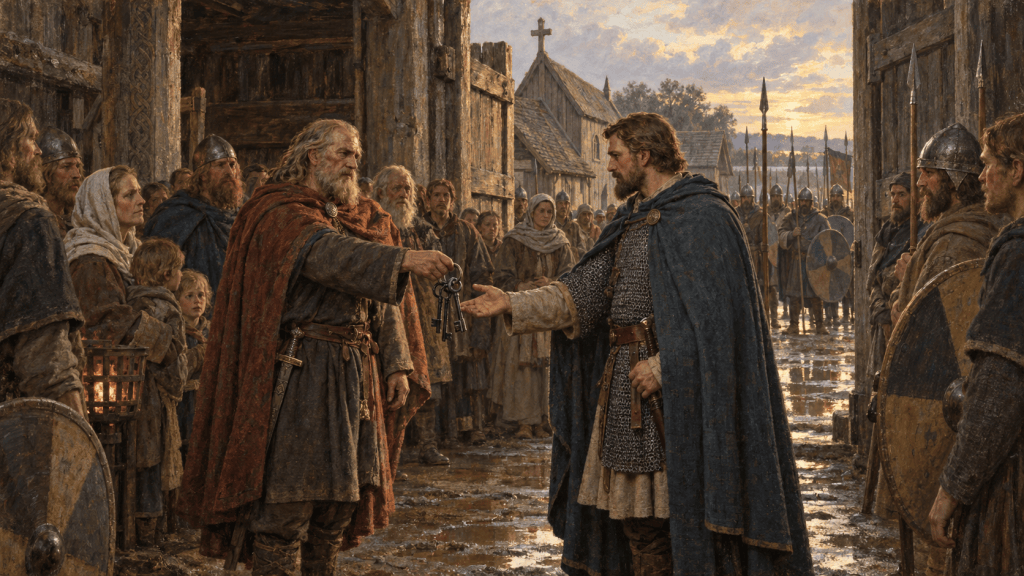
The gates of a Danelaw borough were surrendered to Edward the Elder, as fortified campaigns and steady pressure carried Anglo-Saxon authority deeper into Viking-held territory.
Inspiration Behind the Story
Edward’s reconquest draws much of its power from the absence of one decisive moment. His victories gathered through fortified towns, guarded crossings, reopened roads, patient alliances, and armies able to advance while leaving strength behind them. Alfred’s defences had preserved Wessex during its greatest danger; Edward took the same principles and turned them outwards, carrying survival into conquest.
What fascinates me about this period is how visibly power altered the landscape. A burh raised beside a river could secure an entire district. A garrison placed along an old road could allow merchants, messengers, and soldiers to move through land once exposed to attack. Each strongpoint became more than a wall, for it changed which ruler could offer protection and whose authority local communities were prepared to accept.
For storytelling, this creates a quieter form of momentum. Edward lived beneath Alfred’s formidable legacy and worked beside Æthelflæd’s Mercian achievements, yet his reign became more than a continuation of theirs. Her death brought grief, uncertainty, and political opportunity together, forcing him to hold Mercia while the wider reconquest remained unfinished.
This Chronicle matters because it reveals that England emerged through accumulation. The kingdom took shape through walls, roads, oaths, submissions, and repeated campaigns, until separate victories began to resemble a single design.
From the Author’s Desk
While writing this Chronicle, I kept returning to the strange position Edward occupies within the story of England. Alfred towers behind him, Æthelflæd stands beside him, and Æthelstan waits ahead as the king who would complete the conquest. Edward can seem caught between those more familiar names, even though the political landscape inherited by his son had been transformed during his reign.
That position made him especially interesting to write about. Edward inherited a system built for survival and discovered how to use it for expansion. He seems to have understood that lasting conquest depended upon more than winning a battlefield. Territory had to be held, roads guarded, rivers controlled, towns defended, and local loyalties drawn towards a ruler capable of protecting them.
I also found myself thinking about the personal weight carried through these campaigns. Edward worked alongside Æthelflæd as ruler, ally, and brother, while their separate armies pressed against Viking power from different directions. Her death in 918 brought grief into a moment of opportunity and uncertainty. Mercia had followed her leadership, and Edward now faced the delicate task of absorbing her kingdom while continuing the struggle they had shared.
Historical memory often gathers around the ruler who begins a great work or the one who completes it. Edward belonged to the more easily overlooked space between those two moments. Yet England could scarcely have emerged in the form it did without the roads he secured, the burhs he raised, and the territories he brought beneath his authority. His reign reminds me that some of history’s most important figures are found in the difficult middle, carrying an inheritance forward until an unfinished ambition becomes a political reality.
You can explore my books here:
Books by Simon Phillips
You can watch my YouTube channel here:
Author Simon Phillips
Historical Notes & Context
Additional Historical Notes
Edward inherited a realm strengthened by Alfred’s reforms, yet his succession in 899 remained vulnerable. His cousin Æthelwold, the son of Alfred’s elder brother, claimed the throne and found support among Danish forces in East Anglia. The rebellion ended after Æthelwold was killed at the Battle of the Holme in 902, allowing Edward to secure his kingship before turning towards the wider struggle beyond Wessex.
The principal narrative source for Edward’s reign is the Anglo-Saxon Chronicle, whose surviving versions differ in chronology and emphasis. The West Saxon record presents the expansion of Edward’s authority as a steady series of submissions, while the Mercian Register preserves a stronger sense of Æthelflæd’s independent leadership. These accounts reveal the broad sequence of events, though the political negotiations behind each oath, surrender, and transfer of power remain largely hidden.
Edward’s burhs served as more than defensive refuges. Positioned beside rivers, roads, bridges, and frontier settlements, they allowed garrisons to protect territory while royal armies advanced farther into the Danelaw. Their construction also brought administration, trade, taxation, and military service beneath expanding royal control. The reconquest therefore changed the government of recovered land as deeply as it changed the battlefield. The surviving Chronicle entries record this advance through Hertford, Witham, Buckingham, Bedford, Towcester, Stamford, and other strongpoints.
Related Events
The victory at Tettenhall in 910 weakened the Northumbrian Viking armies that had threatened Mercia and opened greater freedom for Anglo-Saxon expansion. Edward and Æthelflæd then advanced along connected fronts, with West Saxon pressure moving through East Anglia and the southern Danelaw while Mercian forces pushed towards Derby and Leicester. Their campaigns worked through coordination, fortified positions, and the gradual isolation of Danish-held boroughs.
Æthelflæd’s death at Tamworth on 12 June 918 created a difficult question of succession. Her daughter Ælfwynn briefly held authority in Mercia before Edward removed her and brought her into Wessex later that year. A peaceful union would be too simple a description. Edward gained direct control, though Mercian identity, loyalties, and political traditions remained powerful, shaping the succession that followed his death.
An entry generally assigned to 920 records that rulers from Scotland, Strathclyde, Northumbria, and Scandinavian York accepted Edward as “father and lord” near Bakewell. The statement reflected the wide reach of his power, though it should be understood as a claim of overlordship and negotiated recognition rather than permanent conquest. Edward died at Farndon in Mercia in 924, leaving Æthelstan to secure the succession, take York, and carry the unfinished making of England into its decisive final stage.
Further Reading
Edward the Elder, 899–924 – N. J. Higham and David Hill, editors
The Making of England: A New History of the Anglo-Saxon World – Mark Atherton
Æthelstan: The First King of England – Sarah Foot
The Anglo-Saxon World – Nicholas J. Higham and Martin J. Ryan
Next Chronicle
Edward’s death in 924 left the Anglo-Saxon world transformed, though its final shape remained unsettled. West Saxon authority had spread across Mercia, East Anglia, and much of the former Danelaw, while the Viking kingdom of York still guarded the road towards a realm united beneath one crown.
At the centre of the next stage stood Æthelstan, Edward’s son, a prince raised among the Mercians and shaped by the military world created by Alfred, Æthelflæd, and Edward. His succession carried its own uncertainty, yet his ambitions soon reached beyond the lands his father had recovered, drawing him towards York and the last great centre of Scandinavian power in England.
What makes this next Chronicle so important is that Æthelstan’s reign carried the making of England towards its defining moment. When York fell beneath his authority in 927, the old division between the Anglo-Saxon south and the Viking north appeared to close, allowing one king to claim dominion across the lands that would become England.
The next Chronicle moves into the final act of this series, where decades of survival, fortified recovery, and patient reconquest converged beneath Æthelstan’s rule. The kingdom that earlier generations had preserved through marshes, walls, roads, and battlefields was ready to emerge beneath a single English crown.
Next Chronicle: Athelstan and the Birth of England
Alfred had taught Wessex how to survive; Edward carried its strength across roads, rivers, and fortified towns until a divided land stood close enough for Æthelstan to gather beneath one crown.
