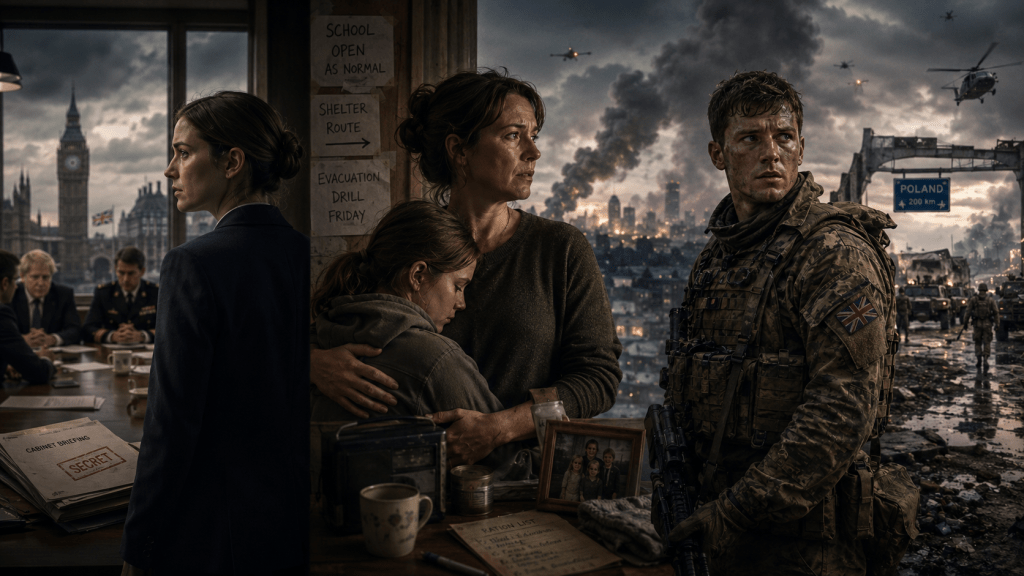
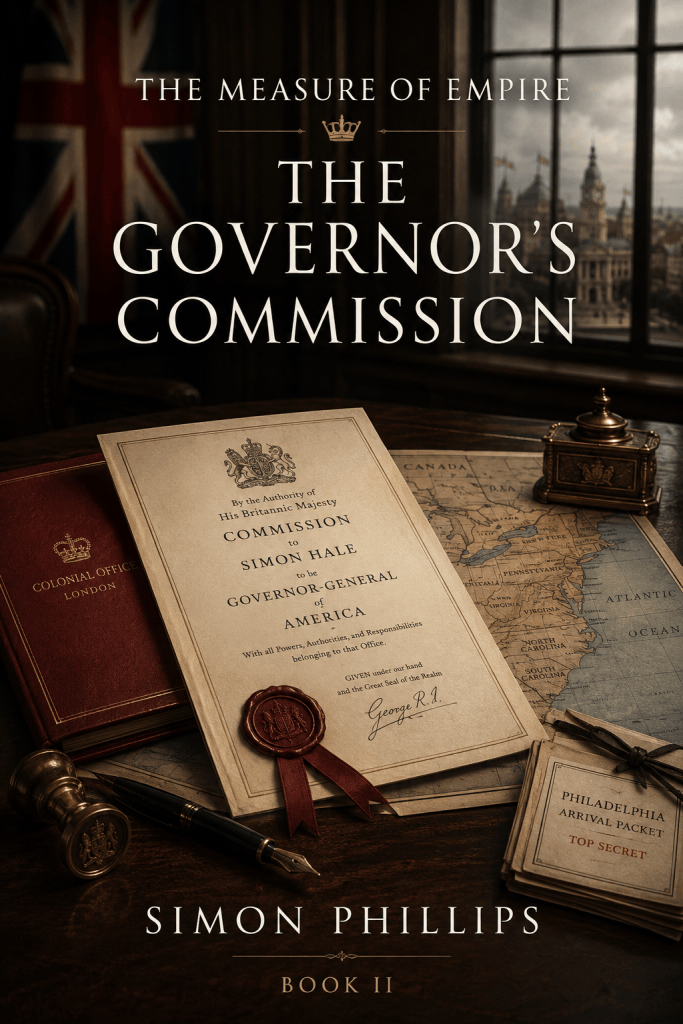
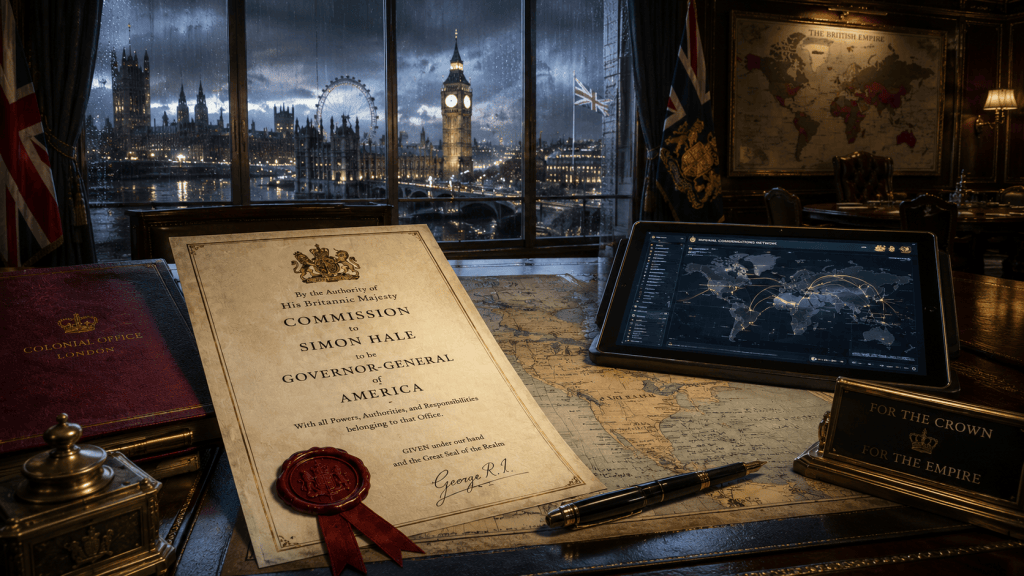
Rain followed Simon Hale from RAF Northolt into the centre of London. He had crossed half the world from Japan expecting his sudden recall to concern East Asia, Britain’s increasingly important alliance with the Japanese Empire, or the growing pressure from China across the Pacific. Instead, Whitehall had prepared something considerably larger. Behind guarded doors, among sealed folders, encrypted tablets and the old ceremonial confidence of imperial government, Simon was offered one of the most powerful offices outside Britain itself: Governor-General of America.
That appointment forms the heart of The Governor’s Commission, Book Two of The Measure of Empire, a modern alternate-history political series set in a world where the British Empire never collapsed and the United States never formed. America remains under British rule, although the continent has long since outgrown any simple idea of colonial dependency. Its cities, industries, military installations, research centres, ports, cyber networks and representative institutions have become fundamental to the strength of the Empire itself. Simon is therefore being sent to govern a territory that remains constitutionally subordinate while becoming increasingly difficult to think of as anything less than a nation in waiting.
The political tension comes from the fact that London does not yet see the situation in those terms. Whitehall believes that America can still be strengthened, reassured and drawn more effectively into the imperial system through competent reform. Simon believes much the same thing. He is ambitious, intelligent and deeply invested in the idea that good government can solve problems before force becomes necessary. His appointment is intended to prove that the Empire still knows how to adapt, although the very reforms designed to preserve imperial authority may also make America more coherent, more confident and more aware of the power it already possesses.
Governing an America That Has Become Indispensable
The America waiting for Simon bears little resemblance to the familiar historical image of thirteen colonies clustered along the Atlantic coast. In The Measure of Empire, the American Territories have expanded across much of the continent and developed into the industrial and technological centre of British power. Aerospace production, naval construction, cyber infrastructure, strategic logistics, agriculture, military bases and advanced research all sit within a colonial system that has grown far beyond the political assumptions under which it was originally created.
That contradiction matters because Britain’s global position increasingly depends upon American strength. Imperial fleets may operate across the Pacific and Indian Oceans, London may remain the centre of political authority, and the Crown may continue to appoint governors and command military forces, yet much of the machinery supporting that power comes from across the Atlantic. America builds, supplies, feeds, maintains and increasingly understands the systems that allow the Empire to remain dominant.
Whitehall knows that something has changed, even if it cannot yet define the full meaning of that change. The officials who appoint Simon describe a continent whose assemblies have become more confident, whose industries understand their importance, and whose military-support networks reach into almost every important theatre of imperial power. Their answer is to send a civilian governor with enough authority to modernise the relationship before resentment hardens into something more dangerous.
Simon is a logical choice because he has spent his career making complicated systems function. His experience in East Asia has taught him how to manage competing political interests, diplomatic sensitivities and administrative structures that cannot simply be commanded into obedience. London does not want a military occupation of America, since the very appearance of coercion could deepen the political problem. It wants someone who can make authority appear reasonable, responsive and modern.
The danger is that Simon may be exceptionally good at doing exactly that.
Simon Hale and the Confidence of the Imperial Reformer
Simon does not arrive in the story as a hidden revolutionary or a man secretly hostile to Britain. He believes in the Empire, takes pride in serving it and understands his appointment as both an honour and an opportunity to prove what capable administration can achieve. His instinct is to reform rather than dismantle, and his ambition lies partly in the belief that history may remember him as one of the great imperial governors.
That confidence gives him both strength and vulnerability. Simon immediately recognises that America cannot be treated as a passive possession. He questions language that sounds patronising, understands that political dignity matters, and prefers the idea of “shared imperial responsibility” to formulations that would reduce America to the obedient child of London. His instinct is to make imperial government more intelligent, more responsive and more respectful of the people living beneath it.
Those choices reveal why he has been entrusted with the office. They also reveal the deeper problem at the centre of the series. Reform changes institutions even when the reformer intends to preserve the system around them. Greater local competence creates greater local confidence. Better channels between government and assemblies make those assemblies more effective. More responsive administration can strengthen the political identity of the territory being governed. Simon believes he can modernise imperial rule while leaving the essential balance of authority intact, yet America has already reached a scale where every improvement carries consequences beyond administration.
The resulting tension gives The Governor’s Commission much of its political weight. Simon is neither foolish nor malicious. His decisions make sense. The reader can understand the attraction of his programme and why London places such faith in him. The unease comes from watching a capable man enter a system whose contradictions may be larger than his ability to manage them.
The Hale Family Pays the First Price

Simon’s appointment may be made in Whitehall, although its consequences reach Japan almost immediately. His wife, Erina Takahashi Hale, remains in Ashiya with their young son Noa while carrying another child, and the speed of the imperial transition means that embassy officials and government departments begin making arrangements around the family before Simon has even had time to return home properly.
The intrusion troubles him because Whitehall has begun treating his household as part of the machinery surrounding the governorship. Erina’s Japanese background and family connections have political importance within the British-Japanese alliance, which means the Hale marriage is viewed by officials as more than a private relationship. Simon understands why his family matters diplomatically, yet he resents the ease with which institutions can transform a wife, child and home into elements of a transition plan.
That private cost becomes clearer when Simon returns briefly to Ashford, the Hale family estate. The house allows the appointment to be seen through parents and siblings rather than ministers. His family understands the prestige of the office, while also recognising what its speed has demanded from Erina and from Simon himself. Pride exists beside worry, and loyalty to the Crown does not remove the sense that imperial duty has once again entered a family room and expected everyone inside it to rearrange their lives.
Erina’s influence remains particularly strong despite her physical absence. Her message to Simon is restrained, practical and perceptive. She will manage Japan while he must learn America. The instruction captures her role within the series because she refuses to become a passive political spouse waiting for decisions to reach her. She understands how officials move, how Japanese society will interpret activity around the family, and how easily public duty can consume private dignity if nobody protects the boundary between them.
The marriage gives Simon’s political rise an emotional weight that an office alone could never provide. America may represent the greatest responsibility of his career, yet accepting it means leaving Erina to manage the first consequences thousands of miles away. The book therefore keeps political history tied to recognisable human experience, showing how government decisions affect homes, pregnancies, children, parents, travel, reputation and the quiet agreements through which families survive public ambition.
Halstead and the Empire Beyond Whitehall

While Simon moves towards America, Admiral Edward Halstead sees another side of imperial power aboard HMS Sovereign. The Imperial Second Fleet operates in the Pacific alongside Japanese forces while China grows increasingly willing to test the limits of the British-Japanese order. The result is a military thread built around restraint, signalling and the difficult work of managing immense force in circumstances where a careless decision could create consequences far beyond the immediate encounter.
The military world is unmistakably modern. Aircraft carriers, stealth aircraft, reconnaissance drones, electronic warfare, satellite-linked communications and cyber systems define Halstead’s environment, while the broader imperial network stretches from East Asia towards Africa and across the American industrial base. The Empire remains capable of projecting formidable military strength, although the demands placed upon that strength are becoming harder to separate from one another.
A British-Japanese naval exercise becomes the focus of Chinese protest, followed by reconnaissance drones testing the boundaries of allied operations and probing electronic systems. Halstead responds with controlled warnings, fighter shadowing, passive recording and carefully limited electronic countermeasures. The point is never simply to demonstrate what the fleet can destroy. His responsibility lies in showing enough strength to preserve credibility while denying China an incident that could be turned into justification for greater escalation.
That approach makes Halstead’s sections more than conventional military action. His command reveals the burdens hidden beneath imperial power: ships diverted towards other theatres, logistics stretched across oceans, allied sensitivities that must be respected, intelligence that remains incomplete and political language that can carry almost as much danger as weapons. Britain is still extraordinarily powerful, yet the fleet’s very scale exposes how many separate pressures must be managed at once.
The most revealing moment comes when American-origin support traffic begins moving through fleet-linked systems in connection with Simon’s appointment. Naval yards, aerospace inventories, cyber routes, Colonial Defence channels and logistical networks become visible inside Sovereign’s operational picture. What appears at first to be administrative traffic gradually reveals something strategically significant. America is not merely another territory receiving a new governor; it is embedded inside the machinery that allows Britain to operate as a global military power.
Halstead can therefore see a truth that London’s political language tends to soften. The Empire is attempting to strengthen its hold over America while simultaneously revealing how heavily imperial strength already rests upon American capacity.
Charlotte Mercer Inside the Machinery of Transition

Philadelphia offers a third perspective on Simon’s arrival. Charlotte Mercer works inside the Colonial Administrative Offices while the incoming Governor-General’s appointment begins reshaping the building around her. Transition packets multiply, departments overlap, security lists change, rooms are reassigned and officials struggle to interpret requests arriving from London under different headings. Simon has yet to set foot in America, although his office is already altering how people work.
Charlotte proves valuable because she understands that administrative disorder often reveals the true structure of power. Where others see confused paperwork, she sees relationships between assembly confidence, industrial capacity, defence support and political sensitivity. Her ability to organise material across departments draws the attention of senior staff and brings her closer to the newly forming Governor-General Transition Office.
Her competence matters because Charlotte also belongs to the underground American independence movement. At this stage, however, resistance remains cautious. There is no open revolt moving through Philadelphia, and the people around Charlotte understand how easily careless action could destroy what they are trying to build. Daniel Mercer, her brother and a former military officer, urges patience, evidence and survival. He understands that access is more valuable when preserved than when sacrificed for a dramatic gesture.
Charlotte follows the same logic. She refuses reckless demands, protects her position and learns through the files moving across her desk. Her usefulness to the colonial administration becomes the very thing that allows her to see more clearly how the imperial system functions. That tension gives her sections their quiet danger, because the state does not yet face an obvious enemy standing outside its walls. It faces politically serious people who understand those walls from within.
The book also carefully establishes the first connection between Charlotte and Simon through ability rather than attraction. Simon notices the quality of the Philadelphia material reaching him during his journey and asks for the name behind the work. Charlotte has helped create the administrative structure that makes those reports clearer. Their paths are beginning to approach one another through competence, political usefulness and the changing machinery of government, which gives their eventual proximity a much stronger foundation than simple personal fascination.
A Modern Empire Rather Than a Historical Costume
One of the defining strengths of The Measure of Empire is that its alternate history does not preserve the British Empire as a museum piece. The surviving Empire has continued developing through the twentieth and twenty-first centuries, adapting its institutions, military systems and technology while retaining political structures that would have disappeared in our own history.
Whitehall therefore combines old architecture and ceremonial authority with encrypted communications and modern security. Imperial aircraft cross continents at high speed. Colonial government operates through contemporary administrative systems. The Pacific is shaped by carrier groups, electronic warfare, drones and missile defence. Philadelphia is a modern American city whose people live beneath British imperial authority as a normal part of civic life.
This creates a different form of alternate history from one built mainly around uniforms, maps or famous historical battles. The divergence has reached into everyday life. America has developed technologically while remaining politically subordinate. Japan has survived as a major imperial power and strategic ally of Britain. China has risen as a challenger to the East Asian order. Britain continues to dominate much of global politics because it still possesses the American industrial and military base that, in our history, belonged to an independent United States.
The world therefore feels familiar enough to recognise while remaining politically different at almost every important level. Readers interested in modern alternate history, geopolitical fiction, political thrillers and military fiction will encounter a setting in which the consequences of historical divergence are visible in government offices, family homes, cities, naval command centres and ordinary assumptions about who possesses the right to rule.
When a Colony Already Functions Like a Nation
The deeper tension in The Governor’s Commission comes from the widening gap between America’s constitutional status and its practical reality. Britain still governs the continent through imperial institutions. The Governor-General remains the highest representative of London’s authority, while Colonial Congress, territorial governments and Colonial Defence structures continue to operate within the wider imperial framework.
Yet America already behaves in many ways like a nation. Its industries sustain global strategy. Its administrative institutions possess continental reach. Its military systems are capable of defending enormous territory. Its political bodies have developed their own expectations and arguments. Its people increasingly understand that British power depends upon American contribution as much as American security depends upon Britain.
That condition makes Simon’s arrival especially significant. He is being sent to improve the relationship between London and America at precisely the moment when better government may make American institutions stronger. Whitehall wants more coherence. Simon wants more effective administration. Philadelphia is already proving that it possesses the competence required to produce both.
Nobody needs to declare a revolution for the political problem to exist. Nationhood can begin as a habit before it becomes a constitutional fact. People can start thinking collectively, institutions can begin operating at national scale, and local authority can acquire its own legitimacy long before anyone agrees that separation has become possible.
Book Two places the reader inside that earlier stage, when the Empire remains powerful enough to assume the situation can still be managed and America remains loyal enough for its growing confidence to appear compatible with imperial rule.
The Governor Arrives After His Office

The final movement brings Simon across the Atlantic aboard the imperial Concorde, where his journey becomes another working extension of government rather than a simple flight. Security routes, assembly questions, industrial reports, cyber confirmations, reception language and Philadelphia transition material pass through his hands while America grows closer beneath the aircraft.
By the time he reaches Philadelphia, the governorship has already developed a life of its own. Officials are waiting. Colonial Defence representatives have taken their places. Security routes have been prepared. The Transition Office is functioning. Charlotte is already inside the administrative machinery that will support his rule. The continent has begun responding to Simon Hale before Simon Hale has had the chance to define what his authority will mean.
That arrival captures the political appeal of The Governor’s Commission. The story does not rely upon an immediate uprising to create tension. Its pressure comes from watching capable institutions move, intelligent people make reasonable choices, and a powerful Empire attempt to modernise a relationship whose underlying balance has already begun changing.
Readers can find The Governor’s Commission on Amazon. It continues the story begun in Book One while bringing Simon Hale directly into the American political world that will define the next stage of The Measure of Empire. The book combines political alternate history, modern military pressure, family consequence and geopolitical rivalry around a central contradiction that grows more dangerous with every sensible attempt to manage it.
Britain still possesses the commission, the Crown authority and the institutions of imperial government when Simon reaches Philadelphia. America still receives its new Governor-General beneath the structures of loyalty and ceremony that have shaped generations. Yet beneath those visible signs of continuity lies a continent whose industrial, military and administrative strength has already become essential to the very Empire claiming the right to govern it, leaving Simon to begin his new office in a country that may understand its own importance sooner than London understands what that importance means.