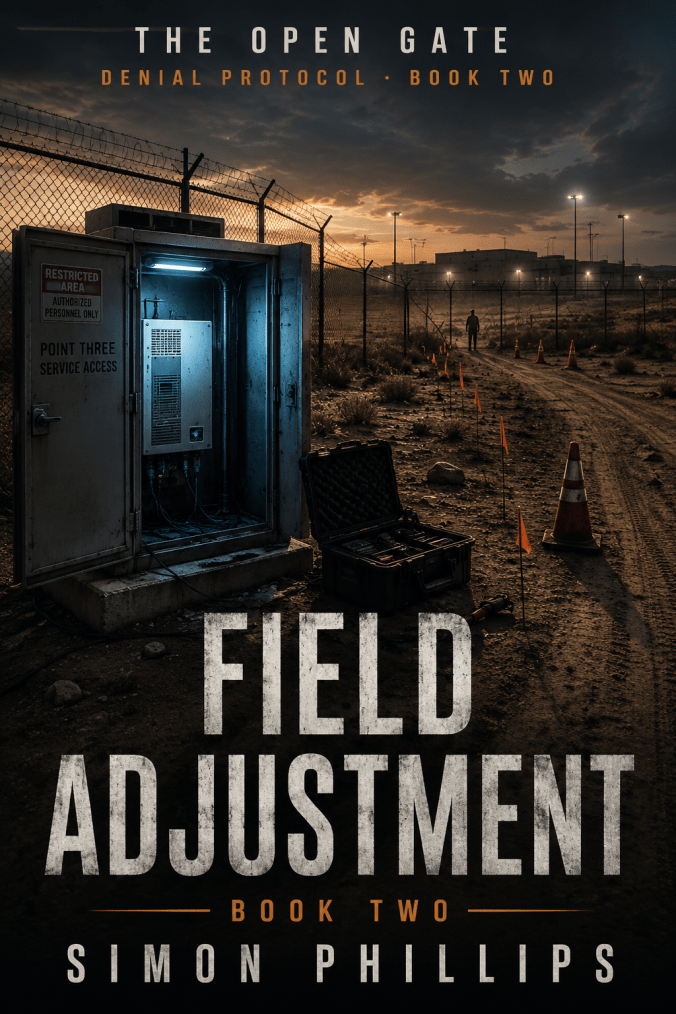
A faded perimeter cabinet, three contractor vehicles and a sealed equipment case should amount to an ordinary maintenance assignment inside a restricted government installation. The paperwork certainly presents it that way. The work has been authorised as a perimeter reliability upgrade, involving sensor replacement, route clearance and contractor support. Every phrase is clean, practical and reassuring.
The equipment begins responding before it has been connected.
That narrow division between what people physically experience and what an institution is willing to record is where Field Adjustment begins to tighten. Book Two of The Open Gate develops its dimensional horror through military procedure, controlled journalism and compartmentalised scientific work, allowing the danger to advance without abandoning the recognisable world surrounding it.
Buildings remain open. Roads continue carrying traffic. Reports are completed, visitors receive badges, researchers correct models and soldiers follow orders. The system does not fail in a sudden, dramatic collapse. It adapts to the contradiction, absorbs it into approved language and continues working.
For readers drawn to slow-burn science-fiction horror, restricted research facilities, institutional secrecy and unsettling events that resist easy explanation, Field Adjustment is available as an ebook through Amazon UK.
When an Anomaly Becomes a Management Problem
Prior Condition, the opening book in The Open Gate, established a world in which several people began noticing details that did not fit the explanations surrounding them. Ethan Ward encountered physical unease along the facility perimeter. Maya Ward gathered civilian reports that appeared ordinary until placed beside one another. Dr Adrian Hale completed technical corrections without being shown the larger system receiving them.
Those contradictions could still be treated as isolated problems. A camera failed because of interference. A power dip belonged to the local grid. A strange movement near a fence could be heat distortion. An unusual data spike remained within tolerance once the model was adjusted.
Field Adjustment begins after the institution has decided that these irregularities require a response. That response is not public acknowledgement, evacuation or even meaningful caution. Contractors are sent to replace perimeter equipment. Access routes are controlled more carefully. Public affairs offers a managed display of transparency. Scientific work moves into more restricted rooms.
The danger has become consistent enough to require action, yet the language surrounding that action continues to deny what the response itself reveals.
This is one of the book’s most effective tensions. The facility behaves as though everything remains under control precisely because it has developed procedures for dealing with events it cannot openly describe. Strange behaviour becomes field variance. A troubling visual becomes a monitoring discrepancy. Removal from duty becomes fatigue management. Professional suppression becomes concern for access terms and visitor safety.
The wording is plausible in every individual situation. Taken together, it begins to reveal an institution constructing an alternative version of reality while the physical world continues pressing against it.
Ethan Ward and the Failure of the Official Record
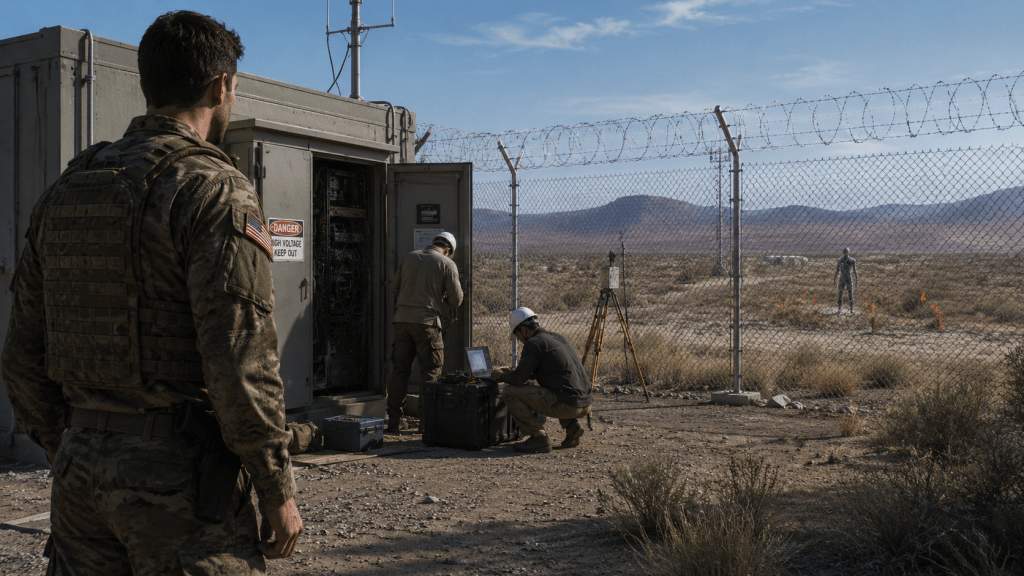
Ethan experiences the crisis through military routine. His task is to escort contractors along the eastern service route while they replace equipment at several perimeter points. He checks badges, watches tools, monitors movement and keeps the work within the boundaries established by the assignment.
His role does not require him to understand what the contractors are installing. It requires him to keep people where their clearance permits them to stand.
This makes him especially effective as the soldier perspective. Ethan is not presented as a conventional action hero waiting for permission to fight. He is competent, observant and accustomed to treating the perimeter as a sequence of practical responsibilities. He knows how many people should be present, where they should be standing and what the ground normally feels like beneath a military vehicle.
When the equipment reacts too early, static touches exposed skin and vibrations move beneath the service road, his experience tells him that something has changed. The institutional response tells him that the work remains routine.
The conflict becomes more serious when Ethan’s own sight contradicts the monitoring system. He sees something within a restricted area where nobody should be present. Davis, his patrol partner, sees enough to know that Ethan is not simply inventing the experience. Yet the official response remains unchanged: monitoring shows clear.
That phrase carries greater force than an overt threat would have done. Ethan has followed procedure. He has reported what he witnessed. Another soldier has partially confirmed it. The institution does not accuse him of lying, nor does it begin an obvious cover-up in front of him. It simply places the monitoring record above the people standing on the ground.
Ethan’s growing distrust emerges from that difference. He knows what he saw, but he also knows how easily an incident disappears once it has been given an acceptable description. His military training allows him to recognise physical danger, while the system around him is designed to prevent that recognition from becoming institutional knowledge.
Maya Ward and Transparency as a Form of Control
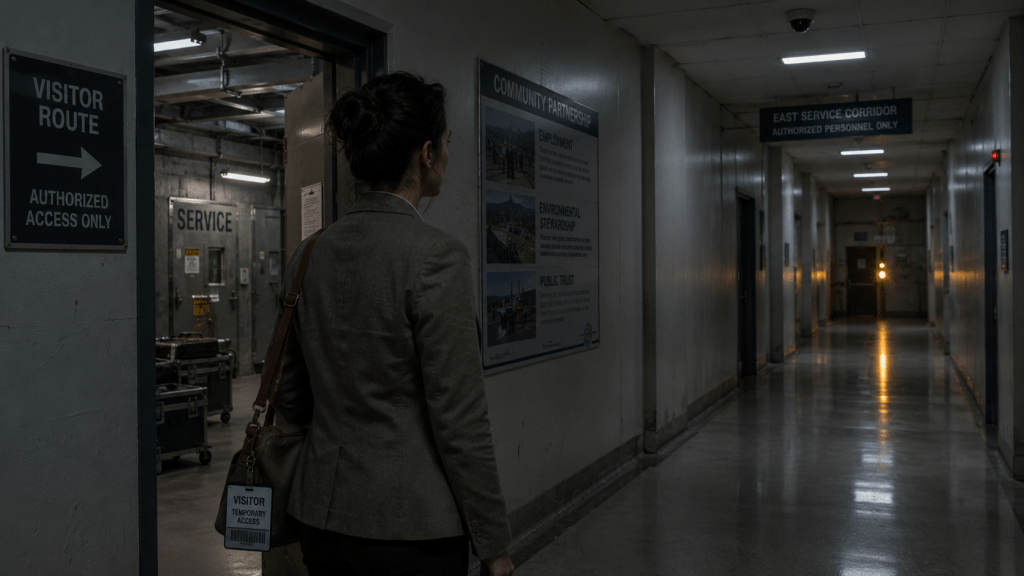
Maya enters the facility through an entirely different route. Where Ethan carries military clearance, Maya receives a visitor badge and a sanctioned public-affairs tour. Her editor presents the opportunity as the access she has been requesting, but the permitted story has already been defined: employment, community partnership, environmental monitoring and public trust.
The facility does not conceal its existence from her. It displays selected parts of itself.
That distinction is central to Maya’s section of the book. The visitor route is polished, carefully managed and filled with language designed to demonstrate openness. Public-affairs staff answer questions, explain environmental programmes and guide local representatives through approved corridors. Screens show maps, measurements and civic information. The tour appears to offer transparency because everything visible has been prepared for visibility.
Maya notices the working edges around that performance. A route changes without explanation. Staff members move with controlled urgency. Internal wording briefly appears on a public display. Radio traffic refers to the east service corridor, visual clearance and the need to keep visitors away from a particular area.
Her investigation does not depend upon hacking systems or performing exaggerated acts of espionage. She listens, notices the physical structure of the building and recognises when the official tour begins moving around something it has not acknowledged.
When she steps outside the visitor route, the institutional response is swift and remarkably calm. Her movement becomes a route exception, then an operational concern, then a media-conduct issue. Public affairs reaches her editor before she has fully left the site. Her access is not merely withdrawn; it is used to undermine the credibility of anything she may have observed.
The suppression works because it remains professionally believable. Her editor faces legal, financial and access pressures. The facility can claim that Maya violated the agreed route. She possesses fragments rather than publishable proof. The truth is not disproved. It is made unusable.
Maya’s response gives the book one of its most important human developments. When official channels can no longer hold what she has witnessed, she begins preserving it privately. Journalism has not ceased to matter to her, but publication is no longer the only measure of whether a record should exist.
Adrian Hale and the Danger of Successful Science
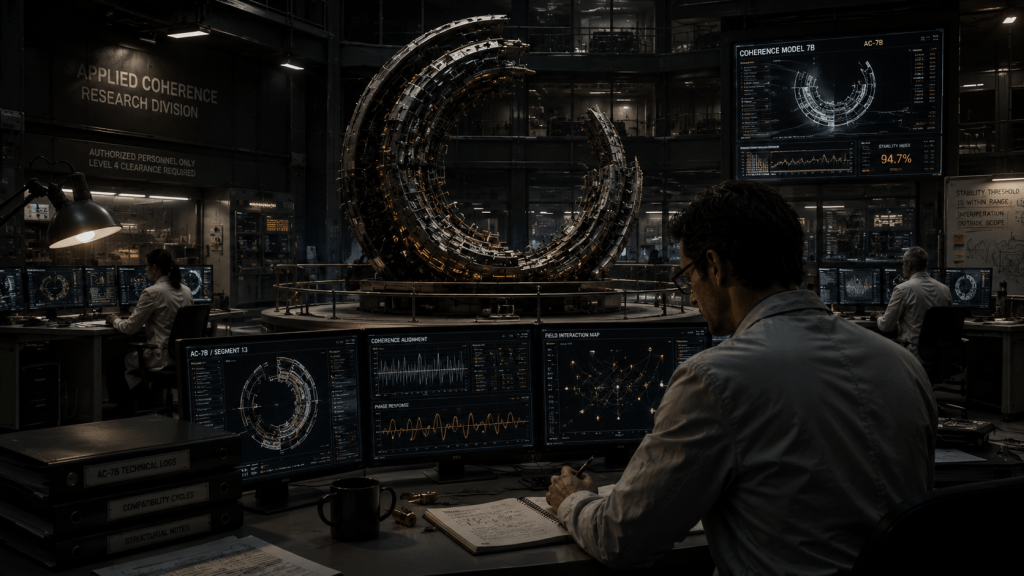
Dr Adrian Hale experiences the same pressure from inside the scientific system. His technical ability has already made him valuable. A correction he completed in the earlier book has held under further load, leading the facility to transfer him into Applied Coherence, a deeper and more restricted section of the research programme.
The move appears to be professional recognition. Adrian receives new access, more complex models and work that better suits his abilities. Every reward also reduces his understanding of the whole.
He is shown a larger structure while being assigned a smaller permitted portion of it. His notes must remain structural. Interpretation sits outside his scope. Wider questions are redirected towards local tolerances, compatibility cycles and managed ranges.
Adrian’s danger does not arise from recklessness or cruelty. It arises from competence separated from moral context.
He can identify where a model is correcting too late. He can refine a threshold, stabilise a segment and improve the way different systems respond to one another. The facility does not need to force him into obvious wrongdoing. It gives him a problem that can be solved and withholds the meaning of the system that benefits from the solution.
This makes the scientific thread particularly unsettling. Failure might have forced the programme to stop. Adrian’s success allows it to continue.
The institutional structure rewards that success with deeper access and further responsibility, even as the language around him grows narrower. Another researcher, Nolan Vale, begins asking questions that move too close to interpretation. His concern is not treated as a scientific debate. It becomes an access matter, a personnel movement and a quiet reassignment.
The work continues around his absence.
The Quiet Violence of Institutional Language
Institutional horror is often most convincing when nobody believes they are behaving like a villain. Field Adjustment builds its pressure through ordinary people fulfilling professional roles.
The shift officer accepts the monitoring record because that is the authorised version available to him. The personnel officer processes leave through welfare language. Public affairs protects access agreements and controls the organisation’s public exposure. Maya’s editor attempts to protect the newspaper from a confrontation it cannot afford. Researchers keep their notes within permitted scope. Contractors finish the installation because their responsibility ends at the equipment.
Each decision can be defended locally.
The horror emerges from the combined result. A figure can be witnessed and removed from the record. A reporter can be invited inside and professionally discredited for seeing beyond the presentation. A scientist can recognise structural instability and be rewarded for making the system accept it.
Nobody needs to announce a conspiracy. The organisation’s existing incentives produce the necessary silence.
This gives Field Adjustment a distinctive place within institutional science fiction. It is concerned with how organisations protect continuity before truth, particularly when admitting the truth would require them to question the work, authority and assumptions upon which the organisation depends.
The language does not merely conceal the crisis from outsiders. It allows the people inside the system to continue participating without having to confront the full meaning of their actions.
Dimensional Horror Rooted in Physical Experience
The dimensional horror of The Open Gate does not depend upon a bright portal opening above the facility or a clearly identified creature stepping into view. Its force comes from familiar spaces behaving incorrectly.
Equipment wakes before receiving the signal expected to activate it. Dust moves where the air remains still. Static is felt through gloves and clothing. A low vibration travels through a vehicle after the engine has stopped. Human-shaped forms remain visible long enough to resist dismissal, while refusing to resolve into something the witnesses can confidently name.
These effects remain close to the body. Ethan feels them through his boots, hands and jaw. Maya experiences them through floors, walls, sounds and changes in controlled movement around her. Adrian encounters them through models whose behaviour implies a structure larger than the one he has been permitted to see.
The separation between the three perspectives allows the reader to recognise connections that none of the characters can yet confirm. What appears at the perimeter has a technical reflection inside the laboratory and an institutional reflection within the visitor route. Each part remains incomplete, which preserves the uncertainty without making the story arbitrary.
The series does not ask the reader to accept that everything is inexplicable. It shows people repeatedly encountering evidence that their current explanations are too small, then continuing to use those explanations because no authorised replacement exists.
A Facility Built from Ordinary Systems
The unnamed installation occupies a remote, dry region of the American Southwest, where isolation supports both the physical work and the public denial surrounding it. Its atmosphere is constructed from service roads, fences, guard posts, concrete pads, low buildings, monitoring cabinets, security desks, laboratories and controlled corridors.
Nothing about the facility resembles a theatrical villain’s headquarters. It feels funded, functional and accustomed to processing risk.
That ordinariness is essential. A more visibly sinister place would warn everyone entering it that something was wrong. The installation in Field Adjustment relies upon recognisable systems whose familiarity reassures the people using them. Badges open the correct doors. Forms record movement. Screens display authorised information. Staff members redirect visitors politely. Work continues beneath fluorescent lighting.
Beyond the facility, the town provides a civilian reflection of the same pressure. Local advisories, bar conversations, changing animal behaviour and small disturbances remain easy to dismiss as separate issues. People continue going to work, meeting friends and returning home because nothing has yet provided a socially acceptable reason to stop.
The boundary therefore becomes more than the perimeter fence. It moves through professional access, approved terminology, bodily sensation and domestic space. By the time the characters begin recognising that movement, the system has already adjusted around them.
Why Book Two Deepens The Open Gate
Field Adjustment does not repeat the opening pressure of Prior Condition. It changes the nature of that pressure.
The first book allowed contradictions to appear. Book Two shows the institution responding to them. That progression gives the story momentum without rushing towards open collapse or easy revelation. The reader learns more about how the pieces connect, while the deeper cause remains unresolved.
Ethan becomes a witness whose report cannot survive the system recording it. Maya discovers that access can be another method of restriction. Adrian moves closer to the centre of the work while receiving less freedom to interpret what he sees.
Their stories do not converge through a convenient exchange of information. They remain divided by professional roles, restricted knowledge and the damaged intimacy of Ethan and Maya’s marriage. The reader occupies the uncomfortable space between those fragments, aware that the same event is being managed through several different institutional layers.
For readers who prefer science-fiction horror driven by atmosphere, psychological pressure and accumulating consequence, this structure offers a more sustained form of unease than immediate spectacle. The danger grows because people continue doing their jobs well.

A Story for Readers Who Prefer Dread to Spectacle
Field Adjustment will particularly suit readers interested in dimensional horror, secret research facility fiction, military science-fiction suspense, investigative science fiction and stories about scientific responsibility.
Its military elements concentrate on routine, observation and the limits of procedure rather than combat fantasy. Its journalistic thread examines credibility, professional containment and the difficulty of publishing evidence that remains fragmented. Its scientific thread explores the danger of technical success when nobody is permitted a complete moral view of the work.
The horror remains restrained, but the restraint does not make it slight. It allows each detail to remain close enough to ordinary life that dismissal feels possible. The reader understands why the characters continue, even as each continuation carries them deeper into a system that has begun changing the conditions around them.
Field Adjustment is Book Two of The Open Gate and follows the events of Prior Condition. Readers returning to the series will find the pressure widening across the perimeter, newsroom, laboratory and home. New readers will encounter a grounded adult science-fiction horror series in which institutional confidence survives longer than the explanations supporting it.
The facility remains operational. The reports remain controlled. The adjustment has been confirmed, and the boundary has already moved beyond the place where anyone expected to contain it.
