A body is discovered inside a sealed maintenance shaft in Sector Twelve, and the report begins to vanish before the investigation can properly begin.
The Shaft Beneath Sector Twelve
The first call reached Ralen Orst during the late recovery cycle, while he was standing beneath a row of restored lights that shone too brightly across the lower maintenance office. The lamps had been replaced after the blackout, and the new glare showed every stain on the floor, every scratch along the cabinets, every old burn mark around the relay board where the western grid had nearly failed. Ashfall Station had recovered its public face. Above Sector Twelve, freight moved through the docking arms, markets reopened beneath steady amber light, and families crossed the habitation galleries as though the darkness had become one more story to fold into ordinary station life.
Down in the service levels, recovery felt thinner. The air still carried dust from opened panels and the dry metallic taste of overworked circuits. Ralen stood with a half-finished repair slate in one hand while the office wall hummed beside him, and he listened to the old station through the soles of his boots. Ashfall always spoke in machinery. Freight lifts, circulation trunks, pressure doors, pumps, relays, all of it moved through the structure in layered sound. Since the blackout, he had found himself listening for a second movement beneath the first.
The call appeared on his slate with an authority marker he rarely saw attached to environmental work. Ventilation Run 12-C. Restricted airflow variance. Manual verification required. The wording looked clean enough to belong to ordinary maintenance. The access trail beneath it looked worse. Three previous entries had been sealed. Two had been reassigned away from local review. One showed a blank where a crew name should have been.
Ralen stared at the line for a moment longer than he liked, then closed his hand around the slate and turned towards the tool racks.
Anik Vale was already watching him from the far bench, one boot on the lower rail, a coil of fibre line looped across his shoulder. He had the restless alertness of a technician still young enough to believe every fault had a proper cause somewhere inside the system. Beside him, Tessa Myr checked the charge on two portable lamps with slow, deliberate movements, her face pale under the hard office light.
“Another airflow call?” Anik asked.
“Sector Twelve,” Ralen said.
That answered more than the words themselves. Anik lowered his boot from the rail. Tessa looked down at the lamp in her hand, then checked the charge again though the display already showed full.
“Which run?” she asked.
“Twelve-C.”
Her mouth tightened. “That one came up during the blackout review.”
Ralen picked a seal cutter from the rack, weighed it in his palm, and placed it into the field kit. “A lot came up during the blackout review.”
“A lot vanished after it too,” she said.
He looked at her then. The office felt smaller under the bright lights. Across the room, the old relay board gave a soft tick as one line shifted load. “Bring the scanner,” he said. “And keep your private notes off-network until we know what we are looking at.”
They left the maintenance office through the lower corridor and descended towards Sector Twelve by way of a service stair that wrapped around one of Ashfall’s older pressure shafts. Each level changed the station around them. The upper maintenance decks still carried modern signage and fresh emergency paint. Two flights down, the walls thickened. The panels grew older. Later repairs sat over original plating in rough layers, each one solving a problem the last record had failed to explain.
The stair opened into a corridor where the light thinned to a tired amber strip along the ceiling. Ralen stepped out first and let the lamp on his shoulder wake across the walls. The passage stretched ahead through reinforced ribs and exposed conduits. Pipes crossed overhead in uneven banks, some labelled in current Fleet script, others marked with faded station codes from earlier construction phases. The deck dipped slightly beneath his boots where old settlement had warped the plates by a few millimetres.
Anik brought the trolley through the stair door, guiding it over the raised threshold with a quiet curse. The wheels rattled across the floor seams. Tessa followed with the scanner already open, its pale display washing her face in blue.
“Pressure in the run reads stable,” she said as they started forward. “Low movement through the trunk. Temperature sits below corridor average.”
“Contamination?” Ralen asked.
“Clear so far.” She hesitated. “The system keeps refreshing the access history.”
Ralen kept walking. “Let it refresh.”
“What does that usually mean?” Anik asked from behind the trolley.
“It means someone above us wants the file to look alive while it decides what we are allowed to see.”
The corridor bent left beneath a junction of old airflow pipes. At the turn, Ralen paused and studied the wall map mounted in a cracked frame. Much of it had been updated by overlays. Blue modern routes sat over grey legacy lines. Several older paths stopped against blank sections as though the station had forgotten where they led. Ventilation Run 12-C appeared twice, once as an auxiliary trunk feeding the lower environmental grid and once, faint beneath the overlay, as part of an older service transit route whose destination had been erased by later mapping.
Tessa noticed the same thing. “That is the wrong alignment.”
“It was the right alignment once,” Ralen said.
“Before the station changed around it?” Anik asked.
Ralen touched the cracked map with two fingers. Dust came away on his glove. “Before the record changed around the station.”
They moved on. Sector Twelve had grown familiar to him across many years of work, though familiarity gave little comfort in those lower runs. The station felt different there. The sounds carried further through the walls. Air moved through hidden channels before entering the open corridors, bringing faint traces from sealed spaces and older shafts. Every few metres, small inspection plates broke the line of the bulkheads. Some were clean from recent use. Others were filmed with dust thick enough to show no hand had opened them in years.
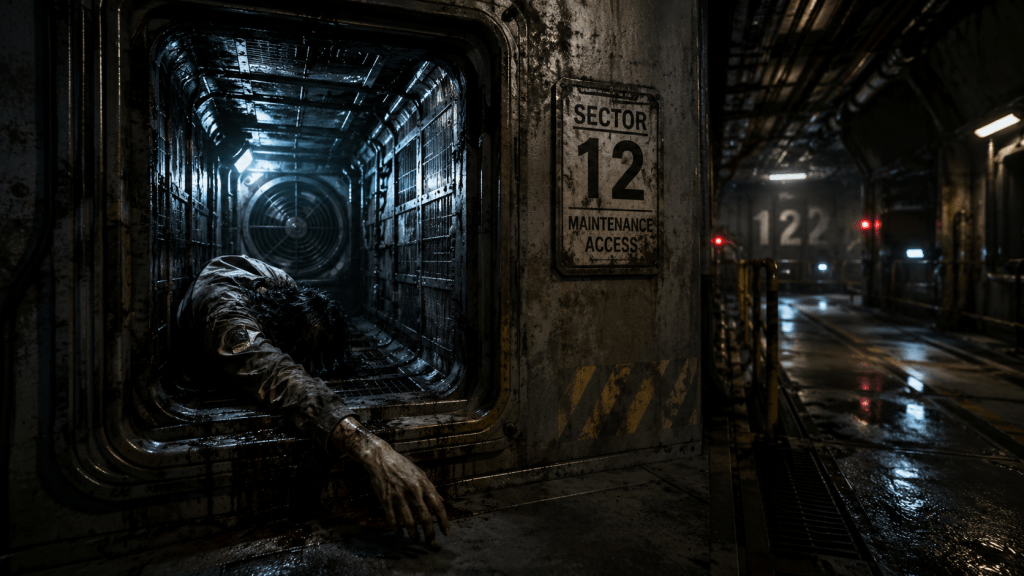
Ventilation Run 12-C sat behind a stack of temporary shielding panels at the end of a narrow spur. The panels had been leaned against the wall long enough to gather dust along their top edges. Ralen and Anik lifted them aside, revealing a broad maintenance hatch set low into the bulkhead. Its frame was black with old sealant. Rust-coloured residue marked the lower edge. Three labels crossed the face of the hatch. The newest read inactive pending manual inspection. Beneath it, an older strip identified the trunk as auxiliary airflow. Beneath both, nearly lost under grime, a third stencil showed a code Ralen recognised only from deep archive fragments.
Tessa stood a step back and raised the scanner. “Internal atmosphere holds.”
Ralen crouched by the hatch and swept his lamp across the frame. “Readings inside the bend?”
“Partial return only. Something is blocking line of sight.”
Anik leaned closer before Ralen lifted one hand and stopped him.
“Stay behind the frame,” Ralen said.
“I’m behind it.”
“Further behind it.”
Anik moved back with the trolley. Tessa watched the hatch as if it might answer before any of them touched it.
Ralen entered his clearance code. The panel took the code, paused, then asked for confirmation through a second prompt that had no place inside ordinary maintenance access. He looked at the authority marker again. It had already shifted. What had opened as an environmental work order now carried a review flag from central systems.
Tessa saw the change on her scanner. “That marker wasn’t there upstairs.”
“No,” Ralen said. “It came to meet us.”
The hatch accepted the second code. The locking bolts began to withdraw. Each one released with a dull knock that travelled into the wall around them. Dust slipped from the upper seal and drifted through the lamp beam. The final bolt scraped loose, and a thin breath of cold air moved through the frame before the door had even opened.
Ralen smelled it at once. Old metal came first, then stale dust, then something sourer beneath it. His fingers tightened around the manual handle.
Tessa lowered her scanner a fraction. “Ralen.”
“I know.”
He pulled the hatch inward. It moved a few centimetres, stuck, then gave with a drawn-out groan that seemed to travel deeper into the wall than the hinge itself allowed. The opening widened. Cold air spilled around his boots. His shoulder lamp reached into the shaft and revealed ribbed wall plating, old cable ties, a pipe run wrapped in cracked insulation, and dust lying thick along the floor.
Something pale rested near the bend.
For a few breaths, the shape refused to become what it was. The light found a sleeve first, grey with dust. Then a hand appeared, palm turned upwards against the floor plating, fingers curled as though the last motion had been interrupted halfway through. A shoulder followed. A head rested at an angle against the right wall, partly hidden by shadow.
Tessa took one step back. Anik stopped breathing loudly enough for the silence to show.
Ralen held the lamp steady. The body lay folded inside the shaft, forced into the narrow space before the bend. One arm stretched towards the hatch. The other disappeared beneath the torso. Work clothes clung stiffly to the limbs, their station-issue fabric darkened by old moisture and dust. No emergency beacon flashed nearby. No tool kit lay within reach. No open panel suggested a repair abandoned in fear.
“Is that maintenance?” Anik asked, his voice thin.
Ralen looked at the sleeve patch, half hidden by the angle of the body. He saw enough colour to know the uniform belonged somewhere within station work, though the grime made the division hard to identify. “I cannot confirm from here.”
“Could they have crawled in?” Tessa asked.
Ralen studied the frame, the dust along the lower lip, the clean disturbance where the hatch had opened for the first time in recent memory. He looked along the floor of the shaft, searching for drag marks, tool scrapes, boot prints, anything that might give the body a route into that position. The dust had shifted around the figure. Near the hatch, it remained settled and undisturbed.
“No,” he said.
Anik stared at him. “No?”
“No one entered this way.”
The statement changed the corridor. Ralen felt it in the way Tessa lowered the scanner and in the way Anik took another half step away from the hatch. The station kept humming around them with its usual weary steadiness. A public deck somewhere above would be bright with repaired lights and evening traffic. Down here, cold air kept flowing from the open shaft around a body that should have had no path into the place where it lay.
Ralen opened the emergency maintenance channel and spoke with care. “Control, this is Orst at Ventilation Run 12-C. Body located inside sealed maintenance shaft. Access opened under assigned inspection order. No entry made. Scene held pending security response.”
The line stayed open. Static moved through it in soft waves. Ralen watched the body while waiting for the response. In ordinary circumstances, Control would ask for identification, environmental conditions, hazard status, scene security, medical readiness. The silence lasted long enough for him to know the report had already travelled somewhere else.
A voice answered at last. It was calm, clipped, and unfamiliar. “Maintain position. Restrict local access. Alter no systems linked to the shaft. Security response has been assigned.”
Ralen looked down at his slate. The incident file opened on its own, then narrowed. His name remained visible. The location remained visible. The body description field greyed out before he could enter the first line. Witness attachment disabled. Local duplication suspended. Audio capture transferred to central review.
Tessa stared at her scanner. “My log just locked.”
Anik whispered, “We only found it.”
Ralen said nothing. The shaft drew his attention again. Beyond the body, the trunk bent out of sight into darkness. His lamp showed a faint line along the inner wall where something had scraped through dust deeper in the passage. It continued past the bend, thin and deliberate, as if the body had arrived from inside the station instead of through the hatch.
A soft click sounded beyond the curve.
All three of them heard it. Tessa went still. Anik lifted his lamp with both hands, though the beam shook against the hatch frame. Ralen kept his own light fixed on the body and listened. Another click followed, further away this time, then a slow settling sound passed through the old ductwork behind the bend. It resembled metal cooling after heat, yet the trunk around them carried no active thermal load. It ended with a faint vibration under Ralen’s knees.
The emergency channel remained open, though no voice came through it. Somewhere far down the corridor, a pressure door opened and closed. The sound felt too distant to matter. The body lay before them in the shaft, its outstretched hand caught in the lamp glow, while Ashfall Station continued its restored routine above and around them.
Ralen finally looked back at Tessa and Anik. He saw the question in both faces and had no answer fit for speech.
“Keep the corridor clear,” he said. “Record what you can by hand.”
Tessa swallowed once and nodded.
Anik glanced towards the dark shaft. “And if they ask what we saw?”
Ralen looked at the locked file on his slate, then at the body, then at the bend where the sound had faded into the hidden structure of Sector Twelve. “Then we remember it properly.”
No one spoke after that. The old ventilation run breathed cold air into the corridor. The hatch stood open like a wound in the wall. Around them, the station hummed with careful normality, as though all its lights, rails, markets, and restored systems had agreed to continue while this one discovery began to vanish inside the record.
By the time local security reached the corridor, the incident file had already changed twice. By the time the first officer looked into the shaft, the maintenance order had disappeared from Ralen’s active queue. By the time the body was logged for removal, its presence had become a restricted matter under central authority. Sector Twelve held its silence around them, old metal, cold air, and buried routes drawing close once more.
Ashfall had given them a body from a sealed shaft. Before anyone could ask how it had reached them, the station had begun taking the question away.
Station Record: Sector Twelve Maintenance Shaft; Suppressed Incident File
Ashfall Station remained under restricted recovery oversight in the operational cycles following the quiet Fleet inquiry that followed the multi-ring blackout. Public systems had returned to stable function across the visible station. Freight traffic resumed through the docking arms, market levels reopened beneath repaired lighting, and habitation corridors carried the usual movement of workers, families, and transit crews. Official communications continued to present the blackout as a managed infrastructure disruption linked to legacy grid complexity, while internal departments adjusted to a station whose records had become increasingly difficult to trust.
During this recovery period, multiple incident files connected to earlier irregularities entered central custody. These included materials concerning the missing survey teams, the outer relay closure, the Deck Twelve sealed corridor, expansion junction anomalies, and witness reports gathered after the blackout. Local departments retained partial indexes in several cases, though full contents became inaccessible through ordinary station channels. Maintenance, records, security, and engineering staff reported shortened files, withdrawn attachments, altered routing markers, and access paths that resolved only into central authority review.
Sector Twelve remained a point of continuing concern during this period. The level contained a dense network of older service routes, ventilation trunks, pressure shafts, and support corridors laid across several phases of station construction. Many of these systems had been rebuilt, redirected, or relabelled during later development. In several cases, current schematics showed only partial continuity between active infrastructure and older spaces embedded behind the modern bulkheads. This made maintenance within the sector unusually dependent on local experience, archived fragments, and manual verification.
Ventilation Run 12-C had been listed in recent maintenance systems as an inactive auxiliary airflow route pending inspection. Earlier references classified the same structure as part of a lower environmental trunk serving older support corridors beneath the active deck. A further legacy code, visible beneath later labels on the access hatch, appears to have linked the run to a service transit route absent from current station mapping. This overlap suggests that the shaft occupied a transitional space between functioning environmental infrastructure and a deeper structural network removed from ordinary station use.
The inspection order assigned to the maintenance crew described a restricted airflow variance within the shaft. Environmental readings available before access showed low movement, stable pressure, and reduced temperature within acceptable limits. No contamination warning, breach event, emergency signal, or active crew assignment appeared in the accessible maintenance record. The shaft access frame remained sealed when the crew arrived, and initial physical inspection found no visible evidence of recent authorised entry through the hatch.
Upon manual release of the access frame, maintenance personnel discovered a body inside the shaft near an internal bend. The body appeared positioned beyond the immediate access point, within a section of trunk whose entry through ordinary maintenance procedure would have required hatch opening, crawlspace movement, and logged environmental access. Personnel at the scene reported no tool kit, emergency beacon, visible repair activity, or active work order connected to the individual found inside the shaft. Early observations also indicated minimal disturbance near the hatch compared with irregular disruption deeper inside the trunk.
The initial maintenance report entered the station system under standard emergency handling, then shifted authority status during the first response window. Witness attachment options were disabled. Local duplication became unavailable. Audio capture transferred to central review. The body description field became restricted before full scene notation could be completed by the assigned maintenance lead. These changes occurred before local security completed arrival at the scene.
Security response records show that the corridor was placed under temporary containment shortly after discovery. Access to the immediate service spur was limited to assigned personnel, with traffic through nearby maintenance routes redirected under an infrastructure safety marker. Medical extraction was delayed while authority status over the scene changed twice within the same cycle. By the time the body was prepared for removal, the maintenance order that led personnel to the hatch had disappeared from active local queues.
System logs associated with Ventilation Run 12-C entered central custody during the same response period. Environmental history, hatch access trace, airflow variance data, and internal sensor returns were withdrawn from ordinary maintenance review. Local departments retained only a shortened incident reference identifying the shaft as subject to restricted structural assessment. Security summaries attached to the discovery later appeared with reduced scene detail and no accessible witness material.
Personnel connected to the discovery were instructed to preserve operational discipline and await further contact from central review. Informal accounts suggest that maintenance staff present at the hatch believed the file had begun changing while they still stood beside the open shaft. Several later references from lower-deck workers indicate that handwritten notes from the scene circulated briefly among trusted crews before those individuals were reassigned across separate sectors.
The public operational archive contains no full incident report for the body discovered inside Ventilation Run 12-C. Index fragments recovered during later archive review indicate that a file existed under Sector Twelve maintenance classification for part of one station cycle before entering restricted authority handling. Subsequent public records mention only a temporary safety closure affecting lower environmental routes, with no reference to body recovery, security attendance, or scene containment.
Later examination of restricted references would identify the suppressed Sector Twelve report as one of the final recorded irregularities before the events surrounding Ashfall Station entered a deeper phase of concealment. The discovery connected active maintenance infrastructure, erased service routes, altered files, and a physical body placed within a shaft whose access history failed to support ordinary entry. For the visible station, the cycle passed into routine. For those who stood beside the open hatch, Sector Twelve had returned something the record was already being taught to forget.
About the Creator
The Future Chronicle is written and curated by Simon Phillips, a writer of science fiction and speculative storytelling who explores the quiet edges of human expansion, where ageing stations, distant worlds, and forgotten technologies continue their slow existence beyond the reach of the central worlds.
Many of the stories presented in these Chronicles exist within a wider fictional universe that follows the lives of investigators, engineers, and frontier workers living far from the comfort of the inner systems, where the machinery of civilisation continues to function long after its original purpose has begun to fade.
One such story unfolds aboard Ashfall Station, an ageing orbital installation whose corridors and industrial sectors form the setting for the science-fiction mystery novella Ashfall Station: The Dead Girl in Sector Twelve. What begins as a routine investigation gradually reveals that something hidden within the station’s structure may have been present for far longer than the official records suggest.
Readers who wish to explore the full investigation and its unfolding events can find the novella below.
Explore the book:
Ashfall Station: The Dead Girl in Sector Twelve
You can watch his YouTube channel here:
Author Simon Phillips
Continuing the Chronicle
The Chronicle continued with the recovery of the suppressed Sector Twelve incident, after Ralen Orst and his crew opened Ventilation Run 12-C and found a body folded inside a sealed shaft.
What first reached the system as an airflow inspection became something older and darker before local security reached the corridor. The hatch had been sealed. The dust near the frame showed little sign of passage. The body lay deeper within the trunk, beyond the place any worker could have reached by simple accident. While the crew stood beside the open panel, the file narrowed around them, taking witness fields, audio capture, and maintenance notes into central custody before the scene had even settled.
Later fragments placed the discovery among the last known warnings before Sector Twelve passed fully into restricted history. Ashfall had returned a body through one of its hidden routes. Before anyone could ask how it had arrived there, the station had already begun taking the question away.
Readers supporting The Future Chronicle can continue the record below.
The Rooms Where Records Changed
Local security arrived with two officers and a medical team whose equipment cart rattled across the service corridor long before any of them appeared around the bend. Ralen heard them coming through the old metal first, their boots and wheels sending small vibrations through the deck plating while the open hatch breathed cold air against his knees. He had remained beside Ventilation Run 12-C with his lamp fixed on the body, because looking away felt like granting the shaft permission to change while no one watched. Tessa stood near the wall map with her scanner tucked under one arm and a grease pencil in her hand, writing on the back of a torn maintenance wrapper. Anik kept the corridor clear with more discipline than Ralen had expected from him, one hand raised each time distant footsteps approached, his young face set in a tight mask that made him look older than he had been at the start of the shift.
The first security officer slowed as soon as he saw the hatch. His name patch read Corvin Hale. Ralen knew him by sight from lower-sector incidents, a broad-shouldered man with the patient, guarded expression common among officers assigned to parts of the station where accidents often carried other meanings. Hale took in the open shaft, the technicians, the sealed trolley, and the way Tessa had her private notes hidden beneath her sleeve. He then looked past Ralen and saw the body lying in the lamp glow beyond the frame.
“Who entered?” Hale asked.
“No one,” Ralen said.
The officer crouched beside him, careful to keep his boots away from the dust gathered along the hatch lip. “You opened under work order?”
Ralen held out his slate. “The order existed when we arrived.”
Hale glanced at the screen, then at him. The slate showed the restricted marker where the work order had once sat. The officer understood the absence at once. His jaw shifted slightly, and that was the only sign his face gave.
“Medical stays back until I clear the frame,” Hale said over his shoulder.
The medical lead, a woman with silver clips along the side of her cap and exhausted eyes, stopped the cart beside the wall. She looked into the shaft from where she stood. “How long has the body been here?”
Tessa answered before Ralen could. “Temperature reading sits below corridor average. Internal atmosphere stable. No active contamination flag. I had more from the scanner, then my log locked.”
The medical lead looked at her. “Name?”
“Tessa Myr. Environmental maintenance.”
“Keep that written copy,” the woman said quietly, then busied herself with the cart as if she had never spoken beyond procedure.
Hale activated his recorder. The device emitted a start tone, flashed twice, and displayed a restricted custody notice. He stared at it for several seconds. “Security capture transferred,” he said, mostly to himself.
Ralen felt the corridor tighten around them. The report was moving ahead of the people assigned to write it. He had seen files reclassified after review. He had seen errors corrected, attachments withdrawn, permissions narrowed. This was different. The record was closing while the scene still lay open in front of them.
Hale removed a hand lamp from his belt and swept the beam around the hatch frame. “Dust near the threshold is settled,” he said, speaking slowly in case any system still listened. “Manual release disturbed outer lip only. No visible entry trail from corridor side.”
His recorder gave no confirmation.
Ralen watched him continue anyway.
The second officer, Jessa Vorn, moved down the corridor and set a temporary barrier at the bend. She spoke into her comm with her back turned, low enough that only fragments carried. Sector Twelve. Restricted. Central marker. Awaiting instruction. Her shoulders stiffened as the reply came through, then she lowered her hand from the earpiece and returned to Hale.
“Command says scene authority has moved above local security,” she said.
Hale kept his lamp steady on the shaft. “Command said that before we got here?”
“Yes.”
Anik looked from one officer to the other. “How could they move authority before the scene was assessed?”
No one answered him. In the silence, the body became heavier inside the shaft, as though the corridor itself had leaned closer around the question.
Hale shifted his beam beyond the figure. The light caught the thin scrape Ralen had noticed along the inner wall, a pale line through the dust that ran deeper around the bend. Hale followed it with care, then angled the lamp under the body’s outstretched arm. The hand lay palm-up against the plating. Dust had settled across the knuckles, yet the fingertips were cleaner, faintly marked where they had brushed the metal.
“Looks dragged from inside,” Hale said.
Jessa Vorn looked sharply at him. “Say that again with central capture active and the sentence may vanish before it leaves the room.”
Hale gave her a brief look. “Then remember I said it.”
The medical lead stepped closer with a compact body scanner held in both hands. Hale allowed her to kneel beside the hatch while Ralen moved back half a pace. The scanner projected a thin sheet of light over the visible portion of the body. Its data flickered in pale bands across the display, then stalled. The medical lead frowned and adjusted the angle.
“Signal scatter from the shaft walls,” she said.
“Interference?” Ralen asked.
“Dense plating. Old conduit. Maybe shielding in the trunk.” She shifted the scanner again. “No clean identity return.”
The words unsettled Anik more than the body had. “Station ID should ping from the sleeve patch at least.”
“It should,” she said.
Hale leaned closer. “Cause?”
“Ask me after extraction,” the medical lead said. “From here I see dehydration signs, pressure exposure, and trauma from confinement. That is all I will say beside an open shaft that keeps eating my readings.”
Another sound travelled from beyond the bend. This time it came as a faint metallic tick followed by a slow sliding vibration, gentle enough to pass for ordinary duct settling if five people had not already learned to fear the place. Hale raised his lamp. Jessa’s hand went to the grip at her belt. Tessa stopped writing. The medical lead held the scanner still above the body.
Ralen felt the vibration move through the floor beneath one knee, then fade deeper into the wall.
Hale looked at him. “Earlier?”
“Twice,” Ralen said. “After the file locked.”
Jessa lifted her comm. “Control, this is Officer Vorn at the 12-C scene. We have internal movement reported beyond the body location inside the shaft.”
A clean tone interrupted the channel, then a voice answered with smooth authority. “Officer Vorn, maintain scene containment. Further structural observations are outside local incident scope.”
Jessa stared at the comm unit. “Outside scope?”
“Maintain scene containment,” the voice repeated.
Hale exhaled through his nose. “There it is.”
The medical team prepared extraction under Hale’s direction. Because the body lay beyond the hatch angle, they had to extend a narrow brace into the trunk and secure the figure without sending anyone inside. The work took time. Every motion had to be slow, every shift logged by hand after the devices began refusing full capture. Ralen held the lamp from one side while Tessa marked times on her wrapper. Anik counted each tool passed forward and each tool withdrawn, his voice shaking at first, then growing steadier as repetition gave him something to hold.
As the body moved, dust lifted inside the shaft in a grey cloud. The smell deepened, and one of the medical assistants turned his face away. The figure came free by degrees, sleeve first, shoulder next, head bowed forward as though the shaft itself resented surrender. Ralen saw then that the back of the work jacket carried maintenance colours, though the name strip had been removed. The patch had been cut out cleanly, leaving a darker rectangle in the fabric. Whoever the person had been, the station had already lost the name before giving the body back.
The medical lead saw it too. Her expression hardened. Hale asked, “Name strip removed before death or after?”
“Edges are clean,” she said. “I need proper light.”
“Make a note.”
“My notes are my own now,” she replied, and for a moment her tone carried more anger than fear.
They laid the body on a portable sheet beside the corridor wall. Hale stood over it with his lamp angled down. The face was partly obscured by dust and the angle of the jaw, yet Ralen saw enough to feel the sudden pressure of recognition trying to form and failing. The dead man might have passed him in a service corridor. He might have stood in the lower office queue, collected spare filters, complained about shift assignments, waited at a lift with one hand on a tool bag. Ashfall was filled with such people, workers made familiar by posture, uniform, fatigue, and shared air, even when names came slowly.
Tessa drew in a thin breath. “I know him.”
Ralen turned. “From where?”
She looked at the body, then at the officers, then back to Ralen. “I think he worked old airflow routes after the expansion hold. Lio Sarn. Maybe. He was transferred after the blackout review.”
Hale opened his slate and searched the name. The screen gave a soft error tone. He tried again. This time it returned a personnel index with no image, no assignment, no current sector, and no active status. Only the name remained, floating in the system without the structure that should have held it.
“Lio Sarn,” Hale said.
The slate greyed out. The name vanished.
Anik swore under his breath. Tessa looked down at her wrapper as if checking whether she had already written the name somewhere the station could not erase. She had. Ralen saw it near the edge of the torn material, pressed hard in grease pencil.
A new arrival reached the barrier before Hale could speak. The man wore Fleet issue with no department colour, his coat sealed high at the throat and his gloves still clean from upper-deck corridors. He came alone, though two local security staff followed behind him with the blank expressions of personnel reassigned by order. Ralen recognised the type from the post-blackout inquiry. The station seemed to clear itself around such people.
“Scene authority transfers now,” the Fleet officer said.
Hale remained beside the body. “Local security has active custody.”
“Local security has attendance.” The officer’s gaze moved across the body, the hatch, the technicians, the medical cart. “Custody has transferred.”
The words landed with practised weight. Hale held the man’s stare for two breaths, then lowered his slate. Ralen saw the moment calculation replaced resistance. A local officer could hold a corridor for a while. He could even delay a report. He could not win a jurisdictional fight inside a station whose records had already chosen a side.
The Fleet officer turned to the medical lead. “Prepare remains for restricted transfer.”
“I need full scan, identity confirmation, and extraction conditions recorded.”
“You will receive the authorised summary.”
Her face sharpened. “I am the medical lead on scene.”
“You are the medical lead present at a restricted infrastructure recovery.”
That phrase altered the body at their feet. It shifted the dead man from person to object, from death to material, from discovery to recovery. Ralen felt Anik’s anger beside him before the younger technician moved, and he reached back without looking, gripping Anik’s sleeve hard enough to keep him still.
The Fleet officer saw the motion and gave no sign. “Names of all personnel present.”
Hale supplied them slowly. Ralen Orst. Tessa Myr. Anik Vale. Corvin Hale. Jessa Vorn. Medical Lead Saela Drin. Two assistants. Each name entered the officer’s slate. Ralen watched the screen as the list formed. For a moment, his own name appeared under witness category. Then the category changed to maintenance attendance. Tessa’s changed as well. Anik’s shifted to support personnel. Hale’s changed from scene lead to local liaison.
The record had found cleaner words for them while they stood breathing the air of the corridor.
“Your accounts will be collected separately,” the officer said. “No unauthorised copies, no informal discussion, no continuation of independent notes.”
Tessa held the wrapper at her side. Ralen stepped half in front of her.
“Tools and materials remain with maintenance until receipt,” he said.
The officer looked at him. “All scene materials transfer.”
“Then issue a receipt.”
The corridor held still. Hale glanced at Ralen with something close to approval. Saela Drin folded her arms. Anik kept his gaze on the deck.
The Fleet officer studied Ralen for a long moment, then tapped his slate. A receipt appeared on Ralen’s device. It contained no item list, only a transfer number and a custody seal.
Ralen looked at it. “That is a hole with a number on it.”
Hale shifted as if ready to intervene. The Fleet officer’s expression remained calm.
“You are finished here, Technician Orst.”
Ralen thought of the body inside the shaft. He thought of the scrape line beyond the bend and the way the name Lio Sarn had vanished between one breath and the next. He thought of the public galleries above them, lights restored, families walking under the impression that recovery meant safety. The station hummed through the corridor with soft, steady discipline.
“No,” he said. “I found him here.”
“You found an object of restricted review inside inactive infrastructure.”
“I found a man.”
The words seemed too plain for the corridor, too heavy for the official air around them. Tessa looked up. Anik stopped staring at the floor. Hale held still, his lamp angled across the body sheet and the open hatch.
For the first time, the Fleet officer looked at the body as though it had become inconvenient in a human way. “You will attend interview when summoned,” he said.
“Then summon me properly.”
The officer gave a small motion to the local security staff behind him. They moved to collect the handwritten notes, the medical preliminary sheet, and the tool wrapper in Tessa’s hand. Hale stepped between them before they reached her.
“Scene integrity requires local duplicate until transfer completion,” he said.
“Scene integrity is under central review.”
“Then central review can write that it removed witness material before final extraction.”
The two men faced one another in the amber light. Ralen knew Hale was buying seconds, maybe less. Tessa used them. Her hand moved once, quick and low, passing the torn wrapper behind the open field kit. Anik shifted his boot to cover it. The gesture was small enough to vanish inside ordinary fear. Ralen kept his eyes on the Fleet officer and willed the station to look elsewhere.
Saela Drin sealed the body sheet herself. “Transfer ready,” she said.
The medical assistants lifted the remains onto the cart. The sheet changed the body into a shape, and the shape began moving out of the corridor under escort. Ralen watched until the cart passed the bend and the sound of its wheels faded into the broader service route. The cold breath from the hatch continued. The shaft remained open, body gone, darkness still bending beyond the reach of the lamps.
The Fleet officer ordered the hatch sealed. Ralen refused to perform the closure. Anik refused before anyone asked him. Tessa said nothing. In the end, two upper-deck technicians brought in under central order fitted a temporary seal across the frame while Ralen stood back with his hands at his sides. The panel they installed carried no maintenance code. It had a smooth white surface and a single authority tag that linked to no visible file.
When it locked, the corridor sounded different.
The open wound had been covered, yet the air around it remained cold. Behind the new seal, the shaft settled into silence. Ralen imagined the old trunk bending away through darkness, the scrape line vanishing around the corner, the hidden route beyond continuing into spaces current maps had never held honestly. Somewhere inside that buried network, metal clicked once, so faintly he wondered if only he had heard it.
The Fleet officer left last. Before he went, he looked at Ralen with the composed patience of a man who expected time, rank, and systems to perform most of his work for him.
“Technician Orst,” he said, “records exist to preserve continuity.”
Ralen met his gaze. “That depends what they preserve.”
The officer gave no reply. He walked away down the corridor with the two local security staff following behind him. Hale remained until the sound of their footsteps faded.
Only then did Anik lift his boot from the field kit.
The torn wrapper lay beneath it, creased, marked with dust, and filled with Tessa’s hard, cramped handwriting. Times. Readings. The first sight of the body. The name Lio Sarn. The scrape line beyond the bend. The first sound inside the shaft after discovery. Hale looked at it, then at Ralen.
“If they find that on you,” he said, “they will make it disappear with everything else.”
Ralen folded the wrapper once, then slid it into the lining behind the cracked casing of his old scanner. “Then they had better search carefully.”
Hale gave him a tired look. “Careful is what they are.”
“Then we remember more carefully.”
No one smiled. There was no victory in the corridor, only a small piece of resistance held inside a damaged tool casing while the larger record closed around them. The service route returned to work by degrees. Medical cleared. Security withdrew. The trolley went back towards the lower maintenance office carrying tools that now felt borrowed from another life. Tessa walked beside Ralen in silence. Anik followed close behind, his earlier anger drained into a pale focus that would keep him awake for many cycles.
At the junction, Ralen looked back once. The new panel over Ventilation Run 12-C reflected the amber strip light with blank perfection. It looked cleaner than the wall around it. That made it worse. Ashfall rarely repaired anything so neatly unless the repair was meant to hide the shape of what had been broken.
By the time they reached the maintenance office, the official message had already arrived. The inspection at Ventilation Run 12-C had been reclassified as a restricted infrastructure recovery. No fatality appeared in the summary. No body appeared in the wording. No named worker appeared in the accessible record. Ralen opened the file, watched the lines settle, and felt the old scanner casing press against his ribs beneath his jacket.
Tessa stood beside his desk, hands folded tight. “He will be gone by morning.”
Ralen kept reading the emptied summary. “He is already gone.”
Anik looked towards the bright office lights, then away. “So what was the point of finding him?”
Ralen closed the file. The screen went dark, and for a moment he saw the reflection of all three of them in it, pale under hard light, carrying the look of workers who had entered a corridor and returned with something the station had refused to keep.
“The point,” he said, “is that someone saw where he was.”
Above them, Ashfall continued its orbit with freight lanes active, markets open, and public lamps restored. In the lower office, three maintenance workers stood around a closed file while the station carried on pretending the shaft had held nothing of consequence. Yet behind the casing of an old scanner, on a torn strip of maintenance wrapper, a different record remained. It was fragile, incomplete, and dangerously small against the weight of Fleet custody. It was still more honest than the archive.
Later, when Sector Twelve became a name spoken with caution across the station, few would know about the wrapper or the hand that wrote on it. Fewer would know how close the body came to vanishing before anyone outside central review had time to understand that it had been there at all. The official record held the incident for less than a cycle. The people who witnessed it carried it for much longer.
In that difference lay the last trace of the event the station tried to erase.
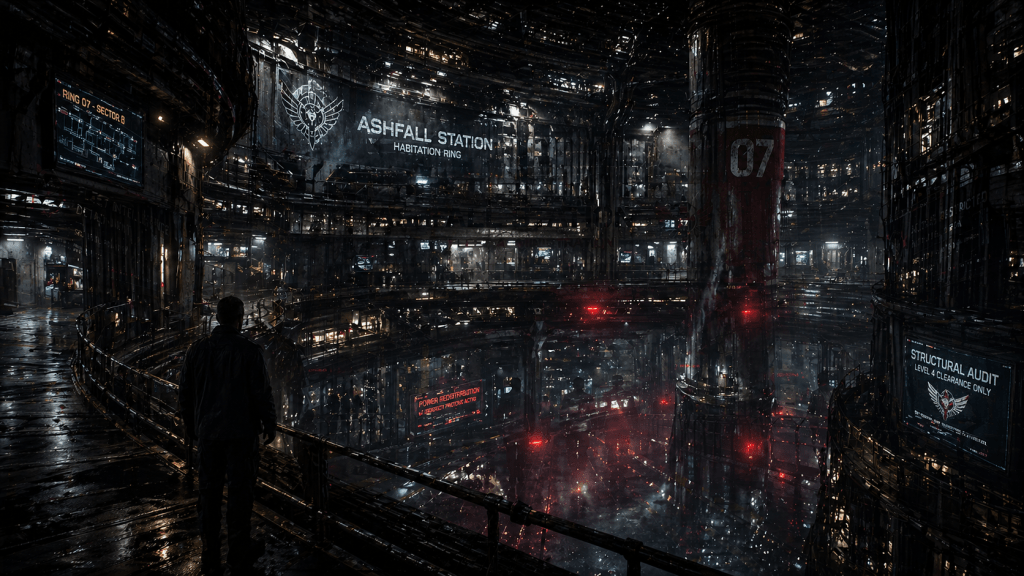
Maintenance crews at Ventilation Run 12-C recorded the body before the incident file began to close around the discovery.
The Idea Behind the Chronicle
Large orbital stations depend on more than machinery. They depend on confidence. Lights must return when they fail, doors must open when commanded, air must move through the decks, and every corridor must continue giving the impression that the structure around its residents can still be trusted. For those living inside a station like Ashfall, survival depends on that trust so completely that the machinery becomes almost invisible. People sleep because the walls hold. They work because the vents breathe. They cross service corridors because the maps say those corridors lead somewhere known.
Ashfall Station existed at the edge of that trust. It had been built in layers, expanded through necessity, patched through decline, and kept alive by workers who understood parts of it more intimately than any central archive ever could. In such a place, infrastructure becomes memory. Every sealed panel, redirected shaft, abandoned corridor, and relabelled route carries the trace of a decision made by someone in an earlier generation. Some of those decisions preserve life. Some bury mistakes. Others survive long after their reason has vanished from the record.
The idea behind this Chronicle grew from the question of what happens when a station begins returning what its records have buried. A body discovered in a sealed maintenance shaft is a crime scene, an engineering problem, a system failure, and an archival disturbance all at once. It belongs to security, medical, maintenance, administration, and Fleet oversight. Each department sees a different shape. None of them holds the full truth. That fragmentation allows the incident to be controlled before it can be understood.
This entry also explores the tension between physical evidence and institutional power. The body inside Ventilation Run 12-C is undeniable in the moment of discovery. People see it. They smell the cold air coming from the shaft. They watch the file change while they are still standing beside the open hatch. Yet the official record begins to reduce the event almost immediately. A death becomes an infrastructure recovery. Witnesses become attendance. A person becomes an object under restricted review. The horror lies in watching reality become smaller inside the language of authority.
Science fiction often imagines the future through grand discoveries: alien objects, impossible signals, lost worlds, and technologies beyond human understanding. Ashfall moves through a quieter kind of speculative fear. It asks what happens when the future is governed by access permissions, controlled archives, automated classifications, and systems that decide what can remain visible. In such a world, truth does not vanish only through lies. It vanishes through workflow. It becomes restricted, transferred, renamed, or placed beyond local authority until the people who witnessed it are left carrying memory without proof.
The maintenance crew at the centre of this Chronicle matter because they are ordinary workers standing at the edge of something far larger than themselves. Ralen, Tessa, and Anik are not investigators in the formal sense. They are people who know how the station breathes, how its panels should sound, how old dust lies when a hatch has remained sealed, and how a maintenance order feels when authority has already touched it. Their knowledge is practical, lived, and grounded in labour. That makes them dangerous to a system trying to simplify what happened.
The Chronicle also turns the maintenance shaft into a symbolic space without making it abstract. Ventilation routes are meant to sustain life quietly. They move air through hidden passages so public spaces can remain habitable. Placing a body inside such a route corrupts that purpose. The shaft becomes both infrastructure and witness, a buried artery carrying evidence back into the visible station. It is an old part of Ashfall’s body returning something the station had tried, or been instructed, to keep out of sight.
There is a broader speculative idea beneath this entry as well. Future societies spread across stations, colonies, and remote installations would rely heavily on technical records to define reality. A person’s identity, access history, movements, work assignments, and even death would pass through interconnected systems before becoming part of public knowledge. If those systems were controlled by distant authority, then memory itself would become vulnerable. A life could be narrowed to a missing name field. A scene could be recategorised. A body could be removed from the archive before grief had time to form around it.
As the final Chronicle in this Ashfall Station sequence, this entry sits close to the boundary between worldbuilding and the events that follow in the wider Ashfall story. It does not explain the mystery outright. It shows the station reaching a point where accident, suppression, infrastructure, and fear can no longer be kept apart. The body in the shaft is important because of where it is found, how quickly the record closes, and how little time ordinary people are given to understand what they have seen.
The fear in this entry comes from the calmness of the response. There is no public panic. No announcement passes through the decks. No dramatic lockdown interrupts the life of the station. Freight continues. Markets remain open. Lights stay on. The incident disappears through procedure, and that is what makes it feel true to Ashfall. The station survives by continuing, even when continuation requires silence.
By the end, the unanswered question is no longer simply how a body reached a sealed shaft in Sector Twelve. The deeper question is why the station’s systems seemed prepared to erase the answer before anyone could properly ask it.
From the Author’s Desk
This Chronicle closes the first Ashfall Station sequence by bringing the mystery back to Sector Twelve, where the wider story of the station begins to press against the edge of the novella. Earlier entries followed the station through distance and disturbance: the strange salvage fragment, the signal in the debris field, the missing survey team, the blackout, and the quiet Fleet inquiry that gathered those separate incidents into restricted custody. This final Chronicle narrows that pressure into one service corridor, one opened shaft, and one body the official record refuses to keep.
That narrowing felt important.
Ashfall works best when the scale of the mystery is held inside ordinary labour. A maintenance crew checking an airflow variance should be one of the most routine scenes possible inside a large station. Workers arrive with a trolley, open a hatch, take readings, make notes, and move on to the next fault. Yet in this world, routine is exactly where the station hides its deeper history. The most frightening discoveries rarely arrive through grand announcements. They emerge through old panels, incomplete maps, and jobs assigned with too little explanation.
Ralen, Tessa, and Anik gave this Chronicle its human centre. They are not detectives or Fleet officers. They are station workers who understand the physical truth of Ashfall more closely than those who control its records. They know how dust should lie around a sealed hatch. They know what a normal airflow fault looks like. They know when a work order has been touched by authority before they ever reach the site. That practical knowledge becomes its own form of resistance.
The body inside Ventilation Run 12-C also carries a deliberate connection to the wider Ashfall atmosphere. It is not only the discovery itself that matters, but the speed with which the discovery is renamed. A death becomes an infrastructure recovery. Witnesses become attendance. A person becomes an object of restricted review. That kind of language interests me because it shows how a system protects itself. The horror comes from calm procedure, not open chaos.
Across these Chronicles, Ashfall has gradually become more than an ageing industrial station. It has become a place where infrastructure, memory, authority, and fear all overlap. The walls hold old routes. The archive holds altered records. Fleet holds the power to decide which parts of reality remain visible. Ordinary workers are left carrying what they saw in private, often with nothing stronger than memory or a scrap of handwritten evidence.
This final entry does not solve Ashfall’s mystery. It was never meant to. Instead, it marks the point where the station’s hidden history becomes impossible to separate from its present condition. Sector Twelve is no longer simply a lower maintenance zone with unreliable lighting and ageing shafts. It becomes a threshold, a place where the station gives something back and the official record immediately tries to take it away.
These Chronicles take place before the events of Ashfall Station: The Dead in Sector Twelve, and they are designed to deepen the world around that story rather than retell it. They show how Ashfall reached the state in which the novella begins: strained, watched, altered, and full of silences that ordinary people have learned to survive around.
Readers interested in exploring more of Ashfall and the wider worlds connected to it can find further work below.
You can explore my books here::
Books by Simon Phillips
You can watch my YouTube channel here:
Author Simon Phillips
Technical Notes & Frontier Context
Maintenance Shafts as Hidden Infrastructure
Large orbital stations depend on systems most residents never see. Air does not simply appear inside corridors, cabins, markets, and docking galleries. It moves through shafts, filters, trunks, pressure regulators, and circulation routes buried behind the visible architecture of daily life. These systems are meant to remain unnoticed. Their success lies in silence, regularity, and the absence of attention.
In a station as old as Ashfall, those hidden systems would carry a long operational history. Ventilation routes might begin as part of one construction phase, then become auxiliary channels during later expansion. A shaft built to serve one industrial zone could later be rerouted into habitation support, then sealed, relabelled, or partially absorbed into a newer environmental grid. Over decades, the practical map of the station could drift away from the original design.
This creates a dangerous kind of uncertainty. A sealed maintenance shaft may be inactive in one system, partially mapped in another, and still physically connected to older routes that current crews rarely enter. For maintenance workers, such spaces are difficult because they sit between infrastructure and memory. They are real enough to affect airflow, pressure, and temperature, yet poorly recorded enough to resist clean explanation when something goes wrong.
In this Chronicle, Ventilation Run 12-C becomes that kind of space. It is a practical system, a physical route for air and maintenance access, and a forgotten corridor into the deeper body of the station. The discovery of a body inside it turns infrastructure into evidence.
Airflow, Pressure, and Access Records
A station’s environmental systems would leave extensive traces whenever a sealed shaft was opened, inspected, or entered. Hatch release logs, pressure changes, internal temperature readings, airflow movement, contamination checks, tool access, and worker assignments would all help establish the condition of the scene. In an ordinary fatality, those details would shape the first layer of investigation.
If a worker crawled into a ventilation run, there should be an access event. If a hatch opened, the station should record it. If pressure changed or air movement shifted, environmental systems should mark the disturbance. Even in an ageing station, the absence of those records would matter. It would suggest either system failure, deliberate removal, or entry through a route outside current mapping.
That is what makes the Sector Twelve incident unsettling. The hatch appears sealed. The dust near the access point remains settled. The body lies beyond the immediate opening. The available readings show stable pressure and low airflow, with no ordinary emergency condition attached. The scene suggests presence without a supported route.
For a maintenance crew, that would be more frightening than visible damage. A broken hatch gives one kind of answer. A sealed hatch with a body behind it gives none. It forces the question away from accident and towards the hidden structure beyond the bend.
The Language of Reclassification
Institutional control often begins with language. A body in a shaft can be called a fatality, a crime scene, a maintenance hazard, a restricted recovery, or an infrastructure matter. Each term creates a different kind of response. Each one determines who has authority, who can view the record, who can speak, and which departments retain access to the evidence.
In a fragile frontier station, official language carries practical power. Calling an incident an infrastructure recovery can move it away from local security and into central technical custody. Witnesses become personnel present at the recovery. Medical findings become authorised summaries. Scene notes become controlled material. The event remains real, yet its public shape changes.
That is the central mechanism at work in this Chronicle. The body discovered inside Ventilation Run 12-C is never allowed to remain simply a body for long. The record begins adjusting around it. The people who found it are renamed by function. Their statements narrow into attendance. The dead worker’s identity begins to slip from the system before ordinary confirmation can complete.
This kind of reclassification creates a quiet horror suited to Ashfall. Nothing needs to explode. No announcement has to be made. Authority changes the frame, and the event begins to disappear inside procedure.
Practical Knowledge Versus Central Records
Maintenance workers understand a station differently from administrators. They know the feel of a hatch that has stayed closed for years. They know the smell of old air escaping from a sealed trunk. They know how dust settles around an untouched panel and how a system sounds when load travels through a line that should have been retired. Their knowledge is physical, repetitive, and built through labour.
Central records understand the station through permissions, files, maps, and classifications. This form of knowledge is powerful because it determines what can be seen by others. A file can confirm a route exists. A map can deny it. A work order can send a crew into a shaft. A restriction marker can erase the reason they were sent there.
The tension between these two kinds of knowledge runs through this entry. Ralen, Tessa, and Anik see the body, the dust, the hatch, the scrape line, and the file changing in real time. Their experience is direct. The record that replaces it is controlled, narrowed, and safer for the station to carry.
In a future built on complex systems, that conflict becomes deeply important. A worker may know the truth of a place through touch, sound, and experience, while the official system holds the power to decide whether that truth exists beyond the corridor where it was witnessed.
Identity Inside a Controlled System
In a station environment, identity would depend on constant verification. A worker’s name, assignment history, clearance level, location access, medical record, communication trail, and personnel file would all form part of their official existence. The system would know who belonged where, which routes they could enter, and what work they had been assigned to complete.
That makes a missing or unstable identity record especially disturbing. A body without a clean return from station systems is more than an unidentified death. It suggests that the person’s relationship to the archive has already been altered. A name strip cut from a uniform and a personnel file that vanishes during scene review both point towards the same fear: the person has begun to disappear from the station before the body itself has been removed.
This is one of the darker speculative ideas behind the Chronicle. In highly managed future societies, erasure may begin administratively before it becomes physical. Someone can still be present, still remembered by co-workers, still lying in front of witnesses, while their official identity is already being withdrawn from accessible systems.
For Ashfall, that idea matters because the station has always been a place where people survive through records. Work assignments, rations, housing, medical access, and movement all depend on being legible to the system. To be removed from that system is to become vulnerable in a profound way.
Frontier Continuity and Suppressed Death
Remote stations survive by continuing. A death in a lower shaft cannot stop freight movement for long. A disturbing discovery cannot keep markets closed. Air systems still need inspection. Docking arms still need crews. Families still require food, heat, water, and habitable corridors. The pressure to resume routine is not only institutional. It is practical.
That practical need becomes dangerous when it is used to bury meaning. A body can be removed. A hatch can be sealed. A corridor can reopen. A report can be renamed. Once those actions are complete, the station can continue functioning while the deeper question remains untouched.
This Chronicle sits inside that tension. Ashfall’s survival depends on continuity, yet continuity has become the means by which the station avoids understanding itself. The body in Ventilation Run 12-C should interrupt the whole structure. Instead, the event is absorbed, reclassified, and placed beyond ordinary reach.
The frontier context is therefore simple and severe. In a distant station, silence can be made to look like stability. Routine can become a form of concealment. The lights can remain on while the truth disappears below the level where most people are allowed to look.
Next Chronicle
In the operational cycles following the quiet Fleet inquiry, Ashfall Station resumed its outward appearance of ordinary function. Freight moved through the docking arms, lighting remained stable across the public galleries, and the market levels filled again with the familiar movement of workers, families, and transit crews. Yet beneath that restored routine, the station’s internal record had changed. Files connected to the blackout, the missing survey teams, the Deck Twelve corridor, and the expansion anomalies had been drawn into restricted custody, leaving local departments with gaps where explanations should have been.
Within Sector Twelve, maintenance crews continued working around older service routes whose history had grown increasingly difficult to trace. Some shafts remained listed as inactive. Others appeared in partial schematics only, their original purpose obscured by later construction and repeated administrative revision. In this part of the station, where ventilation trunks crossed buried support corridors and access panels opened into spaces few residents ever saw, the boundary between working infrastructure and forgotten structure had always been thin.
During a routine inspection inside one of these sealed maintenance shafts, workers discovered a body positioned where no crew member should have been able to enter through ordinary access. The corridor around the shaft showed no immediate sign of open violence, system breach, or emergency activity. The discovery passed first into local maintenance reporting, then into security channels, where the initial incident file began to form around familiar procedural language.
That file would remain visible for only a short time. Before the report completed its movement through the station’s ordinary archive, authority markers appeared across the record. Access narrowed. Witness notes were separated from the case file. System logs linked to the shaft were withdrawn for central review. By the end of the cycle, the discovery had ceased to exist in the public operational archive, leaving only scattered references in restricted channels and the memories of those who had stood beside the opened panel.
Later review would identify this suppressed report as one of the final known entries before the events surrounding Sector Twelve entered Ashfall’s deeper history, where accident, investigation, and concealment became impossible to separate.
Next Week: The Incident That Was Never Recorded
Ashfall Station continued its slow orbit above the pale surface of Kestren-4, its public decks lit, its freight lanes open, and its lower systems carrying air through routes most residents would never see. Sector Twelve returned to the familiar discipline of sealed panels, closed files, and workers moving carefully through corridors where every sound seemed to travel further than it should. The shaft at Ventilation Run 12-C disappeared behind a clean authority plate, smoother than the wall around it, while the official record reduced the discovery to a restricted infrastructure recovery.
Yet the station had returned something before the archive could fully close around it. A body had lain inside a sealed route, a name had flickered briefly inside the system, and a handful of workers had stood close enough to see the truth before it was taken away. Ashfall endured, turning quietly at the edge of the debris field, while beneath its restored lights and ordinary schedules, the old routes held their silence again, carrying whatever remained beyond the reach of the record.