At a fuel-linked support compound near a controlled route, a brief technical failure began to look less like an outage and more like a test.
The Fence That Went Blind
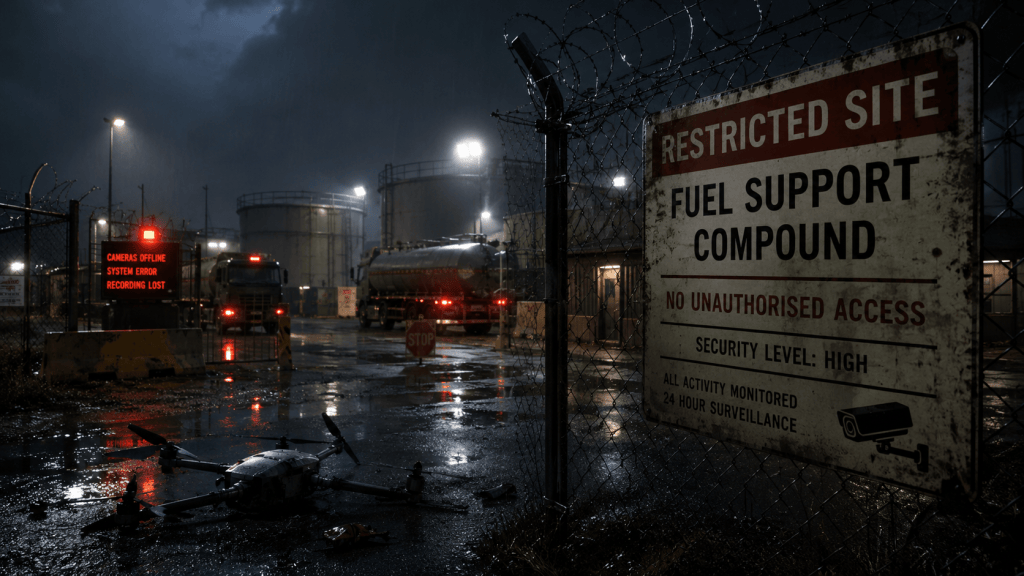
By the time the cameras failed at Rookham Fuel Support Compound, rain had worked into every edge of the evening, running along the mesh fencing, gathering on the concrete lanes, and turning the floodlights into pale broken bars across the yard. The controlled route lay beyond the outer ditch, hidden behind blackthorn and the low bank, although everyone on shift knew when movement passed because blue police lamps slipped between hedge gaps and travelled over wire. Tankers waited beside the southern bay, bowsers sat under temporary lamps, and tarpaulin-covered flatbeds had been kept at the gate long enough for their drivers to lose faith in the printed schedule. Rookham still called itself a fuel support compound on signs fixed to the fence, useful, dull, and safely technical, yet lately it had begun to feel like a small hinge in a route everyone had been told to treat as routine.
Nina Carver had taken over the maintenance-control desk at six, carrying a plastic folder under one arm and a paper cup of tea that had already gone too cool to forgive. She had worked Rookham for six years, long enough to know which pumps whined before rain, which gate sensor sulked during frost, and which drivers arrived with anger already packed in the cab beside them. Extra barriers had appeared near the service gate, contractor access required a second call, and police parked in the lay-by after dusk. Nina preferred valves, pumps, lines, and fuses, because machinery usually failed with more honesty than people.
Across the cabin, Amir Laleh sat beside the access terminal, one shoulder angled towards the window so he could watch the gate between entries. He was logging the Bay Two tanker when the generator sound dipped beneath the rain, softening the lights for less than a second. The screens brightened again, the pumps carried on, and Nina had already turned towards the power panel before Amir finished looking up.
“That was supply side,” Amir said, keeping one hand on the mouse as the green status marks flickered across the terminal.
Nina touched the panel casing with the back of her fingers before she checked the strip of readings. “Or load side. The site enjoys variety when it wants attention.”
Amir reached for the internal phone, his eyes still fixed on the panel. “Should I call Dale?”
Nina kept her attention on the board as a fresh amber mark appeared beside the east fence feed. “Call Dale once we know which part wants to embarrass us.”
The perimeter screens above the maintenance desk had spent most of the evening showing rain, wire, and puddles, which made their sudden failure feel absurdly intimate. Camera Thirteen froze first, preserving a stripe of rain in the floodlight as though the night had been pinned to the screen. Camera Fourteen shivered once and held on the maintenance gate with the warning plate blurred by water. Camera Fifteen turned grey, recovered for half a breath, then fell into black. Amir rose from his chair, the phone still in his hand, and stepped close enough for his reflection to appear faintly beside the dead feed.
“East fence line,” Amir said, his voice lower now as he looked from one screen to the next.
Nina opened the camera status window and watched the system repeat the same useless symbol beside each channel. “Three cameras and one feed alarm.”
The cabin door opened before Amir could reach for a simpler answer, and Dale Houghton came in with rain on his shoulders, a torch in one hand, and his site keys hooked between two fingers. He looked at the frozen screens, then at the power panel, then at Nina’s radio, as water dripped from his jacket onto the rubber mat by the door.
“How long?” Dale asked as he moved beside the desk.
Nina slid the status window across the lower monitor so he could see the feed alarm. “Under a minute.”
Dale raised the torch towards the frozen fence image. “Power dip first?”
Nina kept her hand near the radio. “One pulse, then recovery. The generator caught itself.”
Dale studied the dead channel for a moment. “Machines get blamed for many human talents.”
The yard radio cut across them before Nina could answer. Bay Two reported a pause in fuelling because the driver’s paperwork had changed during entry. The gatehouse asked whether the controlled-route window still held. A third voice from the police car in the lay-by requested confirmation that no external access had been granted along the east fence since shift handover. Nina looked towards Dale as that final question settled inside the cabin, sharper than the generator dip and heavier than the dead screens. Amir turned from the terminal with the phone pressed against his palm.
“Why are police asking about the east fence already?” Amir asked.
Dale took a key from the ring and headed for the door. “Because someone outside this cabin has seen the same hole in the evening.”
Nina pulled her coat from the hook and followed him into the rain, leaving Amir at the panel with instructions to log each feed change and hold Bay Two if any further alarm appeared. The compound opened around her in glare and water, tanks rising as dark curves behind the lamps, pipe runs shining along the low gantries, tanker lights reflecting in the puddles beside the bay. Beyond the fence, traffic moved along the controlled route in brief fragments of sound, engine noise dampened by wet hedges and the soft rush of tyres through standing water.
The east side of Rookham had always felt less settled than the rest of the compound, with the ground dipping towards the drainage ditch and the old service track narrowing near the culvert. Camera Thirteen sat on a black post halfway along the line, its weather hood shining with rain. Beneath it, the junction box remained closed, labelled, and locked, although the conduit below it had a new pale mark near the entry point, visible once Dale’s torch crossed it. Dale crouched in front of the box, bracing one knee against the wet gravel as he worked the key into the lock. Nina stood behind him with her torch angled along the fence, her beam passing across wire, weeds, the outer ditch, and the flattened grass beyond the bank.
The junction-box door opened with a stiff metallic scrape, and Dale leaned in, his torch held close enough to turn the inner casing white.
“Well,” Dale said quietly as he shifted his body aside so Nina could see inside.
The feed line had been cut near the lower entry point, the outer sheath opened in a clean split and the inner cable exposed where it should have run whole into the conduit. Water gathered along the severed edge and dropped onto the gravel in clear beads. The cut carried too much intention for weather, wear, or the old gate’s usual talent for humiliation. Dale kept his hands away from the damaged line and looked at the surrounding gravel, his whole body held still by the kind of care that arrived when a familiar place revealed a stranger’s hand.
“That came from outside,” Nina said as she lifted the radio and kept the torch fixed on the cable.
Dale shifted the beam from the box to the fence base, where wet grass had been pressed low in a narrow patch near the ditch. “Looks that way.”
A movement beyond the wire drew Nina’s eye before either of them spoke again. Her torch crossed the ditch, swept back, then held on a small dark shape half buried in grass near the outer bank, with one broken arm lifted from the mud. At first the rain made it look like roadside scrap, a piece of shattered casing thrown from a van, yet the shape resolved under the light into something more deliberate, black-framed, compact, and wrongly patient. Dale turned his torch slowly across the same spot, and the two beams met on the broken frame as rain gathered along its arms.
Nina pressed the transmit key, watching the object through the fence as she spoke. “Control, this is Carver at east fence. We have confirmed cable damage at Junction Thirteen and possible unmanned debris beyond the perimeter. Hold Bay Two. Lock east access. Request police to the outer ditch and suspend movement near the service track until cleared.”
Static answered first, then Amir’s voice came from the cabin. “Received, Carver. Bay Two held. East access locked. Police requested. I am logging junction damage and possible unmanned debris now.”
Dale stayed by the open junction box, his torch moving from the severed cable to the fence post and back again, as though the line between the two might make more sense under enough light. The compound carried on behind them, pumps humming, tanker brakes sighing, rain striking the tanks, drivers waiting beneath shelters, radios turning fear into procedure. Inside the floodlit fence, Rookham still looked like a fuel site managing a technical fault. Outside the wire, in the wet grass beyond the dead cameras, the damaged drone lay where the fault had started to look like a message.
A Visual Chronicle
A brief camera failure at Rookham Fuel Support Compound became something far more deliberate when Nina Carver followed the fault beyond the fence.
Restricted Infrastructure Incident Report
Extract from Regional Fuel Continuity and Site Security Coordination Log
Subject: Rookham Fuel Support Compound / Eastern Perimeter Camera Failure
Time: 19:17–20:06
Circulation: Regional Movement Desk / Fuel Continuity Cell / Police Liaison / Contractor Security Lead / Defence Access Support
Purpose
To record the initial response to a perimeter-system failure at Rookham Fuel Support Compound during an active controlled-route movement window, with associated impact on fuelling operations, site access, police liaison, and contractor maintenance activity.
Public Position
A minor technical issue affected part of the perimeter-security system at a fuel support site. Site operations remained under control while maintenance checks and routine safety procedures were carried out. There was no confirmed threat to public safety, and relevant agencies continued to monitor the position.
Incident Summary
At 19:17, Rookham maintenance control recorded a brief generator-load dip affecting internal lighting and perimeter-monitoring feeds. Power recovered within normal tolerance, although three eastern-perimeter camera feeds failed or froze during the same event.
The affected feeds covered the outer fence, the old maintenance gate, and the drainage-culvert approach beside the eastern service track. Maintenance staff attended the junction box beneath Camera Thirteen and identified damage to the external feed line near the lower conduit entry point.
At 19:24, maintenance staff reported possible unmanned debris outside the perimeter fence, positioned in wet grass beyond the drainage ditch. Eastern access was locked, Bay Two fuelling was paused, and police liaison was requested to attend the outer ditch under controlled access.
Operational Impact
Bay Two fuelling paused pending perimeter clearance.
Eastern service-track movement was suspended.
Contractor access through the old maintenance gate remained closed.
Controlled-route traffic continued under police supervision.
No site evacuation was initiated.
No injuries were reported during the initial response window.
Technical Position
Initial maintenance assessment indicated deliberate damage to the external camera feed line. The generator dip remained under review, with no immediate evidence of wider compound power failure.
Camera Thirteen and Camera Fourteen remained unavailable during the first response window. Camera Fifteen returned intermittent grey-feed output before failing again. Temporary visual coverage was requested through mobile patrol and police outer-fence observation.
Handling Guidance
Staff were advised to describe the event as a perimeter-system fault under review. Drivers, contractors, and local callers were to be told that fuelling activity had paused temporarily while maintenance and safety checks were completed.
Questions concerning police attendance, camera-feed failure, route movement, drone activity, defence-linked traffic, or wider infrastructure security were to be referred to regional communications.
Lines to Avoid
Avoid confirming deliberate interference pending forensic review.
Avoid linking the incident to protected route movement.
Avoid identifying camera coverage gaps or feed locations.
Avoid discussing unmanned debris, drone recovery, or possible reconnaissance.
Avoid confirming Defence access involvement unless cleared through regional handling.
Avoid suggesting any wider pattern of infrastructure probing.
Internal Assessment
The timing of the camera failure, the generator-load dip, the damaged feed line, and the recovery of unmanned debris beyond the eastern perimeter increased concern that Rookham had been subject to external observation or probing.
Attribution remained unresolved during the initial reporting window. The incident was assessed as operationally contained, although the affected camera line covered a sensitive section of the compound adjacent to controlled-route movement and fuel-handling activity.
Further review was required to establish whether the generator dip was coincidental, induced through local interference, or connected to the camera-feed failure.
Further Action
Police liaison to secure the outer ditch and preserve the debris field.
Contractor security lead to provide maintenance history for Cameras Thirteen to Fifteen.
Fuel Continuity Cell to review Bay Two pause against scheduled movement requirements.
Regional Movement Desk to assess whether further controlled-route activity required temporary camera uplift or mobile patrol cover.
Public-facing explanation to remain limited to a perimeter-system issue under review.
About the Creator
The Modern Chronicle is written and curated by Simon Phillips, an author of modern speculative fiction and contemporary crisis-driven storytelling who explores the point where ordinary life begins to tighten beneath political strain, military movement, institutional caution, and the public language used to keep dangerous realities at a distance.
Many of the records presented in these Chronicles sit alongside Simon’s wider modern-war novella series, where governments, soldiers, families, and civilian systems are forced to absorb a world changing faster than its official explanations. The stories remain grounded in recognisable places: ports, school corridors, freight yards, government rooms, roadside queues, transfer sites, and homes where the news has started to feel too close.
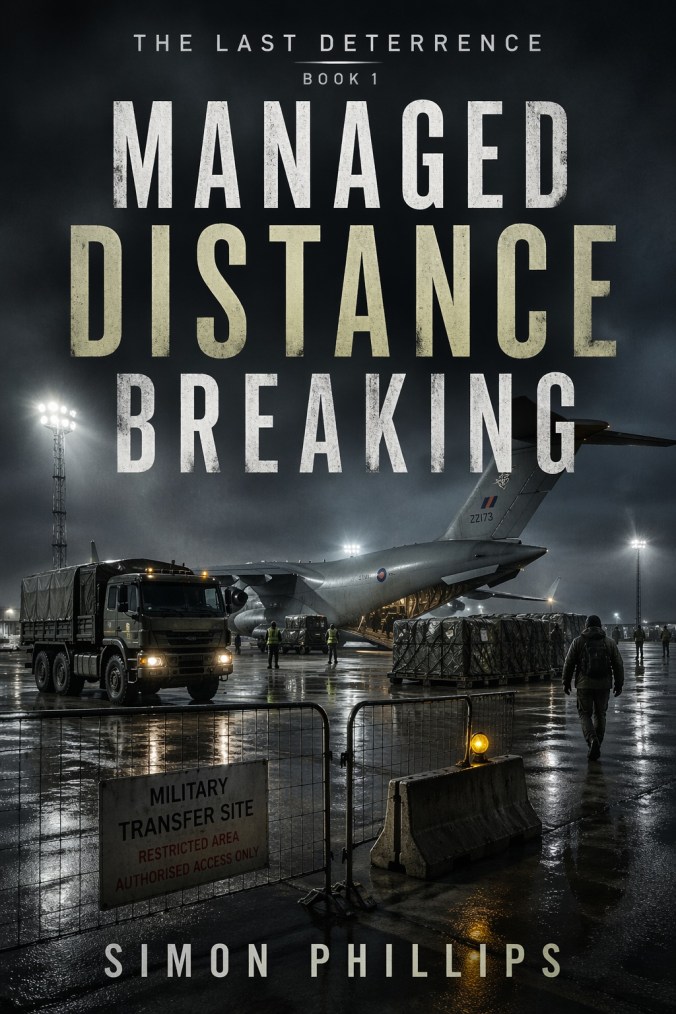
One such world unfolds through The Last Deterrence, a modern-war novella sequence beginning with Managed Distance Breaking and continuing in The Quiet Strike. Together, the first two books follow Britain as support language begins to fracture under freight pressure, European escalation, domestic infrastructure strain, and the growing sense that distance from war has already begun to fail.
Readers who wish to explore the wider published story world connected to this Chronicle can find the novellas below.
Explore the books:
The Last Deterrence: Managed Distance Breaking
The Last Deterrence: The Quiet Strike
You can watch his YouTube channel here:
Author Simon Phillips
Continuing the Chronicle
The following Chronicle continues the night at Rookham Fuel Support Compound, where a brief camera failure, a damaged feed line, and debris beyond the eastern fence began turning a routine perimeter fault into evidence of something more deliberate moving around the edge of Britain’s protected support corridor.
Readers supporting The Modern Chronicle can continue the record below.

Subscribe to continue reading
Subscribe to get access to the rest of this post and other subscriber-only content.
