Ashfall Station Still Works, Which Is Part of the Problem
Ashfall Station has never needed complete collapse to become dangerous. Its lights still come on, even if some sectors receive steadier power than others. Lifts continue to move through the structure, workers report for shifts, ration systems issue allowances, security checkpoints recognise approved credentials and Earth Fleet broadcasts arrive with carefully measured assurances. The station survives because enough of its machinery continues functioning to keep more than a hundred thousand lives moving through another cycle, even while confidence in the institutions controlling that machinery steadily weakens.
That tension lies at the centre of Ashfall Files, a science fiction noir series built around Detective Ruff Kale and his partner, Lena Marik. Their investigations take place aboard an ageing orbital station where overcrowding, ration pressure, damaged infrastructure and political control have become part of ordinary life. Crime rarely arrives from outside that environment. It grows from the same shortages, employment fears, hidden transactions and institutional compromises that shape the lives of the people Ruff questions every day.
The result is a form of dystopian detective fiction where solving an immediate crime rarely repairs the conditions that allowed it to happen. A missing person can reveal weaknesses in an employment system. A damaged wall can expose who controls access to information. A frightened witness may know more than an official record because the witness still remembers the person whom the record has begun turning into an administrative problem.
In The Missing Technician, the third Ashfall Files book, that conflict begins in one of the station’s most protected environments.
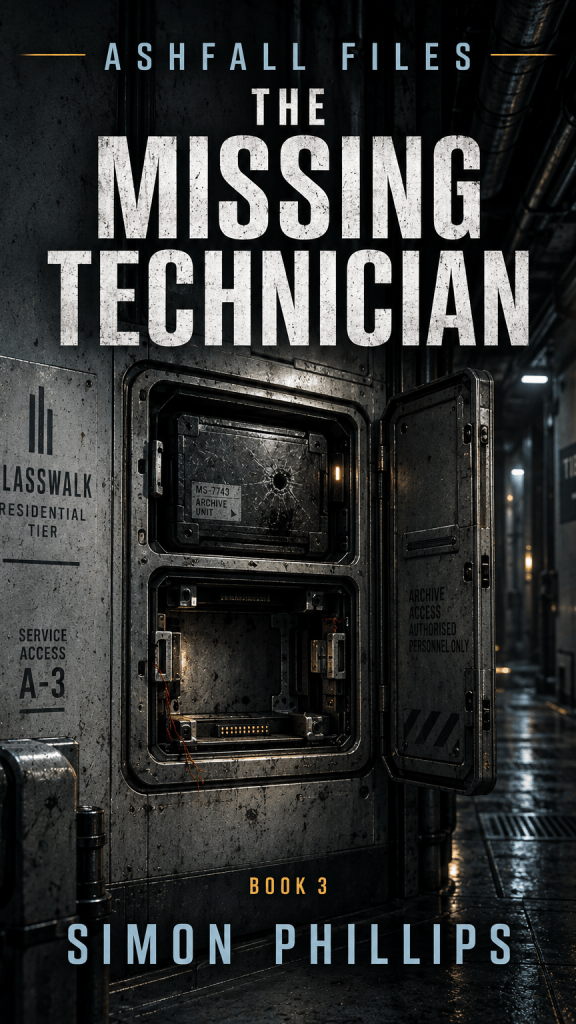
A Gunshot Behind Glasswalk’s Closed Doors
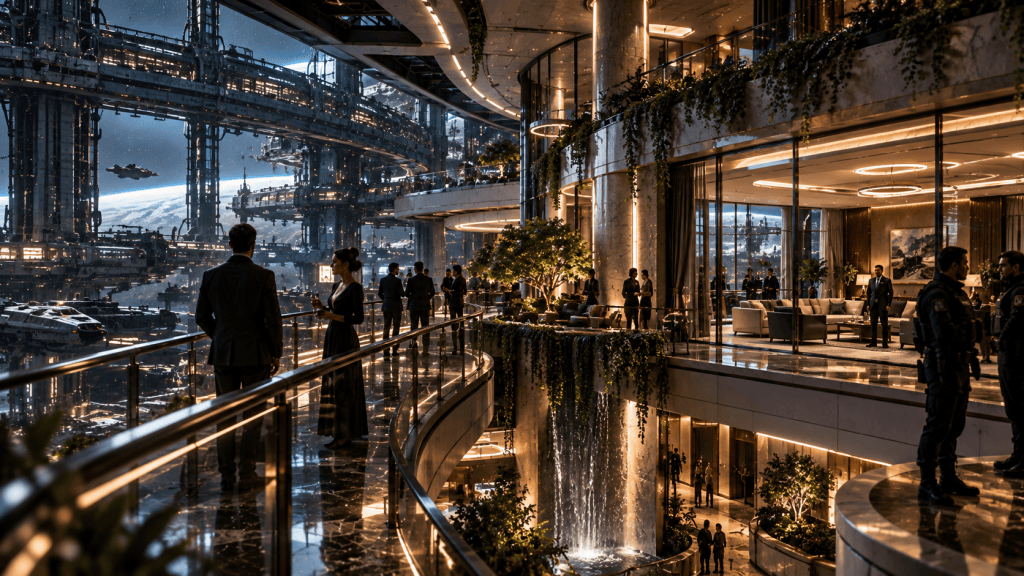
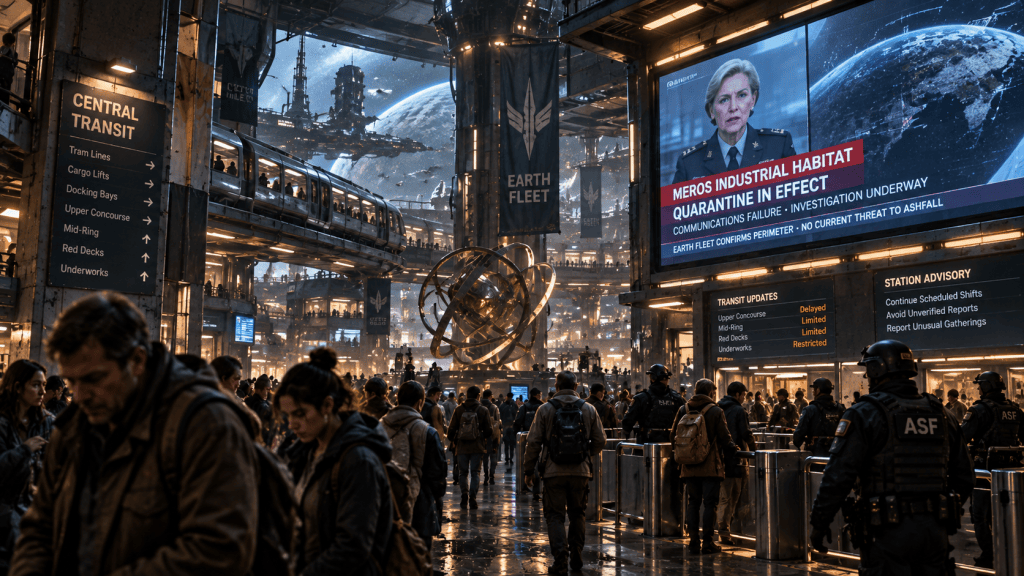
Glasswalk feels almost separate from the Ashfall surrounding it. The lighting remains steady. Ventilation works quietly enough to disappear into the architecture. Real soil supports carefully maintained plants, corridors have room to breathe, and fitted surfaces hide the industrial skeleton that remains visible across poorer parts of the station. Ruff enters the district while Earth Fleet broadcasts continue describing the loss of contact with Meros Industrial Habitat as a communications irregularity under temporary quarantine, language calm enough to create suspicion rather than reassurance.
Inside that controlled environment, a live firearm has been discharged in the home of Ilan Mercer, a wealthy resident with political connections and influence over infrastructure contracts. Mercer believes an armed intruder entered his study and attempted to kill him. Glasswalk security begins treating the incident as an assassination attempt almost immediately, while wider anxiety around Meros encourages political explanations before Ruff and Lena have reached the room.
The physical evidence refuses to settle comfortably into that version.
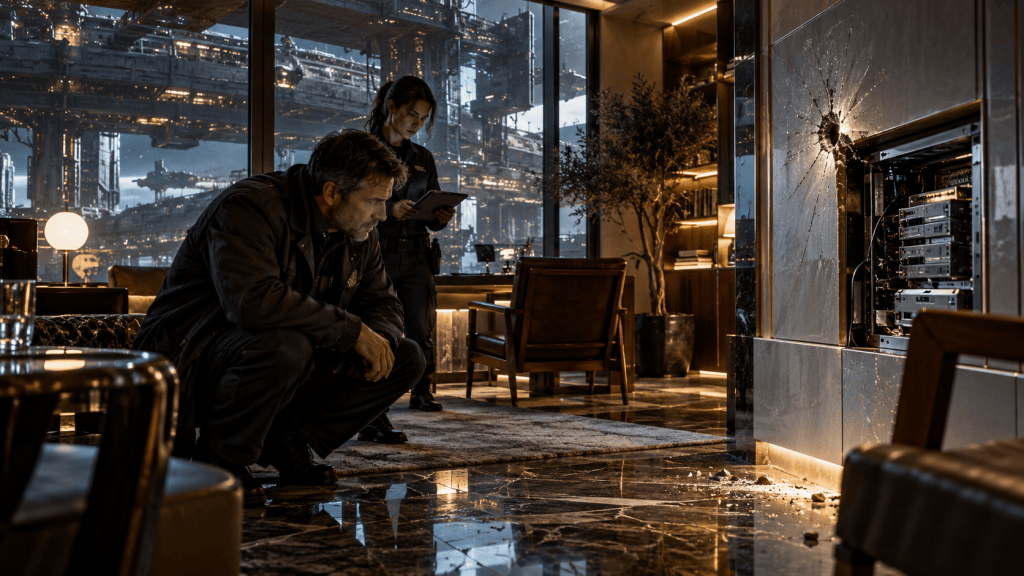
Cleaning solution has been worked into the floor near the threshold. A chair has been moved and returned close to its original position. The line between Mercer’s claimed attacker, his own position and the bullet strike becomes increasingly difficult to reconcile. When Lena reconstructs the trajectory and Ruff studies what the room itself has retained, the probable firing position shifts away from the outer doorway and further inside the study.
The bullet has also struck something more important than a decorative wall.
Behind the fitted panel sits Mercer’s residential access archive, a system holding local records of residence entries, visitor clearances and security validations. Its two mirrored stores should protect the archive against a single damaged component. One has been hit by the round. The other has already been removed.
The technician sent to inspect the damage was Niko Sarr.
By the time Ruff and Lena ask where he went, the station’s records have started producing answers that fail to describe any place where a human being can actually be found.
When a Missing Worker Becomes Employment Language
Sarr’s disappearance carries much of the book’s pressure because it occurs inside systems designed to record movement.
His service history confirms that he accepted the emergency inspection, reached the rear of Mercer’s archive and completed work there. The surviving archive store was released using his credentials, yet no ordinary custody chain records where it went. Soon afterwards, his rota changes, his access is suspended and his location disappears. Administrative entries begin describing leave, reassignment and an eventual external transfer, while people who worked beside him remember a technician who arrived for his shift and expected to return to his ordinary routine.
That contrast gives The Missing Technician its strongest form of institutional menace. Nobody needs to announce that Sarr has been erased. His disappearance can be absorbed into apparently ordinary processes. A supervisor receives an instruction. A locker is cleared. A tool return appears under the missing worker’s credentials. A record describes voluntary leave. Another field prepares a destination that lacks a receiving department.
Each alteration makes the absence easier to explain while making the person harder to find.
For Ruff, that distinction matters. Sarr cannot simply become an unavailable contractor because the words fit comfortably inside a report. Somebody saw him carrying a protected archive sleeve. Somebody saw a security escort beside him. His tools tell their own story, including a diagnostic bridge returned under circumstances that contradict his habits and an archive key that remains missing. Workers remember what the system is beginning to deny.
Ashfall’s technology therefore becomes part of the detective work rather than an effortless answer to it. Live systems can be altered. Local records can preserve fragments. Physical components retain marks long after an authorised screen has changed its account. The investigation has to move between those forms of evidence while Ruff and Lena decide which version deserves trust.
The Working Station Behind the Polished Walls
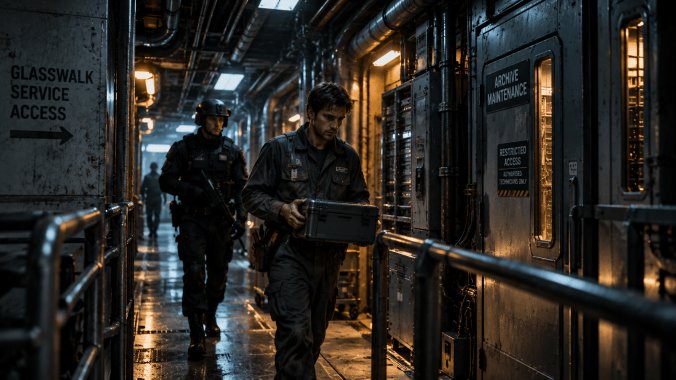
Glasswalk also reveals one of Ashfall Files’ recurring social divisions. Its residents experience the station through clean surfaces, privacy rules and layered protection, while the people maintaining those comforts travel through narrower service passages behind the walls.
Once Ruff, Lena and their Glasswalk liaison Eris Quell move into those spaces, the district begins looking much more familiar. Exposed conduits replace decorative panels. Equipment cages line worker routes. Shift notices change under Fleet readiness orders. Staff worry about delayed transport into Mid-Ring and what another extended shift will mean for their ration allowances, while residents continue moving through rooms designed to keep the supporting machinery out of sight. The book repeatedly allows the political world to enter through these practical consequences rather than through distant speeches or military spectacle.
That difference matters because Ashfall’s inequalities are structural. Work, housing, food, medical access and security vary according to where someone lives and what value the station assigns to their labour. Lower-sector workers can lose access to rations or housing when employment changes, while protected residents have legal offices, privacy classifications and institutional channels ready to respond when their interests are threatened.
Sarr exists on the vulnerable side of that arrangement.
Mercer remains surrounded by representation even while his account develops contradictions. Sarr can disappear while his employment history changes behind him.
The investigation never needs to state that difference as a slogan. It emerges through who receives time, whose records are protected, whose belongings are packed away and whose absence can be converted into routine administration.
Ruff Kale Reads What the System Leaves Behind
Ruff remains useful because he understands Ashfall through years of accumulated experience rather than through the confidence of its databases.
He notices discomfort in people who have rehearsed the correct answer. He studies marks on floors and equipment before accepting the record attached to them. He recognises when cleaning has removed too much, when an object has returned almost to the place where it began, and when somebody’s concern has shifted away from the danger they claim matters most.
His approach gives Ashfall Files its noir foundation. The station is full of systems capable of presenting authority, yet Ruff has spent too long watching those systems fail ordinary people to believe that an official result carries truth simply because it appears on a screen.
In The Missing Technician, his attention repeatedly returns to physical disturbance. The chair inside Mercer’s study matters because somebody moved it. The cleaned threshold matters because residue once existed there. The empty archive cradle matters because the bullet never touched it. The fibre caught beneath Sarr’s returned diagnostic bridge matters because it suggests how the tool travelled after its owner vanished.
These are small details compared with the wider political pressure surrounding Ashfall, yet they are precisely where the story remains grounded. Ruff reaches larger questions through the damage left in front of him.
The Book 3 continuity report describes his strength as an ability to recognise where a controlled environment has been physically disturbed, even while exhaustion, a persistent headache and a tremor in his hand remind the reader that the detective himself is carrying the cost of everything that has already happened.
Lena Marik Preserves What Others Would Separate
Lena approaches the same environment differently.
Where Ruff sees the inconsistency, Lena works to keep that inconsistency from disappearing.
She records access refusals, secures witness statements, preserves changing timestamps and distinguishes between what the evidence proves and what suspicion merely suggests. When Sarr’s terminal continues altering his employment history during an active investigation, she isolates the system while preserving its local cache. When supervisors stand close enough to influence nervous workers, she keeps individual accounts separate. When Glasswalk challenges the investigation, she records who issued the restriction and under what authority.
Her procedure has changed considerably from the simple confidence in rules that defined her earlier place within Ashfall. By this stage, she understands that procedure can protect evidence while another part of the same institution uses procedure to protect power. The value lies in recognising that difference.
That gives Ruff and Lena a partnership built around complementary weaknesses and strengths. Ruff reads human behaviour, physical spaces and the station’s unofficial habits. Lena creates a record capable of surviving the challenge that follows. The series dossier establishes this gradual movement from an unequal working arrangement towards real interdependence, with Lena becoming increasingly active while Ruff begins relying upon the stability her presence provides.
Their success also remains limited by the system surrounding them. Preserving evidence does not guarantee public truth. Sometimes it only ensures that the truth still exists somewhere after somebody has finished rewriting the explanation.
Earth Fleet, Meros and the Management of Uncertainty
Beyond the immediate investigation, Meros continues exerting pressure without becoming the case itself.
Earth Fleet confirms communications loss, a quarantine perimeter and regional restrictions while leaving crucial questions unanswered. No confirmed casualty count reaches the public. Rescue movements remain classified. Rumours pass through civilian channels more quickly than official information, encouraging crowds to gather around screens and forcing ASF officers away from ordinary patrols.
Ashfall already has an information culture built around that distrust. Fleet bulletins and station broadcasts compete with dockside rumours, whispered accounts, black-market data and conversations passed between workers who have learned to judge official language against what they can see happening around them.
The Missing Technician uses that atmosphere carefully. Meros never becomes a convenient explanation for Mercer’s shooting, and Ruff, Lena and Pike repeatedly resist attempts to force the larger crisis into evidence that has yet to support it. Instead, Meros changes the conditions around the investigation. Patrols move elsewhere. Transport becomes restricted. Workers remain on extended shifts. Rumours create political fear. Glasswalk gains another reason to tighten access.
The external crisis therefore makes local concealment easier.
That is how political pressure often enters Ashfall Files. The wider world rarely arrives as spectacle. It appears through a closed lane, a delayed medicine shipment, a reassigned officer or an official phrase that gives frightened people less information than the rumour already moving through the queue beside them.
The Missing Technician and the Wider Ashfall Files Story
The Missing Technician is Book 3 of Ashfall Files, continuing the investigation that began with the unidentified woman found in Sector Twelve and developed through the hidden routes crossing parts of the station.
The third book moves that larger mystery into a different social environment. The trail reaches Glasswalk, where records, professional access and protected institutions carry greater authority than anything available in Ashfall’s poorer sectors. Sarr’s disappearance creates the immediate case, while the evidence he was examining begins reconnecting that disappearance to the unanswered questions Ruff has carried from Sector Twelve.
The connection remains controlled. The wider conspiracy is still incomplete. The encrypted material at the centre of the earlier case has yet to surrender all of its meaning, and the institutions operating beyond Ashfall remain only partly visible. What changes is the scale of the concealment Ruff can now recognise.
The first cases taught him that people and movements could vanish from ordinary station systems. The Missing Technician shows how sophisticated that disappearance can become when multiple records, employment structures and protected authorities begin reinforcing the same convenient account.
This is where the larger space station conspiracy grows from detective work instead of replacing it.
What Ashfall Chooses to Preserve
The most unsettling version of Ashfall is not a station plunged into darkness.
It is Ashfall with the lights still working.
A worker can disappear while his terminal continues producing administrative explanations. A protected resident can return to public respectability while questions remain inside a restricted file. A broadcast can reassure the population while carefully avoiding the questions creating the fear. Evidence can survive inside official custody while the public account loses almost everything that gave it meaning.
The station continues because people still maintain the air, repair the doors, move cargo, clean rooms, inspect archives and return to overcrowded homes at the end of shifts that keep growing longer. Those ordinary acts hold Ashfall together even as the institutions above them become increasingly concerned with managing the appearance of control.
Ruff and Lena work somewhere inside that gap.
They can preserve a witness statement. They can follow a damaged archive. They can prove that records changed. They can refuse to let a missing man become a line of employment terminology simply because somebody with greater authority has supplied the wording.
Whether any of that is enough remains a more difficult question.
Ashfall has entered the stage where truth rarely disappears all at once. It is divided, restricted, relabelled and moved far enough apart that most people never see the complete shape. The machinery carries on around it, the corridors remain occupied and the next shift begins beneath another official announcement, while somewhere inside the working station another record waits for somebody to notice that the story attached to it no longer matches the person who lived it.
