Before the marshes, before the legend, there was a youngest son growing inside a kingdom learning how close disaster could come.
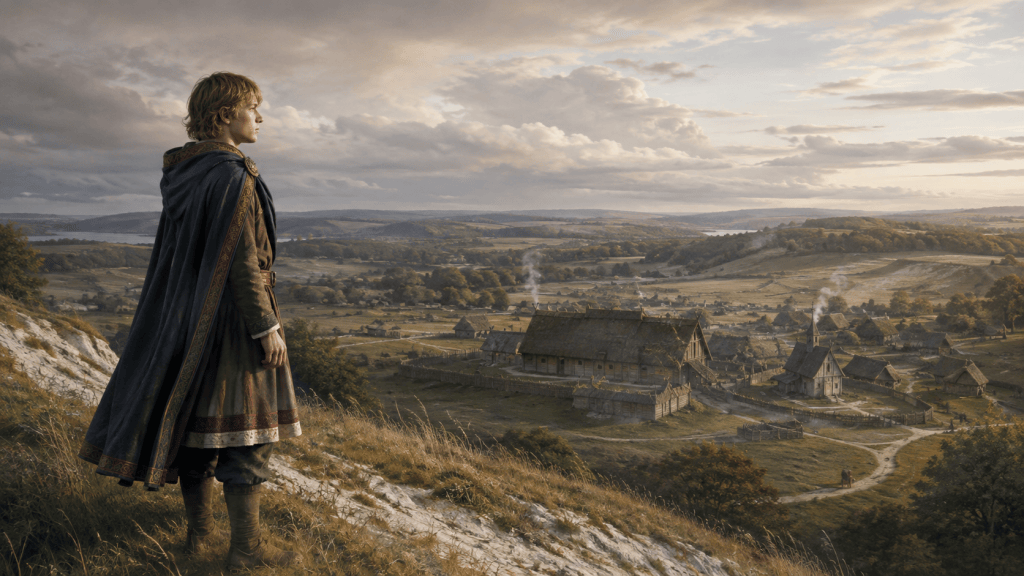
The Prince Before the Legend
The morning light came gently over Wessex, spreading across chalk ridges, timber halls, church roofs, sheep pasture, wooded valleys, and the long roads that tied royal estates to bishoprics, river crossings, and borderlands. This was still a divided island, shaped by rival crowns, older British territories, Mercian memory, church learning, and the restless pull of the sea, yet Wessex already carried a harder outline than many realms around it. Its kings understood that power lived in movement as much as inheritance, in marriage, pilgrimage, battle, counsel, and the slow gathering of loyalty from halls where men listened closely whenever travellers arrived with news from beyond the horizon.
Into that world Alfred was born, youngest son of King Æthelwulf, a child placed deep within the royal household of a kingdom that expected its princes to serve long before any crown came near them. His elder brothers stood before him in the line of succession, each shaped by duty and watched by those who measured the future through blood, land, and alliance. Alfred’s earliest years would have seemed small beside theirs, framed by prayer, instruction, household discipline, and the nearness of power carried by others, yet childhood inside a royal hall was never a quiet thing. Even a youngest son learned the sound of armour being lifted from pegs, the murmur of priests beside candlelit manuscripts, and the way adult voices lowered whenever danger entered the room by rumour.
Those rumours travelled quickly through the Anglo-Saxon world. A merchant from the coast might bring word of ships sighted in hard weather, their sails cutting through mist where only fishermen should have been. A cleric might speak of monasteries stripped of treasure, of frightened communities watching the sea with new dread, of sacred places discovering that prayer alone could never bar an oar-driven hull from shore. Names that once belonged to distant politics began to gather the weight of warning. The northern kingdom had fractured before York fell. Mercia’s old dominance had thinned beneath the strain of changing power. East Anglia had suffered beneath Viking violence, and Edmund’s death had already begun its passage from royal tragedy into sacred memory.
Wessex listened to these stories from the west, close enough to understand their meaning and far enough away to imagine time still remained. In Alfred’s childhood, faith and rulership pressed close together. A prince could be taught scripture in one chamber while armed men spoke of levies, borders, and ships in another. The journey to Rome, remembered in later tradition, placed him within the wider world of Christian authority while he was still young, giving the boy a vision of kingship that reached beyond the halls and fields of his own people. Sickness also followed him through life, according to the accounts that later shaped his memory, and even before kingship claimed him, his body carried its own private struggle.
Before the marshes, before Edington, before burhs, laws, learning, and the name that later generations would bind to greatness, Alfred was a boy growing inside a kingdom that had begun to understand how near ruin could come. His story opened in childhood, family, faith, illness, and inheritance, while the shadow moving across the Anglo-Saxon kingdoms crept ever closer to Wessex.
A Visual Chronicle
Before Alfred became the defender of Wessex, he was a young prince growing beneath the shadow of a Viking threat moving ever closer.
Timeline of Events
c. 849 AD – Alfred is born at Wantage, youngest son of King Æthelwulf of Wessex, far from the direct line of royal expectation.
853 AD – Alfred is sent to Rome as a child, where later tradition records that Pope Leo IV received him with honour.
855–856 AD – King Æthelwulf travels to Rome, taking Alfred with him, placing the young prince within the wider world of Christian kingship and continental power.
858 AD – Æthelwulf dies, leaving Alfred’s elder brothers to rule in succession while Wessex faces a changing and dangerous political world.
865 AD – The Great Heathen Army lands in East Anglia, turning Viking pressure from coastal raiding into a deeper threat to the Anglo-Saxon kingdoms.
About the Creator
This Chronicle is written by Simon Phillips, author of several historical and speculative fiction works exploring forgotten worlds, myth, and the turning points of history.
You can explore his books here:
Books by Simon Phillips
You can watch his YouTube channel here:
Author Simon Phillips
Continuing the Chronicle
The account that follows moves deeper into Wessex and the royal household that shaped Alfred’s early life, from the rule of King Æthelwulf and the journey to Rome to the burden of illness, inheritance, and Viking pressure gathering beyond the borders of the kingdom.
Readers supporting The Forgotten Chronicle may continue into the full record be

Subscribe to continue reading
Subscribe to get access to the rest of this post and other subscriber-only content.
