A planned demonstration was rerouted in the name of public safety, but those caught between the barriers saw a city where foreign policy, policing, media pressure, and ordinary fear had begun occupying the same street.
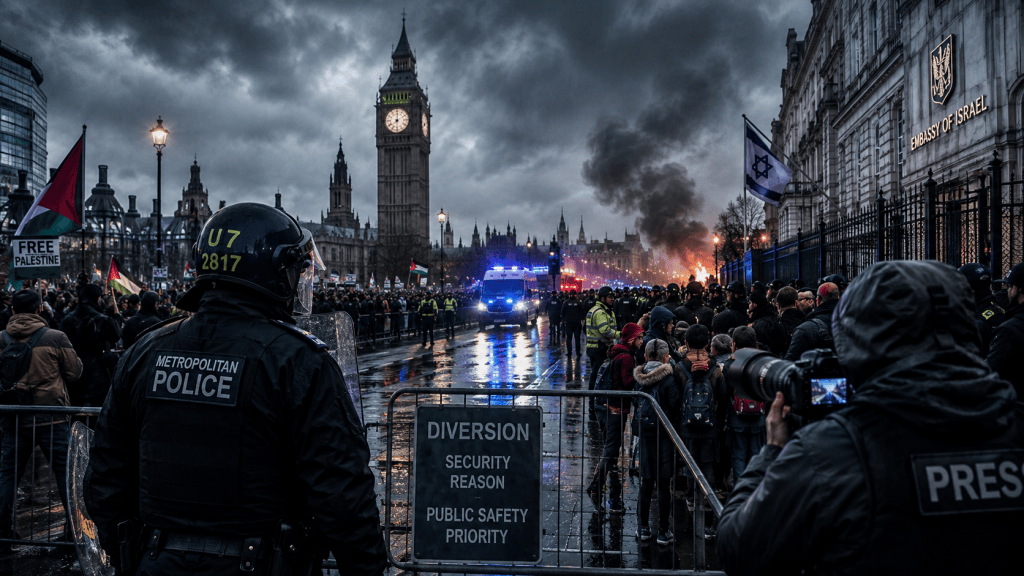
The Street That Changed Direction
The first barrier moved before the children understood that the pavement had ceased to be theirs, lifted by two officers in fluorescent jackets and carried across the wet stone with the slow, awkward care of people trying to rearrange a city while it watched them. Rain had been falling since mid-morning, fine at first and then harder, collecting along the kerbs near Kensington High Street, shining on the black railings, blurring the red brake lights of traffic held behind cones, and turning the press vans into bright rectangular shapes beneath the trees. The march had been due to pass along the agreed route after eleven, with stewards in orange bibs at the front, police horses farther back, and counter-protest groups contained across a separate line. By ten forty-seven the first route change had already moved two streets into the plan. By eleven twelve the second had begun moving through radios, hand signals, school phones, and the faces of teachers who had entered the area under instructions already out of date.
Hannah Vale had brought thirty-one Year Ten pupils from Bracknell to London for a citizenship trip that had looked harmless on the booking form in February and gradually acquired more warnings in the week before departure. The museum visit had survived. The coach company had survived. The packed lunches had survived in torn paper bags and softening foil, although most of the children had eaten the crisps before Slough. What had altered was the city around them, which had seemed at first merely busy and then increasingly arranged by forces Hannah could see only through their effects: a line of metal barriers appearing across a crossing, a police van reversing into a side street, a steward waving a group away from a junction, a broadcast camera turning towards the same gap Hannah was trying to use.
“Keep close to the wall, please,” Hannah called, raising one hand while the pupils gathered under the shallow cover of a stone frontage. “Phones away unless you are contacting home, and stay where I can see your coats.”
Beside her, David Phelps had the attendance sheet held inside a plastic sleeve, his thumb pressed against the names as though pressure could keep the group intact. He taught history, wore a tie with tiny blue ships on it, and had spent the coach ride explaining that public protest formed part of democratic life. He looked less confident now, standing beside a bin overflowing with wet cardboard while sirens moved somewhere beyond the next turn.
“I make it thirty,” David said as he scanned the line of pupils again, his voice low enough to keep the concern between the adults.
Hannah looked across the hoods, rucksacks, headphones, and half-raised faces. “Saira is with Mrs Ellison.”
“She went for the toilets with Ellie and Grace,” David said, checking the bottom of the sheet. “They came back after the first hold.”
Hannah found Saira near the pillar, hands tucked inside her blazer sleeves, eyes wide under damp fringe, and she allowed herself one breath before the crowd noise rose from the far side of the barriers. It came as a layered sound, chants, whistles, engines, shouted instructions, and the strange hollow applause that moved through large crowds when a chant changed shape. A Palestinian flag lifted above the people at the corner, soaked dark by rain, and beyond it a smaller line of Union flags and Israeli flags showed above a row of police helmets. The two groups were still apart, separated by vans, barriers, mounted officers, and a space the police seemed to treat as something alive enough to slip.
A young constable came towards them from the crossing with water running from the brim of her cap. Her name badge read SEN, and her cheeks had reddened with cold. She held her radio close to her shoulder and kept glancing towards the junction as she spoke.
“You are the school party from Berkshire?” PC Sen asked, angling her body so the pupils heard a calm voice before they saw the tension in her face.
“Yes,” Hannah said, lifting the visitor folder. “We were directed this way by an officer at the previous crossing.”
PC Sen looked towards the old route printed on the sheet, then towards the barriers. “That route has changed. We need you to hold here until the next safe crossing opens.”
David shifted the plastic sleeve beneath his arm. “How long will that be?”
PC Sen listened to her radio for a moment, her eyes still on the group. “A few minutes, we hope.”
One of the pupils, a tall boy named Callum Price, looked past her towards the line of cameras gathering near the barrier. “Miss, is this going on the news?”
Hannah turned towards him before his worry could spread through the group. “Callum, keep your voice down and stay with Kai.”
PC Sen followed his gaze and saw the camera crew as well. Two reporters stood beneath umbrellas near the corner, speaking to their producers while a cameraman filmed across the top of the barrier. A second crew had moved closer to the school group because children in uniform beside police tape made a clean image, easier for an editor to understand than route revisions, protest permits, ministerial pressure, and every instruction moving invisibly through the morning.
Hannah saw the same calculation at the same time. “Officer, I would prefer the children moved away from the cameras.”
“So would I,” PC Sen said, touching her radio key. “Control, this is Sen at West Link Two. School group present beside Queen’s Gate frontage. Request movement away from media line when safe crossing opens.”
The reply came through as a burst of static and a voice too clipped for Hannah to catch, although Sen’s expression tightened by a degree.
“Received,” PC Sen said into the radio, then lowered it. “They are opening a crossing behind the second van as soon as the counter group has cleared the side street.”
David looked along the line of pupils, his jaw set hard. “That sounds like a great deal depending on as soon as.”
PC Sen gave him the briefest glance. “Yes, sir.”
A chant rolled closer, louder through the wet air, and several pupils turned towards it at once. Hannah stepped forward, placing herself between the group and the barrier, with one hand lifted in the school gesture that meant listen because I am still calm enough for both of us. In the road, officers were speaking into radios, stewards were holding their arms out to slow the front of the march, and a police horse shifted sideways as a steward waved people back from the kerb. Traffic had been emptied from the nearest lane, yet buses and taxis were still trapped farther down, their windows full of faces watching the city argue around them.
“Miss Vale,” Saira said from near the pillar, her voice thinned by embarrassment and fear, “my mum has messaged four times.”
Hannah turned just enough to see her. “Send her one message saying you are with staff and safe. Then put the phone back in your pocket.”
Saira’s fingers moved quickly over the screen. “She says there are videos online already.”
“Then give her the truth before the videos do,” Hannah said, keeping her eyes on the junction.
David moved closer, speaking from the side of his mouth while pretending to count the pupils again. “The school office has rung twice. Reception says parents have started calling.”
Hannah kept her face steady for the children. “Tell reception we are held near a police cordon and awaiting movement to a safe crossing.”
“They will ask whether they should send that to parents.”
“Tell them to send exactly that,” Hannah said, then added after a breath, “and remove police cordon. Say supervised public-safety hold.”
David looked at her, rain shining along the edge of his glasses. “You have started writing like the council.”
“I have started writing for parents who are refreshing news clips,” Hannah said as a shout rose at the corner and vanished beneath a louder chant.
The second barrier line shifted again. Two officers dragged a section of fencing across the side road while a sergeant pointed towards the school group and then towards the crossing beyond the van. PC Sen stepped away to listen, one hand pressed against her earpiece, her other hand open at waist height as if holding the situation in place by gesture alone. The reporter under the black umbrella saw the movement and touched her cameraman’s sleeve. The lens turned a fraction towards the children.
Hannah felt anger rise through her, sharp and immediate, then forced it into usefulness. “David, put yourself on the camera side. Mrs Ellison, bring the back half forward. Everyone hoods up, bags on, eyes on me.”
Mrs Ellison, the teaching assistant, gathered the rear pupils with a briskness born from playgrounds, bus queues, fire drills, and years of moving teenagers through spaces designed by adults who rarely had to count them. “You heard Miss Vale,” she said, clapping once above the rain. “Pairs, please. We are walking, which means nobody becomes dramatic for TikTok.”
A few pupils laughed, brittle at first and then with relief enough to loosen their shoulders. Callum put his phone away after David gave him a look that required very few words. Saira stayed close to Ellie. Kai pulled his hood down so far he could see only his shoes, and Hannah reached out to lift the front edge enough for him to walk safely.
PC Sen returned at a fast walk. “We are moving you now. Stay tight. Teachers front and rear. Cross behind the van, then left along the service frontage. A liaison officer will take you through to the coach point.”
“Has the route changed again?” Hannah asked, already lifting her hand to signal movement.
PC Sen glanced towards the corner, where stewards had begun turning the front of the march away from the first agreed line while counter-protesters surged against their own barrier in complaint. “The route is being adjusted for public safety.”
David gave a small, strained laugh as he folded the attendance sheet and tucked it inside his coat. “That sounds familiar.”
“It has had practice today,” PC Sen said, and her honesty lasted only a second before the radio pulled her back into duty.
The group moved in pairs between the barriers, shoes slipping on wet paving, rucksacks knocking against hips, staff counting aloud beneath the crowd noise as though arithmetic could keep the city from changing shape around them. On one side, the march pressed against its own delay, voices rising under flags and umbrellas. On the other, cameras tracked movement, police held the gap, and an official explanation waited somewhere ahead, clean enough for a statement and thin enough to pass through every room that needed it. Hannah kept counting as the children crossed behind the van, thirty-one pupils, three staff, all present, all moving, all officially safe, while the city rearranged itself around them for the second time that morning.
A Visual Chronicle
A school trip to Kensington became caught between shifting protest lines, police control, media pressure, and an official explanation that concealed more than it revealed.llowing Visual Chronicle presents a cinematic reconstruction of the events described above.
Extract from Public Order Command and Local Authority Movement Record
Subject: Kensington Protest Route Adjustment / School Group Hold
Time: 10:41–11:26
Circulation: Public Order Command / Local Authority Liaison / Transport Coordination Desk / Government Communications Duty Cell / Media Handling Group
Purpose
To record the route adjustment applied during a planned central London demonstration and associated counter-protest activity, with particular reference to public-safety barriers, media positioning, school-party movement, traffic displacement, and the maintenance of separation between participant groups.
This extract covered the first instruction window after the agreed march route required revision owing to crowd density, counter-protest movement, and reduced safe crossing capacity near Kensington High Street.
Approved Public Position
Police, stewards, local authority teams, and transport partners worked together to support lawful protest, maintain public safety, and minimise disruption across the affected area.
The march route was adjusted during the morning in response to live crowd conditions. The change formed part of standard public-order management and allowed officers to preserve safe movement for pedestrians, road users, nearby businesses, and organised groups present within the area.
Members of the public were advised to follow officer instructions, allow additional journey time, and use marked crossing points where available.
Operational Position
At 10:41, officers began adjusting the initial barrier layout after crowd pressure increased along the western approach. Stewards reported slowed movement at the front of the march, while officers monitoring the counter-protest line requested greater separation near the side-street junction.
At 10:56, local traffic was held across two lanes to allow the movement of barriers and police vehicles. Several bus services were delayed or diverted during the adjustment period. Pedestrian movement remained possible through controlled gaps, although safe crossing capacity narrowed around the museum frontage and adjacent stone walkway.
At 11:08, a school group became held beside the temporary barrier line after being directed away from the first crossing point. Teachers remained with the pupils throughout the hold. Officers identified the group as vulnerable to media exposure owing to camera crews positioned along the revised route.
At 11:13, Public Order Command authorised a controlled movement of the school group behind a police van and through the service frontage. The group was transferred towards the coach point under officer direction.
At 11:26, the second route adjustment was confirmed as active, with the march redirected through the cleared frontage and the counter-protest line held behind the secondary barrier set.
Handling Guidance
Members of the public should be advised that the route changed owing to live public-safety conditions. Officers should describe the decision as an adjustment to preserve safe movement and reduce crowd pressure.
Questions concerning the school group should be answered with confirmation that the pupils remained supervised, were moved under police guidance, and continued towards their planned transport point.
Questions concerning media access, counter-protest movement, embassy security, diplomatic premises, or ministerial involvement should be referred to the media handling group.
Lines to Avoid
Avoid language implying loss of route control.
Avoid speculation regarding foreign-policy pressure, embassy-security requests, or government direction.
Avoid identifying school name, pupil details, staff names, or exact coach location.
Avoid confirming operational separation distances between protest groups.
Avoid suggesting the route change resulted from intelligence beyond live public-safety assessment.
Avoid discussing officer deployment levels, barrier reserve locations, or future protest-route planning.
Internal Assessment
The route adjustment remained operationally contained, although visibility was high owing to broadcast teams, social-media filming, and the presence of school pupils near a temporary barrier line.
The incident demonstrated increased public sensitivity around protest management where diplomatic premises, counter-protest groups, media crews, traffic holds, and vulnerable civilian groups converged within the same instruction window.
The school group’s position beside the barrier line created a short-duration reputational risk, especially where camera angles could imply pupils had been trapped between opposing groups. Officers acted appropriately by moving the group through a controlled gap once safe crossing became available.
The revised route reduced immediate pressure on the side-street junction, although continued crowd density and shifting participant behaviour required further monitoring across the next instruction window.
Safeguarding Note
Local authority education contacts were advised that pupils had remained supervised throughout the public-safety hold. Schools with planned visits inside the affected area should be advised to maintain direct staff-to-pupil counts, preserve coach contact, and follow police instructions where routes altered at short notice.
Operational Note
Further route changes may require earlier liaison with school-trip organisers, coach marshals, nearby cultural venues, and transport operators. Media teams should assume that footage of pupils, barriers, flags, and police movement will circulate ahead of any formal public explanation.
About the Creator
The Modern Chronicle is written and curated by Simon Phillips, an author of modern speculative fiction and contemporary crisis-driven storytelling who explores the point where ordinary life begins to tighten beneath political strain, military movement, institutional caution, and the public language used to keep dangerous realities at a distance.
Many of the records presented in these Chronicles sit alongside Simon’s wider modern-war novella series, where governments, soldiers, families, and civilian systems are forced to absorb a world changing faster than its official explanations. The stories remain grounded in recognisable places: ports, school corridors, freight yards, government rooms, roadside queues, transfer sites, and homes where the news has started to feel too close.
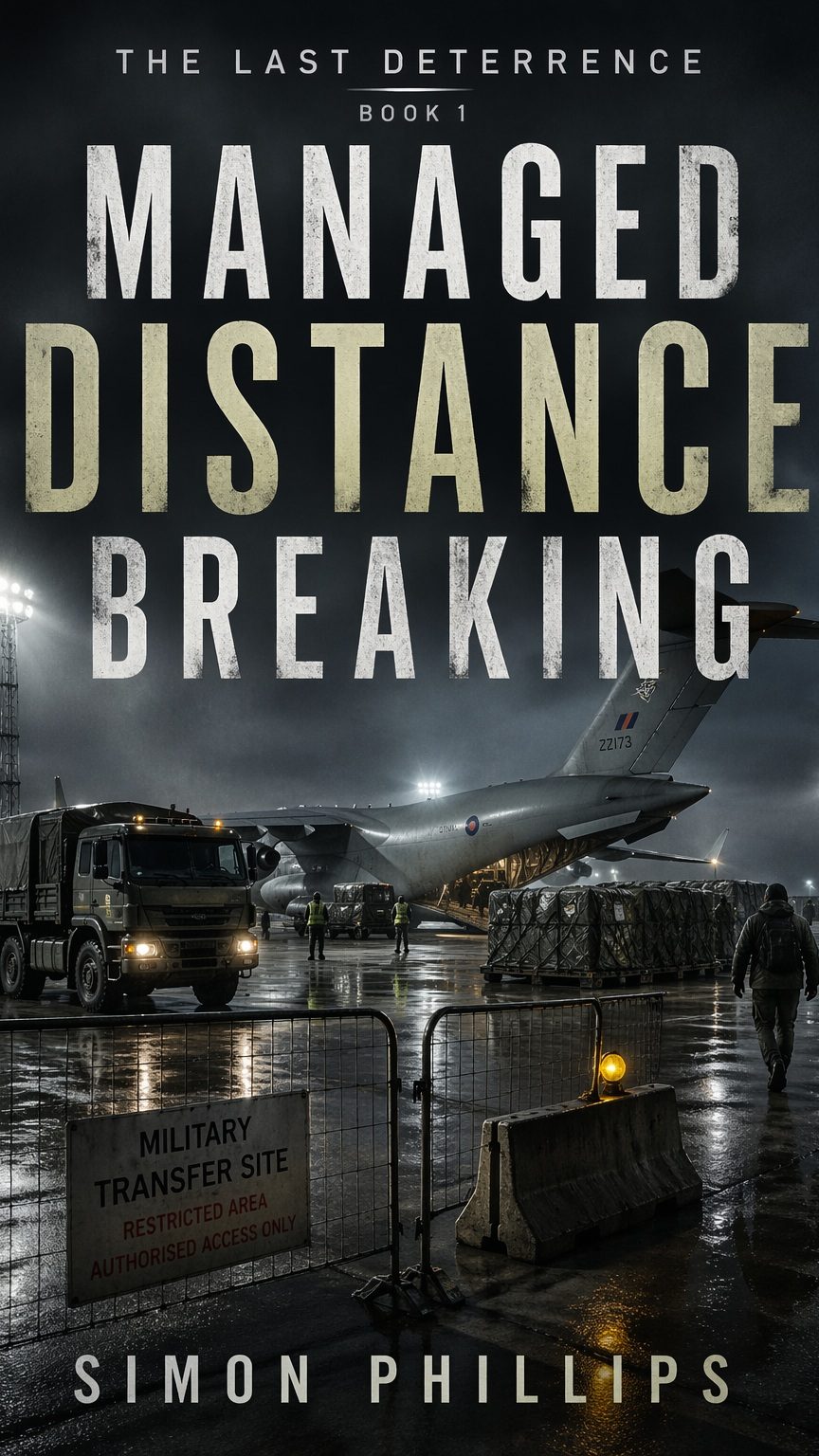
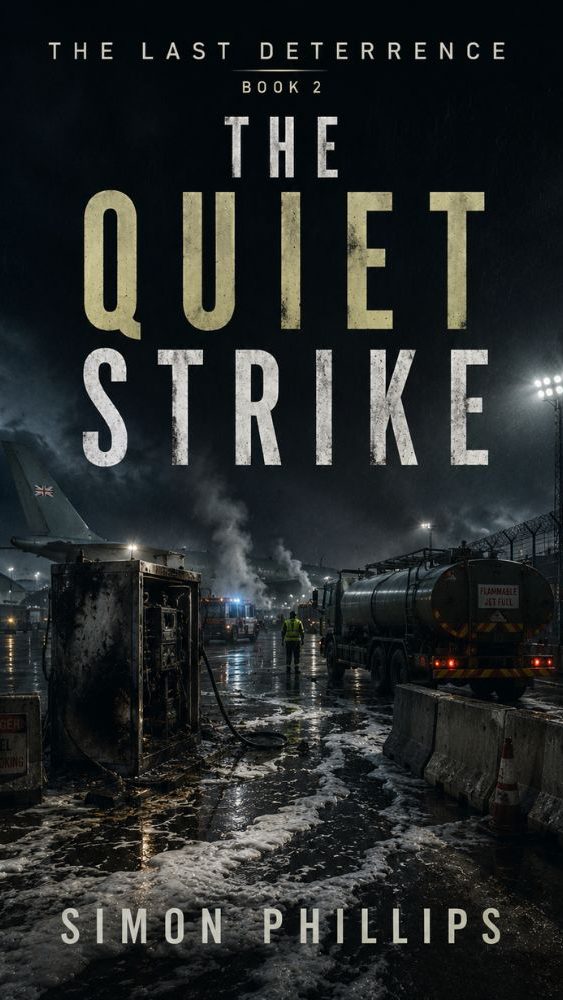
One such world unfolds through The Last Deterrence, a modern-war novella sequence beginning with Managed Distance Breaking and continuing in The Quiet Strike. Together, the first two books follow Britain as support language begins to fracture under freight pressure, European escalation, domestic infrastructure strain, and the growing sense that distance from war has already begun to fail.
Readers who wish to explore the wider published story world connected to this Chronicle can find the novellas below.
Explore the books:
The Last Deterrence: Managed Distance Breaking
The Last Deterrence: The Quiet Strike
You can watch his YouTube channel here:
Author Simon Phillips
Continuing the Chronicle
The following Chronicle continues the morning in Kensington, where a revised march route, a held school group, media crews, police barriers, and competing public explanations turned a planned demonstration into another record of a city being forced to manage more pressure than its official language could safely hold.
Readers supporting The Modern Chronicle can continue the record below.

Subscribe to continue reading
Subscribe to get access to the rest of this post and other subscriber-only content.
