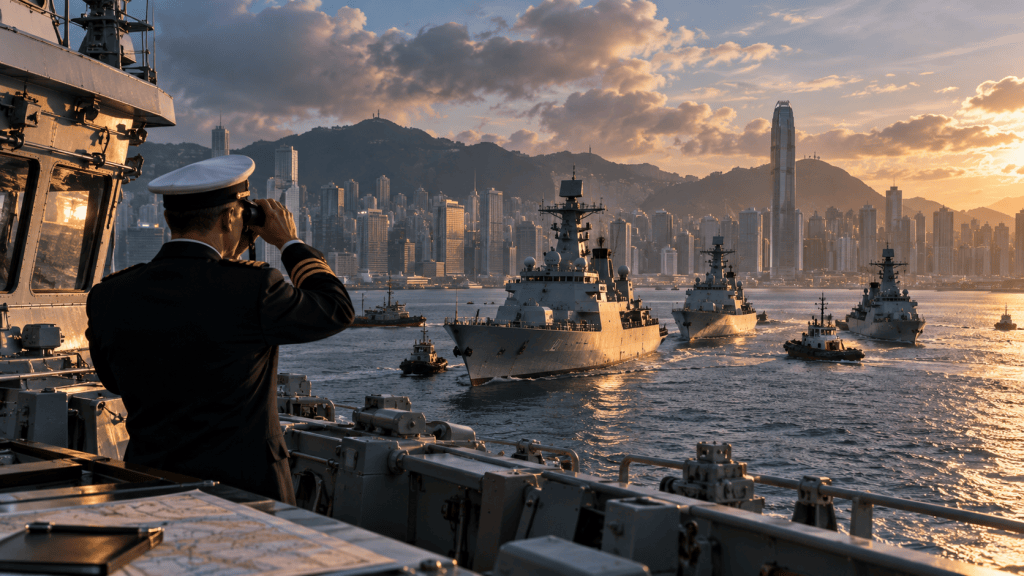
Aboard HMS Sovereign in Victoria Harbour, a naval planner must prepare three warships for distant deployment while preserving the Pacific Fleet’s readiness.
Timeline of Events
Earlier, Mozambique Channel: Merchant vessels travelling towards the Cape trade route faced increasing interference, including aggressive boarding attempts and harassment, prompting concerns over the security of imperial commerce.
That morning, Hong Kong: A dispatch from the East Africa command sector reached the Imperial Second Fleet aboard HMS Sovereign, requesting additional naval support to reinforce existing patrol forces.
During the same period, Japan: Senior British diplomat Simon Hale received an urgent recall to London while the Royal Navy continued its established Pacific security and allied commitments.
Following the Admiralty request, HMS Sovereign: Admiral Halstead ordered an evaluation of a possible detachment comprising one cruiser and two destroyers, including readiness, fuel support and transit requirements through the Indian Ocean.
One Cruiser, Two Destroyers
Lieutenant Peter Ward dragged the third ship marker towards the Indian Ocean on his planning screen and watched the Pacific coverage column change from green to amber. Above the operations compartment, an aircraft engine rose through its pre-flight checks, stirring the floor beneath his shoes, while Victoria Harbour moved across a nearby camera feed. He eased the marker back, waited for the figures to settle and moved it forward again. The warning returned. Ward rubbed at a tea stain on his sleeve, his cup empty for an hour.
Before he could try again, Chief Petty Officer Ellen Kerr arrived with the latest engineering returns and placed them over his untouched breakfast. She studied the warning column, slipping a pencil beneath the printout. “You can have the figures or the toast, sir. Engineering sent the figures first.” Ward drew the plate clear and gestured towards the spare chair. “A cruiser and two destroyers. East Africa wants reinforcement, and command wants to know how soon we can provide it.” Kerr sat down, reading the figures. “They have asked a generous question.”
The dispatch beneath Kerr’s figures described merchant captains harassed along the Mozambique Channel, where existing patrols stretched between Zanzibar and the Cape trade route. Ward understood the need for stronger protection. Much of the cargo moving through those waters would eventually pass through British ports, including the fleet’s own supplies. Yet the proposed three ships belonged to an escort structure whose patrol windows, maintenance allowances and allied commitments were already assigned. He pulled Kerr’s engineering sheet nearer and checked which commitments might survive.
Kerr leaned across the display and pointed to the destroyer whose next maintenance period fell closest to the proposed transit. “That vessel can sail if her engineers finish early,” she said, pressing the date. “They usually do, because the crew work hard enough to make an early finish look ordinary. I would still give them their proper time.” Ward restored the full maintenance allowance and watched the estimated departure slip. “That puts our fuel schedule against a tanker slot shared with the northern patrol.” Kerr returned the pencil to him. “Then the tanker gets to be the unpopular one for a change.”
The fuel adjustment altered the secondary board, where green symbols showed the Second Fleet’s escorts around Sovereign. Each proposed departure created a gap that the software filled with longer patrol arcs and tighter turnaround periods. A deck announcement passed faintly through the bulkhead as the air wing prepared for its morning sortie, reminding Ward that the carrier’s fighters and reconnaissance aircraft would still need protected operating space. He requested the latest patrol commitments, then compared the hours, unwilling to bury an assumption inside an average.
The updated schedule arrived with Sub-Lieutenant Harris, carrying a tablet and half-drunk bottle of water. “Japanese liaison has confirmed the coordination window,” she said, setting the bottle down and turning the screen towards Ward. “They’ve kept their side exactly where we expected.” Ward traced the matching interval on the planning board. “Which means we owe them the same courtesy. Can you check the escort handover before I send this upstairs?” Harris nodded, eyeing the altered symbols. “I thought we were sending help to Africa.” Ward handed back the tablet with a faint smile. “We are. The difficult part is keeping enough help here.”
By the time Harris returned, Ward had a version that held together. The proposed Indian Ocean passage remained possible, and Pacific patrols could continue if each revised window held. A message from command fixed the evaluation around one cruiser and two destroyers from Sovereign’s escort structure and required an assessment of the remaining Pacific profile. Ward entered the prescribed word beside the revised picture: SUSTAINABLE. It appeared in calm green lettering. Kerr, reading over his shoulder, tapped the page where he had kept the limiting assumptions. “Attach those, sir. Someone will want another ship eventually, and they ought to know what this one cost.”
Ward secured the working sheet to the evaluation and sent the packet for Admiralty review while Harris updated the shared display. New patrol arcs filled the empty positions, leaving the Pacific map as orderly as before the request had arrived. The paper beneath Ward’s hand still showed crowded margins and erased choices. Across the camera feed, a ferry crossed between the freighters of Victoria Harbour, keeping to its assigned channel as the morning traffic continued.
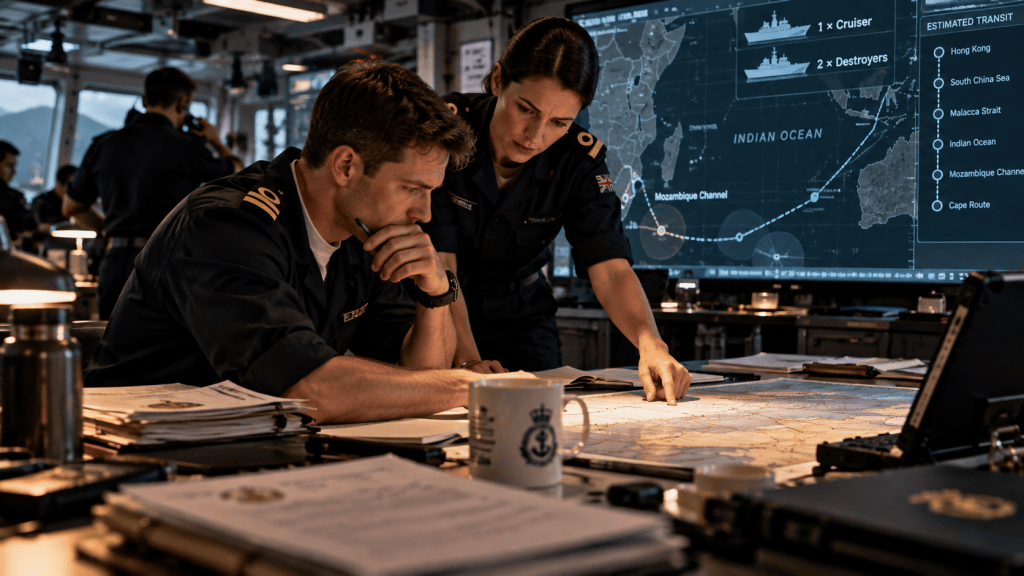
Aboard HMS Sovereign, naval officers reviewed the proposed deployment of one cruiser and two destroyers, balancing distant reinforcement against the Pacific Fleet’s existing commitments.
Inspiration Behind the Story
The interest in this moment comes from how a seemingly straightforward naval decision carries consequences far beyond the ships being reassigned. Instruments of Authority establishes the Imperial Second Fleet as a powerful modern force responsible for protecting trade routes and maintaining stability across the Pacific, even as demands emerge from distant regions.
The request for one cruiser and two destroyers offers an opportunity to explore the people responsible for making such decisions workable. Behind every deployment are fuel calculations, maintenance schedules, crews and existing commitments that must continue. Through a junior officer’s experience, the Chronicle examines how imperial power depends upon careful planning and the increasingly narrow margins hidden beneath an otherwise orderly military operation.
Next Chronicle
The Quarterly Report Came Early
Inside Philadelphia’s Colonial Administrative Offices, a records clerk faces an unexpected request from London for updated provincial economic figures ahead of the usual reporting schedule. As departments struggle to assemble accurate information, an ordinary administrative task begins to reveal the growing attention being directed towards America from across the Atlantic.
The Case by the Door is connected to The Measure of Empire, beginning with Instruments of Authority and continuing through The Governor’s Commission. The books follow the people at the centre of the political and institutional changes that these Chronicles observe from the surrounding households, offices, fleets and administrative systems.