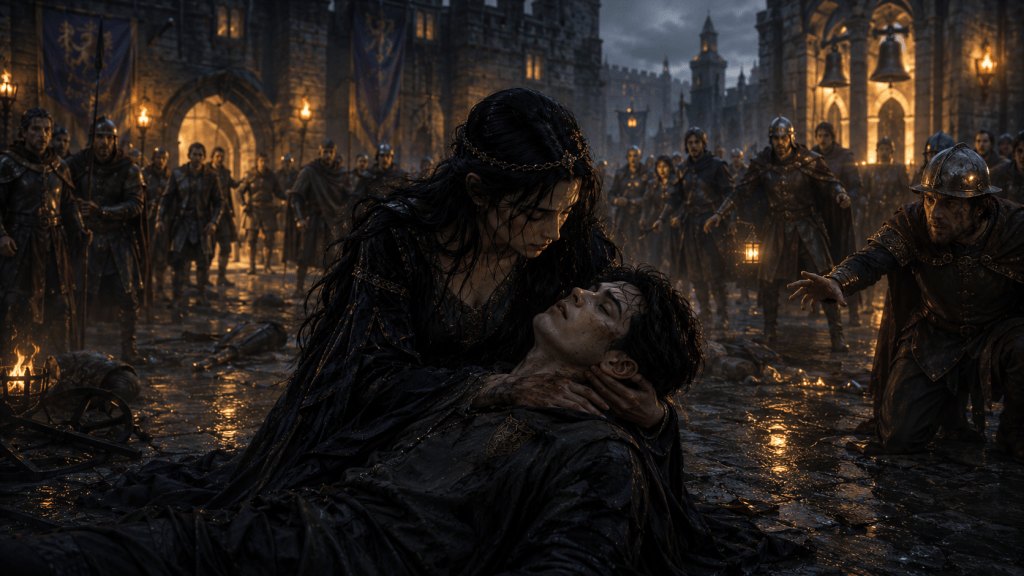
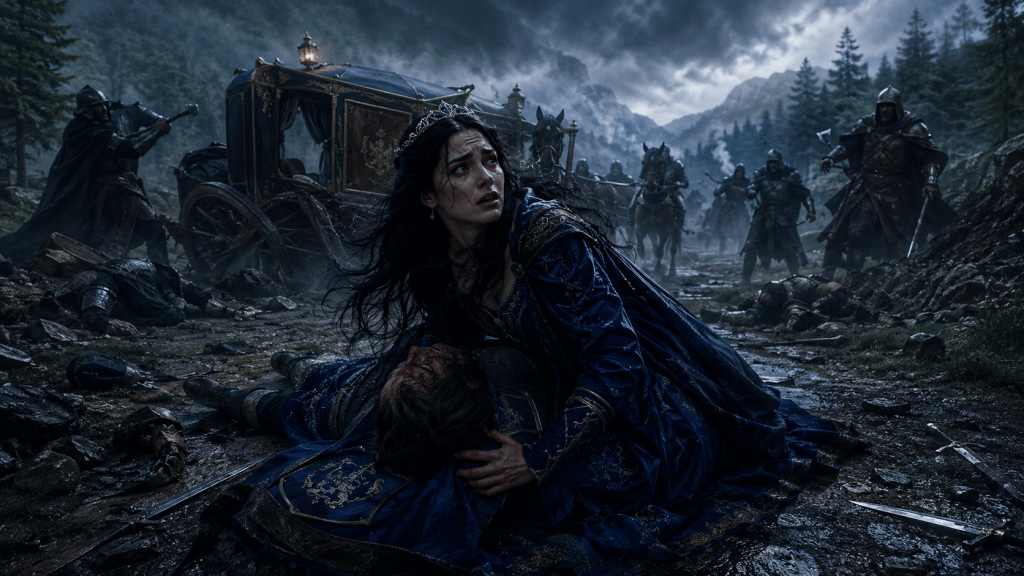
A court-side account of the first dispatches from Vaeldring, where smoke entered Bremyra’s records before the kingdoms understood the war gathering beyond them.
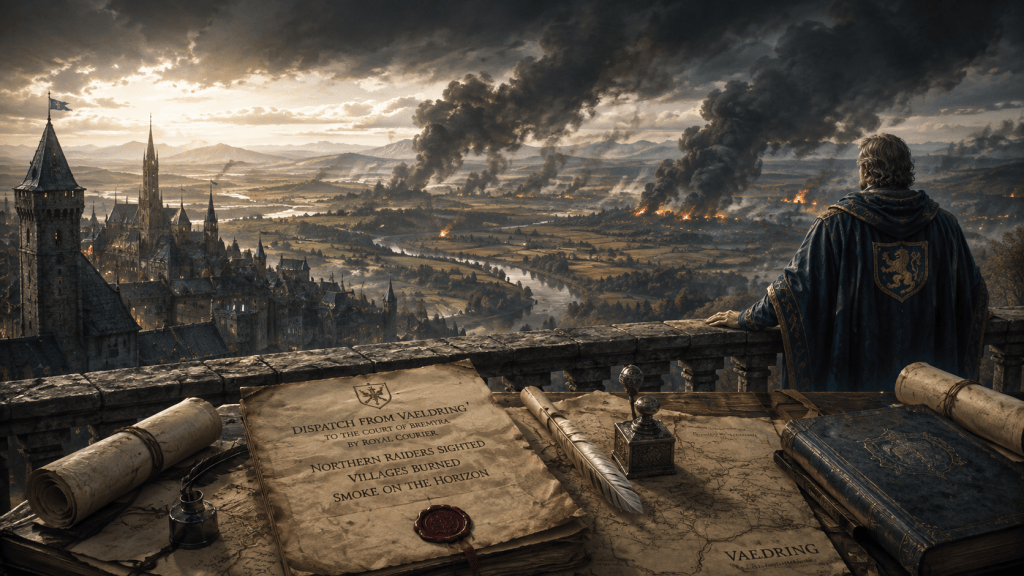
Before War Had a Name
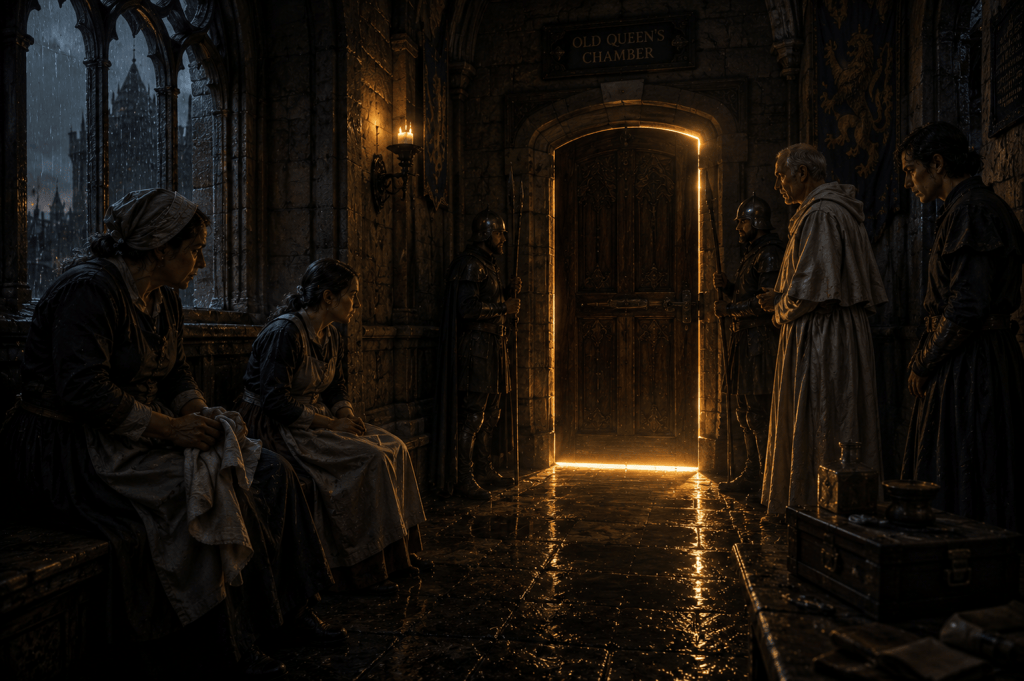
By the hour before dawn, the guarded-return bells had fallen silent above Bremyra, leaving rain to move against the eastern windows while the lesser chancery kept its lamps burning beneath a night already crowded with fear. The western stair remained closed around Princess Elana, the wounded magician, physicians, guards, and servants sworn to quiet, while below those sealed rooms clerks continued the ordinary labour by which kingdoms attempted to hold calamity inside ruled lines of ink.
Edran Vale sat at the third desk from the fire, his shoulders drawn beneath a woollen mantle and his fingers stained where wet wax had softened against them. The receipt ledger lay open before him, filled with entries from the evening: three bells rung under guarded-return authority, western passage closed, physicians admitted, outer gates secured, road patrols recalled. Each line possessed the grave tidiness of court record, giving shape to events whose truth remained elsewhere, behind doors and along roads, within the memories of those who had watched two figures appear upon rain-dark stones where no gate had opened.
Across from him, old Mairen warmed her hands around a cup whose contents had long since cooled. She watched the eastern door whenever wind pressed through its frame. “That hinge has spoken six times since midnight,” Mairen said as she rubbed one thumb along the rim. “If it speaks a seventh, someone will enter carrying trouble.”
“Perhaps the castle has emptied its trouble for one night,” Edran said as he turned the page beneath his hand. “Even ill fortune must tire.”
Mairen settled her spectacles upon her nose. “Trouble rests only while men prepare a larger table,” she said, and the latch struck before Edran could answer.
Cold air entered with wet leather, horse sweat, mud, and the sharp smell of winter roads. A guard came through with one arm around a rider whose cloak hung dark and heavy from his shoulders. Behind them followed a lower-ward clerk clutching a narrow case bound in cracked red leather and sealed with green wax.
“Vaeldring dispatch,” the guard said as he steadied the rider near the bench. “Received at the eastern post before the fourth watch. His horse fell beneath him in the outer ward.”
Master Pellor emerged from the archive screen with his night robe drawn over court linen, his silver hair loose around a face sharpened by interrupted sleep. “Set him near the fire,” Pellor said as he cleared the ledger stand. “Mairen, send for hot water. Vale, prepare receipt under foreign distress.”
The rider resisted the guard’s attempt to lower him fully. Blood had dried along one temple, and mud lay pressed into the seams of his face. “The case goes upward,” he said as his hand closed around the guard’s sleeve. “It was placed under oath for Prince Patrick. I was told it must reach him before daylight.”
“It will reach His Highness through lawful hands,” Pellor said as he rested both palms upon his cane. “Your oath has carried it inside the royal walls. Give us the sender, the road, and the condition in which you received it.”
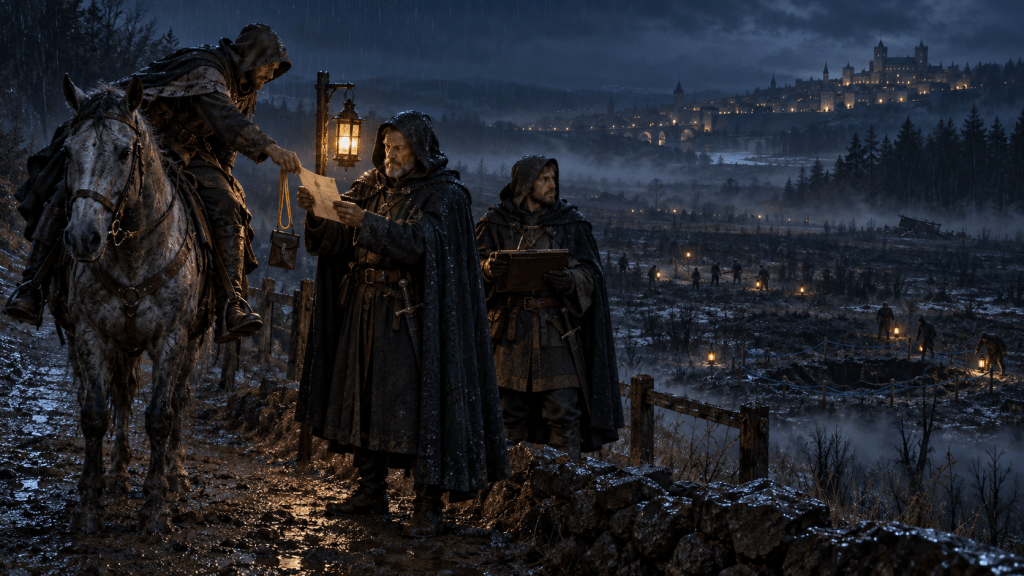
The rider looked towards the leather case as the clerk placed it upon the desk. “I received it at the southern Vaeldring relay from a watch captain out of the northern coast,” he said as his wet fingers worked against one another. “The captain had ridden from a settlement whose name I never heard clearly. His mouth was burned by smoke. He said ships had entered before sunrise, long and shallow through the water, with shields along their sides. Men came ashore while the fishing bells were ringing.”
Edran’s quill slowed above the receipt line. Mairen rose from her chair, the forgotten cup still held between both hands. Pellor gave no sign of surprise, though his grip deepened around the cane.
“How many ships?” Pellor asked as he inclined his head towards the clerk taking witness.
“The captain named twelve, then said more lay beyond the headland,” the rider replied as the guard eased a blanket around his shoulders. “He counted smoke after that instead of sails. Three villages. A watchtower taken. Storehouses opened or burned. Men moving inland in separate companies.”
“Raiders often take the shore and return to the sea before a levy gathers,” Mairen said as she reached for a fresh sheet. “Were these men carrying plunder back towards their ships?”
The exhaustion in the rider’s face hardened around memory. “They carried food and iron inland,” he said as his hand pressed against the blanket. “They drove captured carts before them. The captain said the greater number followed the north road towards the river country.”
Rain continued upon the windows, the fire settled in the grate, and somewhere above them a barred door closed along the western passage. Edran looked towards the map shelf, where surveys of Vaeldring rested among marriage routes, harvest boundaries, bridge tolls, and the careful lines by which courts imagined another kingdom could be understood.
“Bring the Vaeldring road map,” Pellor said as he extended one hand for the sealed case. “The marriage copy, western scale.”
Edran unlocked the cabinet and drew out the blue-corded roll prepared only days earlier for Princess Elana’s journey. He opened it across the long table, weighting each corner with seal cups while Mairen brought the nearest lamp closer.
“The first smoke stood here, perhaps farther east,” the rider said as one shaking finger found the coast. “The captain spoke of a river mouth shaped like a hooked blade. I passed another messenger two relays south. He claimed smoke above the inland farms before nightfall.”
Edran followed the road beneath the rider’s finger. A faint ink line continued south-west through villages and woodland before joining the route intended for Elana’s bridal procession. He felt the connection before any clerk gave it words, though distance remained upon the map, and the night had already taught him the danger of forcing separate wounds into one shape.
Mairen placed a second parchment beside the map. “This came before midnight from the harbour watch,” she said as she smoothed the page. “A merchant vessel out of Vaeldring reported fire along the northern horizon and empty signal towers. Master Pellor entered it as uncertain coastal disturbance.”
“That wording remains until authority changes it,” Pellor said as he drew the seal lamp nearer. “One merchant saw fire. One captain named ships. One rider repeated what a wounded man placed in his keeping. We preserve each distance between witness and event.”
The rider gave a low sound that carried more anger than strength. “Call it distance if that helps the ink lie flat,” he said as he shifted beneath the blanket. “The road behind me filled with families travelling south. One woman carried a child wrapped in sailcloth because every blanket had burned. They called the men sea wolves, frost sons, dead kings returned from the north. By the third relay, people swore the raiders rode white beasts and carried axes bright enough to split church stone. I saw only smoke, Master. I saw enough to hide the stars.”
Pellor studied him, then looked towards Edran. “Enter the account exactly,” he said as he laid the leather case upon the map. “Keep the witness words apart from the receipt. No title of war. No naming of tribes. No joining of this report to the violence upon Her Highness’s road.”
“How shall the movement inland be described?” Edran asked as ink gathered at the point of his quill.
“Armed northern movement under uncertain strength,” Pellor said after a silence. “Add coastal settlements under violent seizure. Smoke observed across more than one district.”
The eastern door opened again before Edran completed the line. Master Vaynor entered with two guards and a folded order held beneath his arm, his face drawn by the hours spent between the western chamber and the court rooms. A faint stain of medicinal smoke clung to his sleeve. He took in the rider, the opened map, the green seal, and the harbour report beside it.
“How many?” Vaynor asked as he crossed to the table.
“One sworn dispatch, one merchant account, and a second messenger reported upon the southern relay,” Pellor said as his finger traced the coast. “Ships along the northern shore. Settlements taken. Armed companies moving inland.”
Vaynor rested both palms upon the map and followed the roads towards the south. “His Highness receives every northern paper at once,” he said as his eyes remained upon Vaeldring. “Copy each report separately, then prepare a common sheet of locations, times, and witness distance. Send word to Captain Rylas that the eastern roads require riders beyond Grey Ash.”
“What heading shall stand upon the common sheet?” Pellor asked as his hand remained near the sealed case.
Vaynor raised his gaze, and Edran saw a man who had passed beyond exhaustion into the harder country where movement continued because too many others depended upon it. “Northern reports,” Vaynor said as he gathered the map’s edge beneath his fingers. “Nothing greater until the council has enough truth to carry the word.”
The rider laughed once, softly and with little mirth. “The word is already travelling,” he said as he lowered his head beneath the blanket. “It reached the roads ahead of me.”
No one answered him. Edran returned to the ledger while Mairen opened fresh sheets, Pellor warmed the green seal above the lamp, and Vaynor stood over the map where separate trails of ink began to gather towards Bremyra. Outside, the rain thinned along the eastern windows, revealing colourless light above the city roofs. The bells remained silent, the western chamber remained closed, and the people of Bremyra slept beneath the fading memory of impossible return while smoke from a kingdom beyond their watch entered the castle one report at a time.
Before Prime, servants below the chancery had heard that northern fleets covered the sea. Before the noon bell, men in the harbour spoke of burned Vaeldring towers and armies walking south beneath black banners, though no such banner appeared in any page Edran had seen. The official heading remained small and provisional: Northern Reports, Uncertain Strength.
The lesser chancery remembered the moment differently, for those present saw how each fragment arrived alone and settled beside the others, until the spaces between them became more fearful than the words themselves. Long before any council named an invasion, the smoke had found its way into Bremyra’s ledgers, and war had begun to take shape in the margins where certainty failed.
Royal Chancery Register: The Northern Smoke Reports
The northern reports entered Bremyra Castle through separate hands, their seals bearing the marks of Vaeldring road stations, coastal watch posts, merchant harbours, and minor officers whose names appeared only once before vanishing from the surviving record.
The earliest dispatch referred to shallow vessels sighted beyond the northern headlands, followed by smoke rising from fishing settlements whose warning bells ceased before the nearest levy could gather. A second report recorded storehouses opened or burned, signal towers left empty, and armed companies carrying food, iron, and captured carts away from the coast towards the inland roads.
No agreed number of vessels or raiders appeared across the surviving copies. One captain entered twelve ships beneath the headland, while later witnesses claimed the sea itself had darkened beneath their hulls. Reports of white beasts, black banners, dead kings, and axes bright enough to break consecrated stone were preserved only upon attached witness sheets and excluded from the common chancery summary.
The royal copy described the disturbance as armed northern movement under uncertain strength, with instruction that each location, time, and witness distance remain separately entered until the council possessed enough evidence to assign a fuller name. A later hand amended movement to incursion, though the alteration was scraped thin before the register passed into sealed storage.
The reports continued after the first page had been filled, arriving from roads farther south and settlements farther inland, until smoke appeared upon maps whose earlier purpose had been marriage passage, harvest measure, bridge duty, and royal travel. The register closed without naming war, while a lesser chancery copy preserved the phrase the north had already entered Vaeldring before Bremyra learned what to call it.
About the Creator
The Mythic Chronicle is written and curated by Simon Phillips, a writer of mythic and speculative fantasy whose work explores forgotten kingdoms, fractured records, old institutions, and the moments when history begins to shift before those living through it understand what has changed.
The accounts preserved within these Chronicles form part of a wider body of work in which castles keep older secrets beneath familiar rooms, roads carry rumours ahead of armies, and ordinary witnesses preserve fragments of events whose true meaning remained sealed from them at the time.
One such account survives in a separate record, following the return of a magician to Bremyra during a season of court unease, royal absence, Church suspicion, and gathering danger beyond the kingdom’s roads. What the servants, clerks, and watchers of the city remembered only in fragments is followed more closely in The Unmarked Path, the opening book of The Veil of Kings and Gods within The Chronicles of the Spiral Realms.
Readers who wish to examine that fuller account may find the record below.
Read the book:
The Unmarked Path
Explore the wider saga:
The Chronicles of the Spiral Realms
You can watch his YouTube channel here:
Author Simon Phillips

Chronicle Record: The Smoke Gathered into War
The first packet left the lesser chancery while morning still lay colourless across Bremyra, carried beneath Edran Vale’s arm through passages smelling of wet wool, lamp oil, ash, and the faint medicinal herbs rising from the western rooms. Servants pressed close to the walls as he passed, their trays and coal baskets held against their chests, while every face turned for an instant towards the red leather case borne ahead by Master Vaynor. The guarded-return bells had given the household one fear to carry through the night. The Vaeldring papers arrived before that fear had found any settled place.
At the upper landing, two royal guards stood beside the council doors with rain darkening their cloaks. Captain Rylas waited between them, mud dried pale along his boots after his return from Grey Ash Rise, his bruised face drawn beneath a night of roads, bodies, and unanswered tracks. He looked towards the case in Vaynor’s hands, then towards Edran’s ledger.
“Another road has opened,” Rylas said as he drew one glove tighter across his wrist. “I can read that much from the way you carry it.”
Vaynor halted before the doors and studied the captain. “The road lies north of Vaeldring’s coast,” he said as one hand remained beneath the case. “Ships, burned settlements, inland movement, and numbers that alter with every witness.”
Rylas’s jaw tightened. “How far inland?”
“Far enough for three separate stations to send warning,” Vaynor replied as he glanced towards the sealed council chamber. “Near enough for rumour to reach our harbour before the riders.”
Edran shifted the ledger beneath his arm. “The first report names twelve vessels,” he said as Rylas’s attention settled upon him. “The same witness believed more waited beyond the headland. A second account speaks only of smoke.”
“Smoke gives a truer count than frightened men,” Rylas said as he rested his palm against the sword at his side. “Each column means somebody lost a roof.”
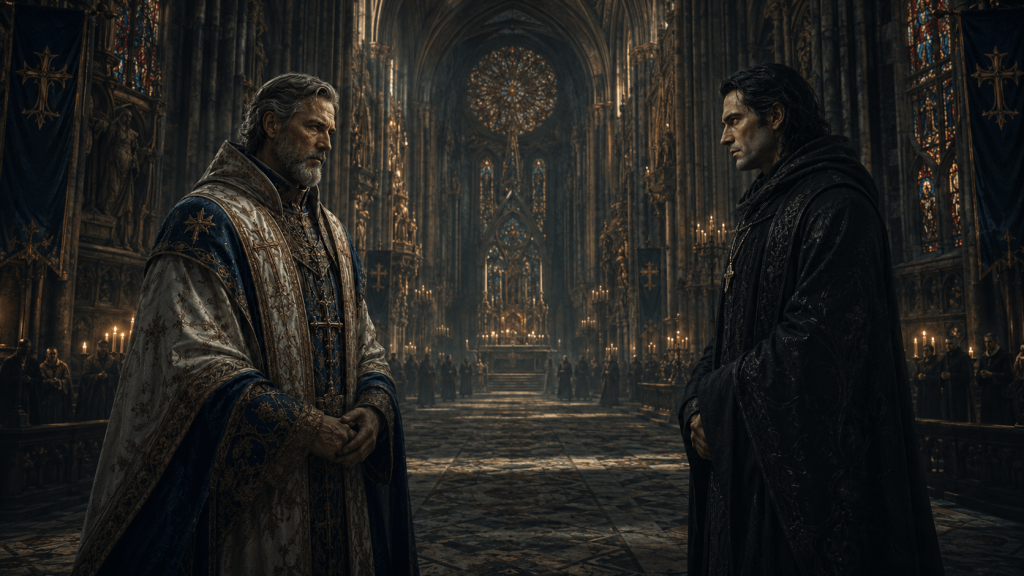
The inner guard opened the doors, releasing firelight across the passage and revealing Prince Patrick at the map table with Archbishop Alaric standing near the hearth. Patrick still wore the dark tunic from the previous evening, its collar loosened and one sleeve marked by a narrow smear of blood that had escaped every servant’s attempt at order. His face had gained the stillness Edran had seen in older rulers during crop failure and siege petition, the expression of a man who understood that weariness could no longer be offered as an excuse.
Patrick looked first to Vaynor, then to Rylas, and at last to the leather case. “Bring it here,” he said as he drew the Vaeldring marriage map away from the other papers. “Tell me what reached us before the court invents its own answer.”
Vaynor placed the case upon the table and untied the outer strap. Edran opened his ledger beside it, while Rylas took the place nearest the northern coast. Archbishop Alaric watched from the hearth with both hands gathered into his sleeves, his white stole catching the low flames.
“The earliest sealed report came from a coastal captain through the southern relay,” Vaynor said as he laid the first sheet flat. “Long vessels entered before sunrise. Fishing settlements and at least one watchtower fell under attack. Armed companies moved inland carrying stores, tools, carts, and prisoners.”
Patrick traced the coastline with one finger. “Raiders take coin, grain, livestock, and people they can sell,” he said as his gaze followed the river road. “They return towards the ships before levies close the shore. Why carry iron inland?”
Rylas bent over the map. “Because they mean to hold ground, repair what breaks, or arm men who arrive after them,” he said as his finger moved from the headland towards the river country. “A raiding party feeds itself from the coast. An army opens a road.”
Alaric left the hearth and approached the table, the hem of his robe moving across the rushes. “One captain’s fear has become an army before the wax has cooled,” he said as he examined the green seal. “The Church has received no formal plea from Vaeldring, and its northern houses maintain their own wardens.”
Rylas lifted his eyes towards the Archbishop. “Those wardens may already hang above their own gates.”
Patrick raised one hand before the exchange sharpened. “We keep each claim beside its source,” he said as his fingers rested upon the map. “Captain Rylas gives military reading. His Grace gives the absence of formal appeal. The ledger preserves both.”
Edran entered the distinction while the room settled around the Prince’s order. The quill sounded small against the page, yet the words changed the shape of the table. Coastal violence. Armed movement inland. Strength uncertain. Purpose unconfirmed. Each phrase narrowed what could safely be declared while leaving the larger fear untouched.
A knock sounded from the outer chamber. Ser Caldus entered with a harbour officer whose blue coat hung open over a salt-stiff tunic. The officer bowed too quickly, caught himself, then placed a rolled witness sheet beside Vaynor’s hand.
“Your Highness,” Caldus said as rain glistened along his shoulders, “the harbour watch detained a grain master from Vaeldring after his crew began spreading alarm among the lower quays. His statement concerns the same smoke.”
Patrick looked towards the officer. “You heard him yourself?”
“I questioned him with two watch clerks present,” the officer said as he kept his cap between both hands. “His vessel left the river mouth before the first fire rose. By dusk, smoke stood across the northern horizon in five separate columns. He passed fishing boats moving south with wounded aboard, then a river barge carrying families from inland farms.”
“How many armed men had he seen?” Rylas asked as he leaned one knuckle against the map.
“None with his own eyes, Captain,” the officer answered as he glanced towards the witness sheet. “One fisherman spoke of shield lines near the shore. A wounded boy claimed horned giants came through the surf. The grain master rejected that part, though his crew kept repeating it.”
Alaric’s mouth tightened. “Fear places horns upon every enemy before giving him a name.”
The harbour officer bowed his head. “By the time they reached Bremyra, Your Grace, the giants had become dead kings from beneath the ice.”
Patrick closed his eyes for a moment, then opened them upon the map. “Enter the grain master as witness to smoke, refugee vessels, and reported wounded,” he said as he looked towards Edran. “The shield lines remain second-hand. The giants and dead kings stay upon the attached sheet.”
Edran wrote while Caldus placed a second report beside the first. Across the table, Vaeldring changed from a kingdom of marriage roads and border promises into a spread of inked warnings, each one arriving through a different mouth. Patrick’s sister had been travelling towards those same lands only a day earlier, carried beneath royal colours towards a marriage meant to strengthen both kingdoms. Now she lay behind guarded doors, and the country prepared to receive her had begun sending smoke southward instead of wedding couriers.
Patrick’s hand came to rest over the road marked for Elana’s journey. “Has any report come from the Vaeldring court?” he asked as the fire shifted behind him.
Vaynor drew a sealed packet from beneath the others. “Only an older message received before the ambush,” he said as he laid it near the prince. “It concerns her reception, lodging, and ceremonial approach. No northern warning appears within it.”
“Then their court either lacks the news, cannot send it, or has chosen silence,” Patrick said as his thumb pressed against the old seal. “Every answer carries its own danger.”
Rylas studied the distance between Grey Ash Rise and the northern coast. “The men upon the Princess’s road spoke a foreign tongue and carried weapons outside our common make,” he said as his forefinger tapped the map. “The dead in Tanner’s Row carried broad axes and round shields. Now long vessels enter Vaeldring from the north.”
Alaric’s gaze sharpened. “Similarity invites certainty where evidence remains thin.”
“I spoke of connection, Your Grace,” Rylas said as he straightened. “I offered no judgement upon who placed them there.”
Patrick looked from one man to the other. “The formal record keeps the incidents separate,” he said as his hand closed around the edge of the table. “Privately, we compare every weapon mark, every word remembered from the alley, every bottle taken from the field, and every sign carried from Vaeldring. If one hand moved through all three places, I want its shape before it reaches for us again.”
Vaynor inclined his head. “The foreign axe remains under watch. The arrowheads from Grey Ash are sealed. Captain Maeran’s lesser copy preserves the witness words more fully than the court transcript.”
“Bring them together under guard,” Patrick said as he turned towards Rylas. “You choose the officers. No chapel inquiry, no Order claim, and no Guild agent enters the room alone.”
Alaric’s expression cooled. “The Church holds knowledge of poisons older than this crown.”
“And the Order holds arts that may draw memory from the dead,” Patrick said as he met the Archbishop’s gaze. “Both institutions may assist when I know what assistance costs.”
For several heartbeats, the room held only fire, rain, and the light scrape of Edran’s quill. Alaric lowered his chin by a measured degree, accepting the boundary while leaving his displeasure visible. Rylas stepped back from the map, though tension remained along his shoulders.
Another knock came before the council resumed. This time a page entered with a strip of wax tablet wrapped in linen. His cheeks were flushed from running, and one stocking had slipped below the knee.
“Message from the east tower, Your Highness,” the page said as he crossed to Vaynor and held out the bundle. “A rider from the chapel road reached the lower ward. He carried no seal, only a tally mark from the Vaeldring border post.”
Vaynor unfolded the linen and read the scratched lines. His eyes moved once across the tablet, then again more slowly. “The border post received displaced families from two inland settlements,” he said as he placed the tablet beside the map. “They reported armed men crossing the north road in separate columns. Carts moved with them. Fires followed behind.”
“How many families?” Patrick asked as he looked towards the page.
“The rider named thirty at the first post and more upon the road,” the page replied as he pressed his hands against his sides to still their shaking. “He said one old woman carried a door key from a house that had already burned.”
The image entered the room more deeply than the number. Edran saw it in Patrick’s face, in Rylas’s lowered gaze, and even in the brief closing of Alaric’s fingers beneath his sleeves. A door key survived because people carried the shape of return long after return had become impossible.
Patrick reached for the tablet and turned it towards the lamp. “Was the rider admitted to the infirmary?”
“Yes, Your Highness,” the page said as he bowed. “His horse had blood beneath the saddle, though the rider claimed the wound belonged to another mount.”
“Send food, dry clothing, and a clerk after he has slept,” Patrick said as he returned the tablet to Vaynor. “No questioning while exhaustion speaks in his place.”
The page withdrew, leaving the council with the old woman’s key among seals, maps, and military estimates. Vaynor took a stick of red wax from the writing tray and placed a small mark beside the northern road. Rylas added another at the river branch, then a third near the inland farms. The map slowly filled with red points whose exact positions remained uncertain, each one a place where smoke, movement, or flight had been witnessed.
Edran watched the pattern grow and understood why later copies disagreed over the morning. Some claimed the red marks formed a claw descending through Vaeldring. Others remembered a serpent, a broken crown, or a spiral tightening towards Bremyra. From where he stood, they formed no sacred sign. They were only warnings placed by tired hands, though fear had already begun teaching the court to see more.
Patrick stepped away from the table and crossed towards the eastern window. Dawn had strengthened over the city, revealing wet roofs, harbour masts, and the old Order manor upon its hill. “How long before these accounts reach the market?” he asked as one hand rested against the stone frame.
“They have arrived already,” Vaynor said as he gathered the loose sheets. “The harbour crews speak of northern kings. The lower gate speaks of fleets beyond counting. Kitchen servants have heard that Vaeldring’s sky has burned black.”
Rylas moved beside the map, his face turned towards the red points. “By noon, Bremyra will believe an army stands beyond Grey Ash.”
“Then the guards keep their mouths measured,” Patrick said as he looked back towards them. “The court issues no proclamation until the next riders arrive. We strengthen the eastern watches, prepare grain tallies, and send quiet warning to the western posts. Vaeldring receives an offer of riders, physicians, and road escort under royal seal.”
Alaric drew closer to the window, candlelight fading from his white stole beneath the growing day. “And what shall the people be told when they ask why the gates carry twice their usual guard?”
Patrick’s gaze travelled across the city below. “Tell them northern reports have reached the court and that Bremyra watches its roads,” he said as his hand tightened upon the stone. “Give them enough truth to prepare, never enough emptiness for fear to fill with monsters.”
Edran lowered his quill after entering the order. He knew the weakness within it, as every clerk knew the limits of royal wording once bells, blood, ships, and smoke had entered common speech. Before midday, stallholders would swear Vaeldring had fallen. Before evening, taverns would name a northern king whose face no witness had seen. By the following morning, the burned settlements would become a hundred, the long vessels a thousand, and the armed columns a host older than the kingdoms they threatened.
The council understood this as well. Their task remained narrower: seals checked, witnesses separated, distances marked, and uncertainty preserved where certainty had yet to earn its place. Patrick returned to the table and set his hand over the northern coast, covering three red marks beneath his palm.
“We keep the heading as Northern Reports,” he said as he looked towards Edran. “When the truth grows large enough to demand another name, the record may change.”
Edran bowed over the ledger and entered the Prince’s words in the margin. Years later, copies would claim that Patrick named the invasion that morning, that bells rang across Bremyra, that smoke appeared upon the sea, or that a black-winged omen circled the castle tower while the court watched Vaeldring burn upon a map. The surviving chancery account preserved a quieter beginning.
A tired prince stood beside his father’s empty chair. A captain placed red wax upon unfamiliar roads. An archbishop questioned each report. A master of court kept every witness at the proper distance from what they claimed to know. A clerk wrote a heading small enough to contain uncertainty.
Beyond Bremyra, armed men continued inland through Vaeldring while the kingdoms searched for a word equal to the danger. Within the castle, the reports lay side by side until their separate smoke became one dark shape in memory, and war entered legend before law, council, or crown had gathered courage enough to name it.
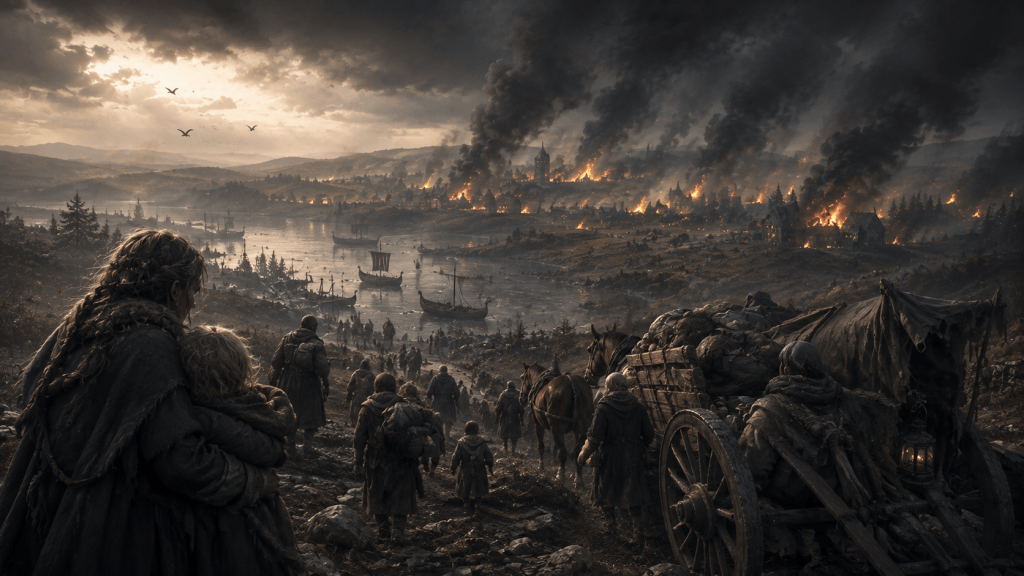
Families fled the northern settlements beneath a sky darkened by smoke, carrying children, keys, and the last possessions they could save, while Vaeldring’s burning roads sent their first warning south towards Bremyra.
The Idea Behind the Chronicle
Wars rarely enter history beneath the name later generations give them. Their earliest presence is often smaller and harder to judge: smoke seen beyond a ridge, fishing boats crowded with wounded families, watchtowers falling silent, roads carrying people south with keys to houses already lost, and riders arriving at court with accounts gathered from other frightened mouths. By the time rulers recognise the shape of invasion, ordinary witnesses have already begun turning scattered violence into memory.
This Chronicle draws upon that uncertain threshold between report and war. Bremyra stands beyond the first northern landings, protected for a time by distance, weather, and another kingdom’s roads. The people receiving the dispatches see no longships, shield lines, burned villages, or armed columns with their own eyes. They encounter the invasion through cracked seals, exhausted messengers, harbour testimony, road tallies, and smoke marked upon maps once prepared for marriage, harvest, and royal passage.
Court records are built to separate witness from rumour. They preserve names, hours, places, seals, and the distance between an event and the person describing it. Such discipline offers a kingdom protection against panic, though it also creates a strange delay between danger and recognition. One clerk records coastal disturbance. Another enters armed movement under uncertain strength. A harbour officer preserves reports of refugees. Each entry remains cautious on its own, while the growing space between them begins to reveal something larger than any single page is willing to declare.
Across old accounts of invasion, rumour often moves ahead of formal knowledge. Raiders become giants, unfamiliar warriors become dead kings, and twelve ships become a sea hidden beneath sails. These changes arise through fear, distance, and the human need to give shape to danger before authority has supplied one. The stories may lose accuracy as they travel, yet they often preserve the emotional truth of the moment more faithfully than the final proclamation: homes have burned, roads have broken, and the world beyond the familiar border has changed.
The Sealed Road of Bremyra has followed a kingdom through signs that gathered slowly around it. An old manor appeared to wake before its guest arrived. A gold-wax letter altered the mood of the court. Church doors closed around buried suspicion. Servants remembered a boy beneath a magician’s robes. Hidden stone shifted behind library shelves. Foreign weapons entered the streets, a princess vanished upon the road, scorched earth resisted ordinary explanation, and guarded bells carried rumours of impossible return. The northern reports bring those separate disturbances beneath one widening shadow, while preserving the uncertainty that has shaped the entire cycle.
The world of The Unmarked Path remains at the edge of open continental war. Vaeldring has begun to suffer northern attack, armed forces are moving inland, royal travel has already broken beneath organised violence, and Bremyra’s institutions remain reactive, measuring danger after it has crossed each earlier boundary. The court understands that something larger has begun, although its surviving language still belongs to reports, border disturbance, uncertain strength, and guarded preparation.
This Chronicle therefore closes the Bremyra cycle through records instead of battle. The invasion remains distant from the chancery windows, though its smoke has already entered the castle through parchment, testimony, rumour, and fear. Clerks continue to preserve careful distinctions while the people beyond their desks begin shaping legend from fragments. The court waits for evidence strong enough to name war, while the roads have already carried its consequences south.
The northern smoke becomes the final threshold of the series. What began with one old house preparing itself ends with whole kingdoms facing a movement whose full shape remains beyond sight. Bremyra has received every warning in pieces, and those pieces now lie close enough for the truth to cast a shadow across them, even as the official record keeps its smallest heading: Northern Reports, Uncertain Strength.
From the Author’s Desk
Thank you for continuing into this Chronicle.
This final account was shaped around the way war often reaches those beyond its first violence: through scattered testimony, damaged seals, exhausted messengers, smoke upon distant horizons, and rumours that grow larger as they travel. Bremyra’s court receives no complete vision of what has begun in Vaeldring. Its clerks hold fragments, compare locations, preserve uncertainty, and wait for enough evidence to give the gathering danger a name.
Across The Sealed Road of Bremyra, each Chronicle has remained close to those standing beside the larger events: servants opening an old manor, clerks receiving sealed authority, chapel attendants guarding uncertain foundations, cooks remembering a vanished boy, librarians recording movement behind familiar shelves, guards examining foreign steel, and road keepers watching royal passage disappear into silence. Their accounts preserve what the world noticed around the story, while the fuller truth remained beyond their reach.
The Northern Smoke Reports brings that movement to its final threshold. The dangers that entered Bremyra as isolated disturbances now appear within one widening pattern, though those recording them still lack the knowledge needed to understand their full meaning. The cycle closes before certainty arrives, leaving the court with maps, warnings, and smoke carried south from a kingdom already facing war.
Beyond the Chronicle, The Unmarked Path follows these events more closely through Simion, Prince Patrick, Týrnan, Elana, and the forces beginning to move through the kingdoms of Ældorra. The book preserves the direct experience behind the partial records gathered throughout this series, while the Chronicle remains among those who witnessed only fragments of what had begun.
Readers who wish to explore further may find my books and additional work through the links included below.
You can explore my books here:
Books by Simon Phillips
You can watch my YouTube channel here:
Author Simon Phillips
Archive & Interpretations
From the sealed chancery folios of Bremyra, copied from Vaeldring dispatches of uncertain origin. Several lines were entered by later hands, while portions of the first witness sheet show signs of smoke damage and water staining.
The first warning entered under coastal seal and spoke of long vessels passing the northern headlands before sunrise, their hulls lying low upon the water and their shields fixed along the rails. The watch captain who supplied the account gave twelve as the number clearly seen, though his final line referred to further sails beyond the curve of the coast, where mist and smoke had already closed the horizon.
A second entry recorded the silencing of three warning bells, one above a fishing settlement, one beside the river mouth, and one upon a stone tower whose fire had served the northern road for more years than the surviving tally preserved. The tower remained visible after the settlement below had begun to burn, though no answering flame rose from its summit and no warden came down to meet those fleeing towards the inland track.
The reports that followed disagreed over the number of armed men, the colour of their banners, and the order in which the coastal settlements fell. Several witnesses described round shields, heavy axes, pale hair, and iron rings woven through the beards of certain warriors. Others remembered only figures moving between smoke and water, their shapes made larger by flame and distance until the first written copies referred to sea-born giants and warriors returned from older graves.
One road account preserved the movement of captured carts away from the shore, laden with grain, tools, barrels, and lengths of worked iron. The writer marked this as unusual conduct for raiders expected to return quickly to their vessels, adding that armed companies had divided beyond the river crossing and continued inland by separate routes. This observation was copied into the Bremyran court summary under the guarded phrase movement of uncertain purpose.
A later sheet gathered statements from families who reached the southern relay after their homes had burned. One woman carried the iron key to a house already lost, while an elderly man held a strip of sailcloth marked with the name of a fishing boat whose crew had vanished before the warning bell. Their accounts supplied no clear number of attackers, though each described smoke rising behind them from more than one direction.
The final chancery line entered the disturbances as coastal seizure, armed inland movement, and displacement of the northern settlements. The word war appeared nowhere within the primary folio. A smaller hand later placed it beside the closing seal, then scraped the letters thin enough to preserve only their pressure upon the parchment.
Beneath that erasure, another annotation remained untouched:
The smoke had already crossed the kingdom while the court still searched for a name worthy of carrying it.
Marginal Notes & Interpretations
Collected from later annotations preserved along the outer edges of the northern folio.
One annotation described the first landings as a familiar pattern of northern raiding, arguing that winter hunger, weak coastal defences, and the promise of Vaeldring grain offered sufficient cause for the attacks. The writer treated the inland movement as an attempt to gather supplies before returning to the sea, though the same hand offered no explanation for the captured carts, divided companies, or occupied road stations recorded upon the following pages.
A second note challenged that reading and drew attention to the transport of iron, tools, prisoners, and stored food away from the coast. Its writer argued that such movement belonged to men preparing roads, camps, and future supply, with the long vessels serving as the first opening through which a larger force might pass. The note ended beside a rough map of the river country, where three dark lines had been drawn southward from the northern shore.
A third annotation, written in faded brown ink, concerned the stories carried by the displaced families. The writer dismissed the horned giants and dead kings as shapes created by fear, firelight, and distance, yet preserved the accounts in full because each version agreed upon the same lesser details: the bells ceased early, the towers gave no answer, and the armed men continued inland after the first settlements had fallen.
Another hand, firmer and darker, added that legend often begins where official language grows cautious. The court recorded uncertain movement, while the roads remembered an army. The court counted seals, witnesses, and distances, while those fleeing south counted columns of smoke.
The last marginal note had suffered damage along the edge of the page. Its surviving words read:
When every witness offers a different enemy, examine the direction in which they all flee.
The remainder had been lost with the corner of the folio.
World Notes
The Northern Coast of Vaeldring
Vaeldring’s northern shore held fishing settlements, shallow river mouths, scattered watchtowers, and road stations linking the coast with the kingdom’s inland farms. Warning bells and signal fires carried danger between these isolated communities, though winter mist, broken weather, and distance often slowed any wider response.
The Southern Relay Roads
Messages from the northern districts travelled through a chain of small posts where horses, seals, and witness statements changed hands. Each transfer increased the distance between the original event and the court receiving it, creating records shaped by exhaustion, repetition, partial memory, and the fears of those already moving south.
Northern Warbands
The first Bremyran reports described long shallow vessels, round shields, heavy axes, and warriors moving inland through Vaeldring. Their names, loyalties, and full strength remained uncertain within the court record, though the surviving accounts confirm that the movement extended beyond a single coastal raid and had begun carrying war into the southern kingdoms before Bremyra fully understood its scale.
Bremyra remained beneath its guarded towers, its ledgers ordered and its roads watched, while beyond the northern horizon the smoke continued to rise, carrying the first shape of a war the kingdoms had yet to understand and the records had only begun to name.