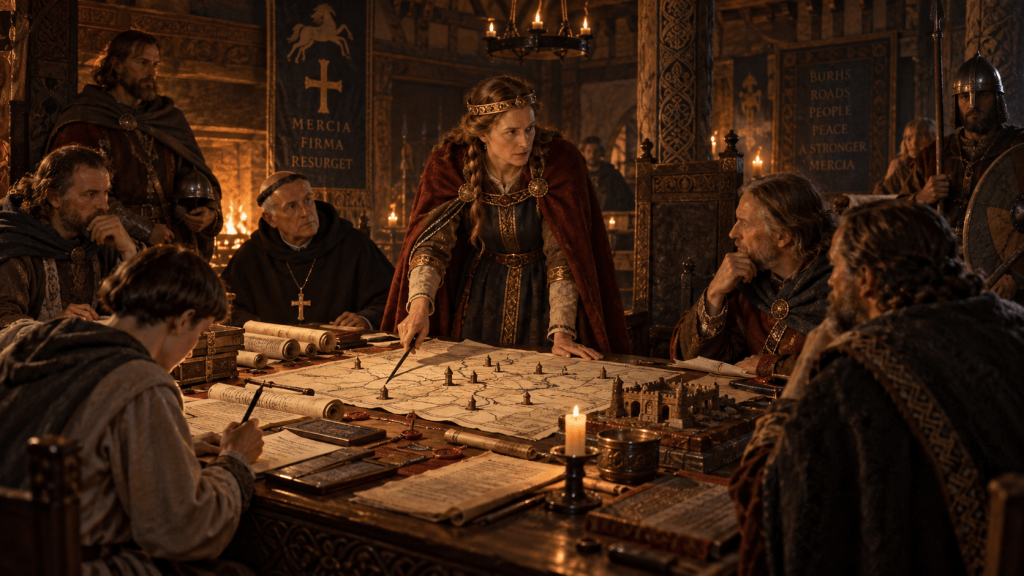
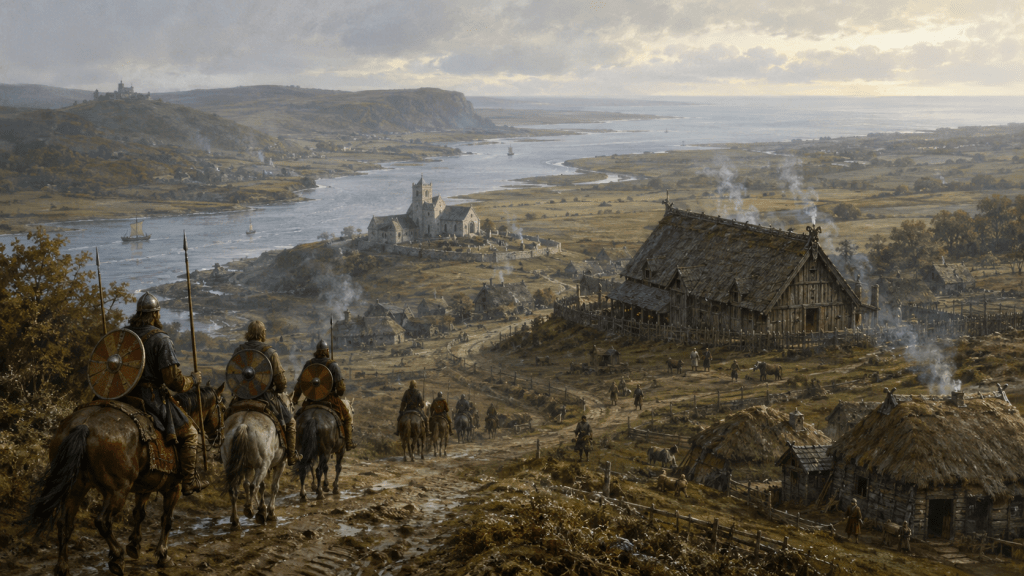
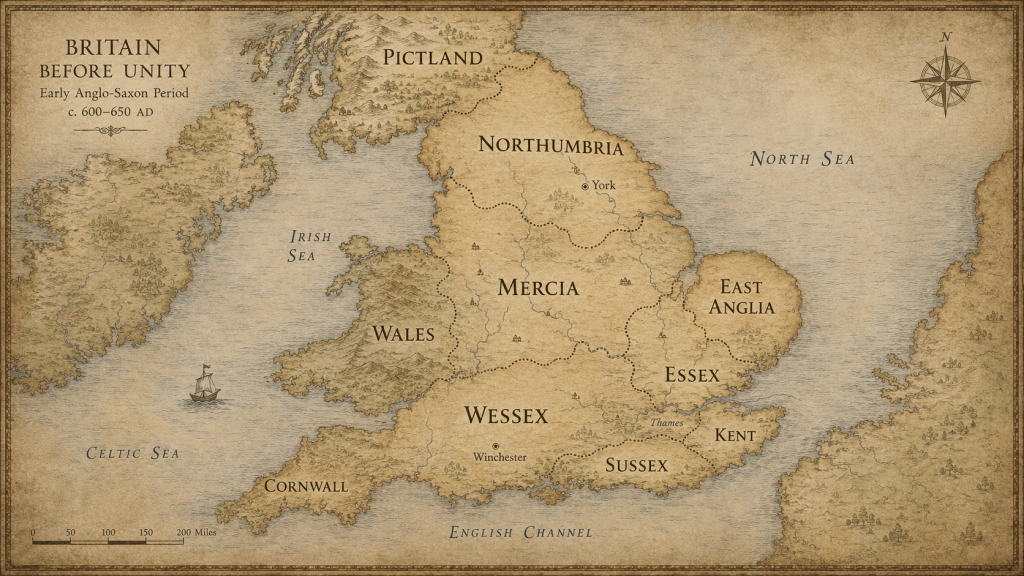
The Forgotten Chronicle: Athelstan and the Birth of England

How Edward’s son took York and gathered the lands that would become England beneath one crown.
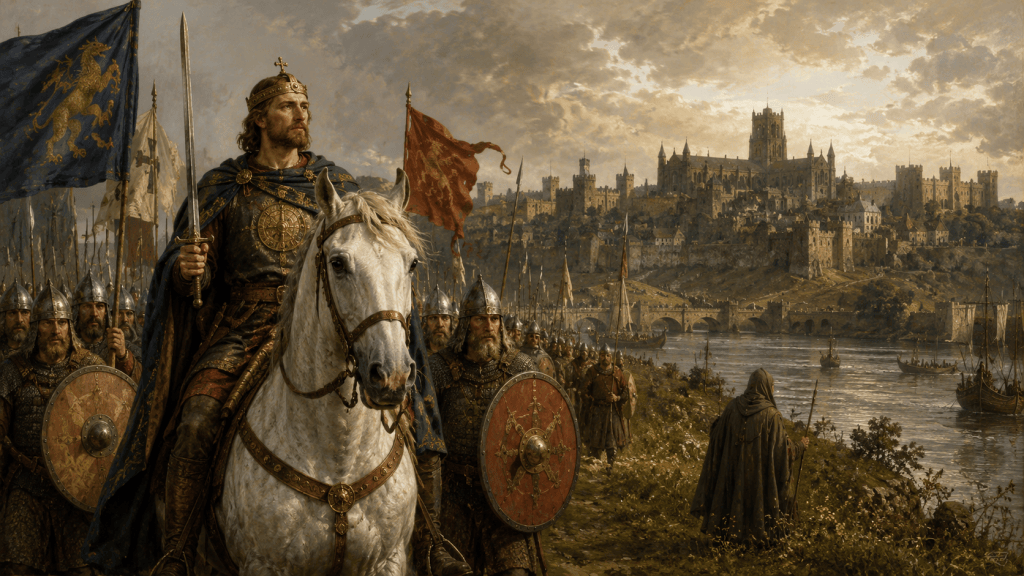

The Gates of York

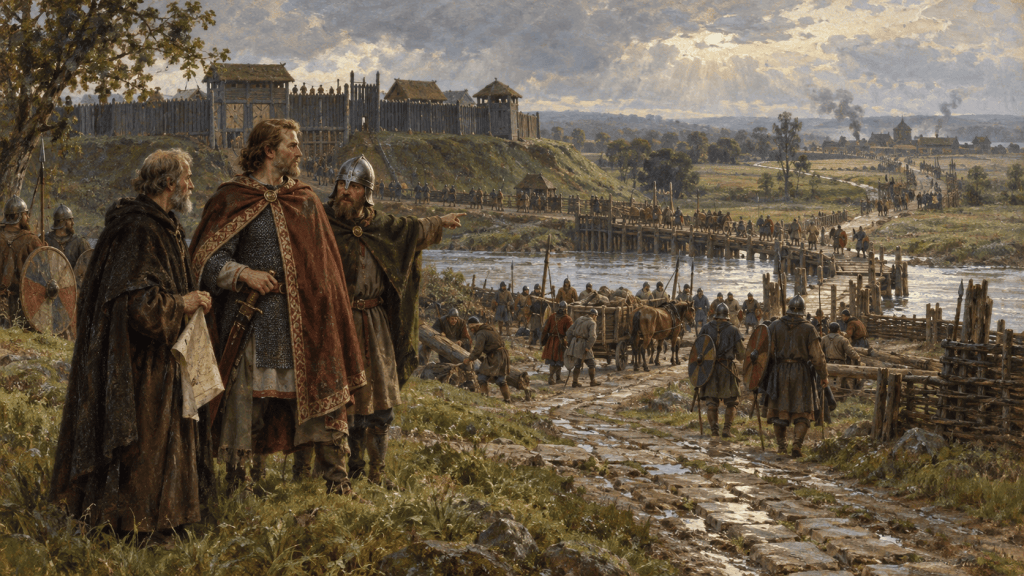
The Ouse moved beneath York’s walls with the slow weight of summer rain, carrying branches, foam, and the broken reflection of the city towards the marshes beyond. Along the southern road, men and horses emerged through the morning haze in a column darkened by mud, their shields wrapped against the damp and their spears rising above them like a travelling wood. The bells inside the city had already sounded, though their voices carried no clear warning. They rolled across the roofs, faded over the river, and left the people upon the walls listening for the first order that would decide whose king entered York before the day was done.

Æthelstan rode near the front beneath a plain royal banner, his cloak heavy across his shoulders as he studied the gate ahead. Three years had passed since Edward’s death, years shaped by disputed succession, Mercian support, and the careful gathering of authority across the lands his father had ruled. York remained beyond that inheritance. Its Scandinavian kings had governed a city of merchants, craftsmen, warriors, and churches, guarding the last great centre of power between the Humber and the kingdoms farther north. King Sihtric’s death had loosened that hold, and Æthelstan had come before another ruler could fasten it again.

A household warrior urged his horse alongside the king and wiped rain from the rim of his helmet. “The gates stand open, lord, yet armed men remain above them,” he said as he glanced towards the figures lining the parapet. “They may be waiting to measure how close we ride before choosing their answer.”

Æthelstan kept his gaze upon the entrance, where water ran in thin streams down the timber doors. “Then they shall see an army prepared for war and a king prepared to receive their oath,” he replied as he loosened the reins enough for his horse to pick a careful path through the rutted ground. “York has watched rulers come and vanish. We must give its people reason to believe this arrival will endure.”

Near the gate, a small group came forward beneath a cross-topped staff. Their leader wore a woollen mantle pinned at one shoulder, and the silver upon his belt caught what little light reached the road. He halted several paces from Æthelstan and lowered his head, while the men behind him watched the West Saxon and Mercian warriors filling the road.

“My lord king,” the envoy said as he lifted both empty hands where the army could see them, “the city seeks peace, its markets protected, its churches left under their own keepers, and its people judged by the laws they know.”

Æthelstan dismounted, passing his reins to a waiting attendant before crossing the wet ground. The mud closed over the edges of his boots as he stopped before the envoy. “Peace will hold where loyalty holds,” he answered, resting one hand against the clasp of his cloak. “Your markets will open, your churches will keep their lands, and every man who gives his oath will receive the king’s protection. York will answer to one crown, and that crown will answer for York.”

The envoy’s expression shifted as he looked beyond Æthelstan towards the army, where Mercian nobles rode beside West Saxon household men and warriors from recovered Danish towns carried shields marked by older loyalties. “Many peoples stand behind you,” he said, his voice lowered as the rain softened around them.

“They stand within the same realm now,” Æthelstan replied as he turned towards the gate. “The work lies in teaching every road, shire, borough, and hall what that realm requires.”

The royal banner moved forward, its wet cloth stirring above the first riders as they passed beneath York’s defences. Townspeople watched from doorways and upper windows while hooves struck the timbered street, carrying the king towards the churches, halls, and storehouses of a city whose allegiance had changed more than once within living memory. Some faces showed fear, others calculation, and a few the guarded relief of people who had learned that conquest mattered less than the peace that followed it.

Behind Æthelstan, the gates remained open as the long column entered. Ahead lay oaths still to be demanded, rulers beyond the city still to be confronted, and lands whose submission would need more than a single morning beneath York’s walls. Even so, the old division had narrowed to the width of that gateway. Wessex, Mercia, East Anglia, and the former Danelaw had been carried to its threshold, and as Æthelstan rode into York, the scattered inheritance of generations began to take the shape of England.


Timeline of Events

924 AD – Edward the Elder dies at Farndon in Mercia, leaving Æthelstan supported by Mercian leaders while the West Saxon succession remains uncertain.

925 AD – Æthelstan is crowned at Kingston upon Thames, bringing the West Saxon and Mercian inheritance beneath his kingship.

926 AD – Æthelstan arranges the marriage of one of his sisters to Sihtric, the Scandinavian king of York, creating a brief alliance between the two realms.

927 AD – Following Sihtric’s death, Æthelstan takes York and receives the recognition of northern rulers at Eamont Bridge, allowing him to rule across the lands that would become England.

937 AD – Æthelstan defeats a coalition of Norse, Scottish, and Strathclyde forces at the Battle of Brunanburh, defending the kingdom created through his conquest of York.


The King Who Gathered England

When Edward died at Farndon in 924, the realm he had built stood wide, powerful, and vulnerable. His campaigns had carried West Saxon authority through Mercia, East Anglia, and much of the former Danelaw, yet the succession opened along old political seams. Æthelstan, his eldest son, had been raised among the Mercians, where Æthelflæd’s court had shaped his education and introduced him to the men who had fought beside her. Mercian leaders recognised him quickly. In Wessex, support gathered more slowly around rival branches of the royal house, and the crown passed through a season of uncertainty before Æthelstan secured his position.

At a Mercian hall, as messengers moved between Tamworth, Gloucester, and the southern shires, an older thegn placed both hands upon the table and studied the prince across the fire. “Your father left many lands beneath one protection, lord, though each remembers the road by which it came there,” he said as sparks rose into the rafters. “Mercia will stand with you, since you were raised among us and know the weight our people carried.”

Æthelstan drew the edge of a wax tablet towards him and looked over the names already marked there. “Then Mercia must stand beside Wessex as a partner,” he answered as the hall quietened around them. “My father recovered towns and roads; I must persuade the men within them that his realm can survive the passing of its king.”

His coronation at Kingston in 925 brought sacred language, royal ritual, and political settlement together. The place lay near the boundary between Wessex and Mercia, a fitting threshold for a ruler whose strength rested upon both. Bishops anointed him, nobles gave their assent, and a crown passed to a king whose inheritance remained unfinished. Ceremony confirmed authority, yet the realm could only endure through loyalty from shires shaped by West Saxon law, Mercian custom, Danish settlement, and memories of former independence.

York remained the greatest challenge. The city stood at the centre of a Scandinavian kingdom whose rulers looked across the Irish Sea, through Northumbria, and towards the courts farther north. In 926, Æthelstan strengthened his position through marriage diplomacy, arranging for one of his sisters to marry Sihtric, king of York. The alliance offered peace across the old frontier and bound two royal houses for a brief season.

At the meeting where the agreement was settled, a churchman leaned towards Æthelstan and lowered his voice while attendants carried wine between the benches. “Some in your court will say the marriage gives too much honour to a king whose people once fought your father,” he warned as he watched the York envoys. “Others will fear that peace makes Sihtric stronger.”

Æthelstan rested his hand upon the carved arm of his chair. “A marriage may hold a road more securely than an army camp,” he replied as Sihtric’s men conferred across the hall. “If peace lasts, both kingdoms gain breathing space. If it fails, every oath made here will reveal who broke it.”

Sihtric died in 927, and the balance changed before another ruler could secure it. Æthelstan moved quickly into Northumbria, drove out Sihtric’s successor, and brought York beneath his authority. The act carried him beyond the achievements of Alfred, Æthelflæd, and Edward. Their wars had broken the power of the Danelaw south of the Humber; Æthelstan now removed the final Scandinavian kingship within England.

His advance drew other rulers towards negotiation. At Eamont Bridge, near Penrith, Constantine of Alba, Owain of Strathclyde, and other leading figures recognised Æthelstan’s supremacy through promises whose exact force remains debated. The agreements grew from military pressure, mutual fear, and the need to define boundaries before another campaigning season began.

A northern envoy looked across the assembled tents towards Æthelstan’s guards and folded his cloak against the wind. “My lord offers peace across the border and friendship where friendship is returned,” he said as clerks prepared the words of the settlement. “He will guard his own people, as every king must.”

Æthelstan stepped closer to the table where a cross and gospel book had been placed. “Let him guard them beneath an oath that keeps armed men from my roads,” he replied as the gathered nobles listened. “I seek no empty words. Let every ruler here leave knowing which peace he has sworn and what its breaking will bring.”

From 927 onward, Æthelstan’s charters increasingly presented him as king of the English and, at times, ruler over a wider Britain. Titles carried ambition, though his kingship also rested upon practical government. Royal assemblies drew bishops, ealdormen, Welsh kings, abbots, and leading landholders into gatherings where land grants were witnessed and decisions made visible before the political community. The long witness lists surviving in his charters reveal a court that travelled widely and gathered men from regions once divided by war.

Law followed conquest. Æthelstan issued measures against theft, disorder, and the failure of local communities to produce offenders. Tithings, oath-taking, sureties, and collective responsibility brought neighbours into the work of royal justice. The severity of some penalties revealed the difficulty of imposing order across a kingdom that had expanded faster than any earlier English realm. A stolen animal, a concealed fugitive, or a broken oath could test the king’s authority as surely as a border raid.

During one council, a reeve placed a bundle of complaints before the king and rubbed tired fingers across his brow. “Men know the law, lord, yet they hide kin and neighbours when the sheriff arrives,” he said as murmurs passed along the benches. “A village will swear ignorance while the stolen cattle stand in a field beyond its own hedge.”

Æthelstan opened the first complaint and traced the mark of the local court. “Then the village must learn that protection carries obligation,” he answered as the reeve waited. “A king’s peace cannot reach every lane by horseback. It reaches through men who understand that silence may serve the thief today and destroy their own safety tomorrow.”

His court also looked beyond Britain. Æthelstan fostered royal children, arranged marriages with continental dynasties, exchanged gifts with foreign rulers, and gathered relics and manuscripts that strengthened the sacred image of his kingship. His sisters married into leading European houses, while exiled princes found shelter at his court. These relationships placed England within a wider network of Christian monarchy.

Yet York’s submission never ended resistance. Scandinavian power remained strong across the Irish Sea, and northern rulers feared the reach of a king who now commanded the whole English realm. In 934, Æthelstan campaigned into Scotland, carrying his army and fleet deep into Constantine’s lands. The expedition demonstrated strength, though lasting submission remained elusive. Three years later, the challenge returned in a far greater form.

In 937, Olaf Guthfrithson of Dublin joined Constantine of Alba and Owain of Strathclyde in a coalition aimed at breaking Æthelstan’s supremacy. Their armies entered England, and Æthelstan marched to meet them with his brother Edmund beside him. The battlefield known as Brunanburh has never been located with certainty, yet the struggle was remembered as one of the fiercest encounters of the age.

Before the fighting, as men tightened shield straps and priests moved along the lines, Edmund approached his brother beneath a sky dulled by autumn cloud. “They have come believing York will rise behind them once our line breaks,” he said as he looked towards the distant mass of the coalition army. “Every promise made since Eamont stands upon what happens here.”

Æthelstan lifted his shield and watched the standards settle above the English ranks. “Then we hold more than ground,” he replied as horns sounded along the line. “We hold the years our father and aunt spent opening these roads. Let every man remember that retreat would carry the war back to his own gate.”

The English victory shattered the coalition’s immediate hope. Olaf escaped across the sea, Constantine lost a son, and the northern armies withdrew after heavy slaughter. The Old English poem preserved in the Anglo-Saxon Chronicle celebrated the battle as a defence of the homeland, linking Æthelstan and Edmund to a shared English identity. Brunanburh proved that the kingdom created in 927 could survive a coordinated assault.

Æthelstan died in 939, and York soon returned to Scandinavian rule, revealing how much the unity of the realm still depended upon a strong king. Even so, the political claim he had established survived the temporary fracture. His successors fought to recover the north because Æthelstan had made its inclusion within the English kingdom appear rightful, achievable, and worth defending.

Alfred had preserved Wessex through fortified survival. Æthelflæd and Edward had carried recovery across Mercia and the Danelaw. Æthelstan inherited their roads, burhs, armies, and alliances, then drove their work through York and into the language of one English kingship. England remained a kingdom whose borders would face future war, rebellion, and conquest, yet after 927 its rulers could imagine the land from the Channel to the north as a single political inheritance.

The crown Æthelstan carried was still new enough to feel uncertain, though the kingdom beneath it had crossed a threshold. What earlier generations had defended in fragments now possessed a name, a ruler, and a memory of standing together.
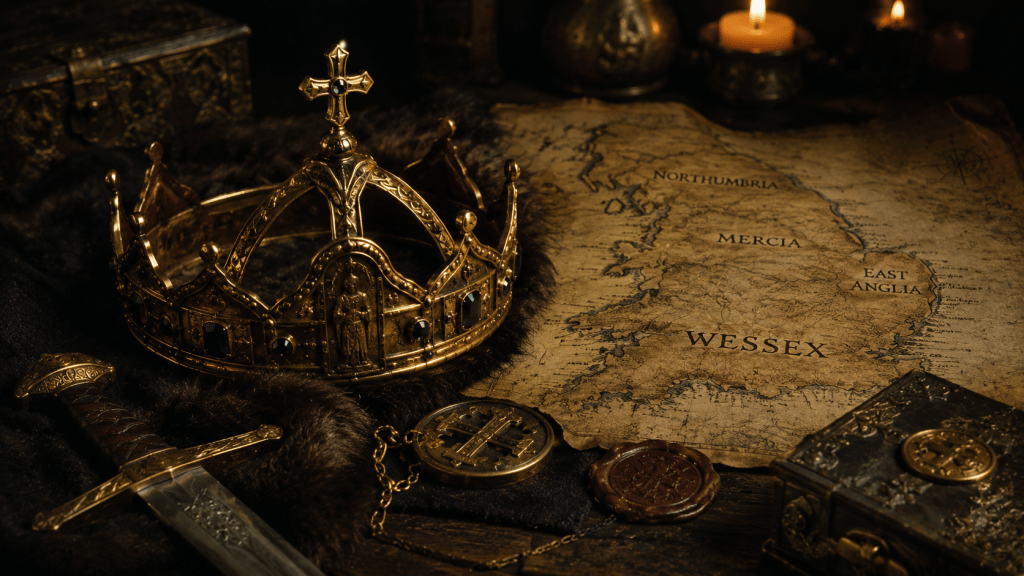

Æthelstan’s crown rests beside the kingdoms brought beneath his authority, symbolising the moment when Wessex, Mercia, East Anglia, and Northumbria began to take the shape of a single England.


Inspiration Behind the Story

Æthelstan’s achievement begins long before he entered York. It begins in the marshes where Alfred preserved Wessex, in the burhs raised across Mercia, and in the roads, rivers, and fortified towns secured by Edward and Æthelflæd. That inheritance gives this Chronicle its power. The taking of York in 927 appears decisive, yet the kingdom gathered beneath Æthelstan’s crown had been shaped through decades of survival, recovery, and patient expansion.

What fascinates me about this moment is how unity emerged from lands that still carried separate memories. Wessex, Mercia, East Anglia, and Northumbria possessed their own loyalties, customs, rulers, and experiences of war. Æthelstan could claim authority across them, though a crown alone could never erase those differences. England had to be created through law, assemblies, oaths, protection, and the belief that one king could hold together what earlier generations had known as separate realms.

For storytelling, this creates a stronger ending than simple conquest. Æthelstan’s victory at York completed one journey while beginning another. The walls could be entered, oaths could be sworn, and rival kings could submit, yet the deeper work of turning conquest into belonging still waited beyond the ceremony.

This Chronicle matters because it reveals that nations rarely appear fully formed. They gather slowly, through inherited struggles, fragile loyalties, and the moment when scattered histories begin to recognise a shared future.


From the Author’s Desk

What stayed with me while writing this Chronicle was the distance between conquering a kingdom and persuading its people that the kingdom truly existed. Æthelstan could enter York, receive oaths, summon rulers to his court, and place his name upon charters stretching across lands his ancestors had once known as separate realms. Even so, those actions marked the beginning of unity as much as its completion.

That tension made him especially interesting to write about. Alfred’s struggle carries the drama of survival, Æthelflæd and Edward possess the momentum of reconquest, while Æthelstan inherited the harder task of gathering those victories into something that could endure. He ruled people shaped by West Saxon, Mercian, Northumbrian, and Scandinavian traditions, each carrying memories that a royal title could never erase. His achievement rested upon convincing those communities that one crown could offer law, protection, and order across old boundaries.

I also found myself thinking about how easily history remembers the visible moment and overlooks the years that made it possible. The capture of York in 927 created a clear landmark, though the road towards it passed through marshes, fortified towns, disputed successions, family alliances, and generations of people whose names have faded from the record. Æthelstan stood at the end of that long movement, carrying the labour of Alfred, Æthelflæd, Edward, and countless others into a new political age.

Reaching the final Chronicle of this series has made that accumulation feel especially clear. The England that emerged beneath Æthelstan’s rule came from kingdoms that once possessed their own courts, ambitions, rivalries, and futures. Across these ten Chronicles, those separate worlds have gradually drawn closer through war, survival, alliance, and necessity.

The crown may belong to Æthelstan in this final chapter, though the kingdom beneath it was built by generations.

You can explore my books here:
Books by Simon Phillips

You can watch my YouTube channel here:
Author Simon Phillips


Historical Notes & Context

Additional Historical Notes

Æthelstan’s succession after Edward’s death in 924 appears to have exposed a division between Mercian and West Saxon support. Mercian leaders accepted Æthelstan quickly, while his half-brother Ælfweard may have held stronger backing within Wessex before dying only weeks after their father. Æthelstan’s coronation followed at Kingston upon Thames on 4 September 925, close to the old boundary between Wessex and Mercia. The setting carried political meaning for a ruler whose authority depended upon joining both traditions beneath his crown.

The conquest of York in 927 transformed the scale of Æthelstan’s kingship. York had remained the centre of the last Scandinavian kingdom within England, and its fall brought the territory south of the northern frontier under one ruler for the first time. Soon afterwards, Constantine of Alba, Owain of Strathclyde, and other northern rulers met Æthelstan at Eamont Bridge. Their promises recognised his supremacy, though they represented negotiated overlordship and immediate political settlement more than direct English government over their kingdoms.

Æthelstan’s charters and coinage reveal how deliberately his court expressed this enlarged authority. He appeared as rex Anglorum, king of the English, and also as rex totius Britanniae, king of the whole of Britain. Such titles proclaimed a reach extending beyond the territory he governed directly, presenting him as the leading ruler among the kings of the island. Surviving grants also show large assemblies where bishops, ealdormen, abbots, Welsh rulers, and other leading figures witnessed royal decisions together.

His law codes reveal a kingdom facing practical difficulties beneath its new unity. Theft, the concealment of offenders, oath-breaking, poor enforcement, and the responsibilities of local communities received repeated attention. Some penalties were severe, then adjusted when their consequences appeared excessive. The laws also strengthened collective responsibility through sworn groups and local officials, showing how royal peace depended upon communities enforcing authority far beyond the king’s immediate presence.


Related Events

Æthelstan’s authority reached far into continental Europe through the marriages of his half-sisters and the presence of exiled princes at his court. These relationships connected England to ruling houses across Francia and the German lands, strengthening the king’s reputation as a Christian monarch whose influence extended beyond Britain. His court also became known for manuscripts, relics, religious patronage, and learned visitors, linking political power with sacred kingship.

The campaign of 934 carried Æthelstan’s army and fleet into Scotland after relations with Constantine deteriorated. The surviving record offers limited detail about fighting, though the scale of the mobilisation demonstrated the king’s ability to draw forces from across England. The campaign failed to create a permanent northern settlement, and the coalition that formed three years later revealed how strongly neighbouring rulers resisted Æthelstan’s expanding supremacy.

At Brunanburh in 937, Æthelstan and his brother Edmund defeated an alliance led by Olaf Guthfrithson of Dublin, Constantine of Alba, and Owain of Strathclyde. The battle’s location remains uncertain, despite several proposed sites. Its significance survives more clearly than its geography: the victory prevented the coalition from breaking Æthelstan’s kingdom and inspired the great Old English battle poem preserved in the Anglo-Saxon Chronicle.

Æthelstan died at Gloucester on 27 October 939 and was buried at Malmesbury, a religious house he had strongly supported. Scandinavian rule soon returned to York, showing that the unity achieved during his reign still required defence. His successors spent years recovering the north, yet they pursued that recovery within the political framework Æthelstan had established: York had become part of the English kingdom, even when control of it temporarily slipped away.


Further Reading

Æthelstan: The First King of England — Sarah Foot

The Making of England: A New History of the Anglo-Saxon World — Mark Atherton

The Battle of Brunanburh: A Casebook — Michael Livingston, editor

The Anglo-Saxon World — Nicholas J. Higham and Martin J. Ryan


England did not emerge in a single victory. It gathered slowly through marshes, walls, roads, oaths, and generations who carried an unfinished kingdom towards one crown.
The Forgotten Chronicle: Edward the Elder and the Reconquest

How Alfred’s son carried the Anglo-Saxon recovery into the Danelaw and prepared the ground for England


The Rider from Tamworth

Morning mist lay across the River Welland, gathering among the reeds and whitening the raw earth where Edward’s men had driven a new line of stakes into the southern bank. Across the water, Stamford rose behind its older defences, a Danish borough whose people had watched the West Saxon army arrive, secure the crossing, and turn captured ground into something intended to endure. Axes struck oak, baskets of soil passed from hand to hand, and the breath of men and horses mingled above the unfinished rampart as the king’s frontier took shape beneath a pale summer sky.

“Pack the earth close against the timber, or the river will find every hollow before an enemy reaches us,” the foreman said as he pressed one mud-darkened heel into the bank. A young spearman rested upon his shovel and glanced towards the roofs beyond the water. “If Stamford has yielded, why are we raising a second wall when the first already stands?” he asked as he wiped rain from his cheek. The foreman drew his thumb along the sharpened edge of a stake before answering. “A town may yield for a day, lad, while a strong wall reminds every man what tomorrow will cost.”

Edward stood above them, his cloak drawn close against the wet breeze as he studied the ford, the bridge, and the road leading through the fields. He had learned the value of such places from Alfred, whose burhs had preserved Wessex when open battle could have destroyed it, and he had carried that lesson into enemy country. Every ditch guarded a crossing, every garrison secured a road, and every new enclosure allowed an army to move farther while leaving strength behind. Stamford had become a fresh fastening in a chain stretching through lands once held by Danish armies.

A lone rider came into view before the gate watch called out, his horse dark with sweat and river mud as it struggled across the broken ground. “A Mercian messenger has come from Tamworth, lord king,” one of Edward’s household warriors said as he descended the rampart. Edward turned from the river as the rider dismounted and crossed the yard. “Bring him forward, then see that his horse is watered and rubbed down,” he replied, resting one hand upon his sword belt. The messenger bowed with the weary care of a man who had ridden through much of the night before drawing breath. “My lord king, the Lady of the Mercians died at Tamworth, and news of your sister’s death is already travelling through Mercia,” he said, holding Edward’s gaze as grief tightened his face.

For a moment, the labour around the new burh seemed to recede behind the rush of the Welland. Æthelflæd had been more than Edward’s sister, for she had ruled Mercia, raised fortresses, recovered towns, and pressed the war forward beside him. Her death opened a space across the Midlands while their combined campaigns were breaking Viking power. Her daughter Ælfwynn remained within the Mercian succession, while loyalties shaped in Tamworth and Gloucester could never be treated as possessions passing quietly between rulers.

Edward looked towards Stamford’s roofs, where submission had been secured through patience and the promise of overwhelming strength. “Have fresh horses made ready, and summon every man who can ride before sunset,” he said as he stepped towards the hall where his commanders waited. “We go to Tamworth, and these works will continue until this crossing can hold against any army that approaches it.”

The axes beside the river resumed their steady labour as preparations spread through the camp, carrying Edward from one hard-won frontier towards the uncertain heart of Mercia. Behind him stood a burh of wet earth and newly cut timber, one strongpoint among many, yet the kingdom emerging from those walls would reach far beyond Stamford. Alfred had built so Wessex could survive; Edward was preparing to discover how far that inheritance could advance.


A Visual Chronicle

Edward inherited Alfred’s walls, turned them into weapons of reconquest, and then faced the decision that could reshape the future of England.


Timeline of Events

899 AD – Edward succeeds Alfred as king, inheriting a strengthened Wessex and an unfinished struggle against Viking power.

910 AD – A combined West Saxon and Mercian army defeats a Northumbrian Viking force at Tettenhall, weakening the northern armies that had threatened the Midlands.

912–916 AD – Edward establishes burhs at Hertford, Witham, Buckingham, Bedford and Maldon, securing rivers and roads as his frontier advances into Danish-held territory.

917 AD – Coordinated campaigns led by Edward and Æthelflæd break Danish power across East Anglia and much of the southern Danelaw as strongholds fall or submit.

918 AD – Æthelflæd dies at Tamworth, after which Edward takes control of Mercia and receives the submission of further Danish-held towns, including Stamford and Nottingham.

920 AD – Edward builds a burh near Bakewell, where the Anglo-Saxon Chronicle records northern rulers recognising him as father and lord, signalling the widening reach of his authority.

924 AD – Edward dies at Farndon in Mercia, leaving Æthelstan to inherit the reconquest and carry it towards the creation of a single English kingdom.


About the Creator

This Chronicle is written by Simon Phillips, author of several historical and speculative fiction works exploring forgotten worlds, myth, and the turning points of history.

You can explore his books here:
Books by Simon Phillips

You can watch his YouTube channel here:
Author Simon Phillips


Continuing the Chronicle

The account that follows moves back through the campaigns that carried Edward’s authority beyond Wessex and into the Danelaw, where fortified towns, secured roads, river crossings, and coordinated armies transformed Alfred’s defensive inheritance into a sustained reconquest. It follows the fall of Viking strongholds, the partnership between Edward and Æthelflæd, and the difficult absorption of Mercia after her death, as separate victories began to shape a kingdom wider than either ruler had inherited.

Readers supporting The Forgotten Chronicle may continue into the full record below.


The War of Roads and Walls

Before the southern wall at Stamford rose above the Welland, and before the rider from Tamworth carried grief into Edward’s camp, the reconquest had begun with a disputed crown and a kingdom still shadowed by Alfred’s achievement. When Alfred died in 899, Edward inherited fortified towns, trained armies, and the allegiance of men who had survived the worst years of the Viking war. He also inherited a royal house whose older branches retained their own claims, while Danish rulers remained powerful across East Anglia, eastern Mercia, and Northumbria.

News soon reached Edward that his cousin Æthelwold had seized the royal estates at Wimborne and Christchurch. “He has chosen his ground carefully, lord,” an ealdorman said as he set a wooden tally beside the king’s cup. “Wimborne holds his father’s grave, and every man who enters that hall will understand the claim he is making.” Edward ran one thumb along the tally before returning it to the table. “Then we answer the claim in daylight, where every oath may be heard,” he replied as men gathered their cloaks and prepared to ride.

Æthelwold escaped before Edward could close around him, travelling north into territory governed by Danish armies, where men hostile to Wessex accepted him as king. His return brought war across East Anglia, Mercia, and the northern borders of Wessex. The struggle ended at the Holme in 902, where the Danish army held the field after savage fighting, yet Æthelwold lay among the dead. Edward’s crown had survived its first challenge, though the cost revealed how easily an English claimant could turn Viking power against an English king.

For several years an uneasy peace followed, until a Northumbrian Viking army raided deep into Mercia and began its journey home in 910. A combined West Saxon and Mercian force intercepted it near Tettenhall, where marshy ground and broken routes of retreat turned the encounter into a disaster for the raiders. Several Viking kings and leaders fell during the fighting, and the northern armies lost much of their ability to strike south with the same confidence. The victory opened space for a different kind of war, one measured through timber, earth, guarded bridges, and the patient occupation of routes which had once carried raiders inland.

Edward used that hard-won breathing space with the discipline of an experienced builder. At Hertford his men enclosed both sides of the River Lea, while Witham secured a road through Essex and Buckingham guarded a crossing of the Great Ouse. Bedford, Maldon, Towcester, and other strongpoints followed as each new burh protected settlers, housed a garrison, and allowed the next army to advance beyond the last secure wall. These places grew from Alfred’s defensive system, yet their purpose had changed, since Edward planted them ahead of settled West Saxon power and made the frontier move with him.

“The river gives us three approaches and an enemy will search for the weakest,” a surveyor said as he pushed a willow rod into the wet bank at Hertford. Edward stepped across the marked line and looked towards the higher ground beyond the water. “Then place the gate where our men can reach every approach before the alarm has crossed the town,” he answered as labourers waited beside their spades. The surveyor shifted the rod uphill and called the ditch gangs forward, turning a king’s instruction into another day of mud, timber, and aching hands.

North of Edward’s advancing line, Æthelflæd carried the same method through Mercia after her husband Æthelred died in 911. She fortified Tamworth, Stafford, Warwick, Chirbury, Runcorn, and other exposed places, creating a Mercian network joined to Edward’s campaigns while remaining rooted in Mercian loyalties. Their partnership joined two armies and two political traditions, and its strength came from coordination more than submission. Edward pressed through the east and south as Æthelflæd closed roads from the west, leaving Danish strongholds facing pressure from directions their rulers had once treated as separate kingdoms.

During a meeting before the campaigning season, a map of roads and rivers lay between brother and sister beneath the wavering light of tallow lamps. “If Derby is allowed to draw men from Leicester, the road into northern Mercia stays open,” Æthelflæd said as she rested two fingers beside the crossing. Edward moved a carved marker towards the Ouse and studied the distance between their armies. “Then I shall keep Bedford and Northampton looking east while you close upon Derby,” he replied as a clerk bent over the wax tablet. Æthelflæd lifted her gaze from the map as the lamp flame trembled between them. “Keep them looking towards you long enough, brother, and they may realise too late where the wall has closed.”

The year 917 brought the method to its fiercest test. Danish forces attacked Towcester and other defended places, seeking to break the new chain before it hardened, while garrisons held until help arrived from nearby burhs. Edward’s armies struck Tempsford and Colchester, repaired captured defences, and received the submission of East Anglia and Cambridge. Æthelflæd’s Mercians entered Derby after bitter fighting that killed four of the thegns dearest to her, then gained Leicester through submission during the following year. Each fall loosened the next alliance, since a Danish town facing a fortified enemy on every road could expect less aid from neighbours already fighting for their own survival.

By the summer of 918, Edward had reached Stamford and ordered a second borough raised on the southern bank of the Welland. The town’s northern population accepted his lordship while men worked upon the new defences, bringing another of the Five Boroughs beneath Anglo-Saxon power. Then the messenger arrived from Tamworth with word that Æthelflæd had died, and the partnership that had driven the reconquest forward ended within sight of its greatest success.

Edward rode into Mercia while grief and uncertainty moved through its halls. Æthelflæd’s daughter Ælfwynn possessed a claim to succeed her mother, and Mercian leaders had long memories of their kingdom’s former independence. “The lady’s oaths were given to Mercia as well as to her kin,” a Mercian thegn said as Edward’s household gathered at Tamworth. Edward removed his riding gloves and placed them beside the hall fire. “Her towns will keep their laws, their markets, and their protection,” he replied as rain ran from the hem of his cloak. “The army beyond those walls will judge us by whether those protections endure.”

The settlement carried a harder truth beneath such assurances. Edward received the allegiance of Mercian communities, secured Nottingham, and placed English and Danish inhabitants together inside its repaired defences. Later that year, Ælfwynn was deprived of authority and taken into Wessex, ending the separate Mercian rulership her mother had preserved. What had begun as a partnership between Wessex and Mercia became direct kingship, and the reconquest drew lands of differing custom, memory, and loyalty beneath a single royal centre.

Edward continued north-west, repairing Thelwall and Manchester before strengthening Nottingham’s southern bank and building near Bakewell. The Anglo-Saxon Chronicle later described Scottish, Northumbrian, and Strathclyde rulers choosing him as father and lord, language that proclaimed enormous prestige while falling short of direct government over their peoples. These recognitions were alliances, submissions, and promises shaped by immediate danger, yet they showed how far the political horizon had widened. A king who had begun his reign defending a disputed succession could now summon rulers far beyond Wessex into negotiation around his power.

When Edward died at Farndon in 924, he left a realm broader and more tightly governed than the one Alfred had entrusted to him. His victories had rarely rested upon a single celebrated battlefield, for they had grown through guarded rivers, repaired towns, disciplined garrisons, negotiated oaths, and walls raised close enough to support the next advance. Mercia’s separate court had vanished, East Anglia had submitted, and Danish authority south of the Humber had been broken into communities increasingly tied to Edward’s rule.

The kingdom was still unfinished, and York remained beyond the lasting reach of the West Saxon house. Edward’s son Æthelstan would inherit that final northern challenge, together with every tension created by conquest and consolidation. Alfred had preserved the ground from which recovery became possible, while Æthelflæd and Edward carried that recovery through the Midlands until the old borders could hold it no longer. England had yet to receive its single crown, though the roads leading towards it now passed through Edward’s gates.


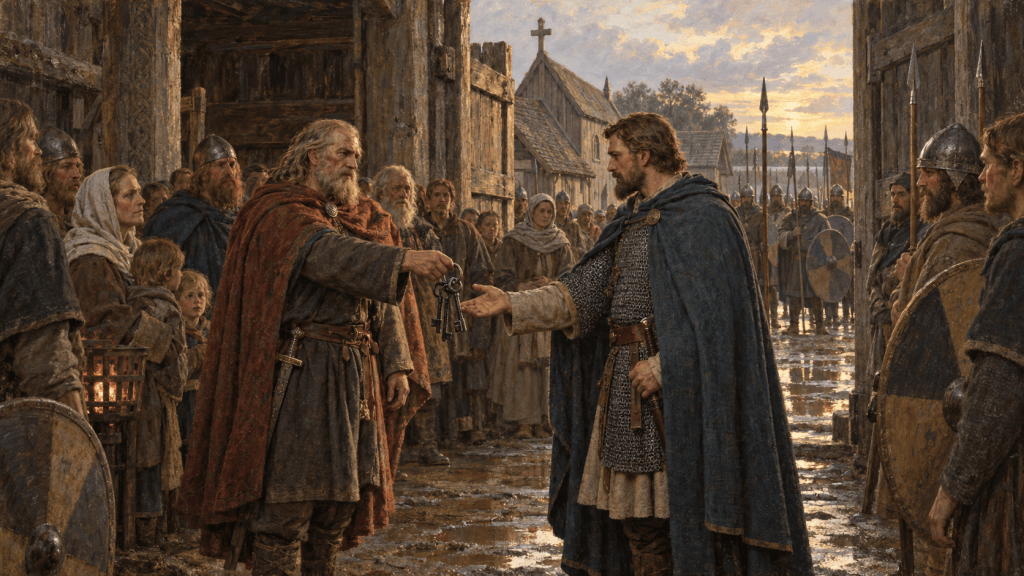
The gates of a Danelaw borough were surrendered to Edward the Elder, as fortified campaigns and steady pressure carried Anglo-Saxon authority deeper into Viking-held territory.


Inspiration Behind the Story

Edward’s reconquest draws much of its power from the absence of one decisive moment. His victories gathered through fortified towns, guarded crossings, reopened roads, patient alliances, and armies able to advance while leaving strength behind them. Alfred’s defences had preserved Wessex during its greatest danger; Edward took the same principles and turned them outwards, carrying survival into conquest.

What fascinates me about this period is how visibly power altered the landscape. A burh raised beside a river could secure an entire district. A garrison placed along an old road could allow merchants, messengers, and soldiers to move through land once exposed to attack. Each strongpoint became more than a wall, for it changed which ruler could offer protection and whose authority local communities were prepared to accept.

For storytelling, this creates a quieter form of momentum. Edward lived beneath Alfred’s formidable legacy and worked beside Æthelflæd’s Mercian achievements, yet his reign became more than a continuation of theirs. Her death brought grief, uncertainty, and political opportunity together, forcing him to hold Mercia while the wider reconquest remained unfinished.

This Chronicle matters because it reveals that England emerged through accumulation. The kingdom took shape through walls, roads, oaths, submissions, and repeated campaigns, until separate victories began to resemble a single design.


From the Author’s Desk

While writing this Chronicle, I kept returning to the strange position Edward occupies within the story of England. Alfred towers behind him, Æthelflæd stands beside him, and Æthelstan waits ahead as the king who would complete the conquest. Edward can seem caught between those more familiar names, even though the political landscape inherited by his son had been transformed during his reign.

That position made him especially interesting to write about. Edward inherited a system built for survival and discovered how to use it for expansion. He seems to have understood that lasting conquest depended upon more than winning a battlefield. Territory had to be held, roads guarded, rivers controlled, towns defended, and local loyalties drawn towards a ruler capable of protecting them.

I also found myself thinking about the personal weight carried through these campaigns. Edward worked alongside Æthelflæd as ruler, ally, and brother, while their separate armies pressed against Viking power from different directions. Her death in 918 brought grief into a moment of opportunity and uncertainty. Mercia had followed her leadership, and Edward now faced the delicate task of absorbing her kingdom while continuing the struggle they had shared.

Historical memory often gathers around the ruler who begins a great work or the one who completes it. Edward belonged to the more easily overlooked space between those two moments. Yet England could scarcely have emerged in the form it did without the roads he secured, the burhs he raised, and the territories he brought beneath his authority. His reign reminds me that some of history’s most important figures are found in the difficult middle, carrying an inheritance forward until an unfinished ambition becomes a political reality.

You can explore my books here:
Books by Simon Phillips

You can watch my YouTube channel here:
Author Simon Phillips


Historical Notes & Context

Additional Historical Notes

Edward inherited a realm strengthened by Alfred’s reforms, yet his succession in 899 remained vulnerable. His cousin Æthelwold, the son of Alfred’s elder brother, claimed the throne and found support among Danish forces in East Anglia. The rebellion ended after Æthelwold was killed at the Battle of the Holme in 902, allowing Edward to secure his kingship before turning towards the wider struggle beyond Wessex.

The principal narrative source for Edward’s reign is the Anglo-Saxon Chronicle, whose surviving versions differ in chronology and emphasis. The West Saxon record presents the expansion of Edward’s authority as a steady series of submissions, while the Mercian Register preserves a stronger sense of Æthelflæd’s independent leadership. These accounts reveal the broad sequence of events, though the political negotiations behind each oath, surrender, and transfer of power remain largely hidden.

Edward’s burhs served as more than defensive refuges. Positioned beside rivers, roads, bridges, and frontier settlements, they allowed garrisons to protect territory while royal armies advanced farther into the Danelaw. Their construction also brought administration, trade, taxation, and military service beneath expanding royal control. The reconquest therefore changed the government of recovered land as deeply as it changed the battlefield. The surviving Chronicle entries record this advance through Hertford, Witham, Buckingham, Bedford, Towcester, Stamford, and other strongpoints.


Related Events

The victory at Tettenhall in 910 weakened the Northumbrian Viking armies that had threatened Mercia and opened greater freedom for Anglo-Saxon expansion. Edward and Æthelflæd then advanced along connected fronts, with West Saxon pressure moving through East Anglia and the southern Danelaw while Mercian forces pushed towards Derby and Leicester. Their campaigns worked through coordination, fortified positions, and the gradual isolation of Danish-held boroughs.

Æthelflæd’s death at Tamworth on 12 June 918 created a difficult question of succession. Her daughter Ælfwynn briefly held authority in Mercia before Edward removed her and brought her into Wessex later that year. A peaceful union would be too simple a description. Edward gained direct control, though Mercian identity, loyalties, and political traditions remained powerful, shaping the succession that followed his death.

An entry generally assigned to 920 records that rulers from Scotland, Strathclyde, Northumbria, and Scandinavian York accepted Edward as “father and lord” near Bakewell. The statement reflected the wide reach of his power, though it should be understood as a claim of overlordship and negotiated recognition rather than permanent conquest. Edward died at Farndon in Mercia in 924, leaving Æthelstan to secure the succession, take York, and carry the unfinished making of England into its decisive final stage.


Further Reading

Edward the Elder, 899–924 – N. J. Higham and David Hill, editors
The Making of England: A New History of the Anglo-Saxon World – Mark Atherton
Æthelstan: The First King of England – Sarah Foot
The Anglo-Saxon World – Nicholas J. Higham and Martin J. Ryan


Next Chronicle

Edward’s death in 924 left the Anglo-Saxon world transformed, though its final shape remained unsettled. West Saxon authority had spread across Mercia, East Anglia, and much of the former Danelaw, while the Viking kingdom of York still guarded the road towards a realm united beneath one crown.

At the centre of the next stage stood Æthelstan, Edward’s son, a prince raised among the Mercians and shaped by the military world created by Alfred, Æthelflæd, and Edward. His succession carried its own uncertainty, yet his ambitions soon reached beyond the lands his father had recovered, drawing him towards York and the last great centre of Scandinavian power in England.

What makes this next Chronicle so important is that Æthelstan’s reign carried the making of England towards its defining moment. When York fell beneath his authority in 927, the old division between the Anglo-Saxon south and the Viking north appeared to close, allowing one king to claim dominion across the lands that would become England.

The next Chronicle moves into the final act of this series, where decades of survival, fortified recovery, and patient reconquest converged beneath Æthelstan’s rule. The kingdom that earlier generations had preserved through marshes, walls, roads, and battlefields was ready to emerge beneath a single English crown.

Next Chronicle: Athelstan and the Birth of England


Alfred had taught Wessex how to survive; Edward carried its strength across roads, rivers, and fortified towns until a divided land stood close enough for Æthelstan to gather beneath one crown.

The Forgotten Chronicle: Æthelflæd: Lady of the Mercians

The daughter of Alfred who helped turn Mercia from a wounded kingdom into a force of recovery against Viking power.


The Daughter of Alfred and the Wounded Kingdom

The morning mist lay low over Tamworth, gathering in pale folds along the river and softening the edges of the timber halls, the church roof, and the watchmen moving along the palisade. Smoke rose slowly from the hearths of the town, grey against a sky still carrying the last colour of dawn, while beyond the walls the fields stretched damp and silent toward the roads that led east, where Viking power still held its grip upon much of the land.

Æthelflæd stood above the gate with her cloak drawn close around her shoulders, watching the world wake beneath her. The men below her moved with practised purpose, loading carts, checking spearheads, leading horses from their stalls. A messenger had ridden through the night, his mount white with foam, bringing word from the frontier. Another crossing had been tested. Another settlement had sent for reassurance. Another road needed guarding before fear could travel faster than soldiers.

Mercia had once been the great power of the Midlands, a kingdom whose name carried weight from the Welsh borderlands to the eastern rivers. Its kings had ruled with confidence, its churches had held learning and wealth, and its armies had stood among the strongest in Britain. Yet greatness could be wounded. Viking armies had broken through old certainties, taken towns, carved settlements into the land, and left Mercia divided between memory and survival. What remained now had to be held with timber, earthworks, oaths, and the steady nerve of those willing to rebuild under pressure.

“My lady,” a reeve said as he climbed the steps behind her, one hand gripping the rail while the other held a folded strip of parchment against his chest, “the riders from the west reached us before sunrise. They say scouts have been seen near the old road, moving in twos and threes, watching the crossings.”

Æthelflæd turned slightly, enough for the man to see that she had heard every word, though her gaze returned at once to the land beyond the gate.

“The crossings will be watched,” she answered, her voice calm as the cold morning air. “Send word to Stafford. The burh is to remain provisioned, and every bridge is to be counted before nightfall. If men are moving through the lanes, I want their path known before they believe themselves unseen.”

The reeve bowed his head, relief passing across his face as though certainty itself had been given to him. “As you command, my lady,” he said, before descending the steps with fresh urgency.

She remained where she was, listening as the order moved through the yard below. A scribe repeated the message. A rider called for his horse. Somewhere near the smithy, a hammer struck iron, sharp and steady, its sound carrying across the morning like a promise being forged.

Æthelflæd knew the weight that rested upon her name. She was Alfred’s daughter, raised in the shadow of a king who had dragged Wessex back from ruin and turned defence into design. She was Edward’s sister, bound by blood to the house that now carried the hopes of the West Saxons. She had been wife to Æthelred, lord of the Mercians, and through years of illness, war, counsel, and governance, she had learned the shape of this wounded realm from within.

Yet Mercia was more than an inheritance passed through marriage or alliance. It was a land of roads and rivers, border towns and old churches, proud nobles and anxious villages, each one looking toward Tamworth for strength. The people here remembered former greatness, though memory alone could guard no gate. If Mercia was to endure, it needed more than remembrance. It needed walls raised in the right places, armies sent at the right hour, and a ruler whose authority could settle fear before fear became collapse.

Below her, the gates opened, and the first riders passed out into the mist.

Æthelflæd watched them go, her face still, her thoughts already travelling beyond the river and the road. The struggle that had shaped her father’s life had entered a new generation. Wessex had survived. Mercia now had to rise.


A Visual Chronicle

Æthelflæd inherited a wounded Mercia, rebuilt its defences, and carried the fight back into Viking-held lands on the road towards England.


Timeline of Events

c. 879 AD – Æthelflæd, daughter of Alfred of Wessex, is married to Æthelred, Lord of the Mercians, strengthening the alliance between Wessex and Mercia.

886 AD – Alfred takes control of London and entrusts the city to Æthelred, placing Mercia at the centre of renewed Anglo-Saxon defence.

911 AD – Æthelred dies, and Æthelflæd becomes Lady of the Mercians, ruling Mercia in her own authority.

913–914 AD – Æthelflæd strengthens Mercia through a chain of fortified burhs, including Tamworth, Stafford, Eddisbury, Warwick, and Chirbury.

917–918 AD – Æthelflæd leads Mercian recovery against Viking power, taking Derby and receiving the submission of Leicester before her death at Tamworth in 918.


A Visual Chronicle

Watch a short visual telling of the Lindisfarne raid.

[Embedded Video]


About the Creator

This Chronicle is written by Simon Phillips, author of several historical and speculative fiction works exploring forgotten worlds, myth, and the turning points of history.

You can explore his books here:
Books by Simon Phillips

You can watch his YouTube channel here:
Author Simon Phillips


Continuing the Chronicle

The account that follows moves deeper into the wounded heart of Mercia, where Æthelflæd stepped from the shadow of Alfred’s world into authority of her own, and where the defence of fortified towns, river roads, borderlands, and old Mercian memory helped turn survival into advance against Viking power.

Readers supporting The Forgotten Chronicle may continue into the full record below.

Subscribe to continue reading

Subscribe to get access to the rest of this post and other subscriber-only content.

The Forgotten Chronicle: The Kingdoms Before England

Before one crown claimed the name of England, the island was divided between rival kingdoms, fading powers, borderlands, and peoples who had no reason to imagine unity would ever come.


Before There Was England

The rain had passed before dawn, leaving the fields silvered beneath a low sky and the tracks between the settlements dark with water. Across the island, smoke lifted from timber halls, monastery kitchens, cattle folds, and watch posts set above river mouths, each thin column rising from a place that knew its own lord, its own laws, its own enemies, and its own memory of power. A traveller moving through Britain in the middle years of the eighth century would have found no single England waiting for him, no shared crown, no settled name that held the land together from sea to sea. He would have crossed borders marked by rivers, ridges, woodland, old Roman roads, and the reach of armed men. In one valley he might hear the speech of Mercia, in another the prayers of Northumbria, further south the commands of Wessex, and along the eastern fields the quieter strength of East Anglia. Beyond them lay peoples with their own histories and claims: Britons in the west, Picts beyond the northern lands, Welsh kingdoms watching the Saxon advance from older ground, and communities whose loyalties shifted with marriage, tribute, hunger, and war.

Power in that age rarely stood still. It moved with armies in the campaigning season, with hostages led from one court to another, with tribute paid in silver, cattle, weapons, and submission. Kings were anointed by Churchmen and tested by warriors; their names were praised in charters, carved into memory, then challenged by brothers, cousins, rivals, and neighbours before the ink had fully dried. Northumbria, once a kingdom of learning and saints, looked outward across the northern sea and inward upon its own divisions. Mercia, heavy with ambition and strength, pressed its authority across the middle lands like a great shadow stretching over smaller courts. East Anglia watched the coast and the rivers, its wealth tied to fields, trade, and sacred kingship. Wessex, still only one power among several, looked westward and southward, shaped by old frontiers and restless opportunity. Each kingdom carried pride enough to imagine itself favoured. None could yet see the shape of the future moving through the mist.

The monasteries kept their bells, their books, and their delicate records of land and souls. The halls kept their feasts, their oaths, and their knives close at hand. On market days, traders came with salt, cloth, horses, amber, iron, and stories from roads that crossed more borders than any king could hold for long. Some spoke of raids in distant seas, of ships seen where no fleet had been expected, of strangers who moved swiftly along coast and river. Such rumours belonged, for now, to the edge of the world, while the rulers of Britain looked first to one another, measuring weakness across familiar frontiers. The island was already full of struggle before the Northmen came. England had yet to be born, and across the divided kingdoms of the Anglo-Saxons, no one heard its first breath.


A Visual Chronicle

A visual companion to The Kingdoms Before England. Follow a lone traveller across the wet roads, guarded ridges and rival kingdoms of an island that had not yet learned to call itself England.


Timeline of Events

731 AD – Bede completes The Ecclesiastical History of the English People, preserving one of the clearest early accounts of the Anglo-Saxon kingdoms and their Christian past.

757 AD – Offa becomes king of Mercia, beginning a reign that will make Mercia the dominant power across much of southern and central Britain.

793 AD – Viking raiders strike Lindisfarne, marking the beginning of a new age of coastal fear and foreign attack.

825 AD – Wessex defeats Mercia at the Battle of Ellendun, weakening Mercian dominance and shifting power toward the south-west.

865 AD – The Great Heathen Army lands in East Anglia, turning Viking raids into a struggle for kingdoms, territory, and survival.


About the Creator

This Chronicle is written by Simon Phillips, author of several historical and speculative fiction works exploring forgotten worlds, myth, and the turning points of history.

You can explore his books here::
Books by Simon Phillips

You can watch his YouTube channel here:
Author Simon Phillips


Continuing the Chronicle

The account that follows moves from the divided landscape of Britain into the rival kingdoms that shaped it, where Mercia, Northumbria, East Anglia, and Wessex each carried their own ambitions before the pressure of invasion forced the island toward a future none of them could yet see.

Readers supporting The Forgotten Chronicle may continue into the full record below.


The Chronicle: The Divided Island

The road between kingdoms was never only a road. It was a line of risk drawn through wet woodland, open pasture, river ford, and broken stretches of old Roman stone, where a traveller might begin the morning beneath one king’s protection and reach dusk beneath another’s suspicion. The land changed slowly beneath the feet, with cattle grazing behind wattle fences, smoke rising from timber halls, and church bells carrying across fields still silvered by rain, yet power changed more sharply than the landscape itself. A ridge, a river, a marsh road, or the outer reach of a lord’s armed household could mark the place where one claim thinned and another began. There was no England waiting behind these borders, no single crown looking out across the island with settled command. There were kingdoms, proud and wounded, each convinced of its own place beneath God, each guarding memory, land, and honour with the same care it guarded cattle and gold.

In Northumbria, the sea wind moved across monasteries and halls that had once made the kingdom famous far beyond its frontiers. Its churches and holy houses kept books, relics, and the memory of men whose names travelled through the Christian world with reverence. The learning of Bede, the sanctity of Cuthbert, and the wealth of monastic communities gave the north a spiritual authority few kingdoms could ignore. Yet beneath that sacred reputation lay a harsher world of rival bloodlines, broken reigns, and kings whose crowns sat uneasily upon their heads. A ruler could be lifted by noble support, blessed by the Church, then cast aside by the same forces that had raised him. The kingdom that had given Britain some of its clearest Christian memory also carried deep political fractures, and those fractures weakened the walls long before foreign sails darkened the horizon.

Mercia, by contrast, stood in the middle lands with the confidence of a great weight pressing outward. Its rulers understood the power of roads, river routes, tribute, marriage, and intimidation. Under kings such as Offa, Mercian authority reached across the island’s heart, drawing smaller kingdoms and border rulers into its shadow. Gifts became obligations. Alliances became restraints. A king who accepted Mercian favour might find that favour costly, while those who resisted learned how quickly diplomacy could harden into force. The great earthwork along the western frontier showed more than defence against Welsh powers. It marked ambition written into the soil, a statement that Mercia saw itself as a kingdom with reach enough to shape the lives of others.

Yet the strength of Mercia required constant renewal. Authority had to be ridden into the shires, spoken in councils, enforced through oaths, and remembered by men who might prefer forgetfulness once the king’s horse had gone from sight. The halls of dependent rulers were places of courtesy and calculation, where every gift had a second meaning and every feast could become a test of loyalty. The Church added solemnity to rule, blessing kingship and preserving documents that turned land into lawful possession, though holy houses also held their own influence and guarded their own privileges. To rule widely in such an age was to remain in motion, forever watching the men who smiled, bowed, and waited.

East Anglia lay lower and more open, rich in fields, rivers, and routes that ran toward the sea. Its strength was quieter than Mercia’s, though no less real to those who lived under its kings. The kingdom held its own sacred dignity, its own royal line, and its own place within the web of Anglo-Saxon power. Its coasts and waterways brought trade, news, and contact with a wider world, filling markets with goods and stories carried from distant shores. In peaceful years, such openness gave East Anglia life. In darker years, the same openings would invite catastrophe. Long before the great armies came, East Anglia lived with the double nature of the sea, a road of wealth and a door through which armed strangers could enter.

To the south and west, Wessex remained a kingdom with promise, though no certainty. Later memory would make it appear almost destined, the surviving root from which England would grow, yet no one in the middle years of the eighth century could have known such a thing. Wessex looked toward old British lands, toward southern seas, toward rival kings, and toward its own unsettled opportunities. Its rulers carried ambition, though ambition alone could never guarantee survival. Like every kingdom of the island, it relied upon harvests, warriors, marriages, judgments, oaths, and the fragile confidence that men would still answer when summoned. Wessex would one day stand where others broke, yet before that day arrived it was only one power among several, watched by neighbours and tested by time.

Around and beyond these Anglo-Saxon kingdoms lived peoples whose presence belonged to the island as deeply as any Saxon hall or monastery. Welsh kingdoms guarded the west with memories older than English speech. Cornish lands held their identity against slow pressure from the east. North of the Anglo-Saxon world, Pictish power remained distinct and formidable, shaped by kings, symbols, and traditions that refused easy absorption into any southern vision. These were no empty margins around an English centre. They were living realms, with their own saints, rulers, warriors, and claims. Britain before England was a crowded island of many stories, and the future would be formed as much by what resisted unity as by what moved toward it.

Across all these lands, the Church kept records while the warrior halls kept score. A monastery might hold a charter proving a royal gift, a gospel book adorned with patient beauty, and the bones of a saint believed to guard the surrounding people. Nearby, a hall might ring with boasting, argument, and the clatter of cups as men pledged loyalty to a lord whose strength had to be visible in generosity as much as victory. Faith and power stood close together. Kings needed blessing. Bishops needed protection. Monasteries needed land. Warriors needed reward. The sacred and the political were woven through the same fields, and few men of power could pull at one thread without stirring the other.

Then the sea began to speak in a new voice. At first the warnings arrived as stories from the edge: a holy place struck, a ship seen where no friendly vessel belonged, men from the northern waters moving with terrible speed. The attack on Lindisfarne entered Christian memory as a wound, a desecration that seemed to shake the order of the world. Yet for rulers inland, danger still wore familiar faces. A rival king gathering men near a border felt more immediate than a raiding crew vanishing back across the waves. Tribute disputes, royal successions, and old hostilities continued to demand attention. The kingdoms mourned, prayed, watched the coasts, and then returned to the struggles already before them.

That was the danger hidden within division. Each kingdom knew its own enemies too well. Mercia measured Wessex, Wessex measured Mercia, Northumbria wrestled with its own instability, and East Anglia guarded its place between stronger ambitions. The island possessed shared faith, related speech, learned traditions, and memories that crossed borders, yet those bonds were too fragile to overcome the habits of rivalry. No council of kings gathered with the power to bind all into one defence. No common army stood ready for threats that fell first upon one shore, then another. Britain’s kingdoms were skilled at surviving one another. They were far less prepared for a pressure that would make their old quarrels seem dangerously small.

The making of England would begin from that fracture. It would not emerge from peaceful agreement or a vision calmly shared among kings. It would come through the breaking of old powers, through the fall of cities, through exile in marshes, through fortified towns, hard laws, royal marriages, campaigns of recovery, and the slow understanding that survival demanded forms of unity earlier generations had barely imagined. The island before England was not empty, nor waiting, nor simple. It was alive with rival centres of authority, each one bright in its own firelight, each one certain enough of itself to resist being swallowed by another.

Before one crown could claim England, the island had to learn the cost of remaining divided. Its kingdoms stood beneath the same unsettled sky, listening to their own bells, sharpening their own blades, guarding their own borders, and watching their neighbours with suspicion. Beyond the sea, other men had begun to learn the shape of its coasts and rivers. Within the island, kings still looked first across land. History had already begun to draw the roads together, though no ruler yet saw the pattern clearly. The future was moving toward them through rain, smoke, prayer, and salt wind, carrying the first hard lessons of a country not yet born.


Britain before England: a divided island of rival kingdoms, borderlands, sacred centres, and shifting powers, long before one crown could claim the whole.


Inspiration Behind the Story

The beginning of this second series carries a quieter kind of drama than the Viking raids that came before it. There is no single burning monastery, no battlefield, no sudden moment when history turns visibly beneath the feet of those who stand within it. Instead, this Chronicle begins with division itself, with an island of rival kingdoms, borderlands, sacred centres, and competing memories that had not yet been drawn into the idea of England.

What makes this moment fascinating is the absence of inevitability. From the distance of the present, it is easy to look backwards and imagine England waiting to be formed, as though the later kingdom already existed in outline. The reality was far less certain. Northumbria, Mercia, East Anglia, Wessex, and the neighbouring non-Saxon powers each occupied their own world of ambition and fear. Unity was not the natural condition of the island. It had to be forced into being through pressure, collapse, survival, and adaptation.

For storytelling, this gives the period its power. The drama lies in watching a future nation emerge from people who were not trying to create one. They were defending borders, making alliances, preserving dynasties, guarding churches, answering raids, and surviving one crisis after another. History moves here through competing lives and local loyalties, long before anyone can see the larger shape forming.

This Chronicle matters because it restores uncertainty to the story. England was not born from certainty. It began in fracture.


From the Author’s Desk

This Chronicle begins the second movement of The Forgotten Chronicle, and in many ways it felt important to start before the familiar names became inevitable. Alfred, Æthelflæd, Edward, and Athelstan all belong to the later shape of the story, yet their world was built upon older divisions, older ambitions, and kingdoms that had no reason to imagine they were stepping toward unity.

While writing this piece, I found myself drawn to the tension between what we know now and what they could see then. To us, England appears as the destination. To them, the future was far more uncertain. Mercia could still seem dominant, Northumbria still carried sacred memory, East Anglia held its own dignity, and Wessex had not yet become the centre of survival. That uncertainty gives the period its strength.

There is something powerful in beginning with a divided map. Every border carried human consequence. Every alliance, feud, marriage, raid, and succession dispute shaped what came next. The making of England was never simply a political result. It was a long human process, formed through fear, loss, ambition, endurance, and the gradual narrowing of possibility.

This series will follow that movement from fragmentation toward crown, though the heart of it remains the same as always: history experienced as lived pressure, not distant summary.

You can explore my books here:
Books by Simon Phillips

You can watch my YouTube channel here:
Author Simon Phillips


Historical Notes & Context

Additional Historical Notes

The Anglo-Saxon kingdoms of early medieval Britain were separate political worlds, each shaped by its own royal line, local elites, military traditions, religious centres, and regional identity. The later idea of England can make this period appear as though unity was always waiting to happen, yet the eighth and ninth centuries were defined by competition between rival powers. Northumbria, Mercia, East Anglia, Kent, Sussex, Essex, and Wessex each occupied different positions within the island’s balance of authority, while Welsh, Cornish, Pictish, and other neighbouring peoples remained vital parts of Britain’s wider political landscape.

Mercia held particular influence during the eighth century, especially under King Offa, whose reign marked one of the strongest phases of Mercian power. His authority reached deep into southern Britain, and his dealings with neighbouring rulers, the Church, and continental powers reveal how significant Mercia had become. Offa’s Dyke, the great earthwork associated with his reign, remains one of the most visible signs of Mercian ambition along the western frontier.

Wessex’s later dominance can obscure how uncertain its position once was. Before Alfred and his successors, Wessex was one kingdom among several, shaped by rivalry with Mercia and by pressure along its western borders. Its later role in resisting Viking conquest and building the foundations of English unity came from survival, adaptation, and political opportunity, rather than from any clear destiny visible in the earlier period.


Related Events

The Viking raid on Lindisfarne in 793 signalled a new threat from the sea, yet the kingdoms of Britain were already shaped by internal conflict and shifting power long before Scandinavian armies began to settle. Rivalries between Anglo-Saxon kingdoms weakened any possibility of a shared defence, while royal succession disputes often left kingdoms vulnerable at crucial moments.

By the mid-ninth century, Viking activity had changed from sudden coastal raiding into larger military campaigns. The arrival of the Great Heathen Army in 865 placed extraordinary pressure on the divided kingdoms. East Anglia, Northumbria, and Mercia all suffered deeply under this new phase of invasion, while Wessex eventually became the centre of organised resistance under Alfred and his successors.

The road from divided kingdoms to a united English crown stretched across generations. Alfred’s reforms, Æthelflæd’s leadership in Mercia, Edward the Elder’s campaigns, and Athelstan’s eventual rule in 927 all belonged to a longer movement that began in the fractured world explored in this Chronicle.


Further Reading

The Anglo-Saxons – Marc Morris
The Anglo-Saxon World – Nicholas J. Higham and M. J. Ryan
The Formation of England 550 -1042 – H. P. R. Finberg
Alfred the Great: Asser’s Life of King Alfred and Other Contemporary Sources – translated by Simon Keynes and Michael Lapidge


Next Chronicle

Northumbria had once stood among the greatest kingdoms of early medieval Britain, a land of powerful kings, sacred islands, learned monasteries, and names that travelled far beyond its own borders. Its churches preserved memory, its saints drew reverence, and its rulers had shaped the northern world with ambition and force.

Yet beneath that reputation lay a kingdom increasingly divided against itself. Royal claimants rose and fell, noble factions shifted their loyalty, and the authority of the crown weakened under the strain of rivalry. Long before the Vikings entered York, Northumbria had already begun to fracture from within.

What makes this next Chronicle so important is that the fall of York cannot be understood only as a Viking victory. It was also the result of a kingdom whose internal wounds left it dangerously exposed at the moment pressure arrived from the sea. The invaders did not strike a united power at its height, but a realm distracted by its own disputes and unable to meet the coming storm with one voice.

The next Chronicle moves into that northern world, where sacred memory and political instability stood side by side, and where the struggle for power helped prepare the way for one of the most decisive collapses in Anglo-Saxon history.

Next Chronicle: Northumbria: A Kingdom Divided


Before England had a crown, it had borders, rival kings, sacred houses, old roads, and watchful kingdoms standing beneath the same unsettled sky.

History had not yet given them unity.

It had only begun to gather the storm that would make unity necessary.