When the Castle Called His Name: The Hidden Passage Beneath Bremyra

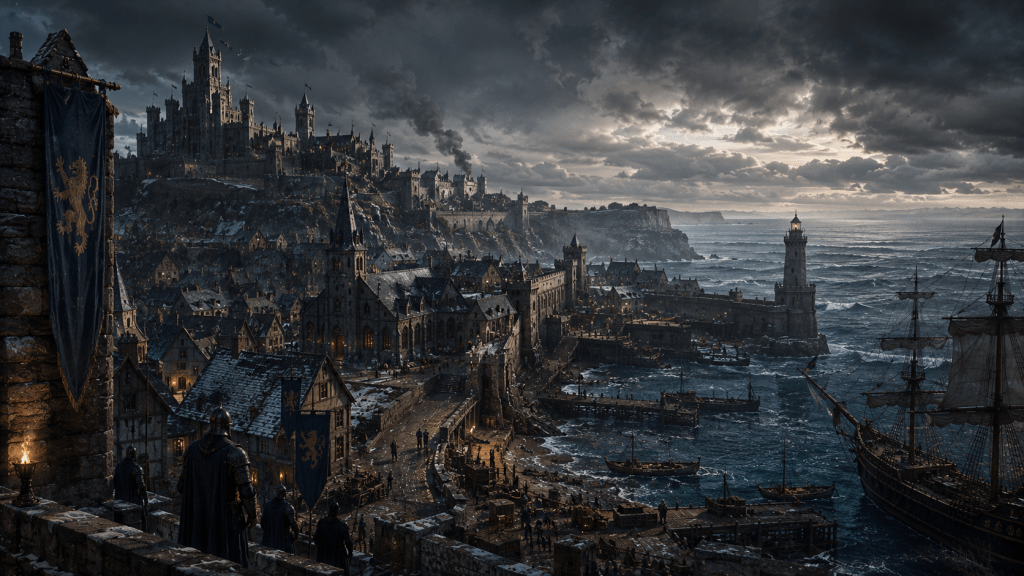
Some castles preserve the authority of the families who rule them, while others appear to retain every footstep, fear, and unfinished secret carried through their halls. Bremyra Castle belongs to the second kind. Its stone corridors have witnessed royal childhoods, political marriages, religious authority, private loss, and the uneasy return of magic to a kingdom that has learned to fear those who wield it.

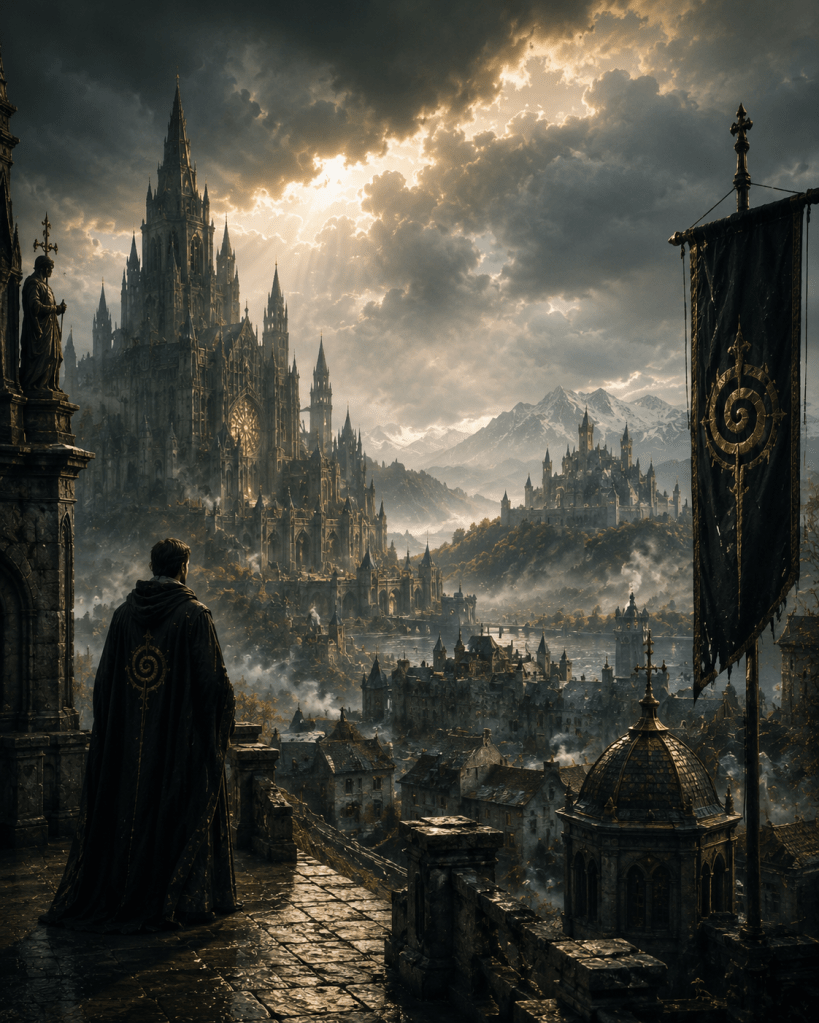
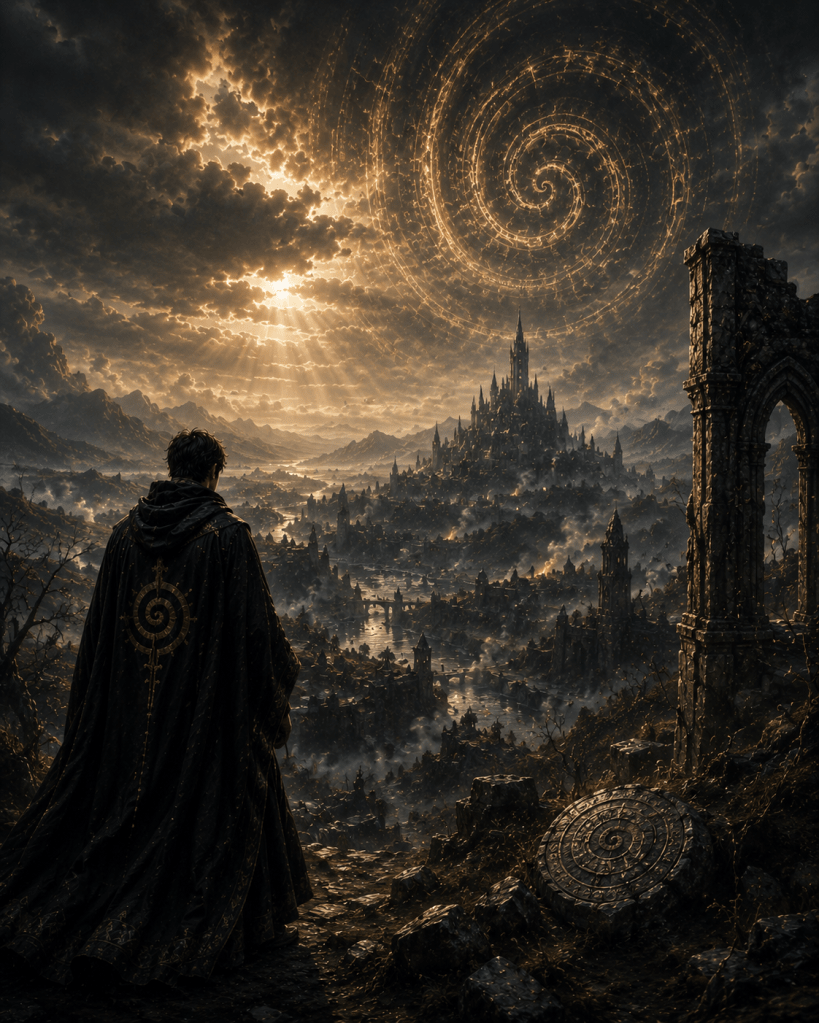
In The Unmarked Path, Book I of The Veil of Kings and Gods, Simion returns to those halls wearing the black robes of the Order of Magicians. He once crossed the same floors as a kitchen boy, almost invisible to the nobles, servants, and guards surrounding him. Years later, his robes command distance and fearful respect, though the castle itself appears to remember the boy beneath them.

The illustrated mini-read accompanying this article captures the moment when that memory begins to open.


Watch the Illustrated Mini-Read

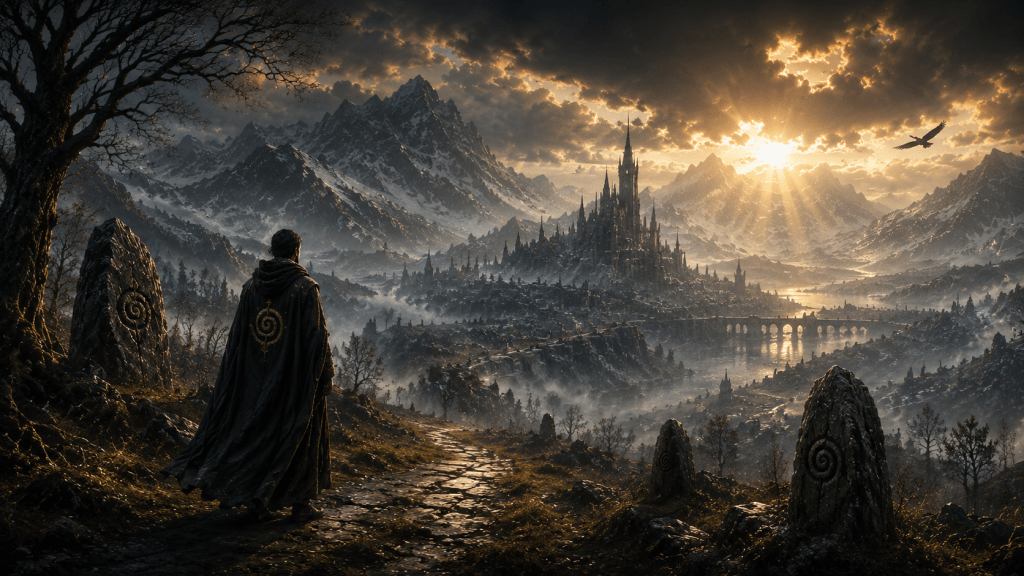
The scene begins with a whisper so faint that Simion first mistakes it for memory. It brushes the edge of his thoughts as he walks through Bremyra’s familiar corridors, where every turn carries traces of a life he can no longer reclaim. The voice grows clearer as he moves, drawing him away from the inhabited chambers of the castle and towards its towering royal library.

Nothing rushes forward to announce the danger. No creature emerges from the shadows, and no great spell tears through the stone. The unease gathers through smaller movements: a voice without a visible speaker, carvings that seem to breathe beneath flickering light, and enormous oak doors whose silence feels strangely expectant.

By the time Simion enters the library, memory has become summons.


Returning to a Place That No Longer Knows Him
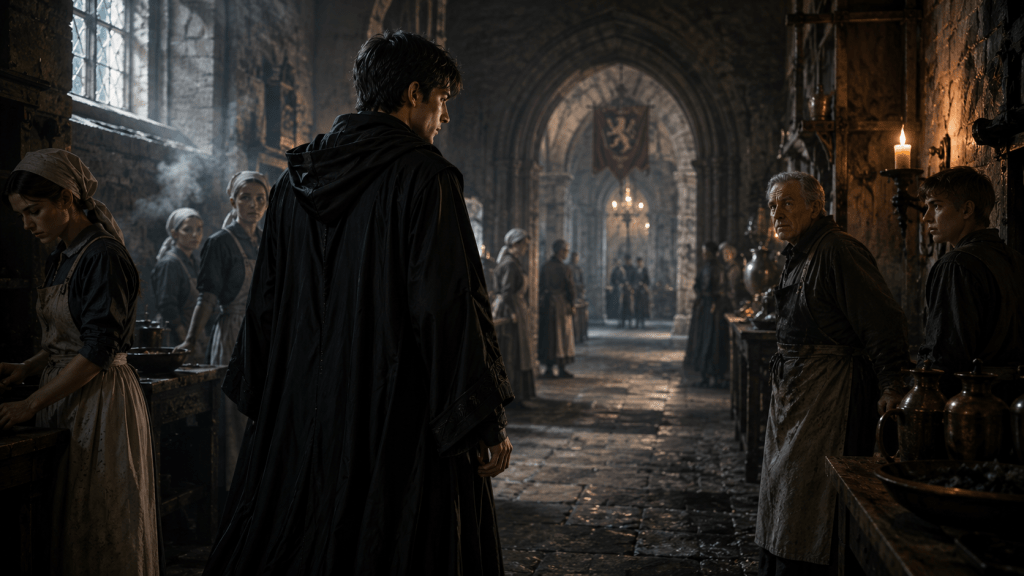
Simion’s return to Bremyra carries a tension deeper than simple nostalgia. The castle formed the boundaries of his childhood, although his place within it remained small. He worked among servants, scrubbed pots, carried trays, and stole brief moments of friendship with Prince Patrick and Princess Elana. Those memories remain warm in places, yet time and rank have altered every relationship surrounding them.

The servants who once worked beside him now lower their eyes. Courtiers measure their words in his presence. The Church watches him with suspicion, while the crown seeks answers from an Order whose motives remain carefully guarded. Simion has gained status, access, and power, though each of those gifts has placed another layer of distance between him and the life he remembers.

This separation gives the library scene its emotional force. The hidden passage appears inside a place tied to his former life, yet it opens for the magician he has become. Bremyra remembers both versions of him, even when its people recognise only one.

The voice calls him by drawing those identities together.


A Castle Built Above Forgotten History
Bremyra stands at the meeting point of royal, religious, and magical authority. The castle governs the kingdom, the cathedral shapes its faith, and the old magician’s manor remains as an uneasy reminder of the Order’s former influence. Beneath these visible structures lies another layer of history, one shaped during the age of the Imperium Arcana.

The library holds the written memory of kings. Its shelves preserve treaties, bloodlines, wars, journeys, laws, and decisions passed between generations. Behind one of those shelves lies a different kind of record, sealed within stone and kept beyond the reach of ordinary scholarship.

That contrast shapes the hidden passage. The royal archive protects what rulers chose to preserve, while the concealed chamber guards what the world attempted to bury.

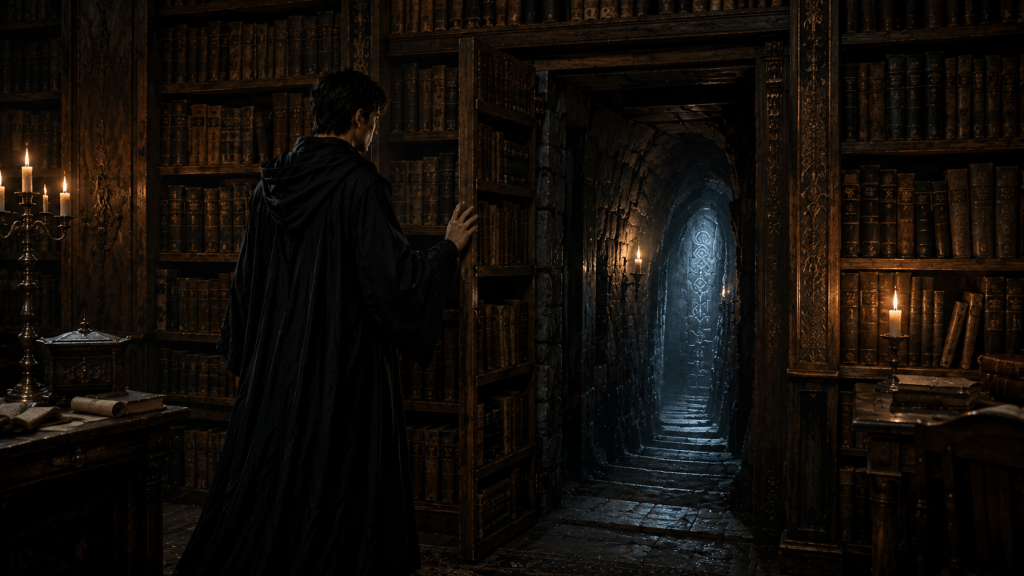
Simion arrives at the precise point where those forms of memory begin pressing against one another. His hand touches the shelf, a mechanism answers, and the structure of the castle alters around him. What appeared complete reveals another depth. What seemed dormant reveals awareness.

The discovery suggests that Bremyra’s foundations were laid across histories its present rulers scarcely understand.


Simion Before the World Understands Him

Powerful fantasy figures are often introduced after their reputations have settled around them. Simion enters The Unmarked Path at a far earlier and more vulnerable stage. He carries the robes of a magician, yet uncertainty follows him into every chamber. His training has given him discipline and access to forces most people fear, while leaving him painfully conscious of the skills that resist him.

He approaches the library without the certainty of a man already crowned by destiny. He hesitates before the doors. He listens to the voice. His hand hovers above the iron handle because some part of him recognises that crossing the threshold will change the shape of his mission.

That hesitation matters.

Simion possesses enough knowledge to recognise danger, while lacking the knowledge required to name its source. He senses power in the castle, though its purpose remains veiled. He knows the Order has sent him to investigate missing magicians, yet the deeper force moving beneath Bremyra lies outside the task he believed he had accepted.

The world has begun to respond to him before he understands why.

This makes his journey human. His importance emerges through pressure, uncertainty, and the slow recognition that forces older than the Order have started drawing him towards them.


The Library as a Threshold

Libraries in fantasy frequently promise knowledge, safety, or sanctuary. Bremyra’s library offers something more severe. It forms a border between the history people can read and the history that continues to act upon them.

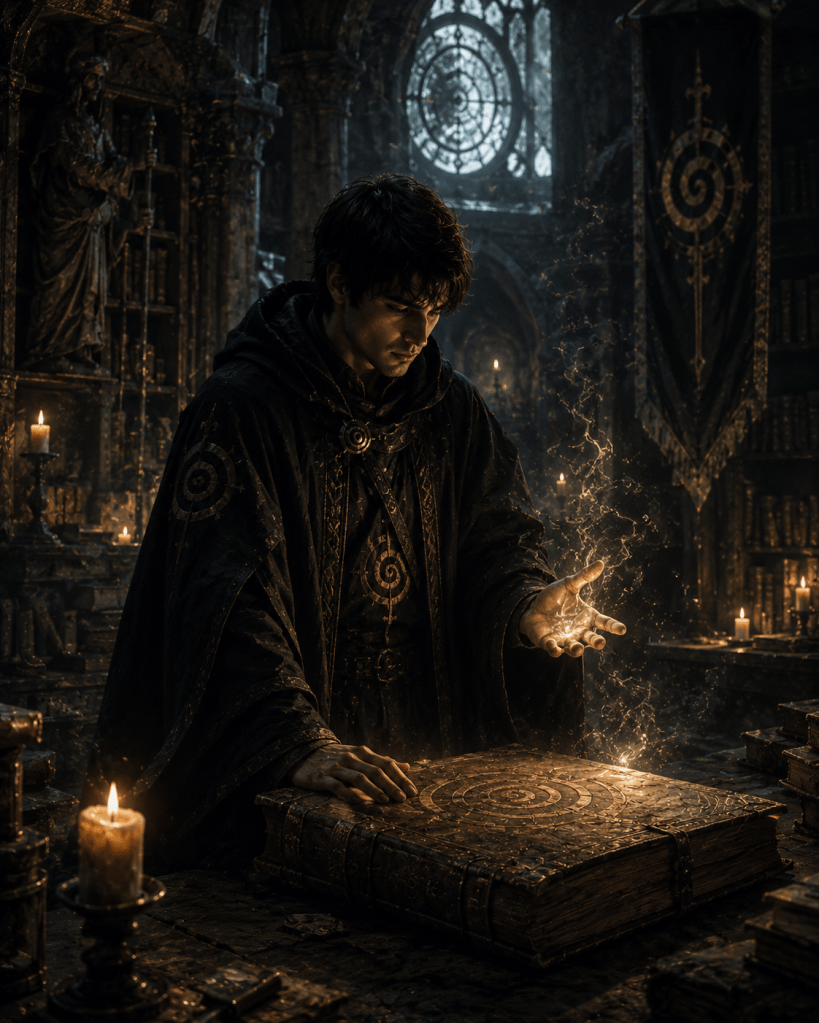
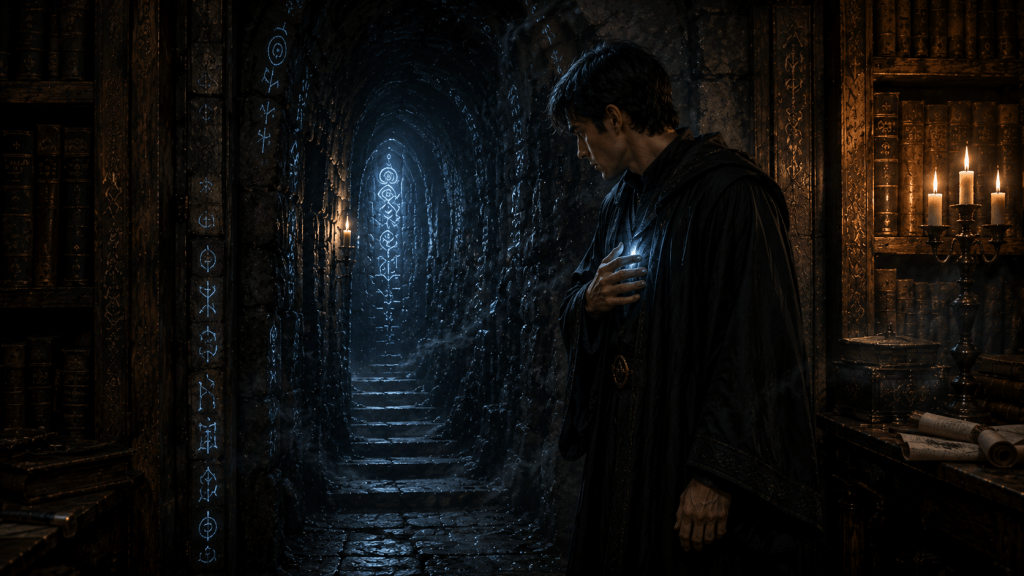
The towering doors create the first boundary. Their carved surfaces appear almost alive beneath the shifting torchlight, giving the architecture an unsettling patience. Once Simion enters, the scent of parchment and aged wood briefly restores a sense of order. Shelves rise in careful rows, old desks wait beneath the shadows, and generations of written thought remain where scholars left them.

Then his fingers touch the wood.

The faint click changes the meaning of everything around him. A hidden mechanism shifts with impossible precision, carrying an entire section of shelving aside. Cold air reaches into the library, disturbing dust and flame, while a low hum answers through Simion’s chest.

The secret becomes physical. It moves through the stone, the air, and his own body.

The scene ends at the threshold because the threshold carries greater power than an immediate answer. The passage stands open, the darkness waits beyond it, and Simion faces the point where curiosity becomes obligation.

The viewer receives the same choice.


Magic That Remembers
Magic within Ældorra carries age, structure, and consequence. It exists within institutions such as the Order, within the Church’s guarded authority, within ruined remnants of the Imperium Arcana, and within objects whose original purpose has slipped beyond present understanding.

It also remembers.

That quality separates the passage from an ordinary secret room. The mechanism resembles forgotten craftsmanship, yet the force guiding Simion towards it feels aware of presence and timing. He finds the correct shelf because the whisper draws him there. The hidden way opens because something beneath the castle has begun to move again.

The castle becomes part of that movement. Stone, timber, dust, and darkness serve as the visible surface of a much older design.

This early moment introduces one of the central pressures within The Veil of Kings and Gods. The present world believes itself governed by crowns, councils, religious offices, and the Order’s laws. Older forces remain embedded beneath every structure of authority, waiting for the balance to shift far enough for them to return.

Simion hears the first call before anyone around him understands that the silence has ended.


Political Pressure Above the Hidden Passage

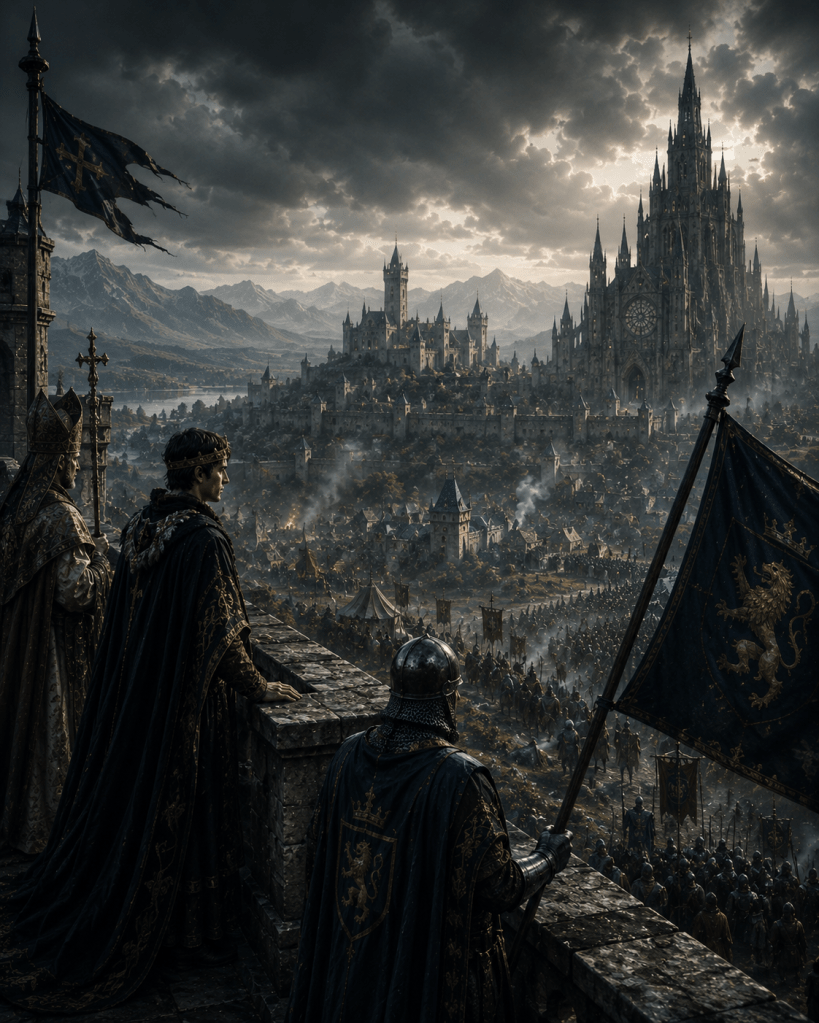
The secret beneath Bremyra gains further meaning through everything unfolding above it. Prince Patrick carries the burden of ruling while his father and elder brothers remain absent. The kingdom faces political uncertainty, growing tension with Arvendral, and rumours of foreign movement beyond its borders. Princess Elana prepares to leave for a marriage shaped by alliance and royal duty. Archbishop Alaric Thorne watches the Order with a suspicion rooted in generations of conflict.

Each character faces a path shaped partly by forces beyond personal desire. Simion’s path merely takes a physical form.

Patrick confronts sealed letters, council demands, and the growing shadow of a crown he was never raised to inherit. Simion confronts a concealed door within the kingdom’s own memory. Both stand before structures passed down from earlier generations, and both must decide how far inherited authority can guide them when the world begins revealing dangers their institutions failed to understand.

This parallel movement gives The Unmarked Path its wider shape. The story moves between Bremyra’s stone halls and the northern seas, between court pressure and approaching conflict, allowing distant events to gather towards one another before the people caught within them can see the complete design.

The hidden passage is one movement within a much larger turning.


The World Beyond Bremyra

While Simion follows whispers through the castle, Týrnan Valgrim crosses the northern seas with the Frostbane. His longboats enter storms, foreign waters, and a campaign shaped by clan duty, faith, conquest, and the ambitions of the High Chieftain.

The distance between Bremyra and the Frozen North creates the impression of separate stories unfolding across Ældorra. One follows a magician searching through hidden history. Another follows a war leader carrying his people towards violence and uncertain purpose. Between them stands Patrick, whose kingdom may soon feel the consequences of movements far beyond his court.

The reader sees the pressure gathering across different landscapes before the characters can recognise their connection. Magic awakens beneath stone. Armies move across water. The Church defends its influence. The Order searches for its missing members. Royal alliances tighten around men and women whose private wishes have little influence over the duties placed upon them.

History has begun drawing these lives into the same current.


Why This Scene Opens the Door to the Series
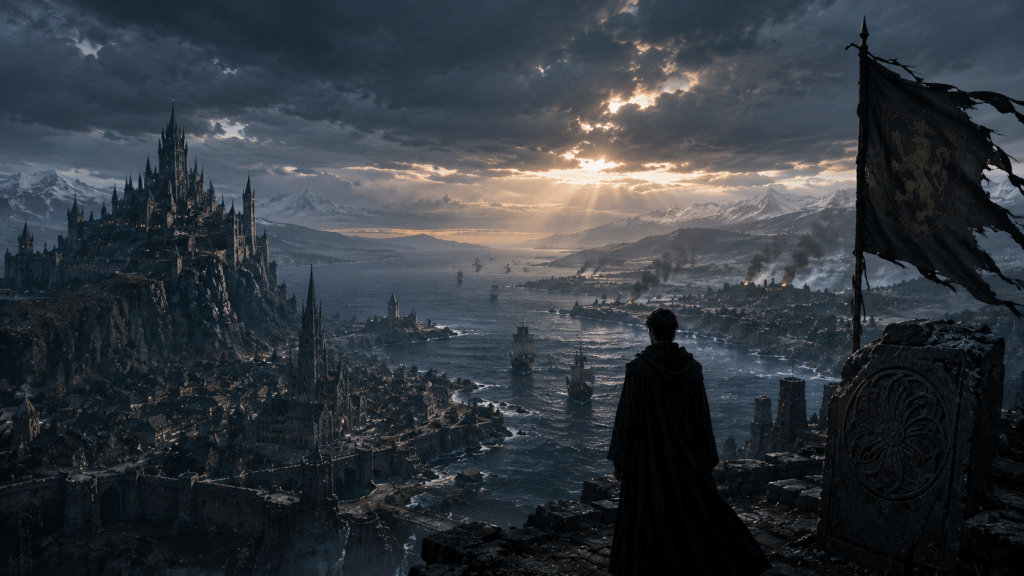
The illustrated mini-read offers a natural entrance into The Unmarked Path because it captures the atmosphere of the wider story without surrendering its answers. Viewers encounter Simion at a moment of movement, enter Bremyra at its most secretive, and feel the first pressure of ancient magic stirring beneath the visible world.

The scene also expresses the heart of the book. These characters begin changing before they understand the forces causing that change. Simion receives a summons from beneath the castle. Patrick feels the crown moving closer while his family remains absent. Týrnan sails towards a campaign whose true scale remains hidden. Elana walks towards a political marriage while reading the dangers gathering around her brother and kingdom.

Their paths appear separate, though each carries a burden shaped by authority, memory, and expectation. Beneath them, older powers have begun bringing the world into alignment.

The concealed passage provides one small opening into that movement. Once it appears, Simion can no longer pretend that his mission concerns only missing magicians or the guarded demands of the Council of Five.

Something beneath Bremyra has recognised him.


Read The Unmarked Path

The Unmarked Path is Book I of The Veil of Kings and Gods, set within The Chronicles of the Spiral Realms. It introduces Simion, Prince Patrick, Princess Elana, Týrnan Valgrim, the Order of Magicians, the Church, and the first signs of a struggle rooted in forgotten history, divine silence, political fracture, and the return of ancient power.

Readers drawn to immersive high fantasy, forbidden magic, political tension, hidden archives, old kingdoms, religious conflict, and characters caught between duty and forces beyond their understanding will find their first threshold here.

Bremyra’s library has opened upon a path concealed for generations, and Simion now stands before a darkness that appears to have been waiting for him alone.
Prince Patrick: The Reluctant Heir of Bremyra

In The Unmarked Path, the first book of The Veil of Kings and Gods, Prince Patrick begins in a place of uneasy authority.

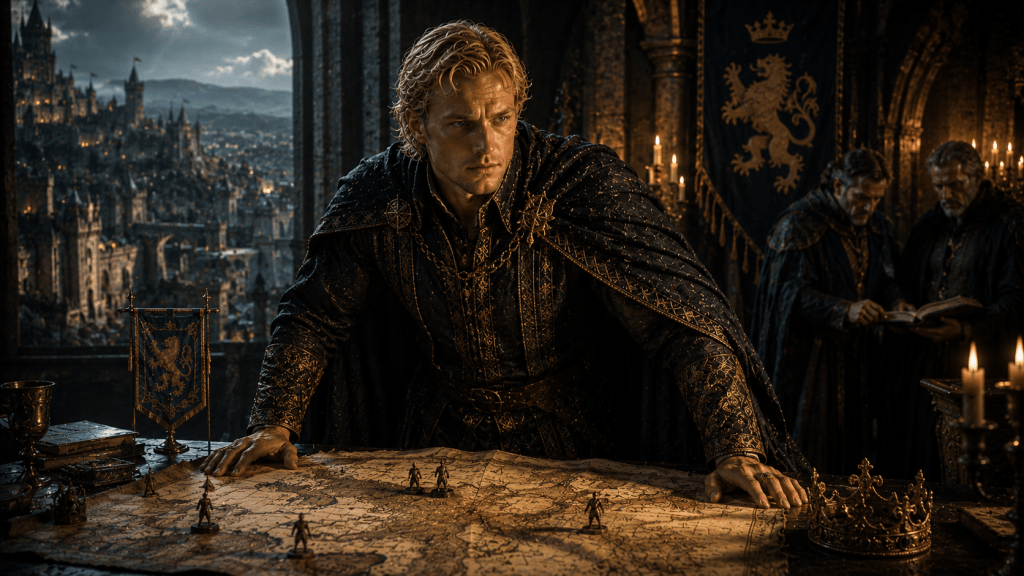
He is not introduced as a king in waiting, nor as a prince hungry for power. He is third in line to Bremyra’s throne, shaped by tutors, court duties, and the quiet expectation that others would stand before him when history made its demands. His father, King Cedric, carried the crown. His elder brothers, Aric and Aiden, carried the future.

Patrick was meant to serve beside them, to advise, to support, to understand the workings of power without being forced to become its centre.

Their absence changes everything.

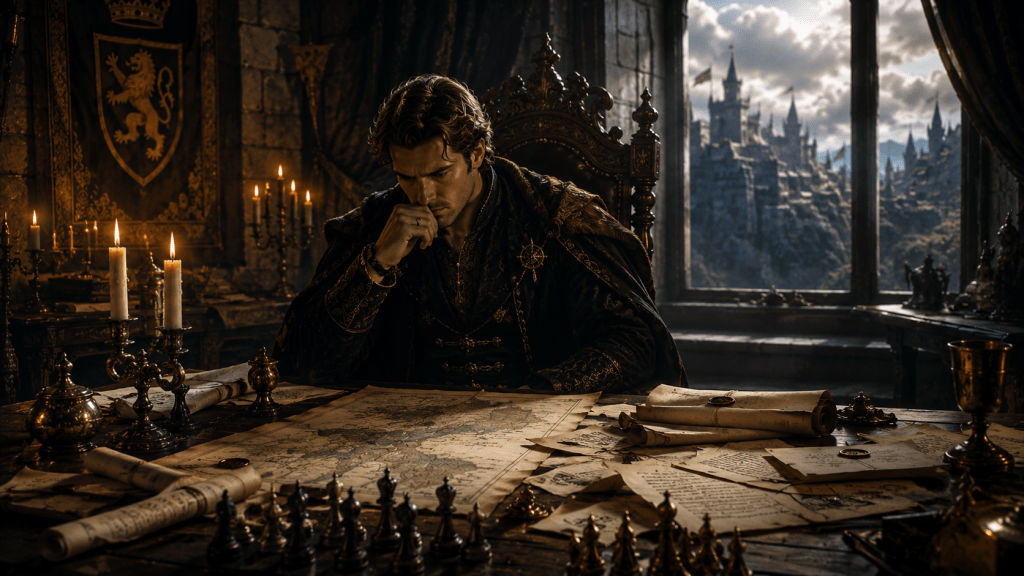
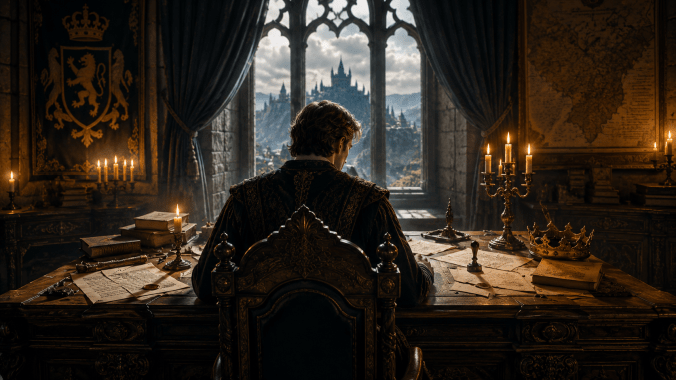
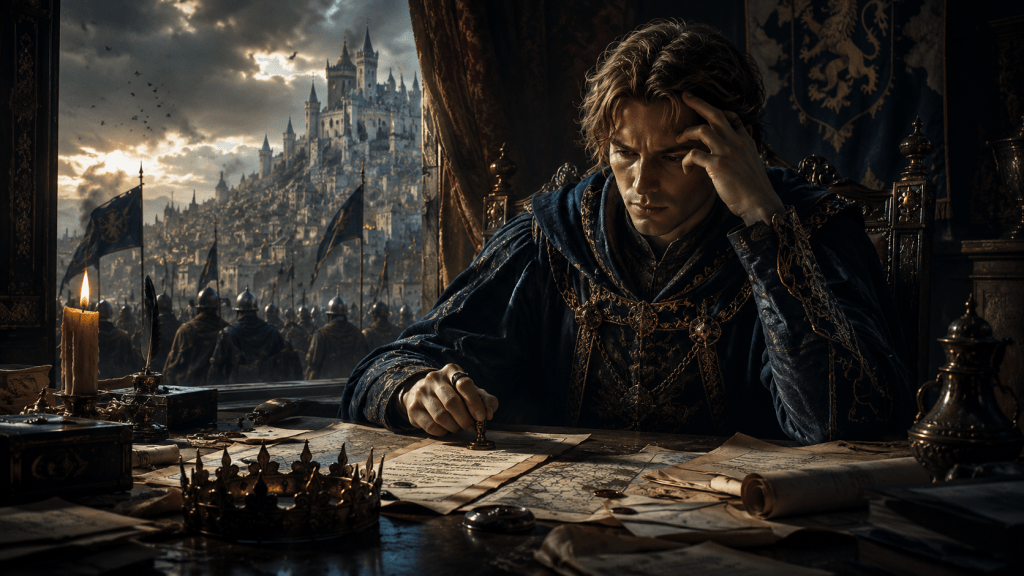
With the King and the twin princes gone beyond the familiar borders of the realm, Patrick is left at a desk that still feels like his father’s, answering petitions beneath banners that seem to remember stronger hands. The kingdom has not stopped to mourn their silence. Bremyra still requires judgement, diplomacy, restraint, and command. Each sealed letter and whispered report draws him deeper into a role he never sought, while the court watches to see whether the third son can hold steady beneath the weight of a crown that has not yet been placed upon his head.


A Prince Left at His Father’s Desk

Patrick’s first appearance places him at his father’s desk, surrounded by court proceedings, petitions, diplomatic letters, and the ordinary machinery of rule. The scene is quiet, yet it carries pressure from the beginning. Bremyra has not collapsed. The castle still functions. Servants still move through its halls, guards still hold their posts, and the court still expects decisions.

That is what makes Patrick’s position so difficult.

There is no grand ceremony announcing that power has shifted. There is no clean moment where he chooses the burden. Instead, responsibility gathers around him slowly, page by page, seal by seal, until the absence of his father becomes its own form of command.

The desk itself matters. It is more than furniture in this scene. It is the place where King Cedric once shaped the movement of the kingdom, where treaties were read, roads considered, disputes answered, and royal judgement turned into law. For Patrick, sitting there is not an act of possession. It is an intrusion into a space that still belongs to someone else.

Every object around him reminds him of that. The papers waiting for his seal, the chair beside him, the formal language of court proceedings, even the silence of the room all point towards the same truth. Bremyra has continued, but it has continued around an absence.

King Cedric and the twin princes have been gone too long. Their expedition beyond the known reaches of the old empire has fallen into silence, and the court cannot live on hope alone. Patrick feels that silence every time he sits in the chair that should not yet belong to him.

This is where his burden begins. Not on a battlefield. Not before cheering banners. Not with a crown lowered onto his head.

It begins in paperwork, in waiting, and in the uneasy knowledge that a kingdom still needs ruling even when the rightful voices have gone quiet.


Patrick is trained, intelligent, and capable, yet capability is not the same as certainty.

He understands statecraft. He understands alliances. He understands that kingdoms survive through careful balances rather than noble feeling alone. His education has prepared him to read treaties, weigh counsel, manage factions, and recognise the danger hidden inside polite words. Yet Book 1 catches him at the moment where knowledge begins to harden into lived responsibility.

Bremyra is not waiting for him to feel ready.

Arvendral stirs with uncertain intentions, offering the language of peace while its movements suggest something more cautious and dangerous. Vaeldring becomes vital through Elana’s arranged marriage, turning his sister’s future into part of Bremyra’s political survival. Thalosia presses its own designs upon Patrick’s future, reminding him that even his personal life is no longer fully his own.

Every alliance has a cost, and every delay invites danger.

Patrick must decide while still grieving absence. He must govern while wondering whether his father and brothers will return. He must listen to advisers who expect steadiness from him, even as he feels the shape of his own inexperience beneath every command. The court sees a prince at the centre of power, but Patrick feels the empty spaces around him more sharply than the authority in his hands.

He is forced to think not as a younger son waiting behind the true heirs, but as the man currently holding the centre of the realm together.

This is the quiet tragedy of his opening arc. He has inherited pressure without inheriting clarity, and the kingdom has begun asking him for the certainty that no one has given him.


Elana and the Human Cost of Royal Duty

Patrick’s bond with Princess Elana gives his story its human warmth.

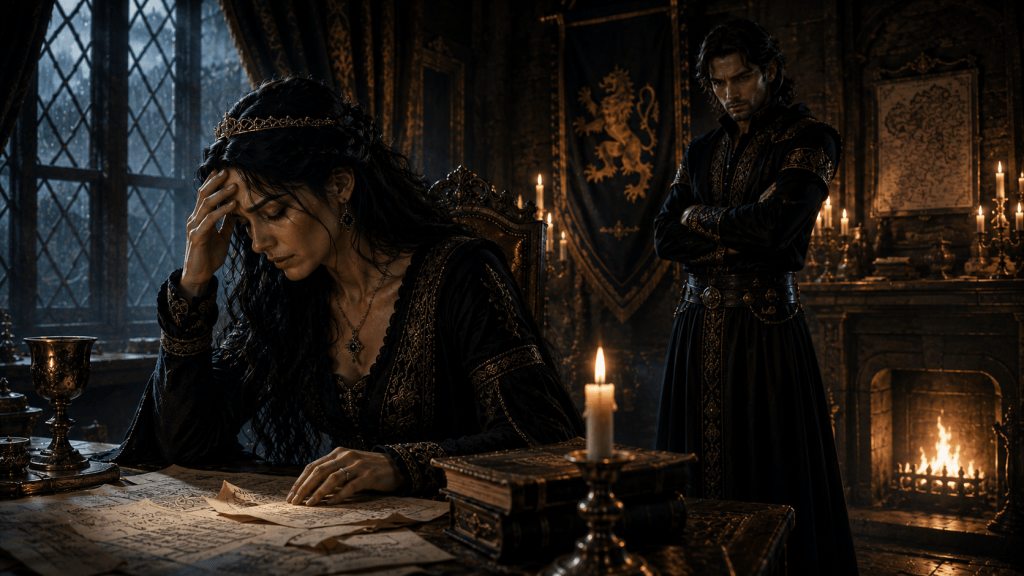
Their conversations carry the ease of siblings who have known one another beyond titles, ceremony, and court expectation. Elana does not look at Patrick only as the acting ruler of Bremyra. She sees the brother beneath the office, the young man sitting at their father’s desk before he has fully learned how to bear its weight. Patrick, in turn, sees more in Elana than the court allows. She is not merely a princess to be sent towards Vaeldring, nor a name placed into marriage negotiations. She is his sister, perceptive, spirited, and quietly braver than many of the men who speak around her.

That makes her departure harder.

Her marriage to Vaeldring is not treated as decoration. It is political architecture. Through her, Bremyra reaches towards stability, alliance, and protection at a time when the kingdom cannot afford isolation. Through Patrick, the same pressure appears in another form, as Thalosia looks towards him as a future husband and political partner. Their lives are being shaped into bridges between realms, and those bridges are built from obedience, silence, and sacrifice.

For Patrick, Elana’s journey is both necessary and painful. He understands why she must go, yet understanding does not soften the loss. Her absence removes one of the few voices able to speak to him honestly, one of the few people who can meet his burden without turning it into performance.

Both siblings are being moved by the needs of the realm.

Neither is truly free.


Bremyra Beneath Strain

Book 1 presents Bremyra as a kingdom still standing, yet already under pressure from several directions.

The danger is not simple. It does not arrive through one army at the gate or one enemy declaring war. Instead, it comes through rumours, border tension, court unease, foreign movement, and unanswered questions. Patrick must govern inside that uncertainty.

The court watches him. The Church measures the arrival of the Order. The nobles depend upon him while also studying his weakness. Every decision he makes is made beneath the shadow of men who are absent and institutions that remain powerful.

Patrick’s strength in Book 1 is not certainty. It is endurance. He keeps sitting at the desk. He keeps answering. He keeps listening. He keeps choosing, even when every choice feels incomplete.


The Arrival of Simion

The arrival of Simion changes the shape of Patrick’s burden.

Until that point, Patrick’s problems, however heavy, still belong to the visible world of rule: letters, borders, marriages, missing family, restless neighbours, and a court that expects him to answer before he feels ready. Simion brings something different into Bremyra. He brings the Order with him, and the Order is not simply another political body waiting to be managed.

To the court, Simion is a magician, and that alone is enough to unsettle the air inside the castle. The Order does not stand beneath a crown in the way soldiers, servants, and councillors do. It carries older authority, colder memory, and laws of its own. Its presence reminds Bremyra that there are powers in Ældorra which do not bend easily to royal command.

Patrick senses this immediately.

He wants plain answers, yet Simion does not offer them. The magician speaks with restraint, carries himself with controlled distance, and seems to move through Bremyra as both guest and investigator. He has returned to a place he once knew, yet he does not belong to it in any simple way. That makes him difficult for Patrick to read. Simion is familiar and foreign at once, tied to childhood memory through Elana, yet shaped by an institution Patrick cannot fully trust.

His presence stirs different fears in different people. Elana remembers the boy from the kitchens and sees something human beneath the robes. The Church sees the shadow of the Order and answers with suspicion. Patrick stands between both responses, aware that Simion may be dangerous, useful, wounded, or all three at once.

That uncertainty matters.

Patrick is not naïve enough to dismiss the threat a magician might pose, but neither is he foolish enough to ignore what Simion represents. Bremyra’s dangers are widening beyond ordinary court business. Foreign attackers have begun to move where they should not. The silence surrounding King Cedric’s expedition has grown harder to explain. The old world, once safely buried in books and ruins, seems to be pressing closer to the present.

In that atmosphere, Simion becomes more than an unsettling arrival.

He becomes a question Patrick cannot afford to put aside.

That tension becomes one of the important relationships in Book 1. Patrick cannot fully trust Simion, but he cannot ignore him either. He needs answers, yet the man most likely to find them carries secrets of his own. The prince and the magician stand on opposite sides of old authority, crown and Order, yet both are being drawn towards the same gathering storm.

For Patrick, accepting Simion’s presence is not an act of comfort.

It is an act of necessity.


Patrick’s understanding of power changes during the ambush in Bremyra.

Until that moment, magic can still be kept at a distance. It belongs to the Order, to old stories, to political caution, and to the fear other people carry when a magician walks through the room. Patrick can study it as a matter of court risk. He can weigh Simion’s presence as a political complication. He can listen to the Church’s distrust and the council’s unease while still treating magic as something held beyond the ordinary shape of his duties.

Then foreign attackers strike inside Patrick’s own city, and all distance vanishes.

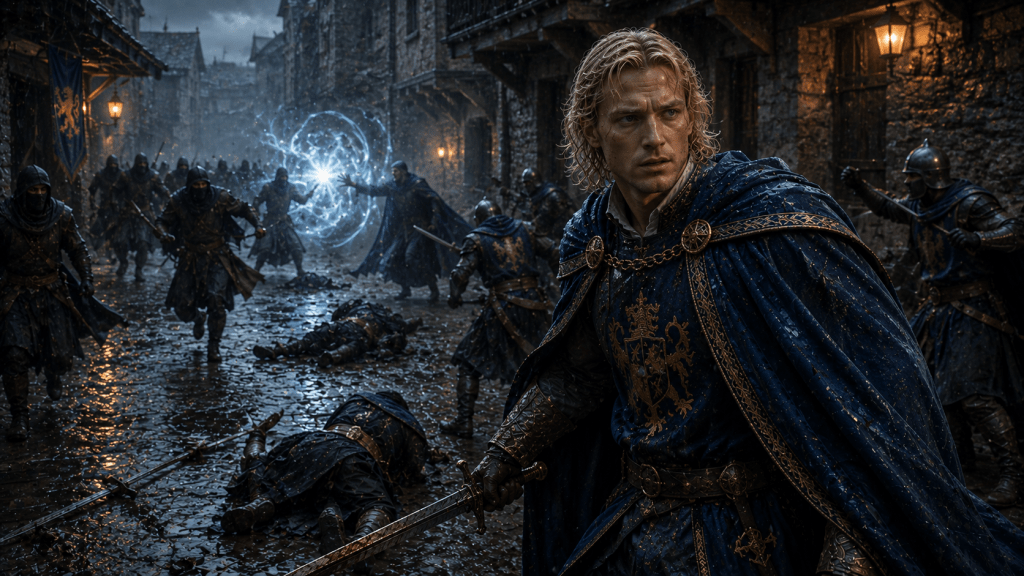
The attack is brutal, immediate, and personal. Patrick is no longer dealing with reports, rumours, or border movement. He is facing steel, strength, and death at close range, with the guards around him struggling to contain a threat that should never have reached him. The street becomes a place of sudden exposure. The prince who has spent his days behind desks, councils, letters, and guarded ceremony is forced into the raw truth of violence.

When Simion intervenes, Patrick sees magic not as theory, but as force.

There is no courtly veil around it. No ancient language softened by distance. No comfortable illusion that such power belongs safely inside the boundaries of the Order. Simion acts with speed and precision, and the world around Patrick changes in the space of a breath. The magician does not merely assist. He alters the outcome entirely.

It saves Patrick’s life.

It also unsettles him.

That is what makes the moment important. Patrick is grateful, yet he is too perceptive to be simple in his gratitude. He understands that the same power which protected him could terrify a court, silence a street, or reshape the balance between crown and Order if misused. He has seen something no council report could fully prepare him for: a man standing beside him who carries a kind of authority no prince can command in the ordinary way.

Patrick does not respond like a fool. He does not dismiss what he has seen, nor does he surrender blindly to it. He recognises the truth placed before him. Bremyra’s troubles may reach beyond ordinary politics, and Simion’s strength may be part of whatever answer the kingdom needs.

From there, Patrick’s relationship with Simion shifts. Gratitude enters the space between them. So does caution. So does necessity.

Patrick may not yet understand what Simion truly is, but he understands this much: Bremyra has stepped onto ground where steel, law, and royal blood may no longer be enough.


The Crown Begins Before the Coronation

Patrick’s arc in The Unmarked Path is not about becoming king in name. It is about the crown beginning to shape him before he is ready to wear it.

He is still a prince. He is still waiting for news of his father. He is still measuring himself against brothers who were meant to stand ahead of him. Aric and Aiden carry the image of succession more naturally in Patrick’s mind, while King Cedric remains the figure whose judgement should steady the realm. Yet their absence leaves no living hand between Patrick and the demands of Bremyra.

That absence becomes a kind of pressure.

Every petition placed before him reminds him that the kingdom cannot pause. Every council meeting asks him to speak with a confidence he does not fully feel. Every border report, marriage negotiation, and whisper from the court presses him closer to the shape of rule. He is not crowned, yet already he is being tested by the crown’s demands.

That is where his story gains its weight.

Patrick does not have Simion’s magic. He does not have Týrnan’s warrior certainty. He does not carry Elana’s hidden brilliance in the same way. His burden is different. He must stand in rooms where everyone wants something. He must listen to soldiers, priests, councillors, nobles, and foreign powers, knowing that each voice carries its own fear, ambition, or concealed truth.

He must make choices with incomplete knowledge. He must protect a kingdom that may already be part of a much older conflict. He must learn that leadership is not always a matter of bold speeches or battlefield glory, but of remaining steady while the world quietly removes every certainty around him.

Patrick’s strength in Book 1 is not triumph. It is endurance under scrutiny. He continues to sit at the desk, answer the summons, weigh the reports, and hold the centre while forces greater than one prince begin to move around Bremyra.


Why Patrick Matters in Book 1

Patrick matters because he gives the opening story its political heart.

Through him, Bremyra becomes more than a backdrop. It becomes a living kingdom, full of fragile alliances, absent rulers, cautious advisers, religious authority, old loyalties, and roads that no longer feel safe. His chapters show what happens when ancient danger begins pressing against ordinary governance, not through prophecy alone, but through letters, councils, rumours, borders, and the silence left by those who should have returned.

He stands between the personal and the political. Elana’s future is not only his sister’s sorrow, but part of Bremyra’s survival. Simion’s arrival is not only the return of a childhood memory, but a threat to the balance between crown, Church, and Order. Every private fear Patrick carries is mirrored by a public consequence waiting beyond the chamber door.

The wider world may be turning towards magic, invasion, and divine memory, but Patrick’s struggle remains deeply human.

He is tired.

He is uncertain.

He is watched.

And still, he must rule.


The Reluctant Heir

By the end of Book 1, Patrick has not solved Bremyra’s troubles. He has not uncovered the full truth of the foreign attackers, his father’s disappearance, or the strange forces gathering around Simion. What he has done is survive the first testing of his authority, and that survival matters.

He has seen that danger can reach him inside his own city, slipping through streets he believed protected by law, guard, and stone.

He has seen that Simion’s power may alter the fate of Bremyra, not as distant legend or court rumour, but as a force standing beside him when steel comes too close.

He has seen that Elana’s path is far more fragile than politics allowed him to believe, and that royal duty cannot always protect those it claims to serve.

Most of all, Patrick has begun to understand that rulership does not arrive with certainty. It arrives through pressure, through fear carefully hidden, through decisions made before every answer is known. His father’s chair remains too large for him, yet the kingdom has already begun looking to him as though he belongs there.

The crown is not waiting politely in the future.

It is already pressing its weight into his hands.

The Unmarked Path begins the first movement of The Veil of Kings and Gods, a fantasy series of political pressure, ancient magic, divine silence, and the people caught at the edge of forces older than kingdoms.

Ancient Gods, Forbidden Magic, and the First Turning of an Epic Fantasy Saga


Where the Road Begins Beneath Winter Stone

A cold road leads into Bremyra, where the sea wind carries salt through narrow streets and old stone holds more memory than any living court dares to name. In The Unmarked Path, the opening novella of The Veil of Kings and Gods, magic is never treated as ornament. It belongs to law, fear, inheritance, and silence. It lingers beneath castle floors, inside sealed books, in the guarded breath of the Church, and in the hands of a magician who scarcely understands why the world has begun to turn around him.

This is the beginning of The Chronicles of the Spiral Realms, a serious adult high fantasy series shaped by ancient gods, forbidden magic, kingdom politics, fallen empires, and the slow return of truths buried beneath the present age. Ældorra is a world where mortal institutions believe they hold power, yet every crown, altar, and magical order stands upon older ground.


A World Built Over Forgotten Power

The world of Ældorra carries the remains of the Imperium Arcana, a fallen magical empire whose ruins still press through the age of kings. Its laws have decayed into custom. Its divine wounds have hardened into doctrine. Its power survives in fragments, watched over by institutions that remember enough to fear the past, yet never enough to understand it.

The Order of Magicians stands at the centre of that inheritance. Powerful, feared, and separate from crown or Church, the Order preserves magic through discipline and secrecy. Yet preservation is not the same as wisdom. Beneath its authority lies fracture, and beneath its history lies a truth far older than its masters are willing to face.

Opposite it stands the Church of Christiana, sacred and political in equal measure. Its cathedrals offer prayer, order, and memory, yet those memories are guarded by men who understand that truth can unmake authority as easily as war can unmake kingdoms. In this kind of mythic fantasy series, faith and magic are never safely divided. Each claims to serve the world. Each fears what the other might uncover.


Simion and the Burden of Reluctant Power

Simion enters the story as no triumphant chosen hero. He arrives tired, uncertain, and obedient, sent by the Order to Bremyra under instructions he only partly understands. His strength lies not in arrogance, but in restraint. He carries power, yet he also carries doubt, old loneliness, and the uneasy knowledge that magic has never fitted him in the way it fitted others.

That makes him central to the series’ tone. The Unmarked Path is an epic fantasy novella concerned with consequence before spectacle. Simion’s magic matters because it alters rooms, relationships, loyalties, and fear. When he walks through Bremyra, people remember the idea of magicians before they see the man. His black robe is enough to change the air around him.

Yet the deeper pressure comes from what he cannot explain. A hidden book. A seal. A divine whisper. A moment when magic moves through him in silence, beyond the methods the Order taught him. These are not answers. They are openings.


Kingdoms, Churches, and the Shape of War

While Simion is drawn toward buried magic, Prince Patrick struggles beneath the weight of mortal rule. Bremyra is a kingdom under strain, held together by court procedure, family duty, marriage alliances, and the absence of a king whose return grows less certain with every passing day.

Patrick’s world is political fantasy in its most human form. There are borders to guard, letters to answer, marriages to arrange, rumours to test, and enemies to watch. War does not arrive as grand spectacle at first. It arrives through uncertainty, through foreign blades in city streets, through reports from the north, through councils where no one has enough knowledge to feel safe.

Týrnan Valgrim’s northern arc gives that pressure another face. His people move south beneath the command of a High Chieftain whose ambition already carries a shadow. Týrnan is a war leader, yet not a simple raider or clean heroic figure. His path is marked by survival, honour, violence, and doubt. Through him, the series begins to show war as moral corrosion as much as military action.


Why Silent Gods Carry More Weight

The gods of The Chronicles of the Spiral Realms are powerful because they are distant. They do not stride through the mortal world giving simple answers. Their silence hangs over prayer, magic, fear, and memory. When divine presence touches the story, it arrives through pressure, vision, symbol, and burden.

This makes the series closer to ancient gods fantasy than conventional quest fantasy. The divine is not a ladder for characters to climb. It is a cost. Mortals pray into silence, institutions build doctrine around absence, and magicians inherit fragments of power whose origins have been softened by myth.

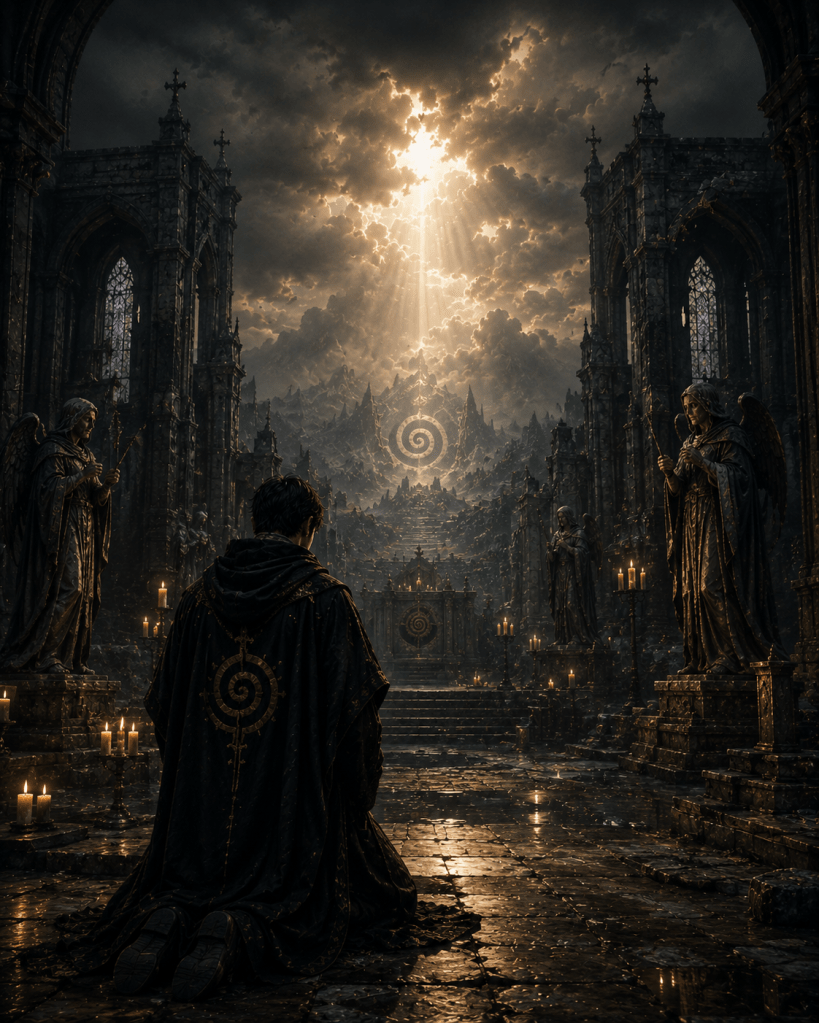
The Spiral itself belongs to that hidden language. It suggests recurrence, divine memory, forgotten truth, and a pattern returning through the lives of people who believe they are facing isolated crises. In The Unmarked Path, the Spiral is felt before it is understood. That restraint gives the saga much of its force.


Entering The Unmarked Path

Readers can begin the saga with The Unmarked Path, available on Amazon Kindle or paperback.

The novella opens the world without emptying it of mystery. It gives the reader Bremyra’s winter roads, the fear of magicians, the weight of royal duty, the unease of the Church, the first movement of northern war, and the sense that older powers have begun to stir beneath every visible conflict.

This is a fantasy novella series for readers who enjoy slow-burn epic fantasy, ancient gods, forbidden magic, magical orders, political tension, and worlds where history is never truly dead. Its power lies in the way the mortal and divine pressures touch one another. A prince’s council, a hidden chamber, a northern storm, a royal ambush, and a sealed book all belong to the same turning, even before the characters can see the shape of it.


The First Sign of a Larger Chronicle

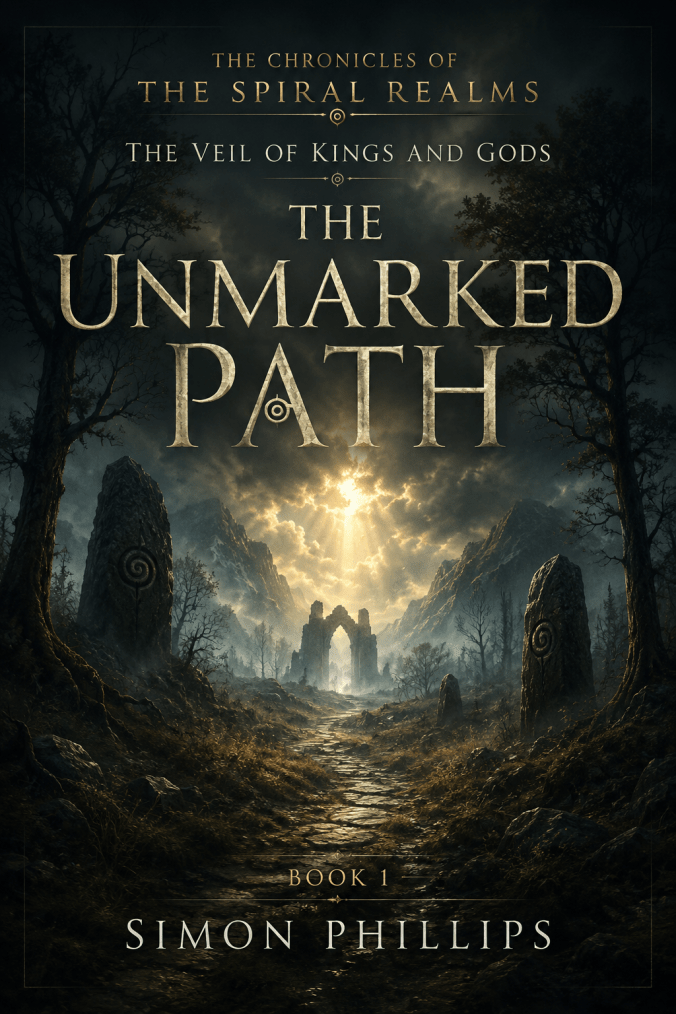
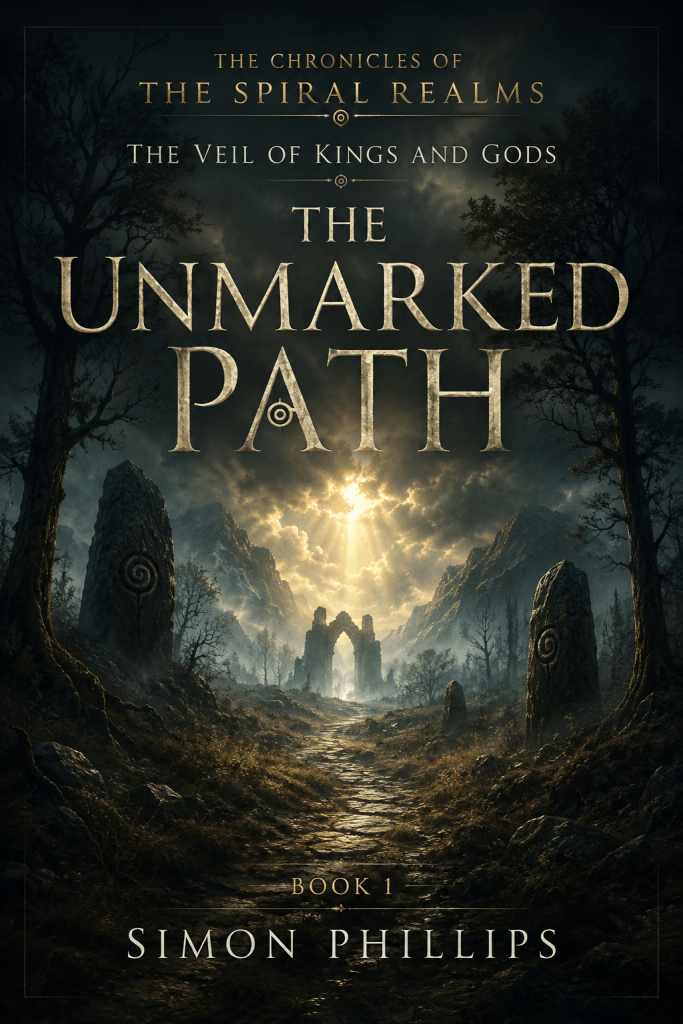
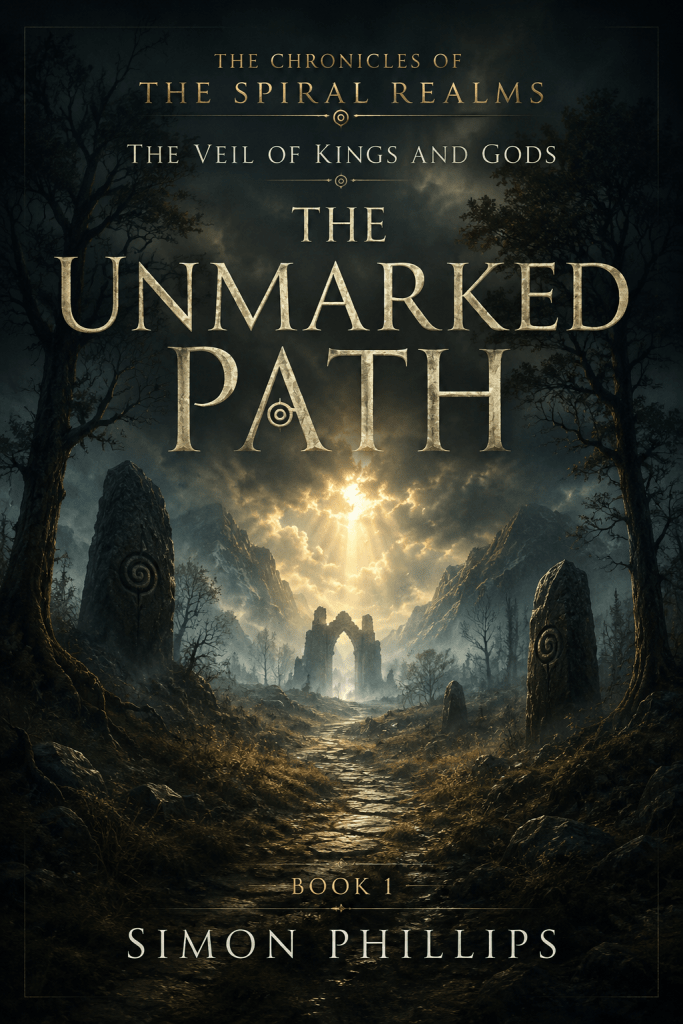
The cover of The Unmarked Path captures that threshold well: a road leading through dark trees and ancient stones, spiral marks cut into a landscape where ruin and destiny seem to share the same breath. It is an image of entry rather than conclusion. The path waits. The title promises no certainty.

That is the heart of the opening novella. The world has not yet broken, yet the first strain is audible. The gods remain silent, yet something divine has already reached toward Simion. The kingdoms continue their ceremonies, yet war gathers beyond their borders. The Order still believes it controls magic, yet magic has begun to move beyond its rules.

The saga is entered through a road, a castle, a book, and a burden. What waits beyond them is older than any king’s claim, deeper than any archive, and far less willing to remain forgotten.