An ESC forensics assistant prepared unrelated incident files for testimony review, and found the same pattern waiting inside every cautious phrase.
Chronicle Opening: The Files That Would Not Stay Apart
Review Chamber Four kept its cold beneath the table surface, inside the wall panels, and around the recessed evidence drawers where the older cases waited in sealed trays. The chamber sat below the legal review deck of the Leda Ark, away from the brighter corridors where officers spoke in controlled voices and witnesses passed between escort points under soft ship light. Down here, the cruiser had stripped comfort to its most practical form, with floor panels that swallowed footfall, ceiling lamps that held a steady clinical wash over every chair, and narrow grilles pulling dry filtered air through the room with the scents of warmed circuitry, sterilised polymer, and paper sleeves brought out for people who still trusted physical records more than screens. It was a room built to steady the living while arranging the dead into sentences.
Tessa Vey stood alone beside the chamber wall with both hands wrapped around a stack of evidence wafers and felt the ship change speed through the soles of her boots. The movement arrived as a slow pressure along the deck plates, smooth enough for command officers to ignore and heavy enough for anyone raised around freighters to recognise. Leda Ark had entered a harder burn, and somewhere above, route control had shifted its boards towards the Verge, while down here Review Chamber Four continued holding its polite temperature, its legal silence, its prepared chairs, as though history would wait until the proper file headings had been assigned.
She set the first wafer into the wall reader and watched the chamber wake.
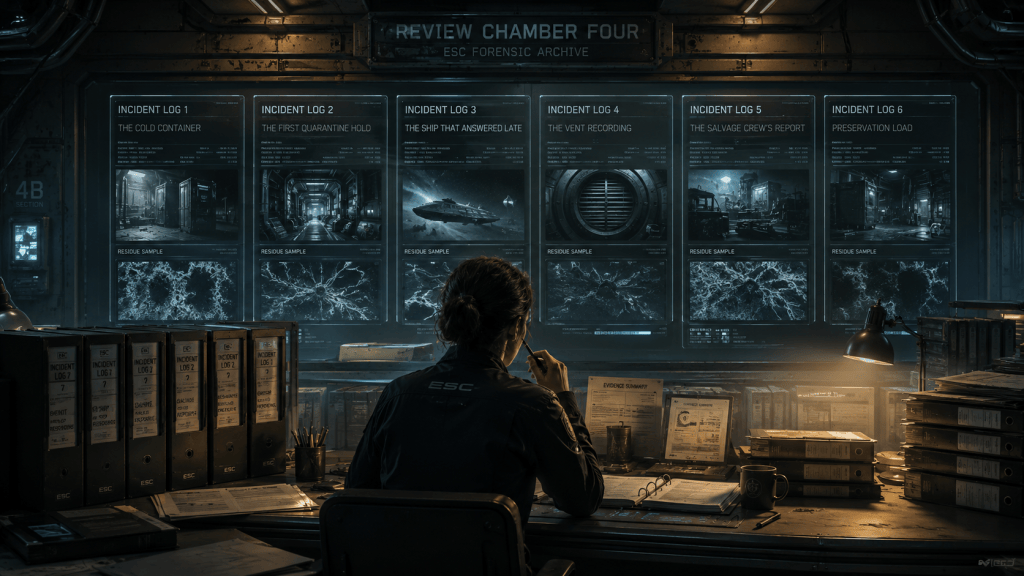
Six files opened in sequence across the display, each given a separate authority branch, a separate seal, and a separate phrase engineered to hold fear inside acceptable language. The first line named freight inspection at Kestrel Relay, the second quarantine intake aboard an ESC corvette, the third route control at R-17, the fourth acoustic review in Chamber Nine, the fifth salvage testimony from the Kordell Wake, and the sixth mining relay maintenance from Kheled-Three. Kestrel Relay had used non-reactive industrial deposit. Quarantine Hold One had used unresolved biological material. R-17 had used delayed authentication variance. Review Chamber Nine had used acoustic artefact. The Kordell Wake file had used stress response and comm distortion. Kheled-Three had used structural contamination risk, then casing irregularity after the relay systems corrected themselves. The language spread across the wall in clean columns, each phrase polished into a shape fit for committee, each one placed far enough from the next to preserve the fiction of separation.
Tessa lifted her slate and began aligning the testimony panels.
“Room status,” Doctor Sel Ardan called from the corridor before she appeared, her voice entering ahead of her through the open hatch.
Tessa turned as Ardan stepped into the chamber with a slim medical case tucked beneath one arm and her hair pinned close at the back of her head. “Local memory is sealed, the wall reader is isolated from ship archive, chair sensors are live, and the cognitive strain overlay is ready if you choose to use it.”
Ardan stopped beside the table and studied the six open files. “If I choose,” she said, placing the case beside the central chair. “Deputy Holt will insist.”
Tessa gave a small smile as she moved one panel higher. “Deputy Holt insists with unusual stamina.”
Ardan’s mouth softened for an instant, then settled back into professional stillness. “He survives by using words until reality grows tired.”
Tessa looked back at the wall, where the Kheled-Three maintenance burst refreshed at the bottom of the sixth column. A maintenance node flagged structural contamination, cleared itself, then reclassified the warning before the central board accepted the milder wording. She had read the line three times during preparation. Each pass left the same pressure behind her ribs.
“Doctor,” Tessa said, keeping her voice low as she enlarged the relay log, “this entry corrected twice before review received it.”
Ardan crossed the chamber and stood beside her. The older woman leaned close enough for the blue display light to edge her cheek. “Show me the raw path.”
Tessa dragged the sequence wider. The warning appeared first as a local node report, then shifted into a stable casing entry, then entered the official summary as cold stress interference around lower exchange conduits. Beside it, a small audio marker blinked with the restraint of a thing command preferred unopened.
Ardan rested one finger against the table edge. “That came from the mining relay.”
“Yes,” Tessa said as she opened the waveform beneath it. “Hab South return duct, recorded before the crew movement markers gathered around the vents.”
Ardan turned her head slightly. “Gathered.”
“That is the maintenance supervisor’s word.” Tessa checked the attached witness line, then corrected herself because accuracy mattered in rooms like this. “Her second word. The first report said drawn.”
The chamber seemed to grow colder while the waveform stabilised. Tessa had learned to distrust that feeling, because review rooms carried emotion through suggestion, through silence, through the careful staging of light against data. Fear found shapes when the mind had too much detail and too little rest. She had been trained in cognitive filtration, witness drift, stress interpretation, memory repair, and the countless ways human perception offered meaning where machinery supplied noise. Still, when she played the relay audio at low volume, every rule in her training stepped back for half a second.
A soft pull of air crossed the speakers. Metal shifted under cold pressure. Static rose beneath the signal, and then came a narrow human-shaped sound, almost a syllable, almost a plea, carried through the return duct with the fragile intimacy of someone speaking through a wall.
Tessa stopped the playback with one hand hovering over the controls.
“Again,” Ardan said, holding her position beside the table.
Tessa played the fragment a second time. The same airflow moved, the same cold metal answered, and the same almost-human shape slipped through the sound before sinking into the station noise.
Ardan looked at the six columns. “Put it beside Jennah’s Pride.”
Tessa opened the Review Chamber Nine file and brought the vent recording into line with Kheled-Three. Two waveforms appeared side by side. Different ship, different structure, different pressure condition, different evidence chain. The shapes should have refused each other. Instead, the middle band lifted in a similar place, the peaks stretching with a patience close enough to speech for the body to answer before the mind could build a defence.
The hatch opened again, and Lieutenant Marris entered carrying two sealed document sleeves. He paused when he saw the audio comparison on the wall.
“I thought today covered testimony stabilisation,” Marris said as he crossed to the table.
Ardan glanced towards him. “It does.”
Marris set the sleeves down. “That looks like correlation work.”
Tessa kept her eyes on the waveforms. “Correlation work was already inside the testimony packet.”
Marris looked at her with a faint tilt of the head, giving the answer more attention than her rank usually received. “That is a dangerous sentence for a junior assistant.”
Tessa swallowed and touched the Kordell Wake file. “It is also accurate.”
He moved beside her, and for a few seconds the three of them looked across the wall while the files held their pale order. The salvage tug testimony carried a captain’s statement about a voice from an empty compartment. The route drone had answered commands seven seconds late with perfect codes while refusing course movement. The quarantine pod had repeated open the lower door across a damaged emergency buffer. Kestrel’s recovered container had remained inert only while cold. Kheled-Three had entered preservation load before its crew movement markers collected near return vents. Every file used separate language. Every file had been handled by a separate office. Every file had arrived with a phrase designed to make it smaller.
Marris opened one of the sealed sleeves and removed a printed summary with a red treaty marker across the top edge. “Holt wants the spread reduced before the witness comes in.”
Ardan’s eyes stayed on the wall. “Reduced how?”
“Remove unresolved files lacking direct evidence chain. Keep Red Titan primary, Kheled alert secondary, Arcturas salvage tertiary. Drone and vent records remain in reserve unless requested.”
Tessa turned from the display. “That removes the timing pattern.”
Marris looked at her again, longer this time. “Explain.”
She forced her hands to remain still around the slate. “The drone answers late. The relay warning populates late. The cargo scanner at Kestrel corrected after the material classification. The quarantine burst repeats origin fields that change after each pass. Jennah’s Pride gives us audio after pressure reversal. Kordell Wake registers the compartment event after the crew member reports hearing it.” She touched each column in order, letting thin lines connect across the wall. “Different terms, different systems, same behaviour around delay. The record catches up after people have already reacted.”
Silence entered the room with weight.
Ardan studied the linked files, her expression held under strict control, although Tessa saw the smallest change in her mouth. Marris looked from one panel to the next, then to the sealed sleeves in his hand. The ship’s ventilation drew through the chamber grilles above them with a steady measured sound.
“Say that again,” Ardan said.
Tessa kept her gaze on the wall. “The record catches up after people have already reacted.”
Marris lowered the printed summary to the table. “That phrasing will cause trouble.”
Ardan gave him a dry look. “Most useful phrasing does.”
The chamber’s door light changed from white to amber as an internal status call reached the corridor. Deputy Review Officer Cassian Holt had entered the lower deck. His clearance marker advanced along the small side display with patient administrative certainty, one sealed access after another opening ahead of him.
Marris gathered the sleeves, then paused. “If Holt asks who built that comparison?”
Tessa felt the question strike with more force than she expected. Her role rarely reached rooms beyond preparation. She arranged files, checked time stamps, aligned testimony fragments, preserved raw entries where she could, and watched senior officers turn witness memory into survivable record. Junior assistants saw patterns because they spent long hours close to the unsmoothed material, yet seeing carried less value than speaking in a voice command could accept.
Ardan answered before Tessa could choose caution. “Mister Holt can ask me.”
Tessa looked towards her. Ardan kept her attention on the wall, already adjusting the chamber state for the coming session.
The hatch opened, and Holt entered with a slate tucked beneath one arm and the composed patience of a man who trusted systems because systems had rewarded him for decades. He took in the wall at once: the six files, the linked timing markers, the audio comparisons, and the phrase Tessa had typed beneath them in a small field near the bottom of the board.
DELAY PRECEDES FORMAL RECOGNITION.
Holt’s eyes settled there before moving to Ardan. “I requested a testimony packet,” he said as the hatch sealed behind him.
Ardan clasped her hands behind her back. “You received one.”
“This is wider than requested.”
“The witness is wider than requested,” Ardan said. “So is the problem.”
Holt crossed to the table and placed his slate down with deliberate care. “Wide problems require narrow language.”
Tessa watched the words reach the room and take their place among all the other careful labels. Narrow language sounded sensible and safe, like every file on the wall before the raw material began undoing the comfort around it.
From the corridor beyond the sealed hatch, two marines took position outside Review Chamber Four. Their boots came through the floor as dull pressure instead of sound. The chamber prepared itself around the table, around the chairs, around the open files that now seemed less like records and more like fragments of a single object seen through different windows.
Holt looked towards Tessa for the first time. “Assistant Vey, remove the visible linkage lines before Mister Vale arrives.”
Tessa’s fingers hovered over the slate. The order belonged to the hierarchy of the room, to the discipline that kept evidence usable and language defensible. Yet the six files remained before her, each carrying its own cautious title, each preserving the same small delay between danger and recognition.
Ardan spoke quietly from beside the wall. “Leave the raw markers.”
Holt turned towards her. “Doctor.”
“Leave them,” Ardan said, her voice calm enough to hold the room. “We can argue over phrasing after we stop pretending the files arrived alone.”
Tessa let her hand fall from the control without changing the display. Above them, the ventilation system shifted by a fraction, and the soft pull of air passed over the chamber grilles with a sound close enough to ordinary machinery to survive any record. The six files glowed on the wall beneath the clinical light, separate in wording, joined by delay, waiting for the witness who had lived through one part of the pattern before anyone in authority could safely name the rest.
A Visual Chronicle
Six unrelated incidents entered Review Chamber Four under different classifications, but when Tessa Vey placed the evidence side by side, the same pattern emerged just as a seventh alert arrived.
Station Record: Review Chamber Four
Review Chamber Four formed part of the legal and cognitive-forensics section aboard the ESC peacekeeping cruiser Leda Ark, a restricted review space used during the earliest attempt to compare scattered contamination records from civilian ships, salvage routes, cargo drones, quarantine holds, and isolated industrial outposts.
The chamber had originally served as a testimony stabilisation suite, where survivor accounts could be arranged beside damaged telemetry, pressure logs, medical traces, ship schematics, route authority records, and partial environmental data. Its first purpose was controlled and procedural, built around the careful repair of sequence after accidents, combat incidents, disputed rescues, or contested emergency actions along politically sensitive lanes.
As the Red Titan case moved into formal review and additional incidents began reaching ESC channels, Review Chamber Four gained a second role. It became a place where separate files could be placed beside one another before command had accepted any formal connection between them. The room’s displays were upgraded for comparative overlays, its local memory was sealed from wider ship archive, and access to raw timing data required cleared review authority.
Rooms of this kind carried unusual pressure during the first Harbinger-related inquiries because the crisis entered official knowledge through fragments. One file described contaminated freight. Another described a quarantine pod. Another described a cargo drone answering late. Another preserved a voice-shaped recording from a damaged vent. Another held testimony from a salvage captain who heard someone calling from an empty compartment. Another came from a mining relay that flagged structural contamination before lowering itself into cold preservation load.
Each record arrived with its own safer language. Residue became industrial deposit. Voice-like sound became acoustic artefact. Crew movement became welfare disturbance. Delayed system response became authentication variance. Structural contamination became casing irregularity. The terms allowed officers, lawyers, route authorities, and treaty desks to handle each event in isolation while avoiding a wider declaration that might spread panic across freight lanes and contested jurisdictions.
Review Chamber Four became significant because its work depended on placing those safe phrases beside the raw evidence they softened. Junior assistants, analysts, doctors, and review officers could see what separate offices had struggled to name: heat, cold, airflow, delayed correction, vent movement, false voice-range audio, pale or dark residue, pressure lag, self-clearing warnings, and records that seemed to recognise danger only after people had already reacted.
The chamber’s purpose therefore shifted from stabilising a witness to testing the integrity of a pattern. If the incidents remained separate, ESC procedure could continue assigning narrow classifications. If they joined, every previous phrase became too small. A cargo problem would become a contamination problem. A contamination problem would become a route-control problem. A route-control problem would become a political crisis.
The Review Chamber Four comparison was never meant to offer a clean explanation. Its value lay in preserving the moment before official recognition, when the files still carried different names and yet began to answer one another across the wall. The chamber records show a system trying to protect evidence from exaggeration while the evidence itself pressed steadily towards a larger shape.
Later ESC summaries would reduce the session into restrained language, describing it as preliminary incident correlation under restricted review authority. The raw chamber log preserved something colder: the first time several cautious records were opened together, and the same delay appeared inside them all.
About the Creator

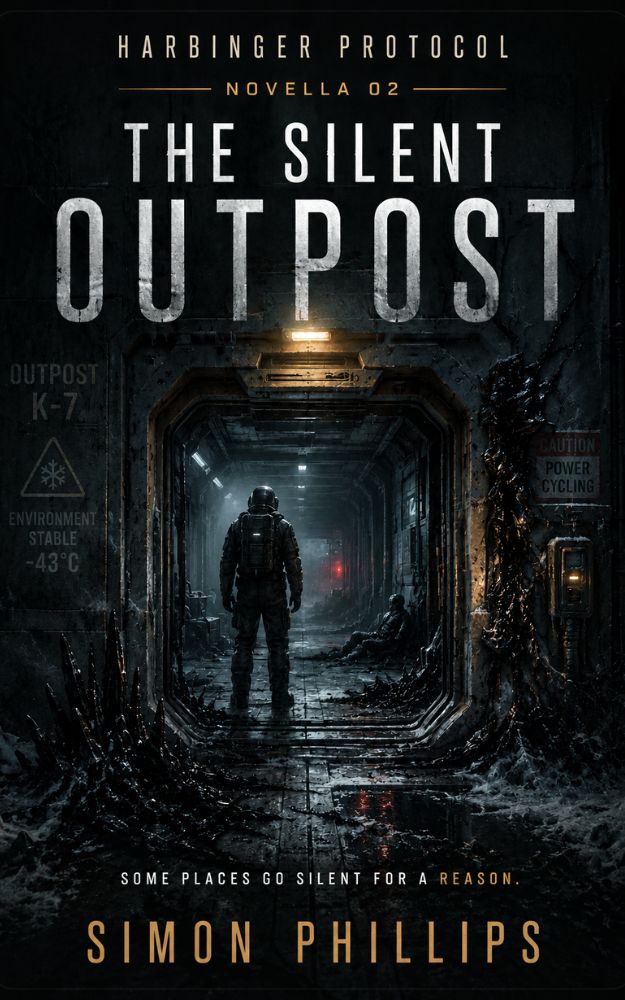
The Future Chronicle is written and curated by Simon Phillips, a writer of science fiction and speculative storytelling who explores the fragile edges of human expansion, where freight routes, inspection bays, patrol vessels, and isolated industrial stations continue their ordinary work while larger dangers gather quietly beneath routine procedure.
Many of the stories presented in these Chronicles exist within wider fictional worlds shaped by workers, survivors, officers, and investigators who encounter the first signs of events far greater than they are prepared to understand. These settings remain grounded in lived environments, where machinery, bureaucracy, and human judgement often shape the path of catastrophe long before anyone can give it a name.
The Harbinger Protocol follow that unfolding pressure through the experiences of Soren Vale, beginning with the civilian freighter disaster recorded in The Ash in Transit and continuing into the colder, more procedural dread of The Silent Outpost, where isolated incidents begin to reveal the outline of something spreading across human routes and systems.
Readers who wish to explore the full opening phase of the Harbinger crisis can find the below.
Explore the books:
The Ash in Transit
The Silent Outpost
You can watch his YouTube channel here:
Author Simon Phillips
Continuing the Chronicle
The following Chronicle reconstructs the restricted session inside Review Chamber Four, where scattered ESC incident files were opened beside Soren Vale’s testimony and separate phrases began forming a pattern no review officer could safely name.
Readers supporting The Future Chronicle can continue the record below.

Subscribe to continue reading
Subscribe to get access to the rest of this post and other subscriber-only content.
