When Ashfall Station fell into darkness, the sounds moving through its walls no longer belonged to failing machinery alone.
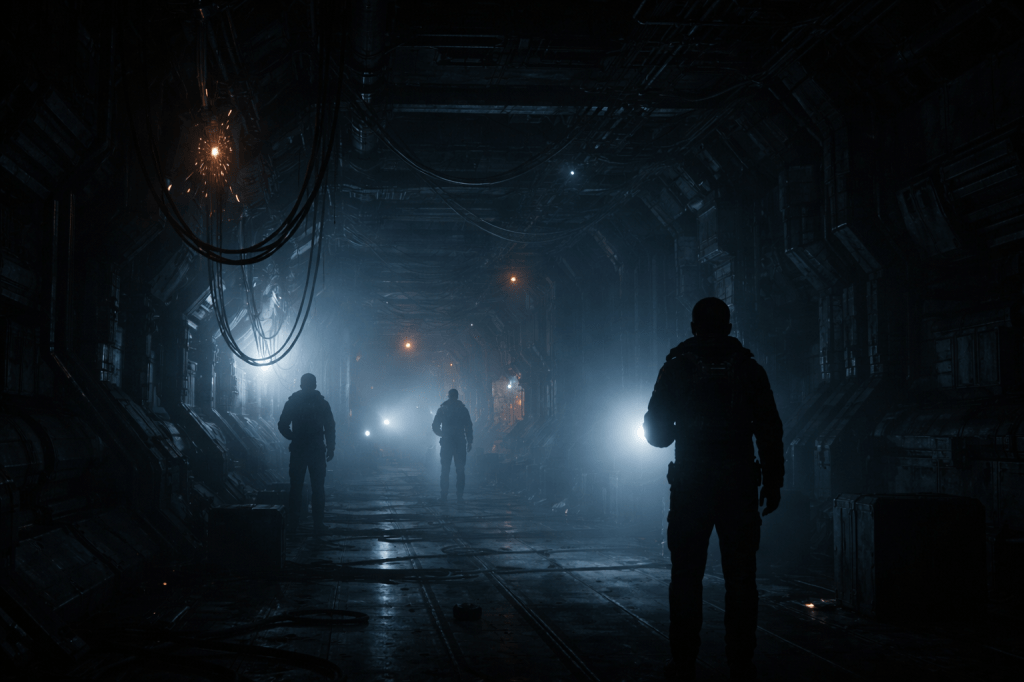
When the Station Went Dark
The evening cycle settled over Ashfall Station with the tired calm of a place that had carried strain for so long that strain itself had become part of the atmosphere. Along the habitation ring, food stalls lowered their shutters one by one, service carts vanished into storage alcoves, and the last of the public traffic thinned into a drifting flow of workers heading home beneath lamps that glowed a little weaker than they had a month earlier. Through the wide gallery windows, Kestren-4 turned below in its pale silence, casting a ghost-grey reflection across the lower structure of the station.
Nera Seln crossed the upper transit spine with a maintenance satchel against her hip and her jacket folded over one arm, following the curve of the public gallery towards the western lift banks. She had spent eleven years inside Ashfall’s lighting grid and had never lost the habit of seeing every fault. As she passed a sealed service hatch near the gallery rail, the wall strips to her left dimmed for half a heartbeat, then filled again with a warm amber wash that slid across the floor plating and the soles of her boots. The shift was small. It was also wrong.
She slowed by the railing and looked down into the interior ring. From that height, Ashfall resembled an immense mechanical city built inside its own turning shell. Freight lanes traced blue lines along the lower decks. Market corridors glowed with softer light. Deeper down, the light thinned into darker layers threaded by the buried pulse of systems few station residents ever saw. Somewhere under those visible decks, the old power routes still carried current through conduits laid during the station’s first industrial years above Kestren-4, and in recent cycles those buried lines had begun to behave in ways the surface reports never managed to explain cleanly.
The comm badge at her collar vibrated once. She glanced down at the display on her wrist and read the incoming line from Control.
Sector Seven lighting variance. Confirm local relay response.
She let out a slow breath and resumed walking. Sector Seven had drifted twice during the previous cycle, and before that the same fault pattern had appeared in Nine, Twelve, the western habitation blocks, and half the service access routes under Dock Ring Two. Each report arrived in the language of routine. Seen together, the incidents formed something else. They moved inward from the station’s outer systems and touched older structural zones where present-day routing crossed layers of buried infrastructure.
The lift carried her down into the service levels where Ashfall showed its age more plainly. The doors opened on a corridor lined with exposed conduit runs, relay cabinets, old power lockers, and bulkheads thick with repeated repair work. The air felt warmer there, dry with insulation dust and the faint metallic tang of hard-driven current. Two technicians waited outside the grid office with the slumped posture of men coming off a long shift.
“You’ve got Seven again,” the older one said as she came up.
“And Nine,” the younger added. “Twelve gave us a dip near shift end. Western support ran low for four seconds, then climbed back as if nothing had happened.”
Nera palmed the office door open. “Control still calling them isolated?”
The younger technician gave a flat little laugh. “Control calls everything manageable until the station chooses a louder word.”
Inside, the grid office hummed with the soft chatter of relays and the pale rise and fall of routing maps climbing the wall displays. Nera dropped her satchel beside the central console and scrolled through the latest reports while the handover continued around her. The figures told the same story she had been reading for days. Tiny dips. Quick recovery. No visible overload. No corresponding damage. Her eyes moved from one time stamp to the next, then to the station map beside it, and there it was again, the pattern that had sharpened after the survey teams vanished out in the relay network. The fluctuations were no longer skimming the edge of the station. They were turning up in older sectors tied to the deep frame.
“You logged the sounds?” she asked.
The older technician folded his arms. “Three times. Western support run, late cycle. Sounded like something moving through the bulkheads.”
“Pipe stress?”
He shook his head. “Too steady. It travelled.”
The younger one nodded towards the map. “Deck Fourteen heard it as well during a lighting dip near midnight. Crew there said the sound passed ahead of them inside the wall, then carried on into a dead section.”
“And Control?”
“Routine structural noise.”
She signed off their handover, watched them leave, and listened to the current moving through the walls. Ashfall always had a sound. The station breathed through vents, vibrated through rails, and murmured through power trunks that had survived more years than some records admitted. Tonight the hum seemed to carry a faint second layer below the usual noise, something intermittent and measured, as if a pulse was rising through the deep grid and touching the modern circuits one junction at a time.
For the next hour she worked through the reported sectors, sending diagnostic pulses along feeder lines and reading the response from substations buried through the station’s lower spine. Some faults cleared the instant she examined them. Others remained vague in the most unhelpful way, giving her tiny losses in output with no matching overload, short, or physical break in the line. By the time she reached the western support run, the map showed a cluster of irregular readings gathered around Junction W-17.
She clipped a portable lamp to her belt and headed out into the support corridors. The route took her away from the busier maintenance channels and into a quieter band of the station where the lighting thinned and the architecture grew older with every turn. Heavy conduit housings jutted from the walls in square banks. Cable trunks vanished into bulkheads whose seams no longer matched current engineering standards.
Junction W-17 stood at the far end of a narrow support corridor where the deck dipped slightly towards the outer ring. The first thing she saw was the relay cabinet door hanging open. It should have been sealed. Instead it stood ajar by a few centimetres, as if someone had eased the catch and walked away before deciding whether to go further. Nera crouched, set the lamp on the floor, and inspected the cabinet interior. The relay stack remained seated. Wiring looms were intact. No scorch marks. No tool damage. No sign that any maintenance hand had been inside. She checked the live load on her wrist display and felt her mouth tighten. Current was moving through the cabinet in pulses too regular for random drift, rising and easing at exact intervals that matched nothing on the demand schedule for that deck.
She closed the panel and stayed where she was for a moment, listening. At first she heard only the familiar life of the station. Air moved through the vents in a long controlled flow. Somewhere far off, a cargo lift engaged and sent a faint tremor through the plating beneath her boots. Then something shifted behind the wall at her right shoulder. The sound arrived low and metallic, deeper than pipe strain and heavier than a loose conduit brace. It travelled through the bulkhead with a slow measured persistence, as though a weight had leaned into the hidden structure and continued forward through it.
Nera put one hand against the wall. The metal felt cool. A second later the movement came again, stronger this time, following the line of the corridor ahead while her palm caught the last of its passing vibration. She pulled her hand away and opened a maintenance query on her wrist unit. No active crews. No mobile service units. No mapped systems under stress. The station’s own data denied the sound even as the bulkhead carried a fading echo of it.
She rose, lifted the lamp, and walked towards the next junction. The corridor narrowed there, squeezed by older reinforcement ribs that pressed closer to the central walkway. Overhead strips flickered once, then settled into a weaker glow. At the far wall, a second relay cabinet stood open exactly as the first had done.
Nera reached it in quick steps and stopped. The pulse pattern on her wrist display had spread. W-17 was no longer carrying the sequence alone. Three adjacent junctions were rising and easing in the same measured order, each one touching the next as if something were moving through the grid by way of infrastructure that had never been intended to carry it. She raised the lamp and turned slowly, trying to locate the source by instinct as much as instrument.
The lights went out.
Darkness fell across the corridor with such force that the station seemed to disappear around her. The ambient hum collapsed into a stunned silence. For one suspended instant Ashfall felt less like a functioning installation than an enormous hollow shell turning through open space. Then the emergency grid tried to answer. A red strip along the floor ignited, flickered twice, and held at a weak output that barely reached the opposite wall.
In that red half-light, the sound inside the structure returned. It moved through the walls ahead of her, larger now, accompanied by the distant cry of voices rising from decks she could no longer see. Somewhere across the station, systems were failing ring by ring. Somewhere close at hand, within the buried layers behind the corridor bulkheads, something metallic was shifting its weight and travelling through Ashfall in the dark.
The station had lost power before. Every resident knew the waiting and the old anger that came with living inside a structure held together by labour and compromise. As Nera stood at the junction with her lamp in one hand and the dead corridor stretching before her, she understood with a cold clarity that this failure carried a different shape. Ashfall had gone dark all at once, and in the darkness something within its walls had begun to move.
Station Record: Multi-Ring Power Disruption; Internal Structural Disturbance Log
Ashfall Station maintained a layered electrical distribution system designed to sustain continuous operation across its habitation rings, freight sectors, engineering corridors, and lower industrial frameworks while the installation remained in orbit above Kestren-4. Power moved through a network of primary conduits, secondary relays, emergency reserves, and local substations assembled across several phases of construction, with later expansions tied into older infrastructure that remained active far beyond its original service projection. Under ordinary operating conditions, temporary lighting variance, local relay drift, and brief environmental inconsistencies were treated as manageable features of an ageing station whose systems required constant balancing across a vast structural footprint.
In the operational cycles following the loss of multiple survey crews within Ashfall Station’s outer relay network, maintenance departments recorded an increase in minor electrical irregularities appearing across sectors unconnected by ordinary load behaviour. Lighting strips dimmed and recovered in public galleries, service corridors, and lower support runs. Door panels lost output for brief intervals before returning to stable function. Environmental controls registered short inconsistencies in pressure and temperature data, then restored baseline readings without direct intervention from station personnel. Early review classified these events as routine infrastructure drift distributed across an ageing system under continuous operational strain.
As reports accumulated, engineering analysis identified a broader spread pattern moving inward from outer support sectors into older structural zones linked to the station’s buried frame. This progression carried no clear relationship to scheduled maintenance work, recorded overload events, or known points of mechanical failure within the active grid. Time stamps attached to these incidents suggested intermittent alignment across multiple decks, with brief reductions in output occurring within narrow intervals despite physical distance between affected sectors.
Alongside these electrical irregularities, maintenance crews working during low-activity cycles submitted repeated observations concerning metallic sounds travelling through sections of wall structure where no active service routes, mobile units, or accessible maintenance shafts were recorded within current station schematics. Descriptions varied in detail while retaining a consistent core impression. Personnel reported slow internal movement, measured impacts within buried structural layers, and the sense of weight shifting along passageways hidden behind bulkheads. Standard systems review failed to identify a corresponding mechanical source for these reports.
During one extended station cycle, a large-scale disruption affected multiple rings simultaneously. Lighting systems across public, industrial, and maintenance sectors fell away within a compressed time window, followed by partial interruption to communication channels, local access control, and environmental regulation across several decks. Initial loss duration remained brief in comparison with catastrophic system failure scenarios, as emergency reserves and automated recovery protocols restored partial function within minutes. Even so, the scale and synchronicity of the disruption exceeded ordinary outage patterns previously recorded within Ashfall’s accessible operational archive.
External observation during the disruption confirmed no major impact event, hull breach, or hostile interference affecting the station’s outer structure. Core rotational stability remained within acceptable tolerances. Primary power source behaviour showed irregular redistribution across the internal grid during the outage window, though no single failed relay, ruptured conduit, or overloaded junction could account for the full spread of the event. Automated diagnostics initiated after partial restoration produced conflicting sequence data, with several substations reporting loss and recovery times that resisted clean alignment when compared across deck records.
Personnel statements gathered in the immediate aftermath revealed a second layer of anomaly associated with the blackout period. Across multiple sectors, residents, technicians, freight workers, and support staff described hearing movement within the station’s structure while primary lighting remained absent or severely reduced. These accounts referred to metallic shifting, internal scraping, and slow directional transit through walls, floors, or overhead spaces beyond visible access points. In several testimonies, the sound appeared to pass ahead of witnesses along corridor lines before fading into deeper sections of the station once emergency lighting returned.
Reports of this movement emerged from habitation levels, maintenance runs, freight access corridors, and older engineering decks alike. In each case, local system review found no authorised maintenance teams, active transit carts, service drones, or structural adjustments recorded along the reported pathways at the relevant times. Environmental monitoring detected ordinary vibration from emergency recovery systems following the outage, though analysis remained insufficient to reconcile the specific directional qualities described by witnesses.
Following restoration of baseline function across the majority of affected sectors, Fleet oversight initiated a restricted review of the blackout and the associated internal disturbance reports. Maintenance logs, relay response records, and substation recovery data were collected for comparative analysis. Access to selected lower service routes and older support corridors was temporarily limited while engineering departments examined the relationship between the outage pattern and the station’s deeper infrastructure layers. Public-facing communications classified the event as a multi-sector power disruption intensified by legacy distribution complexities within Ashfall’s ageing grid.
Internal review records from that cycle indicate growing concern that the boundary between external relay anomalies and internal structural behaviour had weakened in ways the station’s existing diagnostic models could not fully interpret. Several analysis summaries noted the recurrence of pulse-like electrical drift across junctions tied to older frameworks embedded beneath later construction phases. Additional witness logs connected these pulse events to the periods immediately preceding local lighting loss in a number of affected corridors.
No definitive cause for the station-wide disruption was entered into the accessible archive for that cycle. The incident remained logged as a major infrastructure anomaly accompanied by unresolved internal disturbance reports, and later review would place it among the earliest large-scale events in which Ashfall Station’s electrical systems and hidden structural layers appeared to respond in concert across multiple rings.
About the Creator
The Future Chronicle is written and curated by Simon Phillips, a writer of science fiction and speculative storytelling who explores the quiet edges of human expansion, where ageing stations, distant worlds, and forgotten technologies continue their slow existence beyond the reach of the central worlds.
Many of the stories presented in these Chronicles exist within a wider fictional universe that follows the lives of investigators, engineers, and frontier workers living far from the comfort of the inner systems, where the machinery of civilisation continues to function long after its original purpose has begun to fade.
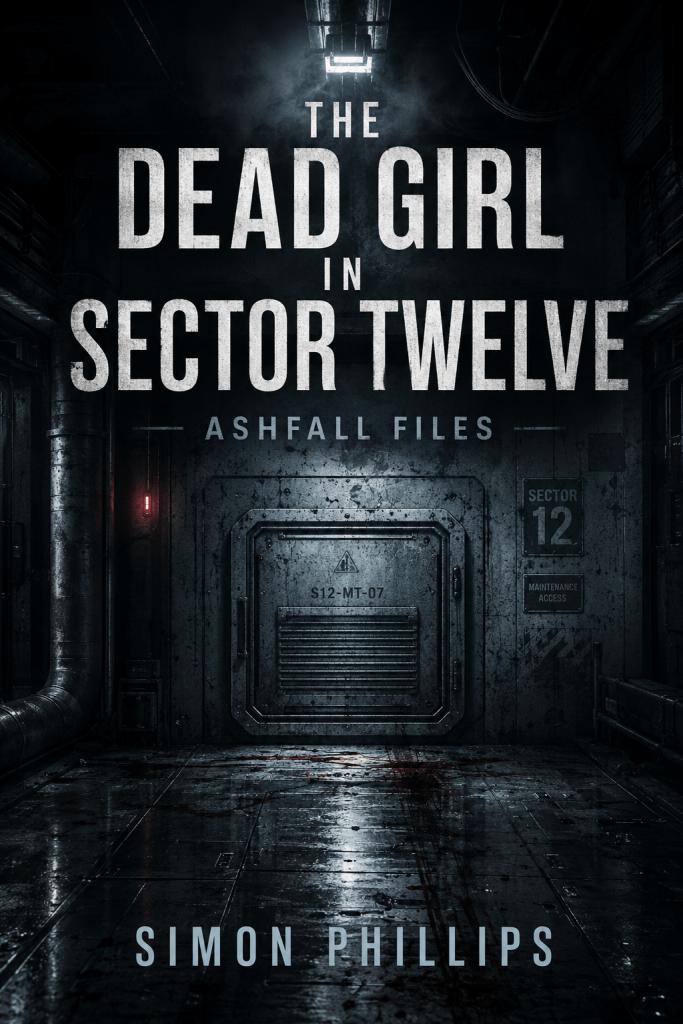
One such story unfolds aboard Ashfall Station, an ageing orbital installation whose corridors and industrial sectors form the setting for the science-fiction mystery novella Ashfall Station: The Dead Girl in Sector Twelve. What begins as a routine investigation gradually reveals that something hidden within the station’s structure may have been present for far longer than the official records suggest.
Readers who wish to explore the full investigation and its unfolding events can find the novella below.
Explore the book:
Ashfall Station: The Dead Girl in Sector Twelve
You can watch his YouTube channel here:
Author Simon Phillips
Continuing the Chronicle
The following Chronicle continues the reconstruction of the station-wide blackout that spread across Ashfall Station after cycles of minor power drift, relay irregularities, and unexplained sounds within the older sectors.
At first, the outage appeared to be one more failure within an ageing grid stretched beyond its intended life. Emergency systems restored partial function within minutes, and Fleet administration treated the disruption as severe yet manageable. Reports gathered across the rings told a darker story. During the period of darkness, workers and residents in widely separated sectors described the same metallic movement travelling through walls, floors, and sealed structural spaces absent from current schematics.
Later review placed this event among the earliest moments when Ashfall’s failing electrical systems and buried infrastructure seemed to move in concert. What vanished during those minutes was more than light. For those who stood inside the red emergency glow and heard the station shift around them, Ashfall no longer felt like a wounded industrial outpost. It felt as though something deeper had begun to answer.
Readers supporting The Future Chronicle can continue the record below.

Subscribe to continue reading
Subscribe to get access to the rest of this post and other subscriber-only content.
