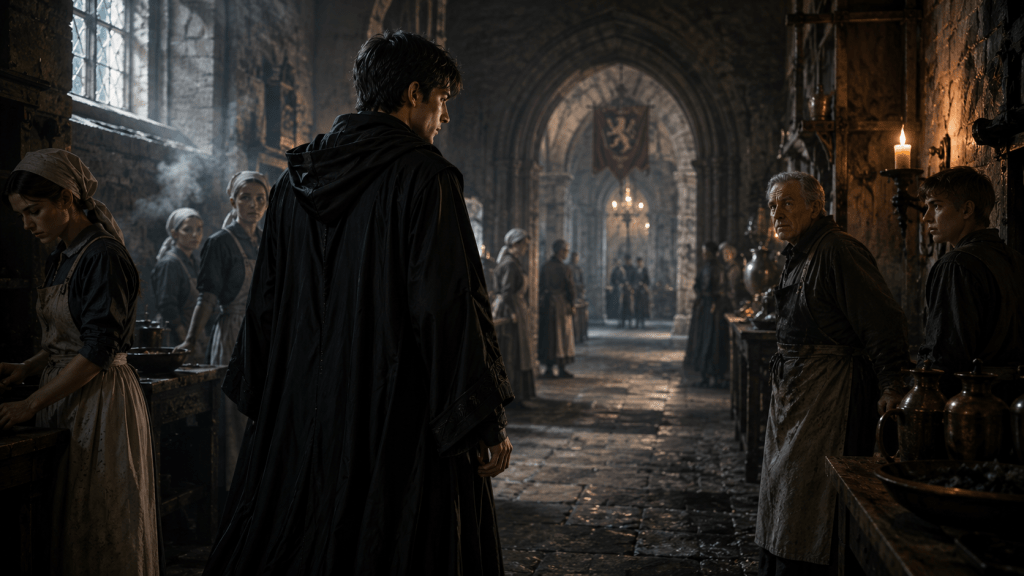
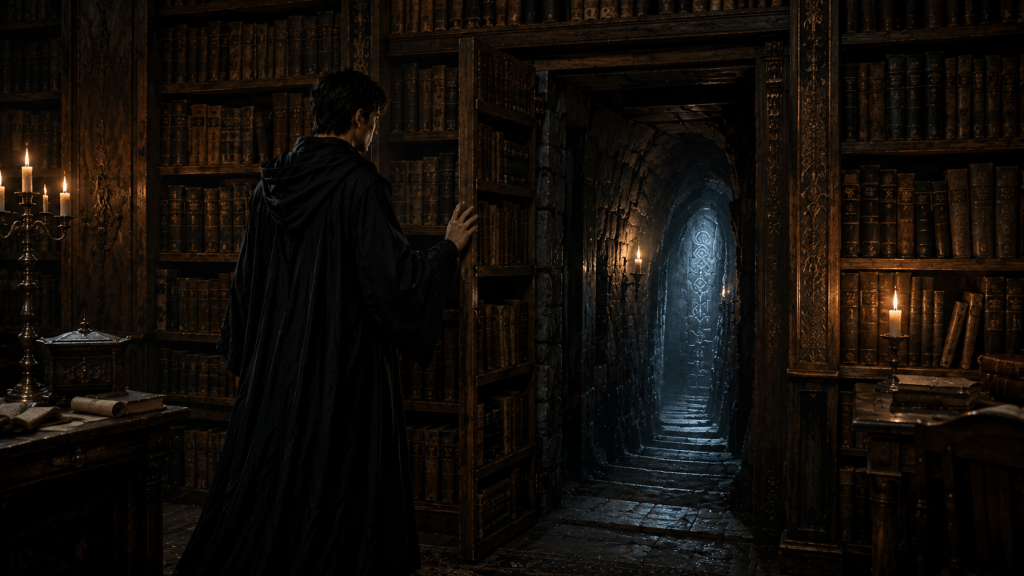
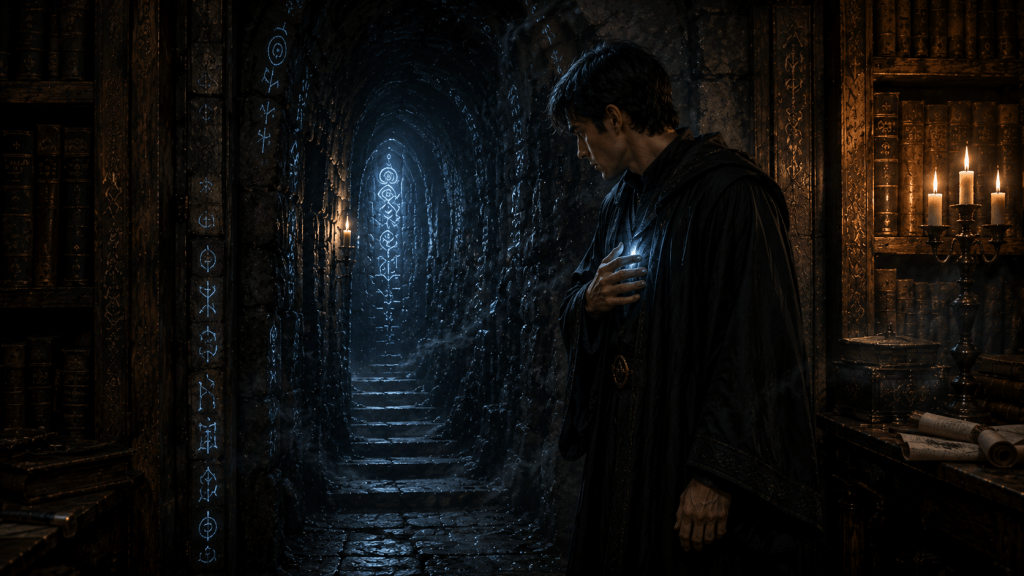
A chapel-side account of the morning Archbishop Alaric’s summons crossed the nave, and the old stones of Bremyra seemed to listen for what the Order might uncover beneath them.
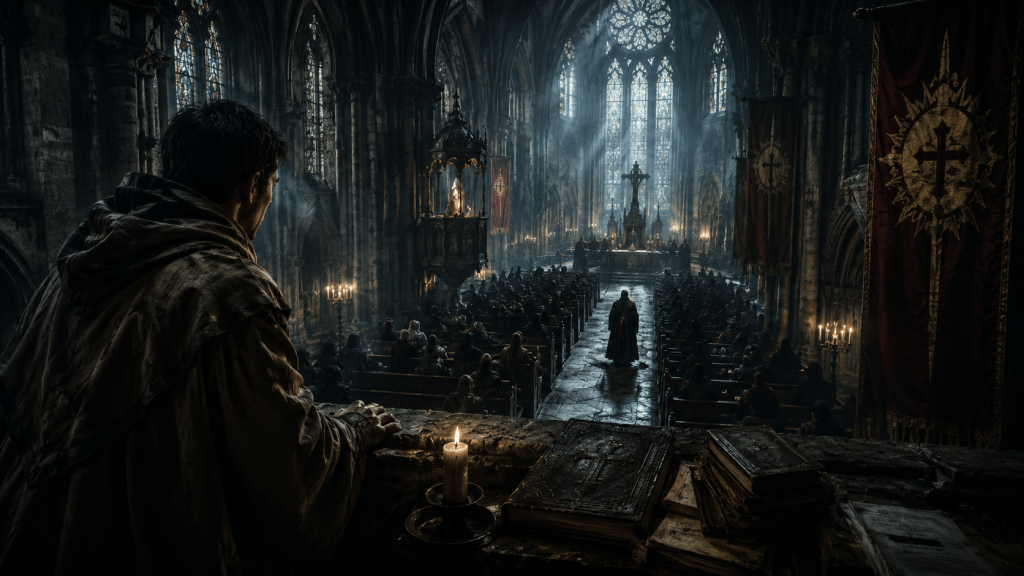
Beneath the Morning Incense
The cathedral bell sounded before Bremyra woke, carrying one low note across the roofs while snow clung to gutters and harbour mist folded against the lower streets. Within the cathedral, Sister Maelis rose by the vestry door and held the taper dish until the tremor passed from her fingers. The bell had been rung by order, three strokes at Prime, a signal reserved for early confession, royal death, or the Archbishop’s own summons, and those beneath the vaulted roof understood that the hour had been claimed for disturbance still held behind closed doors.
She moved along the side aisle with the quiet expected near the sanctuary before first prayer, her woollen hem brushing the cold flagstones while the saints watched from shadowed niches. The candles before Christiana’s image had burned unevenly through the night, three guttered low into cups of hardened wax, one drowned where any draught should have failed to reach, and one still holding a straight white flame that gave no smoke. Maelis marked such things because small traces formed the language of holy houses, and that morning the language of the cathedral felt changed.
Brother Halven entered from the cloister carrying fresh coals beneath a linen cover, his shoulders raised against the cold that had crossed the yard with him. Frost silvered the edge of his beard as he lowered the tray near the chapel brazier, and the first breath of charcoal warmth stirred through the incense-heavy air. “The Archbishop has called for the red book and the winter register,” Brother Halven said, keeping his voice low while his gaze moved towards the closed door beyond the altar screen. “He wants the side chapel cleared before the second bell, and the western candles lit, every one of them.”
Maelis looked towards the sealed door behind the altar screen, where Archbishop Alaric Thorne had already gathered his senior clerks. A line of light glowed beneath the threshold and trembled across the stone, broken now and again by shadows moving on the far side. “For confession?” Maelis asked as she adjusted the taper dish against her apron, although the hush around the sanctuary had already carried the answer ahead of her question. “For a letter,” Halven replied as he lifted the linen from the coals. “A sealed one, brought before dawn from the upper house.”
The upper house meant the manor of the Order, though no servant of the cathedral needed the name spoken aloud. Across Bremyra, certain words drew eyes when carried too freely, and the Order remained one of those old shapes people recognised first through silence. During the previous day’s duties Maelis had heard fragments drifting through the nave as merchants crossed themselves too often, pages whispered near the font, and an old woman paused before Christiana’s image to ask whether magicians still cast shadows like other men. A letter beneath gold wax had entered the castle. Fires had been lit at the manor above the city. A magician had returned to Bremyra, depending upon the mouth that carried the rumour.
The door behind the altar screen opened while Maelis trimmed the third candle, releasing warm light across the sanctuary as Archbishop Alaric stepped into view with two clerks behind him. His robes were immaculate, dark beneath the white stole, and the embroidered signs of Christiana’s blessing caught dull gold where candlelight touched them. His face held the cold control that made merchants lower their gaze and nobles choose their words with care, though Maelis saw the set of his jaw and the stillness of his hands.
He crossed the sanctuary slowly, pausing beneath the great hanging cross, and looked along the empty nave towards the western doors. “The cathedral will open through the south porch after Prime,” Alaric said, his voice carrying to every servant in reach while his gaze settled on no one. “Those seeking blessing may attend the lesser chapel. The nave remains clear until I give further instruction.” Brother Halven bowed over the coal tray. Maelis lowered the taper dish against her apron and bent her head. The younger clerk shifted the parchments in his arms and glanced towards the sealed red book resting upon the lectern beside the choir steps. Alaric saw the movement, and the clerk stilled beneath his eyes.
“Send Tamor to the manor,” Alaric said as one hand moved to the edge of his stole. “He will carry my summons in formal hand. No page from the castle. No royal servant. The Church will speak through its own door.” The words entered the nave and appeared to remain there, held between stone and incense. The Order had entered Bremyra by royal receipt, with manor, lodging, clerk, and seal. Alaric’s reply would come from the cathedral, carried under Christiana’s authority, and every servant who heard the instruction understood that the summons also drew a boundary.
Tamor arrived moments later from the lower sacristy, still fastening his cloak across his shoulder, a narrow young attendant who copied hymn sheets during Lent and delivered alms lists when roads lay clear. One clerk spread a strip of parchment across the small side table, and the Archbishop dictated in a voice so measured that each word seemed chosen from a store of sharpened things. The letter named the Lord Magician with ceremony, acknowledged his presence within Bremyra, and required his attendance at the cathedral before the morning advanced beyond its first offices. It offered welcome in form, summons in substance, and warning in the spaces between its lines.
Maelis kept her eyes lowered while the letter was sanded, folded, and sealed, though she marked every sound. The scrape of the clerk’s knife against wax. The crackle of parchment drawn into shape. The press of Alaric’s ring into red. The small intake of breath from Tamor when the sealed letter was placed against his palms. Outside, the city gave its first waking noises, carts in the lower street, hooves near the fountain, gulls crying somewhere towards the harbour. Inside the cathedral, those daily sounds arrived muted and distant, as if Bremyra had been lowered beneath a bell jar.
Tamor bowed and departed through the south porch with Halven beside him to lift the bar. Cold air entered in a bright blade, cutting through incense and candle warmth before the door closed again. Alaric remained before the altar, his eyes turned towards the western shadow of the nave, where the great doors stayed barred against the morning. Then he spoke again, still facing the doors. “The lower archive door is to remain locked. The reliquary passage also. No attendant enters the undercroft unless Brother Osric stands present with the key.”
Maelis felt Halven’s gaze lift across the sanctuary. The undercroft lay beneath the eastern chapels, a place of stone shelves, sealed reliquaries, old burial slabs, and records older than most families still named in the city. Its door had always remained locked except during feast preparation or episcopal inventory, yet the Archbishop’s instruction gave usual caution the shape of sudden urgency. One clerk made a note with a hand that scratched too quickly. Maelis folded the taper cloth once, then twice, drawing the corners together until the linen edge pressed into her palm.
The Archbishop turned at last, and his gaze moved across them, measuring servant, clerk, brother, flame, door, and shadow. “Bremyra has been kept by the mercy of Christiana and the discipline of her Church,” Alaric said as his hand rested against the red book on the lectern. “No visitor, however adorned by old authority, receives freedom among its holy places.”
By the time the first worshippers came to the lesser chapel, the nave had been cleared, the western candles had all been lit, and the undercroft key had been removed from its usual hook beside the vestry inventory board. Maelis marked the empty place, and the bare shape of it troubled her more than the sealed letter or the closed nave. A key absent from its place meant a door expected pressure.
When the second bell rang, its sound travelled down through the tower and shivered along the pillars, and for a breath the floor beneath the choir seemed to answer with a low, buried tremor too faint for certainty and too near for comfort. Halven looked towards Maelis from the brazier. She looked towards the eastern steps. The candles before Christiana’s image leaned together in their cups, every flame bending towards the sealed undercroft door as though listening to something below the stone. The formal register preserved only the early summons, the restricted nave, and the Archbishop’s reception of an Order magician under conditions of proper ecclesiastical authority. Yet among those who tended the side chapel, a quieter memory endured: that before the summoned man crossed the threshold, the cathedral had already drawn its keys close, gathered its candles, and turned its attention downward, as though the Church feared the Order might hear something under Bremyra that holy stone had long been keeping silent.
A Visual Chronicle
Before the summoned magician crossed Bremyra Cathedral’s threshold, its candles had already turned towards the sealed door beneath the choir.
Cathedral Register: The Eastern Undercroft
The cathedral of Bremyra held an eastern undercroft beneath the choir and lesser chapels, entered by a narrow stair behind the vestry screen and recorded in the oldest inventories as a place of reliquary storage, burial tablets, sealed church papers, and foundation stonework retained from the first raising of the sanctuary.
A winter entry from the episcopal register recorded that access to the lower archive, reliquary passage, and undercroft was restricted on the morning of Archbishop Alaric Thorne’s summons to the newly arrived servant of the Order, with the key removed from the vestry board and placed under Brother Osric’s charge until the close of the day.
The cause of the restriction was entered only as ecclesiastical caution during reception of arcane authority, though a lesser chapel copy preserved additional remarks concerning candle movement near Christiana’s image, unusual stillness beneath the choir steps, and a low tremor felt during the second bell.
The same copy stated that the nave remained clear until the Archbishop’s command, the south porch alone being opened for lesser blessing, while the western candles were lit in full and the red book was brought to the lectern before the summoned guest crossed the cathedral threshold.
Later copies treated the matter as ordinary clerical procedure, yet one marginal hand described the undercroft as “held against inquiry” during the hour of reception, a phrase later scraped from the formal register while remaining visible in the chapel duplicate beneath a thin wash of pale ink.
The undercroft was afterwards entered as secure, its locks restored, its passages accounted for, and its foundation stable, though the winter register gave unusual care to the position of the key, the presence of witnesses, and the condition of the sealed lower door.
About the Creator
The Mythic Chronicle is written and curated by Simon Phillips, a writer of mythic and speculative fantasy whose work explores forgotten kingdoms, fractured records, old institutions, and the moments when history begins to shift before those living through it understand what has changed.
The accounts preserved within these Chronicles form part of a wider body of work in which castles keep older secrets beneath familiar rooms, roads carry rumours ahead of armies, and ordinary witnesses preserve fragments of events whose true meaning remained sealed from them at the time.
One such account survives in a separate record, following the return of a magician to Bremyra during a season of court unease, royal absence, Church suspicion, and gathering danger beyond the kingdom’s roads. What the servants, clerks, and watchers of the city remembered only in fragments is followed more closely in The Unmarked Path, the opening book of The Veil of Kings and Gods within The Chronicles of the Spiral Realms.
Readers who wish to examine that fuller account may find the record below.
Read the Book:
The Unmarked Path
You can watch his YouTube channel here:
Author Simon Phillips

Continuation of the Record
What follows is taken from a later chapel account concerning the morning Archbishop Alaric Thorne sent formal summons to the newly arrived servant of the Order, while the eastern undercroft was placed under key and the cathedral nave held clear beneath the first offices.

Subscribe to continue reading
Subscribe to get access to the rest of this post and other subscriber-only content.