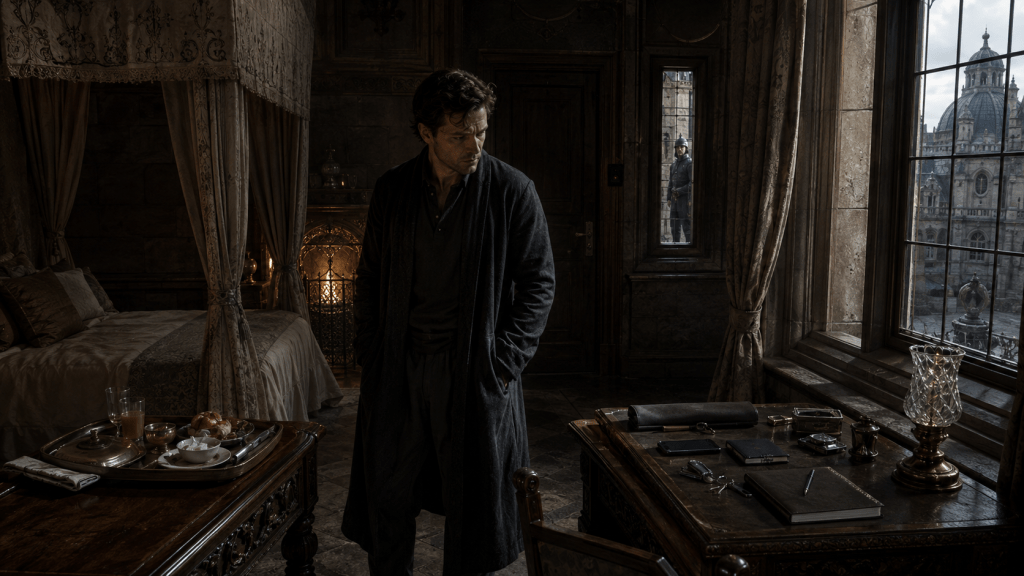
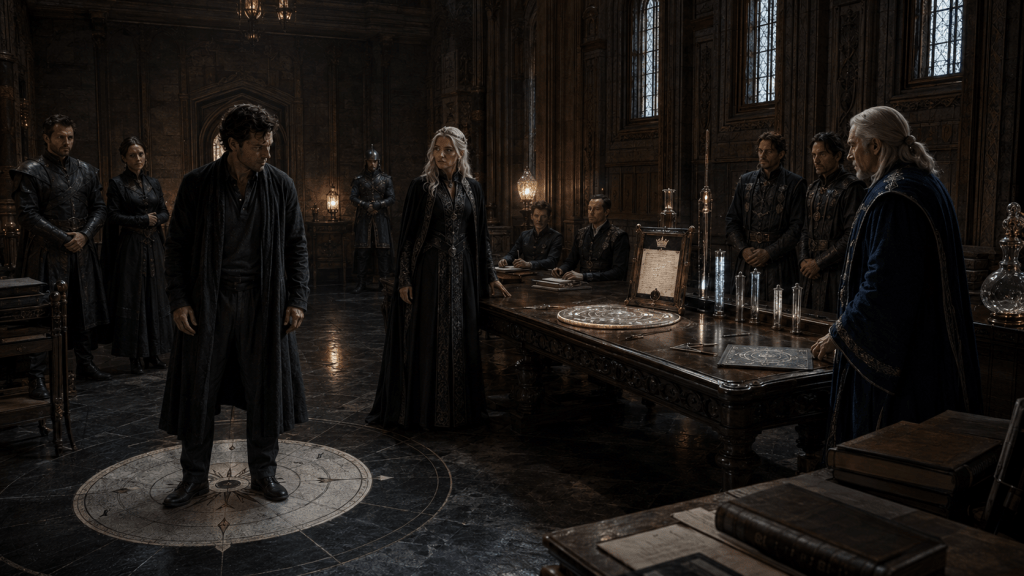
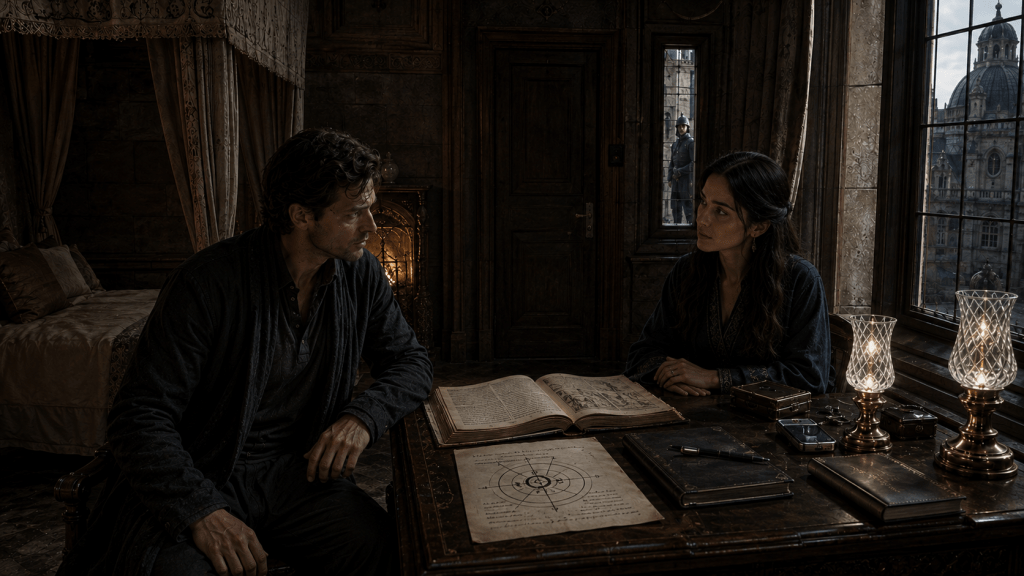
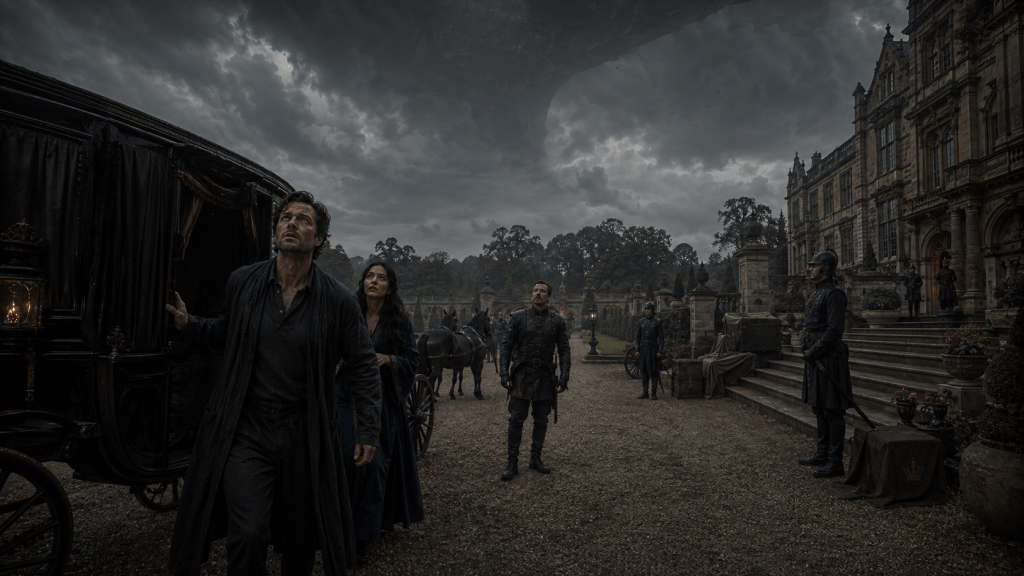
A castle-side account of the hour Princess Elana returned beside a fallen magician, and the bells of Bremyra carried whispers of golden light through every guarded hall.
When the Inner Court Answered
Rain had begun to gather in the inner courtyard before the evening bell, laying a dark sheen across the paving and drawing warmth from every archway beneath Bremyra Castle’s western wall. Servants crossed between kitchen, armoury, stable, and upper hall with shoulders raised against the weather, while guards changed watch beneath dripping banners whose blue cloth clung heavily around the carved beasts of the royal house. Beyond the gate passage, the city descended towards the harbour through roofs, smoke, and mist, its lamps appearing one by one as daylight thinned across the sea, and within the courtyard the castle continued through ordinary burdens carried under cover: bread, coal, sealed messages, folded linen, and broth sent towards the council rooms where Prince Patrick had remained since news came from the Vaeldring road.
Maren Saye had spent the afternoon moving between the lower laundry and the western guest chambers, carrying sheets warmed near the drying hearth because the household expected survivors before nightfall. She was broad through the shoulders, grey beginning at her temples, and trusted with work that required a steady hand around blood, birth, fever, or noble grief. Beside her hurried Nessa, a chambermaid in her first winter of service, whose arms were filled with rolled blankets tied by blue cord. The girl watched every messenger who crossed the yard, reading calamity in mud-dark boots and closed faces, until Maren caught her staring towards the eastern passage.
“Keep your eyes upon the stones beneath you,” Maren said as she guided the girl around a widening puddle, her voice carrying the firmness of long practice. “A broken ankle will serve the royal house poorly, even on a night when every whisper claims the kingdom has ended.”
Nessa tightened her grip around the blankets and glanced towards the gate, where two mounted guards waited beneath the arch. “My cousin came from Grey Ash before the third bell,” she said as she walked close beside Maren. “He swore the Princess’s carriage lay upon its side and the grass burned green beneath the rain.”
“Your cousin swore last harvest that a white stag drank ale from the cooper’s trough,” Maren answered as she mounted the shallow steps towards the west door, though her gaze remained upon the waiting riders. “Carry what your hands can prove. Leave the rest for those paid to write frightened things into ledgers.”
The door ahead opened before they reached it, and Master Vaynor emerged beneath the arch with a clerk, two household guards, and a physician whose leather case struck against his knee as he walked. Vaynor wore no cloak despite the rain blowing through the passage, and the controlled stillness of his face placed silence around him more effectively than any shouted order. He spoke briefly to the captain at the gate, then turned towards the servants crossing the yard.
“Clear the western stair and prepare the old queen’s chamber,” Vaynor said as his hand settled upon the folded warrant carried by the clerk. “Fresh water, warmed linen, two braziers, and every lamp filled. The passage from this court to the upper rooms remains open for the wounded alone.”
Maren lowered the sheets against her apron and bowed. “The linen is ready, Master Vaynor,” she said as rain gathered along the loose strands of her hair. “Shall the Princess’s rooms be opened as well?”
Vaynor’s gaze paused upon her, and something beneath his restraint revealed how little certainty the castle possessed. “Her Highness returns to her own chamber once the physicians release her,” he said as he folded the warrant more tightly. “Until then, the old queen’s room receives whoever reaches us first.”
The answer travelled through every servant who heard it. A groom near the stable lowered the bridle he had been oiling. The kitchen boy carrying broth stopped beneath the covered walk. One of the gate guards turned towards the eastern road, his hand resting upon the pommel of his sword. The castle had spent hours preparing for riders, litters, bodies, perhaps a shattered carriage brought home under guard. No order had spoken of uncertainty over who might arrive first.
Nessa moved nearer to Maren as they crossed beneath the arch. “They have no word of her,” the girl murmured, shaping the fear carefully while the household officers remained close. “They have lamps, beds, and physicians, yet no word.”
Maren set the linen upon the passage bench and began untying the blue cord. “Then give your hands to the work waiting before them,” she said as she passed two folded sheets into Nessa’s arms. “Fear grows quickest in idle fingers.”
They had reached the first turn of the western stair when the air changed behind them.
The sound came as a deep inward rush, as though the whole courtyard had drawn breath through its gates. Lamps under the arcade bent towards the centre stones, rain lifted in a pale circle from the paving, and every horse beneath the stable roof pulled hard against its tether. Maren turned with one hand upon the stair rail as pressure passed through the archway, closing her ears and pressing cold against the roots of her teeth. A cry rose from the yard, followed by the scrape of boots and the bright ring of a sword half drawn before recognition stayed the hand that held it.
Two figures stood where the courtyard had been empty.
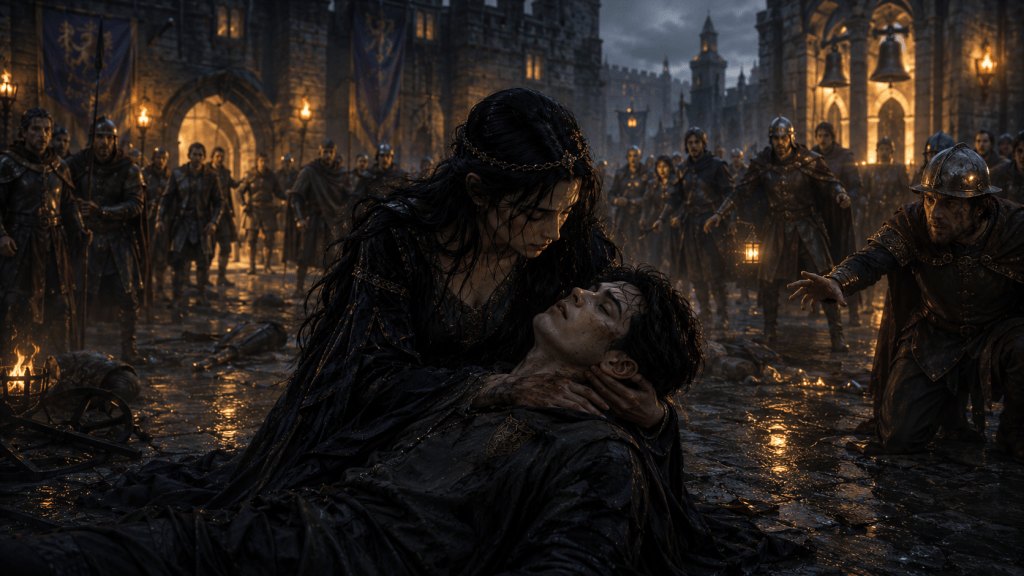
Princess Elana appeared first within the mind because midnight-black hair, torn court blue, and the silver clasp at her shoulder still carried royal identity through mud, ash, and rain. She leaned beneath the weight of the man beside her, one arm locked around his waist while his black robe hung scorched and wet around his legs. For a single breath they remained upright together, caught in the centre of the open court as guards, servants, clerks, and grooms stared across the stones. Then the magician’s knees failed, and Elana went down with him, turning his fall so his head came against her arm instead of the paving.
“Help me,” Elana called as she gathered him closer, her voice sharpened by exhaustion and command. “He is failing.”
Prince Patrick crossed the courtyard before the nearest guard had fully lowered his sword. He came from the council passage with his mantle unfastened and one hand bare where he had left his glove behind, his face altering as he saw his sister kneeling in the rain. He dropped beside her, reached once towards her shoulder, then drew his hand back as his gaze found the dark branching marks beneath Simion’s jaw.
“Elana, look at me,” Patrick said as he bent near enough to search her face while keeping the fallen man within sight. “Are you wounded?”
Elana lifted her eyes towards him, rain and ash streaking her cheeks as her hand remained beneath Simion’s head. “The blood on me belongs to others,” she said as she pressed two fingers against the magician’s throat. “Send for every healer in the keep. The poison has begun again.”
Patrick turned upon the gathered yard, and the brother who had reached for his sister vanished behind the prince required by the hour. “Physicians to the old queen’s chamber,” he ordered as he rose upon one knee. “Clear the western stair, close this court, and ring the inner bells for guarded return. Anyone carrying rumour beyond the gates answers to the crown.”
Master Vaynor pointed the waiting physician towards Simion, sent the clerk to bar the lower passage, and called two guards forward. “Maren Saye,” Vaynor said as he caught sight of her beneath the arch, his voice cutting through the rising confusion. “Take your linen upward. Keep the chamber ready and remove every servant who lacks direct purpose.”
Maren gathered the sheets while Nessa stood frozen beside her, the blankets sliding lower in her arms. “Move, child,” Maren said as she caught the bundle before it reached the wet flags. “You have seen enough to remember all your life. Give the rest of this hour room to pass.”
The physician knelt beside Simion and cut the robe away from the wounded shoulder, revealing flesh darkened around the broken shaft and veins stained like ink beneath the skin. His fingers hovered above the injury before he opened his case and drew out a narrow knife, waxed thread, and a packet of grey powder. Elana watched every movement, her posture held rigid through fatigue.
“He was struck beyond Grey Ash,” Elana said as the physician examined the wound, her hand closing around Simion’s cold fingers. “The arrow carried poison beneath the iron. It slowed once, then rose again when he brought us here.”
The physician looked towards her as rain traced the lines of his face. “What slowed it, Your Highness?” he asked while his thumb rested near the discoloured vein.
A stillness moved through those close enough to hear.
Elana lowered her gaze to Simion and drew his hand against the torn folds of her dress. “He fought it,” she said, each word quiet and controlled. “He remained alive long enough to bring us home.”
Patrick studied her for a breath, his expression carrying a question held behind royal discipline. He removed his mantle and spread the heavy wool across his sister’s shoulders, covering the ash, torn cloth, and blood upon her sleeves. “The rest waits until you are warm,” he said as he fastened the clasp beneath her throat. “Stay beside him if that is what keeps you standing.”
The guards lifted Simion upon a cloak stretched between their arms, moving with the care owed to a man whose life appeared to hang from every uneven breath. Elana rose beside them and swayed once before Patrick steadied her at the elbow. She refused the hand of the waiting maid and followed the litter towards the western passage, her black hair lying wet across the prince’s mantle while her gaze remained fixed upon the magician’s face.
The first bell sounded as they crossed beneath the arch, deep enough to shake rain from the stone tracery around the passage. A second answered from the inner tower, then a third from the ward beyond, each carrying the guarded signal across roofs and stairwells before spreading into Bremyra below. Servants paused in kitchens, galleries, laundries, and chapel aisles while guards closed doors whose bars had stood open since morning. Those in the courtyard watched the wounded magician disappear into the western stair beside the princess whom the road had already given up to rumour, and each person carried away a different memory of the return.
Nessa stood near the bench with one blanket held against her chest. “They came from the empty stones,” she said as Maren gathered the remaining linen. “No gate opened. No horse brought them. They were simply there.”
Maren looked across the rain-dark paving where water had already begun smoothing every mark around the place of their arrival. “Then speak only of what your own eyes held,” she said as she took the blanket from the girl and turned towards the stairs. “A princess came home. A wounded man came beside her. The bells rang after.”
Above them, the western passage filled with feet, commands, the clatter of basins, and the opening of a chamber long kept for royal illness. Below, the courtyard settled beneath rain and guarded silence, while the bells continued over Bremyra, carrying news farther than any officer could follow and giving the city a shape for its wonder before the castle had chosen which part of the truth it could safely preserve.
A Visual Chronicle
The gates stayed closed, the bell rang by itself, and beneath a sealed chamber door Bremyra witnessed a light the castle refused to name.
Castle Register: The Guarded Return
The inner courtyard of Bremyra Castle was entered in the household record as the place where Princess Elana and the Lord Magician appeared following the breaking of the royal escort beyond Grey Ash Rise, their arrival being recorded after the evening watch while the western gate remained closed and no mounted party had crossed the outer ward.
The first entry named the Princess as conscious, clothed in torn court blue, and supporting the magician when his strength failed upon the paving. He was carried to the old queen’s chamber under physician’s care, with darkening around an arrow wound, corruption visible beneath the skin, and repeated failure of breath noted among the signs observed before the chamber doors were secured.
Three bells were rung under the guarded-return signal, beginning in the inner tower and passing through the lower ward before the household order could be fully distributed. The register attributed the ringing to the safe recovery of royal blood, though several service copies stated that the bells began while uncertainty remained over whether either returned traveller would survive the hour.
No official witness described magic within the courtyard. A separate servant account, copied in a hand later removed from the western chamber roll, referred to a fading warmth around the Princess’s hands and a pale gold stain seen upon the magician’s torn robe. The same account stated that the colour vanished beneath rain before any physician entered the court, leaving no mark upon cloth, stone, or skin that could be preserved for examination.
The Princess was recorded as unharmed beyond exhaustion, smoke exposure, and blood belonging to other persons, while questions concerning the poisoned wound were deferred under royal authority. Later copies reduced the incident to the return of two survivors through arcane passage, though one damaged margin retained the phrase brought home by forbidden light, written beside the bell entry and scraped away before the household register was sealed.
About the Creator
The Mythic Chronicle is written and curated by Simon Phillips, a writer of mythic and speculative fantasy whose work explores forgotten kingdoms, fractured records, old institutions, and the moments when history begins to shift before those living through it understand what has changed.
The accounts preserved within these Chronicles form part of a wider body of work in which castles keep older secrets beneath familiar rooms, roads carry rumours ahead of armies, and ordinary witnesses preserve fragments of events whose true meaning remained sealed from them at the time.
One such account survives in a separate record, following the return of a magician to Bremyra during a season of court unease, royal absence, Church suspicion, and gathering danger beyond the kingdom’s roads. What the servants, clerks, and watchers of the city remembered only in fragments is followed more closely in The Unmarked Path, the opening book of The Veil of Kings and Gods within The Chronicles of the Spiral Realms.
Readers who wish to examine that fuller account may find the record below.
Read the book:
The Unmarked Path
Explore the wider saga:
The Chronicles of the Spiral Realms
You can watch his YouTube channel here:
Author Simon Phillips

Chronicle Record: The Bells Behind the Door
The western stair received them beneath a confusion of rainwater, lamp smoke, hurried feet, and orders repeated so quickly that each voice seemed to carry fragments of three others. Maren climbed ahead with the warmed linen held against her breast, while Nessa followed close enough for the blankets in her arms to brush the older woman’s back whenever the press of guards narrowed around them. Above, the old queen’s chamber stood open for the first time since the fever winter, its carved doors drawn wide, its bed stripped and remade beneath the hands of servants who worked with their eyes lowered towards the coverlet, as though the room itself might punish curiosity.
Two guards bore Simion through the doorway upon the stretched cloak. The physician walked beside them with one hand against the magician’s throat, counting each weak beat beneath his fingers, while Princess Elana kept pace at the other side, rain dripping from the ends of her midnight-black hair and Prince Patrick’s mantle hanging heavily around her shoulders. Patrick followed close enough to catch her when the strain in her steps drew her towards the wall, though she straightened before his hand reached her.
“Place him near the fire, away from the window,” the physician said as he swept instruments from the bedside table and opened his case upon the cleared wood. “Maren, bring every linen strip you have. Nessa, fetch boiled water from the western brazier and carry it level, because spilled heat will serve us poorly.”
Nessa lowered the blankets on the bench and fled with both hands gathered beneath her apron. Maren crossed to the bed, spread one sheet over the mattress, then helped the guards lower Simion upon it. His face had turned grey beneath the soot and rain, while the dark veins around his wound reached towards his neck in branching lines that appeared to deepen whenever his breath faltered.
Elana stood at the bedside with one hand fixed upon the carved post. “The arrowhead came free in the field,” she said as the physician cut through the scorched robe. “A piece may remain beneath the flesh.”
The physician glanced towards her, his knife held above the wound. “Your Highness saw its removal?” he asked as he leaned closer to the darkened opening.
“I felt it leave him,” Elana said as her fingers tightened around the bedpost. “He had already grown cold.”
Patrick watched her from the hearth, where rain steamed faintly from his sleeves. “You carried him from the hollow?” he asked as he stepped nearer, keeping his voice low while servants moved around them.
Elana turned her face towards her brother. Weariness had hollowed the skin beneath her eyes, yet the gaze she gave him remained steady. “He came for me,” she said as her free hand settled over the torn cloth near her heart. “I kept him alive long enough to bring us home.”
The words held more than the room received. Maren heard it in the silence that followed, in the physician’s brief stillness, and in the way Master Vaynor closed the chamber doors until only a narrow space remained for servants carrying water, coal, and bandages. Outside, the guarded-return bells continued through the castle, their deep voices crossing one another above the roofline until the stone beneath Maren’s feet seemed to remember each stroke.
Nessa returned with the basin braced against her hips. Steam touched her frightened face as she approached the bed. “The water is fresh from the brazier,” she said while lowering it to the stand with careful hands. “Mistress Arven sent willow bark, honey, and a pot of broth in case either wakes hungry.”
Maren took the cloth from the basin and pressed it into the girl’s palms. “Hold this near the physician’s hand and watch his fingers,” she said as she unfolded the first linen strip. “He will ask before your fear has time to understand him.”
The physician cleaned the wound until the water clouded red and grey. Simion stirred once beneath the cloth, his back arching as a sound escaped him through clenched teeth. Elana moved before anyone else, placing both hands around his wrist and speaking his name close to his ear.
“Simion, remain here,” she said as her thumb pressed against the pulse below his palm. “You have crossed enough distance for one night.”
The dark veins near his throat appeared to throb beneath the skin. The physician drew back, touched the stain with two fingers, then lifted his hand towards the lamp. “The poison is moving again,” he said as he reached into his case for a narrow glass vial. “I can slow fever and keep the wound open, though this corruption answers poorly to the remedies I carry.”
Patrick turned towards Master Vaynor near the doors. “Send for the cathedral healers and the Order manor,” he said as one hand closed over the wet edge of his sleeve. “Use separate messengers. Each carries only the need for aid.”
Vaynor inclined his head, then held the door while a guard stepped into the passage. “The lower halls remain sealed until the household account is agreed,” he said as he passed the instruction onward. “Anyone who saw the arrival waits under watch, and every servant leaving this floor gives a name to the clerk.”
Elana’s head lifted sharply. “The Archbishop stays beyond this chamber,” she said as her hand remained around Simion’s wrist. “Send his healer if one comes. His Grace waits elsewhere.”
Patrick looked towards her, and Maren saw the prince’s concern harden into caution. “The Church will ask why,” he said as he moved to the other side of the bed.
“Then give him the poisoned arrow and the bodies upon the road,” Elana replied as she drew Patrick’s mantle closer around herself. “He has enough questions for one evening.”
A bell sounded directly above them, nearer and heavier than the others, and dust slipped from the carved beam across the ceiling. Nessa started, spilling a few drops from the cloth onto the floor. Maren steadied the girl’s wrist before the physician turned.
“That bell belongs to the old queen’s passage,” Nessa whispered as she looked towards the shuttered window. “It has stayed silent since her burial.”
Maren followed the sound into the stones. “A rope runs through the western gallery,” she said as she folded another strip. “Some guard has pulled the wrong line in haste.”
“The western gallery was barred at sunset,” Nessa answered as she lowered her voice further. “My brother keeps lamps there.”
Maren gave the girl a look that placed work above wonder, though the bell’s fading tremor remained in her bones. Across the chamber, Simion’s breathing ceased for the length of one terrible pause. The physician bent over him, pressed both hands against his chest, and called for the grey powder. Elana moved close enough that her hair fell across the pillow, hiding part of Simion’s face from those standing at the foot of the bed.
“Open your eyes,” Elana said as her voice broke against the final word. “You heard me in the field, and you will hear me here.”
The physician mixed powder into water and tried to pass it between Simion’s lips. Most ran across his cheek. Patrick held his shoulders while Maren placed fresh linen beneath his head, and Nessa stood with the lamp lifted above them, its flame shaking inside the glass.
Then Elana asked them to leave.
Her voice carried little strength, yet the room answered as if royal command had entered through a trumpet. “All except the physician and my brother,” she said as she rose beside the bed, one hand resting on the mattress for balance. “Master Vaynor will keep the passage. Maren, wait beyond the door with water and cloth.”
The physician looked from Simion to the Princess. “Your Highness, every hand here has purpose,” he said as he closed his fingers around the glass vial.
Elana met his gaze. “Then your purpose remains,” she replied as she lifted her chin. “The others have heard enough fear for one chamber.”
Patrick studied his sister for several breaths before turning towards the servants. “Do as she asks,” he said as he drew a chair beside the bed. “Maren, keep the passage clear. Nessa stays with you.”
Maren collected the stained basin and guided Nessa through the doors. Master Vaynor drew them shut until the iron latch settled, leaving the corridor divided between torchlight, waiting guards, frightened servants, and the muffled labour continuing beyond the carved oak. The old queen’s passage had once been among the quietest places in the castle, a narrow gallery of faded tapestries and tall windows overlooking the western wall. That evening it filled with people who tried to occupy less space than their bodies required.
A cathedral healer arrived first, an elderly brother named Calven whose white robe showed rain along the hem. Master Vaynor received him near the stair and spoke in a voice too low for the gathered servants, though the brother’s answer travelled clearly.
“Poison of foreign making falls under body and spirit alike,” Calven said as he held a leather satchel before him. “His Grace sent prayer oils, bitter root, and instruction that the wounded man’s condition be witnessed under Church seal.”
Vaynor kept one hand upon the chamber latch. “The oils and root may enter,” he said as his gaze settled on the satchel. “The seal waits until Prince Patrick requests it.”
Brother Calven’s face tightened beneath the passage lamps. “A magician lies near death inside a royal chamber, Master Vaynor, while the Princess returned from a road where fire crossed wet earth. The Church has cause to witness.”
“The crown has cause to preserve life before argument begins,” Vaynor replied as he accepted the satchel and passed it to Maren. “You will wait in the western solar, where warmth and wine have been prepared.”
Calven looked towards the closed doors, then towards the old bell rope hanging untouched beside the window arch. “Your bells speak beyond every seal you place,” he said as he gathered his wet sleeves. “By morning the city will have chosen its own witness.”
A second messenger arrived from the Order manor with no healer beside him, carrying a cedar box marked by a plain black seal. He bowed to Vaynor and placed the box upon a small table near the door.
“The house held no physician of the Order,” the messenger said as he removed his rain-dark hood. “Master Verlan left these remedies under instruction for wounds touched by corrupted iron. The note says the black vial serves last, once ordinary measures fail.”
Vaynor opened the written instruction, read it twice, and passed it through the narrow space beneath the door. A hand took the paper from within. The latch closed again, and the corridor returned to waiting.
Time lost its clean divisions after that. Servants carried fresh water upward and red water down. The bells ceased one by one across the castle, leaving the western tower last, its single repeated stroke separated by long spaces of rain. Guards changed at the stair. Brother Calven remained in the solar with his prayer oils unopened. Nessa sat upon the bench beside Maren and stared at the line of light beneath the chamber door.
“What happens to a woman who carries magic?” she asked as she kept her hands folded tightly in her apron.
Maren turned towards her. “You have seen no such woman,” she said as she rested the cedar box across her knees.
“I saw the Princess in the court,” Nessa replied as her gaze stayed upon the threshold. “Her hands were warm enough to steam in the rain.”
“You saw fear, blood, and a journey ending upon wet stone,” Maren said as she reached across and covered the girl’s fingers. “Memory takes strange shapes when rank, grief, and magic stand together. Choose carefully which shape you feed.”
A pale glow gathered beneath the door.
At first Maren took it for firelight shifting across the chamber floor, though the hearth lay beyond the bed and cast amber through the lower crack. This light came softer and clearer, the colour of winter sun passing through old gold glass. It spread along the threshold by the width of a hand, touched the toes of Master Vaynor’s boots, then strengthened until every scratch in the oak appeared edged in pale radiance.
Nessa drew breath through parted lips. One guard crossed himself. The second stepped away from the door, his spear held close against his shoulder. From inside came no cry, no physician’s order, and no movement of furniture, only a low sound like breath released after pain had held it too long.
Brother Calven appeared from the solar and stopped beneath the arch. “Open that chamber,” he said as he gripped the prayer cord at his waist. “Whatever moves inside falls under holy witness.”
Vaynor placed himself before the latch. “You will remain where the Prince set you,” he said as the golden line brightened across the floor.
The final western bell rang above them.
Its sound rolled through the passage, entered the chamber door, and seemed to return from the other side in a softer vibration felt through wood, iron, and stone. The light faded with it, drawing inward until the threshold held only ordinary amber from the hearth. For several breaths the whole passage remained still.
The latch lifted.
Patrick opened the door far enough to step into the corridor. His face carried the exhaustion of a man who had watched death approach someone he had only begun to trust. Behind him, the physician bent over Simion while Elana sat beside the bed with her head bowed and both hands hidden beneath Patrick’s mantle.
“He breathes more strongly,” Patrick said as he looked first to Vaynor, then to those gathered beyond. “The corruption has withdrawn from his throat. The chamber remains sealed until morning.”
Brother Calven advanced one step. “By what remedy?” he asked as his eyes moved past the prince towards the bed.
Patrick drew the door closer behind him. “By every remedy offered under this roof,” he said as his hand stayed upon the latch. “That is the account the castle will keep.”
The prince returned inside, and the doors closed again.
By dawn, three versions had already travelled beyond the western stair. One claimed the Order’s black vial had pulled the poison from Simion’s blood. Another placed Brother Calven inside the chamber, praying over the magician while a saint’s light filled the room. The third spoke only of Princess Elana, her hidden hands, and the old bell answering above her while death loosened its hold.
Maren gave no judgement when the household clerk asked for her statement. She recorded the arrival, the wound, the physician’s labour, the sealed chamber, and the light seen beneath the door. Nessa gave the same account in fewer words, though her hand trembled when she reached the final line. Beyond the window, Bremyra woke under rain and bells, while the castle kept its doors closed around a truth already escaping through every servant passage, chapel stair, guardroom, and kitchen hearth.
The official copy later declared that the Lord Magician survived through swift treatment, royal care, and remedies sent from both Church and Order. The lesser record preserved one further detail: when Elana left the chamber after sunrise, her hands remained hidden within her sleeves, and the servants nearest the door stepped aside as though warmth still moved around her, carrying a colour none among them felt safe enough to name.
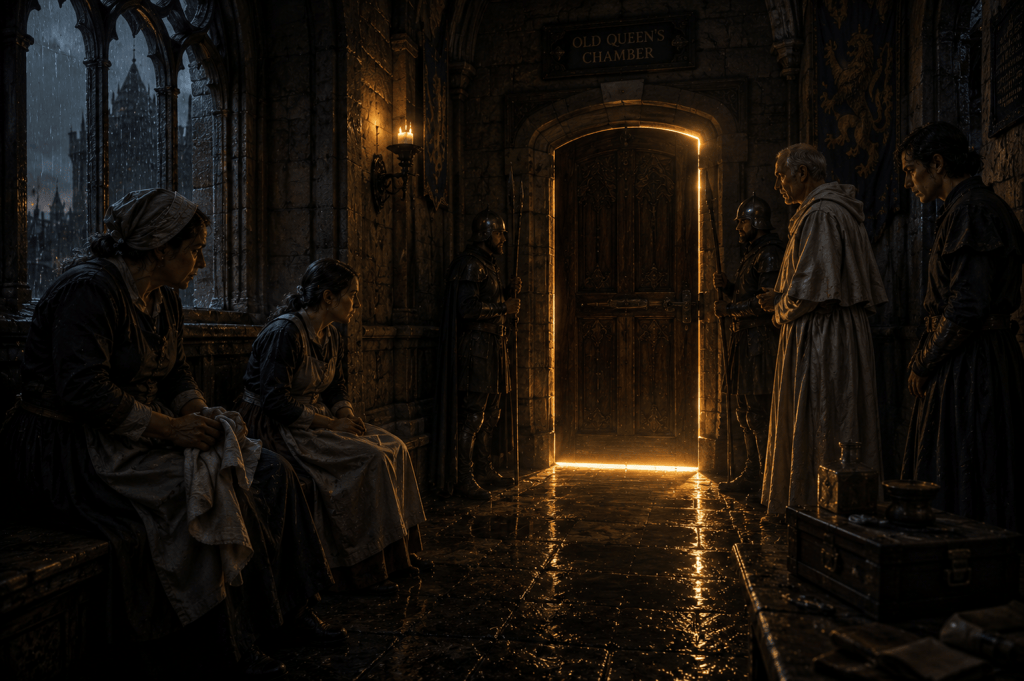
Golden light gathered beneath the old queen’s chamber while guards, servants, and a waiting Church witness stood beyond the sealed door, each carrying away a different account of what had passed inside.
The Idea Behind the Chronicle
A castle rarely keeps panic within the room where it begins. A wounded man may lie behind one guarded door, a princess may speak only to those she trusts, and a prince may order every servant to silence, yet fear travels through stone by older routes. It passes beneath doors, along stairwells, through kitchens, chapels, guardrooms, and servant corridors, gathering shape each time another witness carries it onward.
This Chronicle draws upon that movement of rumour through a royal household. Simion and Elana returned to Bremyra after the broken road, appearing within the inner court while the gates remained closed and the castle still waited for riders bearing news of their fate. Those present saw a princess stained by blood and ash, a magician failing in her arms, and a courtyard thrown suddenly into motion. They saw no clear miracle, though the manner of the return gave ordinary explanation little ground upon which to stand.
The bells became central because bells carried authority beyond sight. They announced death, danger, worship, victory, and royal arrival, shaping the meaning of an event before most listeners had learned what had happened. In this account, the guarded-return signal passed across Bremyra while uncertainty remained inside the castle. The city heard that royal blood had come home, while those nearest the western chamber still feared that the magician might die before morning.
Across old household records, moments of healing often become divided between official language and servant memory. Physicians write of wounds, fever, remedies, and recovery. Clerks preserve names, hours, and sealed orders. Those waiting beyond the chamber remember different details: light beneath a door, warmth where no brazier stood, a bell moving above an empty passage, or a patient’s breathing strengthening after every known treatment had failed. Such fragments endure because each stands close enough to truth to resist dismissal, while remaining too incomplete to form proof.
The secrecy surrounding Elana deepens that uncertainty. Within the world of Bremyra, a woman carrying magic would face more than fear. Her gift would challenge the authority of the Order, disturb the Church, and place the royal house beneath scrutiny at the very hour when the kingdom already stood under strain. The castle therefore had reason to protect her, while those who witnessed traces of golden light had reason to guard their words. Silence became an act of loyalty for some, fear for others, and invitation for rumour among those left beyond the door.
The Sealed Road of Bremyra follows a kingdom learning that events can return home before their explanations do. The road had already produced burned grass, poisoned bodies, missing tracks, and conflicting testimony. When Simion and Elana appeared inside the castle, the uncertainty of the field crossed the walls with them. The danger no longer belonged to a distant bend beyond Grey Ash Rise. It entered the royal household, passed beneath a chamber door, and found a voice in the bells above.
This Chronicle therefore turns away from the visible act of healing and preserves what the castle remembered around it. Servants carried linen and water. Guards closed passages. A Church witness waited beyond the room. Prince Patrick chose which account the household would keep, while a different account had already begun moving through the lower halls. By sunrise, the official record spoke of physicians, royal care, and remedies sent under seal. The quieter record remembered golden light, hidden hands, and bells that seemed to answer before anyone dared name what had occurred.
From the Author’s Desk
Thank you for continuing into this Chronicle.
This account was shaped around the way a single event can divide into several remembered truths before the people closest to it have even left the room. Simion and Elana returned to Bremyra carrying the marks of the broken road, yet the castle received only fragments: a wounded magician, a princess beneath a bloodstained mantle, bells sounding across the inner ward, and a guarded chamber where recovery came under questions no servant could safely ask.
The western passage allowed the Chronicle to remain beyond the hidden truth. Those waiting outside saw light beneath a door, heard the old bell answer above them, and watched Prince Patrick decide which version of the night would enter the royal record. Their testimony preserved the uncertainty surrounding Elana, whose actions had to remain concealed in a world where her gift could place her beneath the judgement of both Church and Order.
Across The Sealed Road of Bremyra, each Chronicle has followed the people and places left at the edges of Simion’s path: servants reopening an abandoned manor, clerks receiving sealed authority, chapel attendants guarding old foundations, road keepers recording vanished travellers, and watchmen trying to give lawful shape to burned fields and foreign violence. Their accounts remain incomplete, yet together they reveal a kingdom beginning to understand that its familiar walls can no longer keep older powers at a distance.
Beyond the Chronicle, The Unmarked Path follows these events more closely, entering the lives of Simion, Elana, Patrick, and those whose choices shaped the first turning of the wider conflict. The Chronicle preserves what Bremyra believed it witnessed. The book carries the reader nearer to the truth hidden behind those records.
Readers who wish to explore further may find my books and continuing visual Chronicles through the links included below.
You can explore my books here:
Books by Simon Phillips
You can watch my YouTube channel here:
Author Simon Phillips
Archive & Interpretations
Fragment from the Archive
From the sealed western household folios of Bremyra Castle, copied during the reign of King Cedric. The surviving leaves show several changes of hand, with portions of the chamber account darkened by later ink and one witness line removed from the lower edge.
The guarded-return bells were rung after the Princess entered the inner courtyard in the company of the Lord Magician, though the outer gate remained secured and the watch stationed beneath the western arch recorded no rider, carriage, escort, or messenger passing through the ward before their appearance upon the stones.
The Princess was entered as conscious and capable of speech, her clothing damaged by travel, smoke, and blood belonging chiefly to others. The Lord Magician was recorded as wounded beneath the shoulder, weakened by a preparation carried upon foreign iron, and unable to remain standing after reaching the court. He was taken under royal protection to the chamber once kept for the old queen during her final illness, where the household physician received him under closed authority.
The chamber doors were sealed after the first examination. Prince Patrick, Princess Elana, the royal physician, and two attendants were named within the earliest copy, though one attendant’s name was later removed and the second reduced to a mark beside the linen count. Servants assigned to the passage carried boiled water, clean cloth, lamp oil, willow bark, bitter root, and remedies delivered from the upper Order house, while a healer sent from the cathedral remained beyond the threshold under instruction from the Master of Court.
The physician’s first entry described blackening beneath the skin, repeated weakness of breath, and a corruption that had resumed its movement after the wounded man entered the castle. A later line stated that ordinary measures brought limited response, though the hand responsible for this sentence differed from the physician’s own script and appeared to have been added after the folio was bound.
Near the final western bell, those stationed outside the chamber observed light beneath the door. The colour was recorded in three surviving copies as pale gold, old amber, and winter brightness, while the formal household duplicate described only an increase in hearth illumination caused by movement within the room. The passage lamps remained unchanged during the same interval, and the brazier positioned outside the chamber showed no rise in flame.
One guard testified that warmth travelled across the threshold and reached the opposite wall. A servant seated near the western window stated that the stone beneath her shoes became warm while rain continued against the glass. The cathedral healer referred to the light as a matter requiring sacred witness, though the Master of Court refused entry until the Prince himself opened the door.
The bell above the old queen’s passage sounded once while the rope remained untouched. Its movement was confirmed by two guards and one servant, though the tower clerk later amended the occurrence to an error arising from strain within the upper mechanism. The old bell had received no maintenance since the queen’s burial, and the line recording its condition ended before any inspection result was entered.
When Prince Patrick emerged from the chamber, he declared that the wounded man’s breathing had strengthened and that the corruption had withdrawn from his throat. He named the recovery as the result of combined treatment, royal care, and remedies supplied under Church and Order authority. No further cause was entered within the sealed account.
Princess Elana left the chamber after sunrise with her hands concealed inside her sleeves. Several servants recorded warmth around her passage, while one younger witness described a faint gold colour along the edge of the cloth near her wrists. The statement was crossed through in the formal copy, and the witness was transferred from the western rooms before the next household rotation.
The final entry named the Lord Magician alive, the Princess restored to her own chamber, and the western passage returned to ordinary service. The household was instructed to preserve a single account of the night, though the order itself survives in four differing forms, each carrying a separate explanation for the light beneath the door.
Marginal Notes & Interpretations
Collected from later annotations written along the outer edges of the same folio.
One marginal hand attributed the light to the opening of the chamber fire after fresh coal had been added, suggesting that polished metal, wet stone, and movement around the bed enlarged the glow beyond its ordinary appearance. The writer gave no account of why the light travelled beneath the door in a narrow, steady line while the hearth stood across the room.
A second annotation connected the recovery to an Order remedy delivered in a sealed cedar box. According to this interpretation, the foreign poison reacted visibly when met by arcane medicine, producing warmth and coloured vapour before withdrawing from the wounded man’s blood. The inventory of the box recorded four vials, three of which remained sealed when returned to the upper manor.
A cathedral note, copied beside the physician’s entry, argued that the light belonged to Christiana’s mercy and that the old queen’s bell answered the passage of healing through a chamber once dedicated to suffering. A later Church hand softened this claim, replacing certainty with the phrase possible grace witnessed under royal distress.
Another annotation challenged both Order and Church accounts, stating that the Princess alone remained beside the wounded man when the light reached its greatest strength. The writer referred to heat around her hands, a gold stain upon the inner sleeve, and a servant’s report that the magician answered only after she spoke his name. The final words of the note were scraped deeply enough to damage the page beneath.
A fifth hand, smaller and pressed close to the binding, warned that any claim concerning the Princess carried danger for the witness. It stated that women accused of arcane practice fell under Order judgement, while royal blood offered protection only so long as the crown denied the accusation. The writer advised silence, then added that silence had already allowed the rumour to spread more widely than open testimony might have done.
The faintest surviving note appeared beside the record of the bell. It contained only one line:
The sound came after the light, as though the castle answered what the household refused to name.
World Notes
The Old Queen’s Chamber
A royal sickroom within the western passage of Bremyra Castle, maintained after the death of King Cedric’s mother and opened only during severe illness, childbirth, or injury involving members of the royal household. Its position near the inner courtyard allowed wounded persons to be carried from the ward while avoiding the public halls.
The chamber retained its own hearth, water closet, physician’s table, prayer niche, and bell line connecting the passage to the western tower. Household records treated it as a place of privacy and royal protection, though servant copies frequently associated it with final vigils, unanswered prayers, and illnesses concealed from the wider court.
The Guarded-Return Bells
A three-bell signal used when members of the royal house returned under danger, injury, or uncertain circumstance. The first bell belonged to the inner tower, the second to the lower ward, and the third carried the signal towards the city-facing wall.
The signal announced the return of royal blood while withholding details concerning condition, threat, or survival. Its use often produced rumour before formal proclamation, since citizens heard the bells long before clerks completed the court account.
Closed-Chamber Authority
A household order allowing Prince Patrick or the Master of Court to seal a royal chamber against servants, guards, clergy, and visiting officials. The order protected privacy during medical treatment and prevented competing institutions from claiming authority over a wounded member of the royal household.
During the guarded return, this authority kept the cathedral healer outside the old queen’s chamber and limited the number of witnesses able to speak directly about Simion’s recovery.
Golden Healing Rumour
A phrase found in servant copies, chapel notes, and later court gossip concerning warmth or pale light associated with recovery from grave injury. Official records usually attributed such accounts to lamplight, prayer, fever, or arcane medicine supplied by recognised practitioners.
Within the sealed western folios, the phrase appeared only once in full. It was written beside Princess Elana’s name and later removed so heavily that the fibres of the page remained broken around it.
Next Chronicle
In the days after the guarded-return bells sounded across Bremyra, further reports reached the castle from the north, carried by riders whose accounts spoke of smoke above Vaeldring, emptied roads, coastal settlements taken under sudden violence, and armed movements passing inland before the kingdoms had gathered any single understanding of what had begun.
The court received these fragments separately, recording each beneath its own seal and assigning them to border disturbance, raiding, or uncertain movement beyond Bremyra’s direct watch. Yet the reports shared the same direction, and the smoke named in one district appeared again in another, spreading across the records long before any council agreed to call the danger war.
No formal connection was made between the violence upon Elana’s road, the foreign weapons found in Bremyra, and the northern forces entering Vaeldring.
Next Chronicle: The Northern Smoke Reports
The bells of Bremyra fell silent before dawn, the western passage returned to guarded quiet, and behind the sealed chamber door the official account settled into ink, while through kitchens, stairwells, and chapel corridors the memory of golden light continued to move, untouched by the record that refused to give it a name.