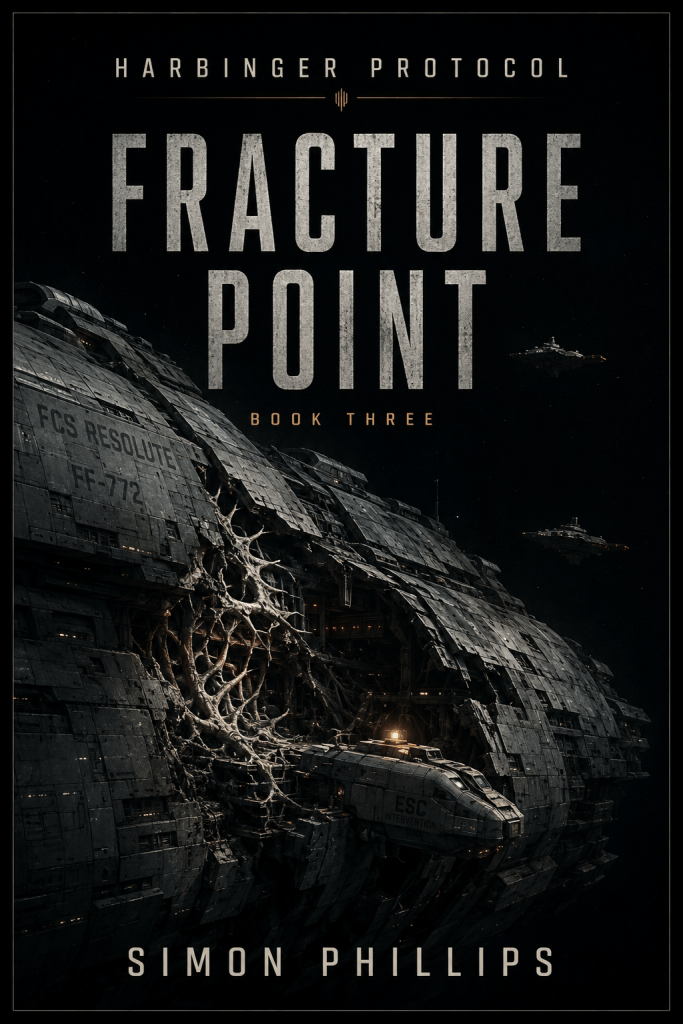
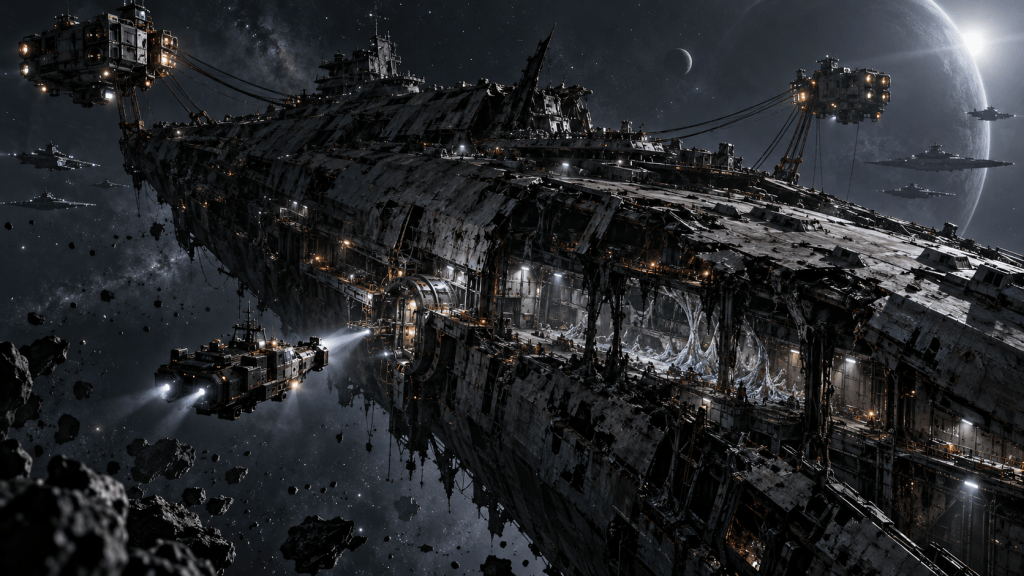
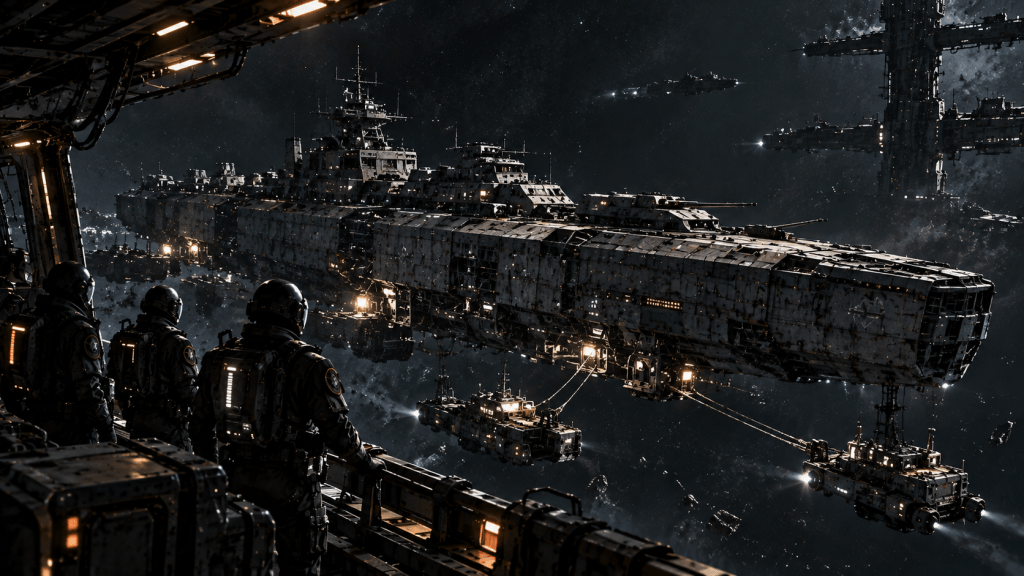
The salvage tugs maintain their hold on the ruined battleship, their reinforced tow lines carrying the strain of a military vessel whose surviving structure has already endured more damage than its designers ever intended. Across the exposed hull, broken armour reveals decks that once held thousands of personnel, while scattered pockets of emergency power continue to sustain machinery deep inside compartments that should have fallen silent.
From outside, the wreck remains an engineering and military recovery problem. Its ownership is established, its damage is being assessed, and the people responsible for bringing it home have procedures designed for precisely this kind of loss. Every remaining system represents something worth preserving, from the vessel’s structural records to the evidence that might explain its destruction.
The difficulty lies in determining what those systems are preserving.
Within the industrial spaces of Harbinger Protocol, science-fiction horror emerges from the gradual failure of familiar distinctions. A functioning machine can become evidence of danger. A recorded human voice can suggest a survivor where no conscious response can be confirmed. A quarantine order may protect one population while placing another beyond the reach of rescue. The consequences extend far beyond a single damaged ship, particularly when several governments possess different explanations for the same evidence.
The wreck has become a place where biological contamination, military authority and human responsibility occupy the same confined space. Every attempt to understand its condition carries the possibility of making that condition worse.
The Machinery That Continues After the Crew
A warship is built to remain operational under circumstances that would destroy a civilian vessel. Its compartments are separated by reinforced pressure boundaries, its emergency systems carry independent reserves, and its medical equipment is designed to sustain injured personnel until proper treatment becomes possible.
Such resilience offers a reassuring foundation for anyone travelling between hostile regions of space. Engineers can isolate damaged circuits, medical teams can maintain failing bodies, and automated equipment can preserve essential functions long after a ship’s command structure has been disrupted.
The same persistence becomes profoundly unsettling when the environment itself begins to change.
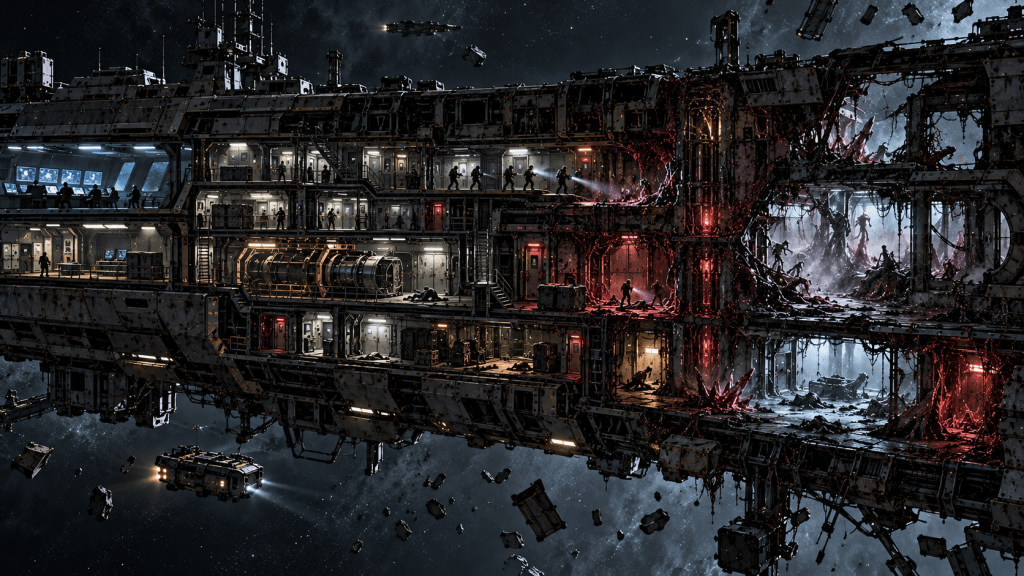
A control station may continue registering an operator because the equipment still receives current through the connected suit. A medical system may report circulation while mechanical support maintains biological activity. A pressure door may complete its operating cycle even after the surrounding structure has ceased to resemble the compartment recorded in its maintenance files.
Each machine continues performing a task that once served a recognisable human purpose. The circumstances surrounding that task have altered beyond anything its designers anticipated.
This relationship between technology and the human body gives biological contamination science fiction a particularly intimate form of horror. Infection can be understood as an illness, an external organism entering a body and changing its condition. Structural integration introduces a more disturbing uncertainty, allowing machinery, living tissue and the physical environment to lose the boundaries that once separated them.
The danger becomes difficult to classify because ordinary definitions begin to fail. Movement offers no guarantee of intention, while biological activity provides an incomplete answer to the question of whether someone remains alive.
For the people entering such spaces, these distinctions carry immediate emotional consequences. A response on a medical display may represent someone requiring help. It may also represent equipment continuing an old routine through tissue that has become part of the machinery.
The decision to investigate cannot be separated from the risk of exposure, particularly when the only available evidence suggests that a human being might still be present.
The Human Voice Inside an Empty Compartment
Among the most disturbing elements of space survival horror is the possibility that familiar sounds have ceased to carry their familiar meanings.
A voice emerging from a damaged communication speaker should offer reassurance. It suggests a person, a location and the possibility of an exchange. Even through static, human speech provides structure within an environment where sight is restricted and physical access may be impossible.
Inside a contaminated vessel, that reassurance becomes unreliable.
Old instructions can remain trapped in damaged audio buffers, returning whenever a failing electrical circuit completes another cycle. Pressure changes alter the movement of air through broken speakers, allowing repeated recordings to acquire small variations. What should be a recognisable loop can sound like someone speaking from another compartment, responding to circumstances as they unfold.
The effect becomes more convincing when damaged machinery moves at the same moment.
A powered suit adjusts its position, an automated workstation changes its display, and a voice issues an instruction that belongs to an earlier emergency. To someone watching through a narrow visor, the combination may appear to demonstrate awareness.
The explanation can be entirely mechanical, yet recognising that possibility offers little emotional protection.
Human beings are accustomed to answering voices, particularly when those voices suggest injury, confusion or distress. The instinct to approach someone calling for help remains powerful even when previous experience has shown how dangerous that response can become.
This tension belongs to the deeper horror of Harbinger Protocol. The unexplained biomass remains reactive to its surroundings, and the apparent presence of human communication offers no reliable indication of conscious intent. The fear comes from the people listening, carrying their own memories of abandonment and loss into places where the difference between a survivor and an environmental echo has become uncertain.
A closed compartment can remain dangerous long after the immediate signs of movement have disappeared. A voice may be enough to convince someone to open it.
When Quarantine Becomes a Political Decision
Beyond the wreck, another form of uncertainty is already taking shape.
The Federation considers the damaged battleship sovereign military property. It represents the loss of a major vessel, its crew and potentially important evidence concerning an unexplained disaster. Recovery is therefore more than an engineering operation. It is a matter of national responsibility, strategic security and the obligation to account for those who served aboard it.
Across the proposed route, Star Kingdom warships maintain a quarantine boundary. Their commanders regard the same wreck as a possible contamination hazard, one whose continued movement threatens systems that have no reason to accept the consequences of another government’s salvage decision.
Both positions carry substantial weight.
Destroying the vessel could erase evidence that might explain the catastrophe and prevent the recovery of anything remaining aboard. Allowing it to continue could carry an unidentified biological threat towards inhabited space.
The central disagreement reaches beyond whether contamination exists. It concerns who possesses the authority to determine what the evidence means and which consequences another government may be required to accept.
This is where interstellar political conflict becomes inseparable from science-fiction horror.
The Earth Strategic Coalition has ships, experienced personnel and the institutional influence required to negotiate an inspection. Its authority remains substantial, supported by military capability, technical expertise and an established role in maintaining stability across competing human territories.
Yet even the ESC cannot transform a disputed scientific finding into universal obedience.
Federation officials retain their claims of ownership. Kingdom commanders maintain responsibility for protecting their territory. Republic observers carry their own knowledge of previous contamination incidents. Each institution approaches the same problem through obligations that were established long before anyone understood the material now present aboard the battleship.
A finding that satisfies one authority may deepen the objections of another.
The resulting danger comes from the interaction of reasonable concerns under extraordinary pressure. Quarantine can become an assertion of sovereignty, while demands for evidence preservation can become indistinguishable from the refusal to acknowledge a threat.
The longer the disagreement continues, the greater the burden placed on those working inside the damaged vessel.
Fracture Point and the Limits of Human Understanding
In Fracture Point, Book Three of Harbinger Protocol, Simon Phillips brings these pressures together through a contested military salvage operation, an ESC investigation team and the deteriorating interior of a Federation battleship.
The story continues Soren Vale’s experience of a biological phenomenon that has already changed his understanding of ships, stations and the institutions responsible for protecting them.
His earlier encounters have taught him to recognise the significance of minor environmental differences. Changes in airflow, unusual mechanical repetition and apparently reassuring system readings can all conceal conditions that require closer examination. The danger lies in accepting a convenient explanation before the physical evidence can support it.
Those lessons have become part of the investigation team’s working procedures.
Equipment is selected for what it can establish locally rather than the volume of information it can collect. Routes are treated as temporary until their stability has been tested. Medical readings are separated into individual forms of biological and mechanical activity, preventing a single comforting classification from replacing the difficult task of understanding what remains.
Such measures suggest professional caution, though caution itself cannot eliminate uncertainty.
The battleship contains overlapping forms of damage. External impacts have fractured armour and opened internal spaces, while surviving equipment continues operating across incomplete power networks. Structural movement changes the pressure on damaged compartments, and areas that appear cold or inactive may remain connected to warmer systems beyond the reach of immediate inspection.
In this environment, the difference between ordinary battle damage and something far less familiar becomes difficult to establish.
For Soren, the problem also carries a moral dimension. His growing usefulness comes from noticing details that others might overlook and recognising patterns whose significance may remain uncertain. He has begun to understand that an accurate observation can be more valuable than a confident explanation.
That understanding offers little comfort when the people responsible for acting on the evidence already disagree about its meaning.
The emotional weight of Fracture Point rests within this narrow distance between recognition and authority. Soren can observe, question and warn. Decisions concerning military property, quarantine enforcement and the movement of sovereign vessels remain beyond his control.
His experience places the reader close to events whose consequences are already extending beyond the people physically present.
The Violence of Containment
The presence of armed warships introduces another danger into an environment where physical disturbance can alter the behaviour of contamination.
Military force has a familiar role in the human territories of Harbinger Protocol. Fleets protect trade routes, enforce borders and preserve political authority. Their weapons can disable vessels, destroy infrastructure and impose decisions that diplomacy has failed to secure.
Such capability becomes less reassuring when the object of concern is biological material whose behaviour depends upon heat, structural disturbance and the systems surrounding it.
A kinetic impact may end an immediate threat while scattering contaminated material into places that previously remained secure. A ruptured compartment can introduce atmosphere into damaged spaces, while fires and electrical failures change conditions across networks that engineers can no longer fully isolate.
Even an apparently successful intervention can leave consequences that become visible only after the violence has ended.
Space warfare therefore carries a different weight from the clean engagements often associated with military science fiction. Combat is experienced through incomplete sensor information, delayed communications and the physical strain of a vessel caught within decisions being made elsewhere.
For those aboard an intervention craft, the wider battlefield may be visible only as changing contact markers, damage warnings and fragments of conversation passing through restricted channels.
A ship disappears from the display, and the immediate question concerns the people who might have been aboard it. A rescue corridor opens, yet the vessels attempting to use it may carry injuries, structural damage or contamination that no external inspection can fully explain.
The aftermath of battle becomes another emergency requiring movement, treatment and repair.
In a civilisation already struggling to distinguish biological danger from mechanical failure, such destruction can produce more uncertainty than it resolves.
The Fragility of an Interconnected Civilisation
The human civilisation surrounding Harbinger Protocol has achieved something extraordinary through its gate network.
Distances that would otherwise demand weeks or months of travel have become manageable through enormous structures maintained by engineers, traffic controllers, customs authorities and military regulators. Freight moves between territories, passengers cross political borders, and damaged vessels can reach specialised facilities before their remaining resources are exhausted.
The system depends upon countless ordinary decisions.
A cargo manifest must agree with its declared contents. A quarantine warning must reach the receiving authority. A damaged military vessel requires clearance, while medical transports must receive priority according to the severity of the casualties aboard.
Behind these procedures lies an immense network of human labour.
Maintenance crews work around active gate structures. Engineers examine ageing infrastructure whose components have been replaced over generations. Civilian vessels wait through transit queues while their operators negotiate fees, scheduling delays and the requirements imposed by governments sharing the same passage.
For most travellers, this machinery has become part of everyday life.
Its reliability is also a source of vulnerability.
A system designed to move people and materials efficiently depends upon classifications that allow decisions to be made quickly. Cargo is declared safe, a damaged ship is approved for repair, and a medical emergency receives permission to cross a boundary that might otherwise remain closed.
The procedures can function correctly while the information beneath them remains incomplete.
That contradiction gives the wider cosmic horror of Harbinger Protocol its foundations. Humanity has developed the means to connect distant worlds, yet those connections make it increasingly difficult to preserve the separation that containment requires.
Freighters, orbital stations, repair yards and military escorts belong to the same civilisation, relying upon overlapping networks of supply, power and movement. A damaged component may pass through several hands before anyone recognises that the problem extends beyond its apparent mechanical condition.
Each transfer creates another opportunity for the unfamiliar to enter an ordinary environment.
The greatest danger may emerge where every institution believes it has completed its responsibilities.
The Point Where the Evidence Changes Nothing
There is a particular unease in watching a system continue working after the people responsible for it have recognised that something is wrong.
The warning has been recorded. The appropriate authority has been contacted. Another inspection has been requested, and the people examining the evidence have explained the limits of what they can establish.
Beyond that point, the machinery of civilisation continues moving.
Vessels require clearance, damaged compartments need stabilising, and medical personnel prepare for the arrival of people whose survival may depend upon immediate treatment. Political disagreements remain unresolved while ordinary workers carry out responsibilities that cannot easily be postponed.
The horror comes from the possibility that everyone involved may be acting according to a procedure that once made sense.
Throughout Harbinger Protocol, human survival depends upon ships, stations and governments whose systems were built to manage familiar risks. The biomass introduces conditions those systems were never designed to recognise, gradually transforming routine decisions into opportunities for a crisis to extend beyond its original boundaries.
For Soren Vale, recognising this pattern offers knowledge rather than control. He can understand why a warning matters while remaining unable to determine how another government will respond to it.
Somewhere beyond the immediate emergency, another crew may already be preparing to receive a vessel, restore a damaged circuit or open a compartment whose status has been assessed through incomplete information.
The instructions waiting for them will be familiar.
Their equipment will be ready.
And the first indication that anything has changed may arrive only after the work has begun.
