An abandoned structural level beneath Ashfall Station reveals a corridor sealed since the station’s earliest construction, drawing the attention of a retiring station detective before Fleet orders the investigation to cease.
Deck Twelve: Ashfall Station
The engineering request reached Detective Adrian Mercer during the quiet middle stretch of the station cycle, when the administrative decks of Ashfall settled into the slow rhythm that followed freight departures. Offices remained lit, terminals remained active, yet movement across the corridors softened into the patient routines of clerks and inspectors completing the final tasks of their shifts. Mercer sat alone within the records office beneath Central Security, surrounded by the layered archives of incidents that had travelled through the station across several decades. Each report carried the calm language of procedure and closure. It held the quiet assurance that whatever disturbance had once drawn attention eventually found its place inside the long memory of Ashfall Station.
Through the narrow reinforced windows behind his desk, the interior ring of the station turned in its endless orbit above the pale, clouded surface of Kestren-4. Cargo lights drifted across the distant docking arms where freight vessels prepared for departure, their engine glow reflecting faintly across the structural ribs of the outer ring. The sight carried a familiarity that came from long service rather than affection. Ashfall never attempted elegance. The station endured through scale, through industry, through the steady labour of crews who kept its immense systems working across decades of frontier commerce.
Mercer closed the final file on his terminal and allowed the quiet hum of the station to settle around him. That sound travelled everywhere through Ashfall. It lived beneath conversation, beneath the clatter of cargo lifts, beneath the distant roar of docking clamps engaging with incoming ships. Power conduits vibrated within the walls. Freight rails shifted their loads across the lower decks. Atmospheric processors breathed steadily through shafts that crossed the station from end to end. A man who served long enough inside the structure eventually learned to hear its mood through those vibrations alone. Older officers spoke of it with a seriousness that once amused Mercer during his early years in security. Time changed the way such remarks sounded.
The message waiting on his terminal carried engineering clearance tags from Deck Twelve, a location whose name appeared so rarely in modern station reports that it held the faint quality of something remembered from another era. Mercer opened the note and read the short description several times before leaning back in his chair.
Structural access discovered during inspection survey. Legacy corridor revealed behind sealed plating. Security presence requested before further entry.
Deck Twelve belonged to the earliest period of Ashfall’s construction, when the station functioned primarily as an orbital transfer hub for the ore shipments rising constantly from the mines of Kestren-4. During those years, the station existed as a harsher place, a skeleton of structural rings and industrial corridors designed for endurance rather than comfort. Later expansions buried much of that original framework beneath new habitation sectors and modern freight systems. Entire levels faded from daily use as trade patterns shifted across the frontier. Some compartments became storage vaults. Some were dismantled to strengthen newer construction. Others survived only as references inside the ageing schematics that engineers consulted whenever expansion projects reached deeper into the station’s buried architecture.
Even so, the phrase legacy corridor carried weight. Abandoned spaces existed throughout Ashfall. Deliberately sealed ones remained rare.
Mercer gathered his coat from the back of his chair and left the office behind, moving through the quiet corridors of Central Security towards the transit lifts that descended into the lower structure of the station. The lift doors opened with the soft mechanical patience common to Ashfall’s older systems. Inside, muted amber light reflected from the brushed metal walls while deck numbers began their steady descent through the station’s interior framework.
The upper levels passed first, familiar sectors filled with administration offices, habitation corridors, and the ordered calm of Fleet oversight. Soon, the lift continued into deeper regions where the architecture changed. Plating grew thicker. Corridor lighting carried a colder tone. Structural doors reflected the heavy engineering logic of an earlier generation of station builders who valued resilience above refinement. Mercer rested one hand against the rail as the lift travelled downward, feeling the subtle vibration of the machinery through the metal beneath his palm.
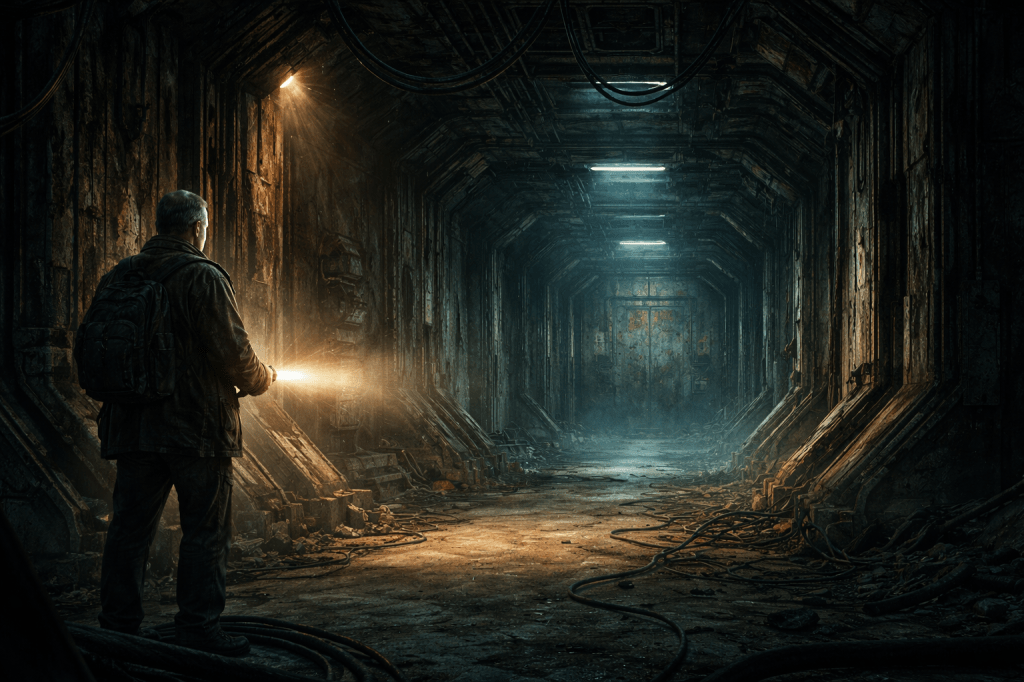
When the doors finally opened onto Deck Twelve, the air carried the dry scent of dust and insulation compounds that gathered slowly inside long-maintained engineering spaces. The arrival corridor extended ahead through reinforced bulkheads lined with power conduits and dormant freight rails. Overhead pipes carried atmosphere and coolant through the deeper infrastructure of Ashfall’s industrial body. Human presence felt thinner here than in the busy decks above. Maintenance crews passed through the level when expansion work required it, yet daily life unfolded elsewhere.
Two engineers waited near the far bulkhead beside a portable floodlamp that cast strong white light across the corridor. The older of the pair stood with the relaxed endurance of someone accustomed to long hours within structural maintenance zones. Silver threaded through the dark hair above his temples, and his coveralls carried the pale dust of recently disturbed plating. Beside him, a younger technician held a scanning slate close against her chest while studying the exposed section of wall with careful attention.
Senior Structural Engineer Tavin Istran inclined his head in greeting as Mercer approached.
“Detective Mercer. I appreciate you coming down.”
Mercer acknowledged him with a quiet nod while allowing his gaze to follow the direction of the floodlamp. An entire panel of corridor plating had been removed to reveal an older access frame buried behind later reinforcement layers. The metal carried a darker tone than the surrounding bulkhead, and the riveted edges reflected construction methods that belonged to Ashfall’s earliest structural phase. At the centre of the frame stood a pressure door whose surface had vanished beneath decades of dust and insulation residue. Someone, long ago, had concealed the doorway behind the new wall rather than leaving it visible within the corridor.
“What exactly came through your survey scans?” Mercer asked.
Istran directed the beam of a handheld lamp across the exposed structure. “Expansion planning for the western support run,” he said. “Engineering required a density survey before we anchored new conduit lines through this section. Current schematics indicated a solid bulkhead. Our scanner showed a hollow space behind the plating. Initial assumptions suggested abandoned cable housing. Once we cut through the reinforcement, we uncovered this.”
The younger technician stepped forward and activated the projection on her slate. A rotating structural image hovered above the screen, outlining a narrow corridor stretching deeper into the station’s buried frame.
“The cavity continues for approximately sixty metres,” she explained. “Straight alignment through the subframe. Internal pressure readings remain low yet stable. Structural integrity appears intact.”
Mercer studied the projection before returning his attention to the sealed doorway. The structure carried a deliberate quality that unsettled him in a quiet way he struggled to explain. Decommissioned corridors existed throughout the station, sealed through convenience during later renovations. This doorway suggested a different decision entirely. The plating around it formed careful layers that erased the original entrance from every visible surface.
“Authority to open?” Mercer asked.
Istran folded his arms while considering the question. “Engineering procedure allows inspection of undocumented spaces that interfere with active construction work. That remained sufficient until the door appeared. Once we realised the corridor had been intentionally sealed, security presence became necessary before any attempt at entry.”
Mercer moved closer to the exposed frame. Dust shifted under his boots as the floodlamp illuminated faded stencilling across the pressure door. Time had worn most of the lettering into obscurity, though one line still remained visible beneath the grime.
DECK 12 SERVICE TRANSIT: EASTERN ACCESS
The words belonged to another age of the station, when workers travelled constantly through corridors like this one during the first decades of Ashfall’s operation. Ore shipments rose continuously from Kestren-4 in those years, and the station’s industrial skeleton thrived on movement. The sealed doorway standing before him hinted at a later moment when someone decided that passage through this corridor carried a risk greater than leaving it buried within the structure.
“Deck Twelve appears in modern registry as structural support,” Mercer said slowly. “Transit corridors should remain mapped.”
The technician glanced at the slate again. “Three generations of station schematics contain no reference to this passage.”
Mercer rested his hand against the cold metal frame beside the door. The station continued its immense labour around them while freight systems shifted through distant decks and atmospheric regulators breathed steadily through unseen conduits. Ashfall had endured for decades through expansion, repair, and quiet compromise. Within that long history, the buried doorway before him suggested a moment when concealment seemed preferable to explanation.
He looked back towards the engineers standing in the bright spill of the floodlamp.
“Release the outer seal,” he said quietly.
Station Record: Deck Twelve Access Survey
Ashfall Station maintained extensive structural archives documenting the layered construction of the installation across several decades of expansion above the mining world of Kestren-4. From its earliest years as an industrial ore transfer platform, the station grew through successive phases of reinforcement and redevelopment as freight activity within the system increased. Each stage of construction left behind segments of earlier infrastructure embedded within the station’s expanding framework, forming a complex internal structure where modern engineering systems frequently intersected with components dating back to the original industrial period.
Deck Twelve belonged to this earliest phase of Ashfall’s development. During the first decades of orbital mining operations, the level formed part of the station’s internal transit network, providing access routes for engineering crews responsible for maintaining the cargo transfer systems that linked the station’s outer docking arms with the ore elevators rising from the surface of Kestren-4. These corridors allowed personnel and equipment to move through the station’s internal framework without interfering with the heavy freight traffic that dominated the primary cargo decks.
As Ashfall Station expanded into a larger logistical hub serving multiple trade routes, many of the original transit corridors were gradually replaced by newer structural pathways better suited to the installation’s evolving layout. Entire sections of the station’s early industrial framework became redundant as modern freight systems bypassed the older infrastructure. Engineering departments frequently sealed obsolete passages behind reinforcement plating during later construction work in order to maintain structural integrity across the station’s expanding hull.
Maintenance records indicate that structural surveys conducted during later expansion projects occasionally revealed compartments whose original purpose had faded from modern engineering documentation. In most cases, these spaces consisted of abandoned cable runs, obsolete machinery housings, or storage cavities left behind during earlier construction phases. Such discoveries were typically catalogued within the station’s structural archive and secured to prevent interference with contemporary engineering operations.
During a routine inspection connected to an expansion survey on Deck Twelve, engineering crews uncovered an access frame concealed behind reinforcement plating installed during a later phase of structural redevelopment. Removal of the outer plating revealed a sealed pressure door belonging to a transit corridor absent from modern station schematics. Preliminary scans suggested that the passage extended several dozen metres through the station’s internal subframe while retaining limited atmospheric pressure.
Initial assessment by the engineering team indicated that the corridor had been deliberately sealed during an earlier construction phase rather than simply abandoned. Multiple layers of reinforcement plating had been installed across the original access point, effectively removing the passage from the visible structure of the surrounding corridor. The doorway itself remained intact beneath these layers, preserving evidence of a transit route that once formed part of the station’s earliest engineering network.
At the time the discovery was recorded, the engineering department requested a security review before attempting to open the sealed corridor. The presence of a deliberate structural closure, combined with the absence of the passage from modern schematics, prompted a preliminary investigation into the circumstances under which the transit corridor had been removed from the station’s operational layout.
Archived engineering logs from that cycle indicate that the request for investigation was transmitted to Fleet administration shortly after the discovery was reported within the station’s internal maintenance network.
Further access to the corridor was temporarily suspended pending instructions from Fleet command.
About the Creator
The Future Chronicle is written and curated by Simon Phillips, a writer of science fiction and speculative storytelling who explores the quiet edges of human expansion, where ageing stations, distant worlds, and forgotten technologies continue their slow existence beyond the reach of the central worlds.
Many of the stories presented in these Chronicles exist within a wider fictional universe that follows the lives of investigators, engineers, and frontier workers living far from the comfort of the inner systems, where the machinery of civilisation continues to function long after its original purpose has begun to fade.
One such story unfolds aboard Ashfall Station, an ageing orbital installation whose corridors and industrial sectors form the setting for the science-fiction mystery novella Ashfall Station: The Dead Girl in Sector Twelve. What begins as a routine investigation gradually reveals that something hidden within the station’s structure may have been present for far longer than the official records suggest.
Readers who wish to explore the full investigation and its unfolding events can find the novella below.
Explore the book:
Ashfall Station: The Dead Girl in Sector Twelve
You can watch his YouTube channel here:
Author Simon Phillips
Continuing the Chronicle
The following Chronicle continues the reconstruction of the engineering survey on Deck Twelve, when maintenance crews first uncovered the sealed pressure door hidden within Ashfall Station’s earliest structural framework.
At the time, the discovery appeared to be a minor irregularity encountered during routine expansion planning. Engineering departments working across older sections of the station frequently encountered abandoned compartments left behind by earlier construction phases, and such spaces were usually catalogued within the station’s structural archive before being secured or absorbed into new engineering layouts.
The doorway revealed beneath the reinforcement plating on Deck Twelve suggested a more deliberate closure. Preliminary scans indicated that the corridor extended through the station’s internal subframe while remaining absent from all modern schematics used by Ashfall’s engineering systems. The presence of multiple reinforcement layers surrounding the original access frame indicated that the passage had been intentionally sealed and removed from the visible architecture of the station many decades earlier.
Later examination of archived engineering records suggests that the discovery on Deck Twelve represented the first documented moment when Ashfall’s contemporary maintenance crews encountered evidence of structural alterations whose origins no longer appeared within the station’s official construction history.
Readers supporting The Future Chronicle can continue the record below.

Subscribe to continue reading
Subscribe to get access to the rest of this post and other subscriber-only content.