The Mythic Chronicle: The Feather in the Basin

An account of water darkened by ordinary injury, and of the pale lines that gathered around a feather where no bird had entered.

The Water That Held the Feather

The basin stood beneath the lower tap where the back room narrowed beside the wall. Its rim had been worn pale by hands, cloth, and years of use, with one side smoothed by labour and the other chipped where buckets had struck it in careless hours. The room had been made for work, with a low ceiling darkened by lamp smoke, a floor sloping towards the drain channel, and shelves crowded with cracked jars, folded rags, lye cakes, dull knives, torn linen, and the quiet tools by which a house removed the signs of ordinary injury before morning. A lantern burned on the rear shelf beneath smoked glass. Its amber light reached the damp walls in narrow bands, showing blisters in the plaster and the older masonry showing through beneath.

Rain had passed through the district earlier that evening, leaving the yard slick beneath the eaves and drawing the smell of wet soil up through the loose stones near the rear threshold. Water gathered in shallow hollows along the flagged passage. It carried sour traces of ash, spilled ale, candle grease, and the iron scent that came from cloth washed too late after blood had settled into the weave. The houses joined one another closely there, wall against wall, roof leaning into roof, with gutters emptying into the same narrow runnels. Sounds travelled between them in softened form, passing through timber, plaster, and the tired hour after midnight.

Edrane Voss had been awake since before dawn, and by the time she brought the basin under the tap her shoulders ached from carrying water up and down the rear stair. She worked in the lower room because the mistress preferred the visible chambers kept clean of such tasks, and because the back room had always received what the upper floors wished to forget before daylight. There had been a fight in the passage after supper, one dock boy striking another with a cup after words passed too close to pride. The wounds carried little mortal concern, yet blood had marked sleeve, collar, knuckle, and the corner of the stair where one of them had fallen against the rail.

Such matters belonged to the district as surely as rain belonged to the gutters. Men came with coin and anger. Women came with painted mouths and tired eyes. Clerks came carrying secrets beneath their coats, while boys ran errands between doors they were too young to understand. By night’s end, someone always brought down a cloth darkened by work, pleasure, sickness, birth, beating, or grief, and the basin received each of them in turn. It had a memory no one cared to name, though its stone had taken colour in places where scrubbing failed to reach. Its drain gave a faint breath from below whenever rain filled the channels under the street.

Edrane set the first bundle into the basin and turned the tap. Water came reluctantly, stuttering through the pipe before falling in a clear line that struck the folded cloth and spread through the blood drying along its edge. She pressed both hands into the water and worked the stain loose with slow, practised force while the lantern flame trembled behind her. The water reddened, first in cloudy ribbons, then more fully, as the cloth surrendered what it had held. She added a shaving of lye, rubbed the linen against itself, and watched the surface gather a dull, bruised colour beneath the light.

Above her, boards creaked under the movement of late customers and women crossing between rooms. A laugh travelled down through the ceiling, broke halfway through, and faded into the general murmur of the house. Somewhere behind the wall, beyond the plaster near the drain, a small scratching sound moved once and ceased. Edrane paused with her hands still in the basin. She listened through the drip of the tap and the shallow movement of water against stone. Rats had troubled the lower rooms in previous weeks, slipping along unseen places with a strange order that unsettled even the older servants, although traps laid under the shelves had remained empty since the yard shifted after the last disturbance.

The sound came again, softer this time, as though something brushed the inner face of the wall with patient care. Edrane turned her head towards the plaster beside the tap. A line ran there, thin as thread, from the lower edge of a repaired patch to the dark seam where basin stone met masonry. She had seen it before. Everyone who worked the room had seen it. The repairman had said the wall breathed damp, and damp always found its own path, especially in houses built over older ground. He had scraped, sealed, and rubbed lime into the mark until it vanished beneath his hand. After each wet night, the line returned in the same place, pale against the surrounding dirt.

She drew her hands from the basin, wrung the cloth, and set it aside on the draining board. The next rag carried less blood, although it had been pressed hard against a split brow and had stiffened along one corner. She lowered it into the water, then hesitated. Something lay upon the surface near the basin’s far rim. At first she mistook it for a loose thread shaken from the linen, a narrow dark strip resting where the lamplight failed to reach. It turned slowly, once, then steadied, and the motion revealed the fine barbs laid along a central shaft.

A feather floated there, black and clean in shape, long enough to span half the breadth of her palm. No window opened in the lower room. The rear door had remained shut since she came in from the yard, and the tap above the basin gave only water from the house pipe, cold and faintly bitter. Edrane stared at the feather while the cloth sank slowly beneath her other hand. It rested upon the reddened surface with a stillness she disliked at once, untouched by the tremor caused by dripping water and untouched by the slow turn of the cloth beneath it.

She looked up towards the ceiling, then towards the shelves, then behind her to the dark corner where buckets stood nested beside the wall. There was no bird in the room, no open vent large enough for such a thing, no broken shutter, and no loose roof gap where it might have fallen from above. Feathers came into houses often enough. They clung to cloaks, mattress ticking, cheap trim, and the straw beneath bedding. She knew all ordinary explanations and had spent most of her life trusting them because ordinary explanations allowed work to continue. Yet the feather in the basin held itself apart from every movement around it, as if it had arrived through the water itself.

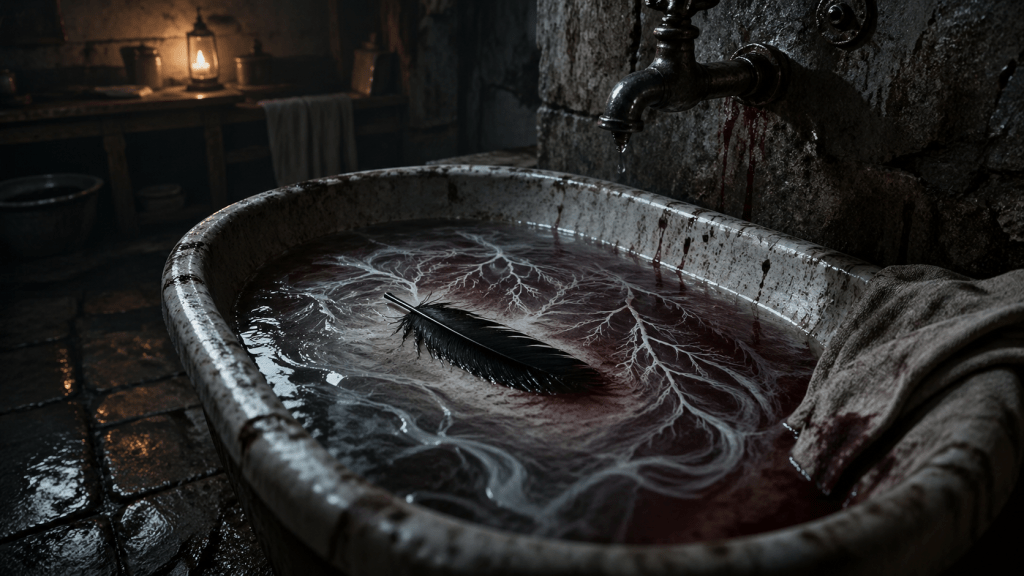
Edrane reached for it, then stopped before her fingers touched the surface. Beneath the feather, the red cloud within the basin had begun to change. At first she thought the lye had bitten into the blood strangely, loosening pale threads from the cloth and drawing them outward. Thin white lines spread beneath the water in delicate branching forms, each one moving from the feather’s shadow towards the basin’s edge. They travelled through the diluted blood with measured quiet, dividing, widening, and joining again in forms that reminded her of winter frost seen on chapel glass. The room held only the stale warmth of labour and lamp smoke.

The tap continued to drip. Each drop struck the basin close to the feather, yet the black shaft barely moved. The pale branching spread further, making a fragile web through the water, and for a moment the whole surface seemed to hold its breath. Edrane felt the skin of her arms tighten. The scratching behind the wall ceased. From the floor beneath her came a faint pressure, less sound than sensation, as though the stone below the basin had taken weight from somewhere under the room.

She backed away a single step and knocked her hip against the shelf. A jar shifted, rolled, and struck the floor with a dull crack. The sound broke through the room with such sudden force that she gasped, while above her the house continued its ordinary life through footsteps, voices, and a muffled cough from the stair. No one called down. No one entered. The basin remained where it was, the feather resting upon bloodied water while white forms grew and thinned beneath it.

Edrane forced herself forward again, with anger rising because fear had no use in a room where work still waited. She took the wooden stir stick from the shelf and plunged it into the basin. The water broke under the blow, red and white twisting together as the feather spun towards the near rim. For several heartbeats the pattern vanished into dirty turbulence. She stirred harder, striking the basin sides, dragging the cloth upward and forcing it under again until the water turned cloudy and the feather disappeared beneath the fold of linen.

When the surface settled, the feather had returned to the centre. It lay exactly where she had first seen it. The pale forms beneath it gathered again, thinner now, spreading outward in slow lines that curved around the sunken cloth and reached towards the drain hole as if seeking a route through stone. Edrane let the stick fall from her hand. The room seemed smaller than it had moments before, its ceiling lower, its walls damp with a closeness that pressed the breath in her throat. She became aware of the line beside the tap once more, the old repair mark gleaming faintly under the lantern light, and of the way the water in the basin appeared to lean towards that wall by a measure too slight for certainty and too clear for comfort.

The back door opened behind her with a groan of damp wood, and one of the younger servants entered carrying another bundle of stained cloth against her apron. She stopped when she saw Edrane standing rigid beside the basin. Her face changed as her eyes moved to the water, to the feather, and then to the pale residue spreading beneath it.

“What is it?” the girl asked.

Edrane turned her head slowly, then looked back at the water. The feather remained upon the surface, though the pale lines beneath it had already begun to loosen, dissolving into the red until only a cloudy brightness remained around the shaft.

“Stray matter,” Edrane said, because the words sounded like something a sensible woman would say in a house where walls listened poorly and rumours travelled faster than fire. “From the yard, perhaps. Bring the rest here.”

The girl came closer, lowering the cloth into the basin with visible reluctance. Her eyes fixed on the feather, then on the pale residue beneath it. Edrane opened the drain with a sharp pull and watched the water begin to turn. Red slipped away first, circling into the dark mouth beneath the basin. The feather turned with the movement, dipped once, then resisted the current as if the draining water had no claim upon it. Only when Edrane seized the wooden stick and pressed it under did it finally vanish into the drain with the last of the reddened water.

The pipe below gave a soft sound, almost like breath drawn inward. For a while, both women remained still. The basin emptied, the tap dripped, and the lower room settled into its former shape around them. The lantern flame steadied. The boards above creaked. Rainwater moved in the yard beyond the door. Edrane reached for the cloth and began again, though her hands shook enough to make the water splash against the rim when she refilled the basin.

By morning, she would tell the mistress only that the lower drain required cleaning and that lime should be rubbed again along the wall near the tap. By evening, the matter would pass into practical speech, where blood, lye, plaster, old pipes, and yard dirt could explain anything that wished to remain inside the house. Yet before the next bucket was carried in, before the floor was scrubbed and the lantern put out, Edrane looked once more into the clean water gathering beneath the tap.

For a moment, as the basin filled, a thin white branch opened silently beneath the surface and faded before the first ripple reached the stone.


Foundation Register: Lower Washing Room Basin Record

The lower washing room entered within the adjoining property plans appears as part of a rear service range set behind several occupied chambers and connected to the shared yard by a narrow threshold passage. Surviving plans describe the room in practical terms, listing a stone basin fixed beneath a lower tap, a shallow drain channel cut into the floor, and a repaired wall section where older masonry met later plaster around the water pipe.

Earlier revisions record repeated maintenance along the same wall, with lime applied across a thin vertical mark that returned after wet weather and heavy use of the tap. These entries assigned the condition to damp movement within the masonry and to pressure carried through the drainage below the rear rooms. The basin itself remained listed as serviceable, with worn stone along the rim, minor chipping near the front edge, and discolouration consistent with ordinary washing use.

During the period following disturbance in the rear ground, several household accounts began referring to irregular matter found within wash water after cloth had been cleaned below the rooms. The earliest entries speak first of darkened water, lye residue, and diluted blood from treated injuries. These descriptions remained within the language of household labour, assigning the matter to wounds received in the passage, work carried out after supper, and the late cleansing of linen, skin, and stone.

A repeated detail appears across later entries concerning a single dark feather observed upon the surface of the basin after the water had already been used. Early descriptions treat the feather as stray debris carried in from the yard, bedding, or garments handled within the house. The same accounts also record that the room held a closed rear door at the time, with the lower windowless wall offering little open passage through which such material might have entered.

Further entries describe changes in the water beneath the feather, where pale branching lines appeared within diluted blood before dispersing through the basin. These forms are entered with caution and placed beside ordinary explanations, including lye reaction, lime residue, plaster dust, and disturbed matter from the lower pipe. Several revisions reduce the detail to cloudy separation within washing water, while earlier wording preserves the description of lines spreading outward from the feather in measured form.

Additional testimony refers to a brief stillness across the basin surface while the tap continued to drip. The feather is described as remaining largely unmoved by falling water and by the turning of cloth beneath it. These observations are absent from later property copies, where the matter is condensed into a reference to contamination within the lower washing basin and unsuitable drainage conditions after rain.

A short entry made by a house servant records that the feather resisted the drain for a moment after the basin plug was pulled, then vanished only when pressed below the surface with a wooden stirring stick. The same entry refers to a soft inward sound from the pipe after the water cleared. This phrase is absent from the copied register and survives only within a loose household sheet kept among repair accounts for the rear rooms.

Several maintenance entries following the incident recommend cleansing the lower pipe, rubbing fresh lime along the marked wall, and washing the basin stone with vinegar and ash. These measures were completed during the next work period. The basin remained in use, though later household remarks refer to fresh water taking a faint pale branching for a moment beneath the tap before rippling clear.

The condition was attributed to contamination within the lower drainage, worsened by wet ground, old plaster, and bloodied cloth left to stand before washing. Repair orders list the matter as local and manageable, requiring cleaning of the basin, inspection of the pipe, and fresh sealing of the wall behind the tap. Further inquiry into the feather itself appears to have ended once the drain was cleared and the visible water ran clean.

A margin hand added beside one early copy describes the event as “water holding shape around a thing that should have sunk or gone away.” The phrase appears once, written beside the section concerning pale lines beneath the surface, and was removed from later prepared summaries of the same account.

Final entries state that the lower washing room returned to ordinary service after cleaning works were completed. The basin, tap, and drain remained listed within the property plan as stable household fixtures, while the irregular matter found in the water was accepted as residue from use, weather, and age within the rear service range. The record closes with the condition entered as resolved, leaving the room to its work beneath the house, where water continued to gather, darken, and pass below the stone.


About the Creator

The Mythic Chronicle is written and curated by Simon Phillips, a writer of mythic and speculative fantasy whose work explores the quieter edges of forgotten worlds, where buried structures, fractured records, and lingering presences continue beneath the surface of recorded history.

The accounts preserved within these Chronicles form part of a wider body of work in which cities stand upon older foundations, and events recorded as isolated disturbances are understood, in later tellings, to belong to patterns that were never fully recognised at the time.

One such account survives in a separate record, detailing an incident within a lower district where a death was first dismissed as excess, though the space in which it occurred retained a presence that resisted clearing, and where investigation revealed signs that the disturbance had not been confined to a single room.

This record is preserved in the novella Black Feathers in a Brothel, where the events surrounding that incident are followed more closely, though even there the full nature of what lay beneath the structure remains uncertain.

Readers who wish to examine that account in its fuller form may find the record below.

Explore the book:
Black Feathers in a Brothel

You can watch his YouTube channel here:
Author Simon Phillips


Continuation of the Record

What follows is drawn from later entries concerning the lower washing room and the basin fixed beneath the rear tap, where the first irregularity was entered as contamination within water used for ordinary cleansing. Early accounts describe the matter in practical terms and assign it to bloodied cloth, lye residue, damp plaster, and disturbed pipework below the rear service range, although subsequent notes refer to repeated moments in which pale branching appeared beneath the surface after the water had darkened. Each occurrence is entered briefly and held within the language of household maintenance, while several annotations refer to a dark feather remaining upon the basin water, a faint stillness around the rim, and a soft inward sound from the drain after the water cleared. In later entries, the pattern is described as gathering around the feather before loosening into the whole, as though the basin held a shape for a measured time before surrendering it to the pipe below. The cause remains assigned to local drainage, old lime, and residue carried through the washing room, and each account concludes with the basin accepted within the limits set down for it in the register.

Subscribe to continue reading

Subscribe to get access to the rest of this post and other subscriber-only content.
The Mythic Chronicle: The Collapse That Was Not Collapse

Where the ground beneath the district gave underfoot, then rose again in measured stillness, as though the stone itself had taken breath.


The Stone that Breathed

The yard behind the adjoining houses lay in the grey hour before trade had taken full hold of the district. High walls enclosed it on three sides, patched through years of repair with fresh mortar laid over older stone, while the flagging underfoot held the shine of recent rain in long dark seams. Water gathered in the shallow wear of the slabs and clung there, turning the ground into a dull mirror wherever the light from above found it. Even at that early hour the place carried a kind of hush that felt set apart from the lanes beyond, as though voices and wheels lost their force before they crossed the passage and entered that enclosed square. When three men came through the side gate with rods, a level frame, and a crate of tools, the scrape of iron over stone seemed to travel too far, then sink away into the yard as if the ground had received it.

Carvel, who led the inspection, stood with one hand resting on the frame and looked across the central run of slabs where the steward had marked a settlement on the evening before. At first glance the paving seemed sound. The rear step held firm beneath the water trough. The stack of empty casks still leaned beside the arch. The drain channel ran straight towards the passage mouth. Yet the eye kept returning to a broad patch near the middle where the joints had darkened into a ring and the stone sat lower by a whisper of an inch. It was the kind of change most men would pass twice before they saw it, then once seen, would carry in the mind with growing unease.

“Set the rods at the edge first,” he said. His voice stayed low, shaped by long habit in old places.

Hedd, younger and quicker in all his movements, crouched at the northern joint and fed the iron down between two slabs until it met resistance. Marr, broad-backed and slow, crossed to the western side and did the same. Carvel opened his folio, fixed the slate within it, and made the first marks while the light strengthened over the wall tops and laid a pale strip across the stones.

“Read.”

“Five inches,” Hedd said.

“Six at this side,” Marr answered.

Carvel marked both figures. “Again.”

They shifted position. Each new measure changed by a fraction. On the eastern side the rod turned slightly as it sank, as though the space beneath the paving opened away from the line where it had been set. Hedd drew it up and rubbed the pale dust from its grooves between finger and thumb. No damp clung to it, though the joints above still held the dark from the rain.

“That came from deeper down,” he said.

Carvel took the rod and looked at it for a moment. Fine grit lay in the score lines, light as ash and dry as old mortar ground under a hammer.

“A hollow sits under the centre,” Marr said.

“Perhaps,” Carvel replied. He lowered the rod and glanced again at the dark ring. “Though hollows in old yards usually keep still.”

They set the level frame over the marked patch and adjusted its feet with care. Hedd hung the plumb line from the crossbar and watched the weighted point circle above the widest slab. The line slowed, steadied, and came to rest over a joint that looked almost black in the poor light.

“Strike the outer edge,” Carvel said.

Marr took the haft of his hammer and tapped the stones in turn. The first four answered with the same blunt contained tone. Each sound travelled across the yard, pressed into the walls, and died there. When he struck the lowered slab, the note changed at once. It dropped away through the ground instead of spreading across it, carrying a depth that seemed out of keeping with the yard’s small measure. All three men heard it. All three men kept still after it passed.

“Hear that again,” Carvel said.

Marr struck the same stone a second time. The note fell as before, though this time it lingered below them for the length of a drawn breath, and during that held moment a faint pressure touched the soles of their boots. Hedd shifted his weight and looked towards the surveyor. Marr lowered the hammer a little, his hand tightening on the wood.

“That moved under us,” Hedd said.

Carvel crouched and laid his palm flat against the slab. The stone felt cold. Beneath the cold there came a rise so slight he could almost have named it memory, save that it gathered under his hand, held, and eased away again with slow purpose. He drew back at once, stood, and closed his folio.

“Clear the casks from the wall,” he said. “Move the crate as well. Leave the yard open.”

Neither man asked him for a reason. Marr went first, lifting the empty barrels one by one and carrying them through the passage into the lane. Hedd gathered the tools and the frame, set them by the gate, then returned and stood just clear of the dark ring, watching Carvel as though the older man might give shape to what had begun under the stone. Carvel’s attention remained on the plumb line. The weighted point hung almost still. Then it drew a fraction to the south, paused, and came back. No wind touched the yard. The water in the trough by the rear step held its surface smooth as glass.

“It shifts between measures,” Hedd said.

Carvel gave a brief nod. “Bring the lamp.”

Hedd fetched it from the crate and lit it with a spill from the shuttered flame he carried at his belt. The small amber light spread over the flagged centre and sharpened the wet seams between the stones. In that warmer glow the ring appeared wider than before, the dark joints holding a moist blackness that seemed fresh laid, as though the paving had drawn breath from below and pressed it upward through the cracks.

Marr came back from the lane and set down the last cask. “The steward will ask what holds us here,” he said.

“He can ask,” Carvel replied. “Take the lifting bar to the centre seam.”

Marr slid the iron under the lip of the broadest slab and leaned his weight into it. At first the stone held firm. Then, with a fine grinding sound from somewhere below its edge, it rose the depth of two fingers and hung there on the bar. A thread of dust drifted upward through the opening, pale in the lamplight. Hedd bent with the lamp and lowered the flame towards the gap. The beam caught broken mortar, a wedge of darkness, and the faint movement of more dust rising from beneath in slow twisting lines.

“There is space under it,” Hedd said.

“There is more than space,” Carvel answered.

A scent came up through the join while he spoke, dry and old at first, then touched by a sweetness that turned the stomach through its very thinness. It carried no richness of rot. It had the strange lightness of something long shut away that still found means to linger. Hedd drew his head back, though his eyes never left the gap.

“That smell came from deep stone,” he said.

“Raise it a little further,” Carvel said.

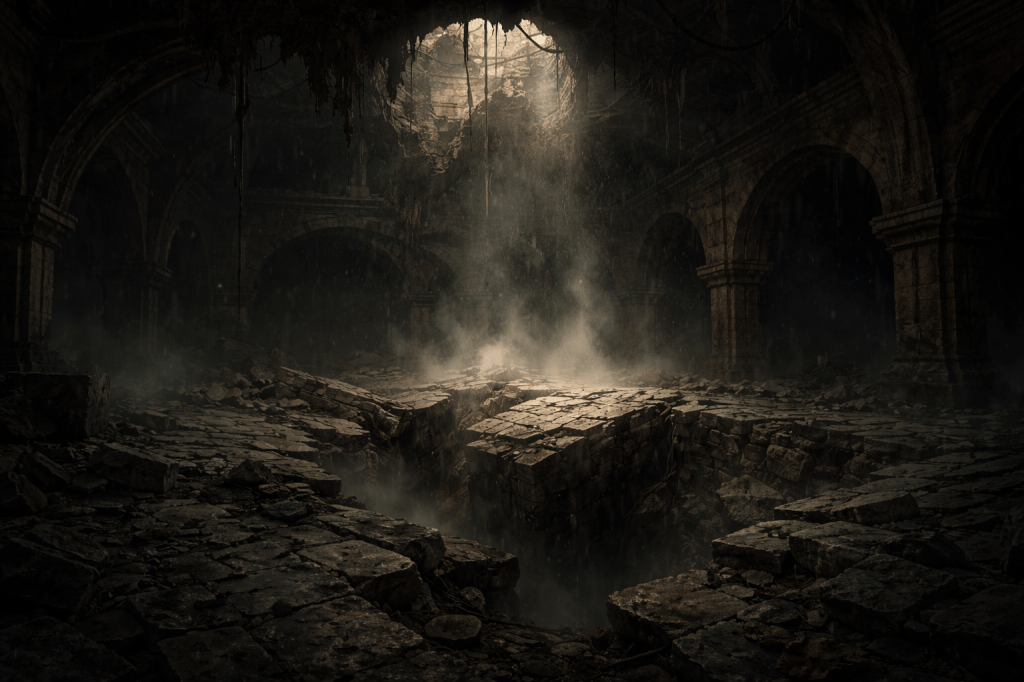
Marr shifted his grip and pressed again. The slab lifted another inch. The sound that followed rose through the opening in a slow drawn exhalation, as if the ground had released a held breath through a narrow throat. The men heard no crack, saw no breaking edge, felt no sudden violence. The change began in the joints around the lifted slab. One seam widened. Then a second opened near it. Across the whole dark ring the paving eased downward together in a motion so slow the eye could follow every part of it. The plumb line trembled above the centre. Water in the worn hollows shivered and drew inward along the widening seams. The entire marked section lowered the depth of a hand.

Hedd stepped back until his shoulders touched the wall. Marr kept the bar fixed under the slab, though his stance had altered and his face had emptied of all labourer’s ease. Carvel alone stayed near the edge, the lamp held low, his gaze moving across the ring as each stone settled into its lowered place.

“It sinks in measure,” Marr said.

Carvel heard him, though his attention had gone elsewhere. A low pressure had risen with the movement, no sound at first, only a gathering in the air that filled the chest and held there. Then, from below the lowered paving, there came a tone so faint it seemed almost to live inside the ear instead of within the yard. It lasted only a moment. Even so, it followed the descent as clearly as a sigh follows effort.

The ground stayed down for the space of three breaths.

Dust continued to rise through the open seam under Marr’s bar. The sweet thin scent strengthened, then spread through the yard in a shallow veil. Hedd kept one sleeve over his mouth. Marr stared into the gap beneath his stone, as though he expected some hand or face to rise into the lamplight. Carvel watched the plumb line. The weighted point had ceased its trembling and now hung slightly lower, the cord pulled taut over a centre that no longer sat where it had sat a moment before.

Then the ground came up again.

The motion followed the same dreadful calm. The lowered slabs rose together by degrees. The widened joints drew inward. Water ran back across the stone in fine trembling lines. Marr’s lifted slab eased down against the bar as the whole centre returned to level, and when at last it settled into its bed the sound it made held the softness of a mouth closing after speech. The plumb weight turned once more and came to rest. The dark ring remained. The yard stood as it had stood when they entered, save that the seams now looked fresher, wetter, and more deeply cut.

Hedd found his voice first. “That was no collapse.”

“No,” Carvel said.

Marr eased the bar from the joint and laid it on the stones with care. “Then what do I enter when he asks?”

Carvel looked across the centre and spoke only after a long pause. “You enter what was seen.”

Marr gave a humourless breath. “The ground gave way and rose again?”

“If you have the courage for plain truth, yes.”

No one moved for a while. Beyond the yard the district had begun its day in earnest. Wheels passed over cobbles. A woman called from an upper window. Somewhere along the lane a hammer started its work upon wood. Within that enclosed space, each outer sound arrived thinned and distant, while beneath them all there seemed to linger the memory of the lower movement, held close under the flags like a second life under the first.

Carvel took the rod from Hedd and knelt again beside the centre seam. He fed the iron into the joint where Marr had lifted the slab. It sank deeper than before. When it stopped, the rod gave a slight turn in his hand, then steadied. He drew it back and found a pale trace upon the lower score lines, finer than dust, almost white.

Marr saw it first. “Mortar?”

Carvel rubbed it with his thumb. The grit felt dry, fine, and faintly greasy, as though it had passed through long-closed air before reaching the surface. He lifted it to the lamp. White flecks caught the light against his skin.

“Keep your hands clear of the joints,” he said.

Hedd’s eyes went at once to the ring around the centre. “You think something is working upward.”

Carvel rose. “I think the ground answered its own measure. That is enough for one morning.”

He closed the folio, though the charcoal in his hand had paused over the slate before making its final line. Marr gathered the bar and hammer. Hedd lifted the lamp and the rods, his gaze still fixed on the central slabs as if he feared a second motion might begin the instant his back turned. Together they moved towards the gate, each step careful and placed with more thought than it had carried on the way in.

At the threshold Carvel stopped and looked back.

The flagged centre lay quiet in the pale light. The ring of darkened joints held around it with a shape too even for chance. A last thread of dust drifted up from one narrow seam and vanished in the damp air. Then, under the watch of all three men, the broadest slab sank by the breadth of a finger and rose again, a small measured motion, no more than a pulse passing through skin.

Hedd made a sound in his throat and stepped into the passage. Marr followed at once. Carvel remained one moment longer, the folio held under his arm, the lamp glow reaching only so far across the yard.

He heard it then, or felt it, and for years afterward he would have struggled to say which. A low interior pressure gathered beneath the stones, held there, and eased away again in a slow returning wave, as though some buried mass below the district had drawn in air through the roots of the walls and released it once more into the foundations above.

When he left the yard and drew the gate to behind him, the sound of the lane closed around the three men and the morning took them back into its ordinary movement. Behind the timber, beyond the patched walls, the ground settled into stillness. It held that stillness with perfect composure, while under the flags the dark seams kept their widened shape and the space beneath the centre lay ready for the next slow descent.


Foundation Register: Rear Foundation Movement Record

The yard entered within the adjoining property plans appears as part of a shared service ground set behind several lower structures, its surface formed through successive layers of paving laid over earlier fill and supporting stone. Surviving revisions record minor alterations to drainage and access across different years, while the central flagged section remained unchanged in outline, its condition accepted as sound within the ordinary pattern of repair.

During routine inspection following reports of settlement within the rear paving, the yard was entered for assessment, and early observations were recorded in practical terms, referring to slight lowering across a central run of slabs, widening damp within the joints, and the possibility of subsidence beneath the flagged surface. These entries held to the language of maintenance and assigned the condition to age, weathering, and long pressure within the underlying fill.

Subsequent notes describe irregularities in the behaviour of the paving during measurement, where rods placed through the joints returned differing depths across a confined section whose outline remained stable in the surrounding stone. Early descriptions refer to this as uneven settlement, though later entries distinguish the movement from ordinary ground loss, recording that the flagged centre appeared to lower and recover within a measured interval while the adjoining sections held firm.

In several accounts, the movement is described as occurring across the full marked section at once, with the slabs easing downward in a single contained shift before returning to their prior level. These observations are entered cautiously, with later revisions attributing the effect to distributed pressure beneath the paving or to movement within a concealed pocket of older material set below the visible surface.

A number of entries refer to changes accompanying the descent, where seams widened briefly, pale residue rose through the opened joints, and a low pressure gathered in the air above the flagged centre. These notes remain limited in detail and are not expanded within the primary record, with several later annotations omitting reference to the atmospheric change entirely and retaining only the structural description.

Further examination records that the behaviour appeared more pronounced where individual slabs were raised for inspection, at which point the movement below the surface was entered as responsive to disturbance within the upper layer. In these sections, the paving is described as lowering in deliberate measure rather than in fracture, and the return is recorded as steady, with no breaking edge or collapse extending beyond the marked ring.

Several observations refer to material recovered from the deeper joints, where a dry pale grit was brought up from beneath the paving despite recent rainfall across the yard above. This substance is entered as degraded mortar or residue from older construction below the present surface, and no further inquiry was undertaken concerning its source or persistence.

The condition was attributed to instability within the underlying fill and to concealed voids or channels set beneath the rear ground, and limited reinforcement was recommended along the affected section. The yard remained in use for a short period following inspection, during which additional observations were entered in reduced form, referring to minor repeated shifts within the central paving and the continued darkening of the surrounding seams.

A marginal notation, written in a later hand, refers to the movement as “measured settlement within the lower layers, as if the ground yielded and resumed in turn”, a phrase set apart from the main entry and left without further explanation. The notation appears once and is absent from subsequent revisions of the same record.

Final entries indicate that the affected section was reinforced during later works carried out beneath the adjoining structures, and its condition was listed as stabilised within the internal plans. The irregular movement was recorded as contained within the limits of structural variation, and no further observation was entered following the completion of those measures.

The matter was entered as resolved within the register, and the yard remains recorded as a stable rear service ground behind the district properties, its condition accepted within the limits assigned to it and requiring no further attention.


About the Creator

The Mythic Chronicle is written and curated by Simon Phillips, a writer of mythic and speculative fantasy whose work explores the quieter edges of forgotten worlds, where buried structures, fractured records, and lingering presences continue beneath the surface of recorded history.

The accounts preserved within these Chronicles form part of a wider body of work in which cities stand upon older foundations, and events recorded as isolated disturbances are understood, in later tellings, to belong to patterns that were never fully recognised at the time.

One such account survives in a separate record, detailing an incident within a lower district where a death was first dismissed as excess, though the space in which it occurred retained a presence that resisted clearing, and where investigation revealed signs that the disturbance had not been confined to a single room.

This record is preserved in the novella Black Feathers in a Brothel, where the events surrounding that incident are followed more closely, though even there the full nature of what lay beneath the structure remains uncertain.

Readers who wish to examine that account in its fuller form may find the record below.

Explore the book:
Black Feathers in a Brothel

You can watch his YouTube channel here:
Author Simon Phillips


Continuation of the Record

What follows is drawn from later entries concerning the rear yard behind the adjoining houses, where movement was first entered as ordinary settlement within the flagged centre. Early accounts describe the change in practical terms and assign it to age, pressure, and variation within the lower fill, though subsequent notes refer to repeated instances in which the ground was seen to lower and recover in measured sequence. Each occurrence is entered briefly and left within the language of maintenance, while several annotations refer to widening seams, pale residue rising through the joints, and a pressure within the air that gathered before the movement took hold. In later entries, the descent is described as affecting the full marked section at once, as though the surface answered to a deeper motion within the hidden layers beneath the yard. The cause remains assigned to structural conditions below the paving, and each account concludes with the ground accepted within the limits set down for it in the register.

Subscribe to continue reading

Subscribe to get access to the rest of this post and other subscriber-only content.

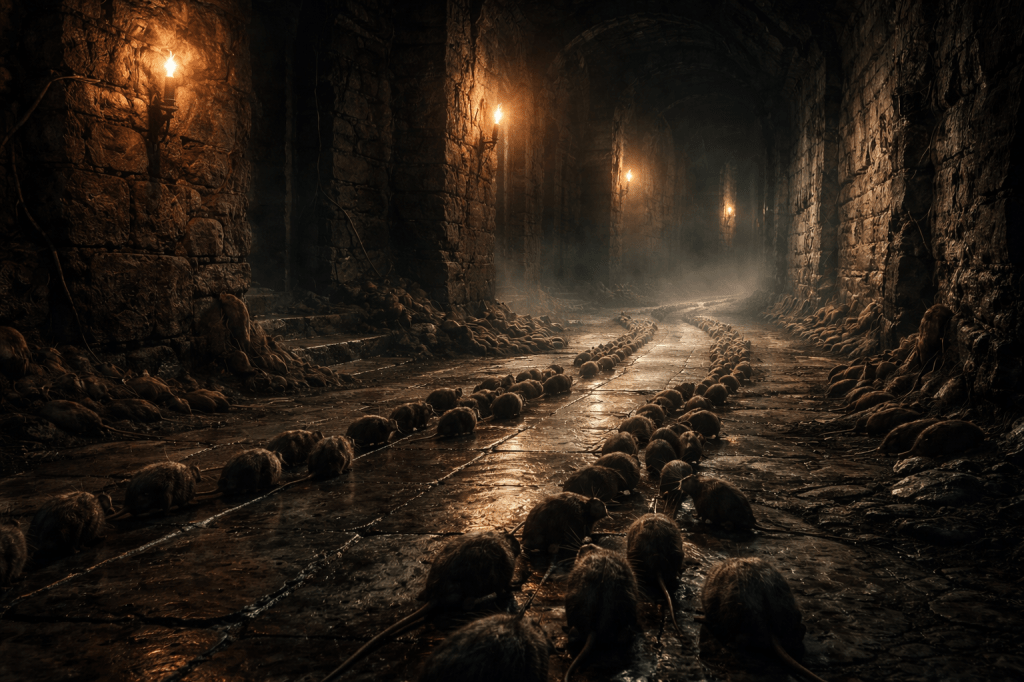
The Mythic Chronilce: The Rats Beneath the Walls


The Record of the Lower Cellar

The cellar door dragged across the stone with a sound that seemed to linger in the wood after the movement had ceased. Merrow kept one hand upon the iron ring for a moment longer than needed, listening into the dark below as though the space might offer some sign of its temper before he trusted his weight to the steps. The lantern in his other hand cast a low amber circle across the threshold, touching the worn lip of the stair and the rough bloom of old damp upon the wall. The smell that rose from beneath carried earth, stale grain, and the faint sour trace of standing water that always gathered under the lower houses once the weather turned.

“You are later than you said,” his wife called from above, her voice softened by the kitchen floorboards and the quiet work of the house settling around her. “If the casks have gone again, leave them until morning. You can mend a hoop in daylight.”

Merrow glanced back over his shoulder, though she remained above and out of sight, somewhere near the hearth where she would be folding the cloths for the next day’s baking. “It is only the latch I came to see,” he said. “Something knocked through the bins after supper. I thought a fox had found a gap.”

“A fox would have made more noise.”

He gave a small breath that might have passed for amusement under easier conditions, then lifted the lantern higher and began to descend. The stone steps were narrow and bowed at their centres from generations of use, and each one received his boot with a dull wet sound that told him the damp had risen further than it should. Their house stood in the lower quarter, where the ground always held the memory of what ran beneath it: old channels and filled hollows, and buried walls that the masons had built across long before Merrow’s father had taken the property. The cellar had never stayed entirely dry through the colder months.

He knew its shapes by habit. He knew where the wall angled inward near the third cask, where the mortar had opened above the eastern shelf, where the timber beam brushed the taller men upon the brow if they forgot to duck.

That knowledge met something altered the moment he reached the foot of the stair.

The room had changed in no obvious fashion. The bins remained in place. The casks stood along the far wall beneath the shelves of winter jars. A bundle of split wood still leaned in the corner where his son had left it. Yet the air carried a pressure that held against the chest, light enough to dismiss if asked, firm enough to feel once one had stepped wholly into it. Merrow paused with the lantern raised as the silence gathered more tightly than the room allowed.

He stood still until his eyes adjusted to the low red dark beyond the reach of the flame. Something moved along the base of the western wall. Then another shape joined it, and another after that, each one small and quick and close to the stone.

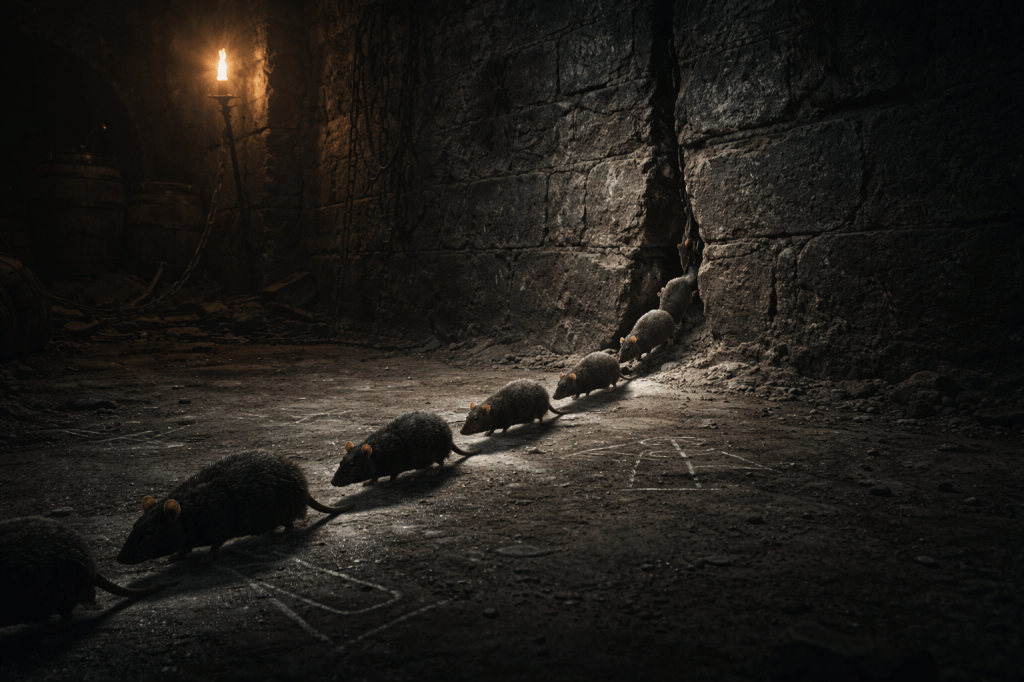
Rats were common enough in this part of the district. He had trapped them before beneath the grain sacks and once above the rafters. What made him hold his breath was the manner of their passing. They crossed the floor in a narrow line, nose to tail, with the same measured spacing between them, and where the lantern light touched their backs they failed to scatter or falter, though any rat with sense would have broken for shadow.

Merrow lowered the lantern slightly and took two steps forward. The line continued. From a crack beneath the shelf they emerged one by one, crossed the room in a shallow curve, then vanished through a seam in the opposite wall where the plaster had separated from the stone. More came behind them. The path they followed held with such precision that it seemed laid down before their paws reached it.

“What in God’s name,” he said, and the words sounded wrong in the cellar, too open for the space that received them.

A shape rustled overhead as his wife reached the top of the stair. “What is it?” she asked. “Have the bins split?”

“Come down with the second light,” he said, keeping his gaze upon the wall. “Slowly.”

Her steps followed after a brief pause, careful and deliberate, and when she reached the lower floor with the tallow lamp cupped in both hands, she stopped at once beside him. “Saints preserve us,” she murmured.

The line of rats held its course between them and the casks. A dozen had crossed already. Another six moved from the crack beneath the shelf. Their bodies brushed the floor with a faint dry whisper, and the sound of it drew across the stone like a seam being stitched.

“They should be running from the light,” she said.

“They should.”

His wife moved a little closer, the warmth from her sleeve touching his arm. “There are too many.”

Merrow nodded. He knew that as well. Rats came in bursts where food lay open or rot had reached the beams, and their movement usually carried the scramble of panic, the ugly energy of creatures snatching what they could before danger closed around them. This procession held no hunger he could see. It held direction.

Even where the floor dipped near the centre, where water from the last rain had gathered in a shallow black sheen, the line bent around it with the same spacing as before, then resumed its course toward the seam in the far wall.

His wife drew a tighter grip upon the lamp. “Fetch the spade,” she said. “If they have found a nest in the plaster, I want them out before dawn.”

Merrow set the lantern upon a barrel head and reached for the short grain shovel resting by the wood bundle. He stepped toward the line and brought the flat of the tool sharply down across the stones ahead of the leading animals. The blow rang through the cellar.

Any common rat would have scattered in all directions. These stopped only for the smallest part of a breath, their bodies gathered close as though receiving a signal too slight for him to notice. Then the first shifted aside and continued past the iron edge. The others followed in order. One climbed over the back of another where the path tightened, then settled again into place.

His wife made a low sound in her throat. “They are following something.”

Merrow turned his head. “There is nothing there.”

She kept her eyes upon the floor. “I can see that.”

The reply unsettled him more than the rats. He knew her habits of speech. She was plain by nature and slow to lend fear a shape before necessity demanded it. Now the lamp trembled in her hands, sending a soft ripple through the cellar shadows, while her gaze remained fixed upon the line as though she feared to lose the pattern once it had been seen.

He crouched near the crack beneath the shelf and thrust the shovel blade against the stones. Two rats emerged as he did so and ran across the iron without changing speed. Their fur brushed the metal. Their whiskers twitched. Their eyes gave him no sign of frenzy. They seemed intent upon a route already chosen.

“There is a draught in the wall,” he said, more to steady himself than from conviction. “They have found heat somewhere beyond.”

“Then why do they keep to one road?”

He had no answer worth speaking. He set the shovel aside and pressed his palm to the plaster near the seam where the animals disappeared. The wall felt cold. Beneath that cold lay something else, a soft uneven pulse that might have been water moving through a hidden channel, if it had carried a rhythm so faint and slow that he felt it more as a suggestion than a touch.

He snatched his hand back and looked down at his fingers, anger rising before he understood the cause.

“Did you feel that?” his wife asked.

He stared at the wall. “Feel what?”

She shifted the lamp to one hand and laid her free palm against the plaster where his had been. For a moment she remained still. Then her expression altered, the colour leaving her face beneath the warm lamp glow. “It is like air through a throat,” she said.

Merrow took her wrist and drew her away at once. “Enough. Go upstairs.”

She resisted him for the first time in years, though only by the smallest measure. “Listen.”

He had been listening since he opened the door. He heard the creak of the floorboards above them. He heard the low hiss of the lamp wick and the wet settling sound from the far cask where the hoop had loosened with age.

Yet beneath those familiar things there came another sound, one he had no wish to name. It lay below hearing and inside it at once, a long faint gathering that seemed to move through the wall without crossing the air. While it held, the line of rats thickened.

From the crack beneath the shelf, a fresh stream emerged. They came from somewhere too narrow to contain them in such number. Small ones. Full-grown ones. Grey-backed and brown-backed. A white-scarred creature with half an ear. All of them entered the same curve across the cellar floor and passed toward the seam in the far wall, as though drawn by a breath he could feel upon the plaster.

His wife stepped nearer to him. “Wake Teren,” she said quietly. “Tell him to go for the ward keeper.”

“At this hour?”

“At once.”

Her certainty cut through his reluctance. He turned toward the stair and raised his voice. “Teren.”

For a few moments nothing followed. Then the boards above groaned, and his son’s sleepy reply came down through the open door. “What is it?”

“Dress yourself and fetch Master Veys from the south lane. Tell him there is movement in the cellar walls.”

A pause answered him. “Movement?”

“Go.”

The boy must have heard something in his father’s tone that allowed no further question, for a moment later they caught the quick uneven tread of feet across the kitchen and the scrape of the outer bar being lifted.

The rats continued. Merrow reached for the lantern again and raised it toward the shelves. He expected to find torn sacks or spoiled stores, some plain cause that would return the room to sense.

The barley stood untouched. The turnips lay clean in their crate. Even the hanging herbs above the stair showed no gnawing. Food had drawn none of this. The line passed through the cellar as pilgrims crossed a church floor, intent upon arrival.

His wife had fallen silent beside him. When he looked at her, he saw that she was following the movement with the focused attention of one trying to hear a distant speaker in a crowded room.

“Do you know where that seam leads?” she asked.

He shook his head. “Into old stone. The neighbour’s foundation lies beyond, or part of it. The mason told my father the wall was thicker there than the house required.”

“The line keeps going lower.”

He listened, then heard it too. Beyond the visible crossing and the dry whisper of paws over stone, there came a continued rustle somewhere inside the wall itself, a layered movement descending through hidden channels and narrow breaks in the buried masonry. The sound might have belonged to many bodies passing through one space, or to one motion repeated over and over beneath the floor.

When Master Veys arrived, wrapped in his dark cloak and carrying a lantern of horn and brass, the rats had thinned enough that the first line had already vanished beyond the seam, while a second still crossed from the crack beneath the shelf. He came down the stairs with the guarded tread of a man summoned often to drunk arguments and burst pipes, prepared for nuisance and unwilling to admit concern before he had earned it.

That manner left him when he reached the floor.

“How long has this continued?” he asked.

“Since I opened the door,” Merrow said. “Perhaps longer.”

Veys crouched near the line. He extended two fingers toward a passing rat, then stopped short of touching it. “They keep the same distance.”

Merrow gave a hard little laugh, empty of humour. “So I had noticed.”

The ward keeper ignored the remark. He lifted his lantern toward the far wall and watched the animals vanish into the seam. “No bait?”

“None.”

“No disturbance in the bins?”

“None.”

Veys rose slowly. The horn panels of his lantern threw a steadier light than Merrow’s, and within that clearer glow the wall seemed older than it had a short while before, its plaster stretched thin across shapes the room was never meant to reveal.

“You said they held their course when checked.”

Merrow took up the shovel once more and laid it across the path. The next rat reached the iron edge, paused, and turned along it until the way opened, whereupon it resumed the line at once. Two more did the same. Behind them, the others continued with patient certainty.

Veys remained very still. “Have no one sleep below stairs tonight,” he said.

His wife answered before Merrow could speak. “You believe this carries a cause.”

The ward keeper kept his gaze upon the wall. “I believe the ground has begun to tell us where it keeps its hidden ways,” he said. “And I believe your cellar sits over one of them.”

The last of the visible rats passed into the seam. Their tails vanished one by one, leaving the stone bare again, though the room felt no lighter for their absence.

Beneath the wall, the faint interior rustle continued, moving downward through the buried foundation as though the line had gone on where sight could no longer follow, and the three of them stood in the cellar listening to that unseen passage, while above their heads the sleeping district held its houses in silence, unaware of the narrow roads that had begun to open beneath them.


Foundation Register: Lower District Cellars

The lower district cellars were recorded across multiple holdings, each structure resting upon earlier stone whose origin remained absent from the surviving plans. What records endured referred only to ground that had been used and enclosed before the present dwellings were raised.

During routine inspection of storage levels beneath several properties, entries began to note irregular activity along foundation walls, where small animals were observed moving in narrow and repeated paths that held their course across the same sections of floor and stone. These movements were recorded without immediate concern and attributed to seasonal change within the ground and the presence of damp conditions below street level.

Further entries describe the persistence of these movements, noting that the animals did not disperse when approached, and that the routes they followed remained consistent across separate properties, even where no direct passage or connection between structures was known to exist. The paths appeared to continue through walls and beneath foundations in a manner that was not accounted for within the existing plans.

The behaviour was recorded in practical terms, with recommendations issued for the clearing of affected areas and the reinforcement of lower walls where necessary. No unified cause was assigned within the register, and each occurrence was treated as isolated, despite the repetition of detail across multiple entries.

A marginal notation, added in a later hand, refers to the alignment of these movements with underlying ground structures not present in the recorded layout. It suggests that the routes may correspond to earlier construction now concealed within the foundation, though this observation remains incomplete and is not expanded upon within the primary record.

Subsequent entries note that the activity diminished in certain locations following clearance efforts, though no formal confirmation of resolution was entered, and the absence of further reports was taken as sufficient indication that the matter had settled without need for continued observation.

The cellars were thereafter recorded as stable, and no connection was made between these movements and earlier disturbances noted elsewhere within the district.


About the Creator

The Mythic Chronicle is written and curated by Simon Phillips, a writer of mythic and speculative fantasy whose work explores the quieter edges of forgotten worlds, where buried structures, fractured records, and lingering presences continue beneath the surface of recorded history.

The accounts preserved within these Chronicles form part of a wider body of work in which cities stand upon older foundations, and events recorded as isolated disturbances are understood, in later tellings, to belong to patterns that were never fully recognised at the time.

One such account survives in a separate record, detailing an incident within a lower district where a death was first dismissed as excess, though the space in which it occurred retained a presence that resisted clearing, and where investigation revealed signs that the disturbance had not been confined to a single room.

This record is preserved in the novella Black Feathers in a Brothel, where the events surrounding that incident are followed more closely, though even there the full nature of what lay beneath the structure remains uncertain.

Readers who wish to examine that account in its fuller form may find the record below.

Explore the book:
Black Feathers in a Brothel

You can watch his YouTube channel here:
Author Simon Phillips


Chronicle Record: The Lines That Held Beneath the Walls

They came to the lower lanes with the same quiet insistence that had held within the cellar walls, passing from house to house by ways no hand had marked. The first to speak of it did so in passing, as though the matter would settle if left without weight.

A cooper set down his tools to watch them cross his floor in a thin line that held from the back wall to the door. When he stamped his heel beside them, the bodies shifted and closed again, their spacing preserved with a care that belonged to craft rather than hunger. The man stood with the mallet in his hand and found that he could not bring himself to strike.

“Drive them out,” his neighbour said, leaning in the open frame with a cloth thrown over his shoulder and the smell of boiled hides clinging to him. “You will have the whole quarter under your boards by week’s end if you leave them.”

“I tried,” the cooper replied. “They keep to a line. Watch how they pass the crack. They turn as one.”

The neighbour bent to look, his brow drawing tight as the lantern light caught the sheen of the worn floor where the animals moved. “There is a draught,” he said after a moment. “You have a hollow beneath you. They follow warmth.”

The cooper gave a slow shake of the head. “Then why does the warmth take a straight road through the stone?”

The question lingered between them, and the neighbour stepped back with less certainty than he had carried in. He left the doorway open, and the line of rats crossed through it without pause, as though the space held no boundary worth their notice.

Across the lane, a woman in the dye house stood over her vats and watched the same passage take form along the base of her wall, where the brick had opened with age and the mortar had drawn back from its join. She saw how the colour in the water shifted as the animals passed, a pale thread moving through the deeper stain, as though something beneath the surface had drawn it aside, leaving a mark that held for a moment before it settled again into the whole.

“You see that,” she said, turning to the boy who tended the fire beneath the vats.

He wiped his hands upon his apron and came to stand beside her. “It is the light,” he said, though he leaned closer as he spoke. “It plays upon the surface.”

“It moves before the light reaches it.”

The boy said nothing more. He watched the line continue along the wall, then turned back to the fire with a care that held his hands too still for a man at his work.

In the baker’s cellar, the flour lay smooth across the stones until the first of the rats crossed it, leaving a narrow track that held its shape even as the man swept it aside. The white line returned by the time he turned back to look, drawn again from wall to wall as though the floor itself had taken the measure of it and set it down once more.

“This is wrong,” he said to his brother, who stood with the door bar in his hand.

“It is vermin,” the brother replied. “We have had worse.”

“We have had hunger,” the baker said. “This carries no hunger.”

The brother looked at the floor, then at the wall where the line vanished into the stone, and he set the bar in place without another word.

The ward keepers were called, and they came with their measures and their small brass instruments, tapping along the foundations and marking the walls with chalk where the tone altered beneath the strike. In each place, the marks formed a path that matched the movement seen upon the floors above, though no plan held those paths within its lines. The men who set the marks spoke in low voices that held more thought than they allowed to reach their words.

“You hear it,” one said in the narrow space beneath a counting house, where the ceiling brushed the crown of his head and the air pressed close around the lungs. “The strike returns to the hand.”

“It settles within the wall,” the other replied, lifting his lantern so that the light slid across the mortar lines and showed the fine dark seam that ran from one corner to the next. “As though the stone holds its own reply.”

They marked the seam and moved on, leaving the chalk to dry against the surface. The line of rats passed across it later that same evening, their bodies carrying the mark forward in a faint broken trail that faded as the movement continued.

Children followed the paths where they could be seen, for children kept their eyes upon the ground where others looked ahead. They laid small sticks across the floor and watched how the line would meet them, and each time the sticks were moved aside, set back into place without force or haste, and the line resumed its course as though the interruption had been measured and allowed for before it arrived.

A boy pressed his ear to the wall where the movement ended and drew back with a look he could not name. When his sister asked what he had heard, he told her only that the wall had held a sound that shaped itself and then was gone, leaving nothing he could carry back into words.

The priests came in the third week, and they stood within a brewer’s cellar where the line had been seen to pass for three nights running. Their robes were held clear of the damp, and their hands were set with the care of men who had been called to restore order where it had slipped beyond the reach of common work. The brewer placed a small table between them with a bowl of water and a single flame, and the eldest among them raised his hand above it and spoke the words that had settled such spaces before.

The water lay still. The flame held. The line of rats entered from the rear wall and crossed the floor between them and the brewer. The eldest watched them pass with a steadiness that did not alter as the animals moved within arm’s reach.

“This is a matter of infestation,” he said, and the words carried the weight of use. “The ground has opened to them.”

“They follow a road,” the brewer answered, his hands set flat upon the table. “I have lived here these twelve years. There is no road where they walk.”

The second priest stepped forward and laid his palm against the wall where the line vanished, holding it there as though the stone might yield something under the pressure. When he drew it back, his expression held a measure that had not been present when he entered.

“There is a current,” he said. “It runs below.”

The eldest inclined his head. “Then we close what we can reach.”

They set their marks upon the wall and floor, small signs placed where the line had been seen to pass, and they spoke their words again. The brewer stood with his hands upon the table and watched as the work was done. When they had finished, the eldest told him that the matter would settle and that he should keep his stores raised from the ground until the season turned.

That night, the line passed again, touching the marks and moving through them as water moves through a narrow place, parting and closing without loss of form. In the morning, the brewer found a pale thread drawn through the water in the bowl, a line that held for a moment before it broke and settled into the whole.

Entries were made in the ledgers, each one set down beneath its own heading, and those who kept the records gave to each a cause that allowed it to stand alone. Damp. Settlement. Infestation. Old work beneath new. The words held in place. The lines beneath the city held elsewhere.

A mason opened a section of wall that had begun to bow inward, expecting to find the rot of timber or the failure of a beam. Instead, he found a narrow space behind the plaster where the stone had been set back from itself, a shallow run that curved downward beyond the reach of his lamp. As he raised the light, a line of rats passed along the hollow, their bodies brushing the inner face of the stone, and he felt a movement beneath his hand that matched their passing, a soft pressure that rose and fell in time with the unseen depth of the space.

“Close it,” he said at once.

“With what?” the apprentice asked, his voice thin within the narrow room.

“With whatever holds,” the mason replied, already reaching for the mortar.

They sealed the opening by lamplight, packing the gap until the wall returned to its line. When they stepped back, the room held its shape, though the mason kept his hand upon the stone as though he expected it to answer him again.

Across the district, similar repairs were made. Cracks were filled. Seams were bound. Floors were lifted and set down again where the boards had worn thin. Each act held its place within the work of a day, and each was set down in the small notes kept by those who tended to such things, entries that spoke of maintenance and care and the usual demands of a city that rested upon older ground.

Yet the lines continued.

They moved through cellars and along walls, across floors and beneath thresholds, appearing where they had been seen before and where they had not, holding their course with a precision that refused to loosen. Those who watched them began to mark their passage with chalk and ash and thread, laying lines across the floor to test where the movement would turn. In each case, the path held to itself, bending where it must and resuming its course beyond the reach of sight.

A clerk in the lower offices gathered the reports and set them side by side upon his desk, drawing a map from the fragments as best he could. His pen moved from one account to the next as he traced the routes described in the margins and the brief notes left in the ledgers. When he had finished, he sat for a long time with the page before him, for the lines he had drawn formed a pattern that held beyond any single house or street, a network that ran beneath the district in a shape that had not been set down in any plan he knew.

He carried the page to his superior and laid it upon the table, and he spoke of the movement in careful terms, avoiding any suggestion that would place the matter beyond the common run of maintenance and repair.

“These are reports of vermin,” the superior said, after a brief glance. “They follow food.”

“They follow a line,” the clerk replied. “The line passes through walls.”

The superior turned the page slightly, as though the change in angle might alter what it showed. “You have drawn this from separate entries.”

“I have set them together.”

“And in doing so, you have made a shape that suits your concern.”

“The shape is present whether I draw it or no.”

The superior scattered sand across the page to dry the ink. “Leave this with me,” he said. “I will see it placed within the proper file.”

The clerk withdrew. When the page was entered into the record, it was entered under the heading of seasonal infestation, and the lines were reduced to notes within the margin, each one assigned to its place without reference to the whole.

Toward the end of the fourth week, the movement lessened in several houses at once, and those who had seen it took this as a sign that the matter had passed, that the ground had settled and the animals had moved on to other quarters where the stores lay open and the walls gave easier passage. The ward keepers marked their notes accordingly. The priests spoke of patience and the virtue of ordered space. The ledgers received their final entries.

In certain places, however, the sound beneath the walls continued, a faint interior rustle that moved through the stone without crossing the air. Those who listened for it found that it held a direction that led downward, away from the reach of the cellars and the rooms above, into depths that the city had long since covered and forgotten. When the nights grew still and the houses settled into their quiet, the walls carried that movement in a manner that suggested it had found a road it would keep, whether watched or left to itself.


Rats were observed moving in narrow lines along the foundation walls, maintaining their course even when the path ahead was disturbed.


The Idea Behind the Chronicle

The lower districts of any city carry a different kind of history, one that settles beneath daily life and gathers within the spaces that remain unseen. Cellars, storage rooms, and foundation corridors often extend beyond their original purpose, shaped over time by repair, extension, and quiet neglect. These spaces hold the marks of earlier construction, where walls have been altered, passages closed, and ground reworked in ways that are no longer fully recorded.

This Chronicle draws upon that layered nature of built environments, where what lies beneath continues to influence what stands above. Movement within such spaces is often attributed to natural causes. Animals follow scent and warmth, water shifts through unseen channels, and structures settle under their own weight. These explanations hold in most cases, though there are instances where behaviour within these environments carries a consistency that exceeds simple cause.

Accounts of unusual animal movement appear across historical records, particularly within dense settlements where food, waste, and shelter draw them into close proximity with human habitation. In many of these accounts, the behaviour follows expected patterns. In others, it reflects something more structured, where movement occurs along fixed routes that persist even when disturbed. These routes sometimes appear to correspond with earlier construction, suggesting that what has been built over may still guide what passes through it.

The Whispering Foundations series explores this relationship between structure and persistence. In these accounts, the environment itself carries behaviour that cannot be easily attributed to any single source. Movement follows paths that hold their form across separate locations. Surfaces respond in ways that seem to retain what has passed over them. Spaces that appear enclosed reveal connections that exist beyond visible design.

In this Chronicle, the movement of rats serves as the visible layer of a deeper pattern. Their behaviour is recorded as practical observation, noted in the same manner as any infestation or disturbance within a working district. Yet the consistency of their paths, and the way those paths extend beyond the limits of individual structures, suggest an underlying continuity that remains unrecognised within the official record.

What is preserved here reflects only what was seen and written at the time. The records remain grounded in explanation, attributing the events to conditions within the ground and the structures built upon it. The possibility that the movement followed something more enduring is left without confirmation, held only in the repetition of detail across separate accounts.

The lower districts continue to function as they always have, their foundations supporting the weight of the city above. Beneath them, the earlier layers remain, carrying the forms and spaces that were set down before the present walls were raised. The Chronicle preserves a moment when those layers made themselves known, though only through the movement of what passed along them, leaving the deeper cause to remain within the ground itself.


From the Author’s Desk

Thank you for continuing into this Chronicle.

This account was shaped around the idea that movement can reveal what structure conceals. In many places, the first sign of change arrives through behaviour rather than form, where something small begins to follow a path that should not exist. That path holds long enough to be seen more than once. The lower districts offered a natural setting for this, where foundations overlap and earlier work remains beneath the visible world.

The movement of the rats serves as the surface layer of this Chronicle, a detail that can be recorded, explained, and set aside within practical terms. Yet what interested me most was the persistence of the line itself, the way it continues and the way it appears across separate spaces without clear connection. That sense of continuity becomes the focus, rather than the animals that carry it.

As this series develops, each Chronicle will return to similar moments of early observation, where something is present before it is understood, and where the records reflect only what could be seen at the time. These accounts remain incomplete by design, shaped by the limits of those who encountered them, and by the tendency of the record to settle upon explanation even when something remains unresolved beneath it.

Beyond the Chronicle, my work continues across a range of fantasy and speculative writing that explores these same ideas from a closer distance, where events unfold more directly and the underlying structures begin to take clearer form. Those stories exist alongside these records, offering a different view of the same world.

You can explore my books here:
Books by Simon Phillips

You can watch my YouTube channel here:
Author Simon Phillips


Archive & Interpretations

Fragment from the Archive

From the lower district registers, compiled across multiple holdings. The script varies in form, suggesting entries gathered from separate hands and later combined within a single record.

Initial reports of movement were entered during routine inspection of cellar levels, where animals were observed passing along foundation walls in narrow and repeated lines. The entries describe the behaviour in practical terms, noting the presence of damp and the likelihood of underlying channels within the ground, though no single source was identified within the early record.

A subsequent entry, written in a tighter hand, records that the movement remained consistent across separate properties, and that the paths taken by the animals appeared to align where structures stood apart. The writer noted that the routes held even where no passage was known to exist, and that interruption of the movement failed to disperse it beyond the immediate point of contact.

Later annotations describe attempts to clear the affected areas, including the sealing of visible cracks and the reinforcement of lower walls. The entries remark upon the return of the movement following such work, with the lines reappearing along the same routes, and no alteration in their course recorded despite repeated disturbance.

One entry, less formal in its structure, refers to the behaviour as following “a line within the ground”. The phrase is set apart from the main record and carries no further explanation, leaving the note preserved without clarification or expansion.

The final entries record a reduction in visible activity across several locations, and the matter is thereafter marked as resolved within the register, though no definitive cause is assigned beyond reference to seasonal conditions and underlying structural variation.


Marginal Notes & Interpretations

Collected from later annotations added to the same register, appearing in varied script and ink.

One annotation attributes the movement to established animal behaviour, suggesting that the consistency of the paths reflects known patterns of travel through confined environments, where scent and environmental memory guide repeated routes. The writer frames the observations as exaggerated by close conditions within cellar spaces.

A second note challenges this explanation, observing that the alignment of the routes across separate structures suggests a continuity that extends beyond individual environments. The persistence of spacing and direction, as recorded in multiple entries, indicates a pattern that is maintained independently of visible pathways, though the writer leaves the observation without further conclusion.

A third annotation, faint and partially obscured, records that those who observed the movement most closely remarked upon a sensation within the walls themselves, described in uncertain terms as a pressure or passage beneath the stone. The note breaks off before the thought is completed, and the remainder of the line is lost to damage along the edge of the page.


World Notes

Lower District Cellars
Subterranean storage spaces constructed beneath residential and trade buildings, often extending beyond their original design through successive modification, and frequently resting upon earlier foundations whose structure is no longer fully recorded.

Foundation Alignment
A term occasionally used within structural records to describe correspondence between features of separate buildings, particularly where underlying construction predates current layouts, and where such alignment may influence movement or stress within the ground.

Recorded Movement
Entries within municipal and trade registers noting the presence and behaviour of animals within built environments, typically attributed to natural causes. In certain cases, however, the consistency of such movement is recorded without clear explanation, and remains preserved only within the repetition of detail across separate accounts.


Next Chronicle

In the days that followed the reports of movement beneath the lower district, attention shifted toward a chamber recorded in earlier plans as storage. Later entries describe the space as holding a presence that remained after each night’s closing, where the air settled in a manner that did not clear with use or passage, and where those who entered remarked upon a weight that returned even after the room had stood empty.

These accounts were entered without formal concern, attributed to damp conditions and poor ventilation within enclosed spaces. Several notes refer to the persistence of the atmosphere, which appeared to restore itself despite efforts to clear it through light and air.

No connection was made to the movement previously observed within the surrounding structures.

Next Chronicle: The Room That Would Not Clear


The lower district returned to its ordinary rhythm, the cellars cleared and the walls repaired, while the records marked the disturbance as settled and the movement as passed. Beneath the foundations, the paths remained where they had formed, holding their course beyond sight, and within that unseen ground something continued along them, unchanged by their disappe