Beyond the broken road, poisoned men lay amid fire without torches, and something believed lost was said to have returned.
Beyond the Pine Hollow
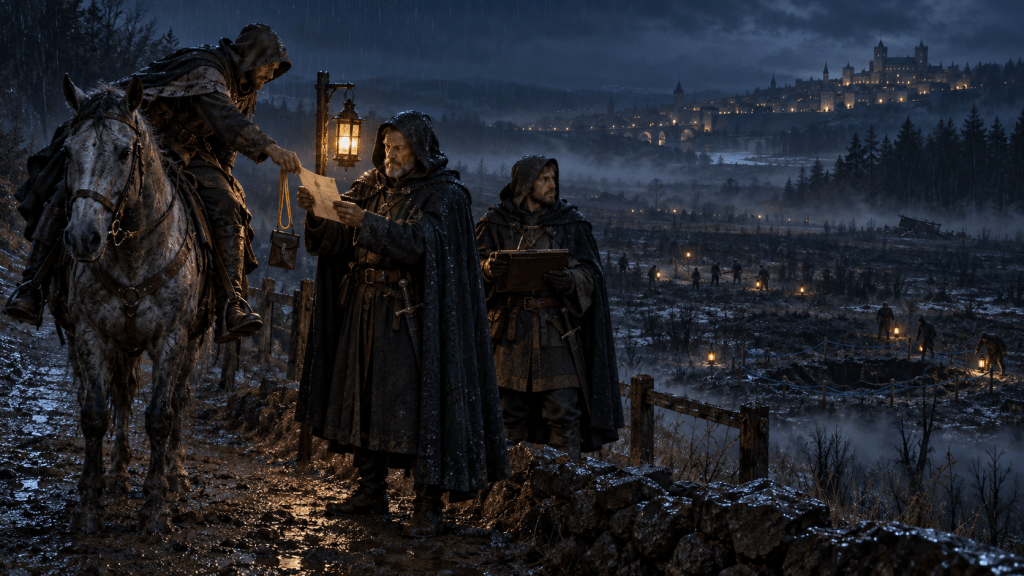
The light was already thinning beyond Grey Ash Rise when Captain Rylas led the first measured line of guards down from the pines, each man placing his boots inside the marks ahead while smoke lay close to the field and winter damp gathered along the blackened grass. From the upper road, the clearing had appeared wounded by the overturned carriage, yet the slope revealed a harsher order as they descended: bodies among the wheel ruts, arrows buried in frozen earth, and a broad darkness where no brazier, torch, or vessel of pitch had been found.
Rylas carried a hooded lamp in his left hand and kept his sword free in his right. Corporal Maeran Holt followed with marking cord across one shoulder, his bruised ribs bound beneath his tunic, while four watchmen came behind them with linen, wax tablets, stakes, litters, and the road surgeon’s leather case held above the smoke.
“Set every lamp low and keep to the wheel line until I give you ground of your own,” Rylas said as he stopped where pale winter grass yielded to the first scorched patch. He lowered his lamp towards blades burned into curled black threads beside others still wet with meltwater. “Any man who moves a weapon, body, buckle, scrap of cloth, or arrow before the clerk marks its place will answer before Prince Patrick with memory as his only witness.”
Maeran planted the first stake beside the burn line, then crouched and pressed two gloved fingers into the soil. Moisture shone across the leather when he raised his hand, while the grass beneath his knuckles crumbled into ash. “This field carried winter water from the ditch,” Maeran said as he rubbed the residue between finger and thumb. “A common flame would have crawled, failed, then smoked itself dead before crossing ten paces of ground this wet.” Rylas watched the scorched edge curve away from the carriage. “Then mark what the earth gives,” the captain said, “because a common flame would have left a common account.”
The burn had travelled in a broad arc through the field, bending away from the carriage instead of spreading outward from its broken timbers. Its western edge stopped sharply where green-brown grass stood untouched beside a blackened hollow once thick enough to reach a man’s knees. The breeze came from the east and carried smoke towards the pines, although the scorched path ran against it, climbing a slight rise before opening into a fan where several bodies lay among the cinders. Some had fallen face first, while others rested on their backs with arms drawn close and clothing burned into the shapes beneath.
Pell, the youngest watchman among them, swallowed against the smell as his lamp shook across every still face in turn. Rylas steadied the iron frame with one hand and drew the guard’s scarf higher across his mouth. “Keep your breath through the cloth and your eyes upon the ground,” the captain said. “The dead have finished fearing this place, and we serve them best by carrying away the part that still speaks.” Pell angled the light towards a round shield half buried beneath ash. “That man bears no royal colour, Captain,” Pell said as his gaze settled on the corpse. “His boots and beard rings match the stranger from Tanner’s Row.”
Beside the corpse lay a short bow tipped with pale horn and three arrows whose heads had escaped the fire beneath the mud. Rylas reached towards one shaft, then withdrew when the road surgeon caught his sleeve. “Leave the iron until I wrap it,” the surgeon said as he opened his case. “The rider carried darkness around his wound before fever took his senses, and a pinprick from the same preparation may purchase a grave.” He lifted the arrow with folded wax linen, revealing dark paste inside the socket. “Watch the lips, fingers, and veins around every wound,” the surgeon said as he turned the head beneath the lamp. “Blue-black branches under the skin reveal corruption of the blood.” Maeran looked towards the fallen escort as his hand tightened around the cord. “Then poison crossed the road before the fire,” the corporal said. The surgeon tied the linen around the iron before meeting his gaze. “Poison came here prepared, and fire found it waiting,” he replied as he returned the wrapped arrow to his case.
They found the first poisoned guard beside the carriage door, lying on one shoulder with both hands drawn hard against his chest. Fire had passed within three paces of his boots while sparing his cloak, and dark lines rose below his jaw from a wound near the collar. The road surgeon examined the stain as the branching disappeared beneath the dead man’s clothing. Rylas drew linen over the guard’s face while Maeran fixed the covering beneath his shoulder. “Enter him as royal escort, fallen by foreign arrow and corruption of the blood,” the captain said as the clerk scratched the words into wax. “His name waits for the castle roll, while his service already stands before it.”
Beyond the carriage, the field gave stranger signs. Fire had consumed a near-perfect sweep of grass, while torn cloth survived at its centre and the earth remained pressed beneath knees, heels, and one larger shape stretched across the soot. Two trails entered that hollow from different directions. One came from the wreck, light and uneven, with the narrow heel of a court shoe sinking deep where its wearer had stumbled. The other began near the upper field where the mud held no approaching path, its first boot mark cut sharply into damp soil as if the traveller had entered between one breath and the next.
“Here is the man who came after the killing,” Maeran said as he held his lamp over the deeper prints. “One stride, then a turn beside the burned grass, though the ground behind him gives no road, ditch, hoof cut, or broken stem.” Rylas followed the marks to the long impression in the soot, where spread fingers remained visible beside two deep knee marks. A patch of earth held dull warmth through his glove after the surrounding fire had cooled. The narrow shoes ended on one side, and the heavier boots ended on the other. Beyond that place, the field offered no departure.
Pell moved his lamp across the untouched grass. “They may have carried the wounded one between them,” Pell said as he bent near the edge. Maeran pointed towards the unmarked soot as fatigue roughened his voice. “Then show me the feet that bore him,” the corporal said. “Three bodies may leave confusion, lad, yet they still owe the earth a heel, a dragged toe, or one crushed blade.” The road surgeon knelt beside the long impression and studied the disturbed ash near the shoulders. “Someone lay here while a second person braced them,” the surgeon said as he held his palm above the mark. “The weight lessened where the shape ends, and this ground gives the form of care followed by absence.”
Rylas looked back across the field towards the overturned carriage, the covered guards, the foreign bows, and the black arc cut through winter grass. Every part of the ambush held violence a soldier could enter into record: arrows loosed from concealment, wheels forced from the road, men killed at close quarters, poison prepared for certainty, and fire driven across the cover where hidden attackers had waited. The hollow alone resisted such order, preserving the pressure of bodies, hands, and urgent movement before releasing them into empty ground beyond the claim of any path.
From the upper road came a watch horn, answered faintly from Grey Ash Rise as daylight thinned behind the pines. Rylas drew blue cord from the clerk’s satchel and tied it between two stakes around the hollow. “Place two guards here where they can watch each other through the night,” the captain said as the cord stirred above the impressions. “The report will say that fire crossed wet ground, foreign poison entered Bremyran flesh, and tracks belonging to two living persons ended where the ash remained warm. Finer truth can wait until those who left choose to return and speak it.”
Maeran gathered the unused stakes and looked westward towards the city beyond the mist. “And if they have already returned before us, Captain?” the corporal asked as smoke drifted between them. “If the road lost them here and Bremyra opened its gates before any rider carried word?” Several men later swore they felt a faint trembling underfoot while Rylas listened to the fading horn. “Then this field holds only the lesser half of what happened,” the captain said as he lowered his gaze to the tracks. “Keep the lamps burning, because by morning every road in Bremyra will claim it carried them home.”
Night gathered slowly across the clearing while linen settled over the fallen and ash clung to the guards moving among them. Above the blackened hollow, the blue cord lifted and fell in the cold air, guarding two trails that reached their meeting place from different parts of the ruined field and departed by no direction any watchman could follow. Long before the bodies were counted, long before the poisoned arrows entered the castle stores, the first whisper had already taken shape among those standing beneath the pines: fire had crossed the grass with no torch before it, and the lost had returned by a road the earth itself could never mark.
A Visual Chronicle
A royal ambush, poisoned arrows and two trails that end in the ash, discover the mystery of Grey Ash Rise in The Field of Burned Grass, a recovered account from The Mythic Chronicle.
Field Examination Register: Grey Ash Rise
The field beyond Grey Ash Rise was entered into the road register following discovery of the royal carriage, its frame overturned beside the western verge and its upper timbers damaged by flame. The surrounding ground held the bodies of royal guards and foreign assailants, though the surviving record supplied no complete number and referred several times to remains removed before formal examination had concluded.
Scorched grass extended across the clearing in a broad curve whose direction opposed the wind recorded that evening. Surveyors found no vessel of oil, pitch, lamp fuel, or other substance capable of carrying fire across the winter-soaked earth, while the carriage itself showed less damage than several patches of open ground lying beyond its wheels.
Foreign arrows recovered from the field bore a dark preparation beneath their iron heads. The road surgeon identified signs of blood corruption among the fallen, including blackened veins, discolouration around the wounds, and a rapid stiffening of the hands. Samples were ordered sealed within the castle stores, though a later inventory listed only two wrapped arrowheads where the original field account recorded seven.
Near the centre of the burned ground, examiners marked impressions belonging to two persons believed living when they entered the hollow. One trail led from the ruined carriage. The second began within the field itself, where no approach could be identified across the mud, grass, or ash. Both ended beside the impression of a body laid upon the earth, and the ground beyond held no departure towards the road, pines, or lower ditch.
The soil inside the marked hollow remained warm after the surrounding ash had cooled. Guards assigned to preserve the site recorded a faint trembling beneath the stakes during the first night, though this observation was removed from the official copy and survived only in a clerk’s unfinished duplicate.
The field was thereafter declared cleared for passage, while the central hollow remained excluded from grazing, burial, and further survey. No reason for that restriction appeared beside the order, and the register closed with the statement that every person sought upon the road had already been accounted for within Bremyra.
About the Creator
The Mythic Chronicle is written and curated by Simon Phillips, a writer of mythic and speculative fantasy whose work explores forgotten kingdoms, fractured records, old institutions, and the moments when history begins to shift before those living through it understand what has changed.
The accounts preserved within these Chronicles form part of a wider body of work in which castles keep older secrets beneath familiar rooms, roads carry rumours ahead of armies, and ordinary witnesses preserve fragments of events whose true meaning remained sealed from them at the time.
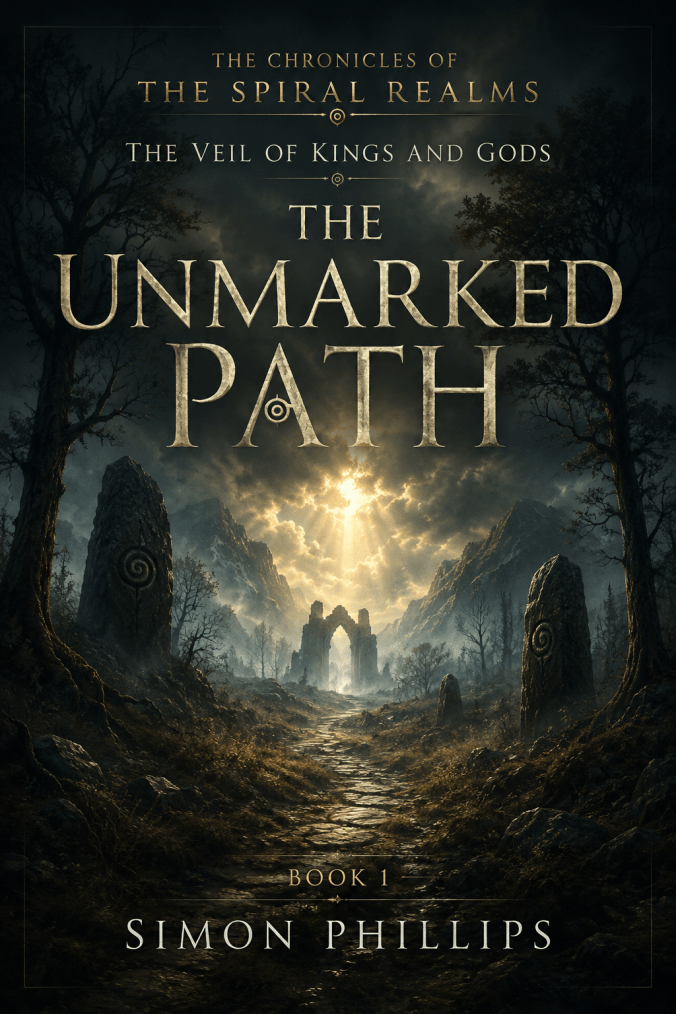
One such account survives in a separate record, following the return of a magician to Bremyra during a season of court unease, royal absence, Church suspicion, and gathering danger beyond the kingdom’s roads. What the servants, clerks, and watchers of the city remembered only in fragments is followed more closely in The Unmarked Path, the opening book of The Veil of Kings and Gods within The Chronicles of the Spiral Realms.
Readers who wish to examine that fuller account may find the record below.
Read the book:
The Unmarked Path
Explore the wider saga:
The Chronicles of the Spiral Realms
You can watch his YouTube channel here:
Author Simon Phillips
Continuation of the Record
What follows is taken from later watch accounts concerning the field beyond Grey Ash Rise, where poisoned bodies lay beside the overturned royal carriage, fire had crossed the winter-soaked grass, and two living trails ended within the ash before word of an impossible return reached Bremyra.

Subscribe to continue reading
Subscribe to get access to the rest of this post and other subscriber-only content.