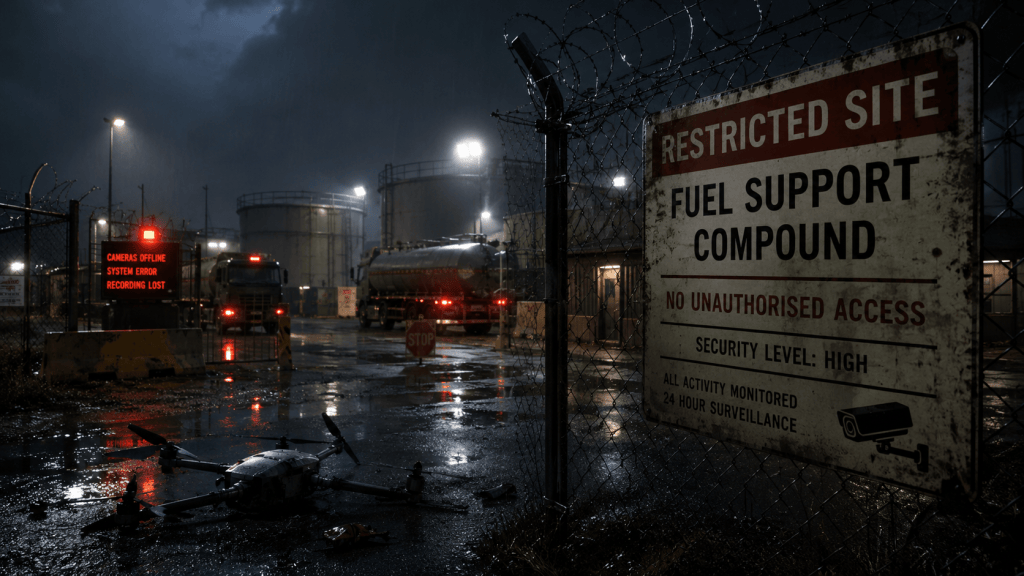
At a fuel-linked support compound near a controlled route, a brief technical failure began to look less like an outage and more like a test.
The Fence That Went Blind
By the time the cameras failed at Rookham Fuel Support Compound, rain had worked into every edge of the evening, running along the mesh fencing, gathering on the concrete lanes, and turning the floodlights into pale broken bars across the yard. The controlled route lay beyond the outer ditch, hidden behind blackthorn and the low bank, although everyone on shift knew when movement passed because blue police lamps slipped between hedge gaps and travelled over wire. Tankers waited beside the southern bay, bowsers sat under temporary lamps, and tarpaulin-covered flatbeds had been kept at the gate long enough for their drivers to lose faith in the printed schedule. Rookham still called itself a fuel support compound on signs fixed to the fence, useful, dull, and safely technical, yet lately it had begun to feel like a small hinge in a route everyone had been told to treat as routine.
Nina Carver had taken over the maintenance-control desk at six, carrying a plastic folder under one arm and a paper cup of tea that had already gone too cool to forgive. She had worked Rookham for six years, long enough to know which pumps whined before rain, which gate sensor sulked during frost, and which drivers arrived with anger already packed in the cab beside them. Extra barriers had appeared near the service gate, contractor access required a second call, and police parked in the lay-by after dusk. Nina preferred valves, pumps, lines, and fuses, because machinery usually failed with more honesty than people.
Across the cabin, Amir Laleh sat beside the access terminal, one shoulder angled towards the window so he could watch the gate between entries. He was logging the Bay Two tanker when the generator sound dipped beneath the rain, softening the lights for less than a second. The screens brightened again, the pumps carried on, and Nina had already turned towards the power panel before Amir finished looking up.
“That was supply side,” Amir said, keeping one hand on the mouse as the green status marks flickered across the terminal.
Nina touched the panel casing with the back of her fingers before she checked the strip of readings. “Or load side. The site enjoys variety when it wants attention.”
Amir reached for the internal phone, his eyes still fixed on the panel. “Should I call Dale?”
Nina kept her attention on the board as a fresh amber mark appeared beside the east fence feed. “Call Dale once we know which part wants to embarrass us.”
The perimeter screens above the maintenance desk had spent most of the evening showing rain, wire, and puddles, which made their sudden failure feel absurdly intimate. Camera Thirteen froze first, preserving a stripe of rain in the floodlight as though the night had been pinned to the screen. Camera Fourteen shivered once and held on the maintenance gate with the warning plate blurred by water. Camera Fifteen turned grey, recovered for half a breath, then fell into black. Amir rose from his chair, the phone still in his hand, and stepped close enough for his reflection to appear faintly beside the dead feed.
“East fence line,” Amir said, his voice lower now as he looked from one screen to the next.
Nina opened the camera status window and watched the system repeat the same useless symbol beside each channel. “Three cameras and one feed alarm.”
The cabin door opened before Amir could reach for a simpler answer, and Dale Houghton came in with rain on his shoulders, a torch in one hand, and his site keys hooked between two fingers. He looked at the frozen screens, then at the power panel, then at Nina’s radio, as water dripped from his jacket onto the rubber mat by the door.
“How long?” Dale asked as he moved beside the desk.
Nina slid the status window across the lower monitor so he could see the feed alarm. “Under a minute.”
Dale raised the torch towards the frozen fence image. “Power dip first?”
Nina kept her hand near the radio. “One pulse, then recovery. The generator caught itself.”
Dale studied the dead channel for a moment. “Machines get blamed for many human talents.”
The yard radio cut across them before Nina could answer. Bay Two reported a pause in fuelling because the driver’s paperwork had changed during entry. The gatehouse asked whether the controlled-route window still held. A third voice from the police car in the lay-by requested confirmation that no external access had been granted along the east fence since shift handover. Nina looked towards Dale as that final question settled inside the cabin, sharper than the generator dip and heavier than the dead screens. Amir turned from the terminal with the phone pressed against his palm.
“Why are police asking about the east fence already?” Amir asked.
Dale took a key from the ring and headed for the door. “Because someone outside this cabin has seen the same hole in the evening.”
Nina pulled her coat from the hook and followed him into the rain, leaving Amir at the panel with instructions to log each feed change and hold Bay Two if any further alarm appeared. The compound opened around her in glare and water, tanks rising as dark curves behind the lamps, pipe runs shining along the low gantries, tanker lights reflecting in the puddles beside the bay. Beyond the fence, traffic moved along the controlled route in brief fragments of sound, engine noise dampened by wet hedges and the soft rush of tyres through standing water.
The east side of Rookham had always felt less settled than the rest of the compound, with the ground dipping towards the drainage ditch and the old service track narrowing near the culvert. Camera Thirteen sat on a black post halfway along the line, its weather hood shining with rain. Beneath it, the junction box remained closed, labelled, and locked, although the conduit below it had a new pale mark near the entry point, visible once Dale’s torch crossed it. Dale crouched in front of the box, bracing one knee against the wet gravel as he worked the key into the lock. Nina stood behind him with her torch angled along the fence, her beam passing across wire, weeds, the outer ditch, and the flattened grass beyond the bank.
The junction-box door opened with a stiff metallic scrape, and Dale leaned in, his torch held close enough to turn the inner casing white.
“Well,” Dale said quietly as he shifted his body aside so Nina could see inside.
The feed line had been cut near the lower entry point, the outer sheath opened in a clean split and the inner cable exposed where it should have run whole into the conduit. Water gathered along the severed edge and dropped onto the gravel in clear beads. The cut carried too much intention for weather, wear, or the old gate’s usual talent for humiliation. Dale kept his hands away from the damaged line and looked at the surrounding gravel, his whole body held still by the kind of care that arrived when a familiar place revealed a stranger’s hand.
“That came from outside,” Nina said as she lifted the radio and kept the torch fixed on the cable.
Dale shifted the beam from the box to the fence base, where wet grass had been pressed low in a narrow patch near the ditch. “Looks that way.”
A movement beyond the wire drew Nina’s eye before either of them spoke again. Her torch crossed the ditch, swept back, then held on a small dark shape half buried in grass near the outer bank, with one broken arm lifted from the mud. At first the rain made it look like roadside scrap, a piece of shattered casing thrown from a van, yet the shape resolved under the light into something more deliberate, black-framed, compact, and wrongly patient. Dale turned his torch slowly across the same spot, and the two beams met on the broken frame as rain gathered along its arms.
Nina pressed the transmit key, watching the object through the fence as she spoke. “Control, this is Carver at east fence. We have confirmed cable damage at Junction Thirteen and possible unmanned debris beyond the perimeter. Hold Bay Two. Lock east access. Request police to the outer ditch and suspend movement near the service track until cleared.”
Static answered first, then Amir’s voice came from the cabin. “Received, Carver. Bay Two held. East access locked. Police requested. I am logging junction damage and possible unmanned debris now.”
Dale stayed by the open junction box, his torch moving from the severed cable to the fence post and back again, as though the line between the two might make more sense under enough light. The compound carried on behind them, pumps humming, tanker brakes sighing, rain striking the tanks, drivers waiting beneath shelters, radios turning fear into procedure. Inside the floodlit fence, Rookham still looked like a fuel site managing a technical fault. Outside the wire, in the wet grass beyond the dead cameras, the damaged drone lay where the fault had started to look like a message.
A Visual Chronicle
A brief camera failure at Rookham Fuel Support Compound became something far more deliberate when Nina Carver followed the fault beyond the fence.
Restricted Infrastructure Incident Report Extract from Regional Fuel Continuity and Site Security Coordination Log Subject: Rookham Fuel Support Compound / Eastern Perimeter Camera Failure Time: 19:17–20:06 Circulation: Regional Movement Desk / Fuel Continuity Cell / Police Liaison / Contractor Security Lead / Defence Access Support
Purpose To record the initial response to a perimeter-system failure at Rookham Fuel Support Compound during an active controlled-route movement window, with associated impact on fuelling operations, site access, police liaison, and contractor maintenance activity.
Public Position A minor technical issue affected part of the perimeter-security system at a fuel support site. Site operations remained under control while maintenance checks and routine safety procedures were carried out. There was no confirmed threat to public safety, and relevant agencies continued to monitor the position.
Incident Summary At 19:17, Rookham maintenance control recorded a brief generator-load dip affecting internal lighting and perimeter-monitoring feeds. Power recovered within normal tolerance, although three eastern-perimeter camera feeds failed or froze during the same event.
The affected feeds covered the outer fence, the old maintenance gate, and the drainage-culvert approach beside the eastern service track. Maintenance staff attended the junction box beneath Camera Thirteen and identified damage to the external feed line near the lower conduit entry point.
At 19:24, maintenance staff reported possible unmanned debris outside the perimeter fence, positioned in wet grass beyond the drainage ditch. Eastern access was locked, Bay Two fuelling was paused, and police liaison was requested to attend the outer ditch under controlled access.
Operational Impact Bay Two fuelling paused pending perimeter clearance. Eastern service-track movement was suspended. Contractor access through the old maintenance gate remained closed. Controlled-route traffic continued under police supervision. No site evacuation was initiated. No injuries were reported during the initial response window.
Technical Position Initial maintenance assessment indicated deliberate damage to the external camera feed line. The generator dip remained under review, with no immediate evidence of wider compound power failure.
Camera Thirteen and Camera Fourteen remained unavailable during the first response window. Camera Fifteen returned intermittent grey-feed output before failing again. Temporary visual coverage was requested through mobile patrol and police outer-fence observation.
Handling Guidance Staff were advised to describe the event as a perimeter-system fault under review. Drivers, contractors, and local callers were to be told that fuelling activity had paused temporarily while maintenance and safety checks were completed.
Questions concerning police attendance, camera-feed failure, route movement, drone activity, defence-linked traffic, or wider infrastructure security were to be referred to regional communications.
Lines to Avoid Avoid confirming deliberate interference pending forensic review. Avoid linking the incident to protected route movement. Avoid identifying camera coverage gaps or feed locations. Avoid discussing unmanned debris, drone recovery, or possible reconnaissance. Avoid confirming Defence access involvement unless cleared through regional handling. Avoid suggesting any wider pattern of infrastructure probing.
Internal Assessment The timing of the camera failure, the generator-load dip, the damaged feed line, and the recovery of unmanned debris beyond the eastern perimeter increased concern that Rookham had been subject to external observation or probing.
Attribution remained unresolved during the initial reporting window. The incident was assessed as operationally contained, although the affected camera line covered a sensitive section of the compound adjacent to controlled-route movement and fuel-handling activity.
Further review was required to establish whether the generator dip was coincidental, induced through local interference, or connected to the camera-feed failure.
Further Action Police liaison to secure the outer ditch and preserve the debris field. Contractor security lead to provide maintenance history for Cameras Thirteen to Fifteen. Fuel Continuity Cell to review Bay Two pause against scheduled movement requirements. Regional Movement Desk to assess whether further controlled-route activity required temporary camera uplift or mobile patrol cover. Public-facing explanation to remain limited to a perimeter-system issue under review.
About the Creator
The Modern Chronicle is written and curated by Simon Phillips, an author of modern speculative fiction and contemporary crisis-driven storytelling who explores the point where ordinary life begins to tighten beneath political strain, military movement, institutional caution, and the public language used to keep dangerous realities at a distance.
Many of the records presented in these Chronicles sit alongside Simon’s wider modern-war novella series, where governments, soldiers, families, and civilian systems are forced to absorb a world changing faster than its official explanations. The stories remain grounded in recognisable places: ports, school corridors, freight yards, government rooms, roadside queues, transfer sites, and homes where the news has started to feel too close.
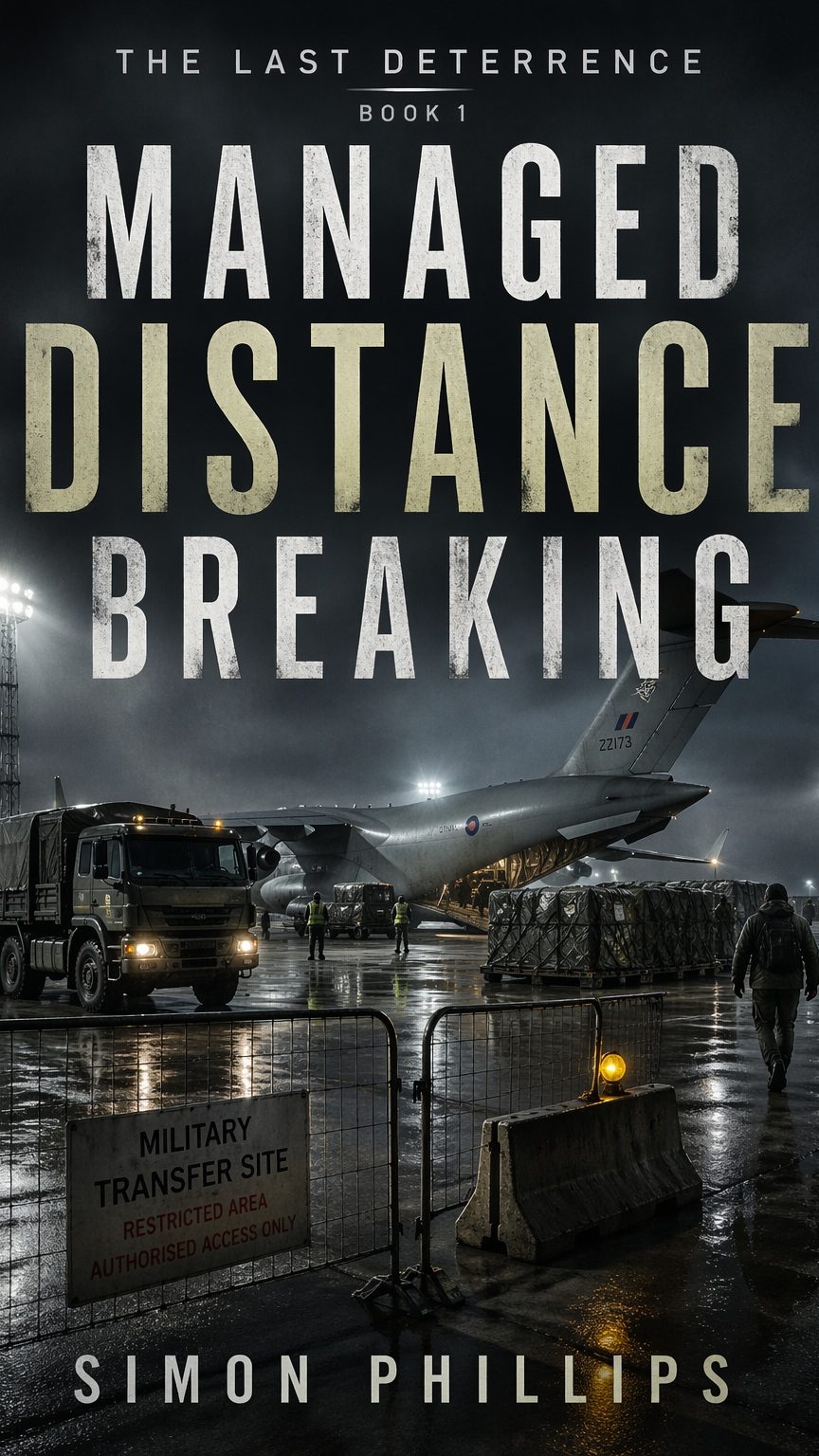
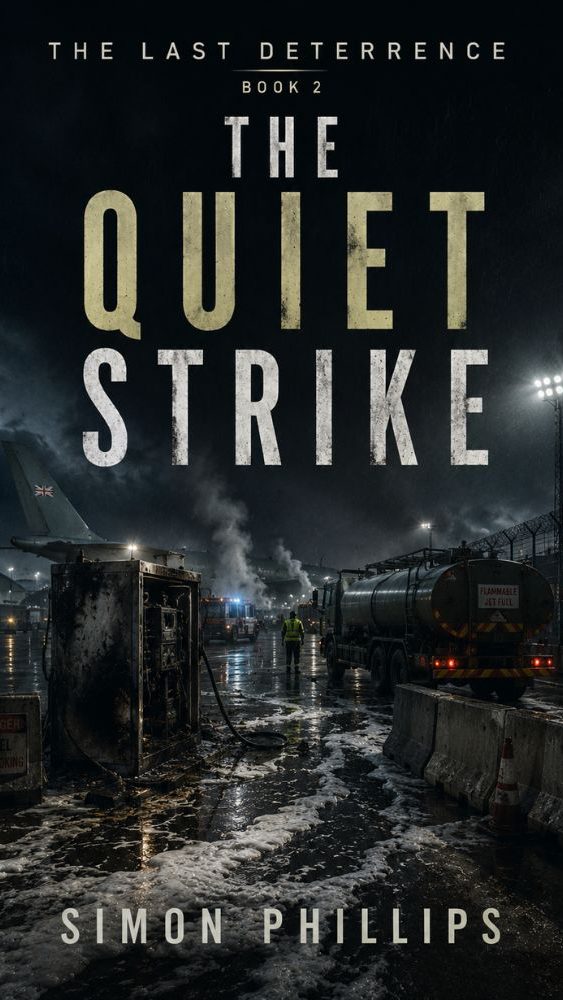
One such world unfolds through The Last Deterrence, a modern-war novella sequence beginning with Managed Distance Breaking and continuing in The Quiet Strike. Together, the first two books follow Britain as support language begins to fracture under freight pressure, European escalation, domestic infrastructure strain, and the growing sense that distance from war has already begun to fail.
Readers who wish to explore the wider published story world connected to this Chronicle can find the novellas below.
The following Chronicle continues the night at Rookham Fuel Support Compound, where a brief camera failure, a damaged feed line, and debris beyond the eastern fence began turning a routine perimeter fault into evidence of something more deliberate moving around the edge of Britain’s protected support corridor.
Readers supporting The Modern Chronicle can continue the record below.
Subscribe to continue reading
Subscribe to get access to the rest of this post and other subscriber-only content.
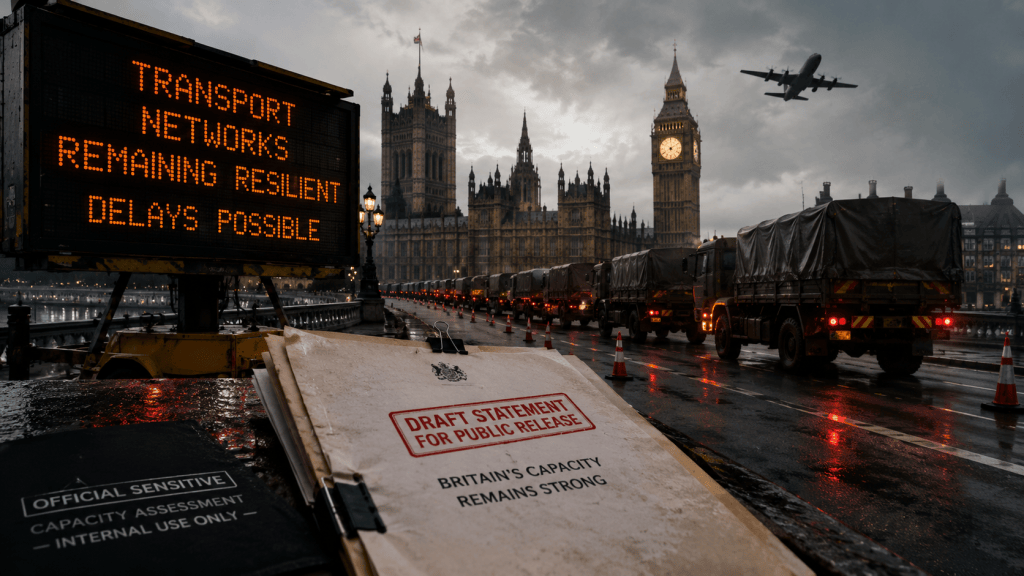
While ministers prepared to assure the country that Britain’s transport systems remained resilient, the figures beneath the statement showed a network already surviving by moving ordinary life aside.
The Sentence That Held
By seven that morning, the public statement had passed through four versions, cleaner than the figures behind it and shaped to sound steadier than the room that produced it.
Rain pressed against the high windows of the Cabinet Office briefing room and ran down the glass in wavering lines, turning Whitehall into grey stone, blue lights, umbrellas, and the pale glow of phone screens held beneath coat collars. The room had been used through the night, and the air had grown too warm with coffee, printer heat, damp wool, and the persistence of people who had moved beyond tiredness into the harder condition where every sentence arrived trimmed for damage. Folders lay open across the table, coloured slips marking the pages that could leave the room, while red handling strips marked the pages that could only travel by hand.
Eleanor Voss stood at the far end of the table, one hand resting on a chair and the other wrapped around a paper cup she had forgotten to drink from. She worked in government communications, in the narrow passage where facts became public lines and public lines returned as questions from broadcasters, ministers, councils, hauliers, unions, and frightened people deciding whether to fill their cars before work. Her name appeared on none of the statements once they went out.
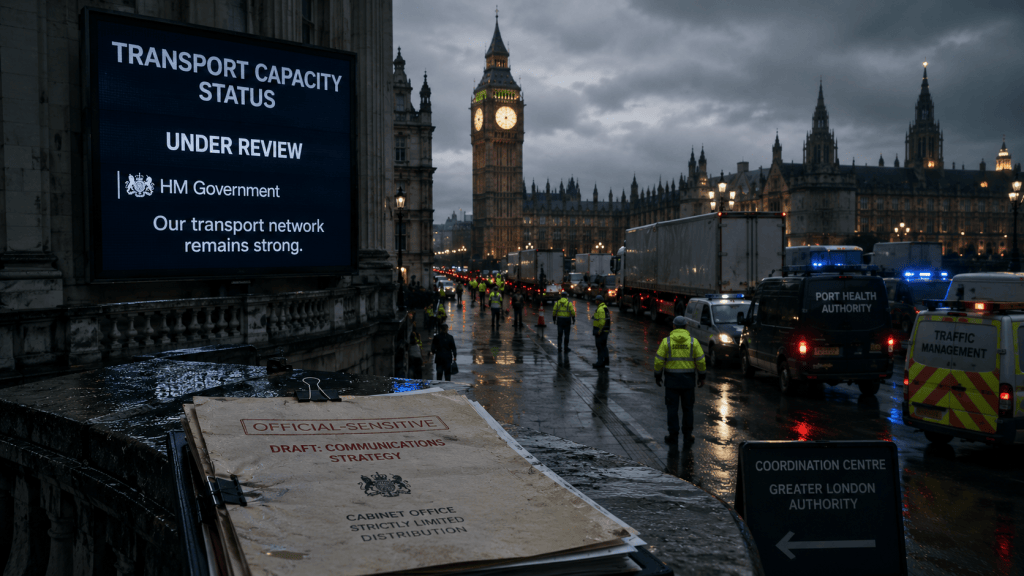
On the wall screen, a transport-capacity dashboard refreshed every thirty seconds. Ports sat in coloured blocks. Road routes sat beside them. Rail access, driver availability, ferry slots, defence consignments, civilian dwell time, fuel pressure, and police-support demand kept shifting in small increments. The colours had started the week in green and amber, with red reserved for weather, accidents, and ports that had lost patience with optimism. Red now appeared in places that held strategic meaning once placed beside a map of Europe, though the public version would speak of increased demand and wider pressure across supply chains.
At the table, Michael Harrow from the Department for Transport turned a stapled pack sideways and slid it towards her. His tie had loosened during the night, and a small dark mark on his cuff suggested he had spilled coffee.
“The present wording says networks remain resilient,” Harrow said, drawing one finger down the top page. “That remains defensible if we define resilience by continued movement across critical routes.”
Eleanor watched a red block pulse beside the east-coast freight line, linger long enough to draw three pairs of eyes, then settle back into amber. “And if anyone defines resilience by whether ordinary movement still has room to breathe?” she asked.
Harrow drew the pack back towards himself, aligning its edge with the table. “Then we speak about temporary prioritisation and sector-specific strain.”
“Sector-specific strain means supermarket stock waits while sealed freight moves.”
Harrow glanced at the Defence adviser near the door before he answered. “It means current movement remains controlled.”
Across the table, Sana Qureshi from the Cabinet Office resilience unit opened a laptop covered in sticker residue where labels had been removed before the device entered the secure floor. She had worked through floods, power failures, fuel disruption, and one winter when half the country appeared to discover logistics at the same time.
“We have regional calls inside twenty minutes,” Sana said, turning the laptop so the screen caught Eleanor’s eye. “Lincolnshire wants clarity on route holds. Kent wants an answer on civilian traffic displacement near the port approaches. The east-coast operators want someone to admit Defence priority has changed the shape of the queue.”
“They will receive careful language,” Harrow said, tapping his pencil once against the page.
Sana looked up from the laptop. “They already have sharper language. They invented it while waiting for ours.”
The room received that with a silence Eleanor recognised, the kind that followed an accurate statement made too early for the hierarchy to absorb. Outside the door, a trolley moved along the corridor, and the uneven rhythm of its front wheel carried through the wood before fading near the lift. Eleanor pictured fresh printed packs, red handling strips, and folders travelling by hand because secure systems were being kept for heavier traffic.
A junior press officer named Daniel Rees sat near the wall with his sleeves rolled above his wrists and three phones arranged in front of him like evidence. He lifted one of the phones, listened for a few seconds, then covered the microphone with his palm.
“Number Ten want a smoother top line before eight,” Daniel said, keeping his voice low as though the phone might carry the room back to its owner. “They dislike manageable.”
Eleanor lowered her cup. “Which part?”
Daniel listened again, his eyes moving across the faces around the table. “The whole word.”
Harrow gave a small, humourless laugh and pressed his fingers against the bridge of his nose. “That is unfortunate. Manageable is doing most of the work.”
Daniel nodded at someone none of them could hear. “They prefer functioning.”
Sana turned the laptop further so Harrow could see the regional summary. “Functioning suggests things are still moving, which is true only because capacity is being taken from somewhere else.”
The summary showed postponed civilian container release, road-haulage shortages, delayed retail loads, pharmacy logistics adjustments, and school-transport knock-on effects from morning diversions around route-control points. The evidence had arrived as timings, lane closures, missed slots, depot holds, driver hours, and ordinary tasks shifted half a day sideways so priority movement could pass through.
Eleanor thought of how it would sound once it reached a kitchen radio. Transport systems remain resilient. Existing commitments remain manageable. Essential goods continue to move. The sentences would be true in the way official sentences were often true, with their feet placed carefully around the softer ground. They would leave out the people already standing at pharmacy counters, depot gates, school stops, and freight windows, learning that ordinary movement had become the part of the system asked to wait.
The door opened, and Tom Merrick entered with rain still on his coat and an adviser from Defence behind him. Merrick worked political handling alongside transport pressure, although lately the distinction had thinned until every problem arrived wearing both badges. He placed a marked page in front of Eleanor and tapped the top paragraph.
“Prime Minister can say this at lobby if pressed,” Merrick said, pulling off his wet coat. “We need it clean, firm, and dull enough to avoid becoming a headline.”
Eleanor read the paragraph once, then again. The United Kingdom’s transport and freight networks continue to function effectively under increased demand. Existing support commitments remain within current capacity. Departments continue to work with operators, local partners, and industry to ensure essential movement is protected.
The line sat there in black print, polished and bloodless. It made the country sound like a machine that had absorbed extra pressure through design. The dashboard behind Merrick told a harsher story, one of improvised holds, narrowed margins, police calls, contractor fatigue, military-linked consignments arriving ahead of expectation, and port supervisors using language with more honesty than anyone in the room could afford to place into a public statement.
“Existing support commitments remain within current capacity,” Eleanor said, keeping her eyes on the page.
Merrick watched her from beside the table. “Can we defend it?”
Harrow answered with professional caution, his hand already moving towards the capacity pack. “At national level, across current reporting intervals, it remains arguable.”
Sana closed her laptop a little, leaving the screen light pressed against her face. “Arguable is a courtroom word trying to pass as public confidence.”
Merrick looked at Eleanor because Harrow had supplied a technical answer and Sana had supplied the one the room preferred to avoid. “Can we say it?”
Eleanor looked again at the dashboard. The east-coast route blinked red, held there for a second longer than before, then returned to amber. Somewhere beyond the building, freight was being delayed in the name of movement, and movement was being protected in the name of support, and support was beginning to resemble something nobody had yet been given permission to call by a heavier name.
“We can say it,” Eleanor said, setting the page down with care.
Daniel started typing at once, his thumbs moving fast over one phone while a second lit beside him. Harrow began reciting figures to the Defence adviser. Sana reopened the regional summary and marked three lines in yellow. Merrick stood over Eleanor’s shoulder, shaping risk into phrases that might hold until lunchtime if the world behaved generously. The rain darkened the windows until the room seemed lit from inside its own fatigue.
On the screen, a fresh warning appeared beneath the dashboard, small enough for the room to miss unless someone was already watching.
Eastern corridor capacity dependent on continued priority sequencing.
Eleanor read it twice before the message vanished into the next refresh. Then she picked up her pen and changed one word in the statement, replacing planned with current, because a tiny place for honesty still survived inside a sentence already chosen.
A Visual Chronicle
Official confidence held on the public screen while Britain’s roads, ports and ordinary deliveries absorbed the strain the statement had been written to conceal.
Cabinet Office Handling Note
Extract from Cabinet Office Press and Resilience Coordination Note Subject: Transport Capacity Line Time: 07:42 Circulation: Restricted internal handling group
Purpose
To support ministerial and departmental handling of anticipated media questions concerning freight movement, east-coast port pressure, route prioritisation, and wider transport resilience following increased demand across allied support corridors.
Approved Public Position
The United Kingdom’s transport and freight networks continued to function effectively under increased demand. Existing support commitments remained within current capacity. Departments continued to work with operators, local partners, and industry to ensure essential movement was protected.
Suggested Response if Pressed
Officials were monitoring regional movement closely. Some localised delays had occurred where demand, weather, port sequencing, and wider European pressure converged. These pressures were being managed through established resilience arrangements, industry coordination, and targeted support for affected operators.
The Government remained focused on maintaining the movement of essential goods, supporting allies, and limiting disruption for households and businesses.
Lines to Avoid
Avoid language implying defence movement had displaced civilian supply. Avoid speculation on route protection measures. Avoid confirming priority categories for sealed consignments. Avoid linking domestic delays directly to overseas military activity. Avoid any formulation suggesting exhaustion of capacity.
Internal Assessment
Current national capacity remained viable under priority sequencing. Continued viability depended upon sustained operator cooperation, police-route availability, port slot discipline, and regional tolerance for civilian delay.
The eastern corridor carried increased sensitivity due to the concentration of freight holds, allied-support consignments, road-haulage pressure, and public visibility around delayed civilian loads. Messaging should therefore maintain confidence while allowing for local variation in delivery experience.
Where challenged on contradiction between public reassurance and visible disruption, ministers should emphasise that resilience meant continued function under pressure, supported by active coordination across government and industry.
Operational Note
Further deterioration in driver availability, fuel access, police support, or port dwell time may require revised language before the midday lobby briefing.
About the Creator
The Modern Chronicle is written and curated by Simon Phillips, an author of modern speculative fiction and contemporary crisis-driven storytelling who explores the point where ordinary life begins to tighten beneath political strain, military movement, institutional caution, and the public language used to keep dangerous realities at a distance.
Many of the records presented in these Chronicles sit alongside Simon’s wider modern-war novella series, where governments, soldiers, families, and civilian systems are forced to absorb a world changing faster than its official explanations. The stories remain grounded in recognisable places: ports, school corridors, freight yards, government rooms, roadside queues, transfer sites, and homes where the news has started to feel too close.
One such world unfolds through The Last Deterrence, a modern-war novella sequence beginning with Managed Distance Breaking and continuing in The Quiet Strike. Together, the first two books follow Britain as support language begins to fracture under freight pressure, European escalation, domestic infrastructure strain, and the growing sense that distance from war has already begun to fail.
Readers who wish to explore the wider published story world connected to this Chronicle can find the books below.
The following Chronicle reconstructs the hours after the capacity statement left Whitehall, as transport officials, regional operators, and local services began living with the difference between a network described as resilient and a system already surviving through postponed civilian movement.
Readers supporting The Modern Chronicle can continue the record below.
The Corridor That Still Functioned
By mid-morning, the statement had left the secure floor and entered the country by quieter routes, passing into newsroom desks, local authority inboxes, haulage groups, regional rooms, port operators, school offices, pharmacy distributors, and the phones of people whose work depended on knowing which delay had been given an official name.
On the government website, the wording sat beneath a freight terminal photograph from a calmer year when stacked containers still looked like trade and confidence instead of time held in metal boxes. Transport and freight networks continued to function effectively under increased demand. Existing support commitments remained within current capacity. Departments continued to work with operators, local partners, and industry to ensure essential movement was protected.
Eleanor Voss heard the first broadcast reading of it in the communications room beside the Cabinet Office, where a television stood on mute above a row of desks and the audio came through a small speaker connected to the media-monitoring feed. The presenter read the line with official warmth, then moved into questions about port delays, petrol prices, and pressure on the eastbound freight corridor. The word corridor had survived into public speech by accident, or through a source somewhere, and once the presenter said it aloud Eleanor felt several people in the room look up from their screens.
Daniel Rees stood by the printer with one hand holding a sheet still warm from the tray. “Sky have corridor,” he said, lowering the page as the speaker carried the next question into the room.
Tom Merrick turned from the desk where he had been marking a fresh response grid. “Who gave them that?”
Daniel glanced down at his phone before answering. “Could be hauliers. Could be port operators. Could be anyone who spent last night watching sealed consignments move ahead of their own slots.”
Merrick rubbed the corner of one eye with his thumb and reached for the phone nearest him. “Get me the transport press office.”
Eleanor stayed where she was, listening as the presenter brought in a freight analyst who spoke over a map of the east coast with care around every line he drew. He spoke of dwell time, ferry slots, pharmacy distribution, driver hours, and official confidence that meant movement still existed, even as ordinary users lost room.
Across the room, Sana Qureshi’s laptop chimed with the regional call opening. She pulled on her headset and lowered her voice until it merged with the hum of printers and phone alerts. “Cabinet Office resilience joining. Lincolnshire, go ahead.”
Eleanor moved closer. Sana had arranged the call into columns: police support, road holds, port approaches, agricultural distribution, medicine, schools, public line. The first local authority speaker sounded as if he had been awake since before dawn and disliked every part of the morning.
“We have tractors backed near the bypass because the southbound lane hold ran over,” the man said through a faint crackle. “School transport took the diversion behind it. Parents saw police units at the roundabout and started ringing headteachers before anyone rang us.”
Sana held her pen above the first column. “Was the route hold linked to priority movement?”
The man gave a dry little laugh that carried more anger than humour. “You know the answer I can place into minutes, and I know the answer your room can hear.”
Eleanor looked at the screen. The government statement sat open in a second window, pristine and usable. The call beside it carried roads, tractors, school buses, and parents hearing danger in police cars placed where routine traffic used to be.
Sana pressed two fingers against the bridge of her nose, then leaned closer to the microphone. “For the record, we need localised traffic management associated with essential freight continuity.”
“For the record,” the man replied, his voice flattening, “we had a roundabout held for forty-one minutes so marked vehicles could pass through a route everyone in town has now noticed.”
Merrick glanced over from his desk. “Sana.”
Sana lifted one hand without turning towards him. “Understood. We will log regional visibility concerns.”
At ten twenty-three, the east-coast port operations group joined the call. The voice came from Harriet Cale, operations director at a container terminal that had appeared on the dashboard as amber since dawn and red in every conversation that used honest language. Her connection carried background noise: reversing alarms, a distant tannoy, wind across the microphone, and the restless murmur of work made harder by waiting.
“We are holding civilian releases behind sealed consignments again,” Harriet said, raising her voice over the yard. “If that remains the instruction, we need fresh phrasing for customers before lunch. People accept delay when they believe weather caused it. They get creative when they can see priority lanes moving.”
Michael Harrow had joined the room ten minutes earlier and bent over Sana’s laptop, one palm on the back of her chair. “The instruction remains prioritisation within current capacity.”
Harriet allowed the phrase to hang for long enough that everyone in the room felt its weight. “Michael, with respect, current capacity means something else from this end of the road.”
Eleanor pictured the terminal as she had seen similar places during earlier visits: cranes against grey water, container stacks rising in lanes, drivers outside cab doors, security staff watching queues lengthen while supervisors invented calm at the speed of paperwork.
On the television, footage showed lorries standing outside a port approach beneath a colourless sky. The camera stayed far enough away to avoid registration plates, yet close enough to capture the shape of delay. A driver in a dark jacket leaned against his cab with both hands in his pockets, staring towards the gate as though he had reached the limit of what questions could do.
At the Department for Transport, two streets away, the movement desk had started separating public disruption from operational necessity with coloured markers on a laminated wall map. Each route carried its own little history of compromise: freight protection, police liaison, visible civilian delay, public explanation required within the hour.
Kiran Holt, a senior transport planner seconded from rail operations, stood before the map with a phone pressed against his shoulder. He had slept for eighty minutes in a chair beside a cabinet marked winter resilience and had woken with his watch strap pressed into his cheek.
“Tell them the slot moves by ninety minutes,” Kiran said into the phone. “No, ninety is the improved offer. The earlier offer involved no slot and a bleak conversation with someone from Defence.”
He listened, eyes on the east-coast route where three orange marks sat too close together. “I understand the refrigerated load has priority. I also understand the sealed load has greater priority. Yes, that phrase is ugly. I am already aware.”
Across from him, a younger planner named Alice Baird was updating a spreadsheet with both hands, her jaw set hard enough to alter her face.
“We’ve shifted medicine to the afternoon run,” Alice said, keeping her eyes on the spreadsheet. “The distributor says they can still make pharmacy windows if the police hold on the A-road clears before eleven.”
Kiran looked at the map. “And if it runs to eleven-thirty?”
Alice kept typing. “Then the pharmacies receive tomorrow’s apologies today.”
One of the screens above the map changed to the official government statement. The wording occupied the screen for thirty seconds before the feed switched to live footage outside a port gate. Kiran watched a reporter speak into rain with the careful brightness of someone standing in front of a queue long enough to make every official line sound smaller.
Within an hour, the line had reached a delivery depot outside Peterborough, a school office in Lincolnshire, a pharmacy distribution centre near Ipswich, and a haulage message group filled with photographs of priority lanes and blocked roundabouts.
At a service station near the A1, Greg Mason sat in the cab of a refrigerated lorry with a paper cup balanced in the holder and the government statement open on his phone. He had been carrying pharmacy stock for long enough to understand which delays mattered. His current delivery sat four hours behind, then two, then three again, because each update came with a new route note and a gentler way of saying wait.
His dispatcher rang as rain crossed the windscreen in thin streaks. “Greg, I need you to hold there another half hour,” Priya from routing said, her voice tight with too many calls. “Police are clearing movement ahead of you.”
Greg looked across the service-station forecourt, where ordinary cars queued for fuel under strip lights. “Movement,” he said, watching a military-green vehicle pass along the road beyond the station. “That’s what we’re calling it now?”
Priya exhaled through the line. “That’s what I can put on the job sheet.”
“My load has insulin on it,” Greg said, resting his hand on the steering wheel.
“I know,” Priya replied.
“Does the movement ahead of me have insulin?”
Priya stayed silent for a second, and the silence gave him the answer her job sheet could never carry.
Greg placed the cup back into the holder and watched the road. “Tell the pharmacy I am still coming.”
“I have,” Priya said, softer now. “They asked whether still means today.”
He looked at the government statement again and read the sentence about essential movement being protected. Then he locked the phone, because anger used battery, and battery had begun to feel like another item worth saving.
Back in Whitehall, Eleanor saw the first contradiction brief at eleven forty-seven. It arrived as a media handling grid, with clips down the left side and proposed responses along the right. One clip showed a minister repeating resilient with visible discipline. Another showed Harriet Cale telling local radio that capacity remained under active management. A third showed an opposition transport spokesperson near a freight gate asking whether the government had started rationing road space by stealth. The phrase was too sharp to ignore and too useful to die quickly.
Merrick placed the grid in front of Eleanor. “We need an answer for rationing road space.”
Eleanor read the phrase again. Rationing belonged to kitchens, petrol stations, supermarkets, and war memories people thought they understood through documentaries. Road space sounded technical enough for present use. Together, the phrase would travel.
Sana joined them with her headset around her neck, the foam earpads leaving red marks beneath her hairline. “Call it prioritised resilience and we invite ridicule. Call it targeted route management and councils will laugh at us.”
Harrow came over from the far desk with a fresh capacity sheet. “We can say essential movement sometimes requires temporary sequencing.”
Merrick pointed at him with the grid. “That is the first useful ugly phrase anyone has offered.”
Eleanor picked up her pen. “Then we use it sparingly.”
Daniel Rees looked up from his phones. “Number Ten wants the noon update in twelve minutes.”
The room shifted into the old rhythm: one person reading aloud, another trimming, a third testing whether the wording would sound cowardly, evasive, or accidental once a minister placed it into the air. Eleanor held the page steady and worked inside the sentence, finding places where precision could hide before the wider truth made concealment impossible.
Outside the windows, rain thinned into a pale mist that left the street shining. A police van moved through the junction below, followed by two dark official cars and a delivery cyclist whose yellow bag flared against the wet grey. London kept travelling in pieces while the eastbound line tightened beyond sight.
At noon, the revised update went out. Transport and freight networks continued to function effectively. Some local sequencing was being used to protect essential movement. Departments remained in close contact with operators and regional partners. The words were calmer than the system beneath them, and for a little while that was enough for the statement to hold.
By twelve eighteen, the dashboard refreshed again.
The eastern corridor went red and stayed there.
Official confidence held its place on the public screen, while the road beneath it showed the strain the statement had been written to contain.
The Idea Behind the Chronicle
Modern governments often speak of resilience as though it were a settled condition, something measured by whether roads stayed open, ports kept working, and goods continued moving through the system. In practice, resilience often depended on quieter forms of displacement. A route could remain active while ordinary deliveries waited. A port could stay open while civilian loads lost their slots. A road could serve the national interest while the people living beside it discovered that their own movement had become secondary.
This Chronicle explores the gap between public confidence and lived capacity. The statement at the centre of the record sounded calm because modern government language was designed to reduce panic, protect markets, reassure allies, and keep public behaviour manageable during strain. The systems beneath that language remained physical, crowded, and limited. They depended on drivers, police holds, ferry slots, distribution depots, local authorities, fuel access, and workers asked to absorb pressure before the country understood its shape.
The eastbound line in this series represents the place where support became material. Containers, sealed consignments, medical loads, fuel movements, and protected roads turned policy into weight, delay, and priority. The public could still be told that Britain remained at a controlled distance from the conflict, while the roads and ports had already begun behaving as though that distance had narrowed.
The Chronicle therefore treats capacity as a human pressure system. A dashboard in Whitehall showed amber and red blocks, while each block held drivers waiting past their legal hours, pharmacy stock arriving late, school buses caught behind diversions, port supervisors explaining queues, and officials searching for language that could hold for a few hours longer. The story sits inside that hidden space between a sentence that remained technically defensible and a country beginning to feel what the sentence left out.
In The Last Deterrence world, war first reached Britain through infrastructure before it arrived through declaration. It came through manifests, transport holds, drone alerts, route changes, freight prioritisation, and official phrases that stayed careful after the situation beneath them had already changed. This Chronicle belongs to that early stage, when the machinery still worked, although each successful movement required some part of ordinary life to wait.
The statement about capacity therefore became a record of transport, language, and pressure at once. It showed a nation still speaking in the language of control while the systems beneath it were already revealing the shape of participation.
From the Author’s Desk
The Eastbound Line began with the thought that modern war often reaches ordinary life through systems long before anyone speaks plainly about war itself. A port queue, a delayed medicine delivery, a police hold at a roundabout, or a careful government phrase can reveal a national shift before the larger public story has caught up with it.
This Chronicle follows that idea through the language of capacity. I wanted the record to stay close to the people who carried the pressure: officials shaping public lines, operators managing queues, planners moving delivery windows, drivers waiting beside roads, and local services absorbing decisions made far above them. The crisis remained official at one level, yet deeply personal at another.
The Last Deterrence novellas explore this same widening pressure through family, government, military service, and ordinary civilian life. The Chronicles sit beside those stories as fragments from the wider national record, showing how the same events touched people and places outside the main spine of the books.
Alongside The Modern Chronicle, I continue writing fiction across several speculative and contemporary-war projects, many of which explore how institutions, families, and communities change when public language can no longer carry private reality.
Readers interested in those stories can explore more through the links below.
Transport capacity often appears in public language as a stable figure, as though a country either has enough space for movement or has reached a clear point of failure. In reality, capacity exists through sequence, timing, labour, fuel access, police availability, port discipline, and the willingness of one part of the system to wait while another moves first. A network can still function while the room inside it grows smaller.
That distinction sits at the centre of this Chronicle. The public statement said the system continued to operate, and from a narrow official view that remained defensible. Goods still moved. Ports still worked. Roads stayed open. Yet the measure of function concealed the method by which that function survived. Civilian freight lost slots, regional roads carried longer holds, pharmacies received later windows, and local services absorbed the consequences of decisions made far above them.
The pressure was therefore visible most clearly to those working inside the movement chain. A driver saw a delivery window change twice. A planner saw medicine shifted behind sealed consignments. A port operator watched priority lanes keep moving while ordinary freight waited at the gate. The dashboard in Whitehall reduced those experiences to colour, timing, and risk, while the people beneath it understood that capacity had become a question of who moved first.
Essential Movement
The phrase essential movement carries authority because it sounds practical, neutral, and difficult to challenge. It suggests that officials have identified what matters most and protected it during strain. Yet every decision to protect one form of movement also creates a shadow elsewhere. A held roundabout delays school transport. A protected freight lane changes civilian delivery times. A sealed load given priority alters the sequence of goods behind it.
This Chronicle uses essential movement as a quiet pressure point. The phrase allowed ministers and officials to speak with control while avoiding fuller description of what had begun happening across the eastbound corridor. The movement itself stayed partly hidden. Its effects spread through ordinary places: service stations, school offices, port gates, distribution boards, and local authority calls.
That form of strain belongs to the wider reality of The Eastbound Line. Britain still described its role as support, assistance, resilience, and coordination. The roads, ports, and movement rooms already carried a heavier truth. What the country called essential movement was beginning to reveal which parts of national life had become secondary.
The Language of Function
Modern crisis language often survives through careful measurement. A road remains open, even when most users have less access to it. A port remains operational, even while some loads wait far longer than expected. A delivery system remains functional, even as planners spend the morning shifting delays from one community to another. The official sentence can remain true while the lived reality beneath it changes sharply.
That is the tension behind The Statement About Capacity. The Government could say that transport networks continued to function because collapse had not arrived. The more difficult truth lay in the cost of continued function. Each successful protected movement required labour, time, route space, police support, and public patience. As those costs accumulated, the statement began to sound less like reassurance and more like a record of how much strain could still be hidden inside a calm sentence.
Across The Modern Chronicle, these details matter because they show how large events enter ordinary systems before they enter public admission. War, escalation, and participation rarely arrive as clean declarations. They appear first as altered routes, priority language, revised delivery windows, and officials choosing one word over another because the wrong sentence could reveal too much too early.
Next Chronicle
After the public statement on capacity had passed through Whitehall, the next visible change came through a freight holding site in the Midlands, where route planners, drivers, loaders, and military police began adjusting to reports from Germany that had arrived in fragments long before any settled public explanation.
Rail sequencing shifted first. Pallets were rescanned, sealed loads were moved ahead of civilian freight, and several drivers who had waited through the night were turned around with new instructions that gave them routes, times, and very little context. Workers gathered around phones showing confused footage from abroad while the yard beneath them began changing its order, one lane and one manifest at a time.
The next Chronicle follows that night inside the holding site, as the German strike reached Britain through route changes, freight holds, armed police, and the quiet recognition among those present that the support system they served had become part of something far harder to contain.
Next Chronicle: The Night Germany Entered the Yard
The statement remained on the record, calm and complete, while beyond Whitehall the eastbound line kept moving through the narrow space it had been given, carrying within its delays the first clear shape of a country already reorganising itself around a war it still described as support.
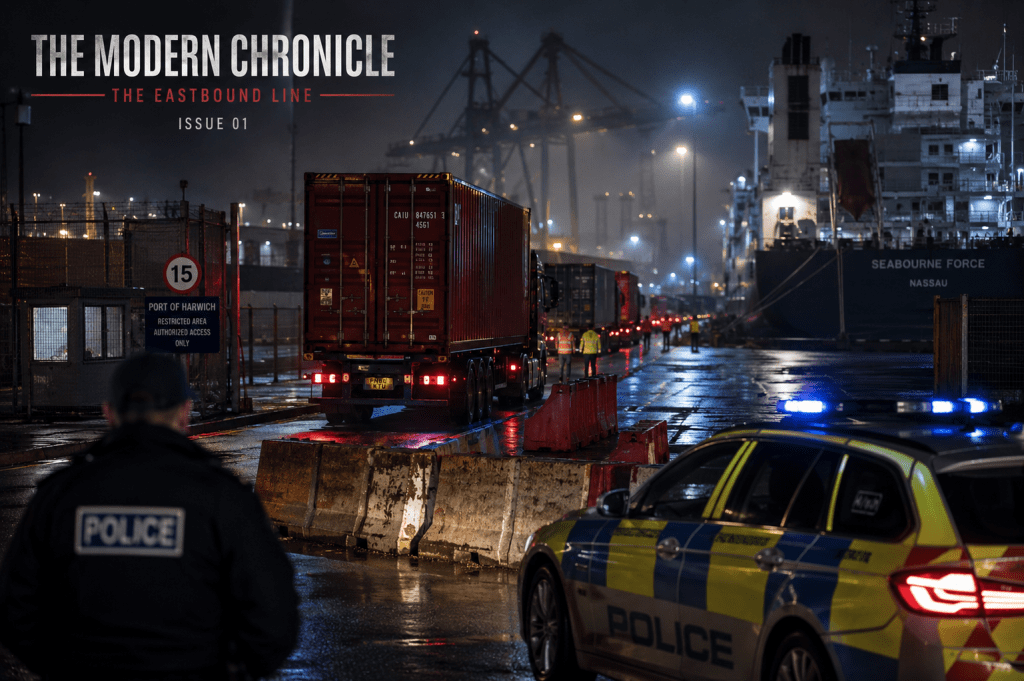
At an east-coast port, the backlog was still called temporary, even as certain loads began moving ahead of everything else.
The Night the Port Began to Hold Back
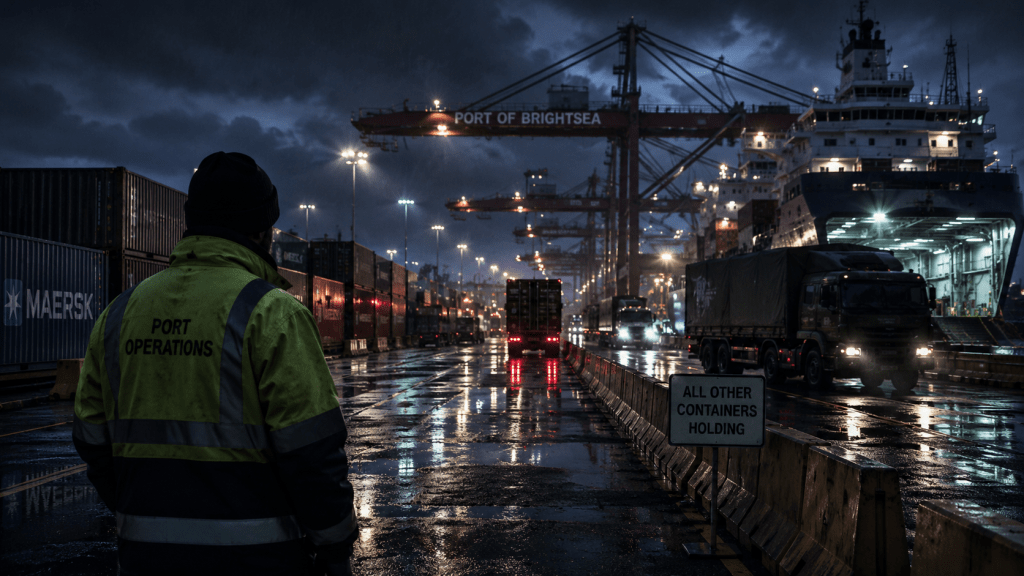
The rain reached the port before the night shift had properly settled, drifting in from the estuary in fine slanting sheets that silvered the yard lights, glazed the painted lane markings, and left the concrete shining beneath the cranes as though the whole terminal had been sealed under dark glass. Floodlamps burned above the container stacks, pale and hard through the wet air, while gantries crawled along their rails with the slow assurance of machinery too large to hurry. Beyond the security fencing, HGVs idled in a queue that had already pushed past the roundabout, their headlamps trembling across puddles while low exhaust folded through the access road and dissolved into the weather.
Elliot Ward had worked the east quay for eleven years and had long since stopped expecting the night to behave. A delayed ferry could spoil one shift, a crane fault could spoil two, and a Customs hold could turn a clean roster into hours of improvised apology. This felt different, although nobody on the operations floor had placed a name on the change yet. Civilian stacks were climbing where they should have been thinning. A supermarket consignment expected inland before dawn still sat beneath floodlights with three other loads that should already have cleared the gate, while sealed units marked for expedited partner handling moved through lanes that had been empty on the printed schedule beside Elliot’s desk.
He stood inside the control cabin with his headset pressed close and watched two screens at once, one showing berth movement and the other turning the yard into coloured blocks, each stack reduced to numbers that never showed tired drivers, shivering lashers, or a forklift operator wiping rain from his face with the back of a glove. The shift supervisor, Sarah Cole, had wedged a paper cup beside the keyboard and forgotten to drink from it. She leaned over a revised movement sheet with a biro tucked behind one ear, her shoulders held too high for someone four hours into the night.
“Lane Four has changed again,” Elliot said, lowering the headset from one ear as another update flashed across the live board. “Civilian export hold. Priority transit coming through from the west gate.”
Sarah glanced from the marked sheet to the screen, then drew the paper closer with two fingers. “Who authorised that?”
“Regional desk,” Elliot said, touching the line with the end of his pen. “It came through on the secure channel.”
Sarah gave a tired breath through her nose and pressed the biro against the margin. “That phrase is becoming very popular.”
The next call reached Elliot before he could answer. A driver at the front of the commercial queue wanted a fresh estimate. Another had missed his onward slot near Peterborough. A haulier outside Ipswich warned that a late handover would cost him his morning contract and his fuel window. Elliot dealt with each one in the careful port language he had used throughout the evening, keeping congestion, sequencing pressure, and revised flow inside sentences calm enough to stop men from shouting through glass.
Outside, a line of dark tractor units crossed the wet yard in steady procession, escorted by two port vehicles with amber lamps turning slowly in the rain. Their trailers carried plain containers with fresh seals and no company branding visible from the cabin. One bore a small white plate near the rear corner, too far away for Elliot to read, although he had seen enough of them across the past fortnight to recognise the handling pattern. They arrived late, they came through with short notice, and every instruction around them treated delay as more serious than the freight already waiting.
Sarah followed his gaze towards the controlled lane and folded one arm across her middle. “Those again.”
“Those again,” Elliot said, keeping his eyes on the convoy as it moved past the stacked retail units.
“Any destination line?” Sarah asked, looking back to the revised sheet.
“Transferred at railhead, then onward under separate coordination,” Elliot replied. “That is all the system gives us.”
Sarah circled one of the delayed retail consignments with more pressure than the page deserved. “Put refrigerated stock on a thirty-minute review. I want confirmation before we bury it another hour.”
Elliot glanced back to the yard map, where Lane Four had already turned amber beneath the updated routing. “If Lane Four stays closed, thirty minutes turns into ninety.”
“I know,” Sarah said, straightening with the biro still caught between her fingers. “Review it anyway.”
At the gate, a man in a navy waterproof climbed down from his cab and walked towards the barrier with his lorry keys still in one hand. A security steward stepped from beneath the shelter to meet him, palms low and shoulders already braced. Elliot saw the exchange through the nearest monitor, then heard the radio click alive from the gatehouse.
“Ops, we have a driver asking why lane priority keeps changing,” the steward reported over the speaker. “He says he has food stock under contracted delivery and his slot closed forty minutes ago.”
Sarah reached for the desk microphone and held it near her mouth while watching the grainy camera feed. “Tell him revised port sequencing is in effect due to external demand pressure. His load remains live in the system. He will move once clearance opens.”
The steward repeated the wording while the driver looked past him towards the dark containers rolling through the separate lane. Even through rain and camera grain, Elliot could read the direction of his anger. His trailer carried a supermarket logo across the side. The priority units moving beyond the barrier carried nothing at all.
The driver lifted one arm and pointed. The steward replied. The driver laughed once, sharply, then turned away and walked back to his cab with rain shining across his shoulders. A second lorry in the queue flashed its headlights twice, which could have meant sympathy, impatience, or the simple desire to be seen.
“External demand pressure,” Elliot said quietly, setting his headset back against one ear.
Sarah kept her eyes on the monitor as the driver climbed into his cab. “Would you prefer telling him certain movements outrank lettuce?”
“No,” Elliot said, lifting the latest hold update from the printer tray.
“Then use the line,” Sarah replied, already returning to the revised yard sheet.
He did. They all did. By ten o’clock the phrase had passed through the gatehouse, the call desk, two handovers, and one haulier who had begun by asking for facts and ended by asking whether anyone at the port had them. Elliot watched civilian dwell times creep up across the board while the sealed priority units continued to enter, hold briefly, and leave again through lanes that kept appearing beneath his hands whenever he believed the board had settled.
The quay offered no cleaner answer. At Berth Three, lashers in reflective jackets moved under towering hull-side lights as the latest ferry unloaded into wet metal glare. Containers came down in measured swings, guided by men who stepped through puddles and radioed numbers into the cold. Elliot went out just after half past ten, sent by Sarah to speak with yard marshal Zahra Iqbal about a failed transfer sequence and a stack built too close to one of the priority lanes. The rain struck his face sideways the moment he left the cabin. Diesel, salt, wet steel, and the sour warmth of brake systems rose together from the concrete.
Zahra met him beside a row of held civilian units, her tablet tucked inside her jacket to keep the screen dry. She had been working the port almost as long as Elliot and carried strain lightly until somebody asked the wrong question twice.
“Lane Four keeps shifting under us,” Zahra said before he spoke, lifting her chin towards the rows behind her. “We cleared the stack once. Then west gate sent through another escorted set. Then regional pushed a fresh hold notice onto export traffic. My people are moving the same boxes in circles.”
Elliot glanced along the line of containers: household goods, packaged food, retail stock, automotive components, mixed freight tagged for Midlands distribution. Ordinary movement had become stationary metal under floodlights. “Sarah wants the transfer sequence reopened before midnight.”
“Sarah can have the moon if someone gives me space to put it,” Zahra said, wiping rain from her eyebrow with the heel of her hand. “Do they know what they are doing up there?”
“They know what they want prioritised,” Elliot replied, looking towards the controlled lane.
“That is a smaller skill,” Zahra said, following his gaze.
A port tug passed them, its amber beacon rotating across the wet sides of the containers. Beyond it, another escorted trailer rolled into the controlled lane and slowed beside a waiting reach stacker. Two men in rainproof jackets checked seals beneath floodlight, one with a clipboard held close against his chest, the other speaking into a handset as if the weather itself might overhear. The trailer had come from somewhere inland, crossed civilian roads, entered a civilian port, and now moved through the yard with an attention no ordinary freight received. Elliot watched until the reach stacker lifted the container clear.
“See that?” Zahra asked, her eyes staying on the suspended load.
“I see it,” Elliot said.
“Three nights ago we had one batch,” Zahra said. “Last night we had two. Tonight we have had four before eleven.”
Elliot looked back towards the control cabin, its windows shining above the yard like a small office suspended over a flood. “The line is that wider European transport pressure has increased port sensitivity.”
“The line is tired,” Zahra said, drawing her jacket closer at the collar.
“So are we,” Elliot replied.
Zahra gave a quiet laugh, although her eyes stayed on the lifted container as it moved above the rain-dark lane. “A driver asked me earlier whether we had started running a second port inside the first. I told him no.”
“Was that true?” Elliot asked, turning slightly towards her.
She met his eyes for a moment, then looked back to the controlled lane. “It was true enough for the radio.”
The container settled onto a waiting chassis with a deep metallic thud. Men moved in. Seals were checked again. The tractor unit pulled away almost at once, heading for the eastern exit where civilian lorries still sat nose to tail beyond the barrier. Elliot watched the escorted movement disappear into rain and reflected light while the held rows beside him remained exactly where they had been when his shift began.
His radio cracked at his shoulder. Sarah’s voice came through, dry and controlled. “Elliot, return to Ops. Regional want updated dwell figures before eleven-thirty. Include civilian delays separately from protected transit movements.”
Zahra heard it and gave him a look that needed no translation. Elliot pressed the talk button and answered that he was on his way, then turned back towards the cabin through rain thick enough to blur the cranes and flatten the yard into lights, steel, and movement withheld. Behind him, the civilian containers waited under floodlamps, their painted company names bright with water, while another sealed load passed through the port as if the night had opened specially to receive it.
A Visual Chronicle
The port never closed, but somewhere inside it, ordinary freight had already stopped mattering.llowing Visual Chronicle presents a cinematic reconstruction of the events described above.
Operational Record: East Quay Night Movement Extract
Record Type: Internal port operations extract Terminal: East Coast Freight Terminal Shift Window: 21:45–23:40 Circulation: Operations Desk / Yard Control / Regional Movement Liaison
21:48 — Night shift assumed live yard control under elevated vessel turnaround pressure and revised inland release timings. Civilian import stacks remained above planned dwell levels at handover, with retail, mixed goods, and temperature-controlled consignments requiring active review through the opening movement window.
22:03 — Regional Movement Liaison issued first protected transit update of the shift. Lane Four reassigned from civilian export staging to priority clearance pending arrival of sealed onward units. Yard control instructed to preserve direct handling access and prevent stacking across the controlled route.
22:17 — Civilian export movement paused through Lane Four. Gate desk advised to use approved explanation for haulier queries: revised port sequencing linked to external demand pressure. No alternative departure window released at this stage. Several waiting drivers requested refreshed estimates owing to missed inland slots and fuel-window exposure.
22:31 — Refrigerated retail consignment group raised for dwell review after original release sequence slipped beyond expected window. Operations Desk requested clarification on whether cold-chain capacity should override protected transit precedence. Regional desk response: maintain current movement order until further instruction. No further explanation supplied.
22:46 — Second protected transit set entered through west gate under escort handling. Units carried reduced exterior identifiers and received immediate controlled-lane processing. Civilian release timing adjusted again to preserve route access. Yard map began showing visible accumulation across mixed commercial stacks nearest Quay B.
22:58 — West gate reported direct challenge from a commercial food-stock driver regarding repeated lane displacement. Gate staff repeated approved sequencing language. Driver returned to vehicle after brief delay. No escalation recorded. Queue remained orderly, though radio traffic indicated growing impatience across the outer access road.
23:07 — Yard Marshal reported repeated rehandling of civilian containers to maintain controlled movement space. Internal comment logged that current lane changes were beginning to distort normal terminal flow beyond earlier estimates. Issue referred to Operations Desk for inclusion in the eleven-thirty dwell brief.
23:19 — Fourth protected transit movement of the evening logged across active yard control. Processing time remained within assigned tolerance. Civilian backlog continued to widen across export holding rows and retail-linked units. One quay-side supervisor requested confirmation of whether present measures should still be treated as temporary sequencing or an altered operating condition.
23:34 — No revised external guidance received. Public-facing delay language remained unchanged. Internal figures showed priority transit clearing at expected rate while ordinary container release continued to lengthen through the shift.
About the Creator
The Modern Chronicle is written and curated by Simon Phillips, an author of modern speculative fiction and contemporary crisis-driven storytelling who explores the point where ordinary life begins to tighten beneath political strain, military movement, institutional caution, and the public language used to keep dangerous realities at a distance.
Many of the records presented in these Chronicles sit alongside Simon’s wider modern-war novella series, where governments, soldiers, families, and civilian systems are forced to absorb a world changing faster than its official explanations. The stories remain grounded in recognisable places: ports, school corridors, freight yards, government rooms, roadside queues, transfer sites, and homes where the news has started to feel too close.
One such world unfolds through The Last Deterrence, a modern-war novella sequence beginning with Managed Distance Breaking and continuing in The Quiet Strike. Together, the first two books follow Britain as support language begins to fracture under freight pressure, European escalation, domestic infrastructure strain, and the growing sense that distance from war has already begun to fail.
Readers who wish to explore the wider published story world connected to this Chronicle can find the novellas below.
The following Chronicle continues the night shift at the east-coast terminal, where ordinary containers remained in place while a quieter class of movement passed through the port with growing urgency, leaving staff, drivers, and local operations teams to work around a pressure they had been given no language to describe.
Readers supporting The Modern Chronicle can continue the record below.
The Containers That Moved First
Elliot reached the control cabin with rain running from the edge of his hood and a dull ache starting behind his eyes, the sort that arrived when a shift had already lived too long inside artificial light and repeated explanations. Warmth met him heavily as he stepped through the door, carrying stale coffee, printer heat, damp waterproofs, and the low electrical hum of screens left too bright for the hour. Sarah had taken his chair while he was out and now rose from it with a sheet of figures in one hand and the desk phone trapped between shoulder and cheek. She pointed at the lower monitor as Elliot crossed behind her, then returned to the call with the exhausted patience of someone trying to make a distant office feel the weight of a place it could only see in numbers.
“Civilian dwell has risen across four stack groups,” Sarah said into the receiver, watching the yard map refresh in blocks of amber. “Retail-linked, mixed commercial, automotive, and temperature-controlled. If protected transit keeps this tempo through midnight, we need additional holding space or a release window restored.”
Elliot hung his wet jacket over the back of a spare chair and bent towards the live board. Lane Four remained closed to ordinary export movement. Lane Two had gained a fresh conditional marker. West gate still showed a queue stretching beyond the roundabout, while one of the sheltered driver areas near the outer fencing had reached capacity. The port could carry a difficult night if strain spread across the whole terminal. Tonight the weight kept settling in the same places again and again, and every fresh adjustment preserved the priority route first.
Sarah listened to the answer, her expression sharpening by degrees. She moved the receiver away from her mouth and looked at Elliot over the edge of the desk. “They want another controlled lane available from twelve-fifteen.”
“From where?” Elliot asked, searching the screen for space that had already gone.
“Quay B exit or eastern transfer.”
“Both are carrying civilian hold traffic already.”
“That was my understanding as well,” Sarah said, returning the receiver to her ear.
She continued the call while Elliot opened the dwell table and watched the numbers climb. The desk radio stirred with static, then Zahra’s voice came through from the yard, flattened slightly by wind and distance.
“Ops, Quay B has lost the clear edge,” Zahra reported. “We can hold one more rehandling sequence, then the stack turns poor for retrieval. I need a decision before the next escorted movement arrives.”
Elliot reached for the microphone and kept his eyes on the west gate marker as he answered. “Stand by, Zahra. Regional are asking for additional lane protection after midnight.”
A pause carried across the speaker, long enough for the cabin to feel it.
“Of course they are,” Zahra replied. “Let me know which part of the port we are pretending still belongs to ordinary freight.”
Sarah lowered the phone from her ear and pointed the receiver towards Elliot with a look that asked for mercy from somewhere else. “They heard that.”
“Good,” Elliot said, opening the operational notes field.
A knock sounded at the cabin door, and Matthew Hales from gate control stepped inside with his fluorescent jacket darkened across the shoulders and his cheeks flushed from the cold. He held a clipboard under one arm and a folded complaint sheet in the other hand.
“Drivers are asking for someone with authority,” Matthew said, closing the door behind him. “I told them authority has been rationed overnight.”
Sarah glanced at him across the desk while the phone rested against her shoulder. “How many?”
Elliot took the complaint sheet and scanned the names. “Any disorder?”
“Only moral disorder,” Matthew said, shifting the clipboard against his chest. “They are wet, behind, and watching unmarked freight clear a queue they have sat beside for hours. That combination breeds philosophy.”
Sarah ended the regional call with a clipped assurance that updated figures would follow, then set the receiver down more carefully than her face suggested. “We need to keep them calm until first release.”
“When is first release?” Matthew asked, raising his eyebrows.
Sarah looked towards Elliot.
“Undefined,” he said.
Matthew rested the clipboard against his jacket. “That answer may land poorly.”
Sarah turned back towards the monitor. “Sequencing review remains under way. Civilian release follows once controlled traffic permits. Use that.”
Matthew reached for the handle, then looked back at Elliot. “One of the drivers asked whether this is military.”
Elliot felt Sarah’s attention shift beside him. “What did you say?”
“That we handle multiple categories of protected freight under standing port rules,” Matthew replied, keeping one hand on the door.
“Good,” Sarah said.
Matthew gave a dry glance towards the yard screens. “He said that sounded like yes.”
The door closed behind him, leaving the cabin quieter than before. Sarah looked towards the monitors, where another controlled movement marker had appeared near the west gate approach.
“They see more than we are authorised to explain,” Elliot said.
“They see what is in front of them,” Sarah replied, lifting the next printed sheet from the tray. “That has always been enough to make management nervous.”
The eleventh hour moved through the terminal with the unsteady patience of a queue that knew nobody intended to release it soon. Another escorted set came through the west gate just after quarter past, plain-sided trailers rolling past commercial traffic with their lights low and their spacing exact. Elliot followed their progress across the camera panels as they cleared the gate, turned past the held stacks, and entered the controlled processing lane. The men receiving them wore port waterproofs, while two unfamiliar staff stood near the seal checks with laminated passes held close against their chests and no interest in small talk.
The first unit lifted under the reach stacker with a groan of hydraulics and rose above the line of waiting commercial freight. Its underside glistened with rainwater, dark and clean under the floodlights. From one camera angle, Elliot could see the supermarket driver from earlier still waiting beyond the barrier, face lit by the dashboard as he watched the movement in silence.
He built the comparison sheet. The figures turned plain once placed side by side. Protected transit sets were clearing at almost perfect pace despite late arrival and weather. Civilian release had slowed through every active commercial stream that touched the same lanes. Some delays still belonged to the port’s usual winter trouble, ferry timing, driver shortages, stacking pressure, late paperwork. Taken together, the pattern looked cleaner than any of those explanations.
The printer woke behind him, fed one page, then another. Elliot gathered them and read the summary line before Sarah could ask. Protected transit processing remained within assigned tolerance. Civilian dwell exceeded shift forecast across multiple categories. Additional review recommended if current movement profile persists.
Sarah took the sheets from his hand and read them twice. “That is careful.”
“It says enough,” Elliot replied.
“It says enough to anyone who already knows.”
“Which may be the only audience,” he said.
At twelve minutes past midnight, a commercial driver sounded his horn at the west gate and held it longer than irritation required. The noise carried faintly into the cabin through the weatherproof glass, flattened by rain and distance, then answered by another horn farther back in the queue. Matthew’s voice came over the radio asking for a supervisor presence before patience shifted into something less useful.
Sarah was already reaching for her jacket. Elliot stood as well.
“I will come,” he said.
“You stay with the board,” Sarah replied, glancing back from the coat hook.
“Zahra knows the yard. Matthew knows the gate. Drivers know I have been giving them numbers all evening. I should stand behind those numbers while they look at a person.”
Sarah studied him for a heartbeat, then gave a short nod. “Fine. Keep it calm. No guessing. No promises beyond release review after the next controlled set.”
Elliot followed her out into the rain. The path to the gate ran past stacked containers, a row of idle tug units, and the edge of Lane Four where forklift lights shifted across wet steel in broad white sweeps. The air smelled stronger outside the cabin, thick with diesel and salt and the sour trace of brake heat. Somewhere on the quay a horn sounded from the latest ferry, low enough to vibrate through the ground.
A cluster of drivers had gathered near the barrier shelter, hoods drawn tight, reflective strips bright under the floodlamps. Matthew stood beside them with one hand raised, his expression patient through visible effort. The supermarket driver from earlier stood nearest the gate, rain dripping from the end of his nose. Another man beside him wore a beanie pulled low and held a delivery folder protected inside a plastic bag.
Sarah addressed them first, naming herself, offering the port’s regret, explaining that sequencing pressure across the terminal had slowed several commercial lanes. Her words were measured and practised. They would have sounded reasonable in a meeting room.
The supermarket driver waited until she finished, then gestured towards the yard behind her. “We can see those units moving through.”
Sarah kept her voice even as she answered. “Certain transit categories remain subject to protected handling rules.”
“What categories?” the driver asked, wiping rain from his mouth with the back of his hand.
“I am unable to discuss individual freight classifications,” Sarah said.
“Then tell us why theirs matters more than ours.”
A smaller man behind him called out that his load carried pharmacy supplies for a regional wholesaler. The driver with the plastic-covered folder said his contract penalties began before dawn. Someone else asked whether the port had lost control of its own timetable. Each voice stayed civil enough on its own. Together they pressed against the air.
Elliot stepped forward slightly, close enough for the supermarket driver to recognise him from the earlier updates. “Your consignment remains live for release. We have a review window due after the current controlled movement clears. I am unable to give you a gate time until that review completes, although I can make sure your delay remains recorded against the port hold in place of your carrier.”
The driver stared at him through the rain. “You said that three hours ago.”
“I said your delay would be recorded,” Elliot replied. “That remains true.”
“True will never get me to the distribution centre.”
“No,” Elliot said, holding his gaze. “It protects you when someone asks why you failed to arrive.”
The driver seemed ready to answer, then stopped. The anger in his face shifted, losing some of its heat while leaving the exhaustion behind. “And when someone asks why food sat here while whatever those are kept going?”
Elliot looked past him towards the queue, towards headlamps waiting under rain, towards the held trailers standing in order because there was nowhere else for them to go. He could feel Sarah beside him, silent now.
“You will have to ask someone above this gate,” he said.
For a moment the only sound came from rain on jackets, the throb of engines beyond the barrier, and a distant container settling onto steel. Then the driver laughed once, softer than before.
“That is the first honest thing anyone has said tonight.”
Sarah drew the conversation back towards process after that. Review timing. Recorded delay. Updates through gate control. No one left satisfied, yet the drivers returned to their vehicles with enough order preserved to carry the next hour. Elliot stayed beneath the shelter until the last of them had gone, watching red tail lamps blink through the rain as cab doors closed one by one.
When he and Sarah walked back towards Operations, another plain-sided trailer entered through the west gate under escort. It passed within a few metres of the waiting civilian queue, lights reflected beneath it in trembling lines. Elliot turned his head to follow it. Sarah kept walking, although her shoulders tightened under the rain.
“How long do we keep calling this temporary?” he asked.
Sarah took a few steps before answering, her face angled towards the cabin lights ahead. “Until someone gives us a different word.”
They returned to Operations just as the printer began producing the midnight review sheets. Zahra had already marked the new civilian dwell figures in red pen. Protected transit clearance remained steady. Ordinary release had slipped again. Outside, the port continued working with all the visible energy of a system under control, cranes moving through rain, forklifts crossing glare, drivers waiting beneath headlamps, and sealed containers advancing through the one part of the night that never seemed to close.
Protected freight continued moving through the east-coast terminal while ordinary containers remained under floodlights, held in queues whose official explanation grew thinner by the hour.
The Idea Behind the Chronicle
Ports rarely feel dramatic from a distance. They appear on maps as fixed points of trade and movement, places where ships arrive, containers change hands, and the country continues receiving what it expects to receive. In ordinary times their importance hides inside routine. Food, medicine, industrial components, fuel-linked equipment, consumer goods, and the quieter cargoes that keep daily life stable all pass through systems designed to make vast dependence look effortless.
That invisibility is part of what makes a port such a powerful setting for The Modern Chronicle. When a country begins placing greater weight on military support, allied movement, or strategic logistics, the first visible changes may arrive far from television studios and government podiums. They appear in dwell times, altered lane priorities, additional checks, sealed consignments, and drivers being told that the latest delay remains temporary even when the pattern has already started to change.
The first Chronicle in The Eastbound Line series explores that threshold. Britain has not openly crossed into war, yet support commitments have begun to acquire physical weight. They need roads, yards, loading space, rail access, escorts, secure handling, and time taken from something else. A statement can present support as measured and controlled, though the port reveals a harder truth. Every prioritised movement creates a shadow behind it, and that shadow falls across ordinary freight, ordinary labour, and ordinary people waiting for release.
This kind of pressure has accompanied modern conflict for generations. Wars, emergencies, sanctions, strikes, and supply shocks often reach civilians through logistics before they reach them through direct danger. A shelf empties more slowly. A delivery misses its slot. A warehouse changes shift patterns. A driver hears one explanation through official channels and sees another truth forming in the queue ahead of him. None of those moments appears large enough to stand alone, though together they mark the point where national systems begin to lean towards crisis.
The Containers Left Waiting was built around that idea. The port workers do not receive a grand revelation, and the drivers are given no complete account of what has changed. They experience the shift through procedure, radio language, lane adjustments, and the simple fact that certain containers move while others remain beneath the lights. The gap between what is explained and what is visible becomes the story.
That gap sits at the heart of The Modern Chronicle. It records the moment before language catches up, when institutions still insist that the system is functioning and the people inside that system can already feel its purpose beginning to alter. In Article One, the port remains active, controlled, and outwardly calm. Yet by the close of the night, it has started serving two realities at once, and only one of them has been named.
From the Author’s Desk
The Eastbound Line grew from a question that has sat behind The Last Deterrence from the beginning: when does a country begin to live inside a war before it admits that the war has reached it? The answer rarely arrives through a single speech or one dramatic announcement. It appears first through pressure placed upon ordinary systems, through freight yards, ports, road closures, delayed deliveries, public statements that remain calm while the world behind them begins to tighten.
This first Chronicle focuses on a port because ports reveal the hidden physical life of a nation. They show what must keep moving, what can be pushed aside, and what begins receiving priority once political commitment starts gaining material weight. In The Containers Left Waiting, the workers and drivers have no access to the full picture. They only see the shift through sealed consignments, altered lanes, dwell figures, and explanations that remain technically usable while growing less convincing each hour.
The wider Chronicle cycle will continue following that eastbound pressure as it moves through roads, statements, holding yards, protected routes, transfer sites, and the quiet hardening of infrastructure that still belongs to civilian Britain even as it begins serving something heavier. These are companion records to the published world of Managed Distance Breaking and The Quiet Strike, written to explore the spaces around the novellas rather than retell them.
Alongside these Chronicles, I continue writing fiction across modern speculative, science-fiction, fantasy, and historical projects, many of them concerned with the same central tension: people trying to live ordinary lives while larger systems begin changing around them.
Readers interested in those stories can explore more through the links below.
Large freight ports sit among the least visible forms of national dependence. Most people encounter them only through the goods that eventually appear on shelves, in warehouses, at building sites, or inside parcels left on doorsteps. The port itself remains distant, represented by container stacks, shipping reports, and occasional headlines about congestion. Yet once a country enters a period of strategic strain, ports become far more than commercial gateways. They become measuring points for national priority.
Every container terminal operates through sequence. Berths, cranes, yards, lorry gates, refrigerated storage, customs checks, rail slots, and onward distribution all rely upon movement occurring in the correct order. Once one category of freight begins receiving urgent treatment, the effect spreads outward. A protected lane requires clear ground. A sealed movement needs staff, escort handling, and release time. A civilian load left waiting in one corner often forces another to be shifted somewhere else. The system can remain outwardly calm while its internal balance changes sharply.
Article One of The Eastbound Line begins inside that balance point. The port has not failed. Cranes still move. Drivers still arrive. Schedules still exist. Yet the night already carries a different hierarchy, and the workers closest to the yard recognise it before public language has caught up.
Protected Transit Movement
Modern states often rely on commercial infrastructure to support defence-related movement, especially during periods that remain publicly framed as support, reassurance, or resilience. Freight terminals, roads, railheads, ferries, contractors, and civilian logistics firms may all become part of a wider national effort long before the public sees anything resembling open mobilisation. The work stays practical: units are sealed, lanes are reassigned, release windows are shortened, and certain loads receive handling attention that ordinary freight rarely enjoys.
That form of movement sits at the centre of The Containers Left Waiting. The protected units in the Chronicle are never fully explained because the workers handling the port would rarely receive that explanation in full. They know only the rules surrounding the load. It arrives late and still moves. It lacks ordinary branding and still earns faster clearance. It carries no public announcement and still reshapes the yard around itself. The absence of detail becomes part of the pressure.
This is one of the core tensions inside The Modern Chronicle. Institutions preserve control by narrowing what people are told. Workers preserve their sanity by reading what happens in front of them. When those two forms of knowledge begin drifting apart, even routine procedure starts sounding like concealment.
The Civilian Cost of Delay
A delayed container rarely feels dramatic in isolation. It can sound like a minor commercial frustration, the kind of thing absorbed by contract penalties, revised delivery estimates, or another call placed to a warehouse office after midnight. Yet repeated delay begins altering the ordinary life of a country in small accumulating ways. Food shipments arrive later. Pharmacy stock sits in transit longer. Retail deliveries lose predictability. Drivers miss fuel windows, distribution centres lose sequencing, and workers across the chain inherit pressure they had no part in creating.
The Chronicle focuses on waiting because waiting reveals the hidden cost of priority. Something moving first means something else remains behind. The people at the port understand that simple truth more quickly than the language surrounding them allows. Sarah can record dwell times. Elliot can log delay reasons. Zahra can reshuffle stacks. Matthew can face angry drivers at the gate. None of them can explain the larger decision that has turned ordinary freight into the slower half of the terminal.
That friction matters across The Eastbound Line. The series follows the same worsening national reality as it moves through government statements, freight yards, protected roads, infrastructure incidents, airfields, and strike aftermath. The containers waiting beneath floodlights mark the first stage of that progression. Their stillness shows the country beginning to reorganise itself around a pressure it continues to describe as controlled.
Next Chronicle
While the port queues continued to lengthen, officials inside Whitehall were preparing a calmer account of the same pressure. Publicly, Britain’s transport systems remained resilient, support commitments remained manageable, and the delays appearing across freight networks could still be described as temporary disruption shaped by wider European demand.
Inside the coordination loops, the picture was less reassuring. Capacity dashboards were beginning to show that ordinary movement could only continue if other forms of movement were pushed aside. Contractor calls grew sharper. Regional warnings arrived more frequently. Ministers required language strong enough to preserve public confidence while leaving room for measures that had already begun altering how the country moved freight, fuel, and strategic material eastward.
The next Chronicle enters that government communications effort, where officials gather around figures that refuse to remain comforting and prepare a statement insisting that the system is still holding.
Next Week: The Statement About Capacity
The port kept working through the rain, clearing what it had been told to clear and holding what it had been told could wait, while beyond the gates the queue lengthened beneath the lamps and the country began, quietly, to move in a different order.