Before the first public warnings, a freight inspection crew recovered a drifting salvage unit whose silence depended on the cold.
Chronicle Opening: Recovered Under Cold Light
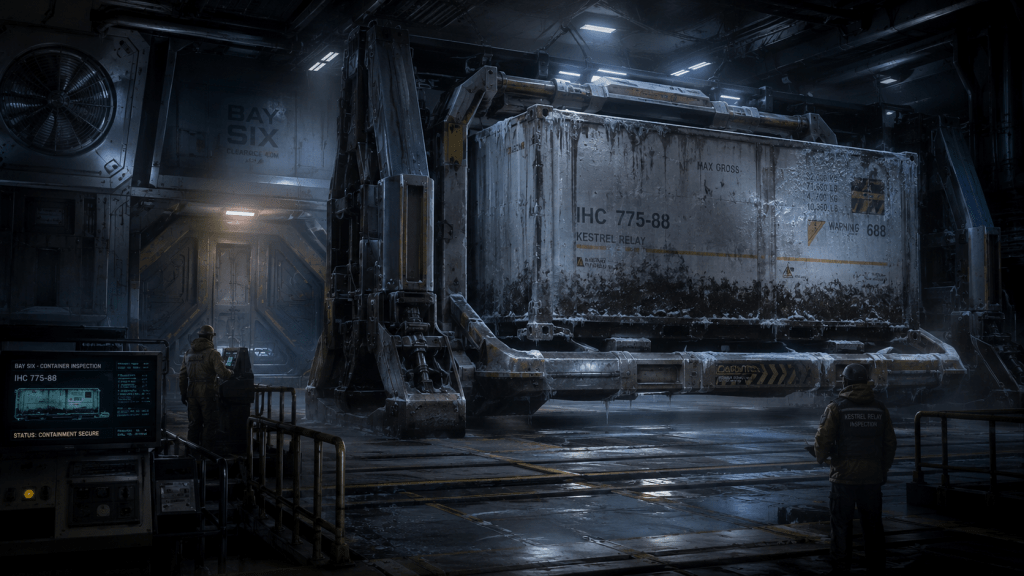
The inspection bay on Kestrel Relay kept its cold long after the recovery cradle powered up. Cargo lamps shone across the deck in pale bands, catching old scoring in the floor plates, yet the chamber itself held a dry metallic chill that slipped through work gloves and collar seams before any warmth reached the body. Mara Ellin felt it as she crossed the marked line between Bay Six and the sealed capture doors, her boots answering the relay’s stabilising vibration with a muted tremor that reached the deck a fraction later than expected, as though the station needed an extra moment to recognise its own motion.
Beyond the armoured doors, Route K-17 passed through a Republic-linked freight corridor where haulers, ore barges, and contract tugs crossed salvage country beneath registry codes and lane schedules. Kestrel Relay handled the objects that strayed from those movements, and Mara had spent six years inside inspection bays, long enough to recognise trouble beneath procedural calm. The container on the outer feed belonged to that kind from the first frame. It rotated slowly beyond the capture lattice, large enough for machine parts or mineral cores, its corners battered, paint stripped along one flank, registry markings scorched into dull shadow. A salvage beacon pulsed from the upper seam in weak amber intervals. The code carried a Republic affiliate prefix, although half its ownership chain failed verification before the relay systems marked the packet incomplete. Frost silvered the plating. Along the lower access seam, dark residue clung in narrow clotted bands that remained fixed despite the container’s slow turn, heavy enough to resist drift and dry enough to gather no gloss beneath the recovery lights.
“Still no match on ownership?” Mara asked as she stopped beside the console bank and studied the incoming scan. Corven Pike lifted his eyes from the identification board. He supervised Bay Six with the weary patience of a man who trusted salvage law only after it returned from several desks unchanged. “No clean match,” he said, drawing the registry tree wider across the screen. “The beacon carries enough recognised chain for preliminary handling. Full review can happen once we bring it inside.” Mara kept her gaze on the seam residue. “That outer section needs a deeper pass before cradle contact.” Corven’s attention moved back to the scan feed. “We gave it two already.” Mara drew the latest sweep onto a side panel. “They corrected against themselves.” He straightened slightly. “The relay corrected them. There is a difference.”
Each reading resolved within tolerance after a faint hesitation that travelled through the channels in sequence, first along thermal, then pressure, then across a material classification that refreshed into surface contaminants. Mara had worked beside ageing equipment long enough to know when a fault carried an unfamiliar shape. “Watch the order,” she said, sliding two fingers along the response trail. Corven leaned closer, although the display had already smoothed its irregularities into clean acceptance. “I see a cold bay and an ageing scanner,” he said. “The delay moves between channels,” Mara replied. Corven eased back from the screen. “Log the delay. Recovery still proceeds.” The answer remained in the air while the container drifted beyond the sealed doors. Its rotation brought the lower seam through the main lamp wash once more. The residue shed no dust. It held itself with a density Mara disliked.
A loader technician named Jalen Rook came down from the gantry steps with his helmet tucked beneath one arm and a sealed mug clipped to his harness. He followed Mara’s gaze to the outer feed and slowed. “That one looks expensive,” he said, stopping a pace behind her shoulder. “Or troublesome,” Mara answered. Jalen lowered the mug into a console recess and reached for the cradle controls. “Trouble often arrives in containers.” Corven opened the handling authorisation. “Registry chain holds enough shape for salvage review.” The bay lights dimmed as the capture cradle shifted outward. Its movement travelled through the deck in a slow tremor, and Mara felt again that faint reluctance in the relay’s response. Through the door feed, the grapple frame spread around the rotating container. Magnetic claws adjusted to the long edges. The salvage beacon flashed. The board acknowledged it a breath after the pulse had faded.
“Hold the thermal read on the seam residue,” Mara said, stepping closer to the side display. Corven opened the requested view while Jalen steadied the capture sequence. The residue sat colder than the surrounding plating, despite its long exposure to open dark. When the grapples settled into lock, faint heat from the field guides brightened the frame edges. The residue remained flat, dark, and unchanged. Jalen shifted his weight away from the console. “That seems wrong.” Mara heard the uncertainty beneath her own voice as she answered him. “Cold keeps many things quiet.” The recovery cradle drew the container through the outer doors while pressure seals adjusted in measured sequence. Frost lifted from the plating in thin vapour sheets. The dark residue stayed fixed. No particulate stirred. The container entered Bay Six as if the relay had accepted something asleep, held in patient suspension instead of left behind.
As the doors closed, pressure moved across the chamber too slowly. Mara felt it first in her ears, then along the fabric at her throat. The wall display reached stable status a moment later. “Pressure lag,” she said, turning slightly towards Corven. He glanced at the board. “Compensation finished.” Mara kept her voice calm. “That tells us where it ended. I am speaking about how it crossed the room.” Jalen looked towards the ceiling vents as the sound above them changed. The alteration was slight, little more than airflow thinning beneath the cradle motors, though once Mara caught it she struggled to hear anything else. It rose and fell through the vent housing in a soft measured draw. The rhythm held through three cycles, then sank beneath the bay noise as the container locked into the cradle. Jalen turned towards Mara, his expression tighter than before. “You heard that?” She kept her eyes on the vent grille for another second before answering. “I heard the system adjusting.” His hand tightened around the rail. “That sounded like breath.”
Corven opened environmental audio capture and dragged the last thirty seconds across the board. The waveform showed vent correction, cradle vibration, outer-door seal completion, and a small unresolved flutter in the middle band. Mara stepped closer once the cradle clamps reported secure. A salvage claim stencil marked one side. Along the seam residue, the cold remained unnaturally deep. Her scanner hesitated over the darkest patch, corrected itself, then classified the material as non-reactive industrial deposit. She ran the pass again and received the same answer. “Industrial deposit?” Corven asked from the console, his tone edged by genuine attention. Mara lowered the device slightly. “That is what the scanner wants it to be.” Corven studied her face, then looked back towards the container. “What do you want it to be?” She kept her gaze on the seam. “Anything that behaves the same way twice.”
Jalen moved a little closer, stopping several paces short of the cradle as his gaze travelled from the scanner to the sealed access latches. “Are we opening it?” Corven dragged the custody packet onto the relay board and shook his head. “Salvage review requires chain confirmation. Seal remains closed until lane authority signs transfer.” Some of the pressure in Mara’s chest eased, even as the bay continued to feel wrong in ways that resisted clean language. The container sat within the cradle under cold lights and careful procedures, accepted by systems that softened each irregular edge into tolerable variance. Bay Six returned to stable status, and the relay resumed its ordinary industrial hum, although she found herself listening past it.
She opened her inspection record and began typing with deliberate care. External unit recovered from Republic-linked transit corridor. Ownership chain incomplete. Residue present along lower access seam. Surface remains inert under low-bay temperature. Scan channels show repeated self-correction across material and environmental reads. Bay pressure equalisation experienced perceptible delay during recovery sequence. Audio event at overhead ventilation unresolved by automated capture. The form suggested pressure stabilisation within acceptable handling window. Mara rejected the phrasing and left her own wording where it stood.
Behind her, the vent system shifted once more. The sound moved through the grille so lightly that Jalen missed it while speaking to Corven about chain tags. Mara heard it because she had already begun waiting for it. A slow draw. A soft release. Almost breath. Almost machinery. Her hand stopped above the record board before the sentence was complete, and when she turned towards the container the dark residue along its seam remained still beneath the cold bay lights, fixed exactly where it had been when first seen in open space. Every visible detail remained exactly as the instruments expected it to remain. That was what unsettled her most.
A Visual Chronicle
The container stayed quiet only while Bay Six remained cold, but once the temperature rose, the station began to breathe with it.
Station Record: Kestrel Relay
Kestrel Relay served as a minor freight inspection and salvage-handling station along Route K-17, a Republic-linked transit corridor used by civilian haulers, contract ore barges, border-route tugs, and recovery craft moving between the outer industrial lanes and the more heavily regulated shipping networks nearer the settled trade systems.
The relay had never been designed for prestige. Its structure remained compact, practical, and deeply utilitarian, built around docking locks, inspection bays, salvage cradles, customs terminals, and a narrow administrative spine where incomplete ownership chains, damaged beacon packets, and contested cargo claims could be reviewed before passing further into recognised traffic.
Stations of this type existed across the outer routes because space rarely returned its losses cleanly. Containers slipped from damaged freight racks. Survey units failed to answer. Autonomous cargo modules drifted from abandoned work zones or appeared along lanes where no active vessel had reported a loss. Some carried valuable equipment. Others carried scrap, expired industrial stock, or years of dispute wrapped inside legal uncertainty.
Kestrel Relay’s role was simple in principle: recover, stabilise, record, and hold. Items found within the surrounding corridor entered inspection custody before salvage authority, route control, or Republic-linked contract offices decided what should happen next. The work demanded patience more often than urgency, and most of the crews assigned to its bays learned to treat every drifting object as paperwork first and hazard second.
That culture shaped the handling of the container recovered shortly before the events recorded in this Chronicle. Its beacon retained just enough registry structure to justify collection, while its ownership chain carried enough damage to delay immediate transfer. The outer residue along its access seam drew attention during inspection, yet its stillness under cold storage conditions allowed the unit to remain within ordinary salvage procedure.
No public alert had yet linked contaminated cargo to the developing incidents later associated with the Harbinger crisis. The Red Titan had not entered common record. The early failures remained scattered across route reports, maintenance logs, and sealed review channels, each described in terms narrow enough to survive local scrutiny.
At Kestrel Relay, the container therefore arrived as one more damaged object from the dark between lanes, carried into Bay Six under cold lights, logged by careful hands, and held for review while the first signs of a wider pattern rested silently along its sealed edge.
About the Creator
The Future Chronicle is written and curated by Simon Phillips, a writer of science fiction and speculative storytelling who explores the fragile edges of human expansion, where freight routes, inspection bays, patrol vessels, and isolated industrial stations continue their ordinary work while larger dangers gather quietly beneath routine procedure.
Many of the stories presented in these Chronicles exist within wider fictional worlds shaped by workers, survivors, officers, and investigators who encounter the first signs of events far greater than they are prepared to understand. These settings remain grounded in lived environments, where machinery, bureaucracy, and human judgement often shape the path of catastrophe long before anyone can give it a name.
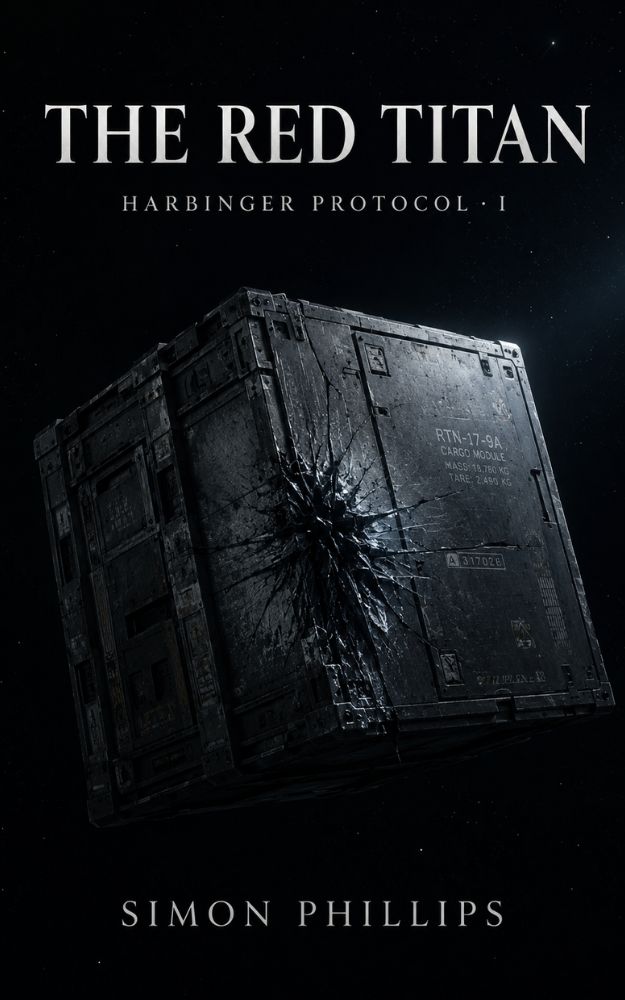
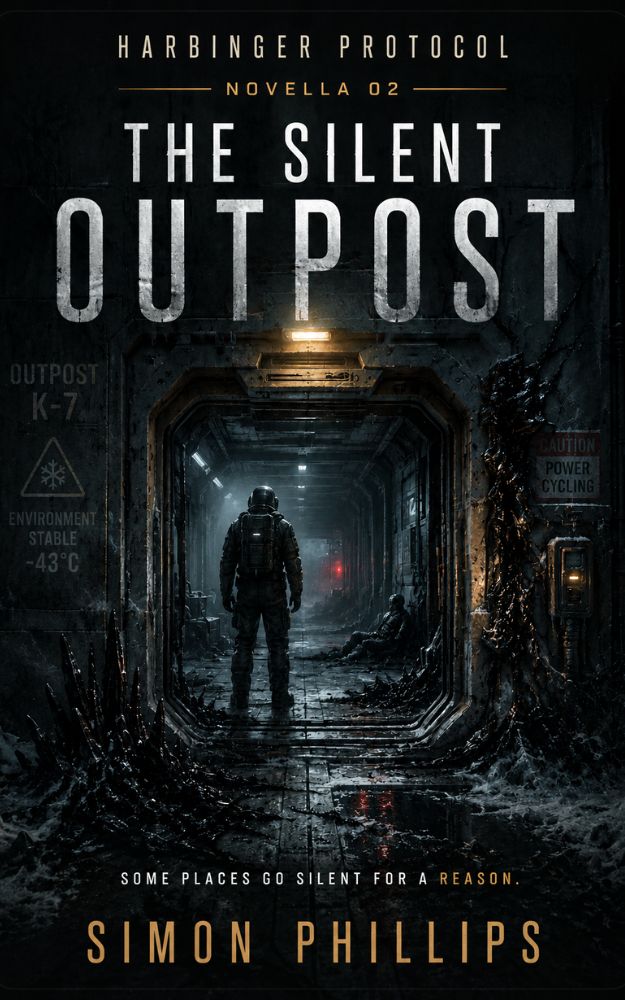
The Harbinger Protocol novellas follow that unfolding pressure through the experiences of Soren Vale, beginning with the civilian freighter disaster recorded in The Ash in Transit and continuing into the colder, more procedural dread of The Silent Outpost, where isolated incidents begin to reveal the outline of something spreading across human routes and systems.
Readers who wish to explore the full opening phase of the Harbinger crisis can find the novellas below.
Explore the books:
The Ash in Transit
The Silent Outpost
You can watch his YouTube channel here:
Author Simon Phillips
Continuing the Chronicle
The following Chronicle reconstructs the hours after the sealed container entered Bay Six at Kestrel Relay, as inspection procedure gave way to unease, the cold storage order came under review, and the first subtle changes around the freight unit began to resist ordinary explanation.
Readers supporting The Future Chronicle can continue the record below.
The Hold Condition
For the first forty minutes after recovery, Bay Six remained under capture conditions while Kestrel Relay processed ownership packets, lane authority claims, and the inspection record Mara had refused to soften. The container stayed fixed within the cradle beneath pale work lamps, its battered plating rimed with thinning frost, its dark seam residue unchanged by every automated pass that crossed it. Around the bay, loader servos reset, door seals cooled, and the overhead vents resumed a steady draw, quiet enough that the earlier flutter could have slipped into memory as part of entry pressure, had Mara trusted the chamber enough to let it.
She kept the residue view open on the nearest monitor while Corven worked through the salvage packet. The registry tree continued to fail in the same places, each broken branch leading towards a vanished contractor record or a dissolved haulage licence from Republic-linked territory. The unit carried enough legal weight to secure handling rights, yet its past had thinned into administrative haze, and each gap in the record made the container feel less like abandoned freight than something that had arrived stripped of context before anyone chose to look too closely.
Jalen stood beneath the gantry ladder, comparing capture-clamp tolerances against the readings on his wrist panel. “Cradle load is steady,” he called across the bay, his fingers moving through the figures as he spoke. “Shell mass tracks within salvage estimate.” Mara turned from the monitor and folded one arm across her middle, eyes still fixed on the live seam feed. “Surface variance?” she asked. Jalen raised his display slightly. “Still the same disagreement. Outer plating reads cold. Seam residue reads colder. Material call keeps settling back to industrial deposit after the first pass.” Corven looked up from his console, one hand resting against the edge of the registry board. “Then the preliminary record holds.” Mara walked closer to the cradle and stopped at the yellow safety line painted across the deck. “A reading that changes its mind every time deserves more respect than a clean answer,” she said.
Corven studied her for a moment, his irritation fading beneath practical concern. “Lane authority has accepted salvage hold,” he said, bringing the power board onto his side screen. “That keeps the container here until transfer terms clear. Bay Six shifts from capture mode to review storage in twelve minutes.” Mara turned fully towards him. “Review storage raises ambient temperature.” Corven widened the environmental profile. “By three degrees. Capture conditions draw harder through the cradle systems. We hold freight after retrieval under standard storage.” Mara glanced back at the residue along the seam, its darkness flattened by the cold lamps. “Procedure assumed freight behaving like freight.” The remark settled between them. Jalen stopped moving through his wrist panel. Corven’s gaze travelled to the container again before he answered. “Give me a reason that survives a review desk.” Mara expanded the thermal spread from the outer seam. “The residue stayed quiet in open dark. It stayed quiet in capture cold. Every other surface has warmed since entry, yet this section refuses to share the bay. I want a cold hold until we understand why.” Corven drew a breath and let it out slowly. “I can delay the storage shift through one additional inspection pass. After that, power management asks questions.” Mara nodded once. “That will do.”
The delay gave her sixteen minutes, and Jalen brought a long-arm sampling camera from the equipment wall, remaining behind the safety line while the lens moved towards the container on a telescoping mount. Scoring marked the paint around the seam. The residue nested within it and along the access gasket in narrow dark ribs. Up close, its surface carried a faint layered texture. It resembled soot only from a distance. Beneath the bay lamps it looked almost mineral, almost fibrous, and fully unwilling to settle into any category Mara trusted.
“Camera distance steady,” Jalen said, bracing the pole with both hands while the lens hovered over the lower seam. “No contact.” Mara opened a side-by-side comparison with the original recovery frame and aligned the gasket. “Corven, look at the left edge.” He came to stand beside her, his shoulder close enough that the cold from his work jacket touched her sleeve. The two images appeared identical at first, yet the closer view revealed a narrow projection along the seal corner, a hairline spur of residue that seemed more defined than it had appeared during capture. Mara zoomed in again. The spur remained. It might have emerged through resolution. It might have been present all along, concealed by distance and frost. The uncertainty tightened her stomach more sharply than a clear change would have done. Corven leaned nearer to the screen. “You think it spread.” Mara kept her eyes on the image. “I think the comparison deserves preserving.” Jalen lowered the camera slightly, his grip tightening around the telescoping shaft. “I would prefer the cold hold.”
The station chimed above them, gentle and administrative. Bay Six capture extension expired. Storage equalisation scheduled. Environmental shift commencing. Mara turned towards the status board. “Cancel that,” she said. Corven had already moved, striking the override key with the heel of his hand before dragging the environmental path backwards through the menu. The command entered. The bay vents changed pitch before the board confirmed receipt. “Override is in,” Corven said, his eyes narrowing at the late acknowledgement. Mara read the environmental line as it refreshed. “Temperature rise has already started.”
Warmth reached the bay only as a subtle thinning of cold against Mara’s face. The container’s frost lost its crystalline sharpness along the upper plates. Moisture gathered in tiny points before evaporating under the lamps. On the thermal display, the cradle edges brightened first, then the nearest shell surfaces. The seam residue remained dark for several seconds, then a faint change surfaced along its lower band, a dull sheen appearing where none had been. “Hold the image,” Mara said, stepping closer to the monitor while Jalen lifted the sampling camera again. The live feed trembled slightly as his hands steadied it over the safety line. The residue reflected a narrow thread of bay light. Mara opened the earlier frame beside it. The old surface had absorbed the glow. The new surface returned a piece of it.
Corven stared at the display, one hand resting flat against the console as though the surface beneath his palm had changed. “Could be condensation,” he said. Mara kept her eyes on the seam. “Condensation gathers on the plating. This turned slick from within its own texture.” The vent above the cradle released a long exhale. Jalen lowered the camera by instinct and looked towards the grille. His face had lost some colour beneath the bay lighting. “That came from overhead,” he said. Corven opened the live environmental feed. It offered only air movement and mechanical correction, yet Mara knew every explanation before he could voice one, while the sound carried a weight that belonged inside a chest. “Bring Bay Six back to capture cold,” she said. Corven kept his eyes on the display. “Storage transition already reached the environmental core. I can force a reverse cycle.” Mara answered before he finished shifting screens. “Force it.”
He worked quickly, stripping away the scheduled equalisation and returning the bay to recovery settings. The system resisted through one delayed response, then another, each confirmation arriving after the vents had already altered. Cold air returned in a stronger draw from the overhead grilles. The sheen along the residue dulled gradually. The thread of reflected light faded. The container settled again into the same patient stillness it had worn beyond the capture doors. Jalen watched the monitor until the seam looked dead once more. “That was enough for me,” he said, setting the sampling camera back on its stand with slower care than before. Mara turned to Corven. “Add temperature sensitivity to the hold record.” Corven reached for the custody field. “Observed under handling conditions,” he said as he began typing. Mara met his gaze. “Add that the surface response ceased once capture cold resumed.” He held her eyes only a second, then entered it exactly.
Mara moved to the auxiliary console and reviewed the last ten minutes frame by frame. The scanner corrections had accelerated while the bay warmed. Material classification flickered through carbonaceous residue, unidentified conductive trace, unresolved surface matrix, then settled once more into industrial deposit after the cold returned. Pressure equalisation had lagged again during a minor vent adjustment. The audio capture showed three low pulsing movements between system events. Each could fit inside a maintenance explanation if viewed alone. Together they carried a heavier shape.
Jalen stood near the equipment wall and rubbed one glove against the other as though clearing away contact that had never occurred. “What happens now?” he asked, keeping his gaze on the cradle. Corven steadied his voice before answering. “Now we wait for lane authority. The container remains sealed. The bay remains cold. Transfer review receives the amended record.” Mara continued scrolling through the scan history. “Send the raw feed with it.” Corven paused over the outgoing packet. “The desk usually receives summary first.” Mara lifted her gaze from the console. “Send raw feed.” He looked at the container, then at the live residue display. “All right,” he said, and attached the unfiltered files.
A message packet left Kestrel Relay nine minutes later, carrying Mara’s inspection wording, Corven’s amended hold conditions, raw thermal comparisons, scan-correction history, and the unresolved ventilation flutter. No answer arrived during the next hour. Bay Six remained under capture cold while routine freight moved through other arms of the station and relay life continued beyond the sealed inspection doors, every ordinary sound seeming more deliberate now that the container had taken a place among them.
Mara stayed beside the bay while Corven left twice to answer administrative traffic, returning each time with less certainty in his posture. Jalen fetched fresh battery packs for the sampling rig and then lingered near the gantry rail, making small adjustments to tools that required none. None of them chose to name their shared reluctance to leave the container alone. The sealed unit had demanded no intervention, issued no alarm, and breached no visible rule. Its presence changed the room all the same.
The relay cycle crossed into local evening. Interior levels softened for second shift and nonessential strips along the inspection wall dimmed to low power. The salvage beacon continued to pulse from the container’s upper seam, amber, steady, faint. During the fourth pulse after the lights lowered, Mara saw the residue shift in the monitor feed. A narrow line along the gasket seemed to draw inward and then settle. She replayed the clip twice. The movement returned in the same place.
“Corven,” she said, keeping her voice low while one hand remained poised above the replay command. He came to her side, weary from unanswered requests, and watched as she played the sequence twice. Corven rubbed his thumb once across his lower lip. “Lamp change could explain it,” he said, though his eyes stayed fixed on the seam. Mara preserved the clip before answering. “Hold the footage and flag it.” Corven nodded slowly. “I will.” Mara kept the monitor open. “Flag it as observed motion under continued cold hold.” His hand paused over the wording field, then resumed. “Entered.”
The vent sound came again before he finished, softer than before, carried from the grille over the cradle and sustained long enough that the bay itself seemed to listen. Jalen turned from the gantry rail. Corven stopped mid-entry. Within the low draw of airflow came a faint irregular flutter. It held no clear word. It carried no structure any recording desk would accept as speech. Still, it pressed close to human effort, like a voice heard through a wall too thick to trust.
Jalen swallowed and looked towards Mara. “Tell me that sits in the audio buffer.” Mara answered while keeping her eyes on the grille. “It will.” Corven reached for the station intercom and straightened before speaking, his tone formal now, steadied through use. “Bay Six entering restricted irregular hold. Access suspended pending transfer review. Environmental state locked to capture cold. Manual opening barred by supervisor authority.” The relay acknowledged his command. Magnetic locks sealed at the bay approach doors. A warning strip along the inner wall shifted from amber to muted red. The container remained where it had rested since recovery, silent in every way procedure could prove.
Lane authority answered thirteen minutes later. The reply authorised continued sealed hold under reduced-temperature preservation until an external review team could assume custody. The wording classified the event as a salvage irregularity with environmental handling concerns. Mara read the sentence twice, then looked back at the container beneath the bay lamps. The phrase felt small, yet it held, and for the moment that was the only form of caution the system seemed willing to keep.
For that night, Bay Six stayed cold. The residue stayed inert. The sealed container waited inside a relay that still believed it had prevented a mistake by keeping one freight unit shut and quiet. Mara completed her final note before shift handover, leaving the clearest warning she could place inside the permitted record: future inspection should preserve low ambient temperature throughout handling, avoid unnecessary access-panel release, and treat unexplained ventilation audio as relevant to the object’s condition, even where automated capture assigned no cause. She signed her name beneath the line and sent it forward. The container’s beacon pulsed once more across the bay. Amber light touched the dark residue along the seam, glanced away, and vanished into the cold.
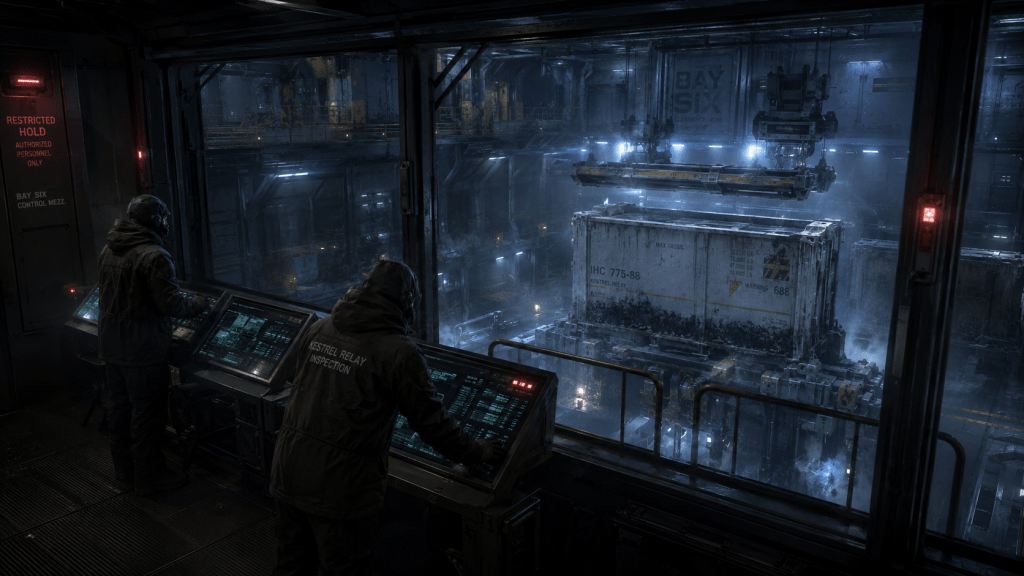
From the Bay Six control mezzanine, inspectors watched the recovered container remain sealed beneath cold containment while its surface readings continued to resist stable classification.
The Idea Behind the Chronicle
Freight systems rarely become the centre of science-fiction stories until something goes wrong, yet any civilisation spread across distant planets and orbital routes would depend upon cargo movement more than almost any other form of infrastructure. Containers, salvage units, inspection relays, customs holds, and route-control stations would form the quiet machinery of expansion, carrying raw material, replacement parts, medical equipment, industrial tools, and countless objects whose journeys matter only when they fail to arrive safely.
The danger explored in this Chronicle comes from that ordinary trust. A sealed container recovered from open space appears manageable because it fits a familiar category. It has a beacon. It carries registry fragments. It enters a known procedure. The people handling it act carefully, record what they observe, and still struggle to justify concern because the threat has yet to become obvious enough for the system around them to treat it seriously.
Cold plays an important role within the Harbinger Protocol world because it creates the illusion of safety. Under low temperature, the residue along the container’s seam remains inert, or appears inert to every tool available in the bay. Its stillness invites procedural confidence. Once the environment begins to warm, small changes emerge: reflective shifts in the surface, scan corrections arriving too smoothly, ventilation behaving with slight irregularity. None of these signs offers certainty on its own, yet together they suggest that the container’s danger depends upon conditions rather than intention.
That idea draws from real scientific principles. Many biological, chemical, and material processes slow under cold storage, while heat, pressure, oxygen, or energy input can alter reaction speed and behaviour. In speculative fiction, this creates a powerful source of tension because a hazardous substance may seem harmless during recovery, transport, or quarantine, only to become active once brought into the warm, controlled spaces designed to protect people from danger.
The Chronicle also explores how institutions respond to early anomalies. Mara recognises that the container behaves wrongly, yet she has to translate unease into wording a review system can accept. Her concern enters the record only because she insists on preserving the exact observations: the pressure lag, the self-correcting scans, the environmental response, the audio disturbance in the vents. The future crisis begins inside those small pieces of language, long before anyone can name what they mean.
In that sense, The Cold Container is less about a dramatic first outbreak than the quiet moment before one becomes possible. It is about the fragile margin between safe handling and dangerous misclassification, and about how a civilisation built on movement may carry its greatest risks through the very systems it trusts most.
From the Author’s Desk
Harbinger Protocol began with a question that felt unsettling in its simplicity: what happens when a civilisation built upon constant movement begins carrying danger through the same routes that keep it alive? Freight corridors, salvage lanes, inspection relays, and civilian haulers form the quiet background of any expanded human future, yet they also create countless moments where routine judgement matters more than anyone realises at the time.
This Chronicle series returns to the earliest phase of that crisis, before the events of The Ash in Transit had settled into public awareness and before the wider pattern had gained any recognised shape. Each entry follows a smaller incident along the edge of that unfolding danger, where workers, technicians, review officers, and route crews encounter something that still fits within ordinary procedure, even as it begins to strain against every explanation available to them.
The Cold Container stands at the very beginning of that sequence. It explores the kind of event that could easily disappear inside a routine salvage record: one sealed object, one inspection bay, one careful worker who sees enough to raise concern before the wider system understands why that concern matters. The Harbinger novellas move deeper into the crisis through Soren Vale’s experience, while these Chronicles widen the world around him by revealing the earlier records gathering quietly in the background.
Alongside these Chronicles, I continue writing fiction across the wider Harbinger Protocol series and other speculative projects that explore human endurance within strained systems, distant frontiers, and worlds where danger often arrives through the structures people trust most.
Readers interested in those stories can explore more through the links below.
You can explore my books here:
Books by Simon Phillips
You can watch my YouTube channel here:
Author Simon Phillips
Technical Notes & Frontier Context
Freight Recovery Corridors
Civilian expansion across distant star systems would depend upon more than powerful engines and large ships. It would require a dense network of relay stations, inspection bays, salvage offices, route authorities, and custody systems capable of handling the debris created by constant movement through contested and industrial space. Freight containers, autonomous cargo pods, damaged work units, and abandoned salvage loads could drift for years before being recovered along a monitored lane.
Stations such as Kestrel Relay would exist to keep that uncertainty from travelling unchecked into active trade. Their crews would stabilise recovered objects, verify beacon codes, inspect damaged ownership records, and place questionable cargo under controlled hold until a transfer decision arrived from route authority or contract jurisdiction.
Most objects entering such stations would prove ordinary. A container might carry failed mining tools, collapsed freight packaging, old machine parts, or goods lost during a manoeuvre decades earlier. That expectation of ordinary recovery creates the danger within this Chronicle. The container enters Bay Six through a procedure built for known risks, while the signs of a newer danger remain too small to force an immediate departure from standard practice.
Cold-Hold Preservation
Cold storage has obvious practical uses within long-range transport and salvage handling. Reduced temperatures slow chemical reactions, preserve unstable cargo, suppress spoilage, and limit the movement of reactive materials while inspectors determine what they have recovered. In a future industrial setting, colder capture bays would therefore serve as a sensible first environment for unknown objects drawn in from open space.
Within the Harbinger Protocol setting, that principle gains a more unsettling significance. The residue along the container seam appears quiet while the bay remains under capture cold. It does not spread visibly. It generates no clean warning. Its danger hides within stillness, allowing the inspection process to continue under the assumption that inactive behaviour equals low risk.
The brief warming of Bay Six introduces the first reason for doubt. Small surface changes appear. Scanner classifications become less dependable. Air movement acquires an organic suggestion that machines struggle to categorise. The Chronicle therefore builds around a simple speculative idea: preservation conditions may suppress an unknown threat without revealing what has been suppressed.
Inspection Records and Early Warning
Before any major crisis receives a recognised name, it often exists as scattered minor reports. One technician logs unusual pressure behaviour. Another flags a scan correction. A supervisor records a questionable environmental response and sends it forward under wording cautious enough to survive institutional review. Each record may seem insignificant in isolation, especially when no single event crosses the threshold required for emergency action.
The Cold Container centres on that fragile stage of evidence gathering. Mara’s importance lies in her refusal to tidy the event into easy language. She preserves the anomaly instead of compressing it into a convenient category. Her wording carries more weight than the station yet understands, because later investigators would need exactly those overlooked details to recognise a pattern beginning to repeat elsewhere.
This reflects one of the central tensions of the wider Harbinger world. Systems are strongest when they rely on procedure, yet procedure can also narrow the imagination of those using it. When a danger first appears through familiar channels such as freight, scanners, custody forms, and ventilation shifts, the earliest warnings may enter the record quietly, waiting for later incidents to reveal their value.
Next Chronicle
As scattered irregularities continued to surface across civilian freight routes, an ESC patrol corvette received a confused distress burst from a hauler whose final transmission carried too little clarity for command to understand what had occurred aboard her. The vessel remained distant, damaged, and difficult to read, yet the signal carried enough urgency that a quarantine bay was prepared before the corvette had any certainty about what it might soon receive.
The work fell to a containment technician trained for biological exposure, chemical leaks, and shipboard casualty handling, every procedure familiar in outline and suddenly fragile in practice. The recovered evidence arriving from the stricken hauler would appear manageable at first: damaged materials, sealed samples, residue taken from a vessel already under emergency classification. Yet the bay itself would begin to suggest that ordinary quarantine rules had been written for dangers far easier to understand.
The next Chronicle follows that first containment effort, when careful professionals attempted to process an incident still lacking a name, and the Harbinger pattern moved one step closer to official recognition.
Next Week: The First Quarantine Hold
Kestrel Relay returned to its evening routines beneath the quiet transit lanes of Route K-17, holding one sealed container in a cold inspection bay while, far beyond the language of its records, the first shape of a wider crisis waited to move.
