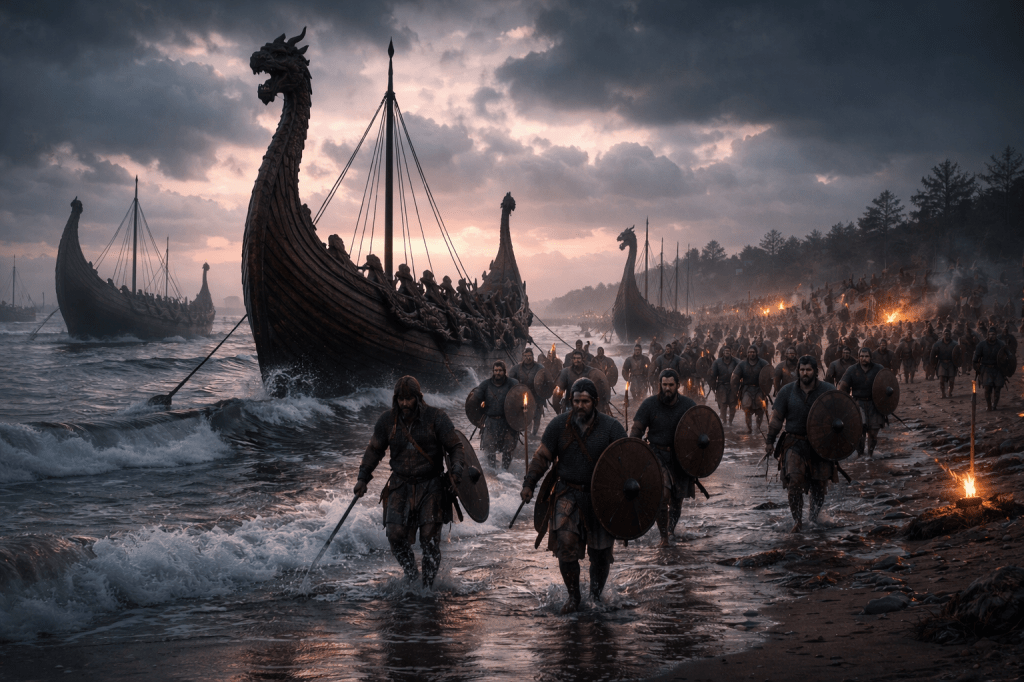
How the Vikings captured one of England’s greatest cities amid the chaos of a divided kingdom.
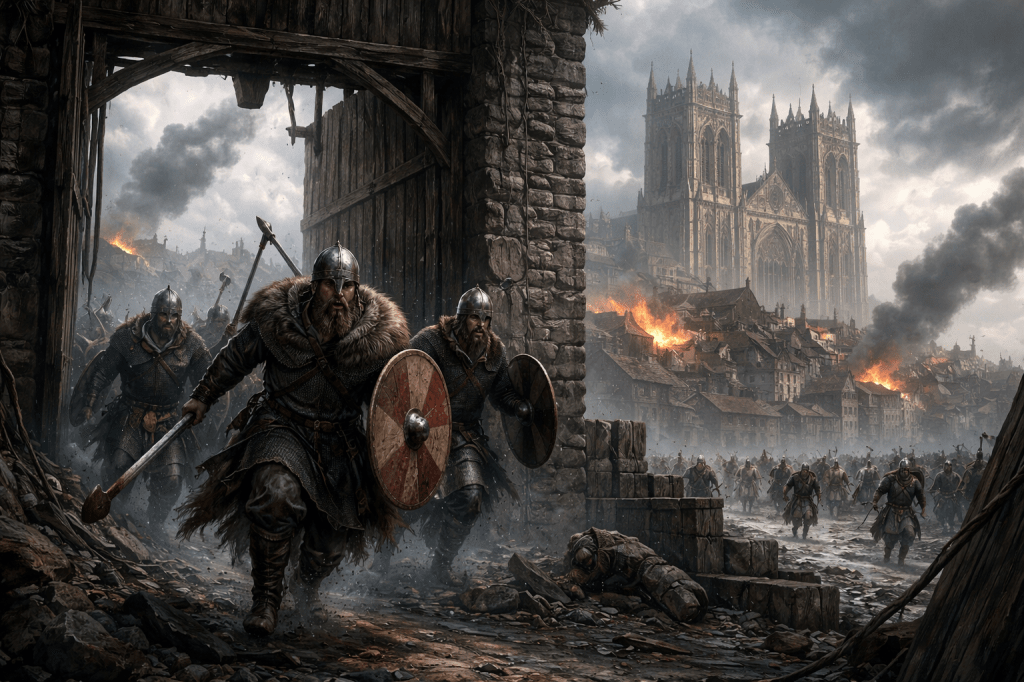
A Kingdom Divided Beneath Quiet Skies
A pale autumn mist lay across the low ground around York as the morning light crept slowly across the fields and marshland that surrounded the ancient city. From the walls, the land appeared quiet and undisturbed, broken only by the distant movement of water birds rising from the River Ouse and the faint shapes of travellers moving along the Roman roads that had bound this place to the wider world for centuries. York stood as one of the great cities of the north, its stone and timber rising above the riverbanks, its markets alive with traders from across Northumbria and beyond, and its churches carrying the sound of bells over the rooftops and narrow streets.
Yet beneath this calm surface the kingdom that ruled the city had begun to fracture. Northumbria, once among the most powerful realms of early England, had drifted into bitter rivalry and suspicion among its own rulers. Two kings now struggled for control of the same crown, their followers divided across the countryside, their loyalties shifting with every rumour that travelled along the roads. Messengers rode between rival strongholds, and each gathering of warriors carried with it the quiet threat of open conflict. The walls of York still stood firm, though the authority that protected them had begun to weaken like timber left too long beneath the rain.
Across the North Sea another force had already begun to stir. Longships moved along the coasts and rivers of Britain with growing confidence as Norse leaders learned the weaknesses of the lands they visited. The raids of earlier years had revealed monasteries filled with treasure and settlements whose defences relied more upon peace than upon preparation for war. Those journeys had brought wealth and fame to the warriors who crossed the sea, and the tales carried home spoke of a divided island where opportunity waited beyond the horizon. The fleets that now gathered carried warriors, families, and leaders who sought more than plunder. They sought land, power, and a future carved from the struggles of others.
When these fleets turned their attention toward Northumbria, the fractured kingdom offered the perfect moment for conquest. Rival kings watched one another with suspicion while the great host of Norse warriors moved inland with speed and purpose. Their arrival fell upon a land already consumed by internal struggle, and the roads that led toward York soon carried the sound of marching men, creaking wagons, and the restless movement of an army that had crossed the sea in search of opportunity.
Within the city, the people continued their daily routines beneath the shadow of the walls, unaware that the fate of York had already begun to change. Markets opened, bells rang for prayer, and the river carried boats toward the bridges as it had done for generations. The great city remained confident in its strength, secure within its ancient defences and the authority of kings who claimed dominion over the north.
Beyond the horizon, however, a new power approached with patient determination. The struggle between rival Northumbrian rulers had opened a gate that no wall of stone could close, and the warriors who advanced toward York carried with them the beginning of a transformation that would reshape the history of England.
Timeline of Events
865 AD — The Great Heathen Army lands in East Anglia
A vast Viking host crosses the North Sea and lands in East Anglia. Unlike earlier raiding fleets, this army arrives prepared to remain through the winter, gathering horses, supplies, and intelligence for campaigns across the English kingdoms.866 AD — Northumbria falls into civil war
The northern kingdom becomes divided as rival rulers, King Ælla and Osberht, struggle for control of the throne. Their conflict weakens the realm and leaves its greatest city vulnerable.Late 866 AD — The Viking army marches north
Taking advantage of the division within Northumbria, the Viking host leaves East Anglia and advances toward the city of York, one of the richest and most strategically important settlements in Anglo-Saxon England.November 866 AD — York is captured
The Viking army seizes the city with surprising speed. York’s strong Roman walls offer little protection against a kingdom already fractured by internal conflict.March 867 AD — Northumbrian kings attempt to retake the city
King Ælla and Osberht temporarily unite and launch an assault on Viking-held York. The battle ends in disaster for the Northumbrians, and both kings are killed in the fighting.After 867 AD — York becomes Jórvík
Under Viking control, the city transforms into Jórvík, a powerful Scandinavian stronghold and trading centre that anchors Norse influence across northern England.
About the Creator
This Chronicle is written by Simon Phillips, author of several historical and speculative fiction works exploring forgotten worlds, myth, and the turning points of history.
You can explore his books here:
Books by Simon Phillips
You can watch his YouTube channel here:
Author Simon Phillips

Subscribe to continue reading
Subscribe to get access to the rest of this post and other subscriber-only content.