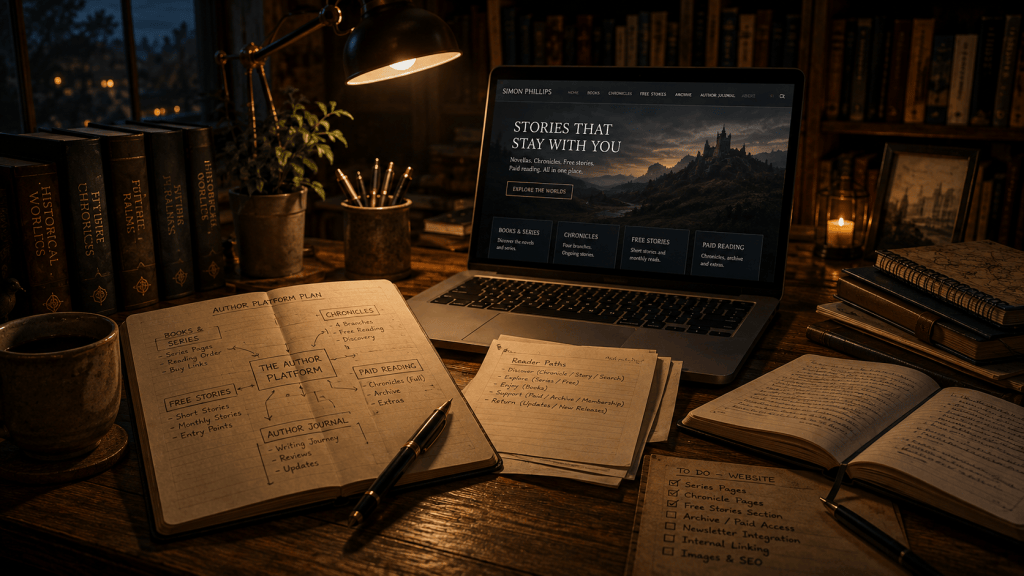
I have been spending a great deal of time working out what my WordPress website is supposed to be. The obvious answer is that it is an author website, although that answer leaves most of the important questions untouched.
An author website can be little more than a collection of book covers, sales links, a short biography, and an occasional update. That structure is tidy and easy to understand, although it does not match the amount of work I am trying to bring together or the kind of relationship I want the website to have with readers.
The more I have worked through the site, the clearer it has become that WordPress needs to function as a platform in its own right. It needs to give the books permanent homes, make the Chronicles easy to follow, provide free ways into the fiction, support paid reading, and give me somewhere to explain what I am building as it develops.
A Static Website Was No Longer Enough
There is nothing wrong with a simple author website. For someone with a small catalogue and only occasional news, a few book pages and a purchase link may be all that is needed.
My own work has grown beyond that shape. I have several series in development, four Chronicle branches, free stories, paid material, book updates, and a growing amount of author-side writing that needs to sit somewhere sensible.
Putting all of that on a single blog feed would create a different problem. A reader interested in science fiction could easily find a historical Chronicle beside a publishing reflection, followed by a fantasy update and then a website post. Everything would technically be available, although very little would feel properly organised.
I wanted the site to help readers find the parts that interest them. That meant thinking beyond individual posts and asking how the whole platform should work over time.
The Books Need Permanent Homes
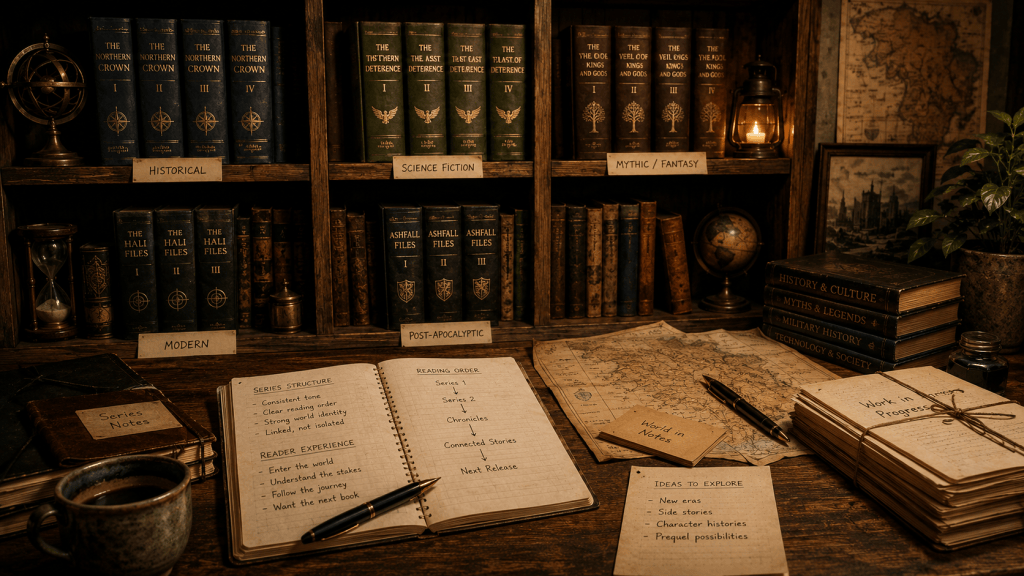
The books remain the main reason for the website. Every other section has to support them rather than compete with them.
A basic books page can show a cover, a description, and an Amazon link. That works for a small catalogue, although it becomes difficult once several connected books belong to the same series and each series has its own setting, reading order, themes, updates, and related material.
I am therefore treating each series as something that needs a permanent home. A series page should explain what the books are, show the current releases, make the reading order clear where necessary, and give readers a direct path towards buying or reading them.
Those pages should also remain useful between releases. When I publish an update, a behind-the-scenes post, a related Chronicle issue, or a piece about developing that series, the relevant material can appear on the series page automatically.
This matters because a series page should not feel finished once the sales copy has been added. It should continue to gather the work connected to that story world while the main description remains stable.
Giving the Chronicles a Clear Place
The four Chronicles create another layer of the site. The Forgotten Chronicle, The Future Chronicle, The Mythic Chronicle, and The Modern Chronicle each have their own identity, subjects, and style of presentation.
They need to be easy to recognise and follow, although they cannot be allowed to divide the website into four unrelated sections. The site still belongs to one author, and the books remain the centre of the work.
I see the Chronicles as reading and discovery branches. They give me room to publish substantial ongoing material, build regular points of contact with readers, and connect certain runs to the book series they naturally support.
That connection needs to be handled carefully. A Chronicle may introduce readers to a historical period, a speculative setting, a mythic theme, or a modern concern that leads towards one of my series. Even then, the Chronicle should retain its own identity while the related series remains clearly presented as the main body of fiction.
WordPress gives me the structure to do that through permanent Chronicle pages, clear categories, and filtered feeds. A reader can follow one Chronicle branch without having to search through every post on the site, while still seeing the wider author platform around it.
Free and Paid Reading Need to Sit Together
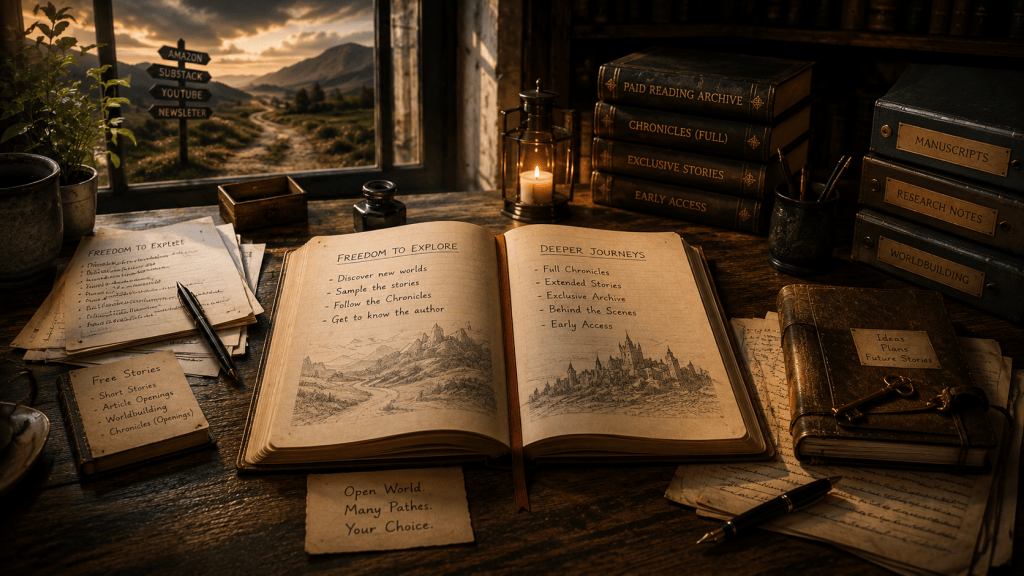
The previous Author Journey post looked at the balance between free and paid work. That decision affects the shape of the website as much as it affects individual stories.
I do not want every path through the site to lead immediately to a payment request. Readers need space to understand the books, sample the writing, read selected stories, and decide whether they want to continue.
At the same time, paid work needs a proper home. The Chronicles, archive material, and longer reading sections require time to write and maintain, and WordPress needs to support that work as part of the author business.
The solution is not to separate free and paid material into two disconnected websites. They need to sit beside one another in a way that feels clear and fair.
A free story can lead towards a related book series. A Chronicle opening can introduce the subject and atmosphere before a paid continuation. An author update can explain why a new archive section exists. A series page can show the books while also gathering related free posts beneath them.
When those parts are connected properly, the reader is given choices rather than being pushed in one direction. Someone can read freely, buy a book, follow a Chronicle, or support the paid archive according to their interest.
Building Around Reader Paths
One of the most useful changes in my thinking has been to stop looking at every page in isolation. A page may look complete on its own and still leave the reader with no clear idea where to go next.
I now think in terms of reader paths. Someone may arrive through a search result, a shared Chronicle post, a YouTube link, an Amazon author page, or the homepage itself.
The site needs to help that person understand where they have arrived and what is connected to the page in front of them. A Chronicle post should lead towards its Chronicle branch and, where relevant, a related book series. A series page should lead towards the current books and a small selection of connected posts. A free story should offer a natural route towards further reading.
This does not mean filling every page with links. Too many choices can be as unhelpful as having none.
The aim is to provide one or two sensible next steps. Readers should be able to continue with the subject they have already shown an interest in, rather than being sent back to the homepage to start again.
Keeping the Homepage Active
The homepage has also changed in my mind. I once thought of it mainly as a fixed introduction, with a short biography, a few featured books, and links to the main sections.
It still needs to introduce me and the work clearly, although it should also show what is active now. A returning reader ought to be able to see a recent Chronicle, a current book or series update, the latest Author Journal post, and a route towards free or paid reading.
The difficulty is keeping the homepage current without rebuilding it every week. That is where filtered post sections become useful.
Instead of manually replacing every item, the homepage can pull the latest posts from the correct categories. The main structure remains stable while the visible content changes as new work is published.
This allows the site to feel active without turning website maintenance into a second full-time job. The homepage can continue to introduce the overall platform while reflecting the work I am actually doing.
Keeping the Author at the Centre
With several series and four Chronicle branches, there is a risk that the website could feel like a group of separate publications sharing the same address. That would make the structure harder to understand and weaken the connection between the different parts of my work.
The author identity has to remain visible throughout the site. The Chronicles can have distinct visual styles, and each series can have its own atmosphere, although they still need to feel connected to the same body of work.
The Author Journal has a supporting role here. It gives me somewhere to explain the decisions behind the site, share progress, discuss publishing work, and record the practical steps involved in building a long-term catalogue.
That does not mean the Author Journal should take over the site. Readers are coming primarily for the books, stories, and Chronicles, and the author-side posts should help them understand that work rather than distract from it.
This is why the Author Journal will sit lower in the overall structure. It adds context and a human voice, while the fiction remains in the stronger position.
The Work Behind the Visible Pages
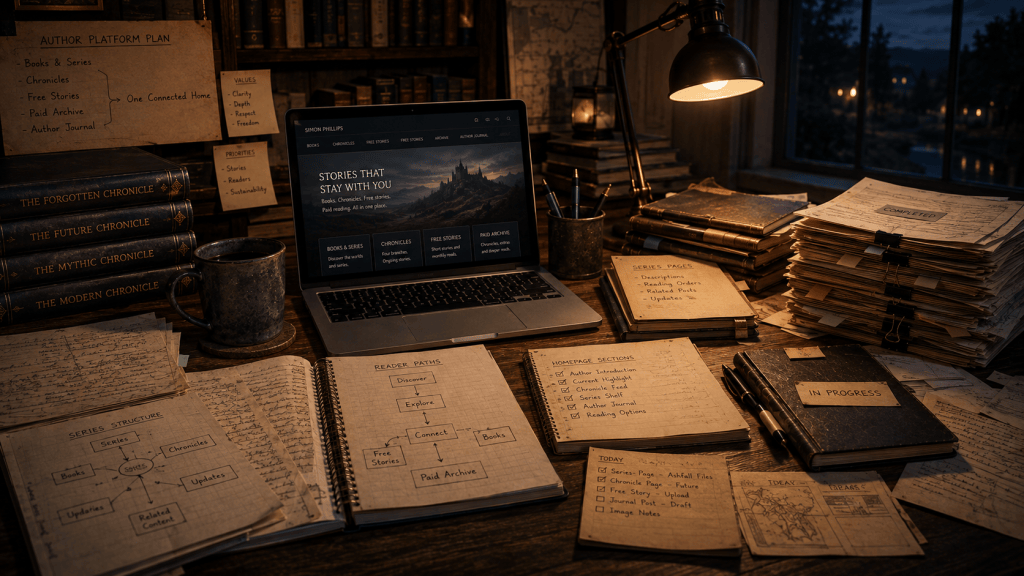
Much of this work is quiet and repetitive. Categories need to be decided, pages need to be connected, old posts need to be routed correctly, images need proper descriptions, and each series needs enough structure to remain useful as the catalogue grows.
None of those tasks produces a new book. It can therefore feel difficult to justify spending time on them when there is always more writing to do.
The problem is that an expanding catalogue becomes harder to use if the supporting structure is ignored. Books can disappear into a long list, older posts can become difficult to find, and readers may never discover that two pieces of work are connected.
I am trying to build the structure before that problem becomes larger. The site does not need every possible feature, and I am avoiding additions that would make it harder to maintain.
What it does need is a clear foundation. Pages need defined purposes, categories need to route posts correctly, and each section needs to lead readers towards the work that belongs there.
What This Means in Practice
In practical terms, WordPress is becoming the main organised home for my author work. The books will have permanent series pages, the Chronicles will have their own branches, and ongoing posts will appear in the correct places through categories and filtered sections.
Free stories will give readers direct access to the fiction. Paid material will have a clear place inside the same platform, with enough free reading around it for readers to make their own decision.
Substack will continue as a parallel publication and discovery channel. YouTube and shorter visual work will provide additional entry points. Amazon will remain the place where the books are sold.
The difference is that WordPress will connect those parts. It will explain the catalogue, preserve older work, show what is current, and provide a stable place that is not dependent on a single external platform.
Building It Slowly and Properly
The site is still developing, and some parts will take time to complete. There are many series pages to build, older material to organise, and several sections that need to work together before the structure feels settled.
I am trying to resist the temptation to rush through it simply so that everything looks finished. A page that exists without a clear purpose can create more confusion than a page that has not been built yet.
The slower work has helped me decide what each part of the site is meant to do. It has also made me remove ideas that sounded useful at first but did not support the books or the reader.
That is probably the most important change. I am no longer treating the website as a collection of things I should have as an author. I am treating it as a working part of the writing and publishing system.
What Readers Can Expect Next
As the structure develops, readers will begin to see clearer series pages, more organised Chronicle sections, regular free reading, and a paid archive that is easier to understand and follow. Each addition should make it simpler to move between the books, stories, Chronicles, and author updates.
The Author Journal will continue to record the practical decisions behind that work. Some updates will be substantial, while others will cover a small change that has taken longer to solve than expected.
The next stage is to keep building the permanent homes for the books and connect the ongoing posts to the correct places. I will continue adding updates as those sections take shape, and the latest free reading can always be found through the main story areas of the site.
