A salvage vessel returned from the Arcturas Loop with fewer crew than it had carried out, damaged intake filters, and a captain who insisted someone had been calling from inside an empty compartment.
Chronicle Opening: Intake Filter Seven
Review Annex C aboard the ESC cutter Valen Moor held its cold in the table, the walls, and the glass-fronted evidence rail beside the door, as if the room had been chilled for the objects brought into it long before the surviving crew of the Kordell Wake came aboard. White ceiling panels cast a steady clinical light over three fixed chairs, a narrow recording strip, two wall displays, and a sealed pressure hatch thick enough to make every exchange feel already buried beneath authority. Air moved through narrow vents above the table with a dry filtered pull that carried disinfectant, old metal, and the faint sour trace of decontamination gel. Captain Ilan Rusk sat on the witness side with both hands wrapped around a paper cup gone soft at the rim, his knuckles raw where receiving staff had scrubbed around suit seals, while the evidence rail preserved the objects recovered from his ship in chilled suspension: a damaged helmet pickup, a strip of torn intake mesh, two glove clips, and Filter Seven, sealed inside transparent polymer with pale ribbed residue caught across its lower curve like frost that had learned a pattern.
The Kordell Wake had returned from the Arcturas Loop eleven hours earlier under partial power, crossing the patrol boundary with her port intake bank locked, her forward lock sealed against its own crew, and three survivors speaking so little that the receiving medics kept lowering their voices as if quiet alone might hold them together. Five people had taken the salvage tug into the outer spread. Three had come back through the ESC decontamination corridor. Rana Veil, outer systems, remained listed as missing under uncertain compartment status. Venn Halek, grapple hand and second shift loader, remained listed as unrecovered after suit telemetry broke inside Compartment Six. Rusk had seen those phrases appear on the receiving board while a medic checked the response of his pupils, and the clean administrative wording had struck him more sharply than accusation. Missing. Unrecovered. Uncertain. The system had room for every word except the one his body still carried from the moment Halek turned towards the sealed compartment hatch and said he could hear someone calling his name.
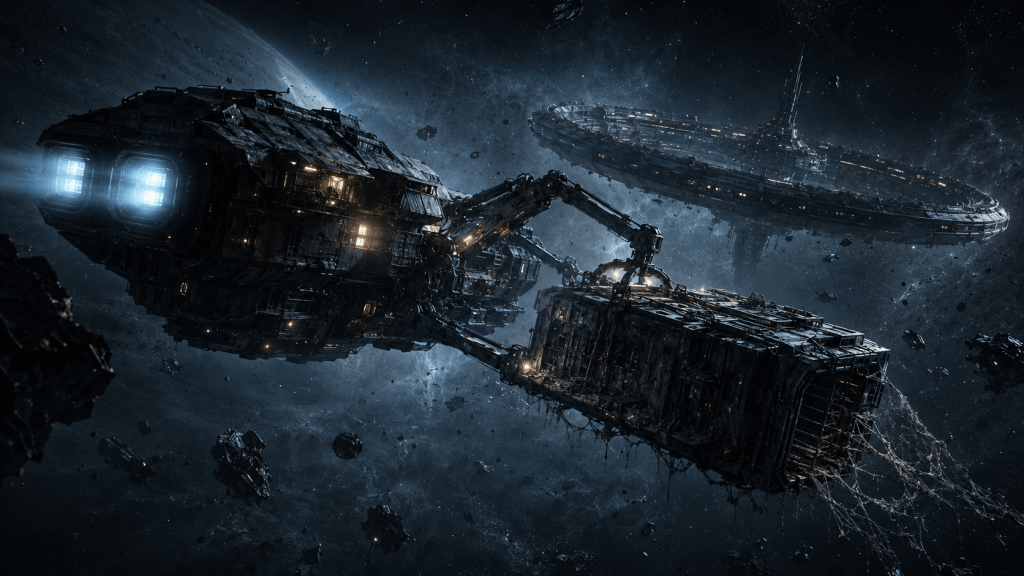
Across the table, Deputy Review Officer Mer Adelin adjusted her slate, then raised her eyes towards him with a stillness polished by too many rooms like this. Her uniform carried evidence authority tabs and route incident review marks, dark grey against dark grey, practical enough to belong anywhere an accident became political. Beside her, Engineer-Coroner Taal Resh sat with one forearm resting near the display control, his sleeves folded back despite the chill, his attention moving between Rusk and the evidence rail with the quiet patience of a man trained to find truth inside damaged material after every living account had begun to fray. The wall display behind them held the Kordell Wake in cutaway profile, a compact salvage tug built around reinforced intake mouths, paired grapple arms, patched shielding, and an engine collar scarred by years of work among broken machines. In the blue light of the schematic, she appeared orderly and almost harmless, a working craft reduced to lines, compartments, ducts, filters, and numbered hatches.
“Captain Rusk,” Adelin said as she set the slate flat beneath one hand, her voice low enough to avoid pressure while still leaving him little space to drift, “we are going to walk the sequence from first debris contact through your return burn.”
Rusk lifted his eyes from the cup, and the motion made the decon cuts along his fingers tighten. “I gave receiving the sequence.”
Adelin leaned slightly forward, the movement measured, her other hand resting beside the recorder strip. “You gave a survivor account under medical intake. This review establishes salvage conditions, evidence chain, and crew-loss sequence.”
The distinction settled across the table with quiet weight. Rusk looked towards Filter Seven again. It should have been dull with ordinary salvage grime, darkened by ore dust, coolant vapour, and the old wreckage the Loop gathered like a tide. Instead, pale strands crossed the mesh in shallow branching arcs, fine enough to pass for ice on a rushed glance, then too deliberate once the eye stayed with them. Dark residue clung along one lower corner where the intake housing had run warm during the retreat burn. A receiving technician had called it ash from a failed processing chassis before Resh sealed the tray and ordered the whole bank removed from the Kordell Wake under cold authority.
“We entered the outer spread at 0410 ship time,” Rusk said, placing the cup down and folding his hands together because the warmth from it had begun to feel like a lie. “The contract ping came from an abandoned coolant chassis drifting outside the registered hazard line. The beacon carried a degraded Republic affiliate chain, old enough for dispute, strong enough for claim. We had dirty debris around us, low visibility, long return path, ordinary salvage conditions.”
Resh touched the wall control, and the Arcturas Loop opened behind him in pale rings and amber points. The Kordell Wake’s course drew itself through the field in a careful curve, threading among broken refinery plates, mineral drums, stripped antenna spines, and cold machine fragments that had drifted out of useful ownership years earlier. Rusk watched the neatness of the reconstruction with a pressure gathering behind his ribs. The display showed the job as a room would prefer it: safe distances, confirmed tracks, controlled mass, lawful recovery. It gave no weight to the way the tug had sounded that morning, how dust struck the hull in smooth pulls instead of ragged waves, how the port intake had seemed to breathe against one steady surface long before any board admitted the filter load had changed.
Adelin glanced from the display to Rusk. “The first anomaly appears at 0436.”
Rusk shook his head slowly, keeping his gaze on the glowing path. “The first anomaly recorded at 0436. The first one I trusted came earlier.”
Resh shifted his slate towards him. “Explain the earlier condition.”
“The intake wash changed while we were still aligning for capture,” Rusk said, his voice held level through effort. “Loop dust usually came in uneven. Grit, ice, metal flake, quiet. The hull told you what the field was feeding. That time it turned smooth, almost gentle, as if the port bank had found something broad enough to pull against.”
Resh marked the account with one finger. “Filter harmonics shifted under low-power draw.”
Rusk looked at him across the cold table. “Your phrase works for the record. Mine was that the ship sounded as if someone had covered her mouth.”
The vent above them adjusted, drawing the room’s air through its grille with a soft mechanical pull. Rusk’s shoulders tightened before he could stop them. Adelin saw the movement, and her expression altered only by the smallest pressure around the eyes. He understood what that gave her: stress response, acoustic fixation, grief after crew loss. Salvage captains heard the dead inside hull noise when guilt needed a place to settle. Crew under pressure misread comm flutter, old announcements, loose ducting, and their own breathing. A review officer could build a clean staircase from shock to explanation before ever touching the thing itself.
He forced his hands open on the table. “We brought the chassis into forward lock two under cold handling. Rana Veil ran the outer scan from the armature station. Halek stayed on the grapple line. Min Korr watched intake load. I held the bridge and kept the lock isolated. The chassis had pale scoring along one edge and dark residue around a maintenance seam. Old refinery muck, we thought. The Loop was full of it.”
“Compartment Six registered an audio event after capture,” Adelin said as she drew a file across the wall display.
“Compartment Six carried a voice after capture,” Rusk answered, his eyes moving towards the Kordell Wake schematic. “The register came later, once the system caught up to what Halek had already heard.”
Resh opened the audio layer beneath the compartment view. A green waveform appeared, then broke into amber where the file degraded across three short intervals. Rusk kept his gaze fixed on the schematic instead of the line. He remembered the original too clearly: his helmet speaker carrying bridge noise, filter strain, Min calling load figures from the intake board, Rana asking for better light on the chassis seam, then Halek falling silent in the forward passage while the tug gave a small pressure shiver around them. When Halek spoke again, his voice had changed from work-talk into something smaller. Someone’s inside Six, captain. I heard her through the hatch.
Adelin placed both hands around the edge of her slate. “Compartment Six had remained sealed since departure from Kordell Yard. Motion scan showed empty volume. Heat return showed empty volume. Internal pressure held stable. Your own pre-launch checklist confirmed the compartment as locked storage.”
“Yes,” Rusk said.
“Yet you authorised a crew movement towards the hatch.”
“I authorised a verification approach.”
“Based on the audio event.”
Rusk looked at the evidence rail, where Filter Seven sat under cold seal with its pale ribs spreading across the mesh. “Based on a person calling from a place every instrument said held empty air.”
Resh touched the playback field before Adelin answered. Static entered the room first, thin and dry, followed by the soft pulse of damaged filter noise. Beneath it, almost lost in the tug’s mechanical strain, a voice-shaped sound rose from the recording, small, distant, and intimate enough to make Rusk’s throat close around the breath he had been trying to control. The software had later offered airflow flutter, comm distortion, hull stress, and crew interpretation under pressure. In the room, through the speakers, the sound carried a different cruelty. It came close enough to a human plea for the body to answer before judgement could defend itself.
Halek’s recorded voice followed, sharpened by helmet compression. “Captain, someone’s in Six.”
On the recording, Rusk heard his own answer come through the bridge channel, calmer than he remembered, held by discipline and the old salvage rule that panic moved faster than damage. “Hold position, Venn. Rana, confirm compartment scan.”
Rana Veil answered from the armature station with a breathless edge beneath her control. “Scan reads empty. Same as launch. I’m getting a pressure ripple around the seal, though it clears as soon as I isolate it.”
Min Korr’s voice came next from intake control, strained by the rising load alarm behind her. “Port bank is taking dust again. Filter Seven is climbing faster than the others.”
Then the voice from Compartment Six returned, too soft for the transcript to name, too shaped for Rusk to forget. It seemed to pass through the hatch, the comm line, the filter noise, and the narrow place inside every person aboard the Kordell Wake that still believed a sealed door could have someone alive behind it.
Rusk closed his eyes for one breath, then opened them because Adelin was watching. Resh had stopped the playback with one hand held over the control. The room returned to its filtered chill, its white light, its evidence rail, its official patience. Rusk looked from the sealed intake filter to the ship schematic and felt again the awful simplicity of the decision they had all been led towards. A hatch. A voice. An empty compartment. A salvage crew trained to recover what other people had lost.
Adelin lowered her gaze to the slate, then lifted it again. “For the formal record, Captain Rusk, when Crewman Halek moved to the hatch, what exactly did you believe you were responding to?”
Rusk held her eyes, and when he answered, his voice carried none of the softness the room wanted from him. “I believed we had heard someone who needed help.”
A Visual Chronicle
A salvage crew returns from the Arcturas Loop with missing crew, contaminated filters, and a captain who swears a dead woman’s voice was calling from inside an empty compartment.
Incident Record: Arcturas Loop Salvage Review
Review Annex C formed part of the restricted evidence and salvage-incident section aboard the ESC cutter Valen Moor, a patrol and recovery vessel assigned to outer-route inspection work near the Arcturas Loop during the early phase of the contamination crisis.
The annex had originally served as a claims chamber for disputed salvage recoveries, where contract crews, route officers, insurers, and evidence technicians could reconstruct contested operations from beacon packets, grapple logs, intake telemetry, suit recordings, and damaged cargo manifests. Its first role had been practical, built around ownership questions and liability after dangerous work in debris fields where abandoned machinery, unregistered fragments, and Republic-linked contract equipment often drifted beyond clear authority.
As unexplained incidents increased along the outer salvage lanes, chambers of this kind gained a second purpose. Evidence rails were refitted with cold seals, audio systems were linked to acoustic review suites, and intake-filter analysis became part of early hazard screening. Objects once treated as ordinary salvage contamination began entering review under restricted handling, especially when crews returned with residue lodged deep inside airflow systems or reports of voice-like sounds from sealed spaces.
The Arcturas Loop made that change more urgent because its debris fields had always carried legal and physical uncertainty. Salvage crews working there recovered industrial wreckage, abandoned refinery gear, broken drone housings, and lost cargo frames from a region crossed by old Republic affiliate claims and shifting contract boundaries. A damaged filter, a corrupted audio file, or a missing crewman could move quickly from field accident into diplomatic dispute once ESC authority became involved.
The Kordell Wake incident entered Review Annex C under that pressure. The salvage tug had returned from the Loop with partial crew loss, port intake damage, and pale residue embedded across Filter Seven and the surrounding mesh. Its surviving captain, Ilan Rusk, stated during formal review that his crew had heard someone calling from inside Compartment Six after scan returns showed empty volume, stable pressure, and a locked hatch history.
At the time of review, ESC personnel had limited language for events of this kind. Salvage crews were known to misread hull stress, comm echo, filter strain, and pressure flutter during difficult recoveries, especially after crew loss. The official file therefore placed the voice report under stress response and comm distortion while preserving the raw audio as restricted evidence.
Later comparison work placed the Kordell Wake beside other early records involving false voice-like events, delayed system responses, intake contamination, airflow irregularities, and human judgement under rescue pressure. The residue inside Filter Seven became important because it suggested that the event had travelled through the salvage vessel’s breathing systems before the crew understood that the recovery target itself might already have been unsafe.
Within the annex logs, the intake scans, compartment audio, captain’s testimony, and cold-sealed filter images remained attached to the same record. Procedure gave the incident a survivable classification, yet the preserved evidence left behind a quieter account of a salvage crew hearing a human call from an empty compartment while their own ship began carrying something unseen through its filters.
About the Creator
The Future Chronicle is written and curated by Simon Phillips, a writer of science fiction and speculative storytelling who explores the fragile edges of human expansion, where freight routes, inspection bays, patrol vessels, and isolated industrial stations continue their ordinary work while larger dangers gather quietly beneath routine procedure.
Many of the stories presented in these Chronicles exist within wider fictional worlds shaped by workers, survivors, officers, and investigators who encounter the first signs of events far greater than they are prepared to understand. These settings remain grounded in lived environments, where machinery, bureaucracy, and human judgement often shape the path of catastrophe long before anyone can give it a name.
The Harbinger Protocol follow that unfolding pressure through the experiences of Soren Vale, beginning with the civilian freighter disaster recorded in The Ash in Transit and continuing into the colder, more procedural dread of The Silent Outpost, where isolated incidents begin to reveal the outline of something spreading across human routes and systems.
Readers who wish to explore the full opening phase of the Harbinger crisis can find the below.
Explore the books:
The Ash in Transit
The Silent Outpost
You can watch his YouTube channel here:
Author Simon Phillips
Continuing the Chronicle
The following Chronicle reconstructs the formal review of the Kordell Wake salvage incident after the vessel returned from the Arcturas Loop with partial crew loss, contaminated intake filters, and a surviving captain whose account pointed towards a human voice calling from inside an empty compartment.
Readers supporting The Future Chronicle can continue the record below.
The Chronicle: The Empty Compartment
Adelin allowed the playback to move beyond Rusk’s answer, and Review Annex C filled with the Kordell Wake’s last clean minutes before the salvage record broke apart. Min Korr read intake load from her station, Rana Veil asked for a tighter light angle on the coolant chassis, and Venn Halek breathed through his helmet pickup outside Compartment Six while the old tug carried every sound through filters, duct metal, and hull strain. Rusk heard himself inside the recording as a captain shaped by procedure, calm enough for the crew to trust and cold enough for fear to find fewer places to enter. On the wall display, Resh aligned the audio with the tug’s internal schematic, and Compartment Six glowed pale inside the forward storage spine, sealed on all four sides, pressure stable, heat return flat, hatch history clean since departure from Kordell Yard.
Adelin lifted one hand towards the schematic, her eyes remaining on Rusk as the empty compartment brightened. “Your crew carried no assigned storage in Six, Captain. Why would Crewman Halek accept the sound as a live call?”
Rusk looked at the small compartment on the wall, and the review room fell away far enough for the old tug to return around him: patched handrails, worn deck plates, cold lock air, intake strain, and Loop dust moving across the hull in a smooth pull that had already begun to feel wrong. “Because the sound used a name,” he answered, his fingers flattening against the table.
Resh raised his eyes from the audio file and shifted the stylus between his fingers. “A relative?”
Rusk kept his gaze on the schematic while the pale outline of Compartment Six held steady in the display light. “His sister. Lysa. Dead six years in a mining decompression on Varda Spindle. There was no public file aboard my ship carrying that name.”
Adelin made no immediate mark on the slate. She gave Resh a small nod, and the engineer-coroner resumed the track. Halek’s helmet pickup carried a soft scrape as he leaned closer to the hatch, then a low murmur crossed the line, buried in filter noise and hull stress. The programme failed to resolve language. Rusk heard the shape beneath it all the same. Venn. Please. The sound reached from the speakers, small and strained, and Rusk saw Resh’s jaw tighten before the man returned his face to professional calm. On the display, Compartment Six stayed empty. Every system agreed with the dead room, while the crew inside the recording breathed like people standing outside a hatch they feared opening too late.
Rana Veil spoke from the armature station, her words clipped by suit compression as she shifted the recovery light across the chassis seam. “Captain, I’m seeing linework on the panel edge. Pale, shallow, following the scoring. Could be cold deposition.”
Rusk heard his recorded answer move through the bridge channel with controlled force. “Image it, then step clear.”
Rana acknowledged him while the armature camera tightened on the chassis. “Copy. The residue along the seam is warming faster than the shell. That makes no sense.”
Min’s voice entered from intake control with a rising load alarm beneath it. “Port bank keeps taking material from the chassis side. Filter Seven is climbing faster than the others.”
Rusk’s recorded voice sharpened by a degree as the bridge feed caught the sound of his hand striking a control. “Bleed the draw into reserve and keep temperature down.”
Resh slowed the playback and opened Filter Seven’s internal scan. Pale ribs crossed the intake threads, branching wherever airflow had carried material longest, while dark residue gathered along warm stress points where the tug’s retreat burn later forced heat through the housing. He linked the filter load to Rana’s warming-residue report, then turned his head towards Rusk with the scan reflected across one side of his face. “Material entered the intake before compartment approach. Port draw pulled it during exterior recovery. Cold slowed the surface response. Heat increased change along the mesh.”
Rusk nodded because the explanation matched the truth his body had understood too late. The tug had taken the danger in through ordinary breath. Compartment Six had become the place where the crew looked, because Halek had heard the call there. The deeper movement had already begun inside ducts, filters, grilles, and narrow warm channels.
On the playback, Halek spoke again, his voice close to breaking beneath the helmet channel. “Captain, she’s saying my name. I need to check the inner side.”
Rusk heard his old command return through the room as the display showed Halek’s marker holding outside the hatch. “You stay outside that hatch, Venn. Rana, pull back from the chassis. Min, isolate port bank.”
Min answered from intake control as alarms layered around her. “Isolation command is delayed.”
Rusk heard his own voice harden through the bridge channel. “How delayed?”
Min drew a breath so sharp the pickup caught it before she spoke again. “Three seconds. Four. It’s accepting the order after the load has already shifted.”
Rana’s armature feed trembled as she drew the recovery light away from the chassis. The beam crossed the seam, and the pale linework brightened for less than a second. At the same time, Halek’s pickup filled with a voice-shaped cry raw enough to cut through every alarm on the bridge. The schematic showed his suit marker leaving the safety line. Rusk heard himself shout Halek’s name, heard the forward passage proximity alarm chime, heard the heavy thud of Halek’s glove striking the hatch release cover.
Min spoke again, her disbelief carried through every syllable as the manual warning crossed the intake board. “Manual cover opened. He opened the manual cover.”
Rusk leaned forward in the review room as if his body could still cross the seconds between command and consequence, and his recorded voice carried full command weight now. “Venn, step back from the hatch. That is a direct order.”
Halek answered through static and breath, his suit marker flickering beside the sealed compartment. “She’s inside the wall.”
The hatch stayed sealed. Halek had touched the manual release cover, then the tug entered a pressure event from the intake side before his hand reached the lever. Filter Seven spiked past safe load. The port bank coughed material through reserve mesh. A pressure ripple crossed forward storage, moved beneath Compartment Six, and passed through the corridor like breath travelling the wrong way through the ship. Halek’s suit marker flared amber. Rana’s armature feed spun as she shouted his name. Min cut port power, then cried through the recording that the command had returned accepted while the draw continued.
Adelin kept her eyes on the wall display as she spoke, her voice controlled beneath the chamber’s cold light. “Crewman Halek’s telemetry ended here.”
Rusk turned slightly towards her, the words leaving him before she could move on. “His suit went blind here. He was alive after that.”
Resh watched him from across the table, one hand resting beside the playback control. “You heard him?”
Rusk looked back to the glowing passage where Rana’s marker had begun to move. “Rana heard him first.”
Rana’s voice returned, cracked by terror as she crossed the forward lock against Rusk’s order and tried to reach the passage. Her marker moved towards Halek’s last position, then slowed near the service grille outside Six. Her suit camera caught a smear across the lower wall, pale ribs spreading over frost, dark residue threading through the grille pattern in a shallow pulse. The horror lay in its refusal to become an enemy. It stayed surface, air, pressure, mesh, and sound.
Rana’s voice shook through the speaker as she stepped nearer to the bend, her lamp beam trembling over the ribbed grille. “Venn, answer me. I’m at the bend. I can hear you.”
Halek answered from somewhere the suit system placed inside Compartment Six, though the compartment stayed sealed and empty. “Lysa’s cold.”
Adelin breathed in gently, perhaps to speak, perhaps to steady the official room against the weight of that phrase. Resh allowed the recording to run. Rusk felt the table edge beneath his palms and remembered the old decision tearing through him. If he sent Rana forward, he might recover Halek. If he pulled her back, he might leave a living crewman to a fault the ship still described as airflow disturbance and intake contamination. He had chosen withdrawal because Min’s filters were failing and the tug’s own air had begun speaking with the same broken throat as the sealed compartment.
Rusk’s recorded voice entered the annex, stronger than he had felt then, with the bridge alarms gathering behind him. “Rana, back to the lock. Min, dump the port bank into cold reserve. I want forward storage sealed, then we burn out of the field.”
Rana’s suit feed showed the service grille one final time before she turned. The pale ribs across the mesh shifted under her lamp. The voice from the compartment followed her down the corridor, soft, close, changing through the duct line. It used Rusk’s name then. Ilan. Help us. The recording preserved the sound as damaged audio, too ragged for language confirmation, yet Rusk had heard enough. So had Rana. Her breath hitched once, and she kept retreating because training had forced pity back behind motion.
The Kordell Wake’s bridge recording became layered alarms after that. Intake load. Pressure mismatch. Grapple arm unsecured. Forward lock isolation delayed. Port bank contamination. Min’s hands moved faster than her voice as she cut feeds, dumped heat, and locked the tug into a retreat burn that scraped the old engine collar near red. Rusk ordered the coolant chassis released. The grapples opened, and the object drifted away into the Loop with its pale seam dimming as distance took it. For fourteen seconds after release, Compartment Six continued to carry sound. Then the forward storage audio died, and Rana’s suit marker vanished near the lock threshold during a second pressure ripple from the duct above her head.
Rusk had gone after her as far as the bridge lock allowed. The recording caught his harness release, his boots crossing the deck, Min shouting that the forward passage had sealed itself, then the hard magnetic slam of an emergency bulkhead closing between bridge and storage spine. He remembered striking the bulkhead with both hands, then stopping because the metal beneath his palms carried a soft internal vibration like air moving through a throat. Beyond it, through sealed alloy and the tangled ducting of a wounded salvage tug, Rana Veil whispered his name.
Resh ended the playback before the retreat burn reached its loudest point. Review Annex C seemed colder after the silence returned. Adelin looked down at the slate for a long time, then moved two fields into the formal classification column. Rusk watched the words assemble there, each one careful, defensible, and smaller than the dead. Acute stress response under crew-loss conditions. Comms distortion across damaged forward storage. Intake contamination of unclassified industrial origin.
Rusk stared at the classification until the letters blurred, then looked at Adelin while the evidence rail held Filter Seven in cold light. “That is how you bury it.”
Adelin lifted her gaze, and for the first time human weariness showed beneath the review officer’s trained control. “That is how a file survives challenge.”
Rusk leaned closer to the table, his voice held low because raising it would give the room an easier excuse. “That sound knew things my crew carried inside them. Names. Fear. Memory. Your labels fail before they reach the hatch.”
Resh rested one hand beside the sealed image of Filter Seven and chose his words with care. “The residue may have crossed audio pathways through pressure, suit pickup bleed, and stored voice fragments. The mind completes partial shapes under extreme stress.”
Rusk turned to him slowly. “My mind completed no shape when Rana called my name through a sealed bulkhead after her marker had gone.”
The vent above the table drew air through the room, steady and clean. On the wall, the Kordell Wake waited in pale lines, forward storage sealed, port intake marked red, Compartment Six still empty in every system record. Adelin saved the classification, then added one further restriction line beneath it. Raw audio, material scan, and survivor account preserved together pending comparison. The phrase carried no comfort, yet Rusk saw in it the smallest refusal to let the record close too tightly around the truth.
When the review ended, Rusk rose from the witness chair and looked once more at Filter Seven. The pale ribbing in the mesh seemed fixed under the cold light, inert inside its sealed case, harmless while the room held the conditions it preferred. Adelin gathered her slate, and Resh dimmed the Kordell Wake display while the official record of the Arcturas Loop salvage incident moved one step deeper into the archive, carrying three lost crew members and a voice from an empty compartment inside language built to survive review.
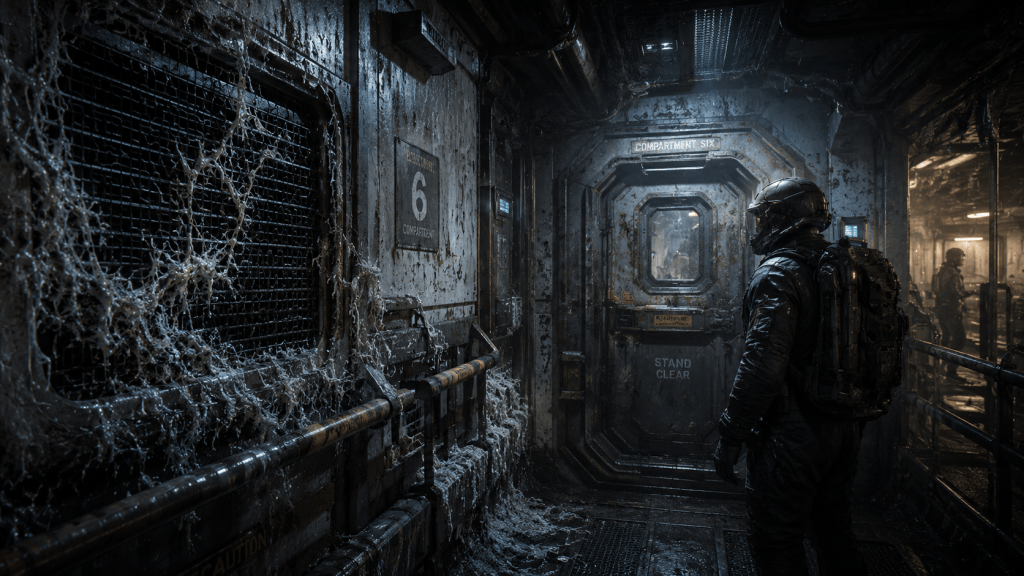
Inside the Kordell Wake, the sealed hatch to Compartment Six became the centre of the salvage crew’s final dispute with their own instruments: every scan reported empty space, while the voice beyond the door continued to sound human.
The Idea Behind the Chronicle
Salvage work in deep space has a strong practical logic behind it. Any future civilisation spread across long trade routes would leave machinery behind: damaged cargo frames, abandoned refinery parts, broken drones, failed station modules, and lost industrial equipment drifting beyond easy recovery. Much of it would still hold value, especially in frontier regions where replacement parts, rare metals, coolant systems, and old processing units might cost more to manufacture than to reclaim.
The Salvage Crew’s Report explores the danger hidden inside that kind of work. Salvage crews would operate in spaces where ownership, risk, and evidence often blur together. A drifting object could be useful cargo, disputed property, wreckage from an accident, or something already carrying a hazard no scanner had been designed to understand. The crew would approach through procedure, cold handling, intake control, grapple discipline, and careful logging, because routine would be their main defence against the unknown.
The Chronicle also uses a recurring Harbinger Protocol idea: human beings trust systems that make danger appear orderly. A scan says a compartment is empty. A hatch log says a door has stayed sealed. A filter board reduces residue to industrial contamination. An audio programme classifies a voice as distortion. Each system offers a reasonable answer, and each answer gives the crew one more reason to keep working inside a situation already moving beyond ordinary rules.
The voice from Compartment Six sits at the centre of that fear. It is frightening because it arrives through empathy instead of attack. The salvage crew hear something close enough to a human call that their training and instinct begin to pull in opposite directions. If they ignore it, they may be abandoning a survivor. If they answer it, they may open a path for whatever has entered the ship. The horror comes from that human pressure, where the need to help becomes part of the danger.
The intake filter gives the Chronicle its quieter scientific image. Spacecraft depend on controlled airflow, filtration, pressure, heat management, and sealed compartments. A threat that travels through those trusted systems would be difficult to recognise at first, because it would appear as maintenance trouble before it appeared as crisis. The Kordell Wake does everything a working salvage tug might reasonably do, yet the event has already entered the ship through its ordinary breathing systems.
The Salvage Crew’s Report therefore continues the Harbinger Protocol pattern of early misunderstanding. The danger has no need to announce itself as a monster. It moves through salvage law, filter readings, pressure delays, comm distortion, crew memory, and official language. By the time the review chamber finds words strong enough to preserve the file, the incident has already become one more quiet piece of a larger pattern.
From the Author’s Desk
The Harbinger Protocol began with the image of an ordinary working ship encountering something it had no language to understand. I wanted the danger to arrive through freight systems, salvage procedure, air filters, damaged comms, route control, and the familiar habits that allow people to keep moving through difficult work. In this world, catastrophe rarely begins with a grand announcement. It begins as a variance on a board, a delay in a response, a strange sound in a vent, or residue caught inside machinery that everyone depends upon.
These Chronicles explore the earliest surrounding incidents of that crisis, following the smaller records that gathered around the first major events of The Ash in Transit and The Silent Outpost. Each Chronicle focuses on people at the edge of the wider disaster: salvage crews, quarantine technicians, route-control operators, analysts, and officers trying to reduce impossible events into language their institutions can survive.
The Salvage Crew’s Report continues that idea through the Kordell Wake, a working vessel caught between procedure and human instinct. The crew hear what sounds like a person calling from an empty compartment, while the real danger has already begun moving through filters, airflow, and trusted ship systems. That tension sits at the heart of Harbinger Protocol: humanity keeps meeting the crisis through systems designed for ordinary hazards, then realises too late that the familiar explanations have become part of the danger.
The Harbinger Protocol follow Soren Vale through the larger unfolding crisis, beginning with the civilian freighter disaster recorded in The Ash in Transit and continuing into the colder institutional dread of The Silent Outpost. The Chronicles widen that world by showing the incidents, records, and human choices surrounding those first failures.
Alongside The Future Chronicle, I continue writing science fiction and speculative fiction across several connected and standalone projects, many of them exploring frontier environments, failing infrastructure, isolated crews, and the fragile systems people build to survive in distant places.
Readers interested in those stories can explore more through the links below.
You can explore my books here:
Books by Simon Phillips
You can watch my YouTube channel here:
Author Simon Phillips
Technical Notes & Frontier Context
Salvage Work Beyond Regulated Routes
Any large interstellar economy would produce a vast secondary world of salvage, especially around old industrial corridors, failed refinery sites, damaged cargo routes, and debris fields beyond regular patrol coverage. Freight systems lose equipment. Mining platforms shed machinery. Contract drones fail and drift out of registered lanes. Over time, those fragments become a scattered resource field for crews willing to work in regions where ownership, danger, and jurisdiction overlap.
The Arcturas Loop belongs to that kind of frontier space. It is valuable because old machinery still drifts there, yet dangerous because each recovered object carries an uncertain history. A salvage crew may approach a fragment as recoverable equipment, only to discover that its previous use, damage, or contamination history has vanished from the record. In such regions, the first question often becomes legal before it becomes scientific: who owns the object, who has authority over it, and who carries responsibility once it is brought aboard?
Airflow and Intake Systems
The Chronicle places particular emphasis on intake filters because spacecraft depend on controlled internal environments. Airflow, pressure, temperature, filtration, and compartment isolation would shape every part of life aboard a working vessel. These systems would usually be trusted because they keep the crew alive, remove particulates, regulate heat, and protect machinery from dangerous contamination.
That trust becomes dangerous when the threat enters through the same systems. In the Kordell Wake incident, Filter Seven is important because it suggests the salvage vessel had already taken material into its airflow path before the crew understood the recovery target as unsafe. The danger therefore appears first as a maintenance concern: filter load, intake strain, pressure ripple, delayed isolation, and residue on mesh.
This makes the incident harder to recognise. A damaged filter sounds ordinary. A delayed command can be explained by ageing systems. A pressure event inside a salvage tug can fit many practical causes. The early Harbinger crisis repeatedly grows through that uncertainty, where the warning signs resemble familiar mechanical problems until they begin joining into a wider pattern.
False Voice Phenomena
The voice from Compartment Six follows one of the central fears of the Harbinger Protocol world: human beings are vulnerable to sounds that resemble people in distress. A worker trained for rescue may ignore a strange noise, yet a voice using a name creates a different kind of pressure. It asks for action before evidence has time to become clear.
The Chronicle keeps the voice ambiguous because that uncertainty is part of the horror. It may be shaped by airflow, damaged comms, pressure movement, stored audio fragments, suit pickup bleed, or the crew’s own interpretation under stress. What matters inside the event is the effect. The crew hear enough humanity in the sound to hesitate, move closer, and question their instruments.
That is where procedure and instinct collide. A scanner can report an empty compartment. A hatch log can confirm a sealed space. A captain can order the crew back. Yet the sound of a person calling from beyond a door carries emotional force that machinery cannot easily cancel.
Institutional Language
The review chamber exists because frontier incidents have to survive official handling. Once the Kordell Wake returns, the event must be translated into evidence categories: stress response, comm distortion, intake contamination, crew-loss sequence, and restricted material review. That language may feel cold, yet it exists because institutions need phrases that can pass through legal, political, and operational pressure.
The danger is that careful language can shrink an event too far. If the voice becomes only distortion, the crew’s actions seem irrational. If the residue becomes only industrial contamination, the intake failure appears local. If the missing crew become only a loss sequence, the deeper pattern remains hidden.
The Salvage Crew’s Report explores that tension. The official file tries to make the event manageable, while the preserved evidence suggests something stranger moved through the ship before anyone knew how to name it.
Next Chronicle
After the Kordell Wake incident entered restricted review, another report reached ESC comparison channels from a low-power mining relay positioned along the colder edge of the Kheled Verge. The site had been operating under reduced thermal load after a processing imbalance, its crew maintaining only essential systems while waiting for a repair vessel to cross the outer route.
The final maintenance burst from the relay described structural contamination inside the processing conduits, pale residue along service grilles, and a pressure irregularity spreading through the lower air system. At first the report appeared to belong to an industrial failure: coolant stress, filter overload, and damaged refinery circulation. Then the station entered preservation mode, lowering temperature across the inhabited sections while its communication windows shortened and the crew began gathering near the vents.
The next Chronicle reconstructs the final recorded hours aboard that relay, where cold slowed the contamination enough for the crew to observe it, while the same cold preserved the station long enough for the silence to become evidence.
Next Week: Preservation Load
The Kordell Wake passed into restricted custody beneath the cold lights of the Valen Moor, carrying in its damaged filters the first quiet proof that the crisis had already begun moving through the ordinary machinery of salvage, rescue, and return.
Discover more from Simon J. Phillips
Subscribe to get the latest posts sent to your email.
