The Mythic Chronicle: The Feather in the Basin

An account of water darkened by ordinary injury, and of the pale lines that gathered around a feather where no bird had entered.


The Water That Held the Feather

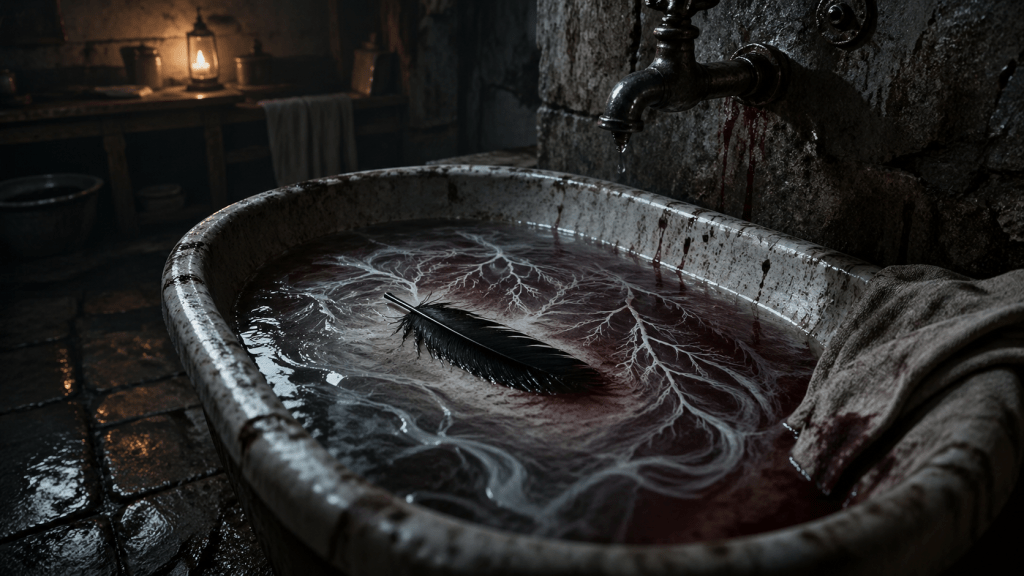
The basin stood beneath the lower tap where the back room narrowed beside the wall. Its rim had been worn pale by hands, cloth, and years of use, with one side smoothed by labour and the other chipped where buckets had struck it in careless hours. The room had been made for work, with a low ceiling darkened by lamp smoke, a floor sloping towards the drain channel, and shelves crowded with cracked jars, folded rags, lye cakes, dull knives, torn linen, and the quiet tools by which a house removed the signs of ordinary injury before morning. A lantern burned on the rear shelf beneath smoked glass. Its amber light reached the damp walls in narrow bands, showing blisters in the plaster and the older masonry showing through beneath.

Rain had passed through the district earlier that evening, leaving the yard slick beneath the eaves and drawing the smell of wet soil up through the loose stones near the rear threshold. Water gathered in shallow hollows along the flagged passage. It carried sour traces of ash, spilled ale, candle grease, and the iron scent that came from cloth washed too late after blood had settled into the weave. The houses joined one another closely there, wall against wall, roof leaning into roof, with gutters emptying into the same narrow runnels. Sounds travelled between them in softened form, passing through timber, plaster, and the tired hour after midnight.

Edrane Voss had been awake since before dawn, and by the time she brought the basin under the tap her shoulders ached from carrying water up and down the rear stair. She worked in the lower room because the mistress preferred the visible chambers kept clean of such tasks, and because the back room had always received what the upper floors wished to forget before daylight. There had been a fight in the passage after supper, one dock boy striking another with a cup after words passed too close to pride. The wounds carried little mortal concern, yet blood had marked sleeve, collar, knuckle, and the corner of the stair where one of them had fallen against the rail.

Such matters belonged to the district as surely as rain belonged to the gutters. Men came with coin and anger. Women came with painted mouths and tired eyes. Clerks came carrying secrets beneath their coats, while boys ran errands between doors they were too young to understand. By night’s end, someone always brought down a cloth darkened by work, pleasure, sickness, birth, beating, or grief, and the basin received each of them in turn. It had a memory no one cared to name, though its stone had taken colour in places where scrubbing failed to reach. Its drain gave a faint breath from below whenever rain filled the channels under the street.

Edrane set the first bundle into the basin and turned the tap. Water came reluctantly, stuttering through the pipe before falling in a clear line that struck the folded cloth and spread through the blood drying along its edge. She pressed both hands into the water and worked the stain loose with slow, practised force while the lantern flame trembled behind her. The water reddened, first in cloudy ribbons, then more fully, as the cloth surrendered what it had held. She added a shaving of lye, rubbed the linen against itself, and watched the surface gather a dull, bruised colour beneath the light.

Above her, boards creaked under the movement of late customers and women crossing between rooms. A laugh travelled down through the ceiling, broke halfway through, and faded into the general murmur of the house. Somewhere behind the wall, beyond the plaster near the drain, a small scratching sound moved once and ceased. Edrane paused with her hands still in the basin. She listened through the drip of the tap and the shallow movement of water against stone. Rats had troubled the lower rooms in previous weeks, slipping along unseen places with a strange order that unsettled even the older servants, although traps laid under the shelves had remained empty since the yard shifted after the last disturbance.

The sound came again, softer this time, as though something brushed the inner face of the wall with patient care. Edrane turned her head towards the plaster beside the tap. A line ran there, thin as thread, from the lower edge of a repaired patch to the dark seam where basin stone met masonry. She had seen it before. Everyone who worked the room had seen it. The repairman had said the wall breathed damp, and damp always found its own path, especially in houses built over older ground. He had scraped, sealed, and rubbed lime into the mark until it vanished beneath his hand. After each wet night, the line returned in the same place, pale against the surrounding dirt.

She drew her hands from the basin, wrung the cloth, and set it aside on the draining board. The next rag carried less blood, although it had been pressed hard against a split brow and had stiffened along one corner. She lowered it into the water, then hesitated. Something lay upon the surface near the basin’s far rim. At first she mistook it for a loose thread shaken from the linen, a narrow dark strip resting where the lamplight failed to reach. It turned slowly, once, then steadied, and the motion revealed the fine barbs laid along a central shaft.

A feather floated there, black and clean in shape, long enough to span half the breadth of her palm. No window opened in the lower room. The rear door had remained shut since she came in from the yard, and the tap above the basin gave only water from the house pipe, cold and faintly bitter. Edrane stared at the feather while the cloth sank slowly beneath her other hand. It rested upon the reddened surface with a stillness she disliked at once, untouched by the tremor caused by dripping water and untouched by the slow turn of the cloth beneath it.

She looked up towards the ceiling, then towards the shelves, then behind her to the dark corner where buckets stood nested beside the wall. There was no bird in the room, no open vent large enough for such a thing, no broken shutter, and no loose roof gap where it might have fallen from above. Feathers came into houses often enough. They clung to cloaks, mattress ticking, cheap trim, and the straw beneath bedding. She knew all ordinary explanations and had spent most of her life trusting them because ordinary explanations allowed work to continue. Yet the feather in the basin held itself apart from every movement around it, as if it had arrived through the water itself.

Edrane reached for it, then stopped before her fingers touched the surface. Beneath the feather, the red cloud within the basin had begun to change. At first she thought the lye had bitten into the blood strangely, loosening pale threads from the cloth and drawing them outward. Thin white lines spread beneath the water in delicate branching forms, each one moving from the feather’s shadow towards the basin’s edge. They travelled through the diluted blood with measured quiet, dividing, widening, and joining again in forms that reminded her of winter frost seen on chapel glass. The room held only the stale warmth of labour and lamp smoke.

The tap continued to drip. Each drop struck the basin close to the feather, yet the black shaft barely moved. The pale branching spread further, making a fragile web through the water, and for a moment the whole surface seemed to hold its breath. Edrane felt the skin of her arms tighten. The scratching behind the wall ceased. From the floor beneath her came a faint pressure, less sound than sensation, as though the stone below the basin had taken weight from somewhere under the room.

She backed away a single step and knocked her hip against the shelf. A jar shifted, rolled, and struck the floor with a dull crack. The sound broke through the room with such sudden force that she gasped, while above her the house continued its ordinary life through footsteps, voices, and a muffled cough from the stair. No one called down. No one entered. The basin remained where it was, the feather resting upon bloodied water while white forms grew and thinned beneath it.

Edrane forced herself forward again, with anger rising because fear had no use in a room where work still waited. She took the wooden stir stick from the shelf and plunged it into the basin. The water broke under the blow, red and white twisting together as the feather spun towards the near rim. For several heartbeats the pattern vanished into dirty turbulence. She stirred harder, striking the basin sides, dragging the cloth upward and forcing it under again until the water turned cloudy and the feather disappeared beneath the fold of linen.

When the surface settled, the feather had returned to the centre. It lay exactly where she had first seen it. The pale forms beneath it gathered again, thinner now, spreading outward in slow lines that curved around the sunken cloth and reached towards the drain hole as if seeking a route through stone. Edrane let the stick fall from her hand. The room seemed smaller than it had moments before, its ceiling lower, its walls damp with a closeness that pressed the breath in her throat. She became aware of the line beside the tap once more, the old repair mark gleaming faintly under the lantern light, and of the way the water in the basin appeared to lean towards that wall by a measure too slight for certainty and too clear for comfort.

The back door opened behind her with a groan of damp wood, and one of the younger servants entered carrying another bundle of stained cloth against her apron. She stopped when she saw Edrane standing rigid beside the basin. Her face changed as her eyes moved to the water, to the feather, and then to the pale residue spreading beneath it.

“What is it?” the girl asked.

Edrane turned her head slowly, then looked back at the water. The feather remained upon the surface, though the pale lines beneath it had already begun to loosen, dissolving into the red until only a cloudy brightness remained around the shaft.

“Stray matter,” Edrane said, because the words sounded like something a sensible woman would say in a house where walls listened poorly and rumours travelled faster than fire. “From the yard, perhaps. Bring the rest here.”

The girl came closer, lowering the cloth into the basin with visible reluctance. Her eyes fixed on the feather, then on the pale residue beneath it. Edrane opened the drain with a sharp pull and watched the water begin to turn. Red slipped away first, circling into the dark mouth beneath the basin. The feather turned with the movement, dipped once, then resisted the current as if the draining water had no claim upon it. Only when Edrane seized the wooden stick and pressed it under did it finally vanish into the drain with the last of the reddened water.

The pipe below gave a soft sound, almost like breath drawn inward. For a while, both women remained still. The basin emptied, the tap dripped, and the lower room settled into its former shape around them. The lantern flame steadied. The boards above creaked. Rainwater moved in the yard beyond the door. Edrane reached for the cloth and began again, though her hands shook enough to make the water splash against the rim when she refilled the basin.

By morning, she would tell the mistress only that the lower drain required cleaning and that lime should be rubbed again along the wall near the tap. By evening, the matter would pass into practical speech, where blood, lye, plaster, old pipes, and yard dirt could explain anything that wished to remain inside the house. Yet before the next bucket was carried in, before the floor was scrubbed and the lantern put out, Edrane looked once more into the clean water gathering beneath the tap.

For a moment, as the basin filled, a thin white branch opened silently beneath the surface and faded before the first ripple reached the stone.


Foundation Register: Lower Washing Room Basin Record

The lower washing room entered within the adjoining property plans appears as part of a rear service range set behind several occupied chambers and connected to the shared yard by a narrow threshold passage. Surviving plans describe the room in practical terms, listing a stone basin fixed beneath a lower tap, a shallow drain channel cut into the floor, and a repaired wall section where older masonry met later plaster around the water pipe.

Earlier revisions record repeated maintenance along the same wall, with lime applied across a thin vertical mark that returned after wet weather and heavy use of the tap. These entries assigned the condition to damp movement within the masonry and to pressure carried through the drainage below the rear rooms. The basin itself remained listed as serviceable, with worn stone along the rim, minor chipping near the front edge, and discolouration consistent with ordinary washing use.

During the period following disturbance in the rear ground, several household accounts began referring to irregular matter found within wash water after cloth had been cleaned below the rooms. The earliest entries speak first of darkened water, lye residue, and diluted blood from treated injuries. These descriptions remained within the language of household labour, assigning the matter to wounds received in the passage, work carried out after supper, and the late cleansing of linen, skin, and stone.

A repeated detail appears across later entries concerning a single dark feather observed upon the surface of the basin after the water had already been used. Early descriptions treat the feather as stray debris carried in from the yard, bedding, or garments handled within the house. The same accounts also record that the room held a closed rear door at the time, with the lower windowless wall offering little open passage through which such material might have entered.

Further entries describe changes in the water beneath the feather, where pale branching lines appeared within diluted blood before dispersing through the basin. These forms are entered with caution and placed beside ordinary explanations, including lye reaction, lime residue, plaster dust, and disturbed matter from the lower pipe. Several revisions reduce the detail to cloudy separation within washing water, while earlier wording preserves the description of lines spreading outward from the feather in measured form.

Additional testimony refers to a brief stillness across the basin surface while the tap continued to drip. The feather is described as remaining largely unmoved by falling water and by the turning of cloth beneath it. These observations are absent from later property copies, where the matter is condensed into a reference to contamination within the lower washing basin and unsuitable drainage conditions after rain.

A short entry made by a house servant records that the feather resisted the drain for a moment after the basin plug was pulled, then vanished only when pressed below the surface with a wooden stirring stick. The same entry refers to a soft inward sound from the pipe after the water cleared. This phrase is absent from the copied register and survives only within a loose household sheet kept among repair accounts for the rear rooms.

Several maintenance entries following the incident recommend cleansing the lower pipe, rubbing fresh lime along the marked wall, and washing the basin stone with vinegar and ash. These measures were completed during the next work period. The basin remained in use, though later household remarks refer to fresh water taking a faint pale branching for a moment beneath the tap before rippling clear.

The condition was attributed to contamination within the lower drainage, worsened by wet ground, old plaster, and bloodied cloth left to stand before washing. Repair orders list the matter as local and manageable, requiring cleaning of the basin, inspection of the pipe, and fresh sealing of the wall behind the tap. Further inquiry into the feather itself appears to have ended once the drain was cleared and the visible water ran clean.

A margin hand added beside one early copy describes the event as “water holding shape around a thing that should have sunk or gone away.” The phrase appears once, written beside the section concerning pale lines beneath the surface, and was removed from later prepared summaries of the same account.

Final entries state that the lower washing room returned to ordinary service after cleaning works were completed. The basin, tap, and drain remained listed within the property plan as stable household fixtures, while the irregular matter found in the water was accepted as residue from use, weather, and age within the rear service range. The record closes with the condition entered as resolved, leaving the room to its work beneath the house, where water continued to gather, darken, and pass below the stone.


About the Creator

The Mythic Chronicle is written and curated by Simon Phillips, a writer of mythic and speculative fantasy whose work explores the quieter edges of forgotten worlds, where buried structures, fractured records, and lingering presences continue beneath the surface of recorded history.

The accounts preserved within these Chronicles form part of a wider body of work in which cities stand upon older foundations, and events recorded as isolated disturbances are understood, in later tellings, to belong to patterns that were never fully recognised at the time.

One such account survives in a separate record, detailing an incident within a lower district where a death was first dismissed as excess, though the space in which it occurred retained a presence that resisted clearing, and where investigation revealed signs that the disturbance had not been confined to a single room.

This record is preserved in the novella Black Feathers in a Brothel, where the events surrounding that incident are followed more closely, though even there the full nature of what lay beneath the structure remains uncertain.

Readers who wish to examine that account in its fuller form may find the record below.

Explore the book:
Black Feathers in a Brothel

You can watch his YouTube channel here:
Author Simon Phillips


Continuation of the Record

What follows is drawn from later entries concerning the lower washing room and the basin fixed beneath the rear tap, where the first irregularity was entered as contamination within water used for ordinary cleansing. Early accounts describe the matter in practical terms and assign it to bloodied cloth, lye residue, damp plaster, and disturbed pipework below the rear service range, although subsequent notes refer to repeated moments in which pale branching appeared beneath the surface after the water had darkened. Each occurrence is entered briefly and held within the language of household maintenance, while several annotations refer to a dark feather remaining upon the basin water, a faint stillness around the rim, and a soft inward sound from the drain after the water cleared. In later entries, the pattern is described as gathering around the feather before loosening into the whole, as though the basin held a shape for a measured time before surrendering it to the pipe below. The cause remains assigned to local drainage, old lime, and residue carried through the washing room, and each account concludes with the basin accepted within the limits set down for it in the register.

Subscribe to continue reading

Subscribe to get access to the rest of this post and other subscriber-only content.

The Mythic Chronicle: The Collapse That Was Not Collapse

Where the ground beneath the district gave underfoot, then rose again in measured stillness, as though the stone itself had taken breath.


The Stone that Breathed

The yard behind the adjoining houses lay in the grey hour before trade had taken full hold of the district. High walls enclosed it on three sides, patched through years of repair with fresh mortar laid over older stone, while the flagging underfoot held the shine of recent rain in long dark seams. Water gathered in the shallow wear of the slabs and clung there, turning the ground into a dull mirror wherever the light from above found it. Even at that early hour the place carried a kind of hush that felt set apart from the lanes beyond, as though voices and wheels lost their force before they crossed the passage and entered that enclosed square. When three men came through the side gate with rods, a level frame, and a crate of tools, the scrape of iron over stone seemed to travel too far, then sink away into the yard as if the ground had received it.

Carvel, who led the inspection, stood with one hand resting on the frame and looked across the central run of slabs where the steward had marked a settlement on the evening before. At first glance the paving seemed sound. The rear step held firm beneath the water trough. The stack of empty casks still leaned beside the arch. The drain channel ran straight towards the passage mouth. Yet the eye kept returning to a broad patch near the middle where the joints had darkened into a ring and the stone sat lower by a whisper of an inch. It was the kind of change most men would pass twice before they saw it, then once seen, would carry in the mind with growing unease.

“Set the rods at the edge first,” he said. His voice stayed low, shaped by long habit in old places.

Hedd, younger and quicker in all his movements, crouched at the northern joint and fed the iron down between two slabs until it met resistance. Marr, broad-backed and slow, crossed to the western side and did the same. Carvel opened his folio, fixed the slate within it, and made the first marks while the light strengthened over the wall tops and laid a pale strip across the stones.

“Read.”

“Five inches,” Hedd said.

“Six at this side,” Marr answered.

Carvel marked both figures. “Again.”

They shifted position. Each new measure changed by a fraction. On the eastern side the rod turned slightly as it sank, as though the space beneath the paving opened away from the line where it had been set. Hedd drew it up and rubbed the pale dust from its grooves between finger and thumb. No damp clung to it, though the joints above still held the dark from the rain.

“That came from deeper down,” he said.

Carvel took the rod and looked at it for a moment. Fine grit lay in the score lines, light as ash and dry as old mortar ground under a hammer.

“A hollow sits under the centre,” Marr said.

“Perhaps,” Carvel replied. He lowered the rod and glanced again at the dark ring. “Though hollows in old yards usually keep still.”

They set the level frame over the marked patch and adjusted its feet with care. Hedd hung the plumb line from the crossbar and watched the weighted point circle above the widest slab. The line slowed, steadied, and came to rest over a joint that looked almost black in the poor light.

“Strike the outer edge,” Carvel said.

Marr took the haft of his hammer and tapped the stones in turn. The first four answered with the same blunt contained tone. Each sound travelled across the yard, pressed into the walls, and died there. When he struck the lowered slab, the note changed at once. It dropped away through the ground instead of spreading across it, carrying a depth that seemed out of keeping with the yard’s small measure. All three men heard it. All three men kept still after it passed.

“Hear that again,” Carvel said.

Marr struck the same stone a second time. The note fell as before, though this time it lingered below them for the length of a drawn breath, and during that held moment a faint pressure touched the soles of their boots. Hedd shifted his weight and looked towards the surveyor. Marr lowered the hammer a little, his hand tightening on the wood.

“That moved under us,” Hedd said.

Carvel crouched and laid his palm flat against the slab. The stone felt cold. Beneath the cold there came a rise so slight he could almost have named it memory, save that it gathered under his hand, held, and eased away again with slow purpose. He drew back at once, stood, and closed his folio.

“Clear the casks from the wall,” he said. “Move the crate as well. Leave the yard open.”

Neither man asked him for a reason. Marr went first, lifting the empty barrels one by one and carrying them through the passage into the lane. Hedd gathered the tools and the frame, set them by the gate, then returned and stood just clear of the dark ring, watching Carvel as though the older man might give shape to what had begun under the stone. Carvel’s attention remained on the plumb line. The weighted point hung almost still. Then it drew a fraction to the south, paused, and came back. No wind touched the yard. The water in the trough by the rear step held its surface smooth as glass.

“It shifts between measures,” Hedd said.

Carvel gave a brief nod. “Bring the lamp.”

Hedd fetched it from the crate and lit it with a spill from the shuttered flame he carried at his belt. The small amber light spread over the flagged centre and sharpened the wet seams between the stones. In that warmer glow the ring appeared wider than before, the dark joints holding a moist blackness that seemed fresh laid, as though the paving had drawn breath from below and pressed it upward through the cracks.

Marr came back from the lane and set down the last cask. “The steward will ask what holds us here,” he said.

“He can ask,” Carvel replied. “Take the lifting bar to the centre seam.”

Marr slid the iron under the lip of the broadest slab and leaned his weight into it. At first the stone held firm. Then, with a fine grinding sound from somewhere below its edge, it rose the depth of two fingers and hung there on the bar. A thread of dust drifted upward through the opening, pale in the lamplight. Hedd bent with the lamp and lowered the flame towards the gap. The beam caught broken mortar, a wedge of darkness, and the faint movement of more dust rising from beneath in slow twisting lines.

“There is space under it,” Hedd said.

“There is more than space,” Carvel answered.

A scent came up through the join while he spoke, dry and old at first, then touched by a sweetness that turned the stomach through its very thinness. It carried no richness of rot. It had the strange lightness of something long shut away that still found means to linger. Hedd drew his head back, though his eyes never left the gap.

“That smell came from deep stone,” he said.

“Raise it a little further,” Carvel said.

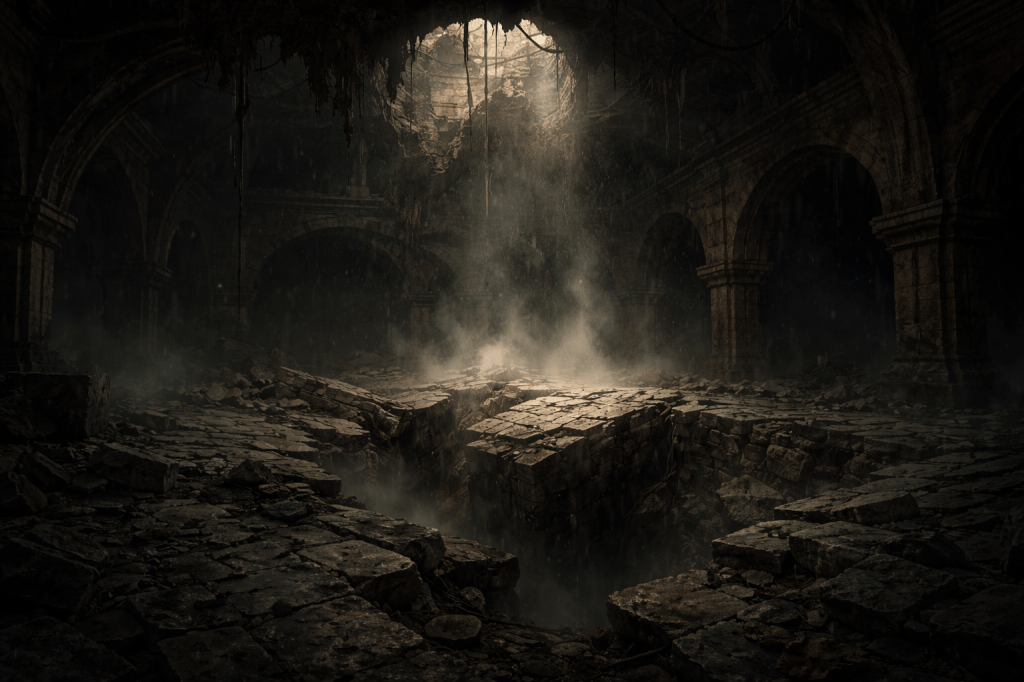
Marr shifted his grip and pressed again. The slab lifted another inch. The sound that followed rose through the opening in a slow drawn exhalation, as if the ground had released a held breath through a narrow throat. The men heard no crack, saw no breaking edge, felt no sudden violence. The change began in the joints around the lifted slab. One seam widened. Then a second opened near it. Across the whole dark ring the paving eased downward together in a motion so slow the eye could follow every part of it. The plumb line trembled above the centre. Water in the worn hollows shivered and drew inward along the widening seams. The entire marked section lowered the depth of a hand.

Hedd stepped back until his shoulders touched the wall. Marr kept the bar fixed under the slab, though his stance had altered and his face had emptied of all labourer’s ease. Carvel alone stayed near the edge, the lamp held low, his gaze moving across the ring as each stone settled into its lowered place.

“It sinks in measure,” Marr said.

Carvel heard him, though his attention had gone elsewhere. A low pressure had risen with the movement, no sound at first, only a gathering in the air that filled the chest and held there. Then, from below the lowered paving, there came a tone so faint it seemed almost to live inside the ear instead of within the yard. It lasted only a moment. Even so, it followed the descent as clearly as a sigh follows effort.

The ground stayed down for the space of three breaths.

Dust continued to rise through the open seam under Marr’s bar. The sweet thin scent strengthened, then spread through the yard in a shallow veil. Hedd kept one sleeve over his mouth. Marr stared into the gap beneath his stone, as though he expected some hand or face to rise into the lamplight. Carvel watched the plumb line. The weighted point had ceased its trembling and now hung slightly lower, the cord pulled taut over a centre that no longer sat where it had sat a moment before.

Then the ground came up again.

The motion followed the same dreadful calm. The lowered slabs rose together by degrees. The widened joints drew inward. Water ran back across the stone in fine trembling lines. Marr’s lifted slab eased down against the bar as the whole centre returned to level, and when at last it settled into its bed the sound it made held the softness of a mouth closing after speech. The plumb weight turned once more and came to rest. The dark ring remained. The yard stood as it had stood when they entered, save that the seams now looked fresher, wetter, and more deeply cut.

Hedd found his voice first. “That was no collapse.”

“No,” Carvel said.

Marr eased the bar from the joint and laid it on the stones with care. “Then what do I enter when he asks?”

Carvel looked across the centre and spoke only after a long pause. “You enter what was seen.”

Marr gave a humourless breath. “The ground gave way and rose again?”

“If you have the courage for plain truth, yes.”

No one moved for a while. Beyond the yard the district had begun its day in earnest. Wheels passed over cobbles. A woman called from an upper window. Somewhere along the lane a hammer started its work upon wood. Within that enclosed space, each outer sound arrived thinned and distant, while beneath them all there seemed to linger the memory of the lower movement, held close under the flags like a second life under the first.

Carvel took the rod from Hedd and knelt again beside the centre seam. He fed the iron into the joint where Marr had lifted the slab. It sank deeper than before. When it stopped, the rod gave a slight turn in his hand, then steadied. He drew it back and found a pale trace upon the lower score lines, finer than dust, almost white.

Marr saw it first. “Mortar?”

Carvel rubbed it with his thumb. The grit felt dry, fine, and faintly greasy, as though it had passed through long-closed air before reaching the surface. He lifted it to the lamp. White flecks caught the light against his skin.

“Keep your hands clear of the joints,” he said.

Hedd’s eyes went at once to the ring around the centre. “You think something is working upward.”

Carvel rose. “I think the ground answered its own measure. That is enough for one morning.”

He closed the folio, though the charcoal in his hand had paused over the slate before making its final line. Marr gathered the bar and hammer. Hedd lifted the lamp and the rods, his gaze still fixed on the central slabs as if he feared a second motion might begin the instant his back turned. Together they moved towards the gate, each step careful and placed with more thought than it had carried on the way in.

At the threshold Carvel stopped and looked back.

The flagged centre lay quiet in the pale light. The ring of darkened joints held around it with a shape too even for chance. A last thread of dust drifted up from one narrow seam and vanished in the damp air. Then, under the watch of all three men, the broadest slab sank by the breadth of a finger and rose again, a small measured motion, no more than a pulse passing through skin.

Hedd made a sound in his throat and stepped into the passage. Marr followed at once. Carvel remained one moment longer, the folio held under his arm, the lamp glow reaching only so far across the yard.

He heard it then, or felt it, and for years afterward he would have struggled to say which. A low interior pressure gathered beneath the stones, held there, and eased away again in a slow returning wave, as though some buried mass below the district had drawn in air through the roots of the walls and released it once more into the foundations above.

When he left the yard and drew the gate to behind him, the sound of the lane closed around the three men and the morning took them back into its ordinary movement. Behind the timber, beyond the patched walls, the ground settled into stillness. It held that stillness with perfect composure, while under the flags the dark seams kept their widened shape and the space beneath the centre lay ready for the next slow descent.


Foundation Register: Rear Foundation Movement Record

The yard entered within the adjoining property plans appears as part of a shared service ground set behind several lower structures, its surface formed through successive layers of paving laid over earlier fill and supporting stone. Surviving revisions record minor alterations to drainage and access across different years, while the central flagged section remained unchanged in outline, its condition accepted as sound within the ordinary pattern of repair.

During routine inspection following reports of settlement within the rear paving, the yard was entered for assessment, and early observations were recorded in practical terms, referring to slight lowering across a central run of slabs, widening damp within the joints, and the possibility of subsidence beneath the flagged surface. These entries held to the language of maintenance and assigned the condition to age, weathering, and long pressure within the underlying fill.

Subsequent notes describe irregularities in the behaviour of the paving during measurement, where rods placed through the joints returned differing depths across a confined section whose outline remained stable in the surrounding stone. Early descriptions refer to this as uneven settlement, though later entries distinguish the movement from ordinary ground loss, recording that the flagged centre appeared to lower and recover within a measured interval while the adjoining sections held firm.

In several accounts, the movement is described as occurring across the full marked section at once, with the slabs easing downward in a single contained shift before returning to their prior level. These observations are entered cautiously, with later revisions attributing the effect to distributed pressure beneath the paving or to movement within a concealed pocket of older material set below the visible surface.

A number of entries refer to changes accompanying the descent, where seams widened briefly, pale residue rose through the opened joints, and a low pressure gathered in the air above the flagged centre. These notes remain limited in detail and are not expanded within the primary record, with several later annotations omitting reference to the atmospheric change entirely and retaining only the structural description.

Further examination records that the behaviour appeared more pronounced where individual slabs were raised for inspection, at which point the movement below the surface was entered as responsive to disturbance within the upper layer. In these sections, the paving is described as lowering in deliberate measure rather than in fracture, and the return is recorded as steady, with no breaking edge or collapse extending beyond the marked ring.

Several observations refer to material recovered from the deeper joints, where a dry pale grit was brought up from beneath the paving despite recent rainfall across the yard above. This substance is entered as degraded mortar or residue from older construction below the present surface, and no further inquiry was undertaken concerning its source or persistence.

The condition was attributed to instability within the underlying fill and to concealed voids or channels set beneath the rear ground, and limited reinforcement was recommended along the affected section. The yard remained in use for a short period following inspection, during which additional observations were entered in reduced form, referring to minor repeated shifts within the central paving and the continued darkening of the surrounding seams.

A marginal notation, written in a later hand, refers to the movement as “measured settlement within the lower layers, as if the ground yielded and resumed in turn”, a phrase set apart from the main entry and left without further explanation. The notation appears once and is absent from subsequent revisions of the same record.

Final entries indicate that the affected section was reinforced during later works carried out beneath the adjoining structures, and its condition was listed as stabilised within the internal plans. The irregular movement was recorded as contained within the limits of structural variation, and no further observation was entered following the completion of those measures.

The matter was entered as resolved within the register, and the yard remains recorded as a stable rear service ground behind the district properties, its condition accepted within the limits assigned to it and requiring no further attention.


About the Creator

The Mythic Chronicle is written and curated by Simon Phillips, a writer of mythic and speculative fantasy whose work explores the quieter edges of forgotten worlds, where buried structures, fractured records, and lingering presences continue beneath the surface of recorded history.

The accounts preserved within these Chronicles form part of a wider body of work in which cities stand upon older foundations, and events recorded as isolated disturbances are understood, in later tellings, to belong to patterns that were never fully recognised at the time.

One such account survives in a separate record, detailing an incident within a lower district where a death was first dismissed as excess, though the space in which it occurred retained a presence that resisted clearing, and where investigation revealed signs that the disturbance had not been confined to a single room.

This record is preserved in the novella Black Feathers in a Brothel, where the events surrounding that incident are followed more closely, though even there the full nature of what lay beneath the structure remains uncertain.

Readers who wish to examine that account in its fuller form may find the record below.

Explore the book:
Black Feathers in a Brothel

You can watch his YouTube channel here:
Author Simon Phillips


Continuation of the Record

What follows is drawn from later entries concerning the rear yard behind the adjoining houses, where movement was first entered as ordinary settlement within the flagged centre. Early accounts describe the change in practical terms and assign it to age, pressure, and variation within the lower fill, though subsequent notes refer to repeated instances in which the ground was seen to lower and recover in measured sequence. Each occurrence is entered briefly and left within the language of maintenance, while several annotations refer to widening seams, pale residue rising through the joints, and a pressure within the air that gathered before the movement took hold. In later entries, the descent is described as affecting the full marked section at once, as though the surface answered to a deeper motion within the hidden layers beneath the yard. The cause remains assigned to structural conditions below the paving, and each account concludes with the ground accepted within the limits set down for it in the register.

Subscribe to continue reading

Subscribe to get access to the rest of this post and other subscriber-only content.

Týrnan Valgrim: The Warleader Who Feared Victory

In The Unmarked Path, Book 1 of The Veil of Kings and Gods, Týrnan Valgrim enters the story from the cold edge of Ældorra, where the northern seas carve strength into those who survive them and the people of Njorvik learn early that mercy does not always keep a tribe alive.

He is introduced as a warleader, yet not as a simple raider hungry for blood or glory. Týrnan stands at the prow of a longboat with the bitter wind pulling at his fur-lined cloak, surrounded by warriors preparing for the voyage south. Behind him are the Frostbane, his own people, bound by loyalty, hardship, and the old belief that endurance is the truest measure of strength. Before him lies the sea, the storm, and the uncertain promise of conquest.

What makes Týrnan compelling is not that he sails towards war, but that he already understands something is wrong before the first battle has truly begun. His world expects strength from him. His warriors expect command. The High Chieftain expects obedience. Yet beneath those demands, Týrnan carries a more difficult burden, because he is beginning to see that victory may require a man to surrender more of himself than defeat ever could.


A Warleader Shaped by the Frozen North

Týrnan belongs to Njorvik, a northern realm of icy fjords, restless seas, and hard coastlines where survival is never treated as a gentle thing. The land itself teaches discipline before any elder or warrior can speak of it. Winter presses close, food must be guarded, ships must be built well enough to withstand storms, and every clan knows that weakness can place an entire people at risk.

That background matters because Týrnan’s violence does not come from emptiness. He has been shaped by a culture that understands war as one of the tools by which a people endure. The Frostbane are not soft men dragged unwillingly into conflict. They are seafarers, fighters, raiders, and survivors, and Týrnan has risen among them because they trust his judgement as much as his strength.

Yet leadership in such a world is never only a matter of being the strongest man with an axe. Týrnan must hold together warriors who carry pride, old grudges, fear, hunger, loyalty, and ambition into the same ships. When men under his command threaten to turn their blades upon one another before the voyage has even begun, he does not answer with rage for its own sake. He steps between them and reminds them that their strength belongs to the tribe, not to private quarrels.

That moment reveals the foundation of his character. Týrnan is dangerous, certainly, but he is not careless. He understands that a warband divided by pride will break long before an enemy army reaches it. His authority rests not merely in his ability to kill, but in his ability to restrain men who might otherwise mistake violence for honour.


The Shadow of the High Chieftain

The southern invasion does not begin under clean banners or noble certainty. It begins under the influence of a High Chieftain whose rule has already darkened into fear. Whispers move through the clans of villages punished for defiance and warriors slain for questioning commands, suggesting that the campaign is being driven by more than survival alone.

For Týrnan, this creates a fracture he cannot easily ignore. He is loyal to his people, and he understands the need for strength, but he also recognises the difference between command and cruelty. The High Chieftain speaks of conquest and unity, yet his rule begins to look less like leadership and more like domination. That distinction becomes important because Týrnan’s own authority depends upon trust, while the High Chieftain’s power increasingly depends upon fear.

Elder Gormund’s warning sharpens this tension. When he tells Týrnan that the Frostbane follow him more than they follow the High Chieftain, he is not simply offering praise. He is placing a weight upon him. It means Týrnan can no longer hide behind obedience. If the campaign becomes brutal, if honour gives way to appetite, if the invasion ceases to be about survival and becomes something uglier, then Týrnan will have to decide how much of it he is willing to carry.

That is where his story begins to deepen. He is not outside the violence. He is part of it. He sails with the invasion, commands warriors within it, and benefits from its victories. Yet the story does not allow him the comfort of pretending that all violence is the same. From the beginning, Týrnan is forced to measure the difference between necessary war and the kind of brutality that consumes the people who practise it.


Across the Storm-Torn Sea

The crossing south is one of Týrnan’s defining early trials because it strips leadership back to its simplest form. There are no walls, councils, thrones, or excuses upon the open sea. There is only the longboat, the storm, the oars, the men, and the question of whether fear will break them before the waves do.

As the sea rises and the sky darkens, Týrnan must become the voice his warriors cling to. He invokes Tharok, the war god revered among the northern tribes, not as decoration, but as a language his people understand in moments of terror. When a young warrior falters and cries that the gods have turned away, Týrnan does not dismiss the fear as weakness. He turns it into endurance, telling the men that the gods test those who would be worthy of their gaze.

This is not simple faith. It is leadership shaped through belief.

Týrnan understands that warriors do not survive because they are never afraid. They survive because someone gives their fear a shape that can be endured. In that storm, he does exactly that. He takes the panic spreading through the crew and binds it back into rhythm, rowing, prayer, and defiance. When lightning reveals the other longboats still moving through the dark sea, the sight becomes more than relief. It becomes proof that the tribes have not yet been scattered, even if the gods remain silent.

The storm therefore becomes a mirror of Týrnan himself. On the surface he is steady, commanding, and immovable. Beneath that strength, uncertainty continues to gather, because surviving the sea only brings him closer to the harder question waiting on land.


The First Shore and the First Doubt

When the longboats reach Vaeldring, the invasion becomes real. The ships grind onto the shore, warriors spill into the shallows, and the first village falls beneath Frostbane steel. It would be easy to frame this moment as triumph, but Týrnan’s reaction complicates it. The victory comes too easily, and that ease unsettles him more than resistance might have done.

The defenders are few. The settlements seem exposed. Villages are abandoned with a speed that suggests preparation rather than cowardice. Other chieftains see weakness and opportunity, while Týrnan sees a pattern he cannot yet explain. Something has drawn Vaeldring’s strength elsewhere, and the silence left behind feels less like surrender than a warning.

This is where Týrnan’s mind separates from the men around him. Some see plunder. Some see captives. Some see a road opening towards greater conquest. Týrnan sees absence, and that absence troubles him because it implies a larger movement beyond the reach of his immediate knowledge.

His refusal to let the Frostbane take slaves matters here. It does not make him innocent, and it does not erase the violence of the invasion, but it marks a boundary within him. He will take resources for war. He will fight enemies. He will march into foreign lands for the future he believes his people need. Yet he refuses to let his tribe become a swarm of men who mistake suffering for spoils.

That line may not be enough to save him from guilt, but it shows that a line still exists.


The Conqueror Who Has Not Yet Chosen Himself

Týrnan’s Book 1 arc matters because he begins as a conqueror who has not fully understood what conquest will ask of him. He believes he is moving towards survival, honour, and perhaps divine favour, yet every step south places him closer to truths that disturb the simplicity of that belief.

He is not a hero standing cleanly apart from the darkness. He is not a villain without conscience. He is a man moving through war while still trying to preserve some inner law against the appetite of the campaign around him. That makes his choices more interesting because they do not come from purity. They come from pressure, contradiction, and the slow recognition that a leader may be judged not only by the victories he wins, but by what he allows victory to turn him into.

The lands ahead are already preparing for another threat, and Týrnan does not yet understand how wide the conflict truly is. The southern kingdoms are not empty prizes waiting for northern hands. They are part of a larger world already strained by hidden forces, political fractures, ancient memory, and powers moving beneath the surface of ordinary war.

By the end of his early movement, Týrnan has crossed the sea, entered the southern kingdoms, and begun the invasion that will shape his future. Yet the most important part of his story is not the land he takes. It is the doubt he carries with him.

The war he crossed the sea to fight is only the beginning, and before long the warleader of the Frostbane will be forced to decide whether strength means obedience, conquest, restraint, or something far harder than any of them.

He will have to decide what kind of man he truly is.

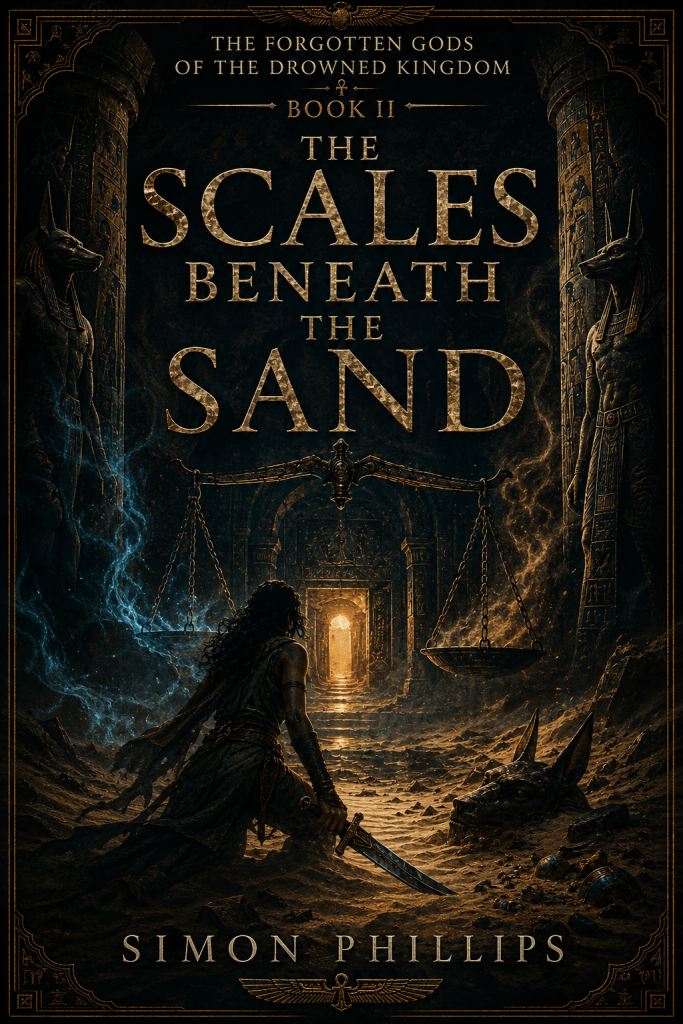
The Scales Beneath the Sand: Anubis, Tomb Routes, and Egyptian Mythic Fantasy


The City Beneath the City

A river city carries its dead differently.

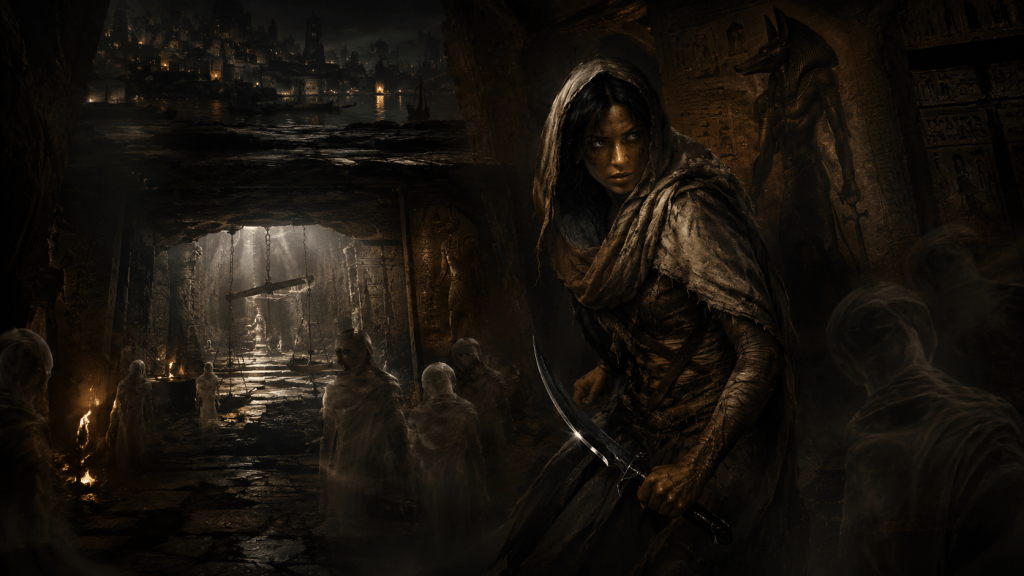
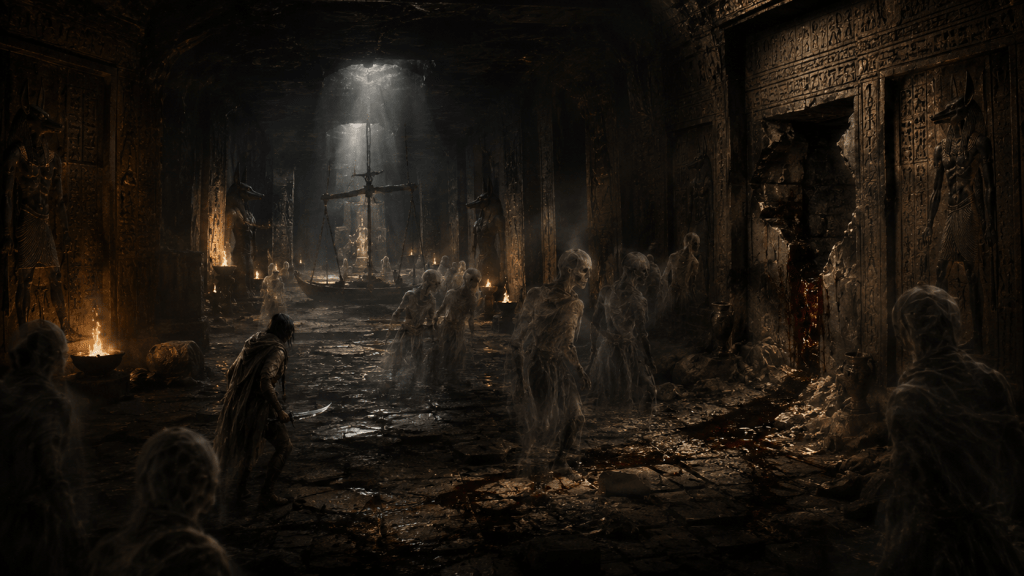
Above ground, life presses through the lanes in smoke, heat, fish-blood, old grain, cheap oil, medicine, shouted bargains, and the dull fatigue of people trying to make one more day hold together. Below those same streets, older systems remain. Tomb passages run beneath foundations. Faded shrines keep their painted eyes turned towards forgotten doors. Burial routes pass through stone chambers where the living once prepared the dead for their final journey.

That is where The Forgotten Gods of the Drowned Kingdom begins to deepen.

For readers drawn to Egyptian mythic fantasy, dark fantasy, and stories shaped by ancient gods rather than borrowed decoration, the river quarter matters as much as any temple or necropolis. It is where Neris lives. It is where she steals from tombs because medicine costs money, rent still comes due, and grief does little to feed a household. It is where the distance between sacred history and ordinary survival becomes painfully small.

Neris has already crossed a threshold that should have remained closed. She has returned carrying the uneasy sense that the dead can find her, that their unfinished burdens can gather at the edge of her thoughts, and that something in the dark has changed the shape of her life. She calls herself a bridge because the word gives her burden a use. A bridge joins two places. A bridge carries weight. A bridge does not need to ask who built it or why.

Yet every bridge can become a crossing point for something far more dangerous.

In The Scales Beneath the Sand, the second book in The Forgotten Gods of the Drowned Kingdom, the old routes beneath the river city begin to fail. Souls gather where they should pass cleanly. Sacred passages hold pressure where there should be release. The dead seem to hesitate before a crossing that has served them for generations.

That kind of wrongness belongs to more than haunting.

It belongs to interference.


When the Routes of the Dead Are Wounded

Tombs in Egyptian mythic fantasy should never feel like empty scenery waiting for an adventurer to enter them. They are architecture built around memory, judgement, ritual, identity, grief, and passage. A burial chamber holds the shape of the people who believed in it. A threshold carries the weight of those who crossed it before. A damaged shrine can become more than abandoned stone when its sacred purpose still remains close beneath the surface.

The buried spaces beneath Neris’s city work in that way.

They are not merely ruins. They are old systems of passage. Ferry chambers, weighing rooms, record houses, forgotten shrine courts, and narrow cut-stone ways still preserve the language of burial order. They remember what the dead are meant to do even when the living have stopped listening.

That makes the disturbance at the heart of The Scales Beneath the Sand more unsettling than an ordinary haunting. The dead are not simply restless. Their routes have been handled. Stone has been cut. Ash and blood have been worked into sacred spaces. Something has opened wounds inside the passages where the dead should move towards judgement.

The result is a form of underworld fantasy grounded in pressure rather than spectacle.

The danger begins in small signs. A spill of natron near a jackal-marked recess. Fresh blood in a place that should have been empty. A torn piece of blackened leather. Marks carved into old stone with enough force to make the sacred architecture itself feel violated. Neris follows those signs because she knows the human cost of walking away from something wrong. The dead follow her thoughts. Their fear becomes difficult to leave behind.

The city above continues unaware. People drink beneath reed awnings. Children cry in upper rooms. Fishmongers scrape scales into buckets as night settles over the quay. Yet underneath those ordinary lives, sacred order has begun to fracture.

That is where the hidden god-war first becomes visible.

Not through armies at a city gate. Not through gods tearing open the sky. Through the dead failing to rest.


Anubis at the Broken Threshold

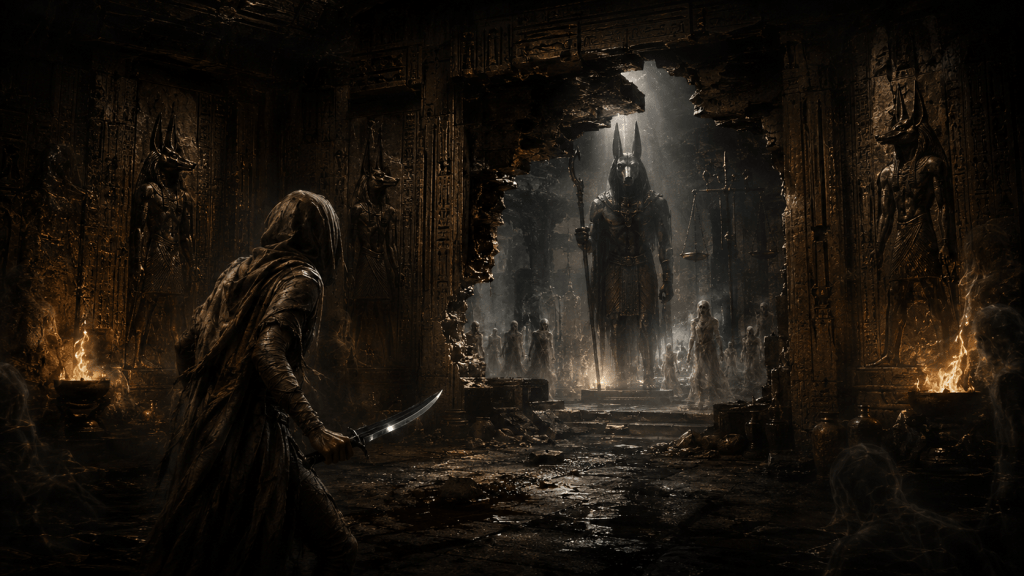
Anubis has always belonged at the edge of fear and judgement.

He is associated with tombs, funerary practice, embalming, the care of the dead, and the passage towards rightful judgement. His presence carries a particular weight because he is not simply a god of death. He stands at the point where death must be ordered, witnessed, and given its proper place.

That makes him a powerful centre for an Anubis fantasy story.

Neris’s connection to him offers no easy blessing. Her jackal talisman becomes a funerary blade only when the dead press too close or when a threshold has been disturbed. The weapon is intimate, cold, and made for narrow places. It belongs in stone corridors, flood-cut passages, old shrines, and the close terror of being unable to step far enough away from another person’s blade.

That distinction matters.

The divine weapon does not turn Neris into a polished fighter. She remains a survivor first. Her instincts come from tomb shafts, slum alleys, unstable stone, hidden routes, and the practical knowledge that escape can matter more than victory. She fights low, close, and desperately. She uses clutter, broken walls, ash, tight spaces, bad footing, and whatever the room gives her.

The funerary blade gives her a way to answer sacred wrongness. It does not erase fear from her body.

This is where the series separates itself from clean chosen-one adventure. Being marked by a god does not lift Neris above poverty, grief, injury, or uncertainty. It makes her visible to forces that already understand more about her than she understands about herself.

The burden comes first.

The meaning comes later.


The Hands Carrying the Gods’ War

The gods of The Forgotten Gods of the Drowned Kingdom do not begin by fighting openly.

Their conflict moves through human hands.

Chosen people carry relics shaped by divine domains. Their weapons reflect the gods who claim them. Their strengths are tied to endurance, discipline, training, fear, nerve, judgement, and the cost of surviving long enough to learn. That keeps the hidden war close to the body. Feet slip. Hands shake. Wounds open. Pride creates mistakes. A blade can be sacred and still fail in an untrained grip.

In The Scales Beneath the Sand, Neris learns that she is no longer alone inside this pressure.

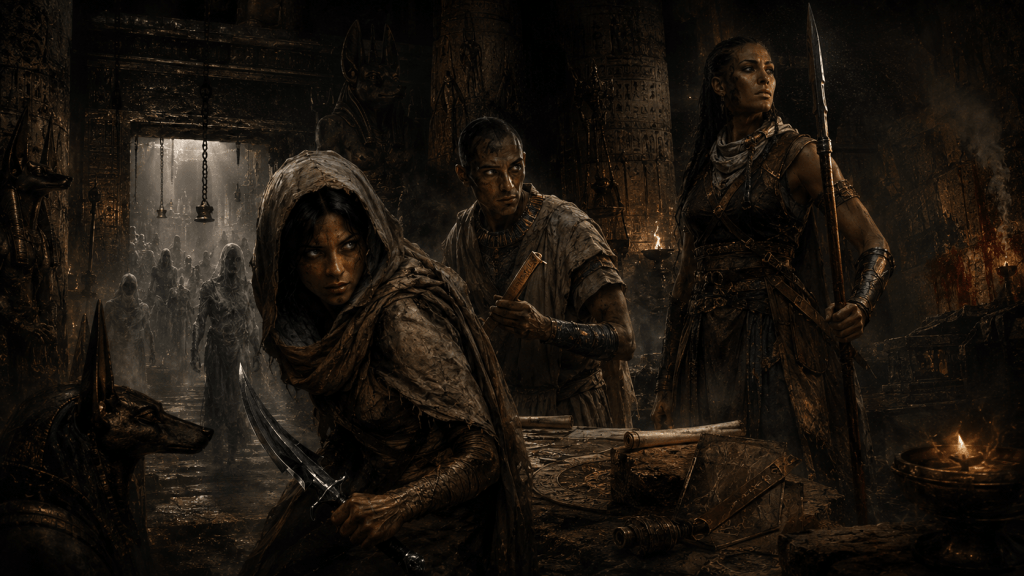
Khamet enters the story through record houses, burial tallies, ferry counts, ledgers, ink-stained fingers, and maps of disturbed passage. His relationship to the dead comes through pattern and reckoning. Where Neris feels the wrongness in her skin and breath, Khamet sees broken measure. He watches the numbers around burial, crossings, oils, and names begin to separate from one another, then follows the distortion towards something buried beneath the city.

He is useful almost immediately.

He is also irritating almost immediately.

Their early connection is shaped by distrust, exhaustion, sharp replies, wounded pride, and practical necessity. Neither gives the other comfort. Neither enters the other’s life gently. That matters because the war has no interest in providing safe companions at the right moment. It brings people together when pressure leaves them no cleaner choice.

Meretneith arrives from a different part of that same world.

She is a veteran chosen of Neith, shaped by martial discipline, old war knowledge, and the unsentimental truth that survival demands more than instinct. Her presence changes the scale of the story because she reveals what long experience looks like. Every movement has purpose. Every correction lands where it needs to land. Her weapon is an extension of training rather than a spectacle.

For Neris, that becomes its own kind of humiliation.

Surviving is not the same as knowing how to fight.

A hard lesson begins with the feet.


The Scales Beneath the Sand

The title The Scales Beneath the Sand reaches towards the deeper tension of the series. Scales suggest judgement. Sand suggests burial, erosion, time, and the slow concealment of what people once believed was secure. Together they point towards a world where sacred order has been buried so long that even those living above it may no longer know what holds their city together.

Neris enters that buried order carrying the wrong tools for a war she never chose.

She has a funerary blade, a sick mother, a body already marked by grief, and a life rooted in streets where every coin must be counted before it can be spent. The hidden conflict enters through those ordinary pressures. It reaches for her because she has been claimed, though the claim means danger long before it means understanding.

The story remains focused on tombs, thresholds, divine weapons, and the uneasy movement of the dead, yet its centre stays human. The fear is not only that a sacred route may break. The fear is that the break will climb. It will move upward through the stone, into the lanes, into the rooms where people sleep, and eventually towards the few fragile lives Neris still believes she can protect.

That is the real weight of hidden god-war.

It begins in the places no one thinks to watch.


When the War Learns the Road Home

The strongest ancient gods fantasy does not need to announce its scale at once.

It can begin with a single wound in old stone.

It can begin with dead souls gathering at a closed passage.

It can begin with a woman carrying medicine home through a river city, sensing that something beneath the streets has started to call her name.

The first signs are rarely grand enough for anyone above ground to notice. A lamp gutters in a shrine that has stood neglected for years. A burial tally fails to match the names written beside it. An offering bowl lies overturned where no living hand should have passed. In the dark beneath the quarter, old routes begin to tighten around the dead, holding them in places meant only for crossing.

By the time fear has a name, the damage has already travelled.

The Scales Beneath the Sand stands at that moment of widening pressure. Neris has moved beyond the lonely belief that she is only a bridge between the living and the dead. The hidden conflict has found her. Other claimed people have entered her path. A predator has tested her strength and seen where her life is weakest.

She still carries the same burdens she carried before the dead began to answer her. Her mother still waits in a narrow room. Medicine still costs more than she can spare. The river quarter remains full of damp walls, thin lamps, crowded lanes, and people trying to protect what little has survived another difficult day. The divine has entered her life, yet it has offered no escape from any of that.

Instead, it has placed those fragile things in danger.

The city remains standing. The temples have not fallen. The gods have not yet stepped openly into the streets. Their names still belong to shrine walls, old stories, ritual words, and the fears people carry quietly through the night.

Even so, the balance has shifted.

Something beneath the city has learned that sacred order can be wounded. Something has begun to test the routes of the dead, the people marked by old gods, and the living ties that make those people vulnerable. Neris has survived the first movement of that pressure, though survival has only brought her closer to the truth waiting beneath it.

The war begins before anyone understands its full shape.

It begins in tomb dust, river stink, jackal shadows, broken thresholds, and the silence left behind when the dead fail to rest.

It begins beneath the sand, where old scales still wait for something to be weighed.

The Mythic Chronicle: The Thing That Answered

A record of sound within the tunnels that did not echo, though returned in answer to those who entered


The Passage That Answered

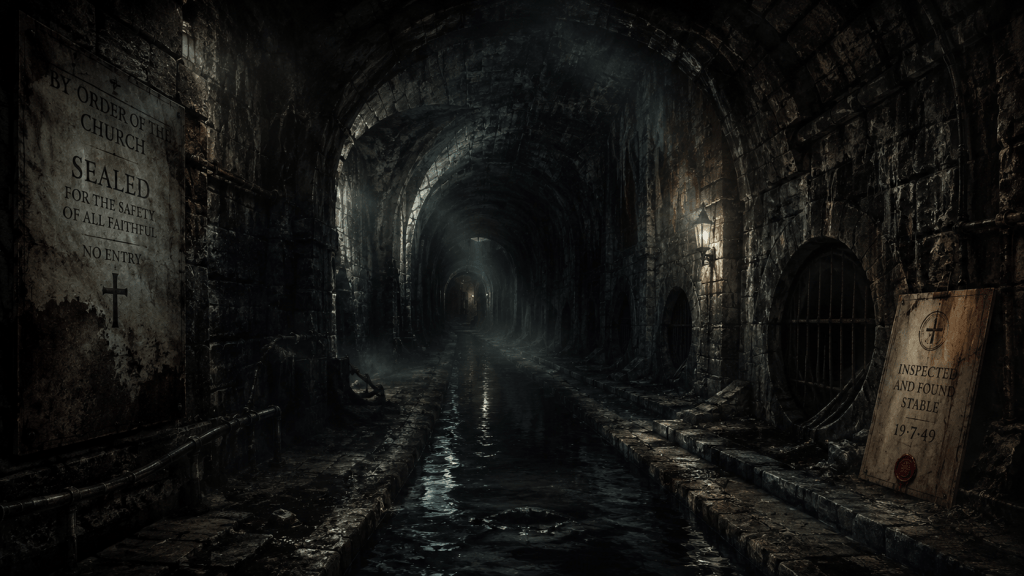
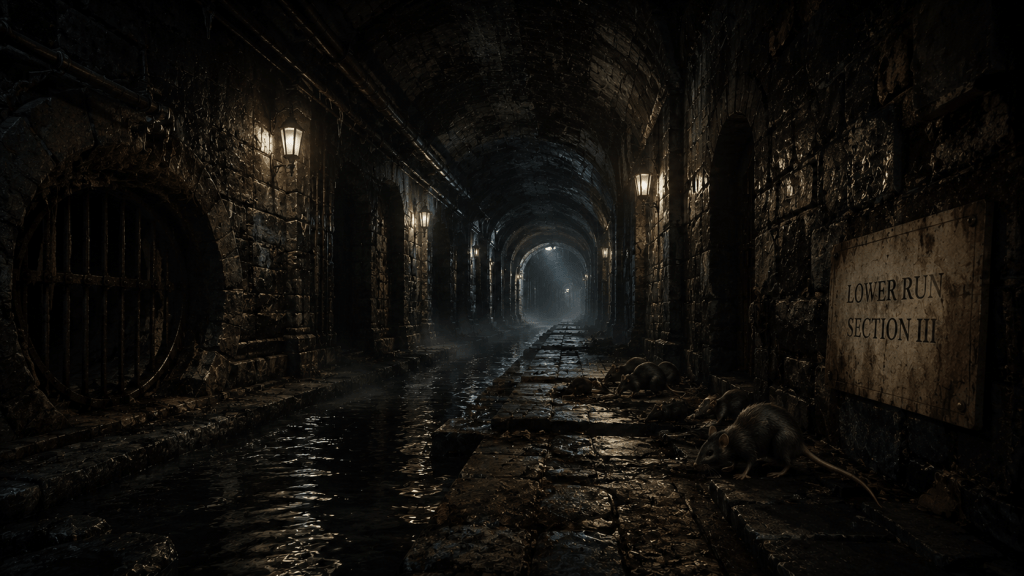
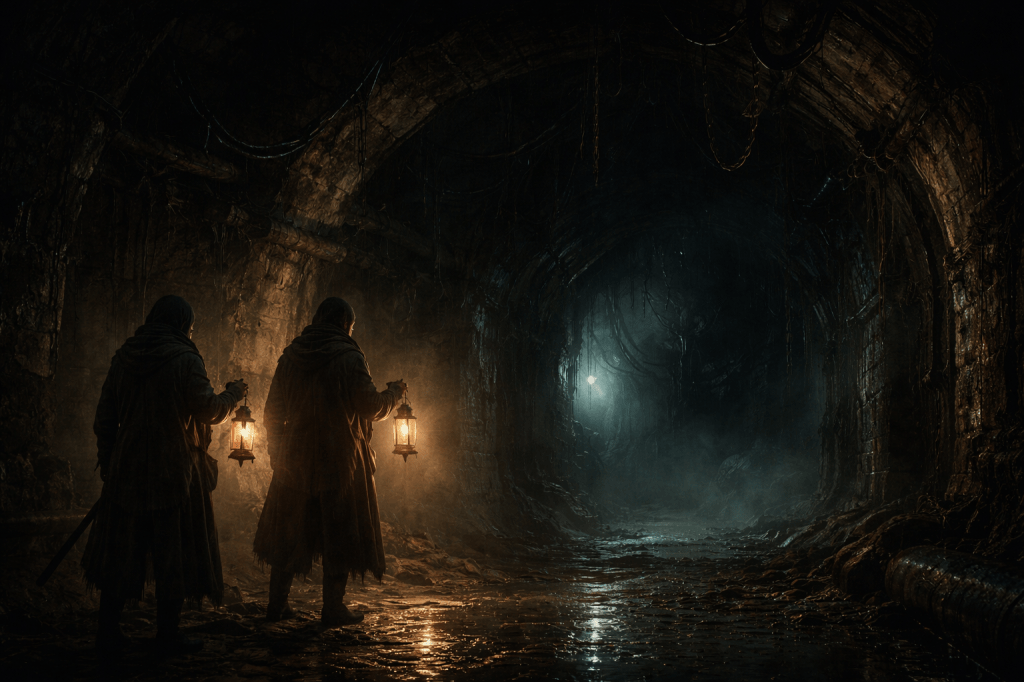
The passage had been entered in the record as a maintenance route, one of several that lay beneath the district and carried no distinction beyond their function. It formed part of an older network that predated the present structures, its course set through stone that had been opened and closed across successive years, though no single plan held its full extent. Those who worked along its length regarded it as ordinary ground, a place where sound travelled poorly and light settled close to the source, leaving the far sections to gather in shadow without depth or clear boundary.

On the morning it was first noted, two men were assigned to inspect a section where damp had been reported along the lower walls, the matter entered as a minor concern within the broader maintenance schedule. They carried a single lamp between them and a length of chalk for marking the points where repair would be required, moving at an unhurried pace through the narrow turn that led into the passage. Their attention was given more to the condition of the stone beneath their hands than to the space ahead of them.

“It ran further than the last plan showed,” the first said after a time, his voice held low as though the walls pressed it back upon him. “The turn should have come by now.”

The second lifted the lamp and let its light fall along the length of the corridor, where the walls drew in slightly before widening again, the line continuing without interruption. “The plans seldom match the ground,” he replied. “They follow what was set when the surface above was taken. This would have been left from earlier work.”

They continued on, marking the points where the stone showed signs of strain, their chalk passing in brief strokes across the surface before they moved on. The air held steady around them, cool and close, carrying a faint weight that settled after each step and returned to its place once they had passed, as though the space retained the shape of their movement before allowing it to fall away.

“It carried differently here,” the first said, pausing near a narrowing in the wall where the stone pressed inward. He rested his hand against the surface and held it there for a moment. “The sound sits lower.”

The second glanced back. “You hear your own step in these places,” he said. “It comes back from the turns.”

The first did not answer at once. He stepped forward and struck the wall lightly with the base of his tool, listening as the sound travelled into the stone and returned in a dull, contained form that held no echo beyond its point of contact. He struck it again, closer to the narrowing, and the sound carried further along the passage before settling.

“That was not the same return,” he said.

The second man set the lamp upon a ledge in the wall and leaned in to listen, his head angled slightly as he followed the path of the sound. “It carries along the length,” he said after a moment. “The wall opens beyond this point.”

The first struck the surface once more, this time with greater force. The sound travelled ahead of them and held for a moment before falling back. Within that brief space between the strike and its return there came a second sound, softer and set further along the passage, as though something within the stone had taken up the motion and given it back again in altered form.

They remained still.

“Did you hear that?” the first said.

The second did not reply at once. He lifted the lamp and stepped forward, holding the light out so that it reached further into the passage, though it revealed nothing beyond the same narrow stretch of stone. “Strike it again,” he said.

The first man did so, placing the tool against the wall and driving it forward with a measured blow. The sound carried ahead, clear and contained, and again there followed that second return, set apart from the first and delayed by a breath, its tone altered in a way that did not follow the shape of the corridor.

“It answers,” the first said quietly.

“It returns,” the second replied, though his voice held less certainty than before.

They moved forward together, their steps slower now, their attention drawn ahead of them where the light fell short. The air shifted as they advanced, the weight within it gathering slightly and then easing again, so that each movement seemed to meet a faint resistance before passing through.

The second man raised the lamp higher. “There is a junction ahead,” he said, though the light revealed no such division. “You can hear where the space opens.”

The first listened, though he could not mark the point where the corridor changed, only that the sound ahead carried a depth that had not been present before. He struck the wall once more, this time at the height of his shoulder. The sound travelled forward and returned, followed by that second response, closer now and more clearly set within the space beyond their sight.

“It came back to meet the sound,” he said.

The second man turned slightly, his gaze moving along the walls as though he might locate the source within them. “It follows the line,” he said. “There are channels set behind these sections. The sound carries through them.”

The first stepped closer to the narrowing and placed his ear against the stone. The surface held a faint coolness that stood apart from the air, and beneath that there lay a low vibration that did not align with the movement of their steps.

“Strike it again,” he said.

The second man hesitated, then did as asked, the tool striking the wall with a firm, controlled motion. The sound travelled into the passage, and for a moment it seemed to fade as before, though instead of settling it returned in two parts. The first followed the path already known, and the second emerged with a clearer shape, as though the sound had been taken up and set again with intent.

The first man drew back from the wall. “That is no echo,” he said.

The second lifted the lamp and held it steady, his hand tightening slightly around its handle. “There is no space ahead large enough to hold such a return,” he said. “It would show in the plans.”

The first gave a small nod. “Then it does not follow the plans.”

They stood in silence for a time, the lamp flame held steady between them, its light pressed close by the walls. The air gathered around their movement and settled again, and within that settling there remained a faint impression of the second sound, as though it had not fully passed from the space.

“We will mark this section,” the second said at last, though his voice carried the tone of a decision made to conclude the matter rather than to resolve it. He took up the chalk and set a small line upon the wall where the narrowing began. “It will be entered for further inspection.”

The first watched him for a moment, then turned back to the passage ahead. “Strike it once more,” he said.

The second man did so, though with less force than before, and the sound travelled forward and returned, followed by that second response, closer still and set at a height that did not align with the strike that had preceded it.

The first man spoke then, his voice held low within the space. “Who carries there?” he said.

The words settled into the passage and moved along it, their shape breaking slightly against the stone before returning, thinner and drawn out by the distance. For a moment there came no further sound, and the air held still around them.

Then, from further along the passage, there came a reply.

It did not take the form of words, though it followed the rhythm of speech, a low shaping of sound that rose and fell within the space ahead, carrying the same pattern as the voice that had preceded it, though altered in tone and set within a narrower range, as though it had been drawn through the stone before being returned.

The second man stepped back at once, his shoulder striking the wall as he turned. “There is someone ahead,” he said.

The first did not move. He stood where he was, his gaze fixed upon the darkness beyond the reach of the lamp. “No light shows,” he said.

“It could be set beyond the turn.”

“There is no turn marked here.”

The second lifted the lamp and held it higher, though the light fell short as before. “Call again,” he said.

The first man hesitated, then spoke once more. “Who stands there?” he said.

The words travelled forward and broke against the space, returning in their first form, and then again in that altered shape. The second sound followed with a delay that held too long to belong to the length of the passage.

The reply came again, closer now and with a clearer structure, though still without form that could be understood, its pattern aligned with the call that had preceded it and set within the same measure of sound.

The second man lowered the lamp slightly. “It repeats,” he said.

The first gave a small nod. “It answers,” he replied.

They did not advance further. The passage held before them, unchanged in its form, though altered in the manner in which it carried sound. The air settled around them once more, though it did not return to the same stillness it had held before their arrival.

“We will return this to the register,” the second said, his voice steadier now that the decision had been made. “It will be marked for survey.”

The first turned at last, though his gaze lingered for a moment upon the darkness ahead. “Mark it as you will,” he said. “It remains where it stands.”

They withdrew along the passage, their steps measured and their voices held low. The sound of their movement travelled behind them, returning in its usual form, though once, before they reached the turn, there came again that second response, faint and set at a distance that did not follow their retreat.

When they emerged into the broader corridor, the air shifted at once, the weight lifting from it as the space opened around them. The sound of their steps returned to its earlier pattern, carrying no second voice beyond their own.

The section was entered within the record as a matter requiring further inspection. The description held to the language of structure, referring to irregular sound return within a confined passage and noting the possibility of unseen channels within the stone. No mention was made of the reply that followed the call, and the matter was set within the register without expansion, its condition accepted within the limits of the space in which it had been observed.

The passage remained open for a time, and those who passed along it recorded no further irregularity, though one note referred to a moment in which a tool struck the wall and the sound returned with a delay that exceeded the expected length of the corridor, a detail entered without further comment.

The section was closed again following later works carried out along the adjoining structures, and the entrance was sealed in accordance with standard practice, its location marked only within the internal plans and its condition listed as stable.

No further reference appears within the primary record.

In later accounts, drawn from separate hands and gathered after the works had passed, there are brief mentions of sound within the lower passages that followed the shape of those who entered, returning in altered form and carrying the pattern of their movement ahead of them. These entries remain unconnected within the record and are set apart from the earlier inspection, their origin left without confirmation.

The passage holds its place beneath the district, its line set within the stone as it was before it was opened, and within it the air continues to gather and settle after each disturbance, returning to its earlier state. The sound within that space does not always follow the path it is given, and where it is carried forward it may return in a form that does not belong to the strike that set it in


Foundation Register: Lower Passage Acoustic Record

The passage entered within the lower district plans appears as part of a continuous substructure extending beneath adjoining properties, its course recorded across successive revisions with minor variation in length and alignment. Earlier entries refer to the corridor in practical terms, noting its function as a service route and its condition as stable, despite signs of prior sealing at several points along its length.

During routine inspection following reports of damp within adjacent structures, the passage was reopened for assessment, and initial observations were entered without distinction, referring to surface wear, minor shifts within the stone, and the need for limited reinforcement along sections where the wall had drawn inward. These entries hold to the language of maintenance and record no condition beyond those expected within enclosed substructures of this age.

Subsequent notes record irregularities in the behaviour of sound within the corridor, where impacts against the wall were observed to return in a manner that did not align with the known dimensions of the passage. Early descriptions refer to this as extended resonance, though later entries distinguish between the initial return and a secondary response set apart from it by a measurable delay.

In several accounts, the secondary sound is described as carrying the form of the original strike while failing to match its placement within the corridor, appearing instead at a distance inconsistent with the recorded length of the space. These observations are entered cautiously, with later revisions attributing the effect to concealed channels within the stone or to variations in the structure behind the visible surface.

A number of entries refer to instances in which spoken words were followed by a return that preserved elements of the original phrasing, though altered in tone and drawn through the structure before being heard. These notes remain limited in detail and are not expanded within the primary record, with several later annotations omitting reference to vocal response entirely.

Further examination records that the behaviour appeared more pronounced within sections where the passage narrowed or where the wall showed evidence of prior disturbance, though no consistent point of origin was identified. In these areas, sound is described as holding briefly within the space before returning in two parts. The second is set apart from the first by both timing and form.

The phenomenon was attributed to structural variation within the corridor and to the presence of voids or channels set beyond the visible surface, and no further inquiry was undertaken. The passage remained open for a limited period following inspection, during which additional observations were entered in reduced form, noting irregular sound return without elaboration.

A marginal notation, written in a later hand, refers to the behaviour as “a return that follows the voice rather than the wall”, a phrase set apart from the primary entry and left without further explanation. The notation appears once and is not repeated elsewhere within the register.

Final entries indicate that the passage was sealed following completion of adjacent works, and its condition was listed as stable within the internal plans. The acoustic irregularities were recorded as resolved through closure of the space, and no further observation was entered following its sealing.

The matter was entered as concluded within the register, and the passage remains recorded as a contained structure beneath the district, its condition accepted within the limits assigned to it and requiring no further attention.


About the Creator

The Mythic Chronicle is written and curated by Simon Phillips, a writer of mythic and speculative fantasy whose work explores the quieter edges of forgotten worlds, where buried structures, fractured records, and lingering presences continue beneath the surface of recorded history.

The accounts preserved within these Chronicles form part of a wider body of work in which cities stand upon older foundations, and events recorded as isolated disturbances are understood, in later tellings, to belong to patterns that were never fully recognised at the time.

One such account survives in a separate record, detailing an incident within a lower district where a death was first dismissed as excess, though the space in which it occurred retained a presence that resisted clearing, and where investigation revealed signs that the disturbance had not been confined to a single room.

This record is preserved in the novella Black Feathers in a Brothel, where the events surrounding that incident are followed more closely, though even there the full nature of what lay beneath the structure remains uncertain.

Readers who wish to examine that account in its fuller form may find the record below.

Explore the book:
Black Feathers in a Brothel

You can watch his YouTube channel here:
Author Simon Phillips


Continuation of the Record

What follows is drawn from later entries concerning the passage beneath the district, where sound was first noted to return in irregular form during routine inspection. Initial accounts record the behaviour in practical terms and attribute it to variation within the structure, though subsequent notes refer to repeated instances in which impact and voice were returned in altered form. Each occurrence is entered briefly and left without further inquiry. In several cases, the response is described as following the shape of the sound set into the space, though no source is identified within the passage itself. Each record concludes with the condition accepted within the limits assigned to it.

Subscribe to continue reading

Subscribe to get access to the rest of this post and other subscriber-only content.

Prince Patrick: The Reluctant Heir of Bremyra

In The Unmarked Path, the first book of The Veil of Kings and Gods, Prince Patrick begins in a place of uneasy authority.

He is not introduced as a king in waiting, nor as a prince hungry for power. He is third in line to Bremyra’s throne, shaped by tutors, court duties, and the quiet expectation that others would stand before him when history made its demands. His father, King Cedric, carried the crown. His elder brothers, Aric and Aiden, carried the future.

Patrick was meant to serve beside them, to advise, to support, to understand the workings of power without being forced to become its centre.

Their absence changes everything.

With the King and the twin princes gone beyond the familiar borders of the realm, Patrick is left at a desk that still feels like his father’s, answering petitions beneath banners that seem to remember stronger hands. The kingdom has not stopped to mourn their silence. Bremyra still requires judgement, diplomacy, restraint, and command. Each sealed letter and whispered report draws him deeper into a role he never sought, while the court watches to see whether the third son can hold steady beneath the weight of a crown that has not yet been placed upon his head.


A Prince Left at His Father’s Desk

Patrick’s first appearance places him at his father’s desk, surrounded by court proceedings, petitions, diplomatic letters, and the ordinary machinery of rule. The scene is quiet, yet it carries pressure from the beginning. Bremyra has not collapsed. The castle still functions. Servants still move through its halls, guards still hold their posts, and the court still expects decisions.

That is what makes Patrick’s position so difficult.

There is no grand ceremony announcing that power has shifted. There is no clean moment where he chooses the burden. Instead, responsibility gathers around him slowly, page by page, seal by seal, until the absence of his father becomes its own form of command.

The desk itself matters. It is more than furniture in this scene. It is the place where King Cedric once shaped the movement of the kingdom, where treaties were read, roads considered, disputes answered, and royal judgement turned into law. For Patrick, sitting there is not an act of possession. It is an intrusion into a space that still belongs to someone else.

Every object around him reminds him of that. The papers waiting for his seal, the chair beside him, the formal language of court proceedings, even the silence of the room all point towards the same truth. Bremyra has continued, but it has continued around an absence.

King Cedric and the twin princes have been gone too long. Their expedition beyond the known reaches of the old empire has fallen into silence, and the court cannot live on hope alone. Patrick feels that silence every time he sits in the chair that should not yet belong to him.

This is where his burden begins. Not on a battlefield. Not before cheering banners. Not with a crown lowered onto his head.

It begins in paperwork, in waiting, and in the uneasy knowledge that a kingdom still needs ruling even when the rightful voices have gone quiet.


Patrick is trained, intelligent, and capable, yet capability is not the same as certainty.

He understands statecraft. He understands alliances. He understands that kingdoms survive through careful balances rather than noble feeling alone. His education has prepared him to read treaties, weigh counsel, manage factions, and recognise the danger hidden inside polite words. Yet Book 1 catches him at the moment where knowledge begins to harden into lived responsibility.

Bremyra is not waiting for him to feel ready.

Arvendral stirs with uncertain intentions, offering the language of peace while its movements suggest something more cautious and dangerous. Vaeldring becomes vital through Elana’s arranged marriage, turning his sister’s future into part of Bremyra’s political survival. Thalosia presses its own designs upon Patrick’s future, reminding him that even his personal life is no longer fully his own.

Every alliance has a cost, and every delay invites danger.

Patrick must decide while still grieving absence. He must govern while wondering whether his father and brothers will return. He must listen to advisers who expect steadiness from him, even as he feels the shape of his own inexperience beneath every command. The court sees a prince at the centre of power, but Patrick feels the empty spaces around him more sharply than the authority in his hands.

He is forced to think not as a younger son waiting behind the true heirs, but as the man currently holding the centre of the realm together.

This is the quiet tragedy of his opening arc. He has inherited pressure without inheriting clarity, and the kingdom has begun asking him for the certainty that no one has given him.


Elana and the Human Cost of Royal Duty

Patrick’s bond with Princess Elana gives his story its human warmth.

Their conversations carry the ease of siblings who have known one another beyond titles, ceremony, and court expectation. Elana does not look at Patrick only as the acting ruler of Bremyra. She sees the brother beneath the office, the young man sitting at their father’s desk before he has fully learned how to bear its weight. Patrick, in turn, sees more in Elana than the court allows. She is not merely a princess to be sent towards Vaeldring, nor a name placed into marriage negotiations. She is his sister, perceptive, spirited, and quietly braver than many of the men who speak around her.

That makes her departure harder.

Her marriage to Vaeldring is not treated as decoration. It is political architecture. Through her, Bremyra reaches towards stability, alliance, and protection at a time when the kingdom cannot afford isolation. Through Patrick, the same pressure appears in another form, as Thalosia looks towards him as a future husband and political partner. Their lives are being shaped into bridges between realms, and those bridges are built from obedience, silence, and sacrifice.

For Patrick, Elana’s journey is both necessary and painful. He understands why she must go, yet understanding does not soften the loss. Her absence removes one of the few voices able to speak to him honestly, one of the few people who can meet his burden without turning it into performance.

Both siblings are being moved by the needs of the realm.

Neither is truly free.


Bremyra Beneath Strain

Book 1 presents Bremyra as a kingdom still standing, yet already under pressure from several directions.

The danger is not simple. It does not arrive through one army at the gate or one enemy declaring war. Instead, it comes through rumours, border tension, court unease, foreign movement, and unanswered questions. Patrick must govern inside that uncertainty.

The court watches him. The Church measures the arrival of the Order. The nobles depend upon him while also studying his weakness. Every decision he makes is made beneath the shadow of men who are absent and institutions that remain powerful.

Patrick’s strength in Book 1 is not certainty. It is endurance. He keeps sitting at the desk. He keeps answering. He keeps listening. He keeps choosing, even when every choice feels incomplete.


The Arrival of Simion

The arrival of Simion changes the shape of Patrick’s burden.

Until that point, Patrick’s problems, however heavy, still belong to the visible world of rule: letters, borders, marriages, missing family, restless neighbours, and a court that expects him to answer before he feels ready. Simion brings something different into Bremyra. He brings the Order with him, and the Order is not simply another political body waiting to be managed.

To the court, Simion is a magician, and that alone is enough to unsettle the air inside the castle. The Order does not stand beneath a crown in the way soldiers, servants, and councillors do. It carries older authority, colder memory, and laws of its own. Its presence reminds Bremyra that there are powers in Ældorra which do not bend easily to royal command.

Patrick senses this immediately.

He wants plain answers, yet Simion does not offer them. The magician speaks with restraint, carries himself with controlled distance, and seems to move through Bremyra as both guest and investigator. He has returned to a place he once knew, yet he does not belong to it in any simple way. That makes him difficult for Patrick to read. Simion is familiar and foreign at once, tied to childhood memory through Elana, yet shaped by an institution Patrick cannot fully trust.

His presence stirs different fears in different people. Elana remembers the boy from the kitchens and sees something human beneath the robes. The Church sees the shadow of the Order and answers with suspicion. Patrick stands between both responses, aware that Simion may be dangerous, useful, wounded, or all three at once.

That uncertainty matters.

Patrick is not naïve enough to dismiss the threat a magician might pose, but neither is he foolish enough to ignore what Simion represents. Bremyra’s dangers are widening beyond ordinary court business. Foreign attackers have begun to move where they should not. The silence surrounding King Cedric’s expedition has grown harder to explain. The old world, once safely buried in books and ruins, seems to be pressing closer to the present.

In that atmosphere, Simion becomes more than an unsettling arrival.

He becomes a question Patrick cannot afford to put aside.

That tension becomes one of the important relationships in Book 1. Patrick cannot fully trust Simion, but he cannot ignore him either. He needs answers, yet the man most likely to find them carries secrets of his own. The prince and the magician stand on opposite sides of old authority, crown and Order, yet both are being drawn towards the same gathering storm.

For Patrick, accepting Simion’s presence is not an act of comfort.

It is an act of necessity.


Patrick’s understanding of power changes during the ambush in Bremyra.

Until that moment, magic can still be kept at a distance. It belongs to the Order, to old stories, to political caution, and to the fear other people carry when a magician walks through the room. Patrick can study it as a matter of court risk. He can weigh Simion’s presence as a political complication. He can listen to the Church’s distrust and the council’s unease while still treating magic as something held beyond the ordinary shape of his duties.

Then foreign attackers strike inside Patrick’s own city, and all distance vanishes.

The attack is brutal, immediate, and personal. Patrick is no longer dealing with reports, rumours, or border movement. He is facing steel, strength, and death at close range, with the guards around him struggling to contain a threat that should never have reached him. The street becomes a place of sudden exposure. The prince who has spent his days behind desks, councils, letters, and guarded ceremony is forced into the raw truth of violence.

When Simion intervenes, Patrick sees magic not as theory, but as force.

There is no courtly veil around it. No ancient language softened by distance. No comfortable illusion that such power belongs safely inside the boundaries of the Order. Simion acts with speed and precision, and the world around Patrick changes in the space of a breath. The magician does not merely assist. He alters the outcome entirely.

It saves Patrick’s life.

It also unsettles him.

That is what makes the moment important. Patrick is grateful, yet he is too perceptive to be simple in his gratitude. He understands that the same power which protected him could terrify a court, silence a street, or reshape the balance between crown and Order if misused. He has seen something no council report could fully prepare him for: a man standing beside him who carries a kind of authority no prince can command in the ordinary way.

Patrick does not respond like a fool. He does not dismiss what he has seen, nor does he surrender blindly to it. He recognises the truth placed before him. Bremyra’s troubles may reach beyond ordinary politics, and Simion’s strength may be part of whatever answer the kingdom needs.

From there, Patrick’s relationship with Simion shifts. Gratitude enters the space between them. So does caution. So does necessity.

Patrick may not yet understand what Simion truly is, but he understands this much: Bremyra has stepped onto ground where steel, law, and royal blood may no longer be enough.


The Crown Begins Before the Coronation

Patrick’s arc in The Unmarked Path is not about becoming king in name. It is about the crown beginning to shape him before he is ready to wear it.

He is still a prince. He is still waiting for news of his father. He is still measuring himself against brothers who were meant to stand ahead of him. Aric and Aiden carry the image of succession more naturally in Patrick’s mind, while King Cedric remains the figure whose judgement should steady the realm. Yet their absence leaves no living hand between Patrick and the demands of Bremyra.

That absence becomes a kind of pressure.

Every petition placed before him reminds him that the kingdom cannot pause. Every council meeting asks him to speak with a confidence he does not fully feel. Every border report, marriage negotiation, and whisper from the court presses him closer to the shape of rule. He is not crowned, yet already he is being tested by the crown’s demands.

That is where his story gains its weight.

Patrick does not have Simion’s magic. He does not have Týrnan’s warrior certainty. He does not carry Elana’s hidden brilliance in the same way. His burden is different. He must stand in rooms where everyone wants something. He must listen to soldiers, priests, councillors, nobles, and foreign powers, knowing that each voice carries its own fear, ambition, or concealed truth.

He must make choices with incomplete knowledge. He must protect a kingdom that may already be part of a much older conflict. He must learn that leadership is not always a matter of bold speeches or battlefield glory, but of remaining steady while the world quietly removes every certainty around him.

Patrick’s strength in Book 1 is not triumph. It is endurance under scrutiny. He continues to sit at the desk, answer the summons, weigh the reports, and hold the centre while forces greater than one prince begin to move around Bremyra.


Why Patrick Matters in Book 1

Patrick matters because he gives the opening story its political heart.

Through him, Bremyra becomes more than a backdrop. It becomes a living kingdom, full of fragile alliances, absent rulers, cautious advisers, religious authority, old loyalties, and roads that no longer feel safe. His chapters show what happens when ancient danger begins pressing against ordinary governance, not through prophecy alone, but through letters, councils, rumours, borders, and the silence left by those who should have returned.

He stands between the personal and the political. Elana’s future is not only his sister’s sorrow, but part of Bremyra’s survival. Simion’s arrival is not only the return of a childhood memory, but a threat to the balance between crown, Church, and Order. Every private fear Patrick carries is mirrored by a public consequence waiting beyond the chamber door.

The wider world may be turning towards magic, invasion, and divine memory, but Patrick’s struggle remains deeply human.

He is tired.

He is uncertain.

He is watched.

And still, he must rule.


The Reluctant Heir

By the end of Book 1, Patrick has not solved Bremyra’s troubles. He has not uncovered the full truth of the foreign attackers, his father’s disappearance, or the strange forces gathering around Simion. What he has done is survive the first testing of his authority, and that survival matters.

He has seen that danger can reach him inside his own city, slipping through streets he believed protected by law, guard, and stone.

He has seen that Simion’s power may alter the fate of Bremyra, not as distant legend or court rumour, but as a force standing beside him when steel comes too close.

He has seen that Elana’s path is far more fragile than politics allowed him to believe, and that royal duty cannot always protect those it claims to serve.

Most of all, Patrick has begun to understand that rulership does not arrive with certainty. It arrives through pressure, through fear carefully hidden, through decisions made before every answer is known. His father’s chair remains too large for him, yet the kingdom has already begun looking to him as though he belongs there.

The crown is not waiting politely in the future.

It is already pressing its weight into his hands.

The Unmarked Path begins the first movement of The Veil of Kings and Gods, a fantasy series of political pressure, ancient magic, divine silence, and the people caught at the edge of forces older than kingdoms.

The Mythic Chronicle: The Mark Beneath the Plaster

A record of markings uncovered within the walls, where a repeated form emerged through the surface and was obscured before it could fully be set.


The Wall Beneath the Surface

The work began in the early light, when the lane still held the damp of night and the first carts had yet to pass in full measure. A grey wash lay across the stone, and the walls carried a quiet that belonged to that hour alone. The section marked for repair showed a faint bowing along its length, a shallow swell that caught the eye once it had been seen. Such strain appeared in many places across the district, drawing little attention and passing into the day as ordinary labour.

Two men arrived with their tools in a shallow crate and a bucket for the broken plaster. They set their things down with care and stood before the wall, weighing its condition through habit more than thought. The older man ran his thumb along the surface where the plaster had begun to lift, feeling for the give beneath it, while the younger watched in silence, his gaze fixed upon the same line.

“It has taken the damp,” the older man said, his voice low in the stillness. “You can see where it has lost its hold.”

The younger stepped closer, his shoulder brushing the timber beside the wall. He leaned in and pressed his palm lightly against the surface. “There is something beneath it,” he said. “It carries through the layer.”

The older man gave a quiet breath through his nose. “Everything carries through when you stand close enough,” he replied. “Take the edge to it. It will come away.”

The first strike broke the surface with a dull crack. A thin section of plaster loosened and fell, splitting as it struck the floor. Dust rose in a brief cloud and settled again with a weight that held close to the wall, and the air took it in and kept it there.

They worked in a steady rhythm, each strike loosening another piece, each piece falling into the bucket or onto the growing scatter at their feet. The sound travelled along the lane in a muted way, held within the narrow space and softened by the walls that contained it.

“It is thinner here,” the younger man said after a time. He lifted a larger section free and let it fall aside. “There is less behind it than I would expect.”

The older man stepped forward. “Move aside,” he said, and the younger shifted without question. The tool pressed into the exposed layer and met a resistance that felt wrong in the hand, giving in a way that did not follow the pressure placed upon it.

He drew the tool back and leaned closer, his eyes narrowing as he studied the surface. “This has been worked before,” he said.

“What do you see?” the younger asked.

The older man ran his fingers across the exposed section. “Feel the line,” he said.

The younger hesitated, then placed his hand where the other had indicated. The surface held a faint unevenness that crossed the grain of the wall, resisting the skin in a subtle way, as though the mark had been set against the structure instead of within it.

“It has been cut,” the younger said.

“Or pressed,” the older replied. “The edge tells little from this.”

They cleared more of the surface, working outward from that point. The plaster came away in larger pieces now, revealing a broader stretch beneath. The marks grew clearer as the wall opened, lines emerging where no sign had shown before.

At first they appeared irregular, and the younger took them for scoring left by earlier work, while the older remained silent as more of the wall was revealed. The lines began to return upon themselves, crossing and curving in a way that suggested intention. A form lay within them, though it resisted being held in the eye.

The younger stepped back and looked at the exposed section. “That is no accident,” he said.

The older man stood with him and took in the surface as a whole. “It carries a pattern,” he said after a moment. “Though it refuses to settle.”

“Then why was it covered?” the younger asked.

The older man glanced towards the lane, where the first cart passed with a slow roll of wheels. “Because it stood there,” he said. “And someone chose to place it out of sight.”

The younger studied the lines again. “It feels unfinished,” he said.

The older gave a small nod. “Many of the strokes end too soon,” he said, “and others cut across them after.”

Several lines broke at their edges, the tool lifted before the stroke could carry through, while other lines crossed those breaks, drawn with a different hand or at a different time. The surface held the marks in layers, each one disturbing the last.

“It has been changed,” the younger said.

“It has been returned to,” the older replied.

They stood in silence for a short while. The lane had begun to wake, voices carrying in low tones from further along the street. Within the room, the dust settled in a way that seemed to cling to the wall itself, as though it found purchase there.

“We will clear it through,” the older said at last. “There is no purpose in leaving it half exposed.”

They returned to the work, though their pace had shifted, each strike coming with greater care and each section lifted with attention. The pattern extended as the wall opened, repeating across the surface in broken forms.

“It carries the same turn,” the younger said. “Here, and again along this edge.”

The older traced the curve with his eye. “It echoes itself,” he said, “though each instance fails to complete.”

Where a line might have closed, another cut through it, and where a shape might have formed, it had been disturbed. The surface resisted completion.

“It never settles,” the younger said quietly.

The older gave no answer. He set the tool aside and stepped back once more, taking in the whole of the exposed section.

A third man entered then, drawn by the sound. He stood in the doorway for a moment before crossing into the room, his gaze fixing upon the wall at once.

“You have uncovered something,” he said.

“Old work,” the older replied, his tone even.

The third man stepped closer. “That carries intention,” he said. “It was placed.”

“It will be covered again,” the older said.

The third man followed the lines with his eyes, his expression tightening slightly. “Who set it there?” he asked.

“No record remains,” the older replied.

The younger looked between them. “Should it be entered?” he asked.

The third man remained silent for a moment, his gaze moving along the broken lines and tracing their repetition. “It has already been addressed,” he said at last.

“How can you be certain?” the younger asked.

He gestured towards the surface. “You can see where it has been struck through,” he said. “Someone attempted to remove it.”

“And left it incomplete,” the younger said.

“Or found no end to the work,” the third man replied.

The older man lifted his tool again. “Our concern rests with the surface,” he said. “We return it to its place.”

The third man stepped back, though his attention lingered on the wall. “You will set it over as it stands?” he asked.

“As it was found,” the older said.

“And if it shows again?”

The older struck the wall once more, the sound sharp and contained. “Then it will be set again,” he said.

The third man gave a small nod and moved towards the door. He paused there and looked back once more at the exposed section before stepping out into the lane.

The work carried on. The final sections of plaster were removed, and the wall lay open across its width. The pattern held throughout, broken and repeated, never resolving into a complete form.

When the clearing ended, they stood back from it.

“That is the full extent,” the younger said.

The older gave a brief nod. “Enough has been seen.”

“And enough left beneath,” the younger added.

The older took up the fresh mix and pressed it against the wall. He worked in long, even strokes, smoothing the surface over the exposed lines. The pattern disappeared beneath the new layer at once, drawn out of sight as though it had never held the wall.

The younger watched for a moment, then took up his own tool and joined the work. Together they set the surface until it lay flat once more, the wall restored to its earlier state.

When they stepped back for the final time, no trace of the marks remained.

“It will hold,” the older said.

“For a time,” the younger replied.

The older set his tools aside. “That is all that is ever required.”

They gathered their things and left the room as they had found it, the wall newly set and the surface clean. The lane had taken on the full movement of the day, voices and wheels passing in steady rhythm.

Behind them, the plaster began to dry. Beneath it, the lines remained where they had been, held within the wall in their broken form, unchanged by the covering placed over them, and waiting where no eye could follow.


Foundation Register: Inner Wall Restoration Record

The section of wall recorded within the adjoining structures appears in district plans as part of a continuous interior surface shared between several properties, its construction formed through layered plaster applied across older stone and timber. Earlier revisions note minor repairs carried out across successive years, though no distinction is made concerning the portion later subject to restoration.

During routine maintenance following reports of surface strain, sections of plaster were removed to expose the underlying layer. Initial entries describe the condition in practical terms, referring to weakened adhesion and the need for replacement of compromised material. These observations were entered without indication that the work extended beyond ordinary repair.

Subsequent notes record the presence of markings beneath the removed surface, where lines were observed within the underlying layer in a form that did not align with known structural scoring. Early descriptions refer to the markings as irregular, though later entries note a repeated arrangement of lines across separate sections, each instance incomplete and partially obscured.

Further examination records that the lines appeared to have been altered after their initial placement, with sections broken or cut through by later marks. In several entries, the surface is described as holding multiple layers of disturbance, suggesting that the markings had been revisited more than once, though no record identifies the origin of these alterations.

The markings were attributed to earlier repair work or to residual scoring within the structure, and no further inquiry was undertaken. The exposed sections were covered during the course of restoration, and the surface was returned to its prior condition through application of fresh plaster.

A marginal notation, written in a later hand, refers to the markings as “a form interrupted within the wall”, a phrase set apart from the primary entry and left without expansion. The notation appears once and is not repeated elsewhere in the record.

Final entries indicate that the restoration was completed without complication, and the wall was listed as stable within the register. No further observation was recorded following the covering of the markings, and no connection was made between this discovery and earlier conditions noted within adjoining structures.

The matter was entered as resolved through restoration of the surface, and the record concludes with the structure accepted as sound, its condition requiring no further attention.


About the Creator

The Mythic Chronicle is written and curated by Simon Phillips, a writer of mythic and speculative fantasy whose work explores the quieter edges of forgotten worlds, where buried structures, fractured records, and lingering presences continue beneath the surface of recorded history.

The accounts preserved within these Chronicles form part of a wider body of work in which cities stand upon older foundations, and events recorded as isolated disturbances are understood, in later tellings, to belong to patterns that were never fully recognised at the time.

One such account survives in a separate record, detailing an incident within a lower district where a death was first dismissed as excess, though the space in which it occurred retained a presence that resisted clearing, and where investigation revealed signs that the disturbance had not been confined to a single room.

This record is preserved in the novella Black Feathers in a Brothel, where the events surrounding that incident are followed more closely, though even there the full nature of what lay beneath the structure remains uncertain.

Readers who wish to examine that account in its fuller form may find the record below.

Explore the book:
Black Feathers in a Brothel

You can watch his YouTube channel here:
Author Simon Phillips


Continuation of the Record

What follows is drawn from later entries concerning the restored wall within the adjoining structures, where the surface had been removed and set again in the course of ordinary repair. The markings beneath were entered at first in practical terms and attributed to prior work within the structure. Subsequent notes refer to the repeated appearance of similar lines across separate sections, each instance incomplete and each returned to concealment without further inquiry.

Subscribe to continue reading

Subscribe to get access to the rest of this post and other subscriber-only content.

Who Is Simion? The Reluctant Magician at the Heart of The Unmarked Path

Every epic fantasy needs a doorway.

Sometimes that doorway is a battlefield. Sometimes it is a throne room, a prophecy, a blade drawn under stormlight, or a kingdom already burning beneath the weight of war.

In The Unmarked Path, the doorway is quieter.

It opens with Simion, a magician of the Order, arriving in the cold coastal kingdom of Bremyra beneath a winter sky. He comes dressed in the black robes of an institution feared across the realm, carrying the authority of ancient magic and the uncertainty of a man who has never fully believed he belongs among those who wield it.

That tension is where his story begins.

Simion is no simple fantasy hero waiting for applause. He is no flawless master of the arcane, no proud champion striding into the world with certainty burning in his hands. He is weary, observant, guarded, and deeply human. He has been trained by the Order of Magicians, shaped by discipline and expectation, yet his place among them has always felt uneasy. Magic answers him in strange ways. Some simple things resist him, while darker and older powers seem to recognise him before he recognises himself.

That makes him dangerous.

It also makes him compelling.


A Magician Who Feels Out of Place

The Order of Magicians stands as one of the great institutions of Ældorra. It is old, powerful, and shaped by a history most of the living world only half-remembers. Its members are trained in discipline, ritual, incantation, and obedience. They carry an authority separate from kings, priests, and ordinary law.

Simion has passed through that world. He has learned its rules. He wears its robes.

Yet from the beginning, he feels like someone standing at the edge of his own life.

He has never been entirely comfortable among magicians who treat power as rank. At the Academy, he struggled where others advanced easily. He lacked the arrogance that often comes with mastery. His gifts seemed uneven, almost unreliable, as though the magic within him moved by some older rhythm than the lessons placed before him.

That uncertainty matters.

Simion begins the story believing himself ordinary by the standards of the Order. Skilled, perhaps. Capable enough to be useful. Still, he sees himself as a man chosen for duty, not destiny. He obeys because obedience is familiar. He studies because study is safer than instinct. He observes because action carries consequences he rarely feels ready to command.

The tragedy and beauty of Simion is that the world has already begun to move around him before he understands why.


Bremyra and the Weight of Return

When Simion arrives in Bremyra, he enters more than a kingdom under political strain. He returns to a place tied to his own buried past.

Before the robes, before the Order, before the careful distance he now keeps between himself and others, Simion once knew Bremyra through smaller rooms, warmer memories, and the overlooked spaces of castle life. He was once close enough to the royal children to carry echoes of childhood mischief, laughter, and belonging.

Years later, he returns as Lord Magician.

That title changes everything.

The servants fear him. The court watches him. The Church distrusts him. Patrick measures him with the caution of a prince carrying too many burdens. Elana remembers the boy beneath the robes, and that memory unsettles him more than suspicion ever could.

This is one of the strongest tensions in Simion’s character. He is treated as a figure of power, yet part of him still remembers being powerless. He is feared by people who once might have ignored him. He is addressed with reverence in halls where he once moved unseen.

Bremyra forces him to confront the distance between who he was and who the world now believes him to be.


The Mission Beneath the Surface

Simion’s official presence in Bremyra carries a polished explanation. He is there to observe, advise, and assist if needed. That is the surface truth presented to the court.

The deeper truth is more troubling.

Three magicians of the Order vanished in connection with King Cedric’s expedition and investigations into remnants of the ancient Imperium Arcana. Simion has been sent to uncover what happened. His task places him at the centre of a dangerous triangle: the Order, the royal household, and the Church.

Every question he asks risks offence. Every answer he finds may damage the fragile balance of the kingdom. If the missing magicians were betrayed, the consequences could reach far beyond Bremyra. If the Order is wrong, then Simion has arrived as a quiet threat inside a court already strained by absence, politics, and approaching war.

This gives his role a constant unease.

He is adviser and investigator. Guest and watcher. Servant of the Order and reluctant participant in royal life. He stands close enough to Patrick to earn trust, close enough to Elana to awaken old feeling, and close enough to hidden history to disturb forces that were meant to stay buried.


A Power Beyond the Lessons He Was Taught

The heart of Simion’s story lies in the gap between learned magic and something older.

In the world of The Veil of Kings and Gods, magic is structured. Magicians speak Flow. They shape power through words, training, and controlled forms. The Order teaches magic as discipline. It gives names to the currents of the world and expects its students to follow them.

Simion’s magic begins to move differently.

At first, these moments are subtle. A sealed book responds to him. Runes stir beneath his hands. Power gathers in silence, where silence should carry no spell. He feels forces he has no language for, forces that seem to reach past the laws of the Order and into the buried bones of the world.

This does not make him triumphant.

It frightens him.

That fear is important. Simion is powerful, yet he is also careful. He does not rush towards glory. He does not understand what has awakened around him. The old structures that shaped his life offer little comfort once his own magic begins to break their rules.

He begins to realise that the Order may have taught him how magic behaves, while something far older may be showing him what magic remembers.


The Hidden Book and the Call of the Seal

One of the defining images of The Unmarked Path is the hidden book beneath Bremyra.

Simion is drawn into the castle’s depths by whispers and old magic, where the familiar world of court duty, council suspicion, and royal politics gives way to something older. Beneath the halls where princes argue, priests watch, and servants move through their ordinary routines, another Bremyra waits in the dark. Its stones remember an age the kingdom has forgotten, and in that buried chamber, the past begins to reach for him.

At its centre waits an ancient book protected by a weave he does not understand.

The book is more than an object. It is a threshold.

It belongs to the part of Ældorra that survived in ruins, buried rooms, sealed warnings, and fragments of divine memory. It represents everything Simion cannot yet name: hidden history, forgotten magic, divine pressure, and the unsettling sense that his life has been touched by something older than the Order. The magicians who trained him taught rules, forms, and discipline. The book offers none of those comforts. It gives him no easy explanation, no clear command, no gentle revelation. It simply waits.

That waiting is what makes it powerful.

When the warning comes, it arrives in fragments. The seal weakens. The burden waits. The path will reveal itself only when its weight is accepted. There is no grand ceremony, no clean answer, and no voice kind enough to tell Simion exactly what he has become part of. The moment feels less like discovery and more like inheritance, as though something ancient has finally found the one person able to hear it.

For a man who has spent much of his life feeling uncertain of his place, this is devastating.

Simion wants understanding. What he receives is responsibility.

He wants answers. What he receives is a sealed path.

He wants control. What he receives is a mystery that responds to him in ways no ordinary magician should be able to explain.

That is why the hidden book matters so deeply to his story. It marks the point where Simion’s life begins to move beyond the limits of the Order. He can still pretend, for a time, that he is only an advisor, only an investigator, only a magician sent to Bremyra under orders. Yet the book has already changed the shape of the world around him. It has placed a quiet hand on his fate.

From that moment onward, Simion is no longer searching only for missing magicians.

He is searching for the truth of magic itself.

And the deeper he follows that truth, the more dangerous the path becomes.


Elana and the Human Thread

Simion’s story would lose much of its force if it only moved through magic, prophecy, and ancient danger.

Elana gives his arc its human warmth.

She remembers him before the title, before the robes, before the fear others attach to him. Her presence cuts through his formal distance, drawing forward traces of the boy he once was. She is bold, perceptive, and unafraid in a way few people around Simion are. Where others see the Order, she sees the man beneath it.

Their connection is layered with memory, restraint, duty, and danger. Elana is bound to royal obligation. Simion is bound to the Order. Neither of them moves freely, and that makes every exchange carry more weight than open confession could.

Through Elana, Simion is reminded that he is still human. He can still be seen. He can still be unsettled by kindness. He can still feel the pull of a life beyond duty, even as darker forces gather around him.

That matters because Simion’s greatest conflict is not simply whether he has power.

It is whether power will leave enough of him behind to love, fear, hesitate, and choose.


Why Simion Matters to the Saga

Simion matters because he stands at the meeting point of several forces that shape The Chronicles of the Spiral Realms.

He belongs to the Order, yet his power challenges its laws.

He enters Bremyra as an outsider, yet his past ties him to its royal family.

He seeks missing magicians, yet finds traces of something divine.

He believes he is following instructions, yet the world around him begins to move as though history has taken notice.

That is the kind of character who can carry a long fantasy saga. Not because he knows all the answers, and not because he rushes towards destiny with a raised blade. He matters because he is uncertain in the face of forces that demand certainty. He matters because he resists becoming the thing others expect him to be. He matters because the power awakening around him is vast, yet the emotional core of his story remains intimate.

He is a man caught between institutions, kingdoms, memory, and magic.

He is also the first sign that the forgotten history of Ældorra has begun to return.


The Story Begins With The Unmarked Path

The Unmarked Path is the opening book of The Veil of Kings and Gods, set within The Chronicles of the Spiral Realms. It begins a slow-burn epic fantasy saga of forbidden magic, ancient gods, royal duty, political tension, hidden histories, and divine silence.

For readers who enjoy mythic high fantasy with atmosphere, mystery, and character-driven tension, Simion’s story offers the first step into a much larger world.

He does not begin as a hero.

He begins as a magician sent to Bremyra under orders he barely understands.

Beneath the castle stones, something waits.

Above him, gods remain silent.

Around him, kingdoms begin to shift.

And somewhere within the sealed places of the world, the Spiral begins to turn.

The Unmarked Path is available now on Amazon Kindle.

The Mythic Chronicle: The Clerk Who Folded Inward

A record of a death where the body settled against itself, and the room retained a stillness that did not pass with breath or with time.


The Record of the Upper Chamber

The room stood above the lane where the evening light lingered longest, its windows set high above the street and its shutters drawn back just enough to admit the last of the day. What entered passed across the floor in a narrow band, touched the foot of the bed, and faded slowly into the dimness, while the chamber held to itself with a quiet reserve that seemed older than the house around it.

The man who had occupied it kept his surroundings in a way that spoke of habit more than comfort. Papers rested in measured piles upon the table, each set bound with cord drawn tight and turned once more through the knot for certainty. The chair stood close to the table’s edge, its legs worn in the same places by years of being pulled back and returned. The coverlet upon the bed had been smoothed in the morning, and a coat still hung from the peg beside the door as though the next hour had been expected to proceed as every other hour before it.

When the room was opened after his death, those who entered remarked first upon the stillness that lay inside it. It settled against the body and held there, deepening the breath and slowing the step, until even the smallest movement seemed to travel farther than it should.

“You felt it as you came in,” said the woman who stood just inside the threshold, her voice lowered by the space before she seemed aware of it. “It presses upon the chest.”

The constable remained with one hand upon the latch for a moment longer, as though the act of releasing it required more thought than usual. The air gathered around him with a quiet weight, and his first breath within the room drew shorter than the one he had taken in the passage.

“It is close in here,” he said at last. “The window should have eased it.”

“It stood open when they found him,” the woman replied. “They left it so for most of the night.”

He stepped fully inside and allowed the door to rest behind him, while the floorboards received his weight with a low creak that seemed to drift thinly through the chamber before settling into the walls. He gave his attention to the bed first, then to the window, then to the table, as though the proper order of ordinary things might restore the room to reason.

“Who found him?” he asked.

“A neighbour from the next house,” she said. “He came for a ledger that had been promised and never brought down.”

“And the state in which he was found?”

She paused then, her eyes returning to the bed with the same reluctance they must have carried the first time. “He had fallen,” she said, “though the form of it carried little of an ordinary fall.”

The constable moved nearer, each step measured and deliberate. The sheets had been drawn back after the body was taken away, though an impression remained in the fabric. It ran inward in a shape that troubled the eye, as though the weight that had made it had folded towards itself before it came to rest.

He stood over it for some moments in silence. The evening light had weakened by then, and the room seemed to hold more of its own dimness than the hour should have given it.

“There is no sign of struggle,” he said.

“None was spoken of,” the woman replied.

“No cry heard through the wall?”

“None that anyone would swear to.”

He bent slightly and held his hand above the sheet, close enough to feel the air gathered there. His expression altered in a way so slight another man might have missed it, though the woman at the door saw it clearly and lowered her gaze.

“It holds itself,” he said quietly.

“It returns,” she answered.

His eyes moved to the window again. The shutters remained open, and a faint current entered from the lane outside, carrying the last sounds of trade and passage below. That air entered the room and weakened within a few feet, as though the chamber accepted it only to set it gently aside.

“You kept the room open after he was found,” he said.

Yes.”

“And the air changed?”

“For a little while.”

He turned away from the bed and crossed to the table. The wood felt cool beneath his palm, and the papers upon it remained aligned with the care of a man who had expected to return to them. He lifted the edge of one packet and let it rest again, the slight sound of cord against paper carrying thinly through the room.

“He had been working,” he said.

“He always worked at that hour.”

“And then crossed to the bed.”

“That is how it appeared.”

The constable studied the chair, then the space between chair and bed, then the bed again. “He rose of his own will,” he said.

“That is what the room suggests.”

He looked towards her then. “The room suggests many things.”

She received that without change. “It does.”

He moved back towards the bed and placed his fingertips lightly upon the sheet. The fabric yielded at once, though the air above it seemed to gather around his hand and hold there, as though preserving the memory of weight after the weight itself had gone. He withdrew at once and straightened, his fingers curling briefly before he let them fall.

“It settles over the bed more strongly,” he said.

“Yes.”

“And nowhere else?”

The woman’s gaze shifted towards the chair by the table. “It held there as well, on the first evening. Less now.”

He followed her look. The chair stood with one leg turned slightly inward, the smallest disturbance in an otherwise ordered room.

“He became aware of something,” she said.

The constable remained silent for a moment. Then he asked, “You speak as though you had seen it.”

“I saw the room after,” she replied. “At times that is enough.”

He accepted that with the reserved expression of a man who had learned that certain answers closed more doors than they opened. His attention returned to the walls, which held plain plaster above old timber, sound enough to the eye and giving no sign of breach or entry.

“There is no mark of another presence,” he said.

“No mark that would satisfy a ledger.”

That drew his gaze back to her once more. She stood with her hands folded before her, composed in the way of those accustomed to difficult rooms and the stories that gathered inside them. Her age was hard to place in the dimness. Her voice had the steadiness of one who had long practised the art of speaking plainly when others wished for easier versions of events.

“It will be entered as failure of the body,” he said.

“Yes,” she replied.

“The position in which he was found will be noted.”

“Yes.”

He glanced again at the bed, then at the chair, and the stillness within the room seemed to draw closer, as though it heard and waited. “There will be no advantage in saying more than that.”

“There rarely is.”

The light had faded enough by then that the lamp in the passage cast a pale shape across the threshold. The constable went to the window and pushed one shutter wider, allowing more evening air to enter. For a brief moment the chamber eased, though the change remained slight and passed almost at once, the weight in the room settling back into its earlier form with a patience that carried something deeply unsettling in it.

He stood very still as that happened, and when he turned back his face had lost the last trace of practical certainty with which he had entered.

“How long has it remained this way?” he asked.

“Since the body was carried out.”

“And each time the room was entered?”

“It gathered again after every disturbance.”

The constable gave a slow nod and moved towards the door. He paused at the threshold, then looked back once more upon the bed, the table, and the ordered papers that would never be touched by the hand that had arranged them.

“Have the room closed,” he said. “There is little to be gained from leaving it open.”

“It will remain as it is.”

“I believe that.”

The woman stepped forward after he had passed into the corridor. She took one last look inside before drawing the door towards her. As it moved, the room seemed to gather itself more fully, the stillness deepening over bed and chair and table alike, while the dimness within held its place against the fading day.

When the latch settled, the chamber was shut again. Within it, the impression upon the bed remained, the papers waited in their ordered stacks, and the air drew inward once more into the same quiet state, patient and unchanged, as though it required no witness in order to hold what had occurred there.


Foundation Register: Lower Chamber Storage Record

The chamber recorded within the upper district plans appears as a private room set above the adjoining trade lane, its structure resting upon earlier timber and plaster whose alterations are noted across several revisions of the building. Surviving layouts refer to the space only in domestic terms, with no indication that it held any distinction beyond its use as a place of work and rest for its occupant.

During routine inquiry following a reported death within the room, entries began to note irregular conditions concerning the atmosphere of the chamber, where the air was described as holding its density beyond expected limits, and where the space failed to clear despite the opening of shutters and the introduction of air from the street below. These observations were recorded alongside the primary account and attributed to the enclosed nature of the room, as well as the materials of its construction and the arrangement of the surrounding structures.

Further entries describe the persistence of these conditions across repeated visits, noting that the atmosphere within the chamber appeared to settle into a consistent state after disturbance, returning to that state regardless of how long the room remained open. The effect was observed in each instance without variation, and no external source within the adjoining properties was identified that might account for the behaviour.

The death itself was entered in practical terms, with the position of the body recorded as having settled in a manner that did not align with an ordinary fall. This detail was included without expansion and was not pursued beyond its initial notation, the cause being assigned to failure of the body under strain.

A marginal notation, written in a later hand, refers to the chamber as holding “a retained stillness”, a phrase set apart from the primary entry and left without further clarification. The notation appears once and is not repeated within the register.

Subsequent entries indicate that the chamber remained in use following the incident, with no structural alteration or remedial work recorded. Recommendations were limited to continued ventilation and ordinary oversight, and the absence of further reports was taken as sufficient indication that the condition had stabilised.

No connection was made between this chamber and other irregularities noted within the district, and the record concludes with the structure listed as functional, its condition accepted without further inquiry.


About the Creator

The Mythic Chronicle is written and curated by Simon Phillips, a writer of mythic and speculative fantasy whose work explores the quieter edges of forgotten worlds, where buried structures, fractured records, and lingering presences continue beneath the surface of recorded history.

The accounts preserved within these Chronicles form part of a wider body of work in which cities stand upon older foundations, and events recorded as isolated disturbances are understood, in later tellings, to belong to patterns that were never fully recognised at the time.

One such account survives in a separate record, detailing an incident within a lower district where a death was first dismissed as excess, though the space in which it occurred retained a presence that resisted clearing, and where investigation revealed signs that the disturbance had not been confined to a single room.

This record is preserved in the novella Black Feathers in a Brothel, where the events surrounding that incident are followed more closely, though even there the full nature of what lay beneath the structure remains uncertain.

Readers who wish to examine that account in its fuller form may find the record below.

Explore the book:
Black Feathers in a Brothel

You can watch his YouTube channel here:
Author Simon Phillips


Continuation of the Record

What follows is taken from later accounts concerning the upper chamber, where the death was first entered as a failure of the body, and where the condition of the room was noted in passing within the same record. Subsequent entries describe the persistence of the atmosphere across repeated visits, where the space was observed to settle into a fixed state, and where the stillness remained after each disturbance, returning as though it held to a form of its own.

Subscribe to continue reading

Subscribe to get access to the rest of this post and other subscriber-only content.

The Mythic Chronicle: The Room That Would Not Clear

A chamber where the air returned to itself, and the presence remained after every closing.


The Record of the Lower Chamber

The chamber appeared on the older plans as storage, though nothing within it suggested a clear purpose beyond enclosure. It lay below the trade houses, reached by a narrow stair that bent once before settling into stone, where the air cooled too quickly and the light from above faded sooner than expected. Those who worked the lower district spoke of it in passing, naming it according to the street from which they entered. Some called it the back cellar, while others referred to it only as the lower chamber, as though withholding a name might lessen their share in it. Across all accounts, one detail held steady and settled into the telling with a quiet certainty. Each time the door opened, the air returned to the same state.

On the first night the record took hold, the room belonged to a merchant of cloth whose stores occupied three adjoining properties above the lane. Bolts of linen rested in the upper rooms, while cheaper dyed stock filled the lower spaces where damp rose through older stone and left a pale bloom along the walls each winter. The chamber itself stood apart from the regular stores, set behind a thick partition and entered through a door whose latch required lifting twice, a small resistance that had endured longer than memory cared to trace.

Edrin came down with the keys after dusk, once the ledgers had been closed and the younger boys sent home with thread still clinging to their sleeves. He carried caution as part of his trade, though he placed trust in what could be weighed and handled. Mould held its place as mould, rot remained rot, and stale air followed neglect. Even so, as he stepped onto the lower stair with the lamp in his hand, his tread softened without his intending it, and the motion settled into him as something he did not question until later.

The sound of the street lingered above him at first, reduced by distance and floorboards into a low, shifting presence. Then the stair bent, and the life of the district withdrew all at once, leaving only his own steps joined by the quiet movement of the lamp flame within its glass.

At the foot of the stair stood Jorren, one hand resting on the iron latch, the other drawn close against his coat as though the cold had reached him before the door had opened. He was a man of figures and measures, known for precision and a reluctance to overstate anything that could be written plainly. That evening, his composure carried a strain that sat uneasily upon him, and it showed in the way he held still when Edrin approached.

“You took your time,” Jorren said.

“The books would not close themselves,” Edrin replied, raising the lamp slightly as his gaze moved over the door. “You sent word as though the wall had given way.”

Jorren stepped aside at once, his movement restrained and deliberate. “Nothing has given way,” he said. “That is the trouble.”

Edrin regarded him briefly, then turned his attention to the door, allowing the moment to settle without pressing it further. “I had not thought sound walls worth a summons,” he said.

Jorren offered no reply, though the silence between them carried more than agreement. He lifted the latch.

The door opened inward with a dull drag, timber pressing close against stone before yielding. The chamber received the light without warmth, and the space within revealed itself slowly as the flame spread across it. It stretched wider than most cellar rooms in that part of the district, though the far end dipped low beneath a beam that carried the marks of long use. Shelves lined one wall, holding a scattering of wrapped bundles and jars left too long without purpose. A table stood near the centre, its surface bare save for a folded cloth and an empty bowl. Nothing lay overturned, and nothing bore the mark of intrusion, yet the absence of disturbance failed to bring any ease.

Edrin paused at the threshold, held there by a resistance that did not belong to the door or the stone. The air pressed gently against the face and chest, settling rather than moving, as though the room had been closed beyond simple enclosure. Something had gathered within it, and that gathering remained, quiet and insistent.

He stepped in, and the smell rose at once, damp plaster and old timber bound too closely together, carrying a sharper trace beneath them, dry and bitter, as though something had been scorched without flame. The lamp flame shortened where it stood, its light thinning at the edges as though the air had lost some willingness to hold it.

“When did you first notice it?” he asked.

“At closing,” Jorren said, entering behind him and closing the door with care. “Mira was below sorting stock. She came up saying the air would not clear.”

Edrin set the lamp upon the table and looked around, taking in the walls, the shelves, and the beam above. The haze lay faint within the chamber, almost absent, though the light struggled to carry fully across it, as though something held it back from reaching the far side.

“She opened the door?”

“She did. Left it wide.”

“For how long?”

“Long enough that it should have eased.”

“And it stayed?”

“It returned.”

Edrin moved to the nearest wall and placed his hand against the plaster, allowing the contact to settle before drawing any conclusion. It held cool and steady beneath his palm, and no fresh damp marked the surface. No seam or flaw offered explanation, and the stone carried its weight as it should.

“Mira thought the dye room carried through,” Jorren said, his voice lower now, as though the space required it.

“And you?”

“I said she should mind her count before naming causes.”

Edrin gave a faint nod, not in agreement, though in acknowledgement that the words had been spoken. “Fetch her,” he said.

Jorren hesitated for a moment, as though weighing whether the request would bring clarity or deepen what had already begun, then turned and left without further word. The door closed behind him, and the chamber settled more fully into itself as the second presence withdrew.

Edrin remained alone, and the silence deepened in a manner that drew his attention rather than eased it. It held between sounds instead of around them, filling the small spaces where quiet should have rested empty. He lifted the lamp and walked the perimeter, his shoulder brushing close to the wall at the narrower end, and there the pressure increased, faint though persistent, pressing inward as though the space drew itself towards a centre he could not see.

He slowed and listened, though no sound answered in any clear fashion. Even so, the room failed to feel empty, and it retained a suggestion of presence, quiet and patient, holding its place without movement or voice. The sensation lingered long enough that it settled into him before he chose to move again.

He turned from the wall and opened the door, leaving it wide and allowing cold air from the stair to drift into the chamber. For a brief moment the weight thinned, and the room seemed to release what it held, though the change failed to carry. The air gathered again, restoring itself as though the opening had been noted and allowed for.

When Jorren returned with Mira, Edrin stood near the table, watching the atmosphere settle back into its earlier form.

Mira paused at the threshold, her sleeves rolled, her hands marked with faint traces of dye. She studied the room before entering, measuring it against memory rather than expectation, and the hesitation in her stance carried a quiet certainty.

“You wished to hear it from me,” she said.

“I wished to hear what you found,” Edrin replied.

She stepped in, her gaze drawn to the chair near the table, as though that simple object held more weight than the walls themselves. “I found nothing,” she said.

“What brought you up the stair?”

“The sense that I had been joined.”

Jorren shifted behind her, though he held his tongue for a moment before speaking. “That is not how you said it.”

She kept her eyes on the chair, her voice steady though her posture held tension. “Before, I was told not to make a story of air.”

Edrin raised a hand, quieting them both before the exchange could take hold. “Begin again,” he said.

Mira nodded, drawing a breath that settled unevenly in her chest before she spoke.

“I came down after supper,” she said. “The room held as it always had. I set the lamp and began sorting the bundles. One had taken dust, so I shook it out, and the dust lingered longer than expected. I thought the air had turned close with the weather, though that thought did not hold for long. After a while, the room changed.”

“In what way?”

“It filled.”

Jorren made a small sound, though Mira continued before he could shape it into words.

“It felt as though someone stood behind me,” she said. “I turned, and no one was there. The door remained shut, though the air had taken on shape.”

Edrin watched her closely, allowing the words to settle before pressing further. “And then?”

“I opened the door. It eased. I closed it. It returned.”

The chamber seemed to receive that answer and hold it, the silence thickening in response.

Edrin drew the chair back across the floor, and the scrape carried further than the movement required. He placed it near the threshold and told Mira to stand where she had stood before. Jorren remained by the stair, his hand resting against the latch, while Edrin opened the door wide and stepped aside.

Cold air entered, and the flame steadied as the space shifted for a moment into something ordinary. The pressure eased just enough to suggest that it might not return.

“There,” Jorren said, the word coming too quickly to carry weight.

The air gathered again, and it did so without haste, returning first at the throat, then along the chest, drawing inward with quiet certainty. Mira lowered her gaze, and Jorren’s grip tightened on the latch as the chamber reclaimed itself beneath the open door.

“It is back,” Mira said, her voice low, as though speaking louder might draw it closer.

Edrin said nothing. He moved halfway towards the threshold and stopped, for from that point the change revealed itself most clearly. The outer air entered, though it failed to take hold, and the room restored its own condition beneath it, steady and untroubled by interruption.

He turned, taking in the walls, the beam, the worn floor beneath the table, and nothing within the space shifted or altered. Even so, the chamber carried a persistence that no simple confinement could account for, and that persistence settled into his understanding with a weight that would not move.

“Leave it open,” he said.

“All night?” Jorren asked.

“All night.”

“And if the damp reaches the stock?”

“Then we lose cloth.”

Mira watched him closely, her attention fixed upon him rather than the room. “And if it remains?” she asked.

Edrin met her gaze, and for a moment the answer held between them before he gave it voice.

“Then the room keeps something of its own,” he said.

The door stood open, and the stair beyond remained clear, while above them the district continued in its ordinary noise, unaware of what held beneath its floors. Within the chamber, the air settled once more, patient and unchanged, as though it required no concealment to remain where it had chosen to stay.


Foundation Register: Lower Chamber Storage Record

The chamber recorded within the lower district plans appears as an enclosed storage space set apart from the primary cellar structures, its construction resting upon earlier stone whose origin is absent from the surviving layouts. What remains within the register refers only to its use as an auxiliary holding room, with no indication that the space held any distinction beyond its position beneath the adjoining properties.

During routine inspection of storage areas, entries began to note irregular conditions within this chamber, where the air was observed to retain its density beyond expected limits, and where the atmosphere failed to clear despite repeated opening of the access door and the introduction of fresh air from the stair above. These observations were recorded without immediate concern and attributed to the enclosed nature of the space, along with the presence of damp within the surrounding stone.

Further entries describe the persistence of these conditions, noting that the atmosphere within the chamber appeared to restore itself after disturbance, returning to a consistent state regardless of the duration for which the room remained open. The effect was recorded across separate visits, with no variation observed between instances, and no external source identified within the adjoining structures that might account for the behaviour.

The condition was entered in practical terms, with recommendations issued for continued ventilation and periodic clearing of the space to prevent the accumulation of stagnant air. No unified cause was assigned within the register, and the matter was treated as a localised issue of storage conditions rather than a structural concern.

A marginal notation, written in a later hand, refers to the chamber as holding “a retained atmosphere”, a phrase left without further clarification and set apart from the primary entry without expansion or supporting detail. The note remains incomplete and is not referenced elsewhere within the record.

Subsequent entries indicate that the chamber continued to be used intermittently, with no formal record of alteration or repair entered into the register. The absence of further reports was taken as sufficient indication that the condition had stabilised, and the space was thereafter recorded as functional.

No connection was made between this chamber and other irregularities noted within the lower district, and the record concludes with the structure listed as stable, its condition accepted without further inquiry.


About the Creator

The Mythic Chronicle is written and curated by Simon Phillips, a writer of mythic and speculative fantasy whose work explores the quieter edges of forgotten worlds, where buried structures, fractured records, and lingering presences continue beneath the surface of recorded history.

The accounts preserved within these Chronicles form part of a wider body of work in which cities stand upon older foundations, and events recorded as isolated disturbances are understood, in later tellings, to belong to patterns that were never fully recognised at the time.

One such account survives in a separate record, detailing an incident within a lower district where a death was first dismissed as excess, though the space in which it occurred retained a presence that resisted clearing, and where investigation revealed signs that the disturbance had not been confined to a single room.

This record is preserved in the novella Black Feathers in a Brothel, where the events surrounding that incident are followed more closely, though even there the full nature of what lay beneath the structure remains uncertain.

Readers who wish to examine that account in its fuller form may find the record below.

Explore the book:
Black Feathers in a Brothel

You can watch his YouTube channel here:
Author Simon Phillips


Continuation of the Record

What follows is taken from later accounts concerning the lower chamber, where the condition of the air was first recorded as returning to a fixed state after each opening. Subsequent entries describe the persistence of this atmosphere across repeated use, where the space was observed to settle into itself regardless of ventilation or disturbance.

Subscribe to continue reading

Subscribe to get access to the rest of this post and other subscriber-only content.