When Norse raiders stopped returning home and began claiming the rivers and lands of England for themselves.
The Kingdom That Had Begun to Fracture
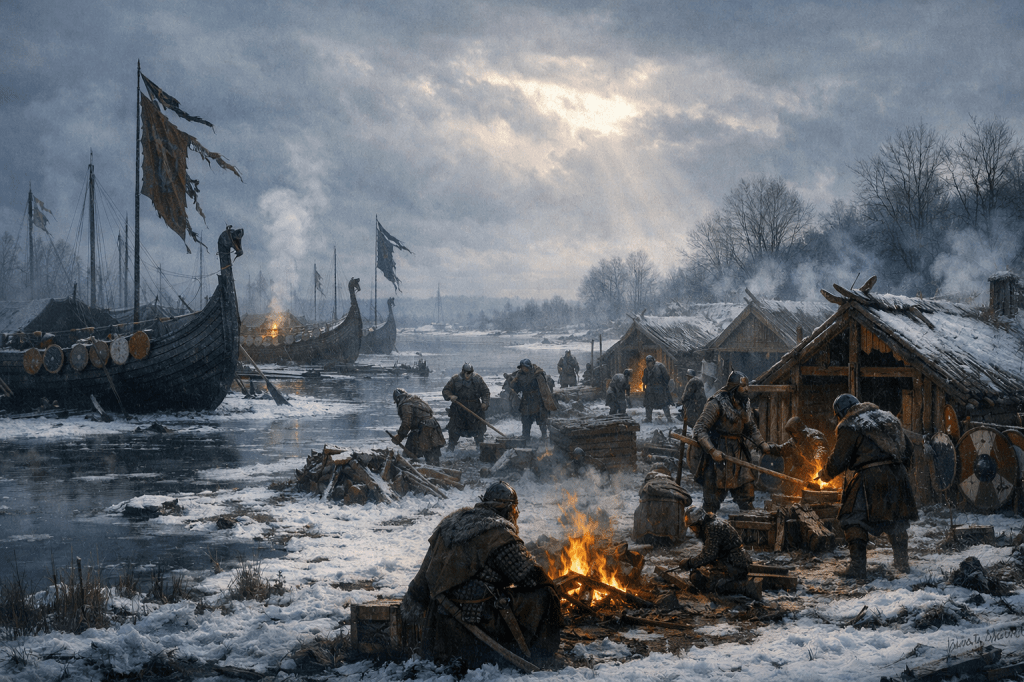
Winter settled slowly across the river valley. Frost clung to the reeds along the banks, and thin ice formed where the slow water touched the earth. A pale sky hung above the fields while smoke drifted in quiet threads across the cold morning air. Along the frozen shoreline a line of longships rested where autumn tides had left them, their dark hulls pulled high upon the bank, prows carved in the shapes of beasts that watched the empty countryside beyond. Shields hung along the sides of the vessels, their colours dulled beneath frost and travel. Around them moved men wrapped in wool and fur, their breath rising in the cold while axes struck timber and small fires burned among the ships.
The sound of labour carried across the valley. Trees fell along the riverbank, and heavy trunks were dragged across the frozen ground where rough walls began to take shape. Timber frames rose slowly between the ships while sod and straw gathered upon their roofs against the wind that swept across the open land. What began as a landing place for raiders had already begun to change its shape with the passing of the weeks. The ships remained where the storms of autumn had forced them ashore, while the men who arrived with oars and swords turned their attention toward earth, timber, and shelter. Smoke thickened above the camp as hearths burned through the long hours of winter light.
Beyond the river the English countryside stretched in quiet ridges and pale fields where distant villages stood among bare trees. For many years the sea had carried strangers across its grey waters, swift raids that struck monasteries and coastal towns before vanishing again beyond the horizon. Those earlier voyages followed the turning of the seasons. Ships appeared with the warmth of spring and faded from the coast as autumn winds gathered across the sea. This winter unfolded under a different design, as the longships remained along the rivers of England while their crews gathered supplies and watched the land that surrounded them.
Scouts moved along frozen tracks beside the water, learning the shape of the valleys and the routes that joined river and road. Each bend of the river revealed farms, cattle, and trading places where silver changed hands beneath fragile protection. Rival kings ruled these lands, their quarrels dividing the strength that guarded the countryside. The rivers carried quiet promise, for through their winding channels men could travel deep into the heart of the country where wealth waited beyond scattered defences.
Within the camp the rhythm of life settled into the long nights of winter. Fires burned while craftsmen repaired blades, shaped iron, and strengthened the ships that rested beside the frozen water. Leaders gathered beside the hearthlight, tracing the memory of rivers and valleys that reached far inland. Winter once meant departure, the season when raiders turned their prows toward distant fjords and narrow homelands across the sea. Along the rivers of England a different choice began to form among the timber halls and watchfires of the camp.
Storehouses filled with grain and salted meat while shelters spread across the frozen ground. Watchfires burned along the banks as though guarding a place newly claimed. The men who arrived with the tide lingered beside the land itself, their camp growing stronger with each passing week. Across the silent fields and frozen rivers a quiet transformation unfolded, one that would shape the fate of England long after the winter snow had melted from the banks.
Timeline of Events
793 AD – Viking ships attack the monastery of Lindisfarne, announcing the beginning of the Viking Age in England.
865 AD — The Great Heathen Army arrives in East Anglia, marking a shift from seasonal raids to organised invasion.
866 AD – Viking forces capture the city of York (Jórvík), securing a powerful foothold in northern England.
867–870 AD – Norse armies establish winter camps along rivers and fertile valleys, allowing them to remain in England year-round.
870s – Viking settlements begin spreading across northern and eastern England, laying the foundations of the future Danelaw.
About the Creator
This Chronicle is written by Simon Phillips, author of several historical and speculative fiction works exploring forgotten worlds, myth, and the turning points of history.
The account that follows moves deeper into Northumbria’s troubled royal house, where rivalry between Ælla and Osberht weakened the kingdom from within and left its greatest city exposed at the very moment danger began to gather from across the sea.
Readers supporting The Forgotten Chronicle may continue into the full record below.
Subscribe to continue reading
Subscribe to get access to the rest of this post and other subscriber-only content.
The raid that shattered the quiet of a sacred island and announced the coming of the Viking Age
Lindisfarne, Northumbria: June 793
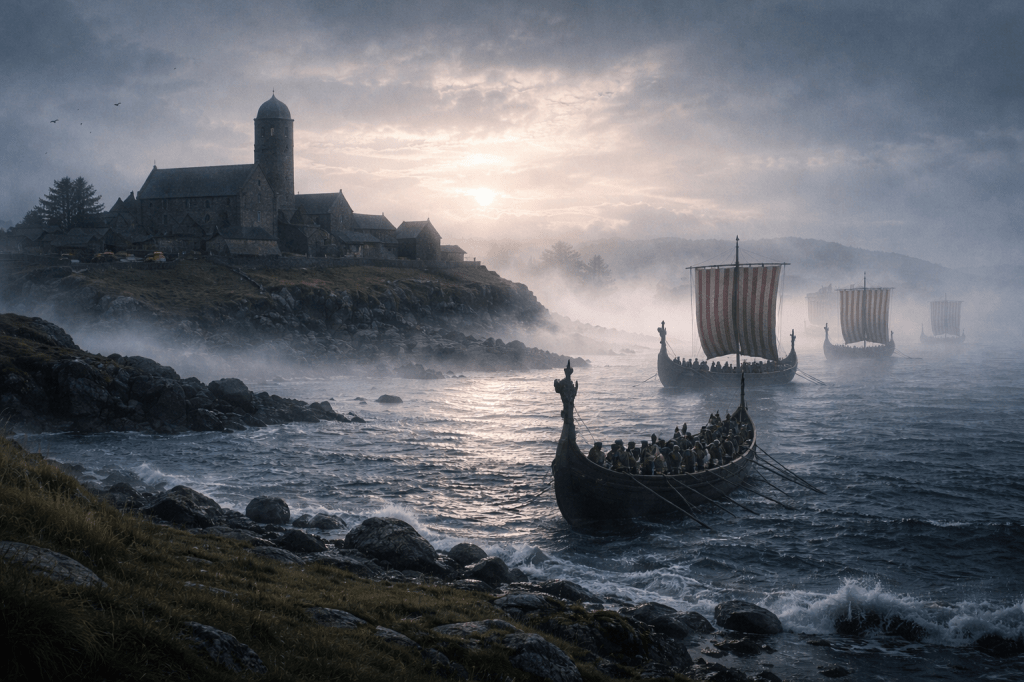
The first light of morning crept slowly across the waters of the North Sea, pale and uncertain beneath a sky still heavy with the fading colours of night. Lindisfarne lay quiet upon its small tidal island, the stone church and timbered buildings of the monastery rising from the grass like an outpost of prayer set against the restless edge of the world. Waves moved softly across the rocks below the cliffs while seabirds circled through the cold air, their distant cries carrying over the water as the monks of the island prepared for another day within the rhythm of worship and labour.
Within the monastery walls the brothers moved through familiar duties. Candles burned low along the chapel as morning prayers echoed through the stone interior, the voices of the monks rising together in measured devotion. Beyond the church, fields stretched toward the narrow causeway that linked the island to the mainland during the turning of the tides. Cattle grazed across the wind-bent grass, and thin smoke drifted upward from hearth fires within the small settlement that had grown around the sacred house over many years of peace.
Lindisfarne had long stood as a place of learning and faith upon the northern frontier of the Christian world. Pilgrims travelled from distant lands to visit the shrine of Saint Cuthbert, whose memory lingered within the island’s stones and stories. Monks copied sacred texts within quiet scriptoria while travellers carried word of the monastery’s holiness across the kingdoms of Britain. Here, at the meeting of land and sea, prayer and scholarship joined with the slow patience of monastic life.
Far out upon the grey water a shape moved through the morning mist.
At first it seemed little more than shadow against the horizon, rising and falling with the long swell of the sea. The island still slept beneath the calm of early dawn, and the watchers upon the shore paid the distant shape little attention. Fishing vessels sometimes crossed these waters, and traders occasionally ventured along the coast when the weather allowed. The sea had always carried travellers toward Lindisfarne.
As the light grew stronger the shape divided into several darker forms, each carrying a tall sail striped with deep colour. The wind pressed against the cloth as the vessels advanced across the water with unsettling speed, their narrow hulls cutting through the mist that clung to the surface of the sea. Carved prows rose at the head of each ship, fierce figures of beasts staring forward as though guiding the fleet toward the island.
Along the monastery shore a few monks paused in their work and turned their eyes toward the approaching sails. The rising sun touched the striped cloth with a dull glow, revealing long rows of oars moving together against the tide. The vessels travelled with purpose, gliding across the water with a confidence that belonged to sailors long familiar with the harsh northern seas.
Lindisfarne had welcomed travellers for generations. Pilgrims, traders, and wandering priests had stepped upon its shores in search of blessing or refuge. Yet as the longships drew closer through the morning mist, a quiet unease began to settle across the island. The sea carried strangers once again toward the monastery of Saint Cuthbert, and the calm of that early morning slowly gave way to a moment that would echo across the centuries.
Timeline of Events
635 AD —The monastery of Lindisfarne is founded by the Irish monk Aidan under the patronage of King Oswald of Northumbria.
687 AD — Saint Cuthbert, one of the most revered figures in early English Christianity, is buried on the island, strengthening Lindisfarne’s reputation as a centre of pilgrimage.
8 June 793 AD — Viking longships land on Lindisfarne. The monastery is raided, monks are killed or taken as slaves, and sacred treasures are carried away.
794 AD — Further raids strike monasteries along the North Sea coasts, spreading fear across Christian Europe.
800–830 AD — Scandinavian raiders begin appearing regularly along the coasts of Britain and Ireland.
About the Creator
This Chronicle is written by Simon Phillips, author of several historical and speculative fiction works exploring forgotten worlds, myth, and the turning points of history.
The longships grounded upon the shingle with the hollow scrape of timber meeting stone as the tide lifted gently around their hulls. Oars rose from the water and rested along the gunwales while the crews stepped down into the cold surf, boots pressing into the shifting pebbles of the shore. Sea mist drifted across the island in thin veils that softened the line between land and water, yet the figures advancing from the ships carried a sense of purpose that cut through the quiet of the morning. Shields hung across their backs, axes rested in their hands, and the carved prows of the vessels behind them watched the island like silent guardians carved from dark wood.
From the fields near the monastery the first witnesses stood in uneasy silence. A herdsman gathering cattle paused beside a low stone wall and stared toward the unfamiliar sails that now rested along the edge of the sea. The sight travelled quickly through the small settlement clustered around the sacred house. Doors opened, tools lowered into the grass, voices carried across the wind as neighbours called to one another across the narrow lanes. Life upon the island moved according to seasons, prayer, and the turning of the tide, yet the presence of armed strangers upon the shore stirred a tension that spread through the community with gathering speed.
Inside the monastery the brothers continued their morning offices as candlelight flickered against the worn stones of the chapel. Voices rose together in steady prayer beneath the timbered roof while thin smoke from the altar lamps drifted through the cool air. The bell had already marked the beginning of the day’s devotion, and the monks followed the rhythm that had shaped life on Lindisfarne for generations. Outside the chapel walls the wind moved through the long grass and carried faint echoes of movement from the shoreline where the strangers crossed the sand.
The first warning arrived through the courtyard with hurried footsteps striking the flagstones. A lay brother entered the chapel with breath still sharp from running, his words spilling through the quiet hall as he spoke of ships resting upon the shore and warriors moving across the island. The prayer faltered, voices fading into silence while several monks stepped toward the doorway to see the horizon with their own eyes. From the rise above the buildings the sails could still be seen above the mist, striped cloth lifting gently in the wind that had carried the vessels from distant seas.
The warriors advanced across the fields with measured confidence, their line spreading gradually as they approached the cluster of buildings that formed the monastery. Lindisfarne had stood for many years as a sanctuary at the edge of the Christian world. Pilgrims travelled from far kingdoms to kneel beside the shrine of Saint Cuthbert, whose memory shaped the identity of the island. Kings sent gifts of silver and gold to honour the holy place, and within its walls scribes laboured patiently over manuscripts that carried sacred words across generations. The quiet structures of timber and stone therefore held wealth that extended beyond prayer alone.
The raiders moved with the discipline of men familiar with coastal settlements and the riches that lay within them. Doors splintered beneath heavy blows from iron axes, wooden chests were dragged into the open courtyards, and the contents of storerooms spilled across the ground as warriors searched for vessels, ornaments, and coin. Monks scattered through the narrow paths between the buildings, some fleeing toward the fields while others gathered within the chapel where the shrine of Saint Cuthbert rested beneath its coverings. The calm order of the island dissolved into movement, shouts, and the crash of breaking timber.
Violence swept across the monastery with swift force. Several brothers fell beside the buildings where they had lived and prayed for years, while others were driven toward the beach where ropes bound their hands and forced them toward the waiting ships. The raiders carried away vessels of silver, reliquaries decorated with precious metal, and manuscripts whose value lay as much in the materials that adorned them as in the words written upon their pages. Leather sacks filled with ornaments passed from hand to hand while warriors moved between the buildings with practised speed.
Smoke soon lifted into the morning air as scattered fires began to take hold among the wooden structures that surrounded the stone church. Flames climbed along roof beams while sparks drifted across the grass that bordered the settlement. The sea wind carried the scent of burning timber across the island and mingled it with the salt air rising from the water below the cliffs. Beyond the smoke the longships waited upon the tide with quiet patience, their crews moving steadily between shore and vessel as the plunder of the monastery gathered within the hulls.
By the time the sun climbed higher above the sea the raiders had begun to withdraw toward the beach. Captives were driven ahead of them across the stones while the remaining warriors carried the final bundles of treasure toward the waiting ships. Oars slid once more into their places along the sides of the vessels, and the tide that had carried the fleet toward Lindisfarne now prepared to bear it back across the northern sea. When the sails lifted again above the water the longships glided away from the island with the same quiet certainty that had marked their arrival.
After the vessels vanished into the pale distance a heavy stillness settled across Lindisfarne. Smoke drifted above damaged buildings while survivors moved cautiously through the ruins that surrounded the chapel. The shrine of Saint Cuthbert remained standing within the stone church, though the community that had guarded it now faced a future shaped by loss and uncertainty. The island that had once seemed a place of safety at the edge of the world had learned that the northern seas carried forces capable of reaching even the most remote sanctuary.
News of the attack travelled quickly across the kingdoms of Britain. Messengers rode south through Northumbria bearing word of the assault upon the holy island, and chroniclers recorded the shock that spread among rulers and churchmen alike. The raid upon Lindisfarne soon became a symbol of a wider change unfolding along the coasts of Europe. From the fjords and harbours of Scandinavia seafaring communities had developed vessels whose speed and flexibility opened distant shores to sudden arrival.
In the years that followed, similar ships would appear along rivers and coastlines throughout the British Isles and the continent beyond. Monasteries once regarded as places of peace began to watch the horizon with wary eyes, and kings slowly recognised that the northern seas had produced a new power shaped by wind, timber, and the ambitions of sailors whose world stretched far beyond their home shores. The morning at Lindisfarne therefore marked more than a single raid upon a monastery. It signalled the arrival of an age in which the Northmen would travel across Europe, leaving traces of their voyages in the history of every shore their longships touched.
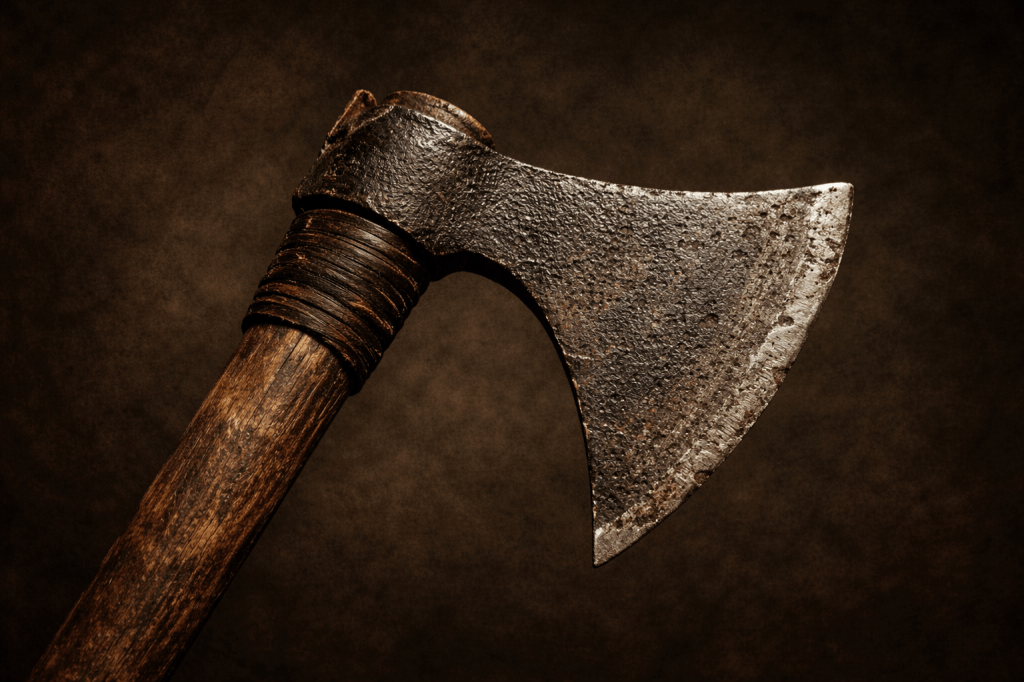
Iron Viking axe of the early medieval period. Weapons of this type were commonly carried by Scandinavian raiders during the first coastal attacks along the North Sea in the late eighth century.
Inspiration Behind the Story
Moments such as the raid upon Lindisfarne hold a powerful place in the imagination of history because they reveal how suddenly the direction of an age can change. The island itself was small and remote, resting quietly at the edge of Northumbria where the tides shaped daily life and the monks followed a rhythm of prayer that had endured for generations. Within those simple buildings lived a community devoted to study, worship, and the preservation of sacred texts that carried the memory of early Christianity across the British Isles.
The arrival of the longships transformed that quiet place into a turning point remembered across centuries. The attack carried a symbolic weight that travelled far beyond the stones of the monastery. Chroniclers across Christian Europe recorded the event with alarm, and their words preserved the moment when distant northern sailors first appeared upon the shores of Britain with violent purpose.
What fascinates many readers about Lindisfarne lies in this collision between two worlds that had grown apart across the sea. On one side stood a spiritual centre shaped by devotion and learning. On the other approached seafarers whose lives revolved around travel, trade, and the opportunities offered by distant coasts. The meeting of those two worlds created a shock that echoed through the chronicles of the age.
The raid therefore marks more than the destruction of a single monastery. It reveals the opening chapter of a long period during which Scandinavian voyagers would sail across rivers and seas throughout Europe. Lindisfarne became the moment when that wider story first entered the written memory of the continent, carried forward by the frightened words of monks who had witnessed the horizon change forever.
From the Author’s Desk
Thank you for reading the first Chronicle. Each week this publication revisits a single moment from the past, told through narrative so the atmosphere of history can emerge through place, people, and consequence.
Alongside the Chronicle, my fiction writing continues across several projects. Short stories and novellas are available through Kindle, while my YouTube channel hosts regular Mini-Reads and Flash-Fiction episodes where short pieces of storytelling are presented in a visual format.
Readers who enjoy historical atmosphere, mythic themes, and narrative storytelling may find those projects worth exploring through the links included in this publication.
Early medieval monasteries often stood in exposed coastal locations where travel by sea offered the easiest route for pilgrims and visiting clergy. Over time these communities accumulated valuable objects given by kings, nobles, and wealthy patrons. Silver vessels used in the liturgy, reliquaries containing fragments of saints’ remains, and manuscripts bound with decorated fittings gradually filled monastic treasuries. Word of such wealth travelled widely across the trading networks of northern Europe, and seafaring communities in Scandinavia understood that these quiet religious houses offered both treasure and limited defence.
Contemporary chroniclers reacted with alarm when news of the Lindisfarne attack spread. One of the most famous records appears in the Anglo-Saxon Chronicle, where the event was described as a fearful sign that struck the Christian world with dread. Other writers interpreted the raid as a divine warning, linking the violence to moral decline within the kingdoms of Britain. Such responses reveal how shocking the attack seemed to those who believed the monastery of Saint Cuthbert stood under sacred protection.
Related Events
The raid on Lindisfarne soon proved to be the beginning of a wider pattern. In the years that followed, Scandinavian ships appeared along other parts of the British coastline. Monasteries in Ireland experienced similar attacks, and by the early ninth century Viking raiders had begun to travel further south along the coasts of continental Europe. These early expeditions focused mainly on quick strikes against coastal settlements before returning home with captured wealth and prisoners.
Later generations would witness a change in these northern voyages. Larger fleets began to remain in foreign lands for longer periods, establishing winter camps and eventually settlements. The first appearance of the longships at Lindisfarne therefore stands at the threshold of a transformation that reshaped the history of Britain and much of Europe.
Further Reading
The Vikings – Else Roesdahl The Viking Age – Anders Winroth The Viking World – Edited by Stefan Brink and Neil Price
Next Chronicle
Within a generation of the raid on Lindisfarne, the longships returned to the coasts of Britain again and again. Monasteries and river settlements soon learned to watch the horizon with wary eyes as Scandinavian raiders pushed further inland along the waterways of Northumbria and beyond.
In the next Chronicle we travel forward to another moment when the northern sea carried warriors toward the shores of England, and a kingdom began to realise that the age of occasional raids was giving way to something far more enduring.
Across the grey waters of the North Sea the longships faded into the morning mist, leaving Lindisfarne changed forever and the horizon of Europe quietly altered.
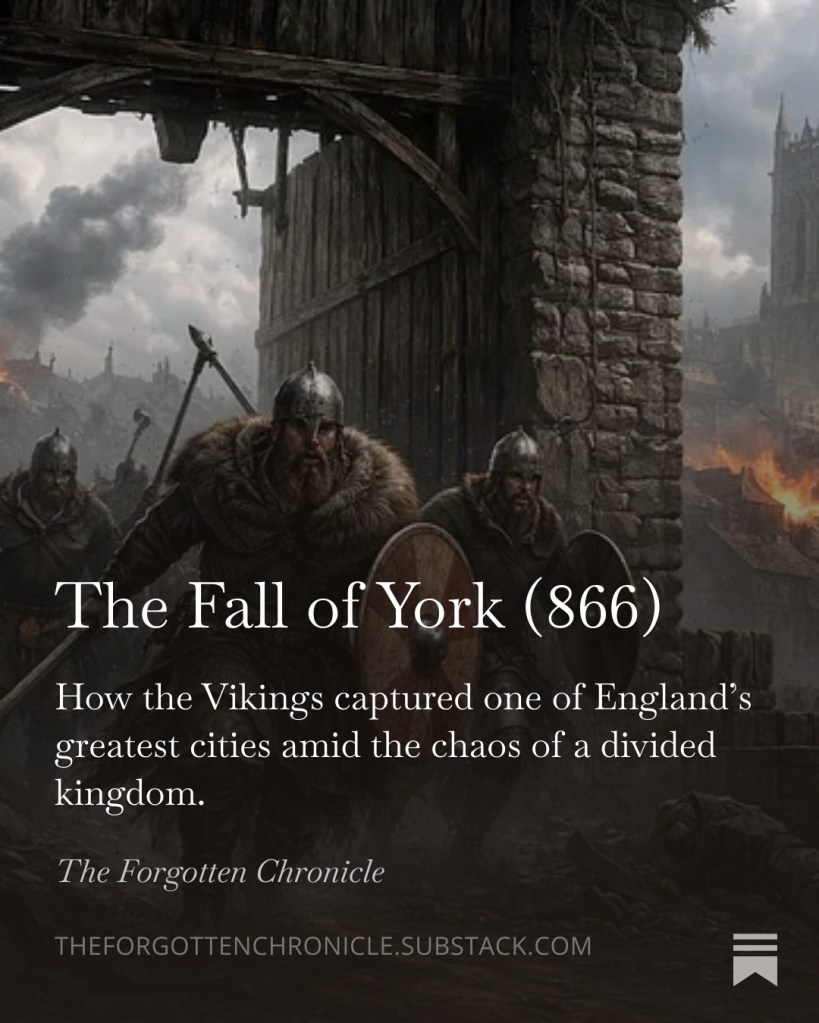
Autumn light could still lie gently across the fields around York in 866, turning the marshland beside the Ouse pale beneath the morning sky while bells carried over roofs, workshops, and crowded lanes. From the walls, the city seemed secure enough to trust its own long memory. Roman stone still held the heart of the settlement, trade still moved along the river, and Northumbria still imagined itself one of the great kingdoms of early England.
Security, however, had already begun to thin. York stood at the centre of a kingdom torn by rivalry between Ælla and Osberht, and the struggle for the Northumbrian crown weakened the very authority that should have guarded the city. When the Viking host moved north in late 866, it approached a prize of immense wealth and strategic value, though its greatest advantage lay beyond wealth alone. The kingdom behind the walls had opened wounds of its own, and the invaders understood exactly how to use them.
Each week The Forgotten Chronicle explores a moment when history quietly changed the world, and the fall of York belongs firmly within that tradition. The capture of the city marked far more than a single military success for the Vikings. It exposed the fragility of Anglo-Saxon power in the north, revealed how quickly internal conflict could unmake a realm, and prepared the ground for the rise of Jórvík, one of the most important Norse centres in Britain.
Why York mattered in ninth-century England
York was no remote settlement waiting on the edge of events. It was one of the great urban centres of early medieval England, a place shaped by Roman foundations, ecclesiastical prestige, and river commerce. Roads linked it to the wider kingdom, merchants moved through its markets, and the city carried a political significance that far exceeded its walls. Whoever held York held more than masonry and streets. He held a symbol of authority in the north.
That status made the city valuable to rival Northumbrian rulers long before the Viking army appeared. It also made York attractive to Scandinavian leaders who had already spent years studying the weaknesses of Britain through coastal raids and river movement. By the middle decades of the ninth century, Viking warfare had evolved far beyond sudden strikes on monasteries. Fleets carried seasoned warriors, commanders with wider ambitions, and a growing understanding of how divided kingdoms could be broken from within.
York offered everything such a force could seek. Wealth, infrastructure, position, and prestige all gathered there. Even more importantly, York sat inside a kingdom already distracted by its own contest for power. A rich city in a stable realm presents one challenge. A rich city in a fractured realm presents another entirely.
The civil war that opened the gates
The fall of York makes little sense when told as a simple story of Viking strength against English weakness. Strength mattered, certainly, and the Great Heathen Army had plenty of it. Yet the deeper drama lay within Northumbria itself. Osberht and Ælla struggled for the same crown, and that contest divided loyalties across the kingdom. Noble support shifted, military response lost coherence, and the authority that ought to have acted swiftly in a crisis became tangled in its own rivalries.
This is where the story acquires its real gravity. Stone walls still stood. The city still possessed defences inherited from an older imperial world. The river still carried wealth and communication through its heart. Even so, walls depend upon leadership, and fortifications become less impressive when the kingdom behind them has already begun to fray.
For the Vikings, this was a political opportunity as much as a military one. They moved toward York through a landscape already destabilised by distrust. Messages could travel slowly or arrive distorted. Decisions carried the weight of faction. Every delay favoured the approaching host. By the time the city faced the reality of the threat, the conditions for its fall had already been prepared by Northumbrian hands.
When the Viking army came north
The Viking army that advanced toward York in late 866 arrived with purpose. This was no fleeting raid launched for quick plunder before the sea turned rough. The Great Heathen Army had entered East Anglia in 865 ready to remain, gather horses, secure supplies, and study the kingdoms ahead. Its commanders understood movement, pressure, and timing. They also understood when a divided enemy had reached the point of greatest vulnerability.
York fell with a speed that still carries a sting. The city’s capture revealed how swiftly a major centre could pass into foreign hands when its defenders lacked unity. In that sense, the event feels almost eerily modern. Institutions often appear strongest just before fracture becomes visible. Streets remain busy, markets remain open, daily routines continue, and then the pressure already building beneath the surface suddenly finds its release.
For the people of York, the change would have felt immediate and disorienting. A city accustomed to its own rhythms found itself overtaken by an army whose ambitions reached beyond looting. The Vikings secured positions, established control, and transformed the political reality of the north in a remarkably short span. What had seemed durable in the morning could feel irrevocably altered by evening.
The failed recovery and the death of Northumbrian power
The tragedy deepened in 867, when Ælla and Osberht at last joined forces in an attempt to retake the city. Their temporary unity came too late. By then the Vikings had already taken hold of York and strengthened their position. The assault that followed ended in disaster, and both Northumbrian rulers were killed in the fighting.
That moment matters as much as the original capture. It meant the city’s fall was no passing shock that the kingdom could swiftly correct. The old order in Northumbria had suffered a wound from which it could no longer recover in the same form. Leadership had collapsed along with the effort to reclaim the city, and the Vikings retained the prize that could anchor lasting power in the region.
History often turns through such sequences, where one failure leads into another until a political landscape no longer resembles the one that existed a year earlier. York in 866 and 867 offers precisely that pattern. Civil conflict opened the way, conquest followed, and the desperate effort to reverse the loss only completed the ruin of the authority that had made the city vulnerable in the first place.
From York to Jórvík
The story gains even greater significance once York begins to change into Jórvík. Viking power in England is sometimes imagined only through warfare, ships, and raids, yet the Norse transformation of York points toward a broader historical reality. Scandinavian rule produced a thriving urban centre linked to trade networks stretching across the North Sea world. Craftsmen, merchants, and settlers entered the picture alongside warriors. Language, commerce, and daily life all began to absorb new influences.
This transformation is one reason the fall of York continues to hold such power for readers of the Viking Age. The city did not simply suffer conquest and pass into silence. It became something new. Jórvík emerged as a Norse centre of trade and influence, and that change left marks that endured far beyond the first battles. The event therefore belongs to the larger story of how Viking presence in Britain moved from attack to settlement, from seasonal violence to lasting political and economic power.
Seen in that light, the fall of York stands at a threshold. One world was collapsing while another was taking shape inside the same streets.
A visual route into the Chronicle
For readers who prefer to enter the subject through image and motion before moving into the longer historical piece, this visual companion can sit naturally within the blog as an embedded feature:
A short visual telling works especially well here because the fall of York carries such a strong sense of approaching pressure. Fields beyond the walls, rival rulers inside the kingdom, longships and marching columns closing the distance, all of it lends itself to a visual threshold that prepares the reader for the fuller Chronicle. The film offers a brief entry into atmosphere. The longer reading carries the weight of consequence.
That Chronicle approaches the event through atmosphere, political strain, and the slow recognition that a city can stand firm in stone while weakening in authority. It enters York before the collapse is complete, lingers over the rivalry that prepared the disaster, and follows the city into its Norse future as Jórvík. The reading experience is designed as an immersive threshold into the period, one that values tension, setting, and consequence over summary alone.
For a reader arriving through search, this piece can serve as an entry point into that wider archive. The Chronicle itself carries the fuller narrative pressure of the moment, while the surrounding publication continues to trace the Viking Age in England through conquest, settlement, exile, recovery, and legacy. In that sense, feels less like an isolated article and more like a doorway into a larger historical sequence.
Why this moment still draws us back
The fall of York continues to compel attention because it reveals a pattern that history repeats with unsettling regularity. External force matters, of course, though internal fracture often matters first. Cities and kingdoms rarely fall through assault alone. They weaken through rivalry, delayed judgement, contested legitimacy, and the gradual erosion of shared purpose. When the blow finally lands, it lands against something already strained.
York offers that truth in concentrated form. A major city, ancient walls, wealth, prestige, and memory all stood in place. Even so, division at the level of kingship made those strengths harder to use. The Viking army recognised the opening and moved through it with the kind of decisiveness that changes centuries.
There is also a deeper imaginative pull here. York sits at the meeting point of several worlds, Roman inheritance, Anglo-Saxon kingship, Christian identity, Viking expansion, and the emerging Norse city of Jórvík. The fall of the city therefore feels like a hinge in the history of England, a moment where power changed hands and the cultural texture of the north began to shift with it.
Closing movement
Across the fields outside York, the first signs of danger would once have looked small enough to misread, riders at distance, movement along the roads, rumours carried in fragments, uncertainty passing from voice to voice. Then the host drew nearer, the kingdom’s rivalries tightened into consequence, and the city that had trusted in its own standing entered a different future.
That is why the fall of York in 866 still lingers. It carries the chill of a warning and the force of a transformation. A divided kingdom lost one of its greatest cities, and from that loss emerged Jórvík, a Norse centre whose influence would shape northern England for generations. The walls remained, the streets remained, the river remained, though the world moving through them had changed.
Some moments in history vanish into sequence and summary. York resists that fate. The city still stands in the record as a place where ambition met opportunity, where internal fracture invited conquest, and where the north of England crossed into a new age whose echoes still move through the past whenever the Chronicle opens the gate again.
A Timeline Fantasy Story from Chronicles of the Spiral Ages
The Memory of Sand and the First Age of Story
Across the earliest horizon of civilisation, long before cities gathered beside rivers and long before history carved its record into clay or stone, humanity moved across the land in small and fragile communities. These early peoples lived within landscapes that shaped every instinct and every belief. Wind across desert ridges, shifting dunes beneath distant mountains, and the slow passage of seasons formed the boundaries of existence. Within such worlds, myth emerged quietly, carried through memory rather than through writing.
Stone Age fantasy fiction often returns to this distant threshold of humanity, since the age itself invites a different kind of storytelling. Survival and wonder exist beside each other. Every natural formation might conceal meaning. Every unexplained ruin stands like a question carved into the earth. When mythic historical fantasy explores this era, the story begins where language itself still searches for shape.
In a timeline fantasy series, these early moments become the first turning of a much larger wheel. Civilisations grow across centuries, belief systems evolve, and symbols travel through cultures long after their original meaning fades. The earliest ages therefore hold unusual significance, since they reveal the beginning of ideas that echo across the entire arc of history.
Within Chronicles of the Spiral Ages, the Stone Age stands as the first chapter of that unfolding world. Here the landscape remains vast and untamed, and the people who cross it carry the first sparks of story. What they encounter in these silent lands will shape memory long after their own voices disappear.
Where Myth Begins: The Landscape of Early Civilisation
Across mythic historical imagination, deserts often become places where forgotten knowledge lingers beneath the sand. The environment itself encourages reflection. Endless red dunes stretch toward a horizon where the sky grows pale and distant, while ancient rock formations rise from the desert floor as though they have watched countless generations pass.
In such a setting, the boundary between natural formation and ancient construction becomes uncertain. A weathered stone structure might appear as though it has stood since the dawn of the world. A carving discovered beneath centuries of wind erosion might resemble a symbol that no living tribe remembers.
This ambiguity forms the foundation of ancient civilisation fantasy. When a story returns to the earliest ages of humanity, the landscape becomes more than scenery. It acts as a silent archive. Every ridge and valley contains traces of cultures that existed before the present generation. Even when the characters possess no written language and little knowledge of the past, the land itself carries memory.
The Stone Age therefore becomes a fertile setting for mythic fantasy storytelling. Humanity exists close to the natural world, moving with the rhythms of migration and seasonal survival. Ritual emerges gradually as communities attempt to interpret forces that feel older than themselves. Symbols appear long before anyone fully understands their meaning.
One of the most powerful of these symbols within the Chronicles of the Spiral Ages timeline is the Spiral.
The Spiral represents continuity across time. It appears within distant cultures that have never met one another, carved into stone or traced in dust by hands that may never know why they repeat the shape. The symbol becomes a quiet thread binding centuries together, suggesting that memory travels farther than any tribe or kingdom.
In this way, the Spiral functions less as decoration and more as a living trace of history. It suggests that the earliest ages of humanity carried fragments of understanding that later civilisations only half remember.
Symbols Becoming Belief
The birth of mythology often begins with observation. A natural formation that resembles a pattern becomes a symbol. A repeated experience becomes ritual. Over time, these small acts of interpretation accumulate until they form the foundation of belief.
Ancient world fantasy novellas frequently explore this transition, showing how early cultures begin to organise the mysteries around them. When language remains young and history remains unwritten, meaning grows slowly through repeated experience.
A spiral carved into a stone wall might first appear as a curiosity. A generation later it might become a sacred mark of passage. Centuries later the same shape could stand at the centre of an entire cosmology.
The transformation occurs gradually, shaped by migration, survival, and the passage of time. Every generation inherits fragments of the previous one. Stories shift, details change, and meanings deepen.
Within a timeline fantasy series, these evolving interpretations become essential. The earliest appearance of a symbol rarely explains its purpose. Instead, the story reveals how different cultures reinterpret the same mark across centuries. What begins as a mystery eventually becomes legend, and legend slowly becomes faith.
This process forms the emotional core of mythic historical fantasy. The stories themselves become echoes of forgotten experiences. A traveller’s discovery, a tribal memory, or a carved monument may ripple outward through centuries until entire civilisations grow around those first quiet moments.
The Stone Age therefore holds unusual narrative weight. It represents the earliest turning of the wheel. Here the foundations of later myth are laid without anyone recognising their importance.
Novella Spotlight: The Sand Beyond Memory
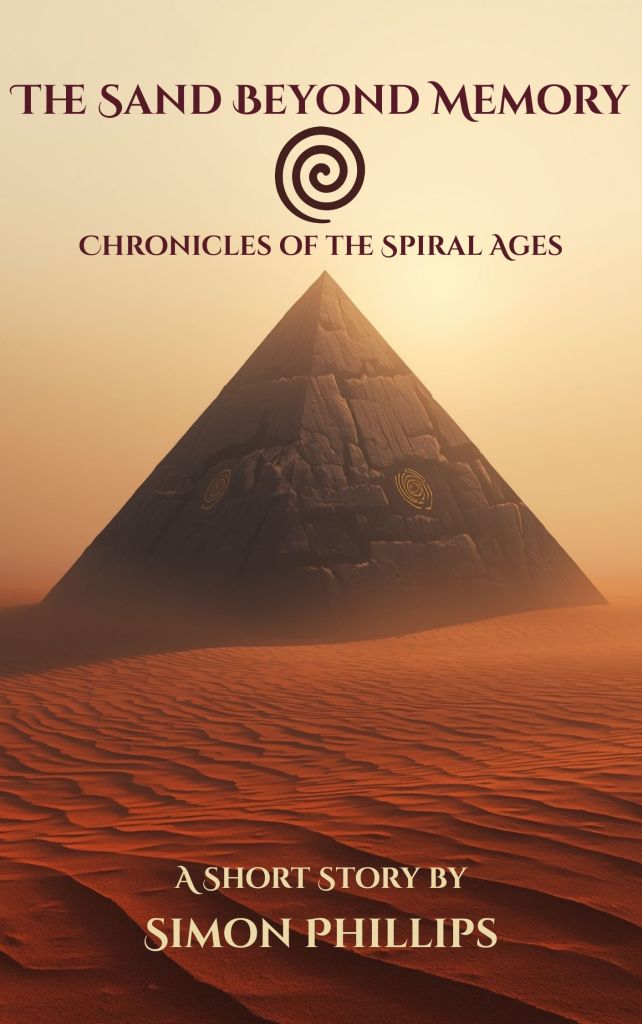
The opening entry within the Chronicles of the Spiral Ages timeline explores this early world through the novella The Sand Beyond Memory. Set within the deep desert of the Stone Age, the story follows a migrating tribe as they encounter a monument whose origin lies far beyond their understanding.
Within the red basin where the desert winds carve endless dunes, a broken pyramid rises from the sand. Time has stripped the monument of its upper form, leaving fractured stone blocks and eroded carvings exposed to the sky. No living tribe remembers who raised it. Even the oldest storytellers speak only in fragments.
For the travellers who discover it, the structure becomes a source of both curiosity and unease. Its scale suggests a civilisation older than any living memory. Its carvings hint at symbols that feel strangely familiar, even to people who have never seen them before.
Through this encounter, the novella explores the earliest tension between instinct and belief. The tribe carries its own traditions, shaped through migration and survival, yet the monument suggests a deeper past that challenges those inherited stories.
Rather than presenting the Stone Age as a primitive world, the story treats it as a formative moment in human memory. The characters stand at the edge of something larger than themselves. They sense the presence of an earlier civilisation without possessing the knowledge required to interpret it.
This quiet confrontation with the unknown forms the emotional centre of the novella. The landscape itself becomes a witness to forgotten ages, while the Spiral symbol begins its long journey through history.
A Fragment Preserved in Motion: The Illustrated Mini-Read
Alongside the written novella, a brief illustrated mini-read offers a glimpse into the atmosphere of this early age. The video functions less as a summary and more as a preserved moment from the world itself.
The sequence focuses on a single fragment of experience within the desert landscape. Dust drifts across the broken monument. Light moves across eroded stone surfaces. The tribe approaches the structure slowly, uncertain whether the place carries danger or meaning.
Within the broader ancient civilisation fantasy setting, such moments hold unusual power. They capture the emotional texture of the story without revealing its deeper transformation. The viewer stands beside the travellers, sensing the presence of history beneath the sand.
This short visual fragment acts as a threshold into the wider world of Chronicles of the Spiral Ages, offering a brief immersion into the earliest chapter of the timeline.
You can view the illustrated mini-read here:
The Spiral Across the Ages
The Stone Age marks only the beginning of the larger timeline explored throughout the Chronicles of the Spiral Ages series. As centuries pass, new cultures emerge across distant regions. Metallurgy reshapes tools and weapons. Trade routes connect societies that once lived in isolation. Kingdoms rise beside rivers and coastlines.
Yet the Spiral continues to appear.
Sometimes it emerges as a sacred carving within temple walls. Sometimes it appears within pottery or woven cloth. In other eras it becomes a philosophical symbol associated with the passage of time itself.
Each appearance suggests continuity across generations who possess no direct knowledge of one another. The symbol survives because memory itself survives. Even when languages fade and cultures disappear, traces remain embedded within tradition and myth.
Through this long historical arc, the Spiral becomes a quiet witness to humanity’s unfolding story. It represents the persistence of meaning across centuries, a reminder that even the smallest discoveries in the earliest ages can ripple outward across time.
A Story That Begins Before History
Stories set in the earliest ages of humanity carry a unique atmosphere. They unfold in worlds where the future remains entirely unknown and where every discovery might shape the direction of civilisation.
Stone Age fantasy fiction therefore invites readers to step into a moment when myth itself still waits to be born. Symbols appear without explanation. Landscapes conceal fragments of forgotten worlds. Every encounter with the unknown becomes part of a larger historical memory.
Within Chronicles of the Spiral Ages, The Sand Beyond Memory stands as the first step into that long journey through time. The desert monument, the Spiral carving, and the quiet uncertainty felt by the travellers form the beginning of a much larger narrative stretching across centuries.
The earliest ages rarely leave written records, yet their influence lingers in the stories told by later civilisations. By returning to that distant beginning, the series explores how myth grows from memory and how symbols endure long after the voices that first carved them have faded.
Across the red desert basin, the wind continues to move across the broken pyramid. Sand drifts slowly against stone that has watched countless generations pass. Beneath those ancient carvings, the Spiral waits patiently for the ages that will follow.
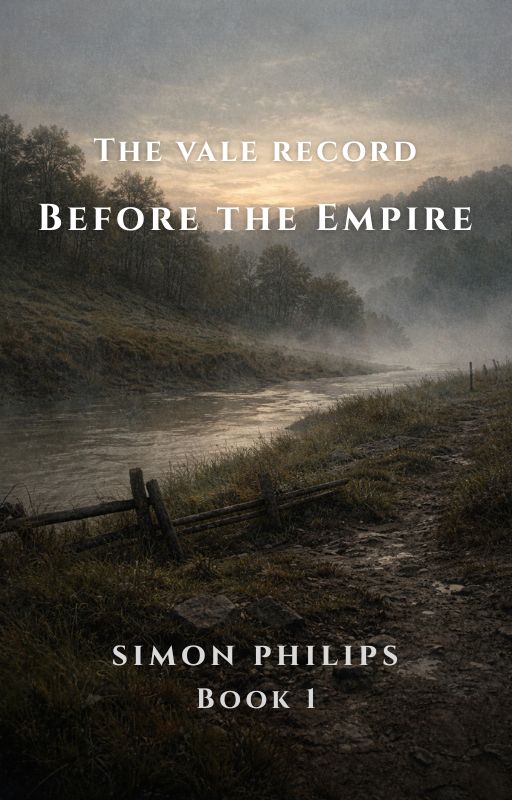
Long before empire fixed its roads across Britain and carved permanence into stone, there were men who believed their lives would rise and fall within the memory of their kin, carried in voice and soil and ritual, measured in seasons and burial mounds rather than conquest. It is within that fragile, communal world that The Vale Record: Before the Empire begins its quiet excavation of immortality, and in doing so positions itself within a rare corner of historical supernatural fiction: the literary vampire novella grounded in realism, erosion, and lived continuity.
This is no spectacle of gothic excess, no romance-bound fever dream of endless youth. It is an examination of survival under historical pressure, an immersive British historical fiction novella in which the supernatural exists as biological divergence, scarcely understood even by the one who endures it. The result is a slow burn gothic novella shaped by land, invasion, and the long aftermath of living beyond one’s allotted span.
Immortality here carries the weight of time, and time itself becomes an instrument of erosion.
Immortality as Erosion, Not Ascension
Within much contemporary vampire fiction without romance, immortality functions as enhancement, an ascension into strength or beauty or mythic dominance. In Before the Empire, survival operates differently. The immortal protagonist does not stride toward destiny; he remains in place while the world shifts beneath him. The land changes hands. Languages soften and fracture. Ritual becomes anecdote. Continuity dissolves.
Immortal protagonist fiction often centres on power. Here, power is incidental. Survival occurs through accident, through circumstance, through an unrecognised biological divergence that separates Marcus Vale from those beside him on the field. There is no revelation, no awakening framed by thunder or prophecy. There is only the slow realisation that time behaves differently for him than for others.
This subtle deviation transforms immortality into erosion. To live across centuries within a framework of historical realism is to experience attrition. Names fade. Kin vanish. Landscapes are renamed. The communal identity of pre-Roman Britain, cyclical and land-bound, yields to Roman order and permanence. Marcus survives through this fracture, and survival itself becomes a quiet violence.
The novella positions immortality and memory fiction within a historically disciplined framework. Major events unfold as they did. Empire advances. Tribes fracture. Cultural erasure proceeds with administrative efficiency. The supernatural offers no correction, no secret mastery. Instead, the immortal remains subject to the same pressures as any other body on the field, with the sole exception that he endures long enough to feel the full arc of consequence.
In this way, the literary vampire novella becomes a meditation on loss, an exploration of how identity erodes when time no longer releases its grip.
Historical Supernatural Fiction Without Spectacle
Historical supernatural fiction often risks spectacle, allowing magic to bend chronology or elevate its protagonist above context. The Vale Record operates with deliberate restraint. The Roman invasion of Britain arrives as disruption, as asymmetrical force, as disciplined machinery pressing against communal land-based identity. There is confusion and brief violence, disorientation and fracture, though the emphasis rests on lived perception rather than panoramic explanation.
The supernatural remains indistinct. There are no mythic hierarchies unveiled, no grand lineage of ancient immortals manipulating history from shadow. Instead, the biological condition that defines Marcus Vale exists within strict limits. He can be harmed. He can age. He will decline. Immortality extends life; it does not suspend consequence.
This restraint situates the novella within a rare sub-genre: supernatural realism novel territory in which the extraordinary unfolds beneath the weight of documented history. The land itself becomes the enduring force. Empires rise. Marcus endures. Yet endurance offers no dominion, only accumulation.
The slow burn gothic novella form proves particularly suited to this thematic terrain. Atmosphere emerges from soil, from communal ritual, from the texture of pre-Roman life before imperial infrastructure. The gothic element lies within the tension between continuity and erasure, between memory and administrative permanence. The horror, if it may be called such, resides in survival without belonging.
Memory as Burden and Inheritance
Immortality and memory fiction often gestures toward nostalgia, toward the romance of centuries. In Before the Empire, memory accumulates unevenly. It remains incomplete, selective, shaped by emotional pressure. Marcus recounts his early life without spectacle. He does not mythologise his own divergence. Instead, memory reveals fracture.
The burden of memory manifests as inheritance. The novella’s modern frame situates Marcus as an ageing patriarch within a private household, choosing to record his life while decline advances. This framing grounds the work firmly within the territory of British historical fiction novella craft, where the past exerts pressure upon the present rather than serving as decorative backdrop.
The act of recording becomes both preservation and distortion. The immortal body weakens while emotional clarity sharpens. The household surrounding Marcus appears stable, ordered, adapted across generations. Yet beneath this surface lies fragility. Memory moves through walls. Secrecy presses inward. The record itself feels finite.
In this sense, the novella becomes as much about inheritance as about survival. Immortality fractures generational continuity. The one who endures cannot fully belong to any generation. He outlives his context. The erosion extends inward.
Readers drawn to Kindle literary novella work that favours psychological restraint over spectacle will recognise this tension. The narrative weight accumulates quietly. Each remembered field, each burial, each vanished voice carries forward into the present room where recording devices hum softly within a Victorian-consolidated house adapted for discretion.
The Vale Record: Before the Empire: A Spotlight
The Vale Record: Before the Empire stands as the opening movement in the series, a British historical fiction novella rooted in pre-Roman Britain during the earliest pressure of Roman incursion. It focuses on a single sustained period, resisting compression, resisting summary. The emphasis rests upon communal identity bound to land and oral tradition, and upon the first unacknowledged divergence from human ageing.
The novella does not offer origin explanation. It avoids mythology expansion. Instead, it presents a lived period in which survival occurs unnoticed, uncelebrated, and misinterpreted. The emotional promise lies in witnessing the quiet collapse of certainty. Tribal belonging yields to empire. The body yields to time, albeit at a different rate. Identity shifts without declaration.
For readers interested in literary vampire novella work that rejects romance tropes and foregrounds historical continuity, this opening volume establishes the tonal discipline of the wider series. Immortality emerges as attrition. Empire becomes the enduring external force against which survival is measured.
The Amazon Kindle edition preserves this atmosphere in its original cadence, allowing readers to enter the world through sustained immersion. There is no urgency attached to that movement. The text waits with the patience of stone.
The Illustrated Mini-Read as Threshold
Alongside the novella, the illustrated mini-read on YouTube functions as a preserved fragment, a threshold moment distilled into visual atmosphere. It captures the tonal quality of early Britain under gathering pressure, offering viewers a brief immersion into the world before empire secures its roads and administrative permanence.
The mini-read does not summarise. It does not reveal. Instead, it extends atmosphere, holding a single breath of time in suspension. As an echo of the novella’s restraint, it operates as a preserved moment rather than promotional device, inviting quiet attention.
Those who encounter the fragment first may find themselves drawn toward the fuller immersion of the Kindle literary novella. Those who begin with the text may recognise familiar textures within the illustrated rendering. The two forms exist in dialogue, each reinforcing the other’s weight.
Empire, Continuity, and the Long Arc of Decline
As the series advances beyond Before the Empire, the scale widens while the emotional centre remains contained. The Roman invasion establishes Marcus Vale’s lifelong relationship with empire, with order imposed upon communal land. The erosion of identity begins here. It continues across centuries.
Immortality and memory fiction of this kind carries forward through accumulation rather than escalation. Each historical role, each belief once held, will gradually be relinquished. Physical decline will unfold without spectacle. Emotional clarity will sharpen even as strength fades.
The closing pages of the opening novella do not promise triumph. They reposition relationships. They introduce fragility within the modern household. The record feels finite. The immortal body approaches its natural end, extended though it may be.
Historical supernatural fiction often gestures toward transcendence. The Vale Record gestures toward extinction, approached with measured composure. The weight of endurance presses inward. Empire remains carved into landscape. Memory persists unevenly. The house stands, adapted and discreet, holding its quiet archive.
In that stillness, the literary vampire novella reveals its true preoccupation: how long a life can extend before it becomes sediment, how memory can preserve and distort in equal measure, and how erosion shapes identity more profoundly than conquest ever could.
Some stories begin with crowns, borders, and conflict already in motion. Others reach further back, to a time when the world itself had not yet learned how to answer those who lived upon it.
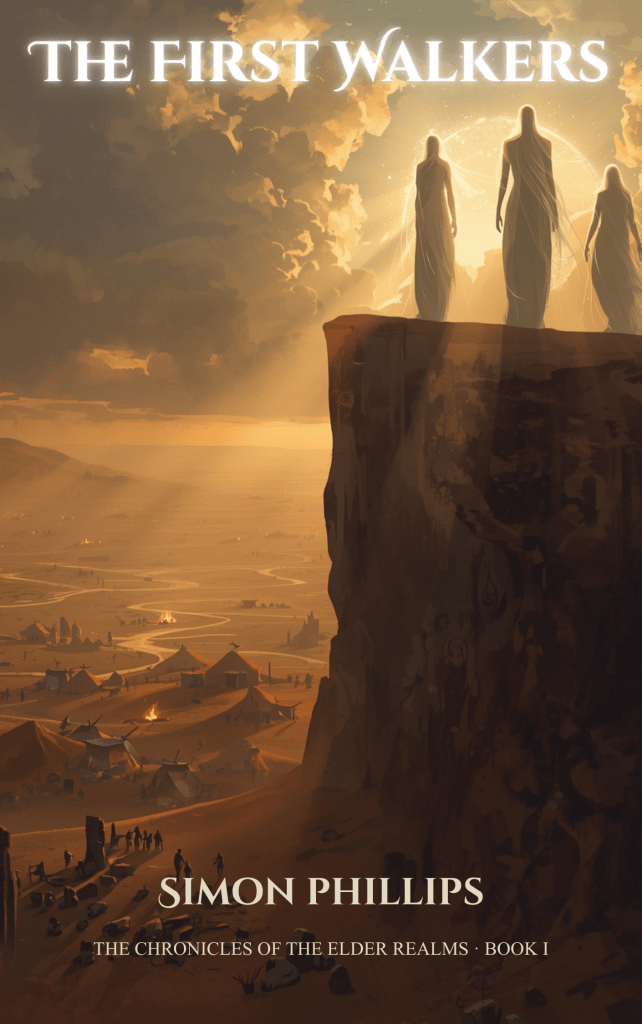
The First Walkers belongs to that earlier age.
This short story emerged during a period of stepping away from the main novel, The Veil of Kings and Gods, in order to explore the ground beneath it. Before returning fully to kings, councils, and divine fracture, there was a need to listen to the first layer of the world. An age shaped by memory, firelight, and watching presences, where meaning travelled through instinct rather than record.
The Elder Realms, in their earliest form, are quiet places. Humanity moves cautiously through landscapes that feel aware yet unreadable. The gods observe from distance and height, bound by their own silences. Magic exists as potential, sensed through alignment and response instead of mastery.
The First Walkers is written as a fragment from this age. It stands as a complete short story, while also serving as a foundation stone for what comes later. Ideas seeded here carry forward into later ages, where they take on clearer shapes through belief, power, and consequence.
Alongside the short story, I have been sharing brief mythic fragments drawn from the same period. These appear as narrated pieces and flash-fiction, shaped to feel like recovered scripture or ancestral memory. They offer atmosphere and tone, allowing the world to be approached slowly, without explanation pressing ahead of experience.
One such fragment can be experienced below. It reflects the mood and substance of The First Walkers, presenting a single moment from the earliest age, shaped for listening.
Watch the narrated mythic fragment here:
These fragments act as quiet entry points. Some readers may encounter the world first through sound and image, others through the written story. Both paths lead toward the same long memory.
The complete short story, The First Walkers, is available as a Kindle ebook for those who wish to read the full piece and remain with the world for longer:
Further stories and fragments from the Elder Realms will follow over time, each exploring a different age in the long descent toward kingdoms, faith, and fracture.