As rival rulers struggled for control of the Nile, Narmer’s claim to rule both Upper and Lower Egypt challenged the loyalties of a divided land.
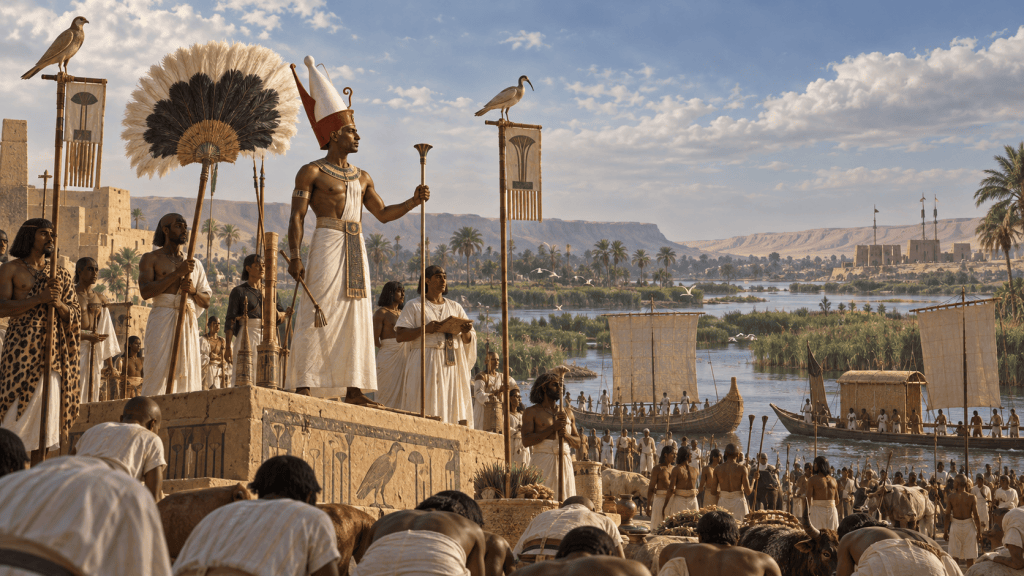
Timeline of Events
c. 3300–3200 BC — Rival centres in Upper Egypt grew in power as political influence spread along the Nile.
c. 3200–3100 BC — Gradual consolidation reshaped Upper and Lower Egypt, although the precise sequence of conflicts and alliances remains uncertain.
c. 3100 BC — Narmer became closely associated with the unification of Egypt and the claim of kingship over both lands.
c. 3100 BC — The Narmer Palette depicted the king wearing the White Crown of Upper Egypt and the Red Crown of Lower Egypt, powerful symbols of emerging unity.
Two Crowns, One King
The carver caught the flint point as it slipped along the edge of the crown, saving the king’s face by the width of a fingernail. A pale scratch marked the stone beside it. He rubbed the dust away, brought the slab closer to the light spilling through the reed screen and tried the line again. Outside, feet crossed the packed earth of the temple court at Nekhen. The offering was expected before the sun climbed higher, and he still had a crown to finish.
His young assistant held the stone steady between his hands, watching the hooked shape emerge above the ruler’s brow. “That is the crown of the northern marshes,” he said, adjusting his grip. “My uncle traded there. Their chiefs had their own boats, their own men.”
The carver drew the point carefully towards himself. “And their own quarrels, if your uncle told the whole story.”
“He told better stories than you.” The younger man smiled, though his fingers stayed tight against the heavy stone. “What will they say when they see their crown on Narmer’s head?”
The carver rested the flint against his thigh, remembering the other face he had finished earlier. There Narmer wore the tall White Crown of the south, his arm raised over a captive. Here he advanced in the Red Crown towards fallen enemies, with men carrying standards ahead of him. The stone told of victory, though boatmen travelling along the river still carried different accounts of the fighting, and people in the northern settlements would have their own memories of what had happened.
“They may say whatever pleases them,” the carver answered, turning the slab a fraction. “Our task is to show what the king claims.”
A temple attendant appeared at the doorway while he was smoothing the last ridge. Linen brushed against his ankles as he crouched to inspect the work, and his eyes went straight to the signs above the king: a catfish and a chisel enclosed within a royal frame.
“Is his name clear?” the attendant asked, reaching towards the stone.
The carver caught his wrist before the fingers touched the fresh dust. “Clear enough to outlast yours and mine,” he said, then brushed the surface clean with a strip of cloth. The attendant frowned, although he lowered his hand.
Together they lifted the palette. Its weight drew at the carver’s shoulders as they carried it out into the sun. From the courtyard came the smell of river mud and the murmur of people gathered near the shrine. The assistant kept looking at the two crowned figures, one on each face, as though expecting them to disagree.
At the threshold, the attendant signalled for the stone to be raised. The younger man loosened his grip reluctantly.
“My uncle will know that crown,” he murmured, watching the attendant turn the palette towards the gathering.
The White Crown caught the light first, followed by the Red Crown as the stone turned. Above each figure stood the same royal name. The carver had spent days cutting two separate scenes, yet before the shrine they declared a single kingship. As the attendant carried the palette forward, he opened his aching hands and watched the people make way for the stone bearing Narmer’s claim to both lands.
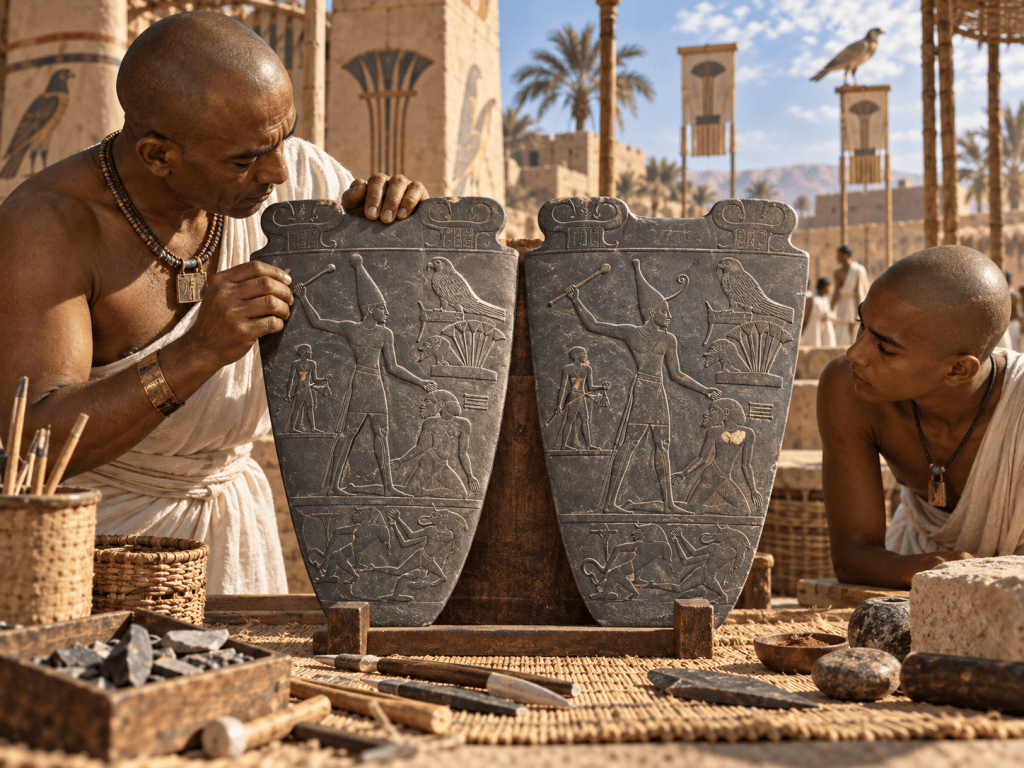
An artistic reconstruction of Early Dynastic Egyptian craftsmen examining carvings inspired by the Narmer Palette, whose royal imagery symbolised Narmer’s claim to rule both Upper and Lower Egypt.
Inspiration Behind the Story
The Narmer Palette offered a remarkable glimpse into the emergence of Egyptian kingship, depicting a ruler whose authority reached towards both Upper and Lower Egypt. Its carved imagery conveyed power and conquest, although the surviving evidence left the actual path towards unification uncertain. That tension made this moment worth exploring, especially through the eyes of those whose hands helped shape the symbols of royal authority. By following a carver and his young assistant, the Chronicle brought a vast political transformation into a smaller, more personal world. The stone became more than a royal offering, carrying an image of kingship that would endure long after the people who fashioned it had vanished.
Explore a Different Egypt
For readers who would like to step from real Egyptian history into mythic fantasy, The Forgotten Gods of the Drowned Kingdom follows tomb robber Neris into a darker world of burial rites, divine relics, judgement and a hidden conflict among the Egyptian gods. It shares the Nile, tombs and sacred traditions of ancient Egypt, while telling an entirely fictional story shaped by Egyptian mythology.

Next Chronicle
Narmer’s image proclaimed a ruler of the Two Lands, yet bringing a kingdom together was only the beginning. Beyond the royal court, officials carried orders along the Nile, storehouses received grain, and marks pressed into damp clay helped establish the authority of the earliest dynasties. At Memphis, Abydos and Saqqara, the foundations of a lasting kingdom gradually took shape. In The First House of Kings, the Chronicle moves beyond the symbols of unification to explore the people, records and responsibilities that helped royal power endure across generations.
