The city in Hali Files has already survived the age people still speak about in lowered voices. The great conflict sits behind them, filed away through doctrine, rebuilt streets, revised civic records, and the steady labour of ordinary life continuing because ordinary life has to continue. Taverns fill. Brothels trade through the late hours. Priests keep offices beside old shrines whose purpose has thinned with neglect. Clerks move through districts where the walls carry older masonry beneath fresh repair, and no one pauses long enough to ask what was sealed inside before the newer plaster went up.
That refusal to look too closely gives Hali Files its particular kind of dark fantasy horror. The world has no appetite for catastrophe. It prefers weakness, vice, bad blood, failed moral character, unfortunate illness. Anything can be named safely, so long as it avoids the word returning.
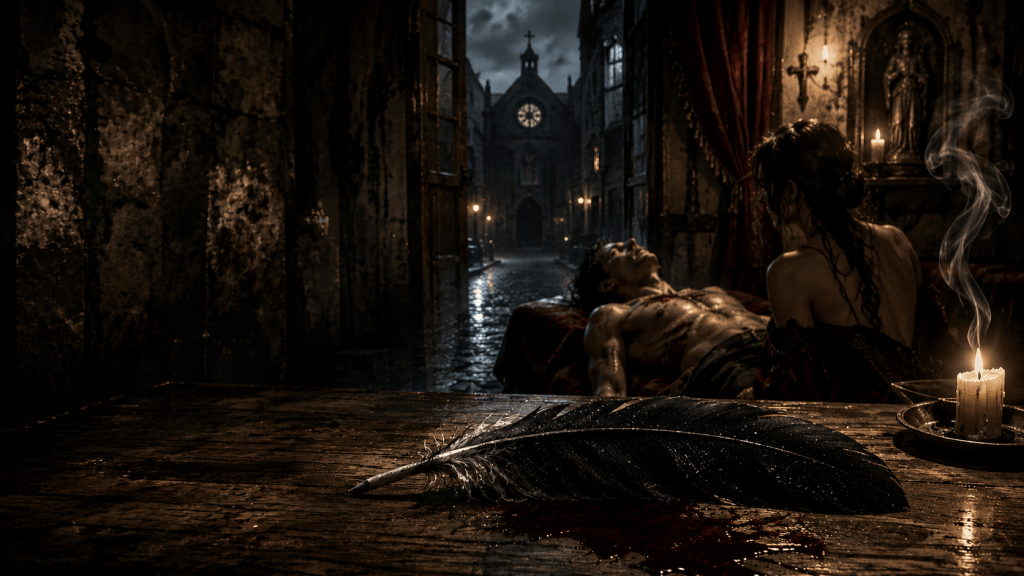
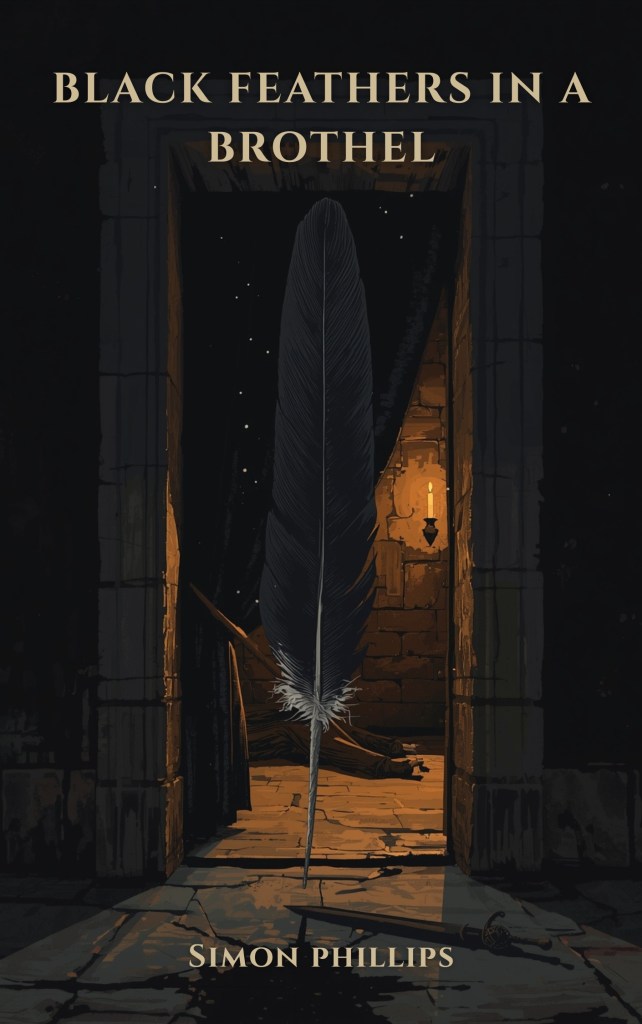
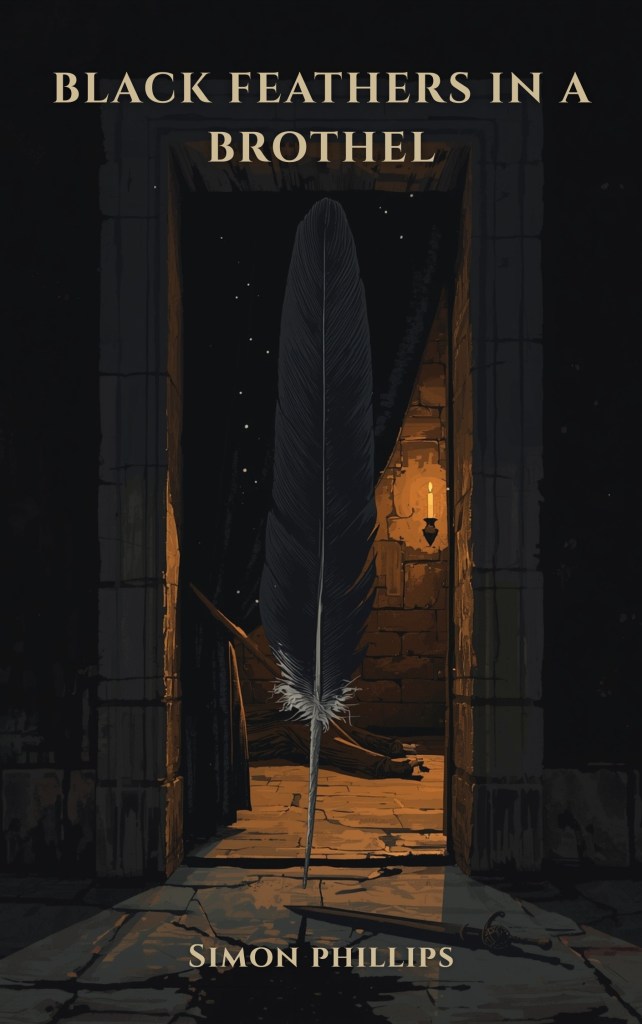
In the opening novella, Black Feathers in a Brothel, horror begins in a room that should have remained small. A paid chamber. A nervous clerk. A woman whose profession has taught her to recognise fear before men name it. The first signs arrive through atmosphere rather than spectacle: heat beneath the smell of candles, pressure against the ear, something scorched in a place where incense has long been banned. Then a feather appears where no feather belongs.
The room has no reason to matter. That is precisely why it does.
A contained death in a lower district can be dismissed. A body distorted beyond natural explanation can be softened through official language. A haunted room can become gossip by morning, folded back into the district’s rhythm before those with authority are forced to speak plainly. This is the texture of the Hali Files world: supernatural horror enters through places society already prefers to ignore, then grows under the cover of institutional convenience.
When the War Ends in Public and Continues in Stone
Many dark fantasy novella series begin with open danger. Hali Files begins with a quieter wound. The danger has already existed for a long time. People simply rebuilt over it.
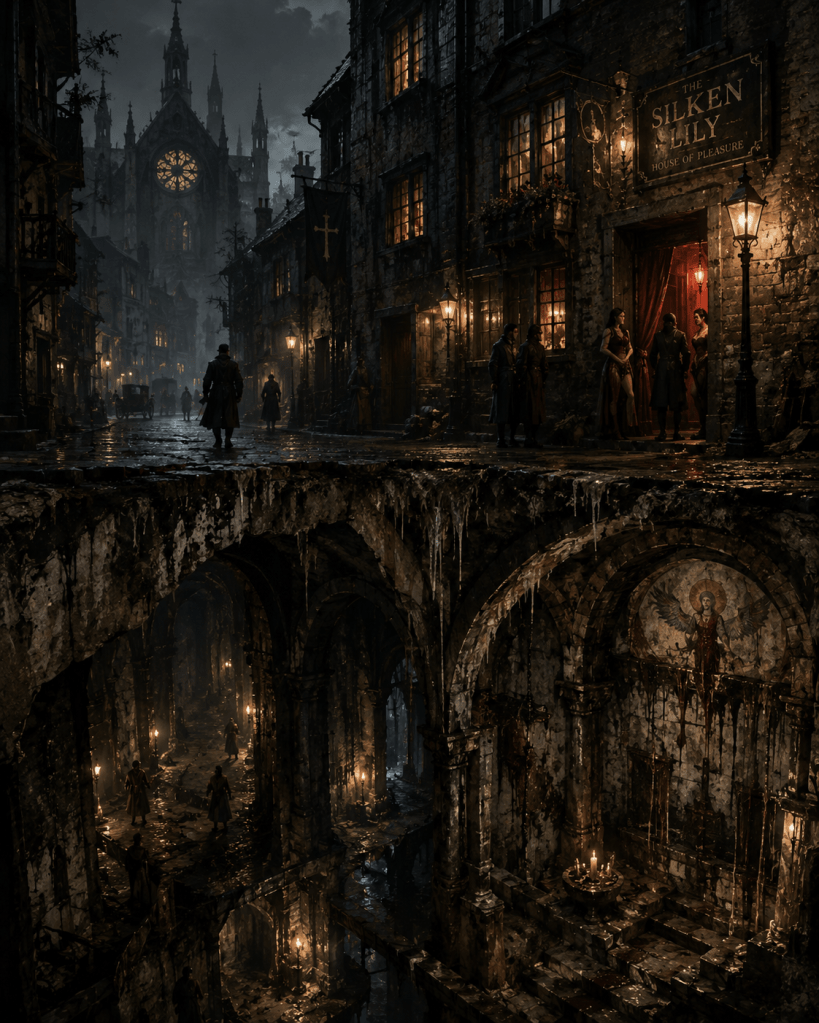
The city’s modern structures sit above older sacred spaces, abandoned passages, ruined containment chambers, and foundations once marked by prayer, panic, and hurried sealing. History remains physically present. It has not faded into legend. It survives as uneven walls, old tunnels behind cupboards, chapels repurposed for commerce, and cold spaces under buildings where the air still carries the residue of events no living official wants reopened.
That layering matters. Black Feathers in a Brothel works as an occult horror novella because the supernatural pressure feels inseparable from the built environment. Corruption does not arrive from elsewhere. It pushes out through a wall. It gathers in stone. It follows old routes. It turns a private room into the shallowest visible edge of a deeper structure.
This is where Hali Files separates itself from cleaner demon hunter fantasy. The threat has no desire to stage itself neatly. It spreads through architecture, bodies, gaps in doctrine, and the human habit of explaining away what causes inconvenience. A clerk’s death, a sealed passage, a thin chalk mark on a door, a priest reaching too quickly for a moral judgement. Each detail belongs to the same condition. The city continues functioning while the ground beneath it learns how to answer.
Kael and the Cost of Surviving the First War
At the centre of the first case stands Kael, a former demon hunter whose greatest danger no longer comes only from what he hunts. He carries the Hali Sickness, a burned condition left by divine fallout and sustained through violence, proximity, and the strain of continued existence. He moves through the city like a man who has practised appearing ordinary. The flask at his belt, the roughness in his speech, the coat drawn close, the readiness of his hand near the hidden hilt all suggest someone surviving through habits that have replaced peace.
Kael is compelling because the series refuses to frame him as a polished supernatural bounty hunter. He is useful, feared, and visibly functional, yet every encounter risks narrowing him towards something less governable. The Hali burn sharpens him around corruption. It also weakens his restraint. Violence becomes easier in the same moment control becomes harder.
That tension gives Black Feathers in a Brothel much of its emotional weight. Kael recognises patterns others overlook. He understands that the room above the sealed passage holds more than residue. He sees that what has surfaced is early, messy, hungry. Even so, recognition offers no safety. The closer he moves towards the anomaly, the more fiercely the Hali condition answers inside him.
The strongest demon hunter horror often comes from this split: the one most capable of facing the threat also carries a version of the same world damage within himself. Kael can draw the sword others cannot use. He can stand where others would break. Yet each act of standing there costs him. The body that protects Maris is also the body steadily slipping away from him.
Maris and the Return of Magic Through Failure
Maris enters the first novella with a different kind of instability. Her magic has no clean ritual structure, no disciplined command system, no safe vocabulary through which to present itself. It comes as reflex. Pressure touches pressure. Fear, proximity, and half-understood resonance bring something out of her before intention catches up.
That matters deeply for the wider occult fantasy series. Returning magic in Hali Files has no triumphant grandeur. It is erratic, embarrassing, dangerous, and often frightening to the person carrying it. Maris senses what lies beneath the brothel because the buried corruption speaks to parts of the world that official structures insist are dormant. When she reaches for understanding, the environment reacts. Blood opens in stone. White flecks catch in it. Scratches flare into a ruined halo mark. Knowledge itself becomes escalation.
Her role within the opening case gives the novella more than investigation. She becomes evidence that the world is changing beneath denial. The Mage Order may dismiss the return of meaningful magic in the broader Hali Files framework, while the Church controls its preferred story of reality, yet Maris exists as a contradiction walking beside Kael. She cannot be filed away cleanly. Her power arrives through misfire, and the misfire reveals more truth than any authorised institution seems willing to tolerate.
By the close of the novella, her fear has shifted. She fears the anomaly, certainly. More piercingly, she fears what her presence does to Kael. When her magic presses against the corruption, something in his Hali sickness answers. Their partnership has already become necessary and dangerous in equal measure.
The Church and the Language of Denial
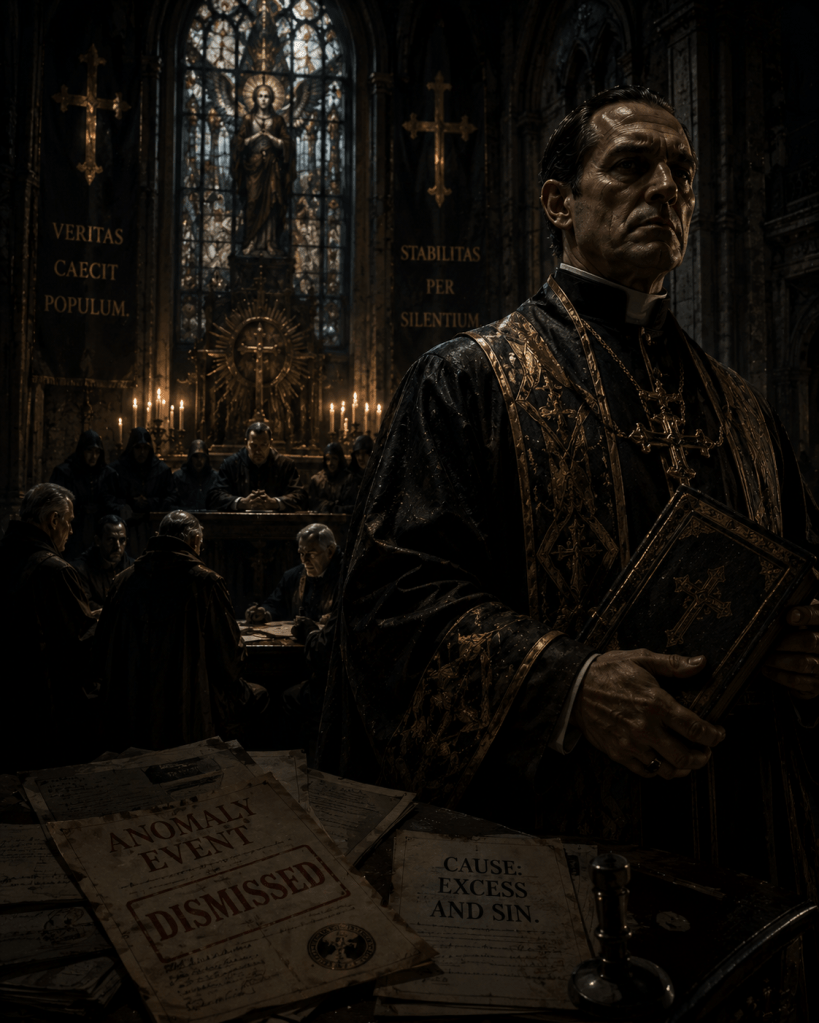
The Church appears early in Black Feathers in a Brothel, and its role is more unsettling because it rarely needs to shout. A priest entering the room after the death sees enough to know the event sits beyond ordinary explanation. The response arrives all the same: excess, guilt, moral failure. The body is made doctrinally manageable through a lie spoken with institutional calm.
That gesture holds the wider theological horror of Hali Files. The Church is not presented as ignorant. Its denial carries structure. It recognises remnants, Hali Sickness, buried anomaly sites, and the dangerous residue of what history prefers to call finished. Its power rests in deciding which truths remain restricted and which events receive harmless public names.
Within an adult dark fantasy horror setting, that distinction is crucial. The world’s governing authority faces no simple choice between belief and disbelief. It faces a problem of control. A population that accepts systemic supernatural reactivation becomes difficult to govern through routine doctrine. So the evidence is sealed. The records remain partial. Priests learn which questions to close before they widen.
The brothel death becomes the perfect opening instance. A lower-district clerk, a sexual setting, and a body the Church can fold into a familiar moral judgement. The supernatural element survives because the official explanation is socially convenient. The feather vanishes. The incense smell lingers. The ledgers close.
Horror proceeds.
Entering Black Feathers in a Brothel
As the first published case in the Hali Files cycle, Black Feathers in a Brothel establishes the series through pressure rather than exposition. It offers a contained supernatural investigation, yet the deeper effect comes from how the case widens underneath Kael and Maris as they follow it.
The novella moves from a chamber above an abandoned chapel into a sealed lower passage where stone has absorbed biological distortion. Bone appears in mortar. Black feathers gather where no airflow reaches. Rats move in deliberate lines. The anomaly embedded below the brothel behaves less like a monster and more like an early expression of a living system. It responds to proximity. It adjusts under attack. It learns.
That unfolding turns the story from demon hunter fantasy into something more uneasy. Kael can cut through what has surfaced, though the encounter refuses to become a clean victory. The final recognition lands with far greater force than a simple defeat: the thing beneath the city was listening.
The value of the opening novella rests in its restraint. It gives enough of the buried system to create dread, enough of Kael’s condition to make future violence emotionally costly, enough of Maris’s magic to suggest a wider awakening, and enough of the Church’s denial to show how the coming danger will be allowed to spread. It opens a door, then makes clear that the room behind it was never the true problem.
Symbols That Refuse to Stay Decorative
The first Hali Files novella also begins building the visual and sensory language that carries through the wider cycle. These symbols are never decorative flourishes. They operate as signs of pressure, recurrence, and hidden organisation.
The black feather appears first as a residue of wrongness, then as a promise that the event has not truly ended. Burning incense signals Hali reaction, threading into scenes where bodies and environments recognise corruption before characters have words for it. The static choir introduces a sacred distortion that feels fractured, ancient, and unresolved. White-flecked blood turns the body into a map of continuing change. Rats moving in deliberate pattern suggest an intelligence or network more patient than individual appetite. A scratched halo mark speaks of divine panic buried beneath human repairs.
Together, these elements give the occult horror novella its distinctive identity. The supernatural is felt through texture, smell, rhythm, and small impossible motions before it declares itself through violence. Readers experience corruption as a pressure on perception. The world becomes wrong by inches.
That approach fits the wider Hali Files series dossier. The Demon Core remains broad series pressure rather than a fully exposed explanation at this stage. It functions through pattern, adaptation, reactivation, and the slow conversion of ordinary spaces into evidence. The symbols let the reader sense that wider architecture long before the world openly names it.
A Case That Opens the Series Without Emptying It
The most important quality of Black Feathers in a Brothelis its refusal to behave like a disposable first monster encounter. It resolves the immediate case with a satisfying shape. The brothel chamber is investigated. The sealed under-space is entered. The anomaly is confronted. Kael draws the sword. Maris’s magic fails and helps in the same motion. The characters emerge changed by what they have witnessed.
Yet the novella leaves the true damage active.
Kael knows the threat bears an unfamiliar behaviour. Maris senses that magic and corruption speak through the same broken atmosphere. The Church remains committed to stabilising appearances. The city settles above the wound almost as soon as the immediate noise fades. Beneath that return to routine, a black feather falls into watered blood, and the pale flecks spread as though tracing a pattern already in progress.
That is where the wider Hali Files dark fantasy novella series begins. Each later case can move through a different district, crime, ruin, bounty, or failure of witness, though the deeper question remains constant: how much can a world misname before denial becomes part of the disaster?
Black Feathers in a Brothel gives the first answer quietly. The city has already begun. Recognition simply lags behind it.
A Fleet inspection mission arrives expecting to close a dying industrial outpost. Instead, the station receives quiet orders for expansion
Chronicle Opening: The Arrival at Ashfall
The inspection shuttle drifted through the outer traffic corridor with the slow patience of an ageing machine that had travelled far beyond the routes it once served. Ashfall Station filled the viewport ahead, an immense ring of darkened metal turning in quiet orbit above the pale curve of the planet below. From a distance the structure possessed the appearance of a relic left behind after a long war, its surfaces scarred by decades of repairs, extensions, and forgotten construction. Amber maintenance lights burned along the docking arms like distant lanterns hanging in a storm.
Inspector Halverin remained seated beside the forward console while the shuttle’s guidance system threaded its approach vector through a cloud of drifting cargo tugs and maintenance craft. Each vessel moved with the weary rhythm of workers who had spent their lives in the shadow of machinery, their engines leaving thin trails of ion light that faded into the deep blue of the surrounding stars. Ashfall grew larger with every passing second until the station occupied the entire frame of the viewport, its ring sections broken by thick industrial spines that connected to a central tower rising through the station’s heart.
Halverin studied the structure in silence while the shuttle rotated to align with Docking Arm Twelve. Fleet files described Ashfall as an ageing extraction hub at the far edge of controlled territory, a place built during an earlier phase of expansion when ore routes from the outer belt carried real promise. Those routes had faded many years earlier, leaving the station suspended between usefulness and abandonment. The inspection order carried a simple purpose: to evaluate the installation and prepare the paperwork required for closure.
Through the shuttle glass Halverin observed long rows of habitation windows scattered across the station ring. Many remained dark. Others glowed with dim interior light that hinted at quiet lives unfolding behind metal walls. Somewhere inside those corridors engineers maintained life support systems older than most Fleet vessels, while cargo crews moved freight between bays that had witnessed decades of traffic. Ashfall continued to function through habit as much as necessity.
The pilot cleared his throat while guiding the shuttle toward the docking corridor.
“Dock control confirms our arrival,” he said. “They sound relieved to see a Fleet inspection team.”
Halverin allowed his gaze to follow the slow movement of a cargo hauler sliding away from the docking arm ahead. The vessel’s hull carried a patchwork of weld seams and fresh plating where older sections had been replaced. Every surface told the same story of endurance and improvisation. A station like this survived through constant repair.
“Relief usually appears when rumours begin,” Halverin replied quietly.
The pilot glanced toward him. “Rumours, sir?”
Halverin opened the inspection tablet resting across his lap and scrolled through the preliminary maintenance reports transmitted by the station administration. Power fluctuations across several outer sectors. Unscheduled system resets inside the older structural corridors. Salvage traffic arriving from beyond the debris perimeter. Each entry carried the tone of routine paperwork, though the pattern beneath the reports suggested a station working harder than its ageing systems allowed.
Beyond the viewport Docking Arm Twelve opened like a vast mechanical tunnel. Rows of guidance lights stretched into the interior bay while maintenance drones drifted along the outer hull inspecting the arm’s pressure seals. Ashfall Station continued its slow rotation above the silent planet below, an immense structure that had survived long enough to become part of the frontier itself.
Fleet command expected a recommendation for decommissioning, a quiet administrative ending for a station that had already outlived the era that built it.
Halverin held the tablet screen in his hands while the shuttle glided toward the docking cradle. The files suggested a different future unfolding across the station’s decks, one that would require expansion orders instead of closure.
By every measure recorded in the inspection files, Ashfall Station had reached the end of its intended life, a frontier installation whose purpose had faded as trade routes shifted and distant mining operations closed.
Yet the deeper layers of Fleet correspondence suggested another direction unfolding beyond the official briefing, a quiet decision somewhere within command. This ageing station drifting at the edge of human expansion would expand instead of vanish.
The arrival of Fleet Inspector Halverin marked the beginning of a series of quiet events that would gradually change the fate of Ashfall Station.
Station Record: Ashfall Station
Ashfall Station occupies a slow orbital path above the frontier world of Kestren-4, a mining planet whose richest deposits were exhausted many decades earlier, leaving behind a landscape of silent refineries and abandoned extraction pits that once supplied entire industrial regions across the expanding territories of human space.
The station itself began life as a resource transfer hub during the fourth wave of outer-system expansion, an era when cargo vessels arrived daily from the belt refineries and the surrounding mining fields, unloading vast shipments of processed ore that were then routed inward toward the manufacturing worlds closer to the core systems, where factories and orbital shipyards transformed that material into the infrastructure of a rapidly growing civilisation.
As the richest mining zones declined and transport routes shifted toward newer territories, many installations built during that period were gradually dismantled or abandoned, their structural rings stripped for salvage or their corridors left drifting in quiet orbit around worlds that had already been forgotten by the trade fleets.
Ashfall, however, remained in operation through a mixture of persistence, adaptation, and the quiet administrative decisions that often shaped the frontier more strongly than official policy ever admitted.
Fleet administration eventually classified the station as a declining industrial outpost whose continued operation served a limited set of purposes, most notably the coordination of salvage vessels working the debris fields beyond the system and the support of long-range transport traffic that occasionally passed through this region of space while travelling between distant territories.
Inspection orders issued shortly before the events recorded in this Chronicle suggested that Ashfall Station had reached the final stage of its operational life and that Fleet command intended to evaluate the installation for decommissioning once the remaining contracts tied to the station had concluded.
Yet within a matter of weeks, the direction of those orders began to change, as if information circulating through the deeper layers of Fleet command had altered the station’s fate long before the reason for that decision ever appeared in the official record.
About the Creator
The Future Chronicle is written and curated by Simon Phillips, a writer of science fiction and speculative storytelling who explores the quiet edges of human expansion, where ageing stations, distant worlds, and forgotten technologies continue their slow existence beyond the reach of the central worlds.
Many of the stories presented in these Chronicles exist within a wider fictional universe that follows the lives of investigators, engineers, and frontier workers living far from the comfort of the inner systems, where the machinery of civilisation continues to function long after its original purpose has begun to fade.
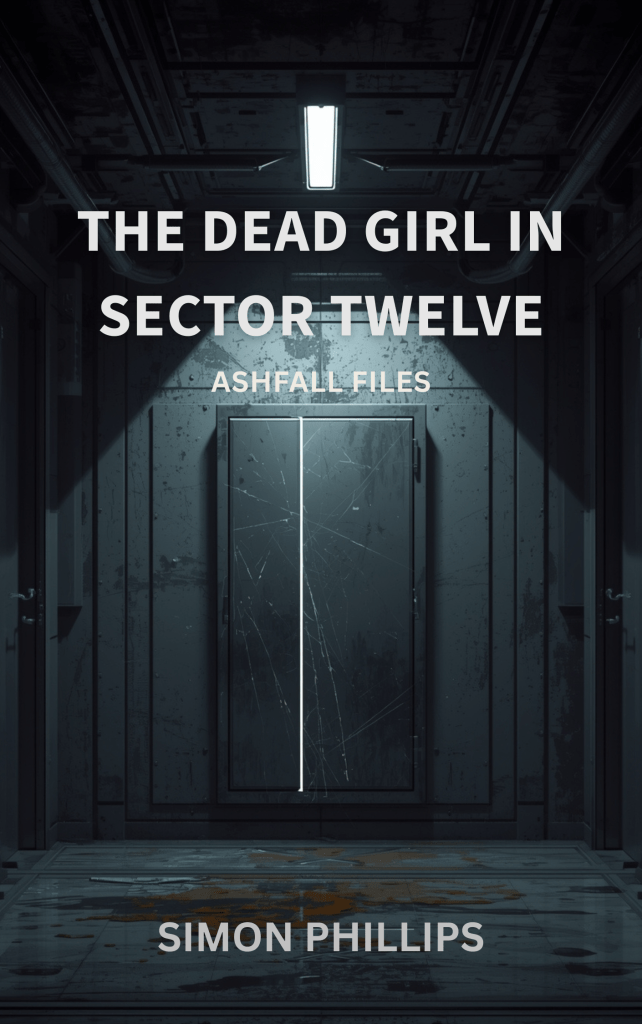
One such story unfolds aboard Ashfall Station, an ageing orbital installation whose corridors and industrial sectors form the setting for the science-fiction mystery novella Ashfall Station: The Dead Girl in Sector Twelve, where a routine investigation gradually reveals that something hidden within the station’s structure may have been present for far longer than the official records suggest.
Readers who wish to explore the full investigation and its unfolding events can find the novella below.
Inspector Halverin followed the station administrator along the docking corridor while the sounds of the bay settled into a steady industrial rhythm that seemed to pulse through every plate of metal beneath his boots. The corridor stretched forward beneath rows of amber maintenance lamps whose light reflected across the worn alloy floor in long warm bands. Along the distant walls, cargo machinery moved with patient deliberation while crews guided freight containers toward the interior lifts that carried materials deeper into the rotating ring of the station.
Ashfall possessed the atmosphere of a place whose working life had continued for so many years that every surface carried the quiet marks of labour. Rail tracks cut shallow grooves through the deck plating where freight trolleys had rolled for decades, and handrails bore the polished sheen left by countless gloved hands guiding themselves through artificial gravity shifts during docking operations. Above them, the massive skeletal framework of Docking Arm Twelve rose into the dimness like the interior of an enormous machine that had grown layer upon layer through successive expansions.
“Your arrival stirred a certain level of curiosity among the station crews,” the administrator said while guiding Halverin toward a security arch positioned at the end of the corridor. “Fleet inspections arrive rarely this far beyond the core trade lanes.”
Halverin glanced across the open docking chamber where two cargo haulers drifted slowly into their assigned berths while docking clamps moved outward to receive them.
“Curiosity usually accompanies uncertainty,” he replied. “Inspection orders tend to appear when Fleet administration begins reconsidering the value of a frontier installation.”
The administrator allowed a thoughtful expression to pass across her face while the security arch scanned Halverin’s identification tablet and cleared them into the interior access corridor.
“Ashfall has endured several such reconsiderations across its history,” she said. “Each time the station adapted to whatever circumstances followed.”
Beyond the checkpoint, the corridor widened into a long transit gallery whose walls were lined with structural ribs and exposed service conduits that carried power and atmosphere throughout the station. Freight lifts descended through circular shafts positioned at intervals along the passage, each platform transporting containers toward sectors hidden deeper within the ring. Overhead, the slow rotation of the station created a subtle sensation of movement, as if the entire structure breathed with mechanical patience.
Halverin studied the gallery while they walked, noting the layered architecture that revealed decades of construction phases. Some sections of the corridor carried the clean geometric lines typical of modern Fleet engineering, while older segments retained heavier structural plating from earlier eras when stations were built to endure harsher industrial demands. The result created a complex patchwork of engineering philosophies that had merged together through years of expansion.
“Fleet records describe Ashfall as a declining transfer hub,” Halverin said while examining a series of maintenance panels mounted along the wall. “Traffic levels appear healthier than the reports suggested.”
“Salvage operations increased across the outer debris field,” the administrator explained. “When older transport routes collapsed, many vessels and relay structures remained scattered across that region of space. Independent crews began recovering those materials several years ago, and Ashfall gradually became their primary staging port.”
The explanation carried the tone of an administrative summary that had been repeated many times. Halverin sensed an additional layer of thought behind the words, something unspoken that hovered beneath the careful clarity of the station official’s voice. Frontier installations often survived through precisely such quiet adjustments, yet the inspection reports resting inside Halverin’s tablet suggested deeper structural changes occurring within the station.
They passed beneath another bank of lighting where maintenance drones hovered close to the corridor ceiling while scanning the integrity of the power conduits embedded in the wall. Each machine moved with delicate mechanical grace, extending slender sensor arms that traced the seams between metal plates. The drones worked with such silent efficiency that their presence almost blended into the surrounding machinery.
“Your crew maintains a considerable amount of infrastructure,” Halverin observed. “The station appears larger than the official registry diagrams indicate.”
The administrator slowed slightly as they approached a junction where three corridors met beneath a circular observation window overlooking the inner ring of Ashfall Station. Through the glass, Halverin saw the immense curve of the rotating habitation decks stretching across the interior structure like the inside wall of a vast mechanical horizon. Cargo traffic moved along illuminated transit lanes while distant maintenance vehicles travelled between docking sectors that appeared as small points of light scattered along the ring.
“Ashfall grew in stages,” the administrator said while gesturing toward the interior view. “Each phase connected new construction to older frameworks. Salvage materials often supplemented the official supply chains during those expansions.”
Halverin listened while studying the station’s interior landscape. Layers of habitation modules, cargo corridors, and structural trusses formed a dense industrial ecosystem whose complexity extended far beyond the simple diagrams included in the Fleet archives. The station resembled a living organism assembled from decades of improvisation.
“Expansion during a period of declining traffic suggests unusual priorities,” Halverin said thoughtfully.
“Frontier economies evolve through necessity,” the administrator replied while guiding him toward a lift platform descending into the lower administrative decks. “Ashfall discovered ways to remain useful.”
The lift platform engaged with a low mechanical vibration and began its descent through the circular shaft that opened beneath the gallery floor. As the platform lowered into the interior levels of the station, Halverin watched the layered structure pass slowly around them, each deck revealing new corridors filled with workers moving between maintenance stations, habitation modules, and equipment lockers arranged along the walls.
Artificial gravity strengthened slightly as they travelled deeper into the rotating ring. The change produced a subtle shift in the balance of Halverin’s stance while the platform continued downward through the immense framework of the station.
Across the descending levels, he noticed several sealed corridors branching away from the primary decks. Their entrances carried reinforced bulkheads whose surfaces bore the faded markings of earlier construction authorities. Some appeared old enough to predate the most recent expansions recorded within Fleet engineering logs.
“Several sectors remain isolated,” Halverin observed while pointing toward one of the sealed passages sliding past the lift cage.
“Structural preservation zones,” the administrator said calmly. “Older engineering frameworks occasionally require separation from modern systems while reinforcement projects proceed.”
Halverin considered the answer while the lift continued its steady descent. Frontier stations possessed many hidden compartments where obsolete equipment waited for eventual removal. Yet the inspection reports inside his tablet contained references to unexplained power fluctuations originating from precisely such sealed areas.
The lift platform reached the administrative deck and slowed as the surrounding corridor came into view. Unlike the industrial spaces above, this level carried the quieter atmosphere of operational management. Offices lined the passage while communication terminals flickered with the pale light of long-range transmissions travelling between Ashfall and distant Fleet relays.
The administrator stepped from the lift and guided Halverin toward a wide observation corridor overlooking the station’s central command tower. From this vantage point, the immense rotating ring of Ashfall Station curved upward into the distance while the planet below cast a soft blue reflection across the lower structural beams.
Halverin paused beside the observation rail and studied the vast interior landscape spreading across the station. Freight moved through the illuminated corridors. Maintenance drones traced their patient circuits along the structural ribs. Human lives unfolded quietly inside thousands of compartments distributed across the rotating ring.
Ashfall continued its slow orbit above the silent world below while the machinery of the station carried on with the steady rhythm of a place that had grown accustomed to survival.
Yet somewhere within that immense industrial labyrinth, the inspection files suggested the presence of changes that had begun long before Fleet command issued the order that brought Halverin to this distant frontier installation.
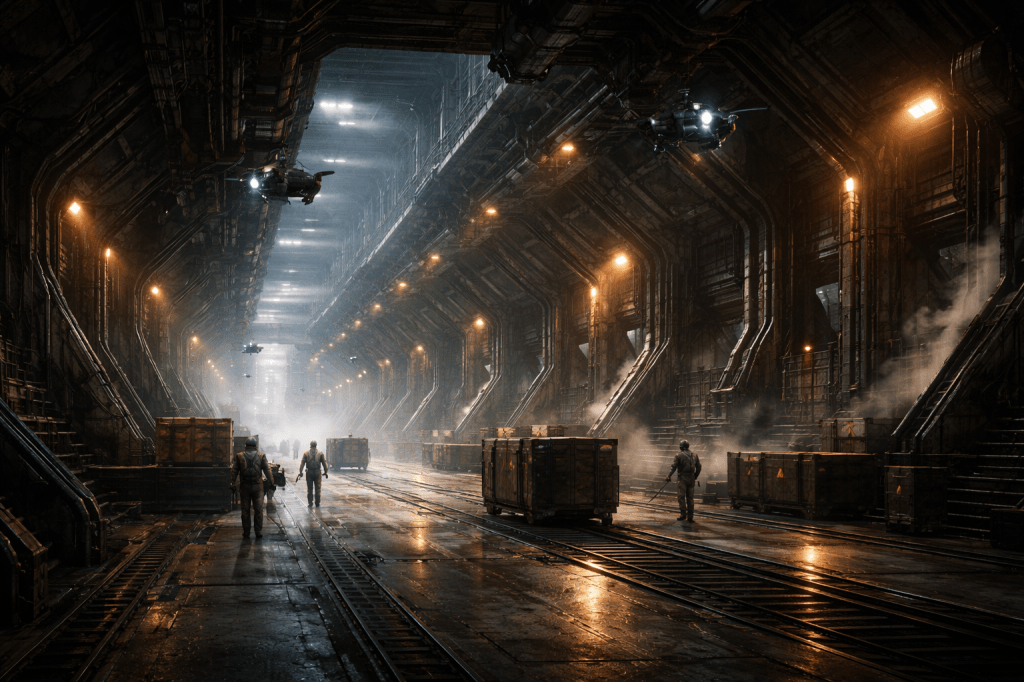
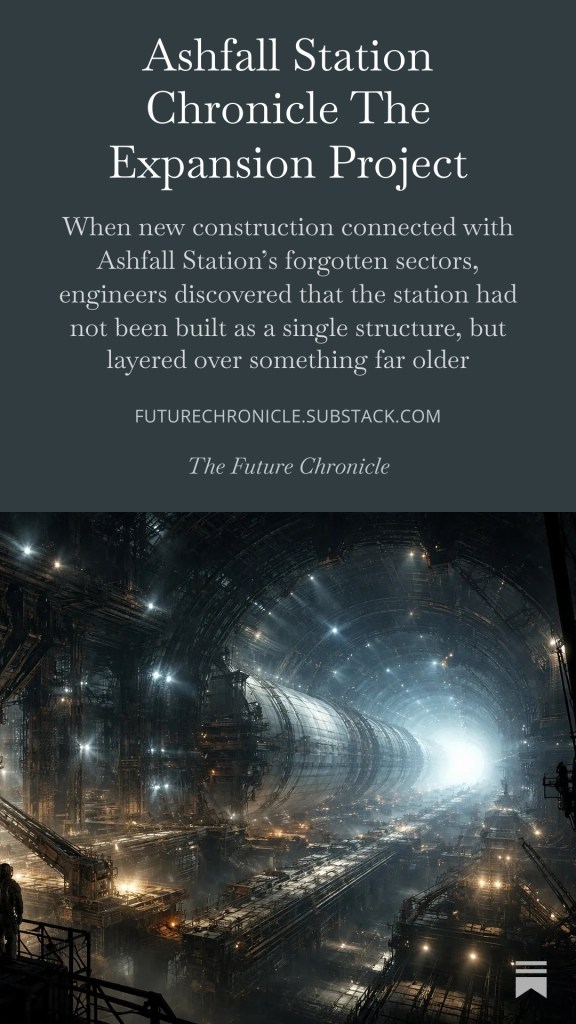
Docking Arm Twelve formed one of the oldest sections of Ashfall Station, a corridor of machinery and freight traffic where decades of expansion had layered new construction upon the station’s original industrial framework.
The Idea Behind the Chronicle
Large orbital stations like Ashfall appear frequently in science fiction, yet their origins come from very real ideas that engineers and planners have considered for decades. As humanity expands further into space, the distances between settled worlds grow wider, and the infrastructure required to support trade, travel, and exploration becomes increasingly complex. Vast stations positioned along transport routes would function as the ports and industrial centres of those distant frontiers.
Early visions of space colonisation imagined elegant rotating habitats filled with gardens and cities suspended in orbit, though the practical reality of expansion would likely unfold in a far more industrial manner. Freight depots, salvage ports, fuel processing hubs, and maintenance platforms would appear long before comfortable civilian settlements, and many of those installations would begin life as harsh working environments where engineers and cargo crews kept machinery running under difficult conditions.
Ashfall Station belongs to this imagined era of expansion. It represents the kind of installation built quickly to serve a specific economic purpose, then left to adapt when the frontier moved elsewhere. Across human history many places have followed a similar path. Mining towns, remote harbours, and railway settlements have often survived long after the industries that created them began to fade, reshaping themselves into something new through the quiet persistence of the people who remained behind.
The Chronicle of Ashfall explores that idea of survival and adaptation. A station designed for one purpose gradually becomes something more complex as new trades appear, old systems are modified, and sections of the structure accumulate decades of layered construction. Over time the installation begins to feel less like a machine and more like a living environment shaped by the countless lives that have passed through its corridors.
In such places the boundary between past and present becomes blurred. Old infrastructure remains hidden behind modern upgrades, forgotten corridors continue to exist beyond sealed bulkheads, and the history of the station lingers within the machinery that keeps it alive.
Ashfall Station therefore serves as both setting and character within the Chronicle, an immense frontier installation whose long history has left traces that the official records may never fully explain.
From the Author’s Desk
Ashfall Station began as a simple image that lingered in my imagination for several years: the idea of an immense industrial structure drifting at the far edge of human space long after the frontier that created it had moved on. Science fiction often grows most naturally from such quiet beginnings, where a single place or moment suggests a much larger history waiting somewhere beyond the visible story.
The Chronicles presented here explore the earlier life of that station, revealing small fragments of its past through the people who lived and worked within its corridors. Each episode focuses on a single event or encounter, gradually uncovering how Ashfall evolved from an ordinary frontier installation into a place carrying deeper layers of history hidden within its structure.
The novella Ashfall Station: The Dead Girl in Sector Twelve takes place much later in that timeline, when the station has already accumulated decades of expansion, modification, and quiet mystery. Writing the Chronicle series offers the opportunity to step backwards into that earlier period and observe the smaller moments that shaped the station long before the events of the investigation began.
Alongside these Chronicles I continue writing fiction across several science fiction and speculative projects, many of which explore frontier environments where technology, distance, and human persistence intersect in unexpected ways.
Readers interested in those stories can explore more through the links below.
Industrial stations such as Ashfall represent one of the most practical solutions to the challenge of distance in space exploration. Vast orbital platforms positioned along transport routes would form the logistical backbone of any expanding civilisation, providing docking capacity for freight vessels, repair facilities for long-range ships, and storage infrastructure for resources moving between distant systems.
During the earliest phases of expansion such stations would likely resemble harsh industrial environments rather than comfortable settlements. Engineers, cargo crews, and salvage operators would occupy modular habitats attached to immense structural frameworks designed primarily for durability and efficiency. Over time these installations might grow far beyond their original plans as new sectors were added to support changing economic activity.
Ashfall Station reflects this gradual evolution. A structure originally designed for ore transfer slowly becomes a hybrid of freight port, salvage hub, and frontier settlement as different industries pass through the system.
Salvage Economies
Salvage operations often emerge in regions where earlier waves of exploration have left abandoned infrastructure behind. Derelict cargo ships, obsolete relay stations, and fragments of industrial platforms may remain drifting through orbital space for decades or even centuries. Independent crews recover valuable materials from these forgotten structures and return them to frontier ports, where metal and components can be reused.
A station positioned near a large debris field would therefore become a natural gathering point for salvage crews and transport contractors. Over time such activity could replace the station’s original purpose entirely, allowing an installation once built for mining traffic to survive long after the surrounding resource economy has faded.
Layered Structures
One intriguing feature of long-lived orbital stations would be the accumulation of multiple engineering eras within a single structure. New modules could be attached to older frameworks, outdated systems might remain sealed behind bulkheads, and corridors originally designed for industrial machinery might later become part of habitation districts or storage sectors.
This layered architecture creates environments where the past remains physically embedded within the present. Forgotten corridors and abandoned compartments can persist inside the station’s interior, hidden behind structural reinforcements that few workers ever have reason to access.
Ashfall Station carries the weight of this accumulated history, a frontier installation whose present appearance reflects decades of adaptation, expansion, and quiet improvisation by the people who have kept its machinery running.
Next Chronicle
Several months before the inspection recorded in this Chronicle, a salvage vessel arrived at Ashfall Station after operating far beyond the normal navigation perimeter of the system. The ship returned with a fragment of unidentified structure recovered from deep orbit within the outer debris field, an object whose origin could not immediately be traced to any registered vessel or industrial installation.
Station logs record that the fragment was transferred quietly into a sealed research hold shortly after the salvage crew docked, and within a few hours the object disappeared from the public cargo registry entirely. Few workers on Ashfall understood what had been recovered from the silent region of space beyond the station, though rumours began to circulate through the docking sectors that the salvage crew had discovered something far older than the drifting wreckage normally collected from the debris field.
The next Chronicle returns to that earlier moment, when the salvage ship first approached the station carrying its unusual cargo and the events began that would slowly alter the future of Ashfall Station.
Next Week: The Salvage Run
Ashfall Station continued its slow orbit above the silent world of Kestren-4, carrying within its vast structure the quiet beginnings of events that few among its workers yet realised had already begun.
The raid that shattered the quiet of a sacred island and announced the coming of the Viking Age
Lindisfarne, Northumbria: June 793
The first light of morning crept slowly across the waters of the North Sea, pale and uncertain beneath a sky still heavy with the fading colours of night. Lindisfarne lay quiet upon its small tidal island, the stone church and timbered buildings of the monastery rising from the grass like an outpost of prayer set against the restless edge of the world. Waves moved softly across the rocks below the cliffs while seabirds circled through the cold air, their distant cries carrying over the water as the monks of the island prepared for another day within the rhythm of worship and labour.
Within the monastery walls the brothers moved through familiar duties. Candles burned low along the chapel as morning prayers echoed through the stone interior, the voices of the monks rising together in measured devotion. Beyond the church, fields stretched toward the narrow causeway that linked the island to the mainland during the turning of the tides. Cattle grazed across the wind-bent grass, and thin smoke drifted upward from hearth fires within the small settlement that had grown around the sacred house over many years of peace.
Lindisfarne had long stood as a place of learning and faith upon the northern frontier of the Christian world. Pilgrims travelled from distant lands to visit the shrine of Saint Cuthbert, whose memory lingered within the island’s stones and stories. Monks copied sacred texts within quiet scriptoria while travellers carried word of the monastery’s holiness across the kingdoms of Britain. Here, at the meeting of land and sea, prayer and scholarship joined with the slow patience of monastic life.
Far out upon the grey water a shape moved through the morning mist.
At first it seemed little more than shadow against the horizon, rising and falling with the long swell of the sea. The island still slept beneath the calm of early dawn, and the watchers upon the shore paid the distant shape little attention. Fishing vessels sometimes crossed these waters, and traders occasionally ventured along the coast when the weather allowed. The sea had always carried travellers toward Lindisfarne.
As the light grew stronger the shape divided into several darker forms, each carrying a tall sail striped with deep colour. The wind pressed against the cloth as the vessels advanced across the water with unsettling speed, their narrow hulls cutting through the mist that clung to the surface of the sea. Carved prows rose at the head of each ship, fierce figures of beasts staring forward as though guiding the fleet toward the island.
Along the monastery shore a few monks paused in their work and turned their eyes toward the approaching sails. The rising sun touched the striped cloth with a dull glow, revealing long rows of oars moving together against the tide. The vessels travelled with purpose, gliding across the water with a confidence that belonged to sailors long familiar with the harsh northern seas.
Lindisfarne had welcomed travellers for generations. Pilgrims, traders, and wandering priests had stepped upon its shores in search of blessing or refuge. Yet as the longships drew closer through the morning mist, a quiet unease began to settle across the island. The sea carried strangers once again toward the monastery of Saint Cuthbert, and the calm of that early morning slowly gave way to a moment that would echo across the centuries.
Timeline of Events
635 AD —The monastery of Lindisfarne is founded by the Irish monk Aidan under the patronage of King Oswald of Northumbria.
687 AD — Saint Cuthbert, one of the most revered figures in early English Christianity, is buried on the island, strengthening Lindisfarne’s reputation as a centre of pilgrimage.
8 June 793 AD — Viking longships land on Lindisfarne. The monastery is raided, monks are killed or taken as slaves, and sacred treasures are carried away.
794 AD — Further raids strike monasteries along the North Sea coasts, spreading fear across Christian Europe.
800–830 AD — Scandinavian raiders begin appearing regularly along the coasts of Britain and Ireland.
About the Creator
This Chronicle is written by Simon Phillips, author of several historical and speculative fiction works exploring forgotten worlds, myth, and the turning points of history.
The longships grounded upon the shingle with the hollow scrape of timber meeting stone as the tide lifted gently around their hulls. Oars rose from the water and rested along the gunwales while the crews stepped down into the cold surf, boots pressing into the shifting pebbles of the shore. Sea mist drifted across the island in thin veils that softened the line between land and water, yet the figures advancing from the ships carried a sense of purpose that cut through the quiet of the morning. Shields hung across their backs, axes rested in their hands, and the carved prows of the vessels behind them watched the island like silent guardians carved from dark wood.
From the fields near the monastery the first witnesses stood in uneasy silence. A herdsman gathering cattle paused beside a low stone wall and stared toward the unfamiliar sails that now rested along the edge of the sea. The sight travelled quickly through the small settlement clustered around the sacred house. Doors opened, tools lowered into the grass, voices carried across the wind as neighbours called to one another across the narrow lanes. Life upon the island moved according to seasons, prayer, and the turning of the tide, yet the presence of armed strangers upon the shore stirred a tension that spread through the community with gathering speed.
Inside the monastery the brothers continued their morning offices as candlelight flickered against the worn stones of the chapel. Voices rose together in steady prayer beneath the timbered roof while thin smoke from the altar lamps drifted through the cool air. The bell had already marked the beginning of the day’s devotion, and the monks followed the rhythm that had shaped life on Lindisfarne for generations. Outside the chapel walls the wind moved through the long grass and carried faint echoes of movement from the shoreline where the strangers crossed the sand.
The first warning arrived through the courtyard with hurried footsteps striking the flagstones. A lay brother entered the chapel with breath still sharp from running, his words spilling through the quiet hall as he spoke of ships resting upon the shore and warriors moving across the island. The prayer faltered, voices fading into silence while several monks stepped toward the doorway to see the horizon with their own eyes. From the rise above the buildings the sails could still be seen above the mist, striped cloth lifting gently in the wind that had carried the vessels from distant seas.
The warriors advanced across the fields with measured confidence, their line spreading gradually as they approached the cluster of buildings that formed the monastery. Lindisfarne had stood for many years as a sanctuary at the edge of the Christian world. Pilgrims travelled from far kingdoms to kneel beside the shrine of Saint Cuthbert, whose memory shaped the identity of the island. Kings sent gifts of silver and gold to honour the holy place, and within its walls scribes laboured patiently over manuscripts that carried sacred words across generations. The quiet structures of timber and stone therefore held wealth that extended beyond prayer alone.
The raiders moved with the discipline of men familiar with coastal settlements and the riches that lay within them. Doors splintered beneath heavy blows from iron axes, wooden chests were dragged into the open courtyards, and the contents of storerooms spilled across the ground as warriors searched for vessels, ornaments, and coin. Monks scattered through the narrow paths between the buildings, some fleeing toward the fields while others gathered within the chapel where the shrine of Saint Cuthbert rested beneath its coverings. The calm order of the island dissolved into movement, shouts, and the crash of breaking timber.
Violence swept across the monastery with swift force. Several brothers fell beside the buildings where they had lived and prayed for years, while others were driven toward the beach where ropes bound their hands and forced them toward the waiting ships. The raiders carried away vessels of silver, reliquaries decorated with precious metal, and manuscripts whose value lay as much in the materials that adorned them as in the words written upon their pages. Leather sacks filled with ornaments passed from hand to hand while warriors moved between the buildings with practised speed.
Smoke soon lifted into the morning air as scattered fires began to take hold among the wooden structures that surrounded the stone church. Flames climbed along roof beams while sparks drifted across the grass that bordered the settlement. The sea wind carried the scent of burning timber across the island and mingled it with the salt air rising from the water below the cliffs. Beyond the smoke the longships waited upon the tide with quiet patience, their crews moving steadily between shore and vessel as the plunder of the monastery gathered within the hulls.
By the time the sun climbed higher above the sea the raiders had begun to withdraw toward the beach. Captives were driven ahead of them across the stones while the remaining warriors carried the final bundles of treasure toward the waiting ships. Oars slid once more into their places along the sides of the vessels, and the tide that had carried the fleet toward Lindisfarne now prepared to bear it back across the northern sea. When the sails lifted again above the water the longships glided away from the island with the same quiet certainty that had marked their arrival.
After the vessels vanished into the pale distance a heavy stillness settled across Lindisfarne. Smoke drifted above damaged buildings while survivors moved cautiously through the ruins that surrounded the chapel. The shrine of Saint Cuthbert remained standing within the stone church, though the community that had guarded it now faced a future shaped by loss and uncertainty. The island that had once seemed a place of safety at the edge of the world had learned that the northern seas carried forces capable of reaching even the most remote sanctuary.
News of the attack travelled quickly across the kingdoms of Britain. Messengers rode south through Northumbria bearing word of the assault upon the holy island, and chroniclers recorded the shock that spread among rulers and churchmen alike. The raid upon Lindisfarne soon became a symbol of a wider change unfolding along the coasts of Europe. From the fjords and harbours of Scandinavia seafaring communities had developed vessels whose speed and flexibility opened distant shores to sudden arrival.
In the years that followed, similar ships would appear along rivers and coastlines throughout the British Isles and the continent beyond. Monasteries once regarded as places of peace began to watch the horizon with wary eyes, and kings slowly recognised that the northern seas had produced a new power shaped by wind, timber, and the ambitions of sailors whose world stretched far beyond their home shores. The morning at Lindisfarne therefore marked more than a single raid upon a monastery. It signalled the arrival of an age in which the Northmen would travel across Europe, leaving traces of their voyages in the history of every shore their longships touched.
Iron Viking axe of the early medieval period. Weapons of this type were commonly carried by Scandinavian raiders during the first coastal attacks along the North Sea in the late eighth century.
Inspiration Behind the Story
Moments such as the raid upon Lindisfarne hold a powerful place in the imagination of history because they reveal how suddenly the direction of an age can change. The island itself was small and remote, resting quietly at the edge of Northumbria where the tides shaped daily life and the monks followed a rhythm of prayer that had endured for generations. Within those simple buildings lived a community devoted to study, worship, and the preservation of sacred texts that carried the memory of early Christianity across the British Isles.
The arrival of the longships transformed that quiet place into a turning point remembered across centuries. The attack carried a symbolic weight that travelled far beyond the stones of the monastery. Chroniclers across Christian Europe recorded the event with alarm, and their words preserved the moment when distant northern sailors first appeared upon the shores of Britain with violent purpose.
What fascinates many readers about Lindisfarne lies in this collision between two worlds that had grown apart across the sea. On one side stood a spiritual centre shaped by devotion and learning. On the other approached seafarers whose lives revolved around travel, trade, and the opportunities offered by distant coasts. The meeting of those two worlds created a shock that echoed through the chronicles of the age.
The raid therefore marks more than the destruction of a single monastery. It reveals the opening chapter of a long period during which Scandinavian voyagers would sail across rivers and seas throughout Europe. Lindisfarne became the moment when that wider story first entered the written memory of the continent, carried forward by the frightened words of monks who had witnessed the horizon change forever.
From the Author’s Desk
Thank you for reading the first Chronicle. Each week this publication revisits a single moment from the past, told through narrative so the atmosphere of history can emerge through place, people, and consequence.
Alongside the Chronicle, my fiction writing continues across several projects. Short stories and novellas are available through Kindle, while my YouTube channel hosts regular Mini-Reads and Flash-Fiction episodes where short pieces of storytelling are presented in a visual format.
Readers who enjoy historical atmosphere, mythic themes, and narrative storytelling may find those projects worth exploring through the links included in this publication.
Early medieval monasteries often stood in exposed coastal locations where travel by sea offered the easiest route for pilgrims and visiting clergy. Over time these communities accumulated valuable objects given by kings, nobles, and wealthy patrons. Silver vessels used in the liturgy, reliquaries containing fragments of saints’ remains, and manuscripts bound with decorated fittings gradually filled monastic treasuries. Word of such wealth travelled widely across the trading networks of northern Europe, and seafaring communities in Scandinavia understood that these quiet religious houses offered both treasure and limited defence.
Contemporary chroniclers reacted with alarm when news of the Lindisfarne attack spread. One of the most famous records appears in the Anglo-Saxon Chronicle, where the event was described as a fearful sign that struck the Christian world with dread. Other writers interpreted the raid as a divine warning, linking the violence to moral decline within the kingdoms of Britain. Such responses reveal how shocking the attack seemed to those who believed the monastery of Saint Cuthbert stood under sacred protection.
Related Events
The raid on Lindisfarne soon proved to be the beginning of a wider pattern. In the years that followed, Scandinavian ships appeared along other parts of the British coastline. Monasteries in Ireland experienced similar attacks, and by the early ninth century Viking raiders had begun to travel further south along the coasts of continental Europe. These early expeditions focused mainly on quick strikes against coastal settlements before returning home with captured wealth and prisoners.
Later generations would witness a change in these northern voyages. Larger fleets began to remain in foreign lands for longer periods, establishing winter camps and eventually settlements. The first appearance of the longships at Lindisfarne therefore stands at the threshold of a transformation that reshaped the history of Britain and much of Europe.
Further Reading
The Vikings – Else Roesdahl The Viking Age – Anders Winroth The Viking World – Edited by Stefan Brink and Neil Price
Next Chronicle
Within a generation of the raid on Lindisfarne, the longships returned to the coasts of Britain again and again. Monasteries and river settlements soon learned to watch the horizon with wary eyes as Scandinavian raiders pushed further inland along the waterways of Northumbria and beyond.
In the next Chronicle we travel forward to another moment when the northern sea carried warriors toward the shores of England, and a kingdom began to realise that the age of occasional raids was giving way to something far more enduring.
Across the grey waters of the North Sea the longships faded into the morning mist, leaving Lindisfarne changed forever and the horizon of Europe quietly altered.
Ashfall Station kept its corridors lit because darkness made people ask questions.
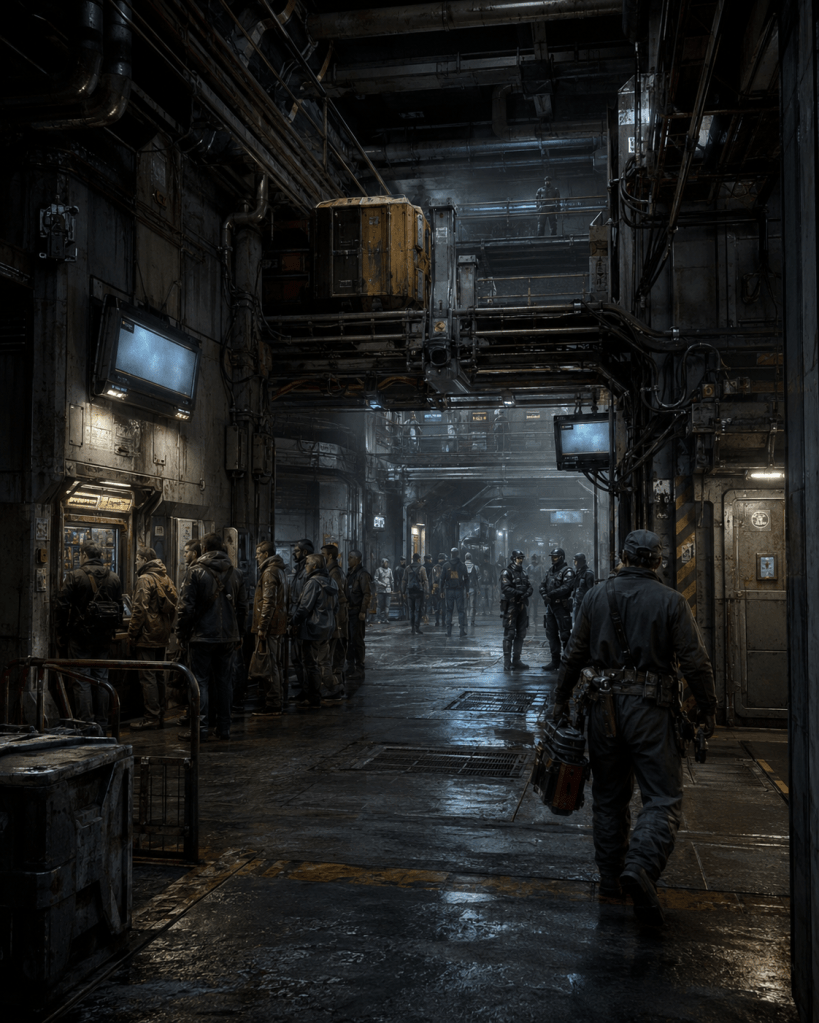
The light was rarely clean. It came from failing strips fixed into patched ceilings, from public screens rolling calm station updates over ration queues, from warning panels that flickered above bulkhead doors which sealed too slowly during drills and too quickly during unrest. Every surface carried the memory of pressure. Scratched metal. Repaired seams. Old stains worked into floor plating by boots, coolant, and time.
For readers entering a sci-fi noir novella, that kind of world matters. A crime aboard a space station only carries weight when the station itself has something to hide. Ashfall Station is built around that pressure. It is an orbital place of work, scarcity, surveillance, and exhausted routine, where a death can be filed as maintenance failure before anyone has finished looking at the body.
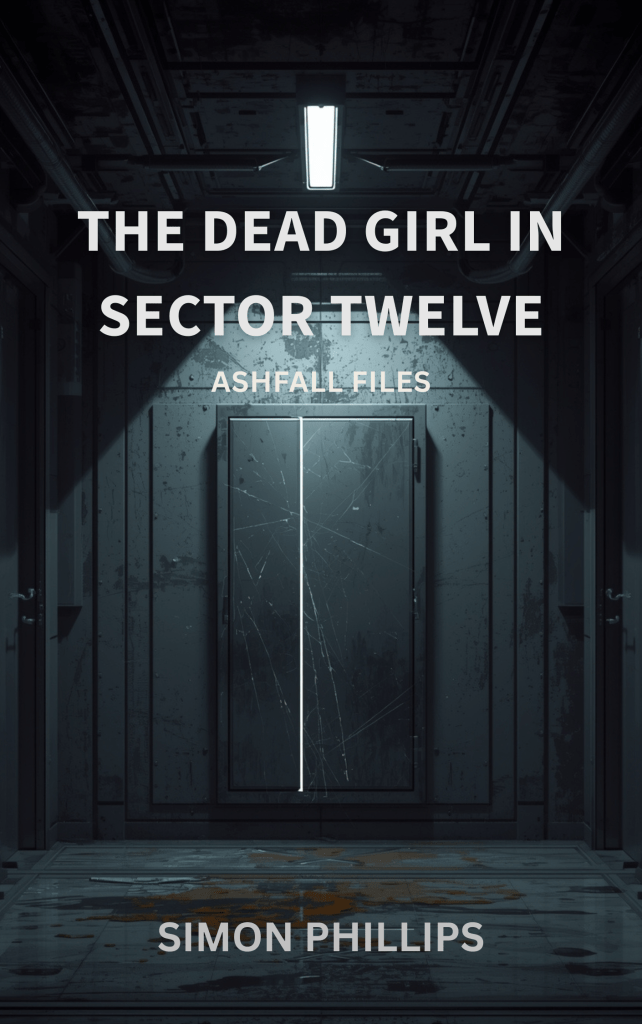
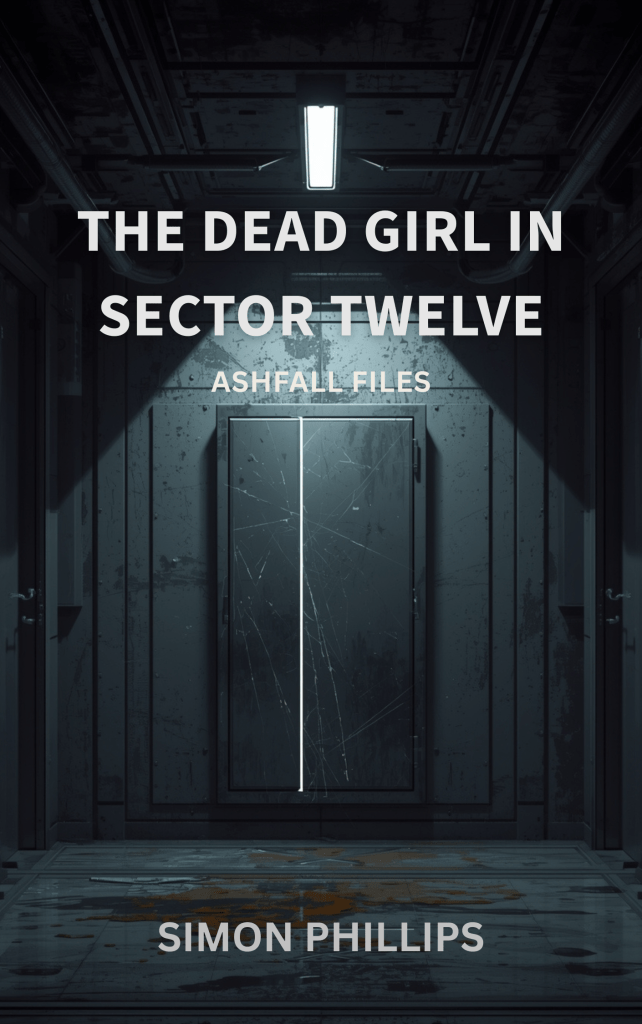
The first case, The Dead Girl in Sector Twelve, opens the door into an atmospheric sci-fi noir world shaped by crime, rationing, damaged infrastructure, official silence, and the slow corrosion of trust. It is a space station crime thriller built around investigation rather than spectacle, where one body in a ventilation shaft reveals more about the system around it than the system is willing to admit.
When a Body Becomes a Question
A failing station teaches people to lower their expectations before it teaches them to survive.
On Ashfall, power dips are routine until they happen at the wrong moment. Missing camera feeds become technical faults until they protect the wrong person. Records vanish into administrative language. Witnesses remember enough to be frightened, then stop speaking before a name leaves their mouth.
That is the central pressure of the series. Crime on Ashfall Station grows from scarcity and neglect. People steal ration tokens because water has value. They lie to security because truth carries cost. They move through half-lit service corridors because official routes belong to patrols, supervisors, cameras, and Fleet oversight. Every investigation becomes a study of how people behave when survival has narrowed their choices.
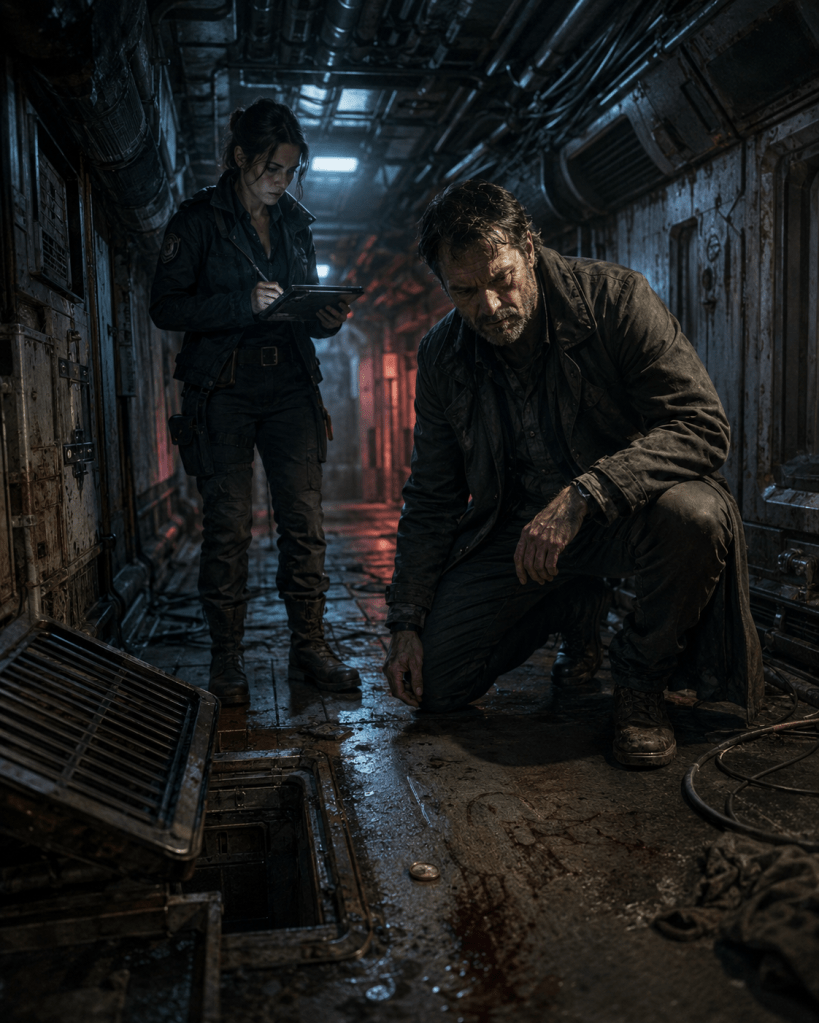
The noir element emerges through that moral compression. Ruff Kale, the detective at the centre of the Ashfall Files, understands the station too well to trust its explanations. He knows how quickly a report can soften a death into an incident. He knows the difference between disorder and arrangement. He knows silence when it has been trained into a room.
Lena Marik enters the case with procedure, discipline, and a belief that careful work still matters. Her presence gives the investigation its second pressure point. She records, checks, documents, and follows the lines the system claims to respect. The case teaches her what happens when those lines lead directly into obstruction.
Together, Ruff and Lena form the human scale of the wider Ashfall cycle. He reads the station through habit and damage. She reads it through records and inconsistencies. Between them, the reader sees how a corrupt space station fiction world becomes believable: through the small details that refuse to align.
A death in Sector Twelve becomes more than a crime scene. It becomes a question.
Who benefits when the records clear themselves?
Who decides which worker stays visible?
Who controls the broadcasts that tell civilians everything remains stable?
And what kind of authority needs a dead maintenance courier forgotten so quickly?
The Dead Girl in Sector Twelve
The Dead Girl in Sector Twelve is the first novella in the Ashfall Files cycle, and it works as the opening case in a larger detective science fiction series. The surface story is controlled and intimate: Ruff Kale and Lena Marik investigate a young woman found dead inside a maintenance shaft in Sector Twelve. Her placement feels wrong. Her records have been stripped. The systems around her hesitate in ways old infrastructure alone cannot explain.
Its strength lies in how quietly it expands. The investigation starts with a body, then moves through missing logs, frightened workers, erased evidence, and Fleet pressure. The case never needs to announce itself as a space station conspiracy. It becomes one through behaviour. A supervisor answers too quickly. A corridor falls silent. A witness disappears from the record before anyone can take a statement. An official explanation arrives with suspicious speed.
The result is an adult science fiction mystery rooted in atmosphere and consequence. The reader is taken through service corridors, Freight Spine noise, tired workers, precinct pressure, and the controlled politeness of authority. Ashfall Station never pauses to explain itself. It continues running, which makes its cruelty feel more convincing.
This opening novella also establishes the wider Ashfall Files method. Each case can be entered as a contained investigation, yet each one contributes to the larger movement of the station. A single death leads toward erased records. Erased records lead toward missing witnesses. Missing witnesses lead toward Fleet jurisdiction. Fleet jurisdiction points toward something far larger than the official report.
That sense of scale remains restrained. The story stays close to Ruff, Lena, and the immediate investigation. It lets the reader feel the conspiracy through pressure before understanding its full shape.
Ashfall Station as a Living Pressure System
Ashfall Station is a living pressure system.
Its sectors carry their own forms of decay. The Upper Concourse holds the polished language of administration and command. The Mid-Ring carries family noise, work exhaustion, and ration anxiety. The Freight Spine moves cargo, rumours, bribes, and bodies of evidence that pass through too many hands. The Red Decks hold the markets, dens, gangs, and informal networks that flourish wherever official supply fails. Beneath them all, the Underworks remain close, dark, humid, and only partly mapped.
Earth Fleet sits across that structure as authority, security, and threat. Its power appears through access locks, jurisdictional claims, missing files, controlled announcements, and the careful shaping of public truth. Fleet control is rarely dramatic at first. It arrives as a polite correction. A procedural reminder. A closed file. A warning phrased so cleanly it leaves no mark.
That is what makes Ashfall Files work as political sci-fi thriller material. The politics are lived before they are named. Civilians feel them in ration lines. Workers feel them when patrols pass. Detectives feel them when evidence disappears from intake. The station’s broadcasts ask people to remain calm while the people closest to the damage already understand that calm is being manufactured.
Ruff’s investigations provide the entry point into this world. He walks the corridors, talks to workers, pressures informants, reads silence, and notices when a room has been made too clean. Lena brings structure and conscience, forcing the case into forms the system then tries to corrupt. Her role matters because Ashfall needs someone who still believes procedure should protect people. Watching that belief bend under pressure gives the series its emotional edge.
The wider Ashfall Files cycle moves from grounded crime into civil fracture. That movement begins here, in small ways. A dead worker. A missing shard. A witness erased from housing records. A public system that keeps speaking after truth has been removed from the room.
A station never collapses all at once. It teaches collapse in stages.
First, people accept faulty lights.
Then they accept missing footage.
Then they accept closed reports.
Then they accept the absence of someone they spoke to yesterday.
By the time open unrest arrives, the damage has already been living in the walls.
The First Thread of the Ashfall Files
The Dead Girl in Sector Twelve matters because it begins with a simple institutional reflex: make the problem small enough to file.
That is how power survives aboard Ashfall Station. It reduces a life to a case number. It reduces fear to rumour. It reduces obstruction to procedure. It reduces truth to something that can be delayed until the station moves on.
Ruff Kale knows better than to expect justice from the machinery around him. Lena Marik still needs to learn how much machinery can lie. Between them, the first Ashfall Files case becomes a quiet act of resistance, carried through observation, unease, and the refusal to let a dead girl vanish cleanly into official language.
The station continues to hum. Broadcasts continue to roll. Ration queues continue to form beneath flickering light.
Somewhere inside that noise, the first thread has already been pulled.
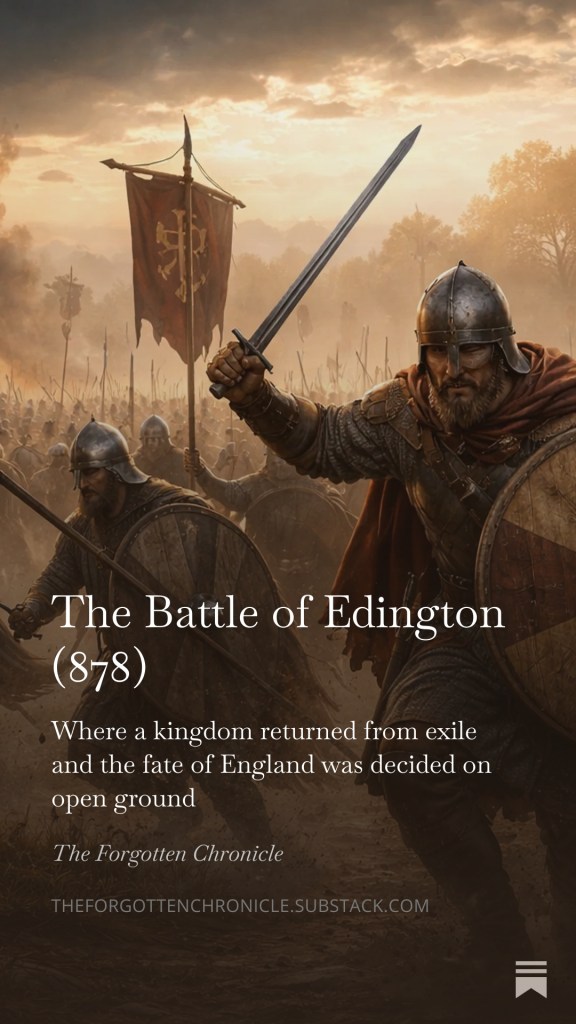
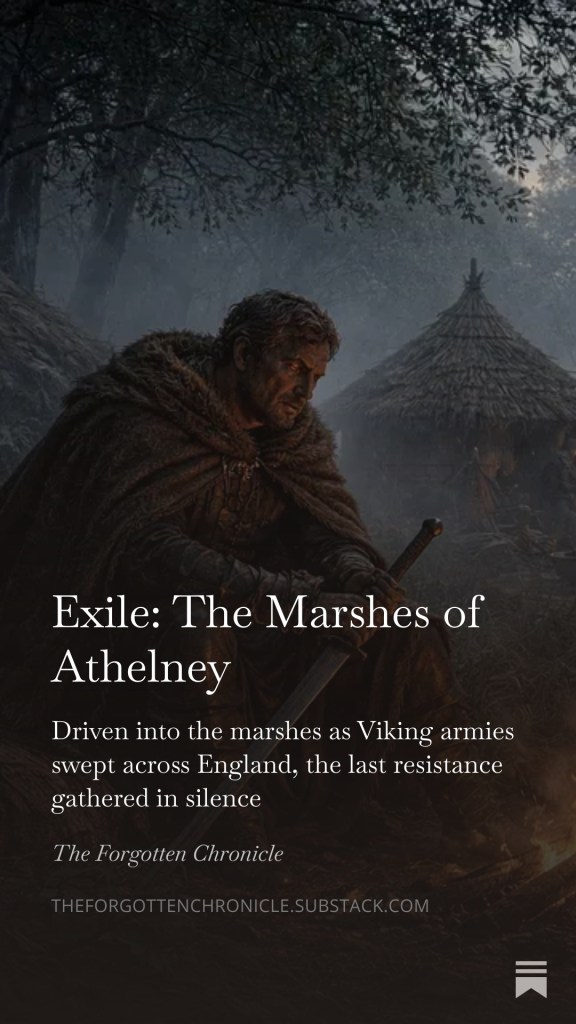
The Battle of Edington stands among the defining moments of Viking Age England, though its force came from more than one clash of shield walls. By the spring of 878, Wessex had endured months of fear, retreat, and narrowing hope. King Alfred had been driven into the marshes, Guthrum’s power pressed deep into the land, and the last major Anglo-Saxon kingdom still standing faced the real prospect of being swallowed into a wider Scandinavian dominion. Edington matters because it was the place where that pressure met resistance strong enough to hold, turn, and endure.
Fields such as these rarely keep their shape in memory. Names survive. Chronicles compress. Later generations return to a few hard facts, then leave the land itself behind. Yet the ground at Edington, most commonly associated with Wiltshire, belonged to a world where slope, weather, footing, and visibility could shape the fate of kingdoms as surely as kings or captains. The battle emerged from a season of concealment, from the marshland refuge at Athelney, from summons carried quietly through farms and tracks, and from a gathering at Egbert’s Stone that transformed hidden loyalty into open resolve.
A Kingdom Pressed to the Edge
Late ninth-century England carried the strain of repeated Viking campaigns. Earlier raids had already altered the imagination of Christian Britain, beginning with the shock at Lindisfarne and growing into something broader and heavier as longships returned along coasts and riverways. By the 860s and 870s, the conflict had moved far beyond plunder. The Great Heathen Army had shifted the pattern from seasonal assault to organised invasion, and major Anglo-Saxon kingdoms felt the consequence in succession. Northumbria suffered collapse, Mercia fractured, and Wessex came under gathering pressure until its survival seemed uncertain.
That wider pressure gives Edington its true shape. A single battle can attract attention through scale or drama alone, though Edington carries a deeper pull because it rose from exhaustion. Alfred’s retreat into Athelney in early 878 has often been remembered as an image of refuge, a king hidden among reed beds while the rest of his world stood under hostile power. The image remains powerful because it speaks of reduction. Royal authority had narrowed to survival. The kingdom endured, though in diminished form, held together through memory, loyalty, and whatever could still be gathered in secret.
This is where the story acquires its distinctive weight. Edington was never simply a day of battle. It was the visible release of months lived under strain. Men arrived there through hidden roads and uncertain loyalties. Messages passed quietly across Wessex. Fragments of resistance began to recognise themselves as a force. At Egbert’s Stone, concealment gave way to muster, and with that shift the kingdom moved from endurance towards confrontation.
From Athelney to Edington
The journey from marsh refuge to battlefield was as important as the clash itself. Historical memory often prefers the instant where armies meet, since battle offers a clean edge in the record. Life within the months before it resists that kind of neatness. Alfred’s movement out of hiding and into command marked a return of structure at a moment when disorder had spread widely across the land. He was no longer surviving at the edge of his kingdom. He was gathering it back into form.
That motion towards Edington signalled something larger than military readiness. It restored the idea of Wessex in visible form. Men who had endured the same fear now stood together beneath shared authority. The countryside they crossed had already been shaped by recent campaigning, and every mile towards confrontation narrowed the space in which Viking control could appear secure. A battle fought in such a setting carried symbolic force long before the first shield struck. It told the land that resistance had returned from concealment and was willing to stand in the open.
The likely site in Wiltshire also suits the feel of the event. Open ground, rising slopes, damp earth, and the slow lifting of mist all belong naturally to the Chronicle’s treatment of Edington, and they belong to the logic of ninth-century warfare as well. This was a military world shaped by formation, cohesion, and physical pressure. A battlefield was never a blank stage. Ground mattered. Pace mattered. The firmness beneath a warrior’s feet mattered.
Why the Battle of Edington Mattered
The Battle of Edington mattered because it interrupted a direction of travel that had seemed increasingly difficult to reverse. Viking expansion across England had developed through speed, adaptability, winter campaigning, and the ability to turn mobility into settlement. Guthrum’s force entered Edington with the confidence of men shaped by earlier success. Alfred’s army entered it with something different: the knowledge that defeat could mean the loss of the final independent Anglo-Saxon kingdom.
Combat in this period relied heavily on the shield wall, on tightly formed ranks, disciplined pressure, and endurance within close fighting. This was no age of sweeping cavalry charge or elegant battlefield manoeuvre. Such encounters could become grim tests of steadiness, where a small failure in the line might widen into collapse. Alfred’s advantage lay partly in position. The Chronicle’s account places the West Saxon line on higher ground, a subtle factor with practical consequence. Firmer footing, resistance against an upward press, and the ability to hold formation under strain all contributed to a turn that began slowly and then became decisive.
That gradual turn is one of the most compelling elements in the whole episode. Edington was no sudden miracle. It was pressure answered by greater steadiness. The Viking line bent, then yielded. Guthrum’s men withdrew towards a fortified position, and the campaign moved into siege. Victory on the field alone would already have mattered. Victory followed through into confinement and submission changed the political future of England. Guthrum sought terms. His later baptism carried both religious symbolism and political weight, and the settlement opened the way towards the territorial division that would become associated with the Danelaw.
Seen in that light, Edington was a hinge. It preserved Wessex, checked a conquest that had seemed close to completion, and reshaped the terms by which Saxon and Viking power would coexist across England. The aftermath extended far beyond the battlefield. Law, identity, frontier, and settlement all moved within the current released by that victory.
The Weight of the Field in The Forgotten Chronicle
This is one reason The Forgotten Chronicle approaches Edington through atmosphere before explanation. The publication’s voice is built around slow immersion, environmental storytelling, and a calm authority that allows historical pressure to emerge through place, weather, silence, and consequence. In Chronicle 8, the field appears through mist, dew, slope, and waiting lines of men before the larger argument of history becomes visible. That approach gives the battle back its human scale.
Readers arriving through the Chronicle encounter Edington as a threshold rather than a summary. The free opening enters the field at dawn, with Alfred’s army standing above the lower ground where Guthrum’s force waits within the haze. From there the full Chronicle carries the reader into the clash itself, the retreat, the siege, and the political consequence that followed. The piece belongs to the wider Viking Age in England sequence, where earlier entries chart the movement from first coastal shock towards invasion, settlement, exile, and eventual reversal. Chronicle 8 sits at the point where that arc tightens and breaks open.
For readers who want a visual threshold into the same moment, the short companion video offers another entry into the atmosphere of the field: watch the Visual Chronicle on YouTube. The focus remains the same: mist-covered ground, gathered ranks, and the sense that a kingdom has reached the place where concealment ends and decision begins. The aim is less explanation than pressure, less lecture than recovered fragment.
The wider body of Simon Phillips’s work also sits beside the Chronicle in useful ways for readers drawn to historical atmosphere, memory, and worlds shaped by hidden turning points. The books page linked through the Chronicle offers that further route: explore the books here.
A First Step into Chronicle 8
For anyone approaching the Viking series for the first time, Edington makes a strong threshold because it holds several layers at once. It is a battle. It is a recovery from exile. It is a study in how kingdoms survive through patience before they survive through force. It is also the beginning of another kind of settlement, since the defeat of Guthrum did more than preserve Wessex. It prepared the ground for a divided England, for a world in which Viking presence would remain embedded across law, language, and place long after the shield walls had broken apart.
That movement from battlefield into settlement gives Chronicle 8 its lingering force. The field itself falls quiet again, as all battlefields do. Grass returns. Paths resume. Names outlast the voices that once carried across the slope. Yet some places continue to hold a larger shape in memory because what was decided there kept moving long after the fighting ended. Edington belongs to that kind of ground.
Where the Past Keeps Its Pressure
The past rarely survives in full. More often it reaches us in fragments, in names, in a contested location, in a chronicle line, in the memory of a king who vanished into marshland and reappeared with an army. The Battle of Edington endures because the record still carries the pressure of that return. Wessex stood close to eclipse. Alfred gathered what remained. A field in Wiltshire became the place where retreat ended and a kingdom recovered its footing.
That is why Edington continues to draw readers. It offers more than victory. It offers the moment when hidden endurance takes visible form. Through The Forgotten Chronicle’s Chronicle 8, that field opens again, quiet at first, then filled with weight, until the mist lifts and the shape of the struggle stands clear. History remains there, waiting in the grass and slope, carrying forward the old pressure of a morning when Wessex chose its ground.
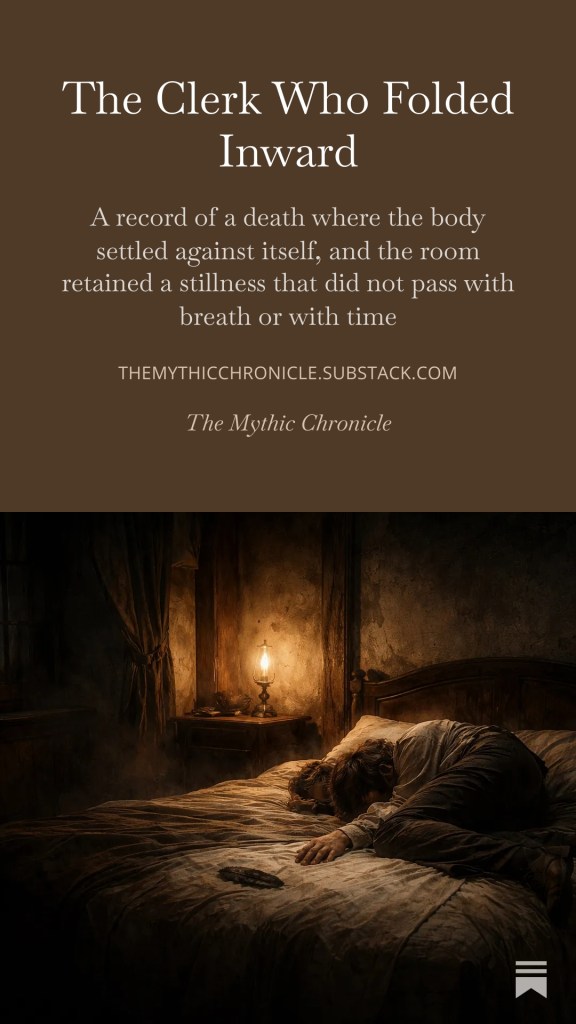
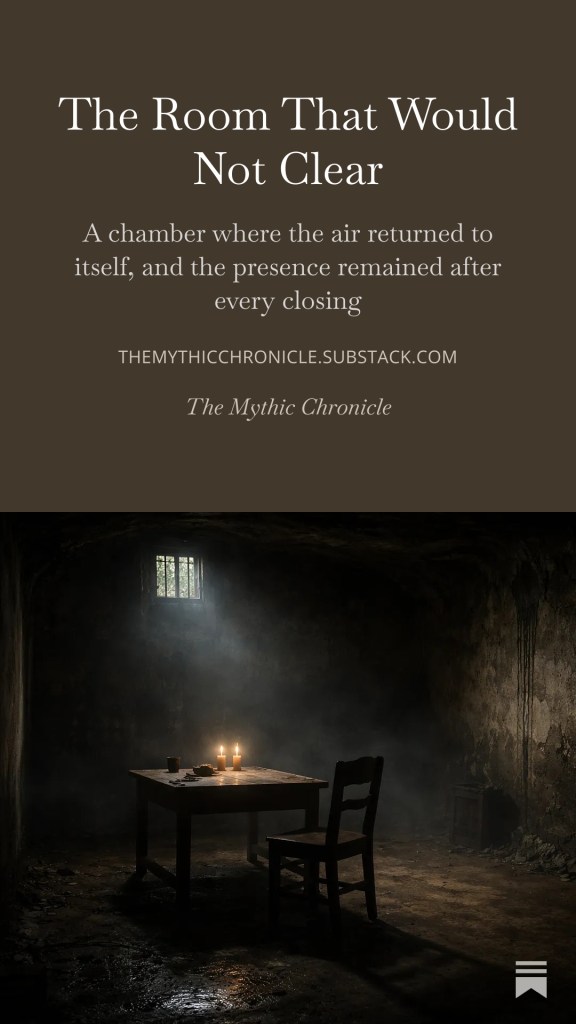
A haunted room in dark fantasy exerts its power through air, pressure, silence, and arrangement. The door closes, the bed remains where it stood, the chair faces the table, the papers wait in their ordered stacks, and still the place feels altered, as though an event has settled into the grain of the world and chosen to remain. Among ancient-feeling fantasy settings, this kind of chamber carries a singular force, since it suggests that memory can cling to matter itself, entering timber, plaster, cloth, and breath until place becomes witness.
That quiet form of haunting carries a deeper hold than spectacle ever could. A monstrous shape may terrify for a moment, while a room that has learned how to keep an absence can linger for far longer, pressing upon the reader with a slower and more intelligent unease. Such spaces feel lived in. They have served ordinary tasks. They have known routine, labour, sleep, ledgers, heat, and dust. Then something enters the pattern, and the familiar order of daily life begins to gather a second meaning.
This is where dark fantasy often finds its most lasting power. The haunted room stands at the meeting point between domestic habit and mythic disturbance. A house may appear ordinary from the lane below. An upper chamber may seem suited to work, sleep, or prayer. Yet once the atmosphere inside it begins to return in the same form after each interruption, the reader senses that the structure itself has joined the story. The haunting no longer belongs to a single hour. It belongs to the building.
The Room as a Vessel of Memory
Old fantasy worlds carry weight through layers. Streets rise above buried foundations. Chapels stand over sealed passages. Walls accept repair after repair until the visible surface and the hidden structure cease to belong to the same age. Within such places, a room becomes more than an enclosed interior. It becomes a vessel, holding the residue of every gesture that has passed through it.
A chamber used for work and rest is especially potent because order makes disturbance easier to feel. A ruined hall already bears the signs of collapse. A battlefield already carries violence in its soil. An occupied room, however, presents another kind of tension. Its chair remains in place. The cord around the papers stays tight. The coverlet lies smoothed from the morning. Every ordinary object reassures the eye, while the air itself begins to resist that reassurance. The result is a far quieter species of dread, one grounded in small recognisable details that begin to estrange one another.
This matters in mythic fantasy because memory seldom survives in complete form. It comes back through fragments, gestures, reports, and traces. A retained smell. A pressure upon the chest. A recurring stillness after the window stands open. These signs feel older than explanation. They belong to the realm of preserved account and partial witness, where certainty thins and atmosphere grows stronger.
In such writing, the room becomes a page that cannot stop rewriting itself. Each person who enters adds a further layer of record, though the deepest impression lies below language. What remains strongest is rarely the formal cause entered into a ledger. What remains strongest is the sense that the place itself has chosen to keep something.
Why Stillness Disturbs More Deeply Than Apparition
Stillness is often more frightening than motion because it suggests patience. An apparition arrives and startles. A sound in the wall provokes immediate alarm. A room that settles into a fixed condition after every disturbance offers something colder. It conveys duration. It implies that the event within the chamber has already passed into the structure, where it can endure with no visible effort.
This is one reason dark fantasy readers remain drawn to enclosed spaces shaped by silence. Silence in such settings never feels empty. It feels occupied. The absence of noise becomes its own kind of presence, and the reader begins to listen for what the room already knows. A hush over a bed, a dimness that gathers too quickly, air that weakens before it reaches the centre of the floor: these details create dread through restraint. The imagination then completes what the record declines to state.
The ancient atmosphere of a mythic setting strengthens that effect. In a contemporary apartment, stillness may suggest poor ventilation or an unpleasant memory. In an older fantasy city built over forgotten works, stillness feels tied to inheritance, ritual failure, or a pressure buried within the foundations. The room belongs to a wider order of things. It has neighbours above and below, and those neighbours belong to a district, and that district stands over earlier structures, older materials, forgotten interventions. A single chamber therefore carries the weight of an entire world beneath it.
This gives the haunted room its symbolic reach. It suggests that private life never stands entirely apart from buried history. A death recorded as strain or failure may still bear the shape of something older. A clerk working at his table may still sit above a line of pressure he has never seen. Dark fantasy becomes most compelling when the visible life of a city continues untouched on the surface while its deeper truth gathers quietly in the spaces people believe they understand.
The Clerk Who Folded Inward and the Architecture of Quiet Dread
The fourth Mythic Chronicle entry, The Clerk Who Folded Inward, appeared on Substack on 28 April 2026 with the subtitle describing a death where the body settled against itself and a room whose stillness outlasted breath and time. Its opening section presents an upper chamber above a trade lane, a bed, a table, ordered papers, and an atmosphere that gathers again after each intrusion, while the post itself stands as a paid Chronicle entry approached through a free opening threshold.
What gives this Chronicle its force is the refusal of excess. The chamber remains plain. The event receives the practical language of inquiry. The witnesses behave with measured reserve. Even the unease enters gently, first as a pressure within the chest, then as a quality of air, then as a pattern of return. The space accepts fresh air only briefly. The impression upon the bed holds the eye. The chair carries a slight turn away from order. Through these details, the room becomes an instrument of dread.
The reader feels the disturbance through arrangement. Nothing has been overturned. No visible breach gives itself away. The chamber has endured within ordinary life, which makes its altered condition feel more intimate and more invasive. The haunting lies in continuity. The room remains useful. The lane continues below. The work of the house carries on. Yet each new entry confirms the same fact: once the disturbance settles, the chamber restores itself to that same enclosed state.
This kind of haunted room embodies a central strength in mythic fantasy. The supernatural enters through pressure, recurrence, and record. The official explanation may stand. The deeper reality continues beneath it. That tension between ledger and atmosphere gives the piece its authority, since the world within the Chronicle still behaves as a world of houses, clerks, constables, shutters, work, and habit. The strangeness grows from inside the structure, never from outside the frame.
When a Room Becomes Part of a Larger Pattern
A single chamber becomes truly memorable when it feels linked to something wider than itself. The upper room in Chronicle 4 carries exactly that quality. It presents an isolated death on the surface, though the atmosphere inside the space suggests continuity with a larger buried pressure. The room feels like one visible symptom in a city that has already begun to answer through its own materials.
This is where the haunted room moves beyond gothic ornament and enters mythic territory. It no longer serves as a backdrop for fear alone. It becomes evidence. A retained stillness hints at a structure learning how to hold events, perhaps even how to shape response. The room begins to feel less like a location and more like a node within a pattern stretching through walls, passages, plaster, and older unseen lines.
Readers who love ancient fantasy often seek precisely this sense of scale concealed inside intimacy. The larger power remains indirect, though its pressure reaches the smallest details. A mark under plaster. A sound beneath stone. A change in the air over a bed. Each sign appears slight when taken alone. Together they suggest a world where forgotten forces persist through environment long before they reveal themselves through open action.
That environmental form of storytelling is especially rich because it preserves mystery. The room can be entered, described, ventilated, reassigned, recorded, and still remain unresolved. The unanswered quality becomes part of the pleasure. The reader leaves with the sense that explanation exists somewhere deeper in the archive, though the fragment itself remains complete in mood and emotional consequence.
The Fuller Record Beneath the Chamber
The wider thread beneath Chronicle 4 leads towards the connected novella, Black Feathers in a Brothel, which the Chronicle page presents as the fuller account preserved elsewhere. Amazon listings for ASIN B0GHHZDYVB identify it as Black Feathers in a Brothel: A Dark Fantasy Horror Story from the Hali Files, published on 18 January 2026.
This relationship between Chronicle and novella is part of what gives The Mythic Chronicle its unusual power. The Chronicle approaches the world through fragment, pressure, and half-preserved authority. The novella follows closer to the wound. One form allows memory to drift through the architecture of the city. The other moves nearer to the people caught within it. Together they produce a reading experience shaped through distance and descent.
For a reader arriving through the blog, Chronicle 4 offers an ideal threshold. The upper chamber stands clear in the mind. The imagery remains grounded. The mystery feels self-contained, while the wider pressure of the world still gathers beyond the walls. From there, the passage into the Chronicle archive feels natural, and the movement towards the novella feels like a continuation of the same atmosphere, only nearer the source.
Entering the Archive Through Place
Fantasy readers often speak of characters, magic systems, dynasties, and wars. Place deserves equal attention, especially in work that seeks a more ancient and preserved mode of storytelling. A memorable fantasy world lives through its rooms as much as through its heroes. Chambers, stairwells, chapels, passages, and yards become the vessels through which pressure moves. They hold the world in material form.
This is why the haunted room remains such a powerful gateway into dark fantasy. It offers scale through enclosure. It offers history through atmosphere. It offers emotional reality through small tactile details. Most of all, it gives myth somewhere to settle. Once that happens, even the simplest room can feel older than the house around it, and far older than the explanation written beside it.
Within The Mythic Chronicle, that power is approached through fragments and preserved accounts, where the world feels remembered, partially obscured, and quietly alive beneath the visible order of things. Chronicle 4 stands as one of those thresholds, a chamber above the lane where a death entered the ledger and the air continued to gather after every departure. From that point onward, the room belongs to memory as much as to architecture.
And that may be the deepest strength of the haunted room in dark fantasy. The door closes. The street continues. The house resumes its labour. Somewhere above the lane, the stillness returns to its appointed place, holding what the record could only touch in passing, and waiting there with the patience of stone.
A station always reveals its age through the places where one era joins another. Fresh trusses arrive with their clean geometry and calibrated tolerances, while the older hull carries decades of weld seams, patched conduits, rerouted cable runs, and corridors whose original purpose has faded into routine. In stories built around space station expansion, that point of contact becomes one of the richest sources of unease, since the act of strengthening a structure often exposes everything the structure has been carrying in silence.
That is the central pressure inside any strong orbital station mystery. The danger rarely begins with explosion or invasion. It begins with access. A maintenance team opens a hatch. A new framework meets an old support corridor. Archived schematics suggest continuity, while the metal itself suggests something else entirely. Within that narrow gap between record and reality, science fiction finds one of its most human tensions, because every large system depends upon trust in its own memory.
Chronicle 6 of The Future Chronicle, Ashfall Station Chronicle The Expansion Project, enters that exact threshold. Its opening presents new construction reaching Ashfall Station, then follows Senior Structural Engineer Halren Voss into older support corridors where real-time scans diverge from the archived grid, a sealed panel rests inside undocumented structure, and the station begins to feel less like a single design than an accumulation of buried decisions. The entry was published on 27 April 2026, and its free opening serves as the reader’s first descent into that layered machinery.
The quiet power of layered infrastructure in science fiction
Science fiction has long loved frontier ships, research domes, and colony towers, though the orbital station carries a unique emotional charge. A station remains in place. It circles, endures, receives cargo, absorbs repair, survives policy changes, staffing shortages, rerouted trade, deferred maintenance, and the long slow compromises that gather around any inhabited machine. Over time, its structure becomes historical in a way that a sleek new vessel never can. It starts to resemble a city’s oldest quarter, a harbour wall rebuilt in sections, a factory expanded under several administrations, each leaving its own logic embedded in steel.
That sense of accumulation gives writers access to an especially believable form of speculative atmosphere. Readers understand instinctively that a long-operating station will have sealed sections, retired junctions, renamed corridors, patched subsystems, and documentation that no longer matches lived reality. Even before anything strange happens, the environment already carries memory. The architecture holds evidence of use. It has been touched by generations of workers who solved urgent problems, then moved on. Their solutions remain, layered one across another, until the present inherits a structure whose behaviour can still be managed, though never fully reduced to a clean diagram.
In practical terms, this creates a powerful narrative engine. A story can begin with ordinary engineering language, ordinary inspection routines, ordinary tolerance checks. From there, the smallest deviation gains dramatic weight. A plate sits at the wrong angle. A seam follows an older grid. A corridor continues beyond the place where the plans say it should end. None of these details requires spectacle. Their force comes from the calm recognition that the station possesses a deeper history than its operators can currently read.
Why forgotten sectors feel inhabited long before anyone speaks
Forgotten sectors in science fiction carry more than mystery. They carry social pressure. A sealed corridor suggests previous labour, previous authority, previous reasons for closure. Someone routed power through that section once. Someone marked it on a map. Someone approved its isolation. Even an empty passage retains the shape of institutional behaviour, and that gives these environments a psychological density that reaches beyond simple suspense.
This is why neglected infrastructure often feels more unsettling than overt ruin. Ruin announces its condition openly. A forgotten sector remains folded inside active life. People work two decks away. Freight continues to move. Lights still hum through occupied corridors. Administrative orders still pass from console to console. The station remains operational, which means the buried section has survived within a living system. Its silence becomes harder to dismiss because the surrounding machinery continues to function with professional confidence.
A strong Chronicle understands that pressure and allows the environment to speak through material detail. Ageing strips flicker. Reinforcement ribs sit at irregular intervals. Cable conduits show decades of rerouting. Air pressure shifts between sectors. A hatch resists opening in small mechanical ways that feel older than bureaucracy. When prose handles these details with patience, readers begin to experience the station as an inhabited archive, a structure that has preserved traces of earlier intentions even after those intentions slipped from official awareness.
That is one reason layered orbital settings hold such lasting appeal. They bring together two scales of time at once. On one level, there is the immediate shift rotation, the engineer with a display in hand, the technician waiting for instructions, the fresh frame arriving along the outer ring. On another, there is the station’s deep duration, measured in decades of expansion, closure, reinforcement, and omission. The human moment unfolds inside an older architectural memory, and the friction between those scales produces a form of unease that feels earned.
Expansion changes the emotional meaning of a station
A sealed section already carries mystery, though expansion changes its meaning. Once new construction begins to connect with older infrastructure, the buried past stops being passive. It becomes load-bearing again. That shift matters because science fiction thrives on moments when routine activity reactivates a larger hidden pattern.
Expansion projects are especially useful for this kind of storytelling since they arrive under the banner of improvement. The language around them belongs to capacity, reinforcement, efficiency, logistics, and operational lifespan. They promise stability. They promise growth. They promise a longer future for the installation and the people who depend on it. Then, through the act of connection, they expose a structure whose continuity stretches beyond accepted documentation. The project meant to secure the station begins instead to uncover the degree to which the station has been living above an unresolved foundation.
This is where the Chronicle’s premise becomes especially compelling. The fear comes less from collapse than from acceptance. The structure accepts the connection. The framework seats itself against older material. Load paths redistribute. Diagnostic systems classify anomalies within acceptable thresholds. Lights shift as though power is learning a route it once knew. A station like Ashfall grows more disturbing in the moment when it appears to cooperate with integration, since cooperation suggests history, and history suggests prior contact.
From a speculative point of view, that is a deeply satisfying move. It keeps the story grounded in engineering logic while opening the emotional space of mystery. Nothing in the scene needs to abandon procedure. Technicians still log variance. Supervisors still authorise holds. Surveys still move through standard channels. Yet the station begins to answer through pattern, rhythm, and structural response. The future feels inhabited through system behaviour rather than explanation.
The Chronicle entry as a threshold into Ashfall Station
Within The Future Chronicle, Ashfall Station Chronicle The Expansion Project uses that layered tension with unusual control. The Substack entry frames Ashfall as an ageing industrial station whose new expansion meets forgotten sectors, and its opening follows Voss from the observation deck into older support corridors where mapping diverges, floor plating resists the established grid, and a sealed access panel introduces a low-level vibration that engineering systems cannot easily resolve. The post is marked paid, while the opening remains available as a free entry point into the wider archive.
That matters because the reading experience mirrors the subject itself. A reader enters through a narrow access point, steps into a compressed corridor of detail, and gradually realises that the station’s visible form rests upon something more layered than first assumed. The Chronicle functions less like a plot summary and more like a recovered operational descent. It offers atmosphere first, then structural implication, then the quiet pressure of a system that seems to recognise the connection being imposed upon it.
A companion YouTube short extends the same premise in visual miniature, presenting the Expansion Project as routine work that uncovers something buried beneath decades of industrial construction. That additional fragment helps establish Ashfall as a living archive across formats, one where each entry feels like another angle on the same long disturbance.
The linked Kindle book page deepens that path further. There, the station’s later consequences take investigative form in Ashfall Files: The Dead Girl in Sector Twelve, a sci-fi noir mystery centred on a young woman found dead inside a maintenance vent. Read alongside the Chronicle, the novella suggests a larger continuity in which buried structure, suppressed records, and institutional pressure continue to gather weight across time.
Why readers keep returning to stations like this
Readers return to this kind of science fiction because it understands that the future will arrive through maintenance as often as through invention. Human beings will keep living inside systems older than the policies governing them. They will keep trusting archives that only partly match material reality. They will keep expanding cities, stations, and networks whose earliest layers were shaped by motives no longer fully visible. A layered orbital station turns all of that into environment.
It also honours a quieter kind of speculative fear. Many futures on the page feel loud from the beginning. The most durable ones often begin with the sound of machinery carrying on as usual. A work order clears review. A frame locks into place. A corridor lights in sequence. Somewhere inside the structure, a pattern continues. That rhythm lingers because it suggests a civilisation extending itself into distances it can manage operationally, though never completely master emotionally.
This is where The Future Chronicle finds its strongest ground. It approaches science fiction through systems, atmosphere, and the lived pressure of environments that have endured long enough to develop their own silence. Chronicle 6 stands as a particularly strong entry into that world, since expansion offers a clean narrative surface while the deeper station keeps pressing upward through it. The official project concerns cargo capacity and reinforcement. The felt reality concerns contact with an older order concealed inside the metal.
A station like Ashfall remains compelling for the same reason old ports, old rail tunnels, and old industrial districts remain compelling. Growth never erases earlier layers. It builds across them. It seals them. It routes around them. Then, sooner or later, someone opens a hatch, extends a new connection, and realises the structure has been waiting much longer than the current shift can measure.
Beyond the record, the station continues its orbit. Framework holds. Reports enter the archive. The deeper pattern remains in place, patient as load-bearing steel, quiet as an active corridor after lights have settled, carrying the sense that somewhere inside the machinery of expansion, the future has touched something that was already there.
Zone Thirteen stood at the edge of human order, though order had become a generous word for what remained there. The roads held their shape through habit more than repair. Pylons leaned into the wind with stripped frames and tired wires. Habitation shells endured by patchwork, scavenged metal, old clamps, and the quiet discipline of those who had learned to survive among systems already past their intended life.
For a mythic sci-fantasy novella, this kind of place matters. Power rarely begins inside palaces or temples. It begins where nobody expects consequence to gather. It begins in forgotten ground, beneath broken infrastructure, among salvage routes and old machines that still carry a faint memory of function. In Zone Thirteen, the opening movement of The Chronicles of Aeloria, the world does not announce itself through prophecy. It presses against the skin first.
Aeloria’s world is built from edges. The edge of roads. The edge of notice. The edge of value. The edge of systems that still respond in fragments. His life among salvage, tokens, failed conduits, and old relay units places him inside a fractured worlds fantasy series before the wider realms are ever named. The science fantasy pressure is already present in the environment itself, where broken technology carries something older than machinery and where dormant crystal behaviour waits beneath practical survival.
Zone Thirteen is not simply a damaged settlement. It is a pressure space. Every surface suggests previous use, previous collapse, previous hands stripping away whatever could still be sold or made useful. The people living there have inherited failure without receiving explanation. They cross unstable ground because the ground still allows them to cross. They use systems because enough of those systems continue to answer. They survive without believing survival has larger meaning.
That is why the shard matters before it is understood.
Power Before Understanding
In many fantasy stories, power arrives as revelation. In Zone Thirteen, power arrives as misalignment. The hum changes. The ground delays its response. Pylons flare when no working line should carry current. A storm gathers around an object whose shape and behaviour exceed every category available to the boy who finds it.
This is where the novella’s strongest discovery language sits. Aeloria does not step into mastery. He is pulled into pressure. The shard responds to him through heat, weight, resistance, and bodily consequence, making power feel like an event before it becomes a destiny. It is a magical crystal world fantasy without the comfort of clean enchantment. The crystal does not explain itself. It enters the body’s awareness through pulse and strain.
That restraint gives the world its force. Ancient systems remain present, yet their purpose has thinned into fragments. Relay units, pylons, conduits, machines, and scanning beams all belong to a technological order, while the shard and surge belong to an inheritance older than human control. The result is fantasy with ancient technology shaped through use, decay, and response. Nothing feels decorative. Nothing exists only to signal wonder. Every object carries function, failure, or threat.
The Zone teaches Aeloria how to read surfaces. He knows which paths draw attention, which structures still offer cover, which salvage holds value, and which movements might leave traces. That training becomes crucial once the world itself begins acting like a system that can notice him. He has spent his life avoiding attention in a place where attention costs. Once the shard wakes, hiding becomes more difficult because the environment responds before people do.
This is one of the deeper tensions inside atmospheric sci-fantasy fiction. A broken system can remain survivable for years, even generations, until something returns meaning to it. Zone Thirteen has survived through neglect because neglect is predictable. The surge changes that. It reminds the Zone of older pathways, older connections, and older power. What once failed quietly begins answering in fragments, and each answer draws the attention of forces trained to contain rather than understand.
The figures who arrive after the surge carry a different kind of fear. They are clean where the Zone is worn. Their machines move with coordinated precision through a place that usually belongs to improvisation and adaptation. They speak in controlled signals: contact, containment, grid. Their presence turns Aeloria’s home into an operational field, reducing lived ground into a map of detection and response.
That shift matters because The Awakening of Power is a series about misreading. Institutions see signal before person. Systems see anomaly before fear. Power is classified before it is understood. Aeloria becomes dangerous to others the moment the world reacts to him, even though he remains the one least able to explain what has happened.
Entering Zone Thirteen
Zone Thirteen is Book 1 of The Chronicles of Aeloria, and it functions as the first contained movement in a slow-burn fantasy novella series shaped around pressure, displacement, and awakening. Its focus remains intimate. It holds close to one boy, one settlement, one guardian figure, one shard, and one rupture that changes the scale of everything.
The novella’s surface is survival. Aeloria moves through salvage routes, trades recovered parts, returns to the shack he shares with Larn, and measures value through tokens, repairs, and risk. Beneath that practical rhythm, the world begins to reveal its deeper instability. The ground shifts by fractions before larger distortions arrive. Systems respond in brief fragments before the surge takes hold. The storm grows from environmental pressure into something that feels almost structural, as though reality itself has begun to move out of alignment.
The experience of entering Zone Thirteen is the experience of entering a world already strained past comfort. It does not rush to explain its history. Instead, it lets the reader feel the shape of life inside its failure. Salvage is labour, habit, economy, and concealment. Larn’s shack is shelter, base, repair space, and emotional centre. The shard is discovery, wound, inheritance, and signal. The rupture is departure, threat, and threshold at once.
What makes this opening work as a science fantasy novella series entry is its refusal to treat awakening as triumph. Aeloria gains no clean victory from the shard. He loses stability. He loses the safety of being overlooked. He sees Larn threatened. He feels the world answer him without consent. By the end, the Zone itself tears open, and the familiar ground beneath him gives way to motion, light, and the unknown.
The result is a beginning that feels complete in emotional pressure while leaving the larger mythic system unresolved. The novella closes the life Aeloria knew. It opens the passage into everything his world had buried.
The First Pressure of the Fractured Realms
Beyond Zone Thirteen, the larger movement of The Awakening of Power rests on fractured realms, ancient crystal systems, separated races, weakened pathways, and a forgotten inheritance that each civilisation understands only in part. The first novella keeps that larger architecture mostly beneath the surface, which strengthens its mystery. The reader senses scale through reaction rather than explanation.
The shard’s behaviour suggests inheritance before history names it. The surge shows that dormant systems can awaken through contact with the right presence. The glider introduces the possibility of non-human craft without turning the scene into exposition. The machines and external operators reveal that human authority has already developed methods for detection and containment, perhaps long before Aeloria ever became visible to them.
This layered approach allows the series to grow without feeling sudden. Zone Thirteen becomes the first pressure chamber of the wider fractured worlds fantasy series. It shows the human edge of a broken order: poor infrastructure, procedural enforcement, salvage economies, survival routes, and old systems degraded into partial function. Later realms may bring temples, pathways, crystal harmonics, elven vessels, ancient ruins, and political fear, yet their foundation is already present in the way Zone Thirteen behaves.
The fractured realms are living systems rather than simple locations. They remember through infrastructure. They answer through instability. They preserve old connections in damaged forms. When Aeloria touches the shard, he does more than activate an object. He forces the hidden relationship between body, crystal, environment, and old design into motion again.
That is where the mythic weight begins. Power in this world is neither prize nor weapon in its first expression. It is pressure. It changes footing. It changes sound. It changes how machines move and how people speak. It turns a scavenger into a signal and a home into a containment zone.
The cost of that awakening lies in the way no one present can fully interpret it. The Zone cannot explain itself. The operators act through procedure. Larn understands enough to recognise danger, yet even his protection cannot hold against the scale of what has begun. Aeloria feels the truth physically, long before he can name it. That gives the series its strongest continuity thread: understanding always arrives late.
What the World Remembers
Zone Thirteen remains behind, though it does not vanish. Places like that never vanish cleanly. They remain in the body through habit, caution, and the memory of ground tested before each step. They remain in the way a person watches doorways, listens to hums, weighs silence, and understands that attention can become a form of danger.
Aeloria leaves the Zone through rupture, yet the Zone has already shaped the way he will move through every realm that follows. He has learned broken systems before he learns ancient ones. He has learned survival before inheritance. He has learned that value is always judged by those holding power, and that being useful can become another kind of trap.
The world beyond the rupture waits with its own temples, pathways, ruins, and crystal pressures. Other races will carry their own partial truths. Other systems will claim older authority. The fractured realms may speak of balance, restoration, fear, and unity, yet the first lesson remains grounded in dust, salvage, and failing pylons.
A forgotten place answered first.
A shard woke inside a boy who had spent his life avoiding notice.
Winter settled hard over the Somerset Levels, where water and earth blurred beneath low skies and the reeds carried every movement in a whisper. In that landscape of mud, mist, and narrow raised ground, King Alfred found refuge during one of the darkest moments in early English history. In January 878, Guthrum’s surprise strike at Chippenham forced Alfred into flight, and from Athelney he rebuilt strength for the campaign that led toward Edington a few months later.
Athelney matters because it was never merely a place of hiding. The Isle of Athelney stood above the surrounding Somerset marshland as a natural island within the Levels, linked to nearby Lyng by a causeway, and the historical record ties that ground directly to Alfred’s refuge and stronghold during the Danish invasion of 878. A king who had lost ground, allies, and momentum entered a landscape where survival depended on patience, local knowledge, and the ability to move unseen.
This week’s Chronicle on The Forgotten Chronicle returns to that moment under the title Exile: The Marshes of Athelney, with the line, “Driven into the marshes as Viking armies swept across England, the last resistance gathered in silence.” The piece opens inside the wet, uncertain world of the marsh itself, where hidden paths and narrow waterways hold the final hope of Wessex in suspension.
Why Athelney mattered in 878
By the time Alfred reached Athelney, the wider shape of the Viking age had already changed. The arrival of the Great Heathen Army in East Anglia in 865 marked a new phase in Scandinavian warfare in Britain. Raiding gave way to conquest. East Anglia, Mercia, and Northumbria had already come under heavy Danish pressure, and Wessex stood as the kingdom still resisting that advance. Alfred’s retreat into the marshes came during a crisis that carried the real possibility of political collapse.
That is one reason Athelney has such enduring force. A last refuge in popular imagination often feels ceremonial, almost symbolic, as though it exists to decorate the story after the decisive work has already been done elsewhere. Athelney carried a harsher meaning. This was the ground from which Alfred endured long enough to recover initiative. According to Britannica, he escaped with only a handful of followers, built a fort there, and used the site as a base for guerrilla warfare while his strength slowly grew again.
The landscape itself helped make that survival possible. Marsh country imposed its own discipline. Every approach route narrowed. Every misjudged step risked water, mud, delay, or exposure. For men who knew the ground, those conditions offered concealment and control. For an invading force working outside its own territory, the same conditions could turn pursuit into confusion. Historic England’s record of the Athelney site preserves that physical reality clearly: raised ground, surrounding marshland, a causeway, and archaeological traces linked to Alfred’s occupation and fortification.
Exile as strategy and survival
One of the strongest aspects of the Athelney episode lies in the way it reshapes the idea of kingship. Alfred at Winchester or in battle armour offers one image of rule. Alfred in wet ground, smoke, reeds, and uncertainty offers another. His authority at Athelney rested less on spectacle and more on endurance. The image survives because it holds a paradox at the centre of power: a king may appear diminished in outward form while becoming more dangerous in purpose.
That pressure runs through the Chronicle itself. The Substack version opens with a marsh world where the land “seemed uncertain” and where a small body of men moved under the damp weight of winter, carrying spears and shields through ground that could swallow a careless traveller. From there the piece draws the reader toward the harder historical truth: exile at Athelney was the stage in which resistance gathered shape again.
For a blog article, this matters because search traffic often arrives through direct historical curiosity. Readers search for King Alfred, Athelney, the Somerset marshes, or the road to Edington. Yet the deeper value of the subject lies in atmosphere and consequence together. Alfred’s refuge speaks to a larger pattern within early medieval warfare. Defeat rarely arrived in a single clean stroke. Power could contract, scatter, and return through local networks, memory, loyalty, and terrain.
In Alfred’s case, that return proved decisive. Britannica places the recovery of strength at Athelney directly in the chain that led to Edington in May 878, where Alfred defeated Guthrum and forced a political settlement that preserved Wessex and reshaped the future line between Saxon and Danish power. The path from marsh refuge to battlefield victory gives Athelney its historical charge. It stands at the hinge between near-ruin and renewed resistance.
Why readers still return to Alfred’s marsh refuge
Readers continue to gravitate toward Alfred at Athelney for the same reason many historical turning points remain vivid centuries later. The scene condenses a whole political crisis into a single setting. Water, reeds, cold, smoke, a king with few companions, and the knowledge that the future of a kingdom hangs on time being bought in silence: that combination carries narrative weight even before later victory enters the frame.
There is also something especially English in the geography of the moment. The defence of Wessex emerges here through marsh, weather, local paths, and hidden movement, through a landscape that resists certainty and rewards familiarity. Athelney reminds us that political survival in the ninth century depended as much on place as on courage. Kingdoms stood or fell through logistics, local loyalties, communications, and terrain as surely as through battlefield heroics.
That is where the Chronicle format serves the subject so well. A straightforward summary can deliver the sequence cleanly: Chippenham, flight, Athelney, gathering forces, Edington. Yet a Chronicle can restore the lived pressure inside those names. It can return the reader to the damp air, the low fire, the fear travelling in fragments from one survivor to another. It can make the wait feel heavy again.
Chronicle spotlight: Exile: The Marshes of Athelney
The current entry on The Forgotten Chronicle leans into exactly that pressure. Its opening section places the reader among still water, mist, reeds, hidden tracks, and the fragile camp of men gathering around Alfred while reports of Viking advance move through the marsh in broken pieces. The article frames Athelney as a place where concealment, patience, and loyalty created the conditions for recovery.
For readers entering the archive through this subject, the Chronicle itself sits here:
A visual companion also accompanies the Chronicle. For WordPress embedding, the watch-format link is the cleaner route:
The visual piece carries the same emphasis found on the Substack page itself, where the article introduces “a short visual Chronicle” exploring Alfred’s withdrawal into the marshes of Athelney and the hidden refuge that became the last shelter of Wessex.
Entering the wider archive of The Forgotten Chronicle
What makes this Chronicle a strong entry point is its position within the larger Viking Age sequence. The series structure places Chronicle 7, Alfred in Exile: The Marshes of Athelney (878), at the point where Viking dominance seems close to complete and resistance begins gathering in secret, before the next Chronicle turns toward Edington. That placement gives the article a natural threshold quality: it stands at the point where defeat begins to reverse.
Within the broader publication, that approach reflects the voice and structure already defined for The Forgotten Chronicle: slow immersion, environmental storytelling, calm authority, and a reflective close that treats history as something felt as well as known. The publication’s writing guidance explicitly frames the Chronicle as narrative history written with literary weight, aiming for storytelling grounded in history instead of academic summary or list-driven blog content.
That distinction matters for new readers. Athelney is a familiar subject in outline, yet The Forgotten Chronicle approaches it through mood, land, and silence before widening into consequence. The result feels less like a classroom recitation and more like a return to the ground itself. For a reader arriving through Alfred, Wessex, Viking England, or the Somerset marshes, this entry offers a threshold into the larger archive of historical narratives already building around the Viking age.
The marsh still waits
Athelney remains one of those places where history seems to gather in the landscape and hold there. Historic England’s record preserves the site as a natural island rising above the surrounding Levels, associated with Alfred’s refuge, stronghold, and later foundation. The ground still carries the memory of pressure, concealment, and return.
That may be why Alfred’s exile continues to resonate so deeply. The moment carries no triumphal certainty. It holds waiting, endurance, and the slow assembling of purpose while the larger world appears to have already turned against him. From there came the march toward Edington and the survival of Wessex. Yet the emotional force of the episode lives earlier, in the marsh itself, where defeat had already arrived and the future still lay hidden among reeds and water.
In that sense, Athelney never really vanished. It remains where it has always been, half historical site, half threshold in the national memory, the place where a kingdom held its breath long enough to begin again.
If you’d like, I can turn this into a tighter SEO variant with a stronger search title and slightly more WordPress-style formatting.
There are places in mythic fantasy where danger arrives with iron, flame, prophecy, or blood, and there are places where the pressure gathers in silence, within a room, along a stair, beneath a district whose people have carried on above it for so long that the older ground has begun to feel patient. Forgotten chambers hold a particular authority in fantasy because they draw the reader towards enclosure, memory, and the sense that stone itself has accepted a burden no living witness can fully name.
That atmosphere stands at the heart of The Mythic Chronicle and of Chronicle Three, Chronicle Three, a preserved account from The Whispering Foundations cycle in which a lower chamber restores its own air after every opening, as though the space has settled into a condition of its own choosing. The entry moves through cellar stone, closed doors, lamp light, and the uneasy rhythm of practical investigation, allowing the chamber to speak through weight, repetition, and the behaviour of the air itself.
Within mythic fantasy, rooms like this endure because they feel older than the people who enter them. They carry the pull of a shrine after worship has faded, a burial place after names have thinned, a store chamber built over an earlier structure whose purpose has long since slipped out of record. A reader steps into such a place and feels, almost at once, that the room has been waiting.
Where Enclosed Spaces Gather Power
A forgotten chamber in fantasy rarely depends upon spectacle. Its force comes from boundary. Wall, stair, lintel, beam, floor, and air create a limit around the body, and within that limit every change becomes more intimate. A hall can echo. A forest can suggest distance. A chamber presses close. It narrows the world until breath, silence, and presence begin to carry the full burden of the scene.
This is why enclosed spaces recur across ancient-seeming fantasy. Temples keep their cold. Burial rooms keep their dust. Undercrypts keep the residue of prayer, grief, and ceremony. Cellars beneath mercantile districts keep the overlooked matter of daily life, and in that neglect they become ideal vessels for another kind of inheritance. What has been sealed away acquires weight. What has gone unexamined acquires shape.
The strongest mythic settings understand that place is never passive. Stone records pressure. Timber holds smoke. Air takes on the character of whatever has passed through it. A chamber that returns to the same atmosphere after every disturbance carries more than a physical oddity. It suggests continuity. It gives the sense that the room has entered into a pattern, and that pattern can outlast the efforts of those who try to name it in the plain language of storage, damp, or disuse.
In Chronicle Three, this effect arrives through repetition. The door opens. The air eases. The air returns. The chamber is cleared. The chamber restores itself. That cycle matters because repetition is one of the oldest engines of mythic dread. A single event may be dismissed as chance. A recurrence begins to feel ordained. The world appears to be obeying a law whose terms remain hidden.
Air, Stone, and the Language of Presence
One of the most compelling features of this Chronicle lies in its treatment of atmosphere as record. The lower chamber is entered and examined through practical eyes. Merchants, clerks, ward keepers, and labourers meet the space with the habits of their work. They weigh, inspect, clear, measure, and return. Even their fear carries restraint. That restraint gives the chamber its power, since the language remains close to lived experience and close to material fact.
This approach matters for mythic fantasy as a form. The genre often becomes most persuasive when it allows mystery to remain inside the grain of ordinary life. The chamber sits beneath trade houses. The shelves are real. The table is real. The lamp flame shortens in air that has grown too close, and the room receives every attempt at clearing with the same quiet persistence. Nothing in the scene asks for thunder. The authority comes from calm observation meeting a condition that refuses to alter.
Readers remain drawn to forgotten rooms for this very reason. Such spaces hold the meeting point between the known and the withheld. A lower room can still be counted on a register, still be entered on a plan, still be used for storage, and yet every practical description starts to bend under the pressure of repeated encounter. Terms such as stale, close, damp, or confined begin as explanation, then gradually reveal their own insufficiency. The language remains grounded while the meaning deepens beneath it.
There is also a sacred echo within these scenes, even when the setting appears secular. A chamber beneath trade houses may carry the emotional force of a buried shrine. Repetition turns use into ritual. Opening the door becomes an act of approach. Standing at the threshold becomes a kind of observance. The air itself begins to feel like a vessel, and the vessel remembers.
That quality gives forgotten chambers a lasting place in fantasy literature. They hold the sense that memory can survive outside speech, outside inscription, outside dynasty. Long after names have faded, a room may keep its pressure. Long after purpose has altered, a space may continue to receive those who enter it according to an older order.
Why This Chronicle Feels Like a Recovered Fragment
The Mythic Chronicle has built its identity around preserved accounts, partial records, and disturbed remnants of older worlds, and Chronicle Three embodies that method with unusual clarity. The reading experience is shaped less like a conventional fantasy scene and more like an entry drawn from surviving testimony, where several hands, several visits, and several layers of understanding settle into a single line of record.
That structure gives the Chronicle a quiet authority. The chamber is never flattened into a convenient answer. The account stays with the room, the stair, the workers, the register, the later annotations. It trusts atmosphere to carry meaning. It allows contradiction and incompletion to remain within the page. For readers who hunger for fantasy that feels ancient, tactile, and preserved through damaged memory, that method has immense force.
The same entry point can be found through the free opening section of Chronicle Three on Substack, where the first movement of the account opens the lower chamber and lets the reader feel the room settle around them. From there, the wider archive of The Mythic Chronicle begins to reveal its deeper habit: each preserved fragment opens onto further disturbance, further record, further hints of a world whose foundations have never been entirely still.
A Threshold into The Whispering Foundations
Chronicle Three also serves as a strong threshold into The Whispering Foundations, the active cycle that follows buried passages, altered air, disturbed stone, and the quiet spread of corruption beneath the city. The chamber stands as a local event on the surface of the record, though its implications travel further. It suggests that the city rests above spaces whose behaviour can no longer be contained by trade practice, repair work, or official language.
This is where the Chronicle form becomes especially powerful. A novella can follow direct experience. A Chronicle entry can widen the world around that experience by showing what the district believed, what the registers preserved, and what passed from one witness to another in forms too partial for certainty. The result feels less like plot and more like recovered history.
Readers who enter through this chamber are entering through atmosphere first. The room offers pressure before explanation, presence before doctrine, and physical unease before any wider pattern has been spoken aloud. That makes it an ideal doorway into the publication as a whole. The Chronicle is approached through mood, material, and symbolic weight, with the city itself behaving like an archive whose pages have been laid beneath plaster, timber, and stone.
Where the Fuller Record Lies
For those who wish to move from fragment into fuller narrative, the connected novella Black Feathers in a Brothel preserves a closer account from the same world. The relationship remains restrained and organic. The Chronicle deepens the atmosphere. The novella follows the pressure as it moves through lived experience. One form watches the world from the angle of record. The other walks into the room and stays there.
That connection matters because mythic fantasy often gains its richest texture when world and story are allowed to answer one another across different forms. A Chronicle entry can hold rumour, register, and marginal hand. A novella can hold encounter, consequence, and proximity. Together they create the sense of a world that extends beyond any single page, and that extension is part of the pleasure. The reader feels that one surviving account has led them towards another.
In the case of Chronicle Three, the movement feels especially natural. The chamber already carries the pressure of an unwitnessed inheritance. It hints at prior structures, unseen causes, and the quiet failure of ordinary remedies. A fuller narrative from the same world therefore feels less like a diversion and more like a descent.
The Lasting Pull of the Room
Forgotten chambers endure in mythic fantasy because they speak to an old human fear and an old human desire at once. They suggest that place can remember, that air can hold a trace, that the built world may preserve forces long after language has thinned around them. At the same time, they invite approach. The threshold remains there. The lamp is lifted. The door opens again.
Chronicle Three understands that power with admirable restraint. Its lower chamber never needs to proclaim itself. It gathers pressure, restores its own atmosphere, and settles back into the record with the patience of something that has found its place beneath the city. Through that patience, the room acquires gravity. Through that gravity, the reader is drawn onward.
Those who step into Chronicle Three are entering more than a single scene. They are entering a preserved account within a larger archive of stone, memory, and buried continuance. Beyond that threshold, Black Feathers in a Brothel keeps the fuller record close at hand, waiting where another door opens, and where the air has already begun to settle.