Anubis and the Weight of Judgement in Egyptian Mythic Fantasy

The river carried more than trade through the city. Beneath the smell of wet reeds, rotting fish and mud disturbed by the evening current lay the quieter presence of the dead. Burial workers passed through narrow streets with folded linen, priests tended chambers cut into ancient stone, and beyond the inhabited quarters the desert held generations whose names had long since disappeared from ordinary memory.

Life continued beneath the heat. Traders counted their silver, labourers returned from the quays, and families gathered around oil lamps in rooms where the walls offered little protection against hunger or sickness. Beyond those familiar struggles stood tombs, sacred passages and the old understanding that death required as much care as life.

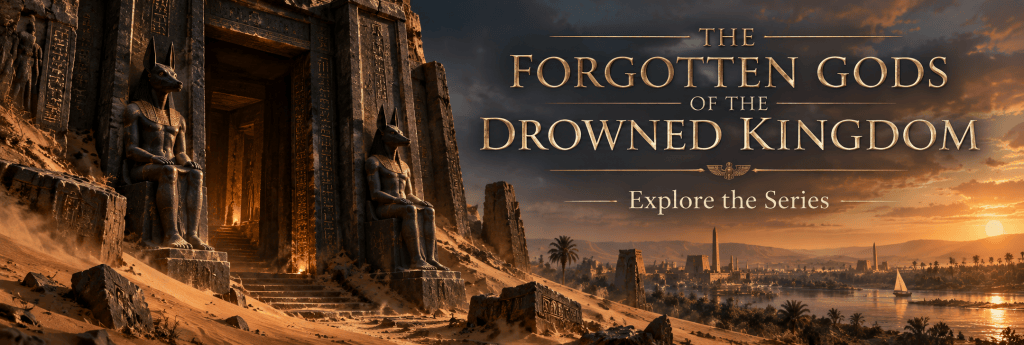
Such a world formed the heart of Egyptian mythic fantasy, where gods, mortals and the dead remained bound together by obligations older than the kingdoms that claimed the river.

In The Forgotten Gods of the Drowned Kingdom, the distance between those worlds had begun to narrow. Sacred places were disturbed, the dead struggled along passages intended to carry them onward, and the authority of ancient gods reached into the lives of people who had never expected to stand beneath their judgement.

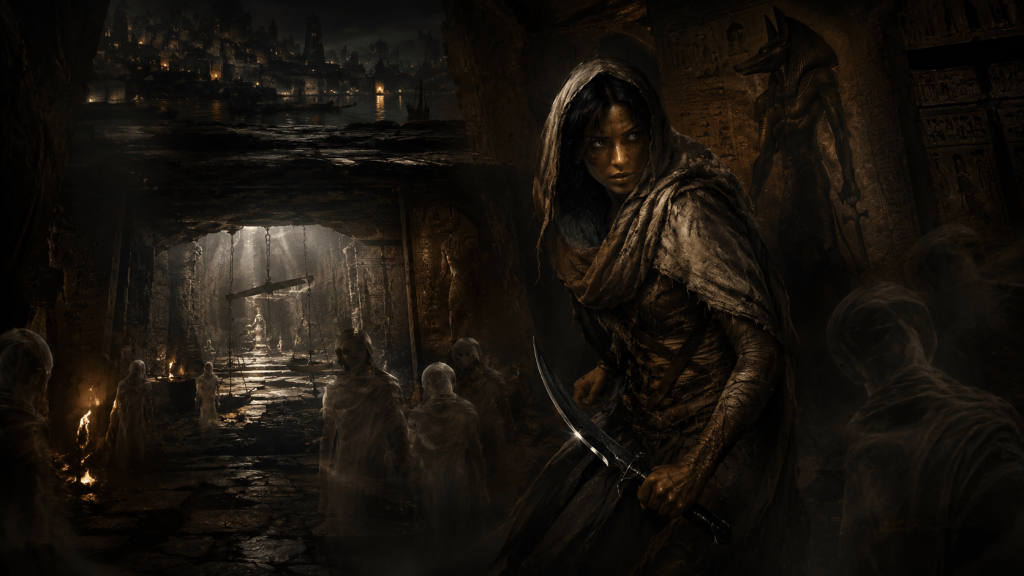
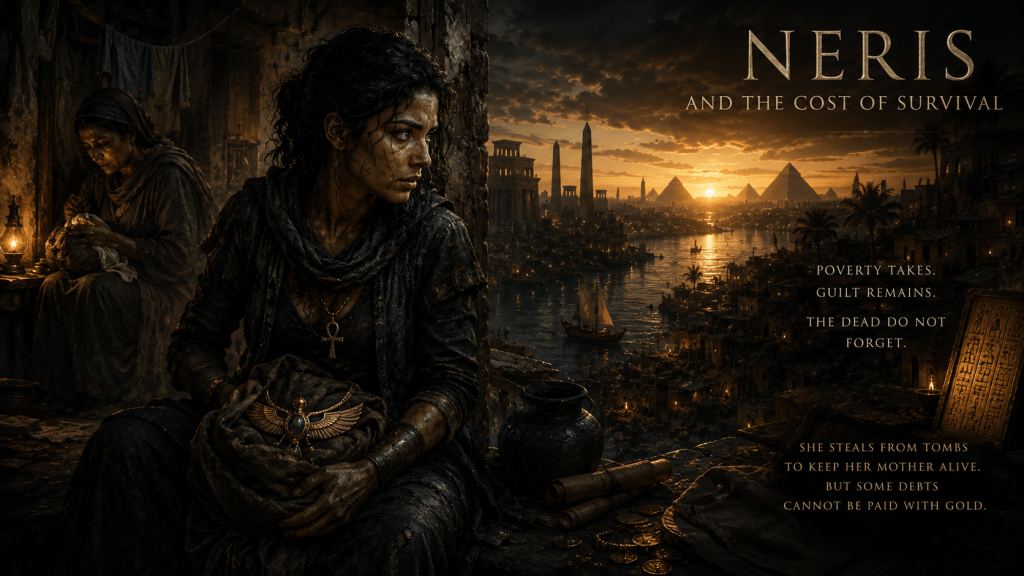
For Neris, a grave thief raised among the river slums, that disturbance had become painfully personal.

When the Dead Could No Longer Rest

A tomb had never been merely a chamber filled with possessions. Its walls, offerings, painted passages and sealed entrances belonged to a greater understanding of death, preservation and rightful passage.

The living prepared the dead with deliberate care. Linen was folded and bound, resin sealed what needed preserving, and sacred objects carried meanings that extended beyond their material worth. Even the arrangement of a burial could express a family’s devotion to someone who had passed beyond their reach.

There was labour beneath every sacred act.

Hands washed the bodies. Workers carried jars, prepared cloth, maintained the buildings and recorded what passed between burial houses. Families paid what they could afford, while others struggled to provide even the simplest preparations.

The grandeur of the Egyptian gods rested beside that ordinary human effort.

Within the world of the Drowned Kingdom, those obligations carried a deeper significance. Beneath the familiar streets and burial grounds lay passages through which the dead were meant to travel. Their proper movement depended upon an order that had endured far longer than the living institutions built around it.

When a passage was damaged, the disturbance reached beyond the stone.

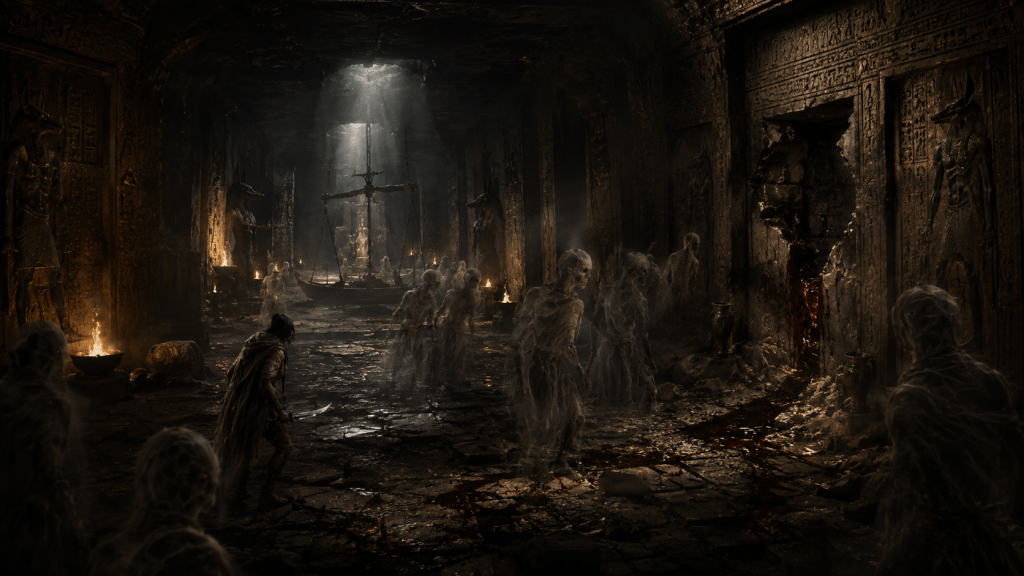
A soul that should have continued might linger. A sacred chamber might become uneasy. A place devoted to preparation and remembrance could begin carrying the wrong kind of silence.

For those living beside the burial houses, such disturbances threatened more than ancient tradition. Their work, their families and their sense of safety existed beside boundaries they could never fully see.

That was where the darker character of Egyptian mythology fantasy emerged. The danger lay in something deeply familiar becoming unreliable.

A place intended to protect the dead had become uncertain.

And somewhere beyond the knowledge of the living, another will had begun to interfere.


Anubis and the Burden of the Threshold
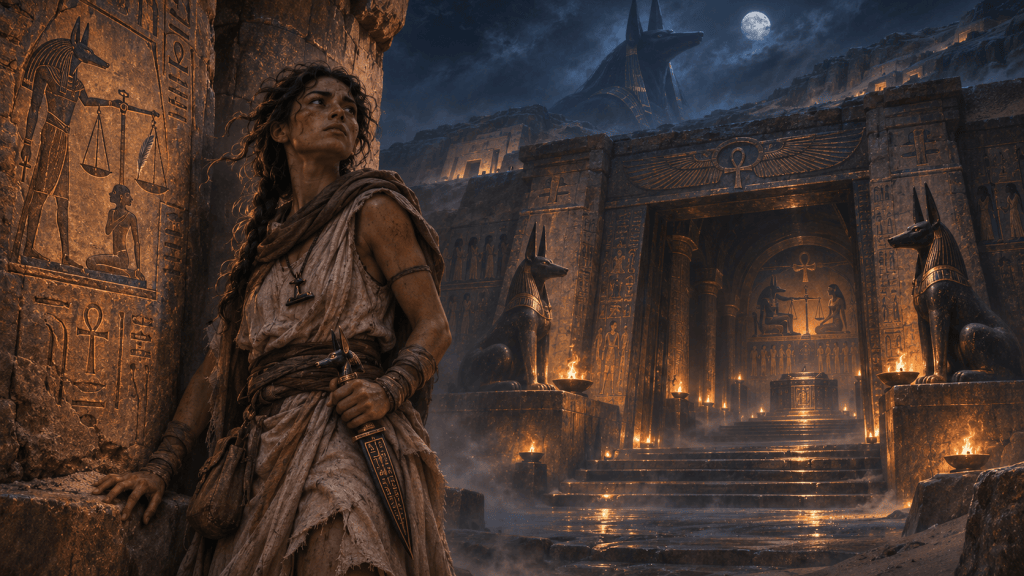
Among the gods of ancient Egypt, Anubis carried an authority inseparable from death, funerary care and the passage towards judgement.

His jackal form belonged naturally to the edges of burial ground, to guarded entrances and to the uneasy division between what remained living and what had crossed beyond. He was a presence associated with the protection of the dead and the solemn duties surrounding their passage.

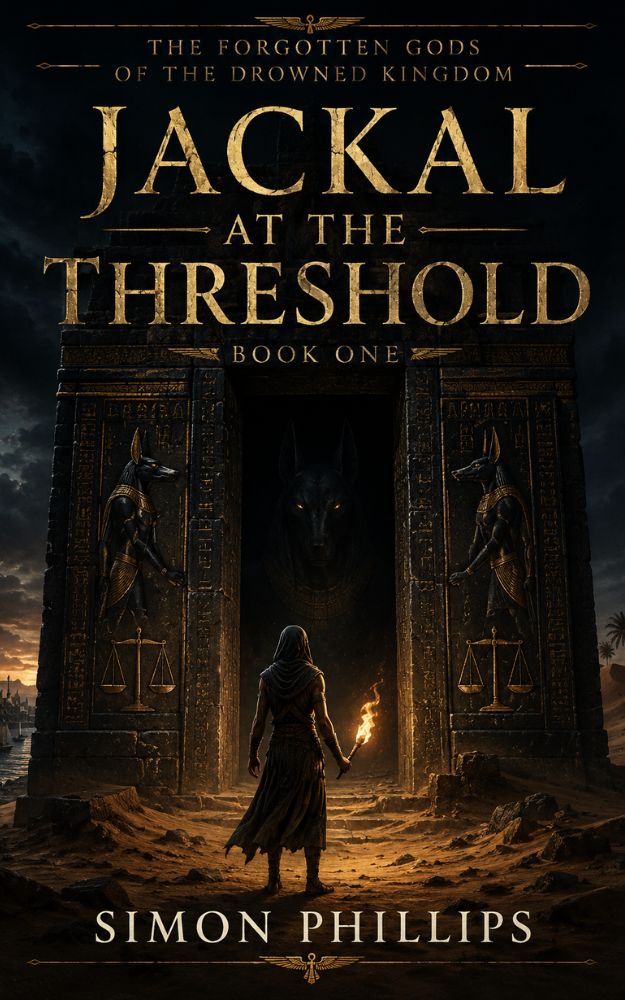
In Jackal at the Threshold, the first book of The Forgotten Gods of the Drowned Kingdom, Neris encountered that authority after entering a buried place she had sought for reasons far removed from divine service.

She had entered the tomb as a thief.

Her concerns had been painfully human. Her mother required medicine, rent demanded payment, and the death of her brother had left behind guilt that years of dangerous work had failed to silence. The wealth buried beneath stone offered the possibility of survival in a city where poverty had already demanded too much.

Yet beyond the sealed chambers, Neris crossed a boundary that ordinary thieves had never been meant to reach.

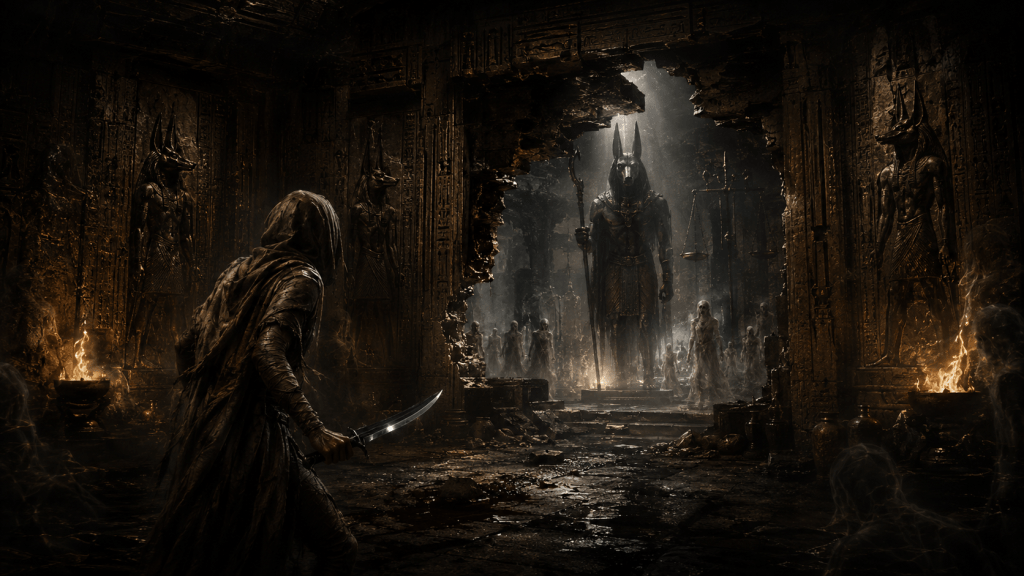
There she faced Anubis and the weight of her own actions.

Her hunger, desperation and grief stood beside the harm she had caused. Judgement offered no convenient erasure of either. Her suffering remained real, while the claims of the dead remained real as well.

That tension gave the encounter its lasting weight.

Anubis represented an ancient authority whose responsibilities extended beyond the concerns of any single mortal life. Neris carried the narrower, immediate knowledge of someone who had struggled to keep herself and her mother alive.

Neither perspective erased the other.

When she returned from the Threshold, she carried a connection to the dead that had altered the course of her life. What began as an encounter with judgement slowly drew her towards a greater conflict, where the meanings of duty, obedience and divine authority became increasingly difficult to separate.

The jackal god remained close to the centre of that uncertainty.

His presence offered neither the simple reassurance of a protector nor the easy cruelty of an enemy. The obligations of death endured, even as the consequences of being drawn into them became harder for Neris to bear.


When the Gods Chose Human Hands

The hidden conflict at the heart of The Forgotten Gods of the Drowned Kingdom belonged to a world where the Egyptian gods possessed powers capable of bringing terrible consequences upon the mortals who lived within their domains.

An unrestricted struggle among them threatened the very order they were expected to sustain.

Their restraint had created another burden.

Human beings were drawn into divine disputes, bound to sacred relic weapons carrying the force of the gods who claimed them. Each weapon reflected the nature of its divine origin, while the person carrying it remained vulnerable to fear, injury, exhaustion and error.

The greater power belonged to the relic. The responsibility for every movement remained painfully human.

For Neris, that distinction mattered.

Her connection to Anubis rested in a funerary weapon whose significance belonged to tombs, burial order and disturbed passage. Its dark presence offered a means of surviving dangers that ordinary steel could scarcely answer, yet possession alone granted no understanding of combat.

Years spent stealing from burial chambers had taught her to recognise a loose stone, judge the narrowest possible passage and move quickly when a shaft threatened collapse. Such instincts had kept her alive long before any god marked her.

They offered little preparation for an experienced opponent carrying another divine weapon.

The discipline of Neith, the measured knowledge of Thoth and the martial authority associated with Horus revealed other forms of strength. Each expressed a different relationship between the chosen human and the ancient power whose burden they carried.

Set’s influence brought a more violent pressure, breaking order through force, fear and opportunities created by the weaknesses of others.

The wider conflict grew through these opposing purposes, while the ordinary people of the river city continued living close enough to suffer their consequences.

A divine weapon could become the instrument of a god’s will.

The person carrying it still had a life that could be broken.


The Human Cost Beneath Divine Authority

Neris had grown up where survival left little room for distant principles.

Every coin carried a purpose. Medicine needed replacing, food had to be found, and the landlord’s demands waited regardless of whatever sacred trouble troubled the city’s tombs.

Her mother’s illness gave those pressures a human face. The woman who had raised her remained sharp-minded and stubborn even as sickness weakened her body. She understood both the dangers of her daughter’s work and the desperation that repeatedly drove Neris towards it.

The arrival of divine conflict offered no release from those obligations.

Instead, the dangers surrounding Neris began reaching into the life she had struggled to preserve.

A room might appear insignificant beside the authority of a god, yet for someone who had spent years fighting to keep a roof over her family, its loss could carry more immediate pain than the threat of an ancient weapon.

A blanket, a cup, an oil flask and a few pieces of worn clothing could contain the material history of an entire household.

This was the human ground beneath the series’ dark fantasy. Its sacred dangers grew from a world where ordinary loss already carried enormous weight.

The gods possessed their domains, their ancient responsibilities and their chosen champions.

Neris possessed memories of hunger, her brother’s death, her mother’s failing health and the knowledge that survival frequently demanded choices for which no simple forgiveness existed.

Those experiences shaped the way she approached every new authority.

A command offered in the name of protection could still carry consequences. A judgement reached through genuine concern could still deny someone a voice. Even help, offered with the best intentions, could become another form of control when the person receiving it lost the freedom to choose.

The distance between divine duty and human consent had begun to matter as much as the danger of the weapons themselves.


The Lines of Judgement: Truth, Discipline and Sacred Suspicion
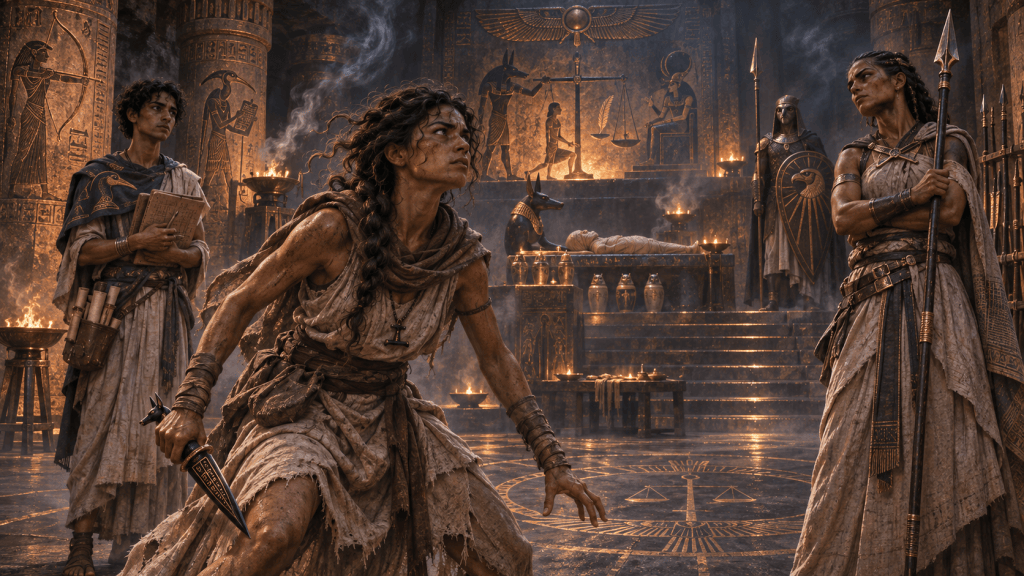
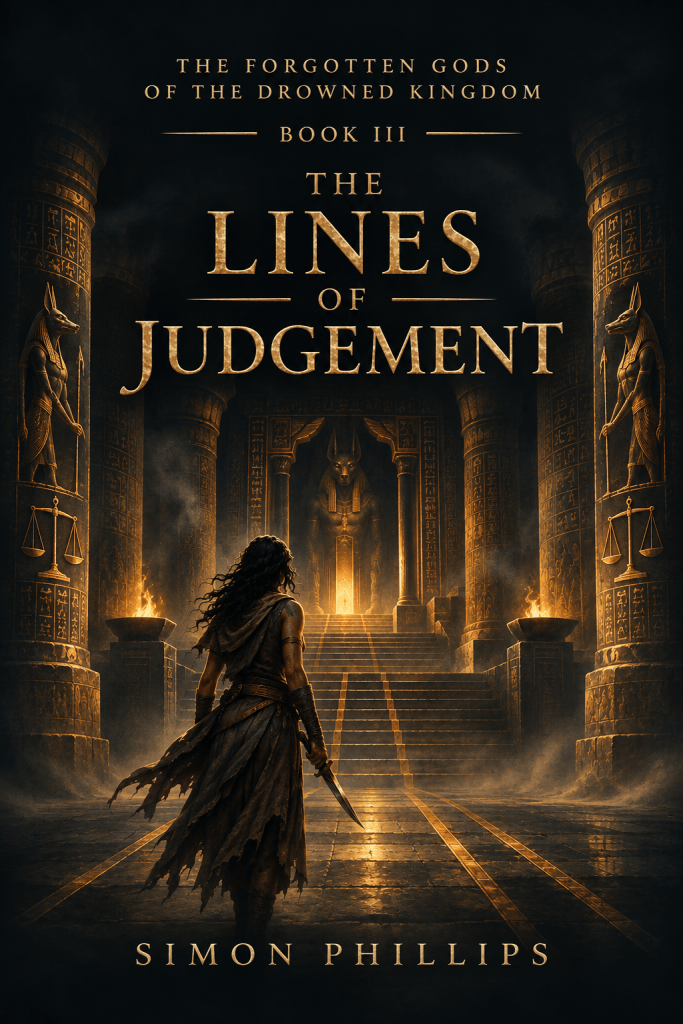
By the third book, The Lines of Judgement, the hidden struggle had moved beyond the first disturbances among the dead.

Neris had encountered others bound to the Egyptian gods, and the existence of an older, disciplined world of chosen humans was becoming impossible to ignore.

The dangers around her now extended beyond an enemy’s blade.

Judgement could take the form of a martial assessment, a written account, an ancient obligation or a decision about who deserved to enter protected ground. The people who understood those customs possessed authority Neris had never sought, yet their knowledge sometimes offered the very protection she needed.

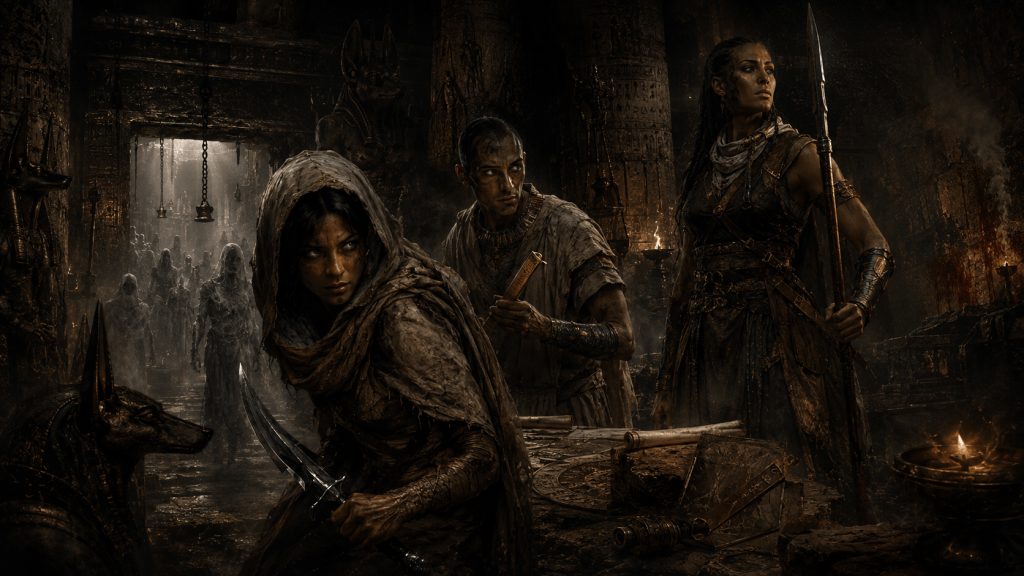
Meretneith, a veteran chosen of Neith, represented the severe discipline of someone who had survived dangers Neris barely understood. Her teaching demanded attention to balance, timing, distance and the smallest movements of the body.

Pain and correction replaced any expectation that divine favour might provide effortless mastery.

Khamet, newly chosen by Thoth, approached danger through records, patterns and measured truth. His instinct to establish what had happened frequently clashed with Neris’s desire to act before another life was lost.

Meanwhile, the authority of Horus brought questions of legitimacy and responsibility into sharper focus. Sacred places belonged to old obligations, and the risks carried by an inexperienced chosen could reach far beyond the person holding the weapon.

These different perspectives made judgement increasingly difficult.

An accurate record might establish what someone had done while leaving the reasons painfully vulnerable to interpretation. A legitimate restriction might protect one person while preventing another from acting upon something only they could perceive.

Even sacred objects could become dangerous when removed from their rightful purpose and placed where their symbolism encouraged suspicion.

Jackal seals, funerary resin and mortuary blades carried the associations of an older sacred order. In the wrong hands, those associations threatened to become something far removed from the duties they were intended to serve.

The struggle had begun reaching into the meaning of evidence itself.

Within The Lines of Judgement, Book Three of The Forgotten Gods of the Drowned Kingdom, those pressures surrounded Neris as she struggled to understand the rules of a conflict that had already claimed her.

The question had grown beyond whether she could survive another encounter.

It concerned how much of herself she would surrender in order to survive it.


The Weight of Choosing

The old stories of gods and mortals often carried the weight of commands issued from beyond ordinary understanding. A divine decision could alter a kingdom, condemn a life or place a burden upon someone who possessed little power to refuse.

Yet the human consequences remained rooted in smaller moments.

A wounded person required help. A worker feared the loss of his livelihood. A mother asked to be heard before someone decided what protection she needed. A frightened fighter had to choose whether anger or discipline would guide the next movement of her blade.

Such moments gave the divine struggle its emotional force.

Neris was learning that instinct could be valuable and still lead her into danger. Those who corrected her might possess genuine wisdom, even when their authority left her angry and suspicious.

Equally, the possession of authority offered no guarantee that every judgement made beneath it would be fair.

Anubis remained bound to the solemn work of death and rightful passage. Neith’s discipline, Thoth’s reckoning and Horus’s responsibility each carried their own place within the wider order. Set’s violence pressed against the weaknesses that existed between them.

For the mortals drawn into their conflict, every claim demanded something.

The distinction between duty and obedience had begun to sharpen, and with it came the possibility that a person could honour a sacred responsibility while questioning the authority that placed it upon them.

That possibility would carry consequences far beyond a single broken passage.

Across the buried chambers, mortuary courts and river roads of the Drowned Kingdom, the dead still required passage. The living continued their work beneath the same heat, counting linen, tending wounds and carrying bodies towards the places prepared for them.

The gods remained present in those obligations, even where their intentions could scarcely be understood.

Somewhere beneath the old stone, another boundary had weakened.

And the people drawn towards it would have to decide how much of the burden belonged to the gods, and how much they were willing to carry themselves.
The Forgotten Gods of the Drowned Kingdom: Only Half Came Back

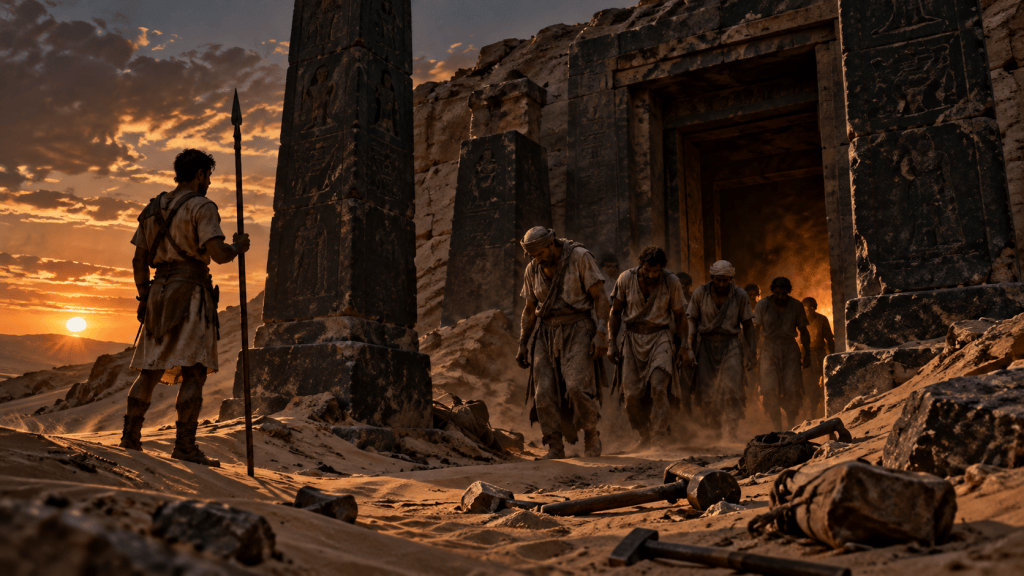
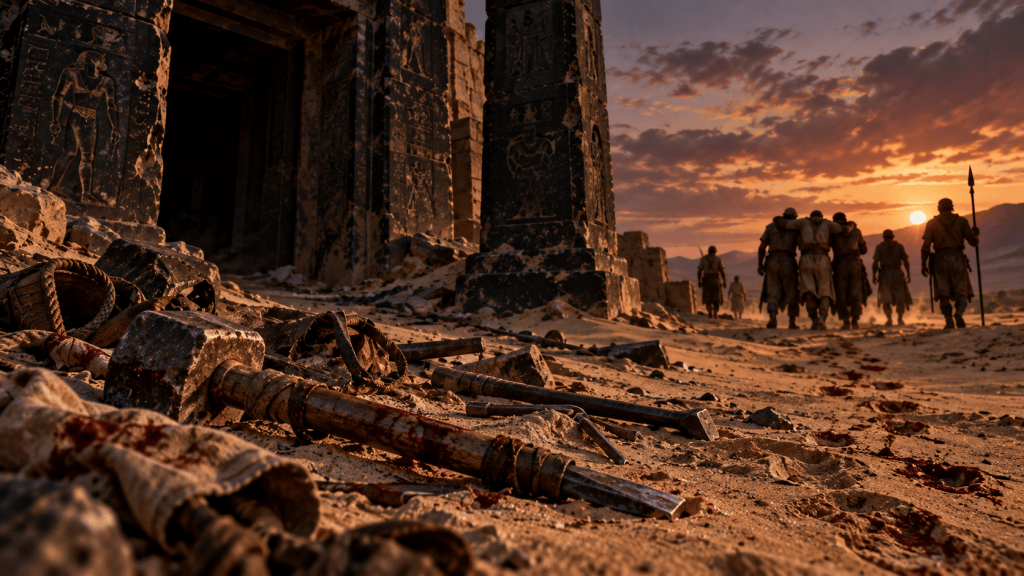
Beneath the black pillars, a young guard counted the men entering the buried doorway, unaware that some would vanish beyond the reach of their companions.


Timeline of Events

The Storm
A violent storm stripped sand from the western dunes, exposing black pillars and a buried doorway beyond the last cultivated fields.

The Report
A field labourer discovered the ancient stonework. His account reached the city, bringing the newly exposed site to the attention of priests and officials.

The Expedition
Stone-cutters and armed guards travelled west under priestly authority. The workers began clearing the entrance while a junior guard remained outside to record their numbers.

The Withdrawal
Only half the men returned from the darkness. Tools lay abandoned, footprints were disturbed and blood marked the sand. The expedition withdrew, leaving the missing workers’ fate unresolved.


Only Half Came Back

The sand slipped over Ipu’s sandals as he carried the tally board along the line of stone-cutters gathered beneath the black pillars. Morning had gone in hauling water and keeping men clear of falling masonry. At the city gate, such a duty would have earned him less grit between his teeth. Still, he had waited half a year for an assignment beyond the walls, and he intended to bring his captain an accurate count.

“Count their feet if their faces trouble you,” said Henu, the older guard beside him, watching two cutters lever a slab aside. “They keep moving. You keep counting. Everyone remains employed.”

“I know how to count,” Ipu replied, scratching another mark into the wax. He glanced towards the labourers dragging stone from the doorway. “I am waiting for them to stand still long enough to prove it.”

The priest’s seal-bearer approached, lifting the hem of his robe from the sand. He inspected the opening the cutters had cleared, where shadow filled the space beyond the pillars. The wind swept along the ridge above them while the hollow itself remained strangely still. Touching the seal at his neck, he ordered the cutters inside and sent selected guards behind them.

Kebi, a broad-handed cutter who had shared dried figs with Ipu at midday, paused to tighten the leather around his mallet. He had spent their meal complaining about the price of flour.

“Put me down as one who came willingly,” Kebi said, a crooked smile showing beneath his dusty beard. “My wife will enjoy hearing it. She says I have to be pushed towards honest work.”

“Then come out willingly as well,” Ipu answered, making the final mark. Kebi laughed and followed the others into the shadows. Ipu watched the last guard disappear, drew his fingertip down the board and checked the total. Twelve had entered.

For a while the sounds of their work carried through the entrance. Stone struck stone, someone called for more light, and a quarrel rose over a tool passed the wrong way. Ipu took comfort in those familiar complaints. As afternoon thinned towards evening, the blows grew farther apart, until he found himself waiting for each one. Henu cleaned sand from his sandal fastening, though his eyes kept returning to the doorway.

The first man stumbled out as the sky reddened above the ridge. He dropped to his knees beside a pillar, clutching his bleeding arm. Others followed in a rush, one supporting a companion whose heels dragged through the sand. Ipu helped lower the man, then searched the dark entrance for the rest. Only six figures had emerged.

“Where is Kebi?” Ipu asked the wounded cutter, crouching beside him. “He was working with you.”

The cutter turned towards the doorway, lips moving before his voice came. “Behind us,” he said, tightening his hand over the torn sleeve. “I heard him call.”

Ipu started forwards, yet Henu reached the entrance first and barred his way with an outstretched arm. For the first time that day, the older guard’s voice had lost its humour.

“Stay here. Count who is standing.”

Ipu looked past him. A stone mallet lay in the sand near the pillar, its leather handle dark from a worker’s grip. Farther back, a bronze chisel caught the last daylight. He thought he heard movement within, faint beneath the wind sliding across the ridge.

“There are men inside,” Ipu said, closing his hand around his spear. “We have guards. We can bring them out.”

The seal-bearer stepped into his path, dust caught in the creases of his face. “The order is to withdraw. Help the wounded to the road.”

“And the others?” Ipu demanded, holding up the board. “What answer shall I carry back?”

The official studied the marks and looked away. “Write what returned.”

Henu helped the injured cutter stand, and Ipu went beside them as the diminished party climbed the ridge. He kept the board close to his chest, shielding the wax from his sleeve. Twelve marks stood in one column, six in the other. The missing men had names, trades and families waiting for them, yet the only certainty he could carry home was the space between those numbers. Behind him, the tools remained scattered below the black pillars, and the last light left the doorway while he was still watching it.


Abandoned mallets and chisels lie in blood-marked sand beneath the black pillars, left behind when Ipu and the surviving expedition withdrew, leaving six men’s fates unknown.


Inspiration Behind the Story

The disappearance of the stone-cutters offers a way to approach the buried doorway through the ordinary people caught in its consequences. Ipu begins with a simple duty: count the workers entering the ancient tomb and account for their return. As the day passes, that responsibility becomes something far more personal. Every missing man has a life beyond the expedition, with family, work and people expecting him home.

The abandoned tools, wounded survivors and disturbed sand connect this Chronicle to the evidence later discovered in Jackal at the Threshold. Yet the greater mystery remains beyond the black pillars. Through Ipu’s experience, the story explores the conflict between obedience and conscience, and how a few marks on a tally board can become the first surviving record of something the city will struggle to understand.


Related Book Series

Related Books of The Forgotten Gods of the Drowned Kingdom

Six men disappeared beyond the black pillars. Their companions returned with abandoned tools, blood in the sand and questions no surviving witness could answer.

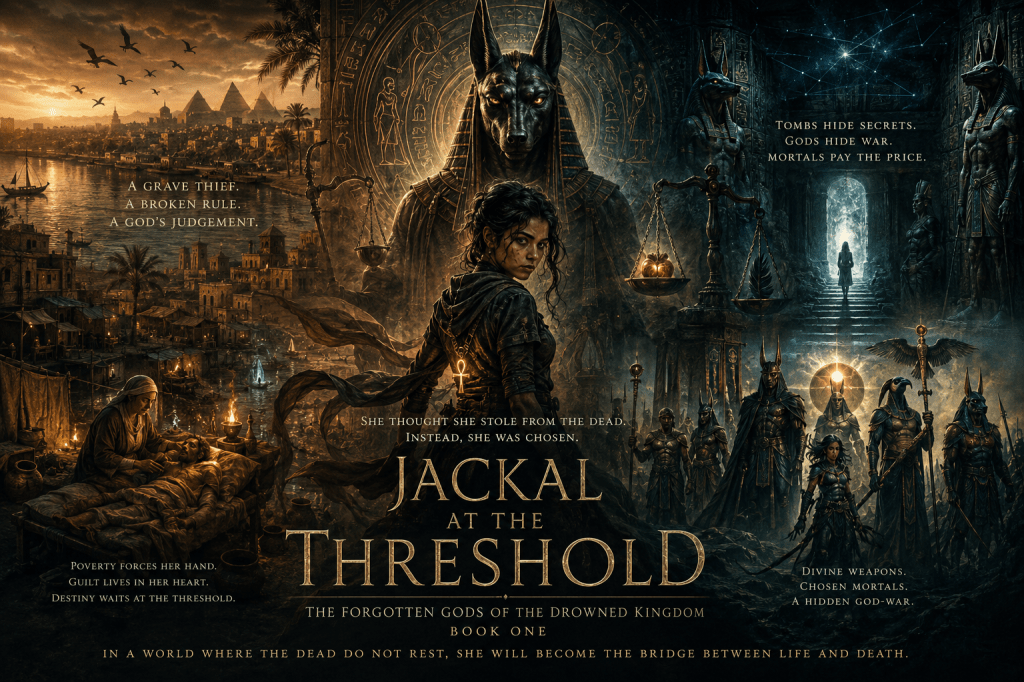
In Book One: Jackal at the Threshold, tomb robber Neris follows rumours of the newly uncovered necropolis into the western dunes. What begins as a desperate search for treasure leads her towards ancient judgement, buried gods and a truth that will change her life.

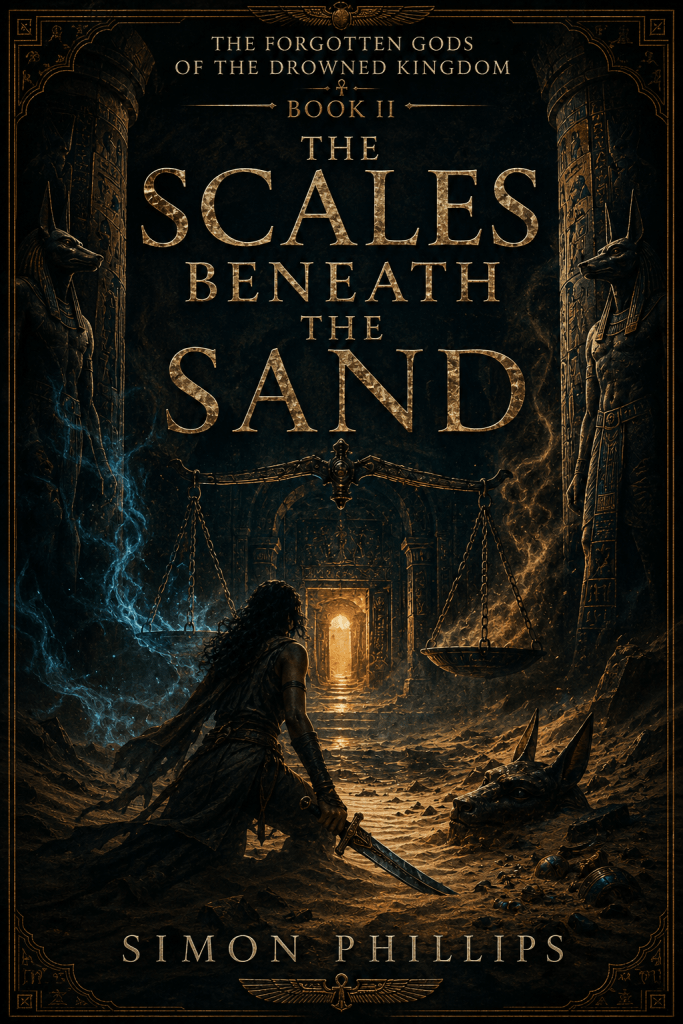
The story continues in Book Two: The Scales Beneath the Sand, as the disturbance spreads beyond the desert into the city’s burial routes, sacred shrines and living streets. With the old powers stirring, Neris finds herself drawn deeper into a conflict whose consequences are only beginning to emerge.


Next Chronicle

News of the failed expedition reaches the river quarter, carrying fear into households whose men travelled west in search of honest wages. At the city work court, a stone-cutter’s wife searches the diminished line of returning workers for her husband. She wants answers from the guards and officials, while the men who survived struggle to explain what happened beyond the black pillars. As rumours spread through the streets, the absence of a body, a familiar voice and even a working tool begins to carry a terrible weight of its own.

Next: No Bodies, No Tools

The Scales Beneath the Sand: Anubis, Tomb Routes, and Egyptian Mythic Fantasy


The City Beneath the City

A river city carries its dead differently.

Above ground, life presses through the lanes in smoke, heat, fish-blood, old grain, cheap oil, medicine, shouted bargains, and the dull fatigue of people trying to make one more day hold together. Below those same streets, older systems remain. Tomb passages run beneath foundations. Faded shrines keep their painted eyes turned towards forgotten doors. Burial routes pass through stone chambers where the living once prepared the dead for their final journey.

That is where The Forgotten Gods of the Drowned Kingdom begins to deepen.

For readers drawn to Egyptian mythic fantasy, dark fantasy, and stories shaped by ancient gods rather than borrowed decoration, the river quarter matters as much as any temple or necropolis. It is where Neris lives. It is where she steals from tombs because medicine costs money, rent still comes due, and grief does little to feed a household. It is where the distance between sacred history and ordinary survival becomes painfully small.

Neris has already crossed a threshold that should have remained closed. She has returned carrying the uneasy sense that the dead can find her, that their unfinished burdens can gather at the edge of her thoughts, and that something in the dark has changed the shape of her life. She calls herself a bridge because the word gives her burden a use. A bridge joins two places. A bridge carries weight. A bridge does not need to ask who built it or why.

Yet every bridge can become a crossing point for something far more dangerous.

In The Scales Beneath the Sand, the second book in The Forgotten Gods of the Drowned Kingdom, the old routes beneath the river city begin to fail. Souls gather where they should pass cleanly. Sacred passages hold pressure where there should be release. The dead seem to hesitate before a crossing that has served them for generations.

That kind of wrongness belongs to more than haunting.

It belongs to interference.


When the Routes of the Dead Are Wounded

Tombs in Egyptian mythic fantasy should never feel like empty scenery waiting for an adventurer to enter them. They are architecture built around memory, judgement, ritual, identity, grief, and passage. A burial chamber holds the shape of the people who believed in it. A threshold carries the weight of those who crossed it before. A damaged shrine can become more than abandoned stone when its sacred purpose still remains close beneath the surface.

The buried spaces beneath Neris’s city work in that way.

They are not merely ruins. They are old systems of passage. Ferry chambers, weighing rooms, record houses, forgotten shrine courts, and narrow cut-stone ways still preserve the language of burial order. They remember what the dead are meant to do even when the living have stopped listening.

That makes the disturbance at the heart of The Scales Beneath the Sand more unsettling than an ordinary haunting. The dead are not simply restless. Their routes have been handled. Stone has been cut. Ash and blood have been worked into sacred spaces. Something has opened wounds inside the passages where the dead should move towards judgement.

The result is a form of underworld fantasy grounded in pressure rather than spectacle.

The danger begins in small signs. A spill of natron near a jackal-marked recess. Fresh blood in a place that should have been empty. A torn piece of blackened leather. Marks carved into old stone with enough force to make the sacred architecture itself feel violated. Neris follows those signs because she knows the human cost of walking away from something wrong. The dead follow her thoughts. Their fear becomes difficult to leave behind.

The city above continues unaware. People drink beneath reed awnings. Children cry in upper rooms. Fishmongers scrape scales into buckets as night settles over the quay. Yet underneath those ordinary lives, sacred order has begun to fracture.

That is where the hidden god-war first becomes visible.

Not through armies at a city gate. Not through gods tearing open the sky. Through the dead failing to rest.


Anubis at the Broken Threshold

Anubis has always belonged at the edge of fear and judgement.

He is associated with tombs, funerary practice, embalming, the care of the dead, and the passage towards rightful judgement. His presence carries a particular weight because he is not simply a god of death. He stands at the point where death must be ordered, witnessed, and given its proper place.

That makes him a powerful centre for an Anubis fantasy story.

Neris’s connection to him offers no easy blessing. Her jackal talisman becomes a funerary blade only when the dead press too close or when a threshold has been disturbed. The weapon is intimate, cold, and made for narrow places. It belongs in stone corridors, flood-cut passages, old shrines, and the close terror of being unable to step far enough away from another person’s blade.

That distinction matters.

The divine weapon does not turn Neris into a polished fighter. She remains a survivor first. Her instincts come from tomb shafts, slum alleys, unstable stone, hidden routes, and the practical knowledge that escape can matter more than victory. She fights low, close, and desperately. She uses clutter, broken walls, ash, tight spaces, bad footing, and whatever the room gives her.

The funerary blade gives her a way to answer sacred wrongness. It does not erase fear from her body.

This is where the series separates itself from clean chosen-one adventure. Being marked by a god does not lift Neris above poverty, grief, injury, or uncertainty. It makes her visible to forces that already understand more about her than she understands about herself.

The burden comes first.

The meaning comes later.


The Hands Carrying the Gods’ War

The gods of The Forgotten Gods of the Drowned Kingdom do not begin by fighting openly.

Their conflict moves through human hands.

Chosen people carry relics shaped by divine domains. Their weapons reflect the gods who claim them. Their strengths are tied to endurance, discipline, training, fear, nerve, judgement, and the cost of surviving long enough to learn. That keeps the hidden war close to the body. Feet slip. Hands shake. Wounds open. Pride creates mistakes. A blade can be sacred and still fail in an untrained grip.

In The Scales Beneath the Sand, Neris learns that she is no longer alone inside this pressure.

Khamet enters the story through record houses, burial tallies, ferry counts, ledgers, ink-stained fingers, and maps of disturbed passage. His relationship to the dead comes through pattern and reckoning. Where Neris feels the wrongness in her skin and breath, Khamet sees broken measure. He watches the numbers around burial, crossings, oils, and names begin to separate from one another, then follows the distortion towards something buried beneath the city.

He is useful almost immediately.

He is also irritating almost immediately.

Their early connection is shaped by distrust, exhaustion, sharp replies, wounded pride, and practical necessity. Neither gives the other comfort. Neither enters the other’s life gently. That matters because the war has no interest in providing safe companions at the right moment. It brings people together when pressure leaves them no cleaner choice.

Meretneith arrives from a different part of that same world.

She is a veteran chosen of Neith, shaped by martial discipline, old war knowledge, and the unsentimental truth that survival demands more than instinct. Her presence changes the scale of the story because she reveals what long experience looks like. Every movement has purpose. Every correction lands where it needs to land. Her weapon is an extension of training rather than a spectacle.

For Neris, that becomes its own kind of humiliation.

Surviving is not the same as knowing how to fight.

A hard lesson begins with the feet.


The Scales Beneath the Sand

The title The Scales Beneath the Sand reaches towards the deeper tension of the series. Scales suggest judgement. Sand suggests burial, erosion, time, and the slow concealment of what people once believed was secure. Together they point towards a world where sacred order has been buried so long that even those living above it may no longer know what holds their city together.

Neris enters that buried order carrying the wrong tools for a war she never chose.

She has a funerary blade, a sick mother, a body already marked by grief, and a life rooted in streets where every coin must be counted before it can be spent. The hidden conflict enters through those ordinary pressures. It reaches for her because she has been claimed, though the claim means danger long before it means understanding.

The story remains focused on tombs, thresholds, divine weapons, and the uneasy movement of the dead, yet its centre stays human. The fear is not only that a sacred route may break. The fear is that the break will climb. It will move upward through the stone, into the lanes, into the rooms where people sleep, and eventually towards the few fragile lives Neris still believes she can protect.

That is the real weight of hidden god-war.

It begins in the places no one thinks to watch.


When the War Learns the Road Home

The strongest ancient gods fantasy does not need to announce its scale at once.

It can begin with a single wound in old stone.

It can begin with dead souls gathering at a closed passage.

It can begin with a woman carrying medicine home through a river city, sensing that something beneath the streets has started to call her name.

The first signs are rarely grand enough for anyone above ground to notice. A lamp gutters in a shrine that has stood neglected for years. A burial tally fails to match the names written beside it. An offering bowl lies overturned where no living hand should have passed. In the dark beneath the quarter, old routes begin to tighten around the dead, holding them in places meant only for crossing.

By the time fear has a name, the damage has already travelled.

The Scales Beneath the Sand stands at that moment of widening pressure. Neris has moved beyond the lonely belief that she is only a bridge between the living and the dead. The hidden conflict has found her. Other claimed people have entered her path. A predator has tested her strength and seen where her life is weakest.

She still carries the same burdens she carried before the dead began to answer her. Her mother still waits in a narrow room. Medicine still costs more than she can spare. The river quarter remains full of damp walls, thin lamps, crowded lanes, and people trying to protect what little has survived another difficult day. The divine has entered her life, yet it has offered no escape from any of that.

Instead, it has placed those fragile things in danger.

The city remains standing. The temples have not fallen. The gods have not yet stepped openly into the streets. Their names still belong to shrine walls, old stories, ritual words, and the fears people carry quietly through the night.

Even so, the balance has shifted.

Something beneath the city has learned that sacred order can be wounded. Something has begun to test the routes of the dead, the people marked by old gods, and the living ties that make those people vulnerable. Neris has survived the first movement of that pressure, though survival has only brought her closer to the truth waiting beneath it.

The war begins before anyone understands its full shape.

It begins in tomb dust, river stink, jackal shadows, broken thresholds, and the silence left behind when the dead fail to rest.

It begins beneath the sand, where old scales still wait for something to be weighed.

Egyptian Mythic Fantasy, Anubis, and the Burden of the Dead


Where the River Meets the Dead

The dead were never far from the living in The Forgotten Gods of the Drowned Kingdom. They pressed close through river stink, damp stone, old prayers, sealed doors, and the narrow spaces where poverty forced the living to touch what should have remained undisturbed. In this Egyptian mythic fantasy world, tombs were never simple ruins. They were sacred architecture, built around memory, judgement, passage, and the uneasy belief that the dead still had claims upon the world they had left behind.

That closeness shaped Jackal at the Threshold, the first book in the series, before Anubis ever stepped fully into view. The story began in the river quarter, where Neris lived between hunger and guilt, between the need to keep her mother alive and the knowledge that her work among the dead had already cost too much. The noble terraces rose upriver in white stone, catching the last light of the day, while the slums below sank into shadow, smoke, mudbrick, and the rot lifted from the water by evening heat.

This is the root of the series. Egyptian mythology is not laid over the world as decoration. It is felt through burial practice, thresholds, funerary silence, jackal imagery, and the dreadful possibility that judgement may be waiting in places ordinary people have learned to rob, fear, or ignore. The gods do not begin as distant names from old stories. They begin as pressure in the stone, as warnings cut into doorways, as whispered talk of Anubis stirring when a boundary has been broken too often.


Anubis at the Edge of Judgement

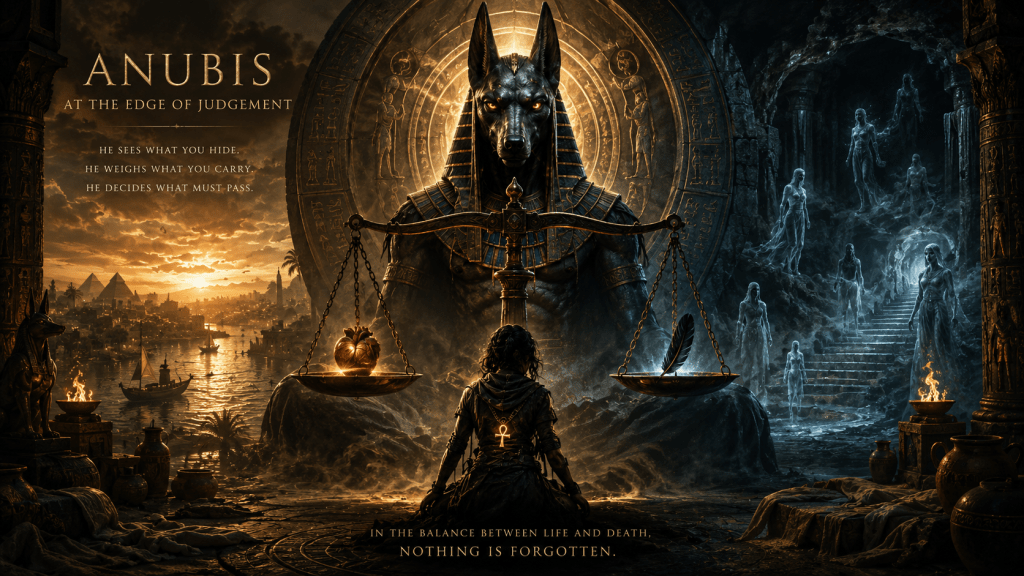
Anubis belongs to thresholds. He stands at the edge between the living and the dead, between burial and desecration, between memory and judgement. In this dark mythological fantasy series, that role matters more than spectacle. He is not a generic shadow god, nor a simple patron offering power to a chosen hero. His presence is severe, patient, and bound to what has been done.

That is why Jackal at the Threshold begins with theft rather than battle. Neris is a tomb robber from the river slums, and her skill lies in stone, rope, darkness, narrow ledges, old mechanisms, and the ability to keep moving when fear should have stopped her. She steals from the dead because rent, food, medicine, and hunger have left little room for clean choices. Yet the story refuses to make survival into absolution. Poverty explains much. It does not erase everything.

Anubis enters through that tension. The western dunes uncover black stone after a storm. Workers enter and fail to return. Rumours move through the slums faster than certainty. A buried place, older than the known order of the city, waits beneath the sand. Neris goes because the world has trained her to see danger and value together. She knows the signs. She reads blood, abandoned tools, carvings, warnings, and silence. Still, need pulls harder.

When she crosses into the Drowned Kingdom, the tomb itself becomes an instrument of judgement. Jackals walk the walls. Scales wait in carved stillness. Hearts are shown in stone as if every secret has already been measured. The deeper Neris goes, the less the place feels like a tomb built for the dead alone. It becomes a boundary that remembers who has entered it, what they carried, and what they tried to leave unnamed.


Neris and the Cost of Survival

Neris is central because she is human before she is anything else. She is not a polished champion waiting for a divine weapon. She is a daughter, a thief, a survivor, and a woman shaped by a death she has never truly faced. Her brother’s collapse in a tomb shaft lies beneath every choice she makes. She saw the crack. She dismissed it. She sent him ahead. That single remembered moment gives the first book its deepest weight.

The power of this Egyptian mythology fantasy series comes from that kind of pressure. Divine judgement does not arrive in an empty life. It arrives where guilt has already made a home.

Neris’s mother keeps the story grounded in the mortal world. Her illness, the cost of healers, the bare room by the river, the careful division of four silvers between medicine, rent, and food all matter. These details prevent the mythic world from floating away into abstract gods and relics. Before Neris stands before Anubis, she stands before hunger. Before she touches the Threshold, she has already crossed moral boundaries in order to survive.

That makes her judgement more painful. Anubis does not condemn her simply because she is poor. He does not ignore the cruelty of a world where the dead are buried with gold while the living starve beside the river. Yet he draws her back to the moment where choice remained. The crack in the stone. The hurry. The brother who trusted her. The weight she carried and refused to name.

This is where the story changes. Neris returns the relic she came to steal. She confesses what she has hidden even from herself. Anubis marks her, and the burden he gives is no easy blessing. She will see when souls stray. She will hear unrest where others hear only night wind and water. What she disturbed will no longer pass unnoticed.


The Door Opened by Jackal at the Threshold

Jackal at the Threshold is the first entry in The Forgotten Gods of the Drowned Kingdom, and it works as a doorway rather than an explanation of the entire war. It brings the reader into a world of tombs, river-prayers, restless spirits, funerary dread, and divine attention without emptying the larger series of mystery.

The book belongs to Egyptian mythic fantasy because its supernatural force rises from recognisable sacred ground. The Drowned Kingdom is not simply an ancient ruin with treasure inside. It is a necropolis of judgement, silence, and unfinished passage. Its walls are carved with jackals, scales, hearts, stars, drowned kings, and warnings left by those who understood too late that the dead are not abandoned things.

The experience of entering the book is intimate rather than grand. The reader follows Neris through the alleys, the heat, the old smoke of her home, the desert road, and finally into cold black stone. Every movement carries the body with it: sand under sandals, torchlight bending across carved walls, breath misting in impossible cold, fingers testing ledges, muscles straining against fear. This is not a clean chosen-one adventure. It is a story about what happens when someone desperate crosses into death’s territory and is allowed to return.

By the end, Neris has stopped being merely a thief of the dead, yet she has not become safe, powerful, or fully informed. She believes she has become a bridge between the living and the dead. She has no understanding yet of the full hidden god-war moving beneath the surface of the world. That ignorance is essential. The first book closes with a woman changed by judgement, walking back into the same poor streets, with the same hunger still waiting, and a new awareness of the dead moving around her.


The Gods Beneath the Sand

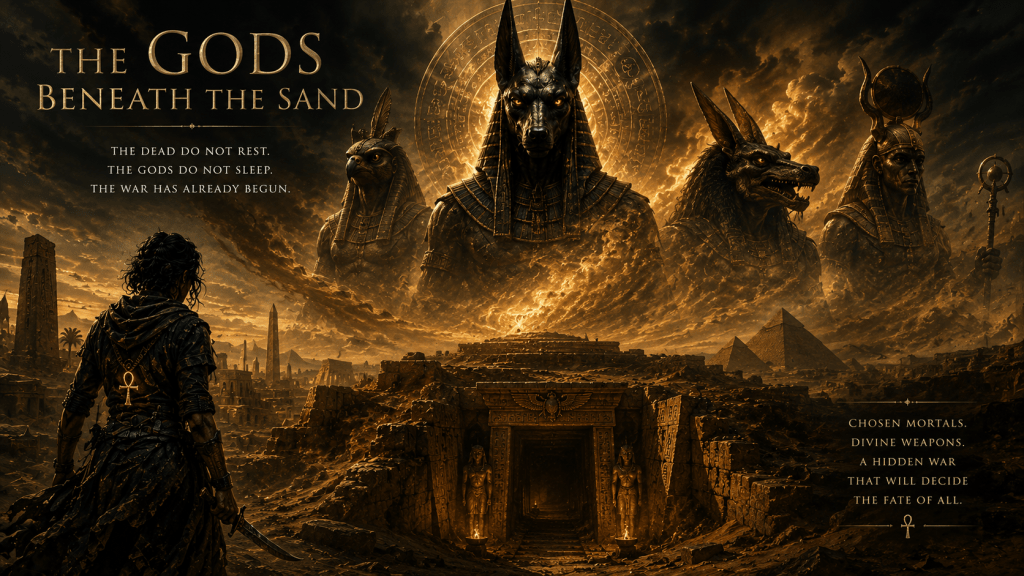
The wider series will open slowly from that first burden. The Egyptian gods do not begin by shattering the sky. Their war begins through sacred wrongness. Burial routes falter. Souls fail to pass cleanly. Tombs open when they should remain sealed. Relics wake. Human beings are chosen, armed, watched, and used.

This is the hidden engine of The Forgotten Gods of the Drowned Kingdom. The gods avoid open war because such conflict would devastate the mortal world. Instead, they act through chosen humans bound to divine weapons. The weapon carries the force first. The human bearer becomes dangerous only through endurance, discipline, survival, and cost.

That rule keeps the series grounded. Neris does not rise because she has been handed effortless power. Her first Anubis-linked weapon is intimate, funerary, close-range, and judgement-bound. It belongs to tombs and thresholds, not battlefield spectacle. Its danger comes from what it is tied to: burial order, false return, broken passage, and the dead who have failed to rest.

Other gods wait beyond the first threshold. Set moves through disorder, desert violence, destabilisation, and predatory pressure. Thoth brings record, reckoning, hidden knowledge, and an intelligence that can be as dangerous as any blade. Neith carries ancient discipline, strategy, and martial severity. Horus represents visible legitimacy, kingship, and ordered force. Ra remains the remote solar authority whose weight shapes the divine hierarchy even before he steps forward.

Yet the series must always return to Neris. Gods may shift the board, but human lives carry the cost. The river slums, Hamat’s warnings, her mother’s illness, the memory of her brother, and the quiet work of guiding unsettled souls remain as important as any relic duel or divine decree. Without those things, the war would become spectacle. With them, it remains sacred, dangerous, and painfully human.


What Waits Beyond the Threshold

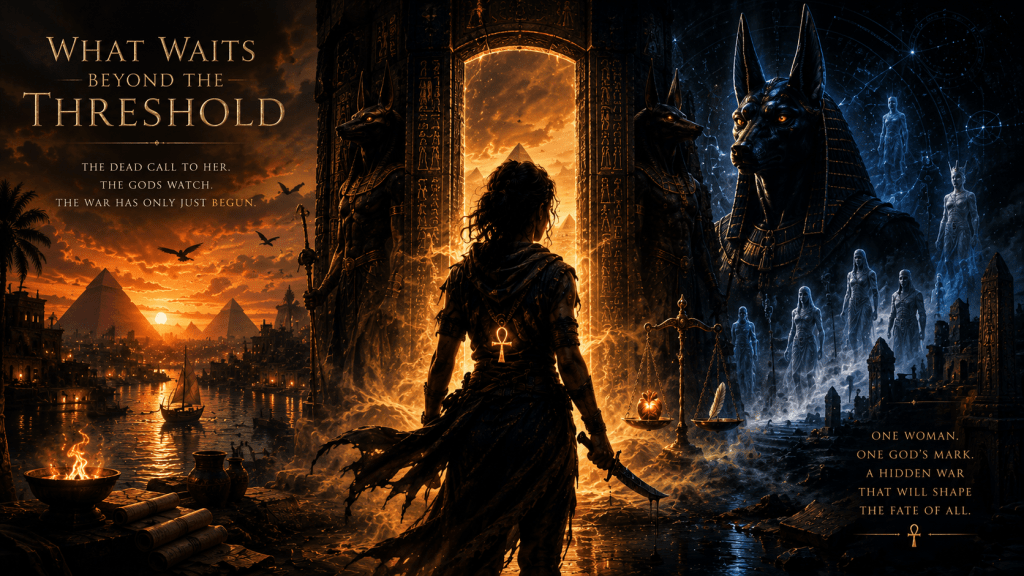
The first book leaves its deepest questions unanswered because the world has only begun to move. Neris has crossed the Threshold. Anubis has marked her. The dead now call to her when their passage fails. Somewhere beyond the city, old stone shifts beneath the sand, and attention stirs in places she cannot yet name.

That is the shape of the series promise. A grave thief has been pulled into the service of judgement, yet the judgement of gods may prove no cleaner than the lives they weigh. Divine weapons will appear as burdens rather than gifts. Chosen humans will discover that being claimed by a god can mean being protected, used, lied to, or sacrificed. The dead will not always pass cleanly, and the living will not always understand who has broken the route.

In this world, tombs are not background scenery. They are pressure points between the living and the dead. The river is not merely water. It is memory, passage, rot, need, and prayer. Anubis is not a symbol printed on the surface of a fantasy setting. He is first felt through the silence before judgement, the dark edge of a doorway, the unseen weight of a heart, and the terrible mercy of being sent back changed.

The war has already begun, though Neris does not yet understand its shape.

She has only heard the dead.

The gods will come later.