The river carried more than trade through the city. Beneath the smell of wet reeds, rotting fish and mud disturbed by the evening current lay the quieter presence of the dead. Burial workers passed through narrow streets with folded linen, priests tended chambers cut into ancient stone, and beyond the inhabited quarters the desert held generations whose names had long since disappeared from ordinary memory.
Life continued beneath the heat. Traders counted their silver, labourers returned from the quays, and families gathered around oil lamps in rooms where the walls offered little protection against hunger or sickness. Beyond those familiar struggles stood tombs, sacred passages and the old understanding that death required as much care as life.
Such a world formed the heart of Egyptian mythic fantasy, where gods, mortals and the dead remained bound together by obligations older than the kingdoms that claimed the river.
In The Forgotten Gods of the Drowned Kingdom, the distance between those worlds had begun to narrow. Sacred places were disturbed, the dead struggled along passages intended to carry them onward, and the authority of ancient gods reached into the lives of people who had never expected to stand beneath their judgement.
For Neris, a grave thief raised among the river slums, that disturbance had become painfully personal.
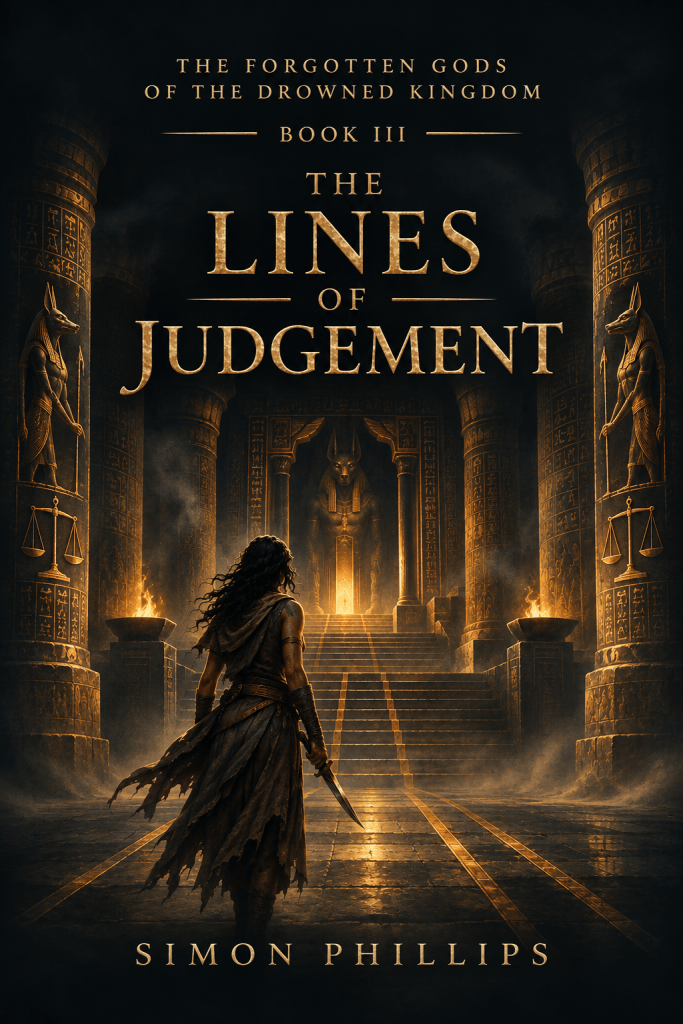
When the Dead Could No Longer Rest
A tomb had never been merely a chamber filled with possessions. Its walls, offerings, painted passages and sealed entrances belonged to a greater understanding of death, preservation and rightful passage.
The living prepared the dead with deliberate care. Linen was folded and bound, resin sealed what needed preserving, and sacred objects carried meanings that extended beyond their material worth. Even the arrangement of a burial could express a family’s devotion to someone who had passed beyond their reach.
There was labour beneath every sacred act.
Hands washed the bodies. Workers carried jars, prepared cloth, maintained the buildings and recorded what passed between burial houses. Families paid what they could afford, while others struggled to provide even the simplest preparations.
The grandeur of the Egyptian gods rested beside that ordinary human effort.
Within the world of the Drowned Kingdom, those obligations carried a deeper significance. Beneath the familiar streets and burial grounds lay passages through which the dead were meant to travel. Their proper movement depended upon an order that had endured far longer than the living institutions built around it.
When a passage was damaged, the disturbance reached beyond the stone.
A soul that should have continued might linger. A sacred chamber might become uneasy. A place devoted to preparation and remembrance could begin carrying the wrong kind of silence.
For those living beside the burial houses, such disturbances threatened more than ancient tradition. Their work, their families and their sense of safety existed beside boundaries they could never fully see.
That was where the darker character of Egyptian mythology fantasy emerged. The danger lay in something deeply familiar becoming unreliable.
A place intended to protect the dead had become uncertain.
And somewhere beyond the knowledge of the living, another will had begun to interfere.
Anubis and the Burden of the Threshold
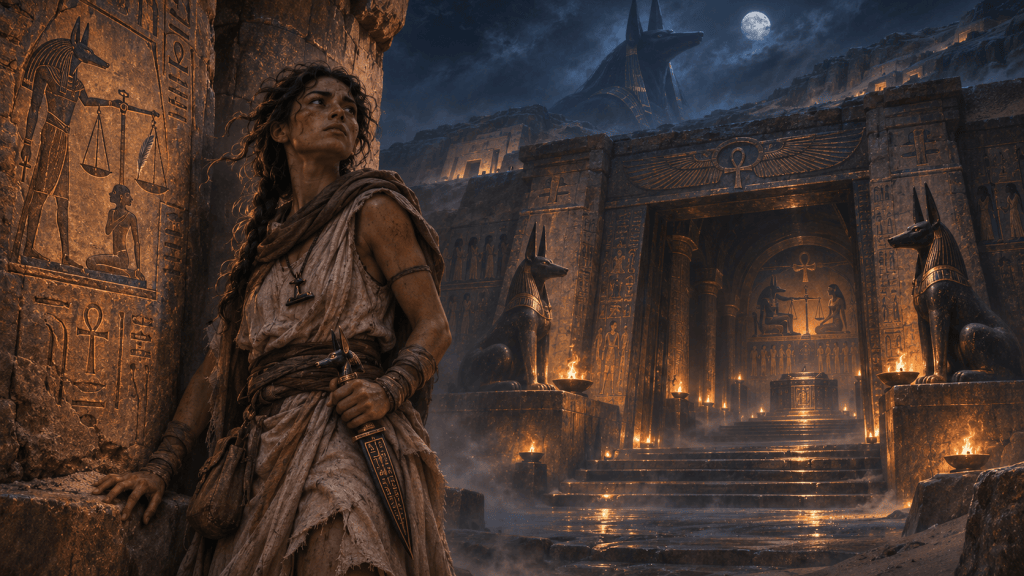
Among the gods of ancient Egypt, Anubis carried an authority inseparable from death, funerary care and the passage towards judgement.
His jackal form belonged naturally to the edges of burial ground, to guarded entrances and to the uneasy division between what remained living and what had crossed beyond. He was a presence associated with the protection of the dead and the solemn duties surrounding their passage.
In Jackal at the Threshold, the first book of The Forgotten Gods of the Drowned Kingdom, Neris encountered that authority after entering a buried place she had sought for reasons far removed from divine service.
She had entered the tomb as a thief.
Her concerns had been painfully human. Her mother required medicine, rent demanded payment, and the death of her brother had left behind guilt that years of dangerous work had failed to silence. The wealth buried beneath stone offered the possibility of survival in a city where poverty had already demanded too much.
Yet beyond the sealed chambers, Neris crossed a boundary that ordinary thieves had never been meant to reach.
There she faced Anubis and the weight of her own actions.
Her hunger, desperation and grief stood beside the harm she had caused. Judgement offered no convenient erasure of either. Her suffering remained real, while the claims of the dead remained real as well.
That tension gave the encounter its lasting weight.
Anubis represented an ancient authority whose responsibilities extended beyond the concerns of any single mortal life. Neris carried the narrower, immediate knowledge of someone who had struggled to keep herself and her mother alive.
Neither perspective erased the other.
When she returned from the Threshold, she carried a connection to the dead that had altered the course of her life. What began as an encounter with judgement slowly drew her towards a greater conflict, where the meanings of duty, obedience and divine authority became increasingly difficult to separate.
The jackal god remained close to the centre of that uncertainty.
His presence offered neither the simple reassurance of a protector nor the easy cruelty of an enemy. The obligations of death endured, even as the consequences of being drawn into them became harder for Neris to bear.
When the Gods Chose Human Hands
The hidden conflict at the heart of The Forgotten Gods of the Drowned Kingdom belonged to a world where the Egyptian gods possessed powers capable of bringing terrible consequences upon the mortals who lived within their domains.
An unrestricted struggle among them threatened the very order they were expected to sustain.
Their restraint had created another burden.
Human beings were drawn into divine disputes, bound to sacred relic weapons carrying the force of the gods who claimed them. Each weapon reflected the nature of its divine origin, while the person carrying it remained vulnerable to fear, injury, exhaustion and error.
The greater power belonged to the relic. The responsibility for every movement remained painfully human.
For Neris, that distinction mattered.
Her connection to Anubis rested in a funerary weapon whose significance belonged to tombs, burial order and disturbed passage. Its dark presence offered a means of surviving dangers that ordinary steel could scarcely answer, yet possession alone granted no understanding of combat.
Years spent stealing from burial chambers had taught her to recognise a loose stone, judge the narrowest possible passage and move quickly when a shaft threatened collapse. Such instincts had kept her alive long before any god marked her.
They offered little preparation for an experienced opponent carrying another divine weapon.
The discipline of Neith, the measured knowledge of Thoth and the martial authority associated with Horus revealed other forms of strength. Each expressed a different relationship between the chosen human and the ancient power whose burden they carried.
Set’s influence brought a more violent pressure, breaking order through force, fear and opportunities created by the weaknesses of others.
The wider conflict grew through these opposing purposes, while the ordinary people of the river city continued living close enough to suffer their consequences.
A divine weapon could become the instrument of a god’s will.
The person carrying it still had a life that could be broken.
The Human Cost Beneath Divine Authority
Neris had grown up where survival left little room for distant principles.
Every coin carried a purpose. Medicine needed replacing, food had to be found, and the landlord’s demands waited regardless of whatever sacred trouble troubled the city’s tombs.
Her mother’s illness gave those pressures a human face. The woman who had raised her remained sharp-minded and stubborn even as sickness weakened her body. She understood both the dangers of her daughter’s work and the desperation that repeatedly drove Neris towards it.
The arrival of divine conflict offered no release from those obligations.
Instead, the dangers surrounding Neris began reaching into the life she had struggled to preserve.
A room might appear insignificant beside the authority of a god, yet for someone who had spent years fighting to keep a roof over her family, its loss could carry more immediate pain than the threat of an ancient weapon.
A blanket, a cup, an oil flask and a few pieces of worn clothing could contain the material history of an entire household.
This was the human ground beneath the series’ dark fantasy. Its sacred dangers grew from a world where ordinary loss already carried enormous weight.
The gods possessed their domains, their ancient responsibilities and their chosen champions.
Neris possessed memories of hunger, her brother’s death, her mother’s failing health and the knowledge that survival frequently demanded choices for which no simple forgiveness existed.
Those experiences shaped the way she approached every new authority.
A command offered in the name of protection could still carry consequences. A judgement reached through genuine concern could still deny someone a voice. Even help, offered with the best intentions, could become another form of control when the person receiving it lost the freedom to choose.
The distance between divine duty and human consent had begun to matter as much as the danger of the weapons themselves.
The Lines of Judgement: Truth, Discipline and Sacred Suspicion
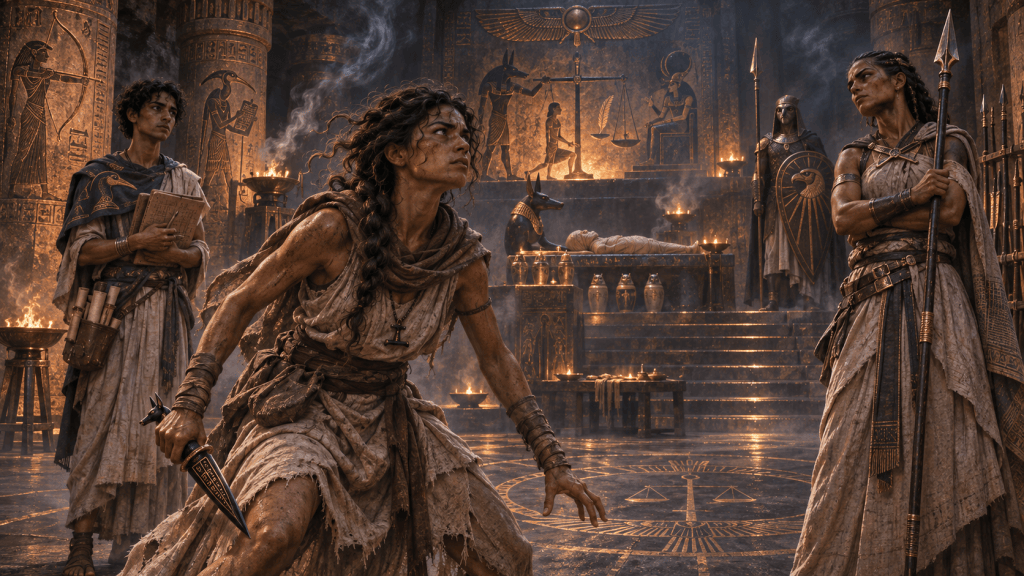
By the third book, The Lines of Judgement, the hidden struggle had moved beyond the first disturbances among the dead.
Neris had encountered others bound to the Egyptian gods, and the existence of an older, disciplined world of chosen humans was becoming impossible to ignore.
The dangers around her now extended beyond an enemy’s blade.
Judgement could take the form of a martial assessment, a written account, an ancient obligation or a decision about who deserved to enter protected ground. The people who understood those customs possessed authority Neris had never sought, yet their knowledge sometimes offered the very protection she needed.
Meretneith, a veteran chosen of Neith, represented the severe discipline of someone who had survived dangers Neris barely understood. Her teaching demanded attention to balance, timing, distance and the smallest movements of the body.
Pain and correction replaced any expectation that divine favour might provide effortless mastery.
Khamet, newly chosen by Thoth, approached danger through records, patterns and measured truth. His instinct to establish what had happened frequently clashed with Neris’s desire to act before another life was lost.
Meanwhile, the authority of Horus brought questions of legitimacy and responsibility into sharper focus. Sacred places belonged to old obligations, and the risks carried by an inexperienced chosen could reach far beyond the person holding the weapon.
These different perspectives made judgement increasingly difficult.
An accurate record might establish what someone had done while leaving the reasons painfully vulnerable to interpretation. A legitimate restriction might protect one person while preventing another from acting upon something only they could perceive.
Even sacred objects could become dangerous when removed from their rightful purpose and placed where their symbolism encouraged suspicion.
Jackal seals, funerary resin and mortuary blades carried the associations of an older sacred order. In the wrong hands, those associations threatened to become something far removed from the duties they were intended to serve.
The struggle had begun reaching into the meaning of evidence itself.
Within The Lines of Judgement, Book Three of The Forgotten Gods of the Drowned Kingdom, those pressures surrounded Neris as she struggled to understand the rules of a conflict that had already claimed her.
The question had grown beyond whether she could survive another encounter.
It concerned how much of herself she would surrender in order to survive it.
The Weight of Choosing
The old stories of gods and mortals often carried the weight of commands issued from beyond ordinary understanding. A divine decision could alter a kingdom, condemn a life or place a burden upon someone who possessed little power to refuse.
Yet the human consequences remained rooted in smaller moments.
A wounded person required help. A worker feared the loss of his livelihood. A mother asked to be heard before someone decided what protection she needed. A frightened fighter had to choose whether anger or discipline would guide the next movement of her blade.
Such moments gave the divine struggle its emotional force.
Neris was learning that instinct could be valuable and still lead her into danger. Those who corrected her might possess genuine wisdom, even when their authority left her angry and suspicious.
Equally, the possession of authority offered no guarantee that every judgement made beneath it would be fair.
Anubis remained bound to the solemn work of death and rightful passage. Neith’s discipline, Thoth’s reckoning and Horus’s responsibility each carried their own place within the wider order. Set’s violence pressed against the weaknesses that existed between them.
For the mortals drawn into their conflict, every claim demanded something.
The distinction between duty and obedience had begun to sharpen, and with it came the possibility that a person could honour a sacred responsibility while questioning the authority that placed it upon them.
That possibility would carry consequences far beyond a single broken passage.
Across the buried chambers, mortuary courts and river roads of the Drowned Kingdom, the dead still required passage. The living continued their work beneath the same heat, counting linen, tending wounds and carrying bodies towards the places prepared for them.
The gods remained present in those obligations, even where their intentions could scarcely be understood.
Somewhere beneath the old stone, another boundary had weakened.
And the people drawn towards it would have to decide how much of the burden belonged to the gods, and how much they were willing to carry themselves.
